
China Valve Shortlist: BOV303 Triple Offset Butterfly Valve Options
Independent industry reference · Triple offset butterfly valves · Oil, gas and chemical service
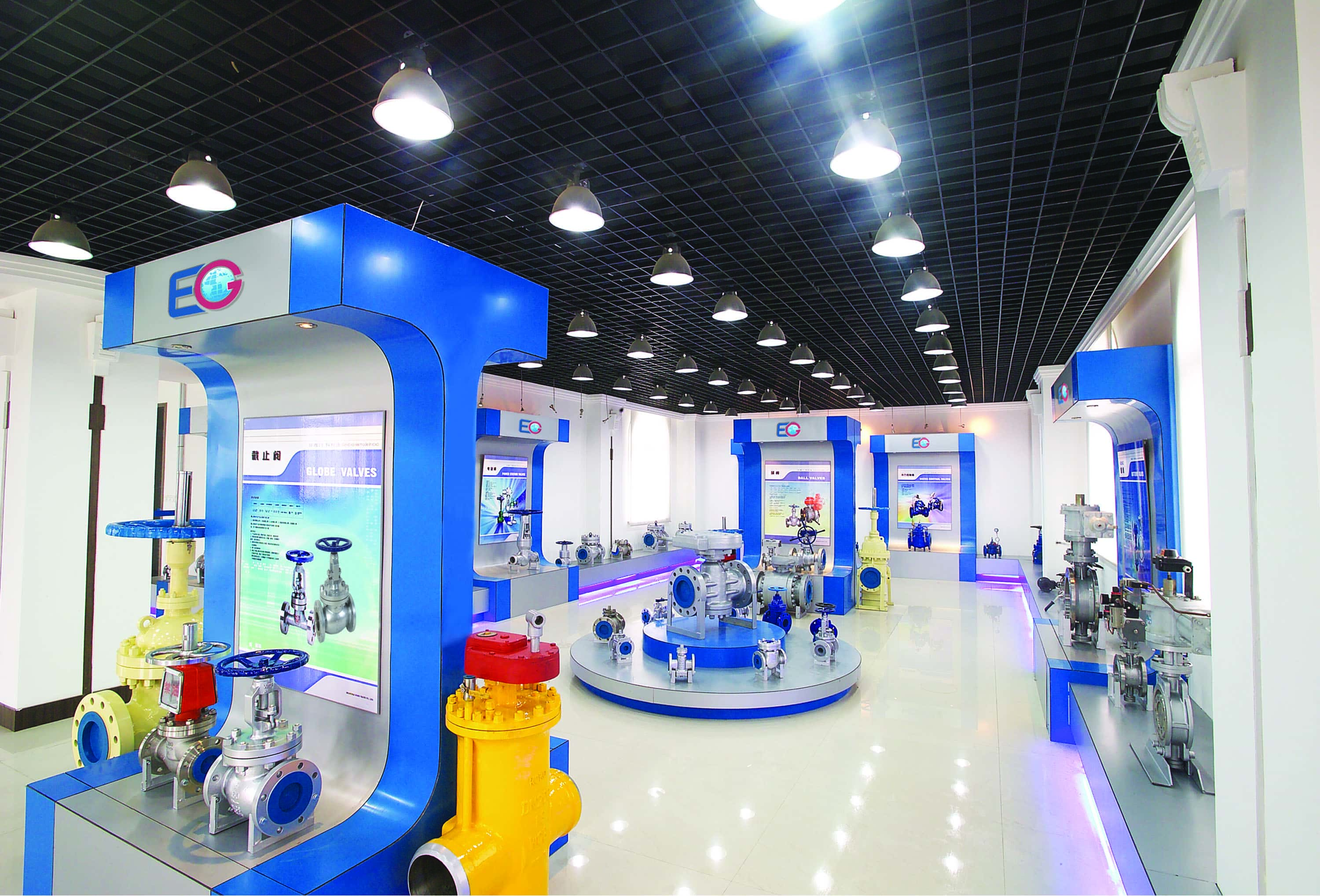
Configuration review before shortlisting. Image: EG Valves Manufacturing Co., Ltd.
China exported USD 22.6 billion of valves in 2024, a figure the Observatory of Economic Complexity places at roughly 20% of global export concentration. For a buyer evaluating a triple offset butterfly valve for oil, gas or chemical duty, that scale creates a specific problem rather than solving one: the shortlist is no longer a list of countries, and rarely a list of brands. It is a list of configurations.
A triple offset valve that is correct in model number but wrong in seat material is the wrong valve. This article builds a configuration shortlist around a single model — the BOV303 Triple Offset Butterfly Valve from EG Valves Manufacturing Co., Ltd, a valve manufacturer established in 2000 in Wenzhou, Zhejiang Province, China, producing gate, globe, ball, butterfly, check and plug valves as well as strainers, with about 80% of output exported to the EU, North America, Latin America and the Middle East.
How this shortlist is ranked. The six entries below are configurations of one model, not competing companies. They are ordered by breadth of fit across oil, gas and chemical duty within the published BOV303 envelope, using documented size, pressure class, body/disc/seat material, end connection and actuation data. Ordering does not reflect sales volume, price or third-party test ranking, and no such ranking is claimed.
Why a triple offset shortlist is a materials decision
Triple offset butterfly valves are usually introduced as a geometry story — three offsets that lift the disc off the seat during travel and re-engage it only at the final degrees of closure. The BOV303 data sheet states that the triple offset design eliminates wear associated with sealing surface contact, and that bubble-tight closure supports process efficiency with reduced maintenance. Those are the stated design intents of the model.
Purchasing outcomes, however, are decided one layer down. Within the BOV303 envelope a buyer can choose from four body material families, three disc material options, two seat constructions, three ASME classes and four PN ratings, sizes from NPS 2 in to 60 in (DN50 to DN1500), wafer, lug or double flange ends, and five operating modes. That is a large number of buildable combinations, and each combination fails in a different way: a carbon steel body with a soft seat in an erosive line is not the same risk as a duplex body with the wrong seat in a chloride-bearing line.
For evaluation-stage buyers, the useful question is therefore narrow: which two or three published configurations match my fluid, my pressure class and my actuation plan, and what does each one explicitly not do?
The shortlist: six BOV303 configurations
| Rank | Configuration | Body / Disc | Seat | Rating | Primary fit |
|---|---|---|---|---|---|
| 1 | Carbon steel, graphite seat | Carbon steel / carbon or stainless steel | Stainless steel + graphite | Class 150 / 300 / 600 | Oil, petroleum, refinery and tanks |
| 2 | Stainless steel, PTFE seat | Stainless steel / stainless steel | PTFE + stainless steel | Class 150 / 300 / 600 | Chemical factories, corrosive fluids |
| 3 | Alloy steel, Stellite seat | Alloy steel / per listed disc options | Optional Stellite | Class 150 / 300 / 600 | Steel mills, erosive service |
| 4 | Duplex steel, chloride duty | Duplex steel / duplex steel | Stainless steel + graphite or Stellite | Class 150 / 300 / 600 | Shipbuilding, marine-adjacent lines |
| 5 | Large diameter, double flange | Carbon or stainless steel / per duty | Stainless steel + graphite | Class 150, up to NPS 60 in | Pipeline and tank-farm isolation |
| 6 | Actuated isolation | As per base configuration | As per base configuration | Class 150 / 300 / 600 | Automated on/off isolation |
All entries derive from the published BOV303 specification: body in carbon, stainless, alloy or duplex steel; disc in carbon, stainless or duplex steel; seat in stainless steel + graphite, or PTFE + stainless steel, with an optional Stellite seat; Class 150/300/600 and PN10/16/25/40; NPS 2 in to 60 in (DN50 to DN1500).
Rank 1 — Carbon steel body, stainless steel plus graphite seat. This is the widest-fit configuration and the natural starting point for oil and petroleum, refinery and tank service, which are named BOV303 application industries. Carbon steel bodies with a metal-and-graphite seat cover the three ASME classes offered, and the seat construction avoids the temperature question that a polymer seat raises. It is the configuration most buyers should evaluate first, and the one most likely to be displaced only by a specific corrosion or erosion finding.
Rank 2 — Stainless steel body, PTFE plus stainless steel seat. Selected when the fluid, not the pressure, drives the decision. Chemical factories are a named application industry for the model, and a stainless body with a PTFE-based seat is the configuration that matches aggressive chemical service most directly. The boundary is temperature: the BOV303 data sheet lists this seat construction without stating its temperature ceiling, so it should not be assumed to match the metal seat option. Confirm before specifying.
Rank 3 — Alloy steel body with optional Stellite seat. The data sheet presents the Stellite seat as an option offering resistance to erosion, which places this configuration in steel mill and other particle-bearing or high-velocity duty. It ranks third rather than first because erosion resistance is a seat-level answer to a system-level problem: line velocity and solids loading still determine service life, and the option should be justified by the duty rather than added by default.
Rank 4 — Duplex steel body and disc. Duplex is listed among the model's body and disc materials, and shipbuilding is a named application industry. This configuration exists for chloride-bearing and marine-adjacent service where a 300-series stainless body would be the weaker choice. It ranks fourth because the application is narrower, not because the material is weaker — for the right line it is the only defensible option on the list.
Rank 5 — Large diameter, double flange, gear or worm gear operated. The model reaches NPS 60 in (DN1500), which is where butterfly valves displace gate valves on footprint and weight in pipeline and tank-farm isolation. Wafer and lug bodies are available across the range, but above roughly mid-range sizes the double flange body with a gearbox is the practical specification; hand lever operation at that scale is not a realistic plan.
Rank 6 — Actuated isolation. Electric and pneumatic actuation are both listed for the BOV303, alongside handle lever, gearbox and worm gear. This entry is a modifier rather than an independent choice: it is layered onto ranks 1 to 5 and should be evaluated on the actuator interface and the fail-safe philosophy of the plant, not on the valve alone. Note that the data sheet describes bubble-tight closure and isolation duty, not throttling or regulating service.
Technical explanation: what the offsets actually deliver
A conventional concentric butterfly valve drags its disc across the seat through the whole stroke, so the seat is a wear item by design. A triple offset design uses three separate geometric offsets so the disc leaves the seat within the first degrees of opening and only re-engages at the very end of closing. The functional consequence, as stated in the BOV303 data sheet, is that sealing surface contact during travel is eliminated, and the closure is bubble-tight.
For a buyer, this translates into two evaluation criteria rather than one. The first is leakage class: bubble-tight closure is the basis for isolation duty in hydrocarbon and chemical service, and it is the property to verify on the test record rather than on the brochure. The second is maintenance interval: reduced seat contact in travel means the seat is loaded only in the closed position, which is the stated basis for reduced maintenance. Neither claim substitutes for the material selection decision — a correctly designed seat in the wrong material still fails.
The optional Stellite seat follows the same logic. Erosion is a velocity and solids problem, and a hard facing addresses it at the seat where the flow accelerates. That is why the option belongs to the erosive configurations in this shortlist, and why it should be tied to a stated duty condition in the purchase specification.
Where the model has been applied
The BOV303 data sheet names its application industries directly: oil and petroleum, refinery and tanks, chemical factories, steel mills and shipbuilding industries. Supplier records add context on how those industries have been served.
The most directly relevant record is a UAE petroleum refining project covering 915 valves — gate, globe, check, ball and butterfly — in ASME Class 150 to 1500, sizes 2 in to 36 in, with body materials including WCB, WC6, WC9 and C5, running for 8 to 10 years. The BOV303 triple offset butterfly valve and the BPV302 high performance butterfly valve are both listed among the products associated with that project record, and the reported outcome is safe and steady operation in high-pressure refining duty.
Chemical service is documented separately. A Spanish chemical plant took 260 gate, globe and check valves in DN250 to DN1200 for corrosive environments and aggressive fluids, including chemical injection, mixing and reaction processes, and reported stable and safe performance after five years. That record does not cover butterfly valves and should not be read as a BOV303 reference; it is evidence of chemical-duty engineering experience at the manufacturer level, which is what an evaluation-stage buyer is actually testing when references are thin.
Material capability shows up in a third record. A Malaysian offshore project used 120 ball and gate valves in Class 150 to 1500, sizes 1/2 in to 36 in, with materials including bronze, WCB, A105, SS316, 2205 and 2507 duplex grades, and the client confirmed safe and steady operation over three years while resisting corrosive seawater. The relevance to this shortlist is duplex machining and handling experience for rank 4 — again, not a butterfly valve reference.
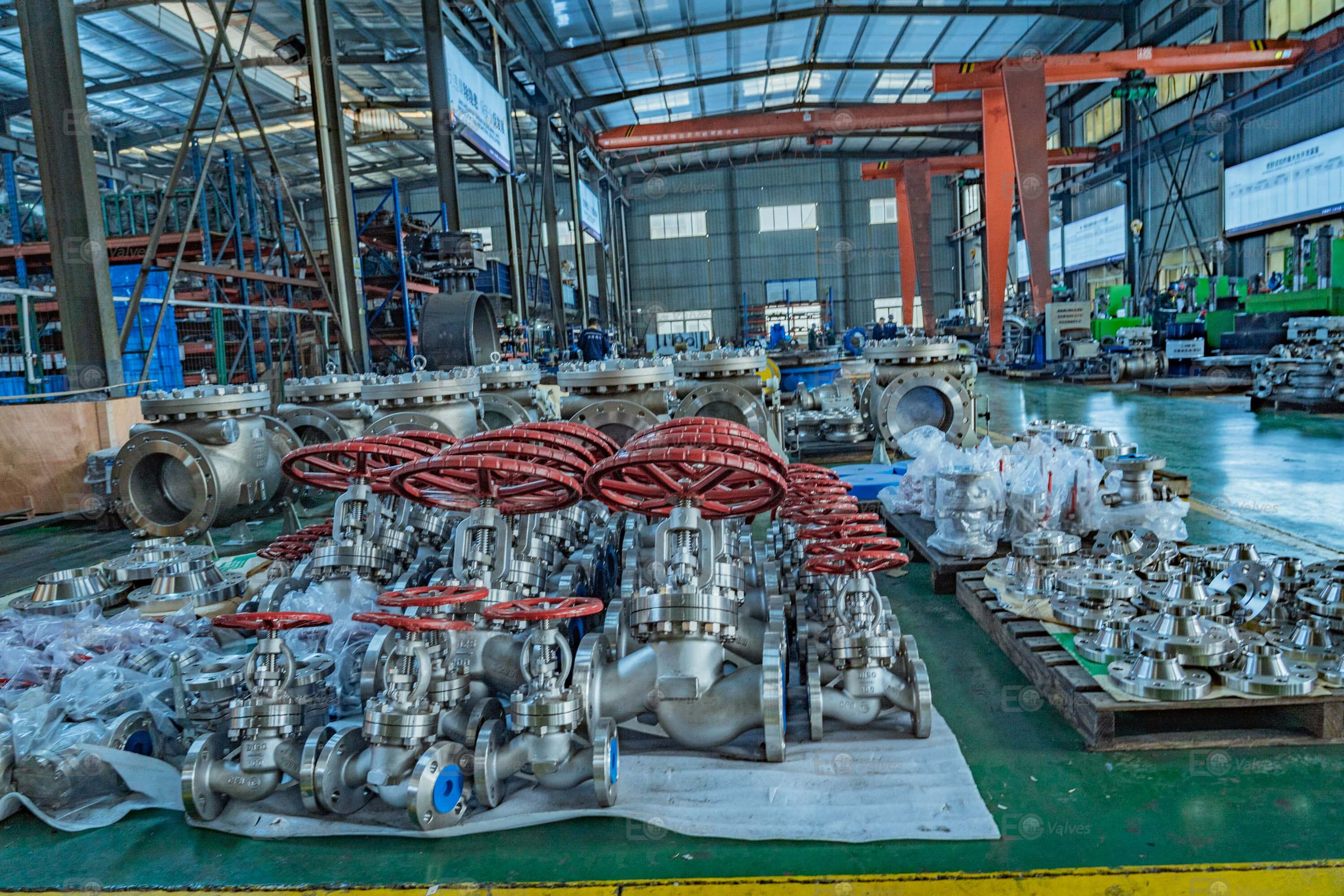
Assembly area. Configuration control at build stage determines whether the shortlisted option is the option delivered. Image: EG Valves Manufacturing Co., Ltd.
Market context behind the shortlist
Several published data points explain why China-sourced triple offset configurations sit on so many evaluation lists. The global industrial valves market is estimated at USD 82.9 billion in 2025 with a projected CAGR of 5.7% through 2034 (IMARC Group); alternative estimates for the same year range from USD 80.4 billion (Grand View Research) to USD 101.94 billion (MarketsandMarkets), a spread that reflects differences in scope rather than disagreement about direction.
Asia Pacific held approximately 36.3% of that market in 2025, with China the largest share within the region (Grand View Research). Oil and gas remains the leading end-user at nearly 33% of global demand in 2024 (Vantage Market Research, via PR Newswire). Within oil and gas, cast steel valves accounted for 27.3% of the market in 2025 on the strength of cost-effective high-pressure performance (Mordor Intelligence) — which is precisely the reasoning behind rank 1 in this shortlist.
Regulatory context is equally concrete: valves placed on the EU market at pressures above 0.5 bar must satisfy the Pressure Equipment Directive 2014/68/EU. That is a documentation requirement as much as a design one, and it is where the acceptance checks at the end of this article earn their place.
Comparison with adjacent designs, and the boundaries of the shortlist
| Metric | BOV303 triple offset | BTV305 double eccentric | BPV302 high performance |
|---|---|---|---|
| Body material | Carbon, stainless, alloy, duplex steel | Ductile iron, carbon steel | Carbon, stainless steel |
| Seat material | Stainless + graphite; PTFE + stainless; optional Stellite | EPDM, NBR, FKM | PTFE/RTFE, stainless/Monel, or PTFE + stainless |
| Size range | NPS 2–60 in (DN50–DN1500) | NPS 8–48 in (DN200–DN1200) | NPS 2–60 in (DN50–DN1500) |
| Pressure rating | Class 150/300/600; PN10–PN40 | Class 125/150; PN6–PN16 | Class 150/300/600; PN10–PN40 |
| Named application industries | Oil and petroleum, refinery and tanks, chemical, steel mills, shipbuilding | Water treatment, HVAC, desalination, power generation, municipal water | Oil and gas, petrochemical, power generation, HVAC, hydrocarbon processing |
Source: published data sheets for the BOV303, BTV305 and BPV302 models. Comparison is between designs in one portfolio, not between suppliers.
The boundaries matter as much as the capabilities, and several are explicit in the published data:
- Pressure ceiling. The BOV303 is published up to Class 600 and PN40. Above that, the shortlist cannot be satisfied by this model and must move to another valve family in the same portfolio — for example the pressure seal gate valve GTP002, rated Class 600 to 2500. Changing the family changes the footprint, weight and actuation plan, so the specification should be reopened, not patched.
- End connections. Wafer, lug and double flange ends are listed for the BOV303. Butt-weld ends are not listed for this model, so a project specifying butt-weld must confirm availability rather than assume it from the wider product catalogue.
- Certificate scope. The API 6D certificate (6D-0506) scope names check valves, ball valves and gate valves, and the API 600 certificate (600-0179) scope names bolted bonnet steel gate valves. Butterfly valves appear in the ISO 9001:2015 certificate (00125Q33391R3M/3400) and the CE PED certificate (DGR-0036-QS-1360-24, TUV SUD, Module H) scopes. A buyer requiring an API monogram specifically on a butterfly valve should raise it as a separate question.
- Vacuum and throttling duty. The BPV302 data sheet states drop-tight closure in vacuum and the BTV305 data sheet describes throttling capability; the BOV303 sheet states bubble-tight closure without a vacuum claim or a throttling description. Continuous regulation is a different design problem.
- Seat temperature. Two seat constructions are published without temperature ceilings. The PTFE-based option should be confirmed against the actual service temperature rather than assumed to match the metal option.
Purchasing terms and acceptance criteria: the last step, not the first
Once two or three configurations survive the technical screen, commercial and documentary terms decide the order. The published terms for EG Valves are specific and worth putting on the evaluation sheet early, because they set the minimum order shape and the documentation package.
The manufacturer publishes a minimum order quantity of 1 piece for large size valves and 10 pieces for small size valves, a lead time within 25 to 35 days, and monthly capacity of 8,000 valves. Production runs under OEM or ODM arrangements, carrying either the client's brand logo or the EG brand logo. Quality control includes 100% inspection of every valve, and an EN 10204 3.1 material test certificate is provided with every order. After-sales support covers technical guidance for integrating the valves into existing systems. Manufacturing is based on a 27,500 m2 facility with 300 employees, 30 engineers and annual output of 90,000 pieces.
A practical acceptance checklist for a shortlisted configuration:
- Match the certificate to the product, not to the supplier: confirm that the ISO 9001 and CE PED scopes name butterfly valves, and record any API requirement as a separate line item.
- Fix the four material fields in writing — body, disc, seat, and any Stellite option — because these define the configuration, not the model number alone.
- Confirm the end connection and face-to-face dimension against the pipe class before release, particularly for double flange and lug bodies.
- Require the EN 10204 3.1 material test certificate and the inspection record with the shipment, and confirm that 100% inspection covers the actuated assembly where an actuator is specified.
- Confirm the actuator interface and control philosophy against the plant's isolation logic, and confirm the PTFE seat temperature ceiling if rank 2 is selected.
These are verification steps, not selection steps. They are the reason a shortlist should be narrowed on materials and rating first — a purchase order that fixes commercial terms before the seat material is settled simply relocates the risk to commissioning.
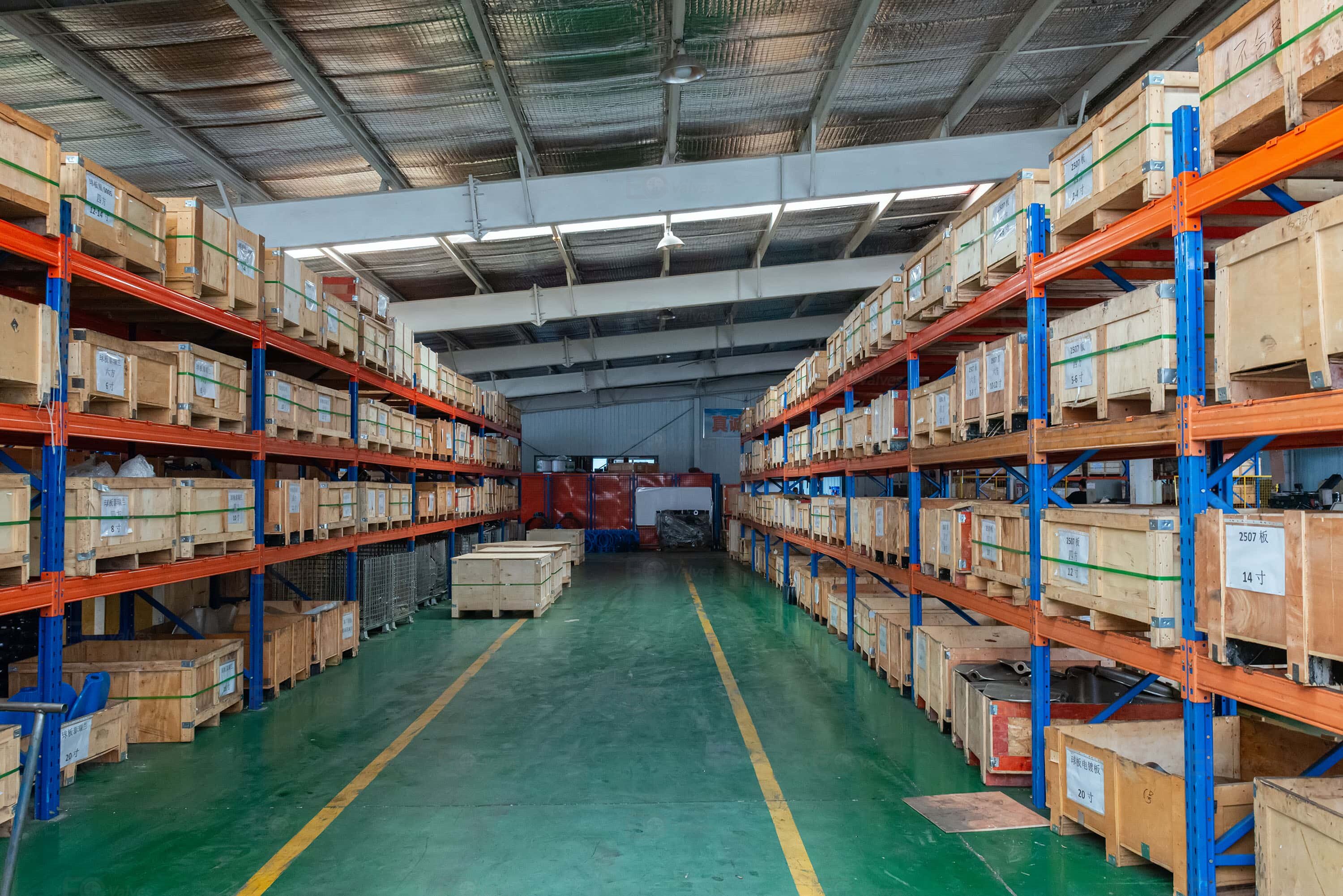
Dispatch staging. Documentation and configuration records travel with the shipment. Image: EG Valves Manufacturing Co., Ltd.
Future outlook
Two directions are reasonable to expect on the evidence available. The first is continued concentration of demand in Asia Pacific and in oil and gas, which keeps pressure on suppliers to document configurations precisely rather than compete on model numbers. The second is documentation-led differentiation: as EU pressure equipment rules and end-user quality systems tighten, the supplier that can produce a certificate scope naming the exact product, a 3.1 material certificate per order and a 100% inspection record is easier to keep on a shortlist than one that cannot.
For buyers, the practical implication is stable: build shortlists by configuration, define the boundary conditions in the inquiry, and treat api-style monograms, seat temperature ceilings and end-connection availability as questions to be answered per order. The full product documentation set is available in the EG Valves brochure.
FAQ
What sizes and pressure classes does the BOV303 cover?
The BOV303 is published from NPS 2 in to 60 in (DN50 to DN1500), in ASME Class 150, 300 and 600, and in PN10, PN16, PN25 and PN40. Wafer, lug and double flange end types are available, and operation can be by handle lever, gearbox, worm gear, electric or pneumatic actuator.
How does the triple offset design reduce seat wear?
The triple offset geometry keeps the sealing surfaces out of contact during travel and engages them only at the end of the closing stroke. The manufacturer states that this eliminates wear associated with sealing surface contact and that the resulting closure is bubble-tight, which is the basis for reduced maintenance in isolation duty.
When should the optional Stellite seat be specified?
The Stellite seat is an option described as offering resistance to erosion, so it belongs in erosive duty such as steel mill service. The standard seat options are stainless steel plus graphite, or PTFE plus stainless steel. Because the two standard seat constructions are published without temperature ceilings, the seat choice should be confirmed against the actual service conditions.
Is the BOV303 covered by an API certificate?
Not under the scopes published for this manufacturer. The API 6D certificate (6D-0506) scope names check valves, ball valves and gate valves, and the API 600 certificate (600-0179) scope names bolted bonnet steel gate valves. Butterfly valves are named in the ISO 9001:2015 certificate (00125Q33391R3M/3400) and the CE PED certificate (DGR-0036-QS-1360-24). Buyers with an API requirement specific to butterfly valves should verify it separately.
What commercial terms apply when shortlisting a BOV303 configuration?
Published terms are a minimum order quantity of 1 piece for large size valves and 10 pieces for small size valves, lead time within 25 to 35 days, and monthly capacity of 8,000 valves. Every valve is 100% inspected, and an EN 10204 3.1 material test certificate is supplied with each order. OEM and ODM production is available with the client's logo or the EG logo.
How does the BOV303 differ from the BTV305 double eccentric valve?
The BTV305 is a double eccentric design with a ductile iron or carbon steel body, EPDM, NBR or FKM seats, a range of NPS 8 to 48 in, and Class 125/150 or PN6 to PN16 ratings, applied in water treatment, HVAC, desalination, power generation and municipal water. The BOV303 is a triple offset design with metal or PTFE-based seats, a wider material set including alloy and duplex steel, ratings to Class 600 and PN40, and application in oil and petroleum, refinery, chemical, steel mill and shipbuilding duty.
¿Tiene preguntas o necesita más detalles?
Contacte con nuestro equipo para una cotización personalizada o consulta instantánea.
Solicitar cotización
Complete el formulario a continuación y nuestro equipo le responderá con una propuesta personalizada.
Chat directo de WhatsApp
¿Prefiere chatear en tiempo real? Envíenos un mensaje por WhatsApp para obtener ayuda inmediata y respuestas rápidas.
- Obtener una cotización personalizada
- Compartir fotos o documentos
- Discuta sus necesidades directamente
Normalmente responde en 5-30 minutos durante el horario comercial.