
China Valve BOV303 Triple Offset Butterfly Valve Specs and Fit
Oil and gas pipelines, chemical processing plants, steel mills and shipyards share one isolation requirement: when a line closes, it has to close completely, and it has to keep closing completely after thousands of operating cycles. In these services the part that usually ends a butterfly valve's working life is not the body. It is the sealing surface, which wears as the disc travels across the seat.
The BOV303 is a triple offset butterfly valve manufactured by EG Valves Manufacturing Co., Ltd, a valve maker established in 2000 in Wenzhou, Zhejiang Province, China. The company operates a 27,500 m2 factory with roughly 300 employees and an annual output of about 90,000 valves, around 80% of which is exported to the EU, North America, Latin America and the Middle East, with products accepted in more than 33 countries and regions. The BOV303 itself is specified for oil and petroleum, refinery and tank, chemical factory, steel mill and shipbuilding industries.
For a buyer in the research and evaluation stage, the useful question about a China valve such as the BOV303 is not whether the triple offset concept works. It is which configuration fits a specific line, which seat material survives the media, which certificate actually covers this product family, and where the design stops so that another valve type can take over. Those are the questions this article answers, using the published specification set rather than marketing claims.
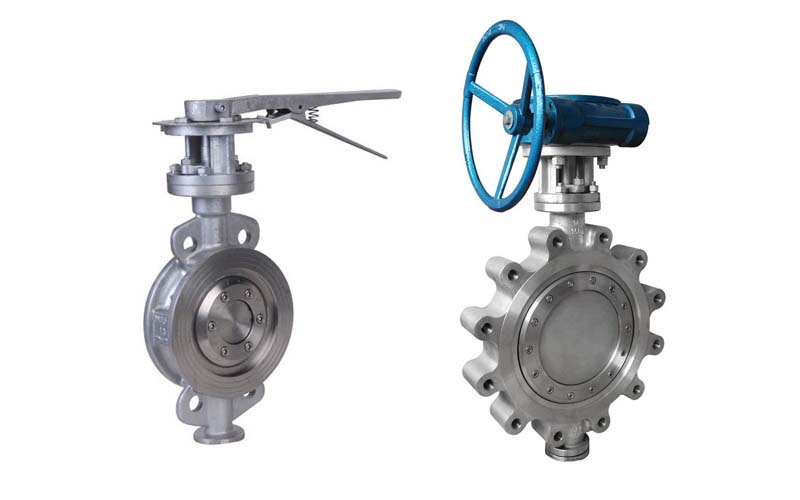
The BOV303 triple offset butterfly valve, published for NPS 2 to 60 (DN50 to DN1500) and Class 150 to 600 or PN10 to PN40 service.
The Isolation Duty Behind the Specification
The service conditions that shape valve selection in these industries are well documented. Oil and gas production is characterised by high temperatures and pressures, flammable and explosive media, toxicity and hazard exposure, severe corrosion, and continuous, largely automated operation. Chemical production units typically run at high temperature and pressure inside closed, continuous systems, with complex media that are strongly corrosive, flammable, explosive or toxic. Petroleum refining adds proximity to hydrogen, a tendency to coke formation, and long-cycle continuous operation in which an unplanned shutdown is the most expensive failure mode. Steel mills and shipyards add their own constraints: large-bore lines, tight installation envelopes, and abrasive or erosive flow.
Across all four industries, three requirements dominate the specification of an isolation valve. It must close bubble-tight. It must resist erosion at the sealing surface. And it must reduce maintenance frequency, because every seat replacement stops production. The BOV303 specification is built around those three requirements rather than around a single headline parameter.
BOV303 Specification Set at a Glance
| Parameter | Published specification |
|---|---|
| Product type | Triple offset butterfly valve, model BOV303 |
| Size range | NPS 2 to 60 (DN50 to DN1500) |
| Pressure rating | Class 150, Class 300, Class 600; PN10, PN16, PN25, PN40 |
| Body materials | Carbon steel, stainless steel, alloy steel, duplex steel |
| Disc materials | Carbon steel, stainless steel, duplex steel |
| Seat materials | Stainless steel with graphite, or PTFE with stainless steel |
| Optional seat | Stellite seat, offered for optimum resistance to erosion |
| Body styles | Wafer, lug and double flange |
| Actuation | Handle lever, gearbox, worm gear, electric, pneumatic |
| Closure performance | Bubble-tight closure |
| Design feature | Triple offset geometry eliminates wear associated with sealing surface contact |
| Service industries | Oil and petroleum; refinery and tanks; chemical factories; steel mills; shipbuilding |
Specification set as published for the BOV303 triple offset butterfly valve.
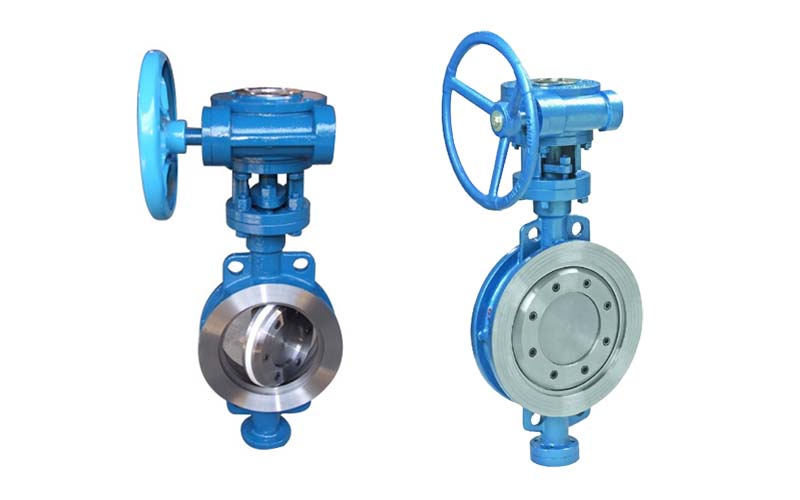
Body and disc material options for the BOV303 range from carbon steel through stainless, alloy and duplex steel grades.
How the Triple Offset Design Eliminates Seat Wear
In a conventional concentric butterfly valve, the disc and the seat remain in contact throughout the 90-degree stroke. Every cycle therefore rubs the sealing surfaces against each other, and the resulting wear is progressive: operating torque rises, closure quality falls, and the valve eventually weeps.
A triple offset design breaks that contact. The shaft is set behind the disc sealing plane, offset from the pipe and disc centreline, and the seat cone axis is inclined. The practical effect is that the disc swings clear of the seat for almost the whole stroke and engages the seat only at the final seating angle, where the geometry converts rotation into a wedging action against the seat. The published design claim for the BOV303 states this directly: the triple offset design eliminates wear associated with sealing surface contact. The same documentation states that bubble-tight closure provides process efficiency with reduced maintenance.
For procurement, this has two consequences. First, closure quality is designed to remain within specification over a longer cycle count, which lowers the frequency of maintenance intervention on critical isolation points. Second, because contact occurs only at seating, the operating torque profile is more predictable, which matters when the valve is actuated rather than manually operated and when actuator sizing has to be fixed at the order stage.
Seat Selection: Stainless Steel with Graphite, PTFE with Stainless Steel, or Optional Stellite
Three seat configurations are published for the BOV303:
- Stainless steel with graphite, a metal-based seat intended for the general heavy-process duties listed for the valve's service industries.
- PTFE with stainless steel, a polymer-assisted combination that suits duties where a softer sealing interface is appropriate.
- An optional Stellite seat, which the specification describes as offering optimum resistance to erosion.
The seat decision is a duty decision rather than a preference. Where the media carries solids, catalyst fines, coke particles or other abrasive content, the standard metal or polymer-assisted seat may become the maintenance driver for the isolation point, and the optional Stellite seat is the configuration intended for that condition. Where the media is clean and the process is closer to general isolation duty, the standard seat options remain appropriate. Because seat performance depends on how media abrasiveness interacts with process temperature and cleaning cycles, the seat grade should be confirmed against the actual line condition instead of being assumed from the valve type.
Body Configuration: Wafer, Lug and Double Flange
All three body styles are published as available for the BOV303 across the listed size and pressure range, so the choice is normally made on installation and maintenance logic rather than on pressure capability.
| Body style | Installation character | Where it is usually specified |
|---|---|---|
| Wafer | Compact body held between two pipeline flanges | Space-constrained lines where the valve can be removed with the line isolated |
| Lug | Lugged body with threaded inserts, generally allowing one side of the line to be opened while the valve stays in place | Lines where downstream pipework must be accessible for maintenance |
| Double flange | Flanged on both faces; the most self-supporting of the three configurations | Large-bore and higher-class lines where alignment and mechanical support matter |
These are general installation characteristics rather than fixed rules. The final choice has to match the mating flange standard and the buyer's piping specification, and the manufacturer states that its valves are produced to ANSI, DIN, BS and JIS standards or to customer requirements.
Actuation options published for the BOV303 are handle lever, gearbox, worm gear, electric and pneumatic. Because required operating torque rises with bore size and pressure class, larger and higher-rated valves are commonly ordered with a gearbox or an actuator interface rather than a lever, and the actuation mode should be fixed at the enquiry stage together with the valve rating.
Applying the BOV303 Across Four Industry Services
Oil and gas pipelines
Pipeline isolation places the sealing surface directly in the path of produced fluids, which may carry sand, scale or other particulate content. The combination that matters here is bubble-tight closure plus erosion resistance at the seat: closure quality keeps the line safe during shutdown and maintenance windows, while the optional Stellite seat addresses the abrasive side of the duty. For long-distance crude oil and natural gas transport where double block and bleed capability and a fire-safe design are required, the company's through conduit gate valve GTT021, rated Class 150 to Class 2500 in sizes NPS 2 to 48, is the specification that carries those functions rather than the butterfly line.
Refineries and tank farms
Refinery service combines high temperature and pressure with hydrogen exposure, coking tendency and long uninterrupted runs. Metal-seated closure is the relevant option in this environment, and the stainless steel with graphite seat configuration is the published choice for that type of duty. One documented reference point is a refinery programme in the United Arab Emirates, where EG Valves supplied 915 valves including gate, globe, check, ball and butterfly valves in sizes from 2 to 36 inches and pressure classes from Class 150 to Class 1500, in materials including WCB, WC6, WC9 and C5. The reported service duration for that installation is 8 to 10 years, with the valves operating safely and steadily. The alloy steel grades used in that programme correspond to the alloy steel body option published for the BOV303.
Chemical processing plants
Chemical plants operate closed, continuous processes with strongly corrosive, flammable, explosive or toxic media, which is why sealing reliability and corrosion resistance dominate valve selection. For BOV303 service in this environment, the PTFE with stainless steel seat option and the stainless steel or duplex steel body and disc options are the relevant specifications. Where the medium is an acid, alkali, oxidant or organic solvent that calls for a fully lined flow path rather than a metal wetted surface, the company's PTFE lined butterfly valve BTF301, with PTFE, FEP or PFA seat and a fully PTFE lined stainless steel disc option, is the appropriate product in the range rather than the metal-seated triple offset design.
Steel mills and shipbuilding
Steel mills and shipbuilding industries are listed as applicable industries for the BOV303 alongside oil and petroleum, refinery and chemical service. Both environments put a premium on erosion resistance at the seat and on compact installation in congested pipework, which is where a butterfly valve geometry generally competes well against a gate or globe valve of the same bore. Where the medium is aggressive and a lined or fully corrosion-resistant flow path is preferred, the PTFE lined option again becomes the specification to evaluate.
Market Context: What the Numbers Say About China Valve Supply
China exported USD 22.6 billion in valves globally in 2024, representing approximately 20% of global export concentration, according to the Observatory of Economic Complexity. IMARC Group estimates the global industrial valves market at USD 82.9 billion in 2025, with a projected compound annual growth rate of 5.7% through 2034. Grand View Research puts Asia Pacific's revenue share of that market at approximately 36.3% in 2025, with China holding the largest share within the region.
Demand concentration reinforces the same picture. The oil and gas industry accounted for nearly 33% of global valve demand in 2024, and Mordor Intelligence reports that cast steel valves represented 27.3% of the oil and gas valve market in 2025 because of their cost-effective high-pressure performance. For the buyer, that combination means China valve supply is structurally relevant to oil and gas, refining, chemical and heavy-industry procurement, and that cast and alloy steel bodies remain the mainstream material choice in those segments.
Comparison With Alternative Designs, and the Boundary of the BOV303
| Design | Pressure rating | Sealing approach | Size range | Where it fits |
|---|---|---|---|---|
| BOV303 triple offset butterfly | Class 150 to 600; PN10 to PN40 | Stainless steel with graphite, or PTFE with stainless steel; optional Stellite | NPS 2 to 60 (DN50 to DN1500) | Isolation in oil and gas, refinery, chemical, steel and shipbuilding service where bubble-tight closure and low sealing-surface wear matter |
| BPV302 high performance butterfly | Class 150 to 600; PN10 to PN40 | PTFE or RTFE, stainless steel or Monel, or PTFE with stainless steel; soft or hard sealing | NPS 2 to 60 (DN50 to DN1500) | Hydrocarbon processing and process isolation, including drop-tight closure in vacuum |
| BTV305 double eccentric butterfly | Class 125 and 150; PN6, PN10, PN16 | EPDM, NBR or FKM soft seals | NPS 8 to 48 (DN200 to DN1200) | Water treatment, HVAC, desalination, power generation and municipal water supply |
| BTV300 resilient seated butterfly | Class 125 and 150; PN6, PN10, PN16 | EPDM, NBR, FKM or PTFE | NPS 1.5 to 48 (DN40 to DN1200) | Water, sewage, air conditioning, mining, irrigation and food and beverage lines |
| GTS019 cast steel gate valve | Class 150 to 1500; PN10 to PN160 | Metal seated, rising stem | NPS 1.5 to 48 (DN40 to DN1200) | Higher-pressure isolation where a gate valve footprint is acceptable |
| GTP002 pressure seal gate valve | Class 600 to 2500 | Full Stellite overlay sealing surface, self-sealing bonnet | NPS 2 to 60 | Service above the butterfly rating range, including power plant duty |
The BOV303 is not a universal isolation answer, and the published specification makes the boundaries explicit:
- The rating range ends at Class 600 and PN40. Above that, gate, globe or ball designs take over, such as the Class 600 to 2500 pressure seal gate valve GTP002 or the forged steel trunnion ball valve BVF209, which is rated Class 150 to 2500.
- The minimum published bore is NPS 2 (DN50). Small-bore lines below that are served by other types, for example the threaded ball valve BVS213 in NPS 0.5 to 4.
- Erosion resistance depends on the seat grade. The Stellite seat is an option, not a default, so an abrasive duty that is quoted with a standard seat should be re-checked at the specification stage.
- Double block and bleed and fire-safe functions are not listed in the BOV303 specification. Where those functions are mandatory, the through conduit gate valve GTT021 carries double block and bleed capability and a fire-safe design for crude oil and natural gas transmission.
- Highly aggressive chemical media may be better served by a lined flow path, in which case the PTFE lined butterfly valve BTF301 is the appropriate reference point.
Against those limits, the design advantage is straightforward. For the same bore and rating, a triple offset butterfly valve occupies less space and weighs less than a comparable gate or globe valve, and its triple offset geometry is specifically intended to remove the sealing-surface wear that shortens service life in other butterfly designs. That is the trade a buyer is making when the BOV303 is shortlisted.
What to Verify Before Shortlisting a China-Sourced BOV303
At the evaluation stage, certificate scope is more informative than certificate count. The published certification set relevant to this product family is as follows.
| Certification | Authority and number | Published scope | Valid to |
|---|---|---|---|
| ISO 9001:2015 | China Quality Certification Center (CQC), 00125Q33391R3M/3400 | Gate valves, globe valves, ball valves, butterfly valves, check valves, pipe filters and flanges | 22 May 2028 |
| CE / PED 2014/68/EU Annex III, Module H | TUV SUD Industrie Service GmbH, DGR-0036-QS-1360-24 | Gate valves, ball valves, globe valves, check valves, butterfly valves, strainers | 26 May 2027 |
| API 6D | American Petroleum Institute, 6D-0506 | Check valves, ball valves, gate valves | 30 March 2027 |
| API 600 | American Petroleum Institute, 600-0179 | Bolted bonnet steel gate valves | 30 March 2027 |
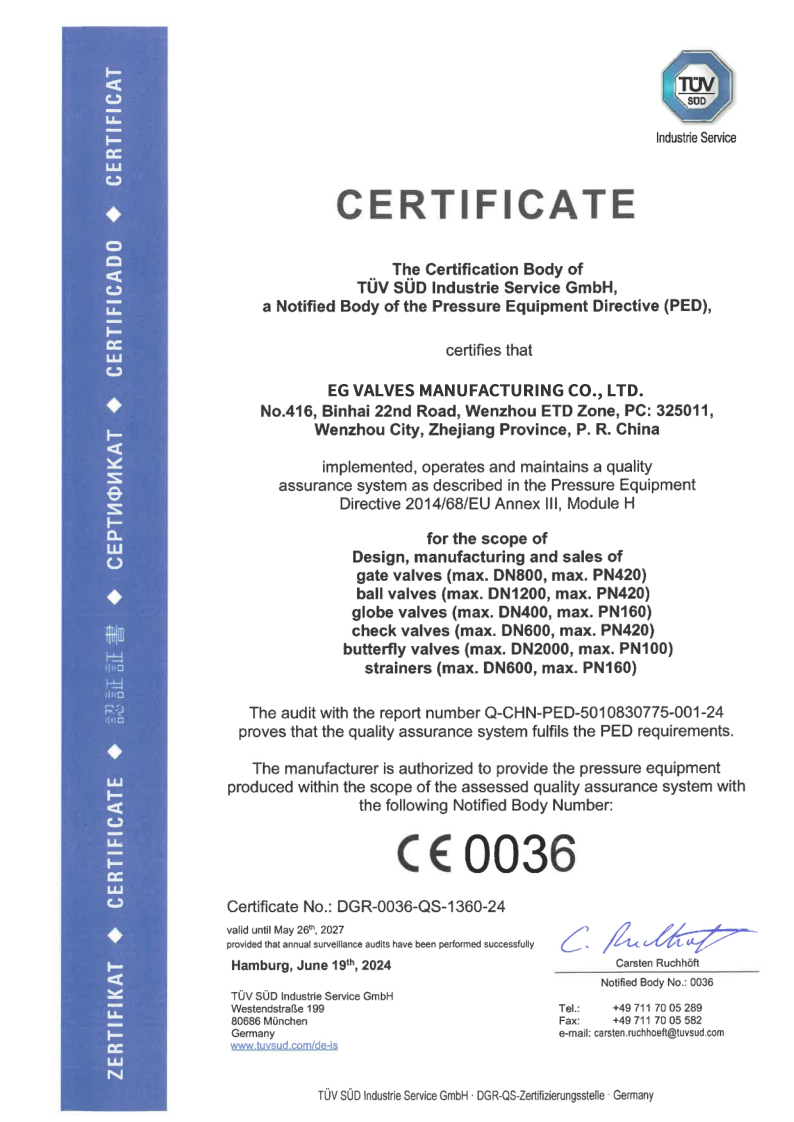
The CE/PED certification published by the manufacturer lists butterfly valves within its scope, which is where the BOV303 family sits.
The scope column is the important one. As published, API 6D and API 600 cover the company's check, ball and gate valve lines. The butterfly valve line, including the BOV303, is covered by the ISO 9001 registration and by the CE/PED certification for the EU market. Buyers comparing China valve suppliers should therefore read the scope of each certificate against the exact product being ordered, rather than assuming that a logo applies to every product in a catalogue. For EU imports, this is also a regulatory point rather than a preference: equipment with pressure exceeding 0.5 bar falls under the Pressure Equipment Directive 2014/68/EU.
Beyond certification, the commercial and documentation parameters published for orders are:
- Minimum order quantity of 1 piece for large size valves and 10 pieces for small size valves.
- Lead time within 25 to 35 days.
- Monthly production capacity of 8,000 valves.
- 100% inspection of every valve, with EN 10204 3.1 Material Test Certificates provided with every order.
- OEM and ODM production with either the customer's brand logo or the EG brand logo.
Future Outlook
Replacement and upgrade demand in refining, chemical, steel and marine service is likely to keep metal-seated isolation valves in steady demand, since those industries run continuously and cannot defer shutdown-critical maintenance indefinitely. Against that demand, Asia Pacific's position as the largest regional supply base, and China's share of global valve exports, suggest that China valve sourcing will remain a default option for cost-sensitive industrial programmes rather than a fallback.
The more interesting shift is on the buyer side. As procurement teams move from brand assumption to document review, the practical differentiator between suppliers becomes traceable configuration: a stated pressure class, a stated seat grade, a stated actuation mode, and a certificate whose scope matches the product. The BOV303, with a defined envelope of NPS 2 to 60, Class 150 to 600 and PN10 to PN40, three body styles, three seat configurations and five actuation modes, is a product that can be specified and verified on those terms. The limits of the design are equally explicit, which is what allows a buyer to decide where it fits and where another valve type should be selected instead.
Frequently Asked Questions
What sizes and pressure classes does the BOV303 triple offset butterfly valve cover?
The BOV303 is published for NPS 2 to 60, equivalent to DN50 to DN1500, and for pressure ratings of Class 150, Class 300 and Class 600, or PN10, PN16, PN25 and PN40. Lines outside that envelope, such as very small bore lines below NPS 2 or services above Class 600 and PN40, require a different valve type.
How do I choose between the wafer, lug and double flange versions of the BOV303?
All three body styles are available across the published size and pressure range. A wafer body is compact and held between two pipeline flanges, a lug body generally allows one side of the line to be opened while the valve stays in place, and a double flange body is flanged on both faces and is the most self-supporting of the three. The final choice must match the mating flange standard and the buyer's piping specification.
When should the optional Stellite seat be specified on a BOV303?
The standard seat options for the BOV303 are stainless steel with graphite, or PTFE with stainless steel. The optional Stellite seat is described as offering optimum resistance to erosion, so it is the appropriate specification where the medium carries abrasive solids, particles or fines that would otherwise drive seat maintenance. Seat grade should be confirmed against the actual line condition rather than inferred from the valve type alone.
Which certifications cover the BOV303, and which cover other valve lines?
ISO 9001:2015 certification 00125Q33391R3M/3400, issued by the China Quality Certification Center, lists butterfly valves within its scope and is valid to 22 May 2028. CE/PED 2014/68/EU Annex III Module H certification DGR-0036-QS-1360-24, issued by TUV SUD Industrie Service GmbH, also lists butterfly valves and is valid to 26 May 2027. As published, API 6D certificate 6D-0506 and API 600 certificate 600-0179 cover check, ball and gate valve lines and are valid to 30 March 2027.
What are the practical limits of the BOV303 compared with gate or high-pressure ball valves?
The BOV303 rating range ends at Class 600 and PN40, so higher-pressure service requires a gate, globe or ball design such as the Class 600 to 2500 pressure seal gate valve or a trunnion ball valve rated to Class 2500. Its minimum published bore is NPS 2, so smaller lines need another valve type. The BOV303 specification also does not list double block and bleed or fire-safe functions, which other designs in the range do provide.
What commercial and documentation parameters apply to a BOV303 order?
The published order parameters are a minimum order quantity of 1 piece for large size valves and 10 pieces for small size valves, a lead time within 25 to 35 days, and a monthly production capacity of 8,000 valves. Every valve is inspected, and EN 10204 3.1 Material Test Certificates are provided with every order. Production is available as OEM or ODM, with either the customer's brand logo or the EG brand logo.
Manufacturer reference: EG Valves Manufacturing Co., Ltd, www.egvalves.com. The company product brochure is available for download here: EG Valves product brochure (PDF).
¿Tiene preguntas o necesita más detalles?
Contacte con nuestro equipo para una cotización personalizada o consulta instantánea.
Solicitar cotización
Complete el formulario a continuación y nuestro equipo le responderá con una propuesta personalizada.
Chat directo de WhatsApp
¿Prefiere chatear en tiempo real? Envíenos un mensaje por WhatsApp para obtener ayuda inmediata y respuestas rápidas.
- Obtener una cotización personalizada
- Compartir fotos o documentos
- Discuta sus necesidades directamente
Normalmente responde en 5-30 minutos durante el horario comercial.