
China–India Air Freight: Warehouse, Team and System Evidence
China–India Air Freight: Warehouse, Team and System Evidence
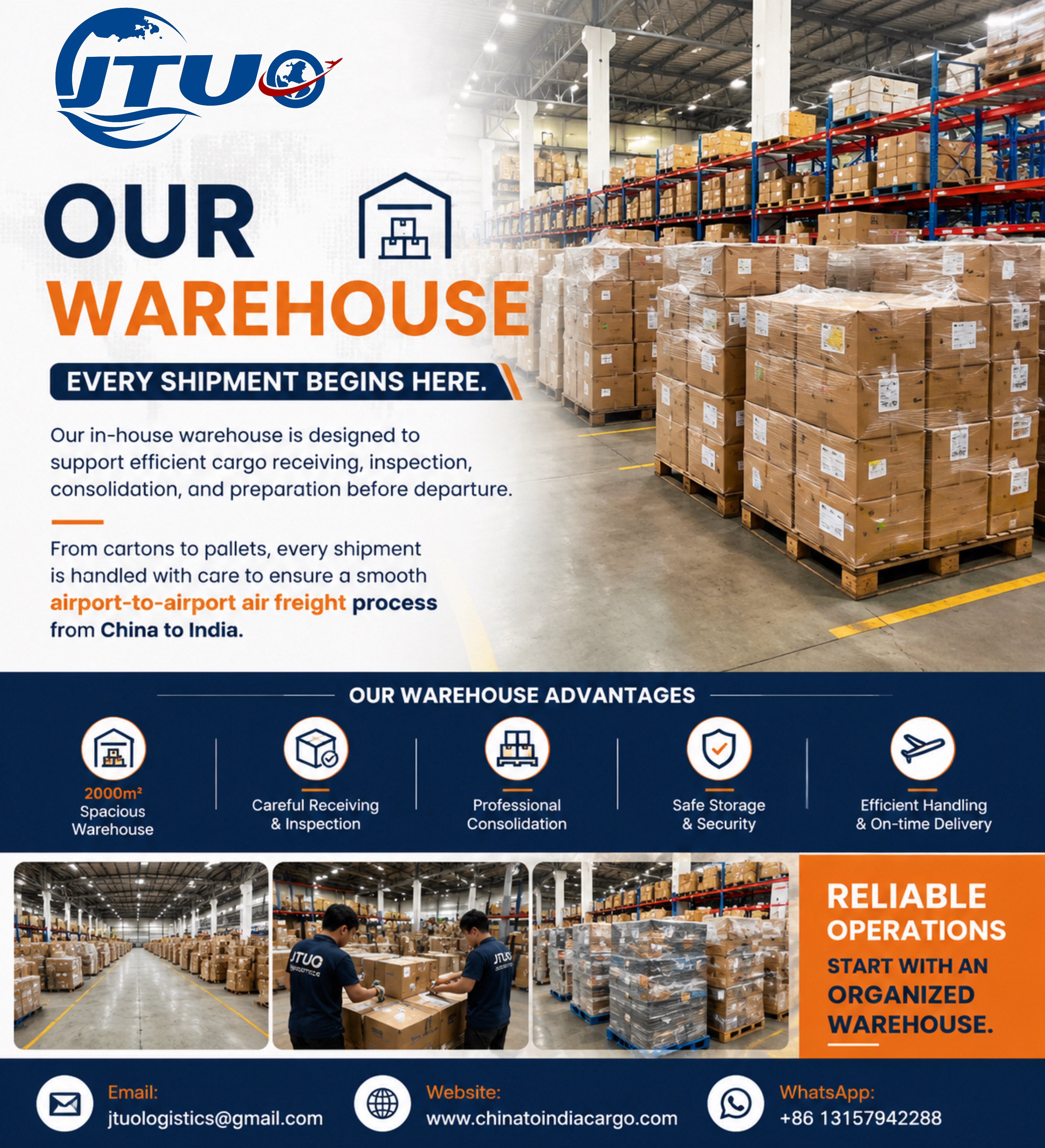
Airport-to-airport air freight from China to India is sold on an almost identical promise by every provider: space secured, cargo consolidated, documents issued, flight departed. What separates providers is not the promise but the evidence standing behind it. This assessment examines three inspectable assets at JTUO Logistics — a Guangzhou base comprising a 200 m² office and a 2,000 m² warehouse, a core team of more than 30 people, and the Air Cargo Space & Consolidation Coordination Control System (Version 3.0) — and maps each one to the nine-stage China–India airport-to-airport process that freight forwarders, manufacturers, wholesalers and e-commerce shippers transact against.
The framing matters at the evaluation and execution stages. By that point, most buyers have already shortlisted on rate, routing and transit estimate; the question that remains is whether the China-side partner can physically receive, consolidate and dispatch cargo on the flight it sold. Warehouse floor space, headcount allocation and system control are the three variables that answer that question before the first shipment is tendered — and all three produce records that can be checked.
Why this lane rewards operational evidence over capability statements
India's air cargo market reached 3.6 million tons in 2025, according to IMARC Group research, and Delhi (DEL) and Mumbai (BOM) together handle approximately 60% of the country's international air cargo volumes, as reported in 2026 industry coverage by EIN Presswire. Standard air freight transit from China to India is commonly quoted at 3 to 8 days. Those figures describe a lane with concentrated destination capacity and a transit window short enough that one missed cut-off becomes visible to the consignee.
In that setting, the failures buyers encounter are rarely about aircraft. They are about what happened before the aircraft: cargo arriving at a warehouse without a verified piece count, a consolidation plan that changed after the cut-off, space confirmed verbally and lost during peak, or a handover at the air cargo terminal that nobody documented. Each failure traces back to a missing physical or operational control — which means each can be tested in advance rather than discovered mid-shipment.
The Guangzhou base: what 200 m² of office and 2,000 m² of warehouse establish
JTUO Logistics operates from Guangzhou with a 200 m² office and a 2,000 m² warehouse. The split is more informative than the total. The office houses solution design, supply chain management, customer service and the space allocation and scheduling function; the warehouse houses receiving, verification, consolidation, palletisation and dispatch. Keeping both functions in one city means the team that commits space and the team that loads the cargo work to the same cut-off.
The warehouse receives a mix that matters for this corridor specifically: full consignments, consolidation from multiple suppliers, e-commerce small parcels, and consolidated loose cargo. On receipt, actual weight and dimensions are re-measured, because air freight is charged on the greater of actual weight or volumetric weight, calculated as length × width × height in centimetres divided by 6,000. That control converts packing density from an assumption into a chargeable-weight figure agreed before the flight is finalised.
| Disclosed asset | Figure | Operational function |
|---|---|---|
| Guangzhou office | 200 m² | Solution design, supply chain coordination, customer service, space allocation and scheduling |
| Guangzhou warehouse | 2,000 m² | Receiving, verification, consolidation, palletisation, airport dispatch |
| Core team | 30+ people | 10+ at the Guangzhou branch, warehousing team of 20+ |
| Air cargo handled | 1,500+ spaces per month | Multi-route consolidated air freight between China and India |
| Annual moved volume | 5,000+ T by air; 30,000+ CBM by sea | Scale indicator across air and sea modes |
| Market concentration | 80% of business on India | Corridor focus rather than general export forwarding |
Two qualifications belong beside those figures. A 2,000 m² warehouse establishes receiving and consolidation capacity; it does not by itself establish throughput, racking configuration, handling equipment or a reserved allocation for any individual buyer. Likewise, 1,500+ air cargo spaces handled per month and 5,000+ tonnes moved by air per year describe activity already processed, not capacity held in reserve. Read them as scale indicators, then ask for the stage records — warehouse receipt, piece-count verification, dimensional weight report, consolidation manifest — that show the controls working on your own cargo profile.
The team: 30+ people mapped to the nine stages
JTUO Logistics describes a core team of more than 30 people, including more than 10 at the Guangzhou branch and a warehousing team of over 20. The composition is stated functionally — logistics solution designers, supply chain management, warehousing, and customer service and operations management — and organisationally as four working teams: Customer Service; Space Allocation and Scheduling; Warehouse Operations; and Airport Coordination. Named roles include Air Freight Operations Manager, Logistics Manager, Warehouse Manager, Customer Service Manager and Space Allocation Coordinator.
Headcount only becomes evidence when it maps to stages. The test is simple: every stage of the process should have a named function responsible for it, and a document that function produces.
| Team function | Stages supported | Document produced |
|---|---|---|
| Customer Service Team | Inquiry and quotation; order confirmation; AWB issuance; arrival | Quotation sheet, flight options, booking confirmation, departure and arrival notices |
| Space Allocation & Scheduling Team | Space allocation and booking; flight coordination | Space booking confirmation, cut-off time notification, inbound schedule |
| Warehouse Operations Team | Warehouse receiving; cargo consolidation | Warehouse receipt, weight and volume report, consolidation manifest, packing list |
| Airport Coordination Team | Airport delivery; export customs clearance | Airport handover record, airline acceptance confirmation, export declaration record |
The stated experience behind this structure is 15+ years in China–India air shipping logistics and cargo space management, and the company reports supporting 500+ freight forwarding partners. Both are scale claims rather than performance claims: they indicate a book of business large enough to sustain airline relationships and consistent consolidation volumes, not a measured service level. Performance — on-time departure, roll-over frequency, claims — is a separate question answered by shipment records, not by team size or years in the lane.
The nine-stage process, and the timelines that are actually stated

The China-to-India airport-to-airport process runs through nine defined stages: inquiry and quotation; order confirmation; space allocation and booking; warehouse receiving; cargo consolidation; airport delivery; export customs clearance; air waybill issuance and release; and arrival at the destination airport. Each stage carries stated inputs, outputs and split responsibilities between client and provider, which is what makes the sequence auditable rather than descriptive.
Stage-level time estimates are published for the first four stages only: inquiry and quotation at 0.5 days, order confirmation at 1 day subject to the client's confirmation timing, space allocation and booking at 1 day, and warehouse receiving at 1 to 2 days including delivery to the warehouse. Consolidation, airport delivery, export clearance, air waybill issuance and arrival are not given stage-day estimates in the published process; in practice they move with the airline cut-off, the flight schedule and customs processing. Buyers building a delivery commitment should therefore plan the second half of the sequence against confirmed flight dates rather than against a summed stage total.
Warehouse receiving is where the process turns physical. Cargo must arrive within the agreed cut-off with packaging that meets air freight standards, fragile goods clearly labelled, and shipping labels correctly attached for MAWB reference, destination and shipment number. The warehouse then verifies piece count, shipping marks, order data and declared attributes, logs the shipment into the system and records the inbound timestamp. Discrepancies generate an exception report — the document to request whenever a booking aggregates several suppliers.
Consolidation differs by cargo type. For cross-border e-commerce parcels the operations are consolidation of multiple orders, consolidation of goods from multiple suppliers, palletisation of aggregated small parcels, and verification of weight and dimensions. For general air freight the operations are sorting and organising, consolidated stacking, large pallet handling and stretch-wrap reinforcement. In both cases consolidation verifies product information, package count, weight, volume, shipping marks, flight details, HS code and special-cargo status — batteries, liquids, powders, magnetic materials, and branded or restricted goods. This is the point at which a shipment becomes either bookable or delayed.
Airport delivery, export customs clearance and air waybill issuance then run as one sequence: transport to the airport cargo terminal and handover to airline ground handling; submission of customs documentation for export declaration and airline release; issuance of the Master Air Waybill by the airline and the House Air Waybill by JTUO Logistics, followed by a departure notice and estimated arrival time. The first leg closes when the destination airport arrival is notified to the customer.
Where system control replaces coordination by phone

The Air Cargo Space & Consolidation Coordination Control System (Version 3.0) is the operating layer that ties space, cargo and flight schedule together. Its functional scope covers airline capacity negotiation and procurement, freight booking and allocation management, flight scheduling and space optimisation, and warehouse consolidation and cargo handling. That translates into four controls a buyer can question directly.
- Space pre-allocation and locking. Fixed space can be reserved in advance for long-term partners, and priority allocation plans can be arranged for high-volume customers during peak seasons. The system separates Block Space Agreement (BSA) capacity from general cargo capacity — the mechanism that lets a forwarder commit volume without committing to a single flight.
- Real-time cargo space monitoring and dispatch. Capacity is tracked against bookings so a shipment is not confirmed against space already released elsewhere.
- Consolidation and load optimisation. The proprietary consolidation and dispatch optimisation model groups cargo by attribute, flight and destination before palletisation, so the consolidation manifest matches what is handed to the airline.
- Warehouse management. The WMS logs receipts, weights, dimensions and consolidation status, producing the audit trail behind each stage output.
The integrated Air Freight Headhaul Operation System acts as the flight-facing counterpart, sequencing flight scheduling and space optimisation across the headhaul leg so that booked space, the consolidation plan and airport delivery are worked against one schedule rather than three. A review loop closes the model: space utilisation efficiency, consolidation performance, delay causes and bottlenecks are examined, supported by a monthly operational optimisation report and continuous adjustment of allocation logic. When a client changes schedule, volume or booking, the system re-evaluates available airline capacity and issues an updated plan recorded in the operational system or email log — which is the difference between a change and an undocumented verbal adjustment.
Three situations where this evidence changes a buying decision
Pre-peak space pre-booking. The stated application scenario for this solution is pre-booking air cargo space before peak seasons. The evidence to weigh is whether capacity is reserved before the peak arrives and whether the reservation is documented through a space booking confirmation, an estimated cut-off time and a warehouse inbound schedule. A provider that only begins requesting space once the peak is visible converts a booking into a roll-over risk.
Multi-supplier consolidation for forwarders and e-commerce operators. Target client segments are cross-border logistics service providers and international freight forwarders, and the industries served include cross-border e-commerce logistics, international freight forwarding and NVOCC operations, and supply chain logistics service providers. For these buyers the constraint is rarely the flight; it is the number of suppliers feeding it. A warehouse that receives, verifies and palletises loose cargo from several suppliers against one consolidation manifest removes the most common pre-airport delay.
Mixed BSA and general cargo capacity. Forwarders running committed volume alongside ad-hoc bookings need both treated in one allocation logic, because the two behave differently under peak pressure. Keeping them in a single control system, with documented revision when a schedule or volume changes, is what prevents one stream from silently consuming the other's space.
An anonymised mid-size freight forwarder case illustrates the model in operation. The stated problems were unstable space during peak seasons, high rate volatility, fragmented warehouse operations, multi-handling delays and unstable delivery performance; the diagnosis was a lack of stable airline capacity access combined with fragmented warehouse operations. The applied solution combined capacity locking, warehouse consolidation and airport execution across an ongoing partnership, with a 3 to 7 day cycle per shipment. Reported outcomes were qualitative — improved supply chain stability, more predictable delivery performance, reduced operational workload and stronger peak-season scalability — and the client reported more stable space availability during peak seasons than when working through multiple forwarders. No quantitative performance results are published for this case, so it should be read as a description of an operating model, not as a benchmark.
What the evidence does not cover
Airport-to-airport has a defined stopping point: responsibility ends with arrival notification at the Indian airport. Import readiness stays on the importer's side. Indian customs procedure requires an Importer-Exporter Code before importing, and airport imports require an electronic Bill of Entry filed through ICEGATE or the relevant service centre, as set out by Mumbai Customs Zone III. Goods imported by air attract customs duty unless covered by transit or transshipment treatment — a distinction worth settling before the shipment departs rather than after it lands.
Where cargo is consigned onward to another airport, Indian customs procedure requires the carrier or console agent to file a transshipment application with the destination airport indicated in the HAWB, per Chennai Customs Zone documentation. The cited Mumbai procedure also allows pre-arrival Bill of Entry filing, valid where the aircraft arrives within 30 days of presentation. Both are customs rules that support document planning; neither is a forwarder service commitment.
Three supplier-side gaps should be closed inside the RFQ rather than assumed. First, the capability material summarised here does not include on-time arrival, roll-over or claims performance data. Second, stage-day estimates are not published for consolidation through arrival, so the second half of the transit window must be built from confirmed flight dates. Third, 1,500+ spaces per month is a handled-volume figure, not a reserved allocation for a specific account. These are legitimate questions for any provider on this corridor, not disqualifiers.
A verification sequence for the execution stage
The practical way to test the three assets is to request one document per stage for a shipment profile comparable to your own.
| Stage | Document to request | What it establishes |
|---|---|---|
| Inquiry and quotation | Quotation sheet, flight options list, transit estimate | The rate is tied to a named schedule, not a generic lane |
| Space allocation and booking | Space booking confirmation, cut-off time notification, inbound schedule | Space was held, not merely requested |
| Warehouse receiving | Warehouse receipt, piece-count and shipping-mark verification, weight and volume report, exception report | Cargo identity and chargeable weight were verified on site |
| Cargo consolidation | Consolidation manifest, packing list | What was handed to the airline matches what was booked |
| Airport delivery and export clearance | Airport handover record, airline acceptance confirmation, export declaration record | Cargo was accepted airside and declared for export |
| AWB issuance and release | MAWB, HAWB, departure notice, ETA update | The shipment departed on a specific flight |
| Arrival at destination airport | Arrival notification, landing confirmation, receipt confirmation | The first leg closed and import handling could begin |
What this means for buyers planning the next peak
IMARC Group projects India's air cargo market growing at a CAGR of 11.38% through 2034. That is a forecast, not a measurement, and it carries the usual assumption that capacity expands in step with demand. If it holds, peak-season pressure on China–India capacity becomes a recurring planning condition rather than an annual exception, and the value of pre-booked space, documented consolidation and a named operations team rises with it. If it does not hold, a buyer loses little by having asked for documented controls before committing volume.
The practical conclusion is narrow. Treat the Guangzhou facility, the 30+ member team and the Version 3.0 control system as claims to be tested against records, not as differentiators to be accepted on presentation. JTUO Logistics publishes its operating base and contact channels openly; the fastest way to convert three assets into a decision is to request the stage-level records for a shipment profile close to your own, timed to the peak you are actually planning for.
FAQ
What does JTUO Logistics' Guangzhou base include?
It comprises a 200 m² office and a 2,000 m² warehouse in Guangzhou. The office supports solution design, supply chain management, customer service and space allocation and scheduling; the warehouse handles receiving, weight and dimension verification, consolidation, palletisation and airport dispatch. A core team of more than 30 people works across both, including 10+ at the Guangzhou branch and a warehousing team of over 20.
How do warehouse and team capacity connect to the nine-stage process?
Each stage has an assigned function and a document output. Customer Service covers inquiry, order confirmation and arrival notification; Space Allocation and Scheduling covers booking and cut-off control; Warehouse Operations covers receiving and consolidation; Airport Coordination covers terminal handover and export processing. This mapping is what allows a buyer to request evidence stage by stage rather than relying on a general capability statement.
Which stages of the China–India airport-to-airport process have stated timelines?
Estimates are published for the first four stages: inquiry and quotation at 0.5 days, order confirmation at 1 day subject to client confirmation, space allocation and booking at 1 day, and warehouse receiving at 1 to 2 days including delivery to the warehouse. Consolidation, airport delivery, export clearance, air waybill issuance and arrival carry no stage-day estimates in the published process, because they depend on the airline cut-off, flight schedule and customs processing.
How does the space control system handle peak-season capacity?
The Air Cargo Space & Consolidation Coordination Control System (Version 3.0) covers airline capacity negotiation and procurement, space pre-allocation and locking, real-time space monitoring and dispatch, consolidation and load optimisation, and warehouse management. It separates Block Space Agreement capacity from general cargo capacity, allows fixed space to be reserved in advance for long-term partners, and supports priority allocation for high-volume customers during peak seasons.
Where does airport-to-airport responsibility end on a China–India shipment?
At arrival notification at the Indian airport, which marks completion of the first leg. Import-side obligations remain with the importer and its customs broker, including the Importer-Exporter Code and the electronic Bill of Entry. Where cargo is consigned onward to another Indian airport, customs procedure requires a transshipment application from the carrier or console agent, with the destination airport indicated in the HAWB.
Can a buyer verify consolidation capability before booking?
Yes, by requesting the records the process already produces: a warehouse receipt with piece-count and shipping-mark verification, a dimensional weight and actual weight report, an exception report for discrepancies, and a consolidation manifest with packing list. Reviewing these for a comparable shipment profile shows whether receiving and consolidation controls operate consistently, before any volume is committed.
¿Tiene preguntas o necesita más detalles?
Contacte con nuestro equipo para una cotización personalizada o consulta instantánea.
Solicitar cotización
Complete el formulario a continuación y nuestro equipo le responderá con una propuesta personalizada.
Chat directo de WhatsApp
¿Prefiere chatear en tiempo real? Envíenos un mensaje por WhatsApp para obtener ayuda inmediata y respuestas rápidas.
- Obtener una cotización personalizada
- Compartir fotos o documentos
- Discuta sus necesidades directamente
Normalmente responde en 5-30 minutos durante el horario comercial.