
China Hydraulic Fitting Supplier: Factory Evidence to Verify
China Hydraulic Fitting Supplier: Factory Evidence to Verify
A China hydraulic fitting manufacturer can be assessed on five evidence layers that a buyer is able to check before the first order: legal entity and site, installed production equipment, quality management system, declared reference standards per connection family, and engineering response to drawings and samples. Commercial terms belong to a second pass. Where those five layers cannot be documented, a lower unit price is not a comparison — it is an unpriced risk.
That framing matters more than it did a decade ago. Strategic Market Research's Hydraulic Fittings Market Report 2024–2030 values the global hydraulic fittings market at USD 12.7 billion in 2024 and projects USD 17.9 billion by 2030, a 5.8% compound annual growth rate. Growth of that order brings new factories, new trading intermediaries and a large volume of capability language that reads almost identically from one supplier website to the next. The distinguishing information is not the claim; it is the evidence trail behind it.
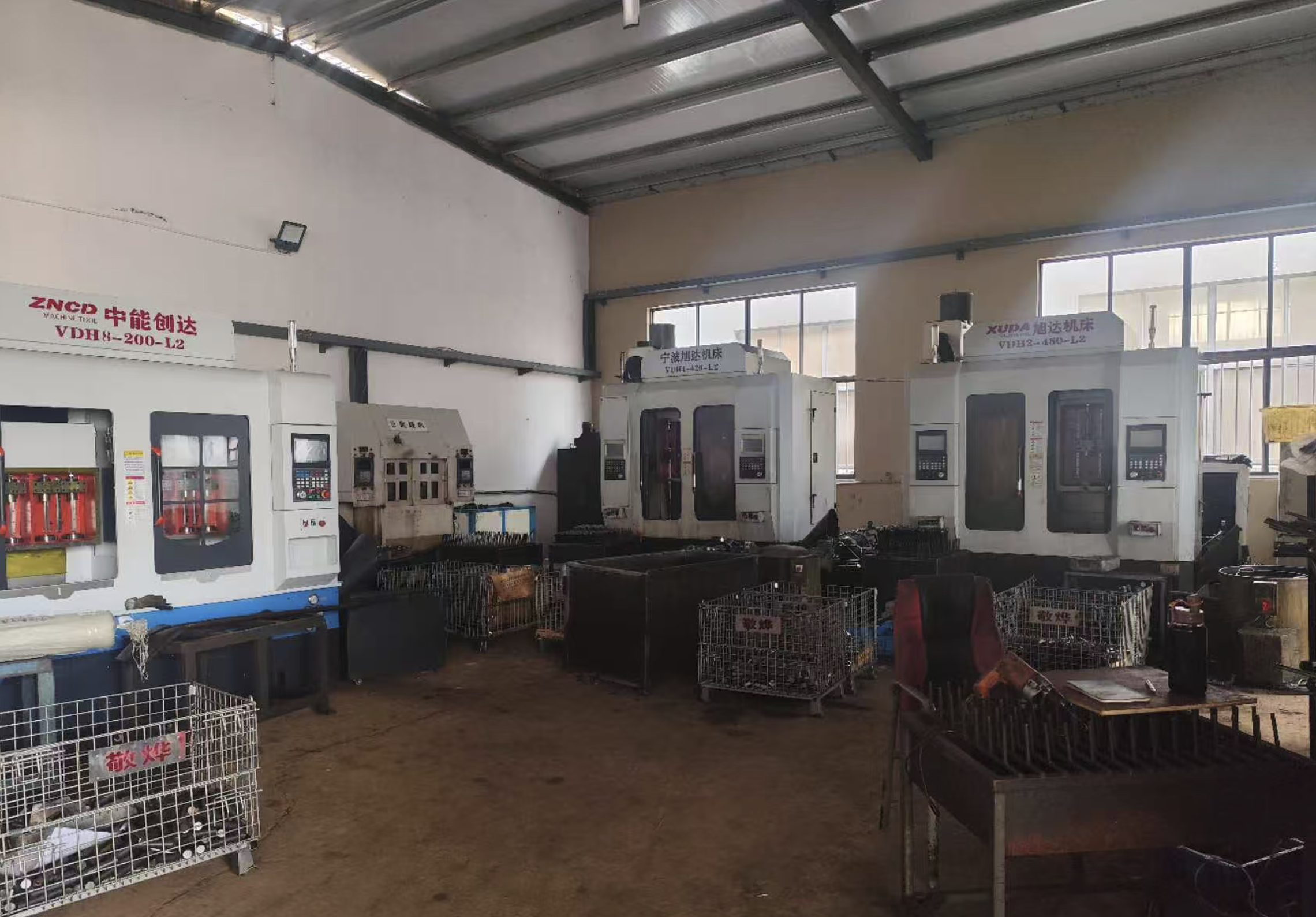
Multi-station deep-hole drilling equipment. Process assets like this are checkable items in a supplier review — a machine list that can be matched against the product families being quoted is stronger evidence than a facility photograph.
Why capability claims have stopped differentiating suppliers
Most hydraulic fitting catalogues in the China export market carry the same three statements: an ISO certificate, a reference to advanced CNC machining, and an invitation to discuss OEM projects. None of those statements is false by itself, and none of them separates one supplier from another. A buyer comparing quotations therefore faces a decision problem rather than an information problem: the RFQ responses look equivalent, so the selection defaults to price or to an existing relationship.
The consequence is a familiar failure pattern. A fitting family arrives with correct thread geometry but a plating thickness below the corrosion class the application requires. Or a substitution is approved on the basis of a thread match, and the sealing geometry or pressure class turns out not to be equivalent. Both failures trace back to the same root cause — the supplier was qualified on a claim rather than on a document.
The practical alternative is to convert the qualification question into a set of verifiable artefacts. Each of the five layers below can be answered with something a buyer can hold: a certificate with a legal entity name on it, an equipment list, an inspection record, a document number, or a first-article report.
What "factory evidence" means in practice
Factory evidence is any supplier statement that can be traced to a document, a physical asset or a measurable output, and that a buyer can independently check. It differs from marketing content in one respect only: it can fail a verification test. An ISO certificate can fail because the entity name does not match the contracting party. An equipment claim can fail because the machine list does not cover the operation being quoted. A standards claim can fail because no document number is named. A sample can fail because the first-article dimensions do not match the drawing.
This is the basis on which a manufacturer such as JINGYE Hydraulic is worth examining. JINGYE Hydraulic (Ningbo Jingye Fluid Fittings Co., Ltd.) is a manufacturer of hydraulic fittings, hydraulic adapters, hydraulic hose fittings, quick disconnect couplings, camlock couplings, stainless steel, brass and pneumatic fittings, and customised fluid connection components, founded in 2008 and based in Ningbo, Zhejiang Province, China. Its published facts are specific enough to be tested — which is the point of using them here as a worked example rather than as a recommendation.
Layer 1 — The legal entity and the manufacturing site
The first check is the least glamorous and the most frequently skipped: does the company that signs the contract match the company named on the certificate, and is there a manufacturing site behind it?
For JINGYE Hydraulic, the operating facts are a founding year of 2008, a 6,000+ m² manufacturing facility in Ningbo, approximately 100 employees, an engineering team of 8, and an annual production capacity of more than 40 million fluid connection components. The company reports an export ratio of 70%, with Europe and North America as key markets alongside Australia, Southeast Asia, the Middle East and OEM customers in China. It states that it can operate as a regular production supplier, a complementary supplier or a second-source supplier for long-term programmes.
A buyer should test four things at this layer:
- Certificate holder name versus contracting entity name — a mismatch usually means a trading intermediary or a group structure the buyer has not been told about.
- Site address versus the address on shipping documents and the certificate scope.
- Headcount and engineering headcount as a ratio — 8 engineers against roughly 100 employees describes an engineering function sized for standard product support and defined custom work, not for open-ended development programmes.
- Capacity stated in a unit that can be checked against your own demand — 40 million components a year averages roughly 3.3 million pieces a month, which is meaningful only when compared with the monthly volume in the RFQ.
Layer 2 — Installed process equipment, not photographs
The second layer is the process footprint. A claim of CNC machining capability is only useful if it is specific enough to be matched against the parts being quoted.
JINGYE Hydraulic's stated manufacturing resources are more than 100 CNC machines, together with drilling, crimping, assembly and precision inspection equipment. That combination is what supports both high-volume standard production and customised work. The relevant question for a buyer is not whether 100+ machines exist, but which of them touch the specific configuration in the RFQ — a 90-degree swivel assembly, a bulkhead fitting, a non-standard thread, a stainless body.
Three questions reliably separate a real process footprint from a reseller's catalogue:
- Which operations are performed in-house, and which are subcontracted — forging, heat treatment, plating, passivation, marking?
- What inspection equipment is installed, and what does it measure — thread gauges, profile measurement, vision inspection, hardness, plating thickness?
- Is there a documented process route for the product family being quoted, including the inspection points and the record produced at each one?
Corrosion protection is a useful probe because it is measurable. Standard finishing for JINGYE Hydraulic's carbon steel fittings is 8–12 μm zinc plating with ≥96 hours resistance to white rust and ≥240 hours to red rust, with enhanced coatings up to 16 μm and extended salt-spray performance available. Those are numbers a buyer can compare directly against the corrosion class the application demands, and against a coating thickness report from the production lot. Whether plating is performed in-house or subcontracted is a fair question, and the answer should come with a process certificate rather than a description.
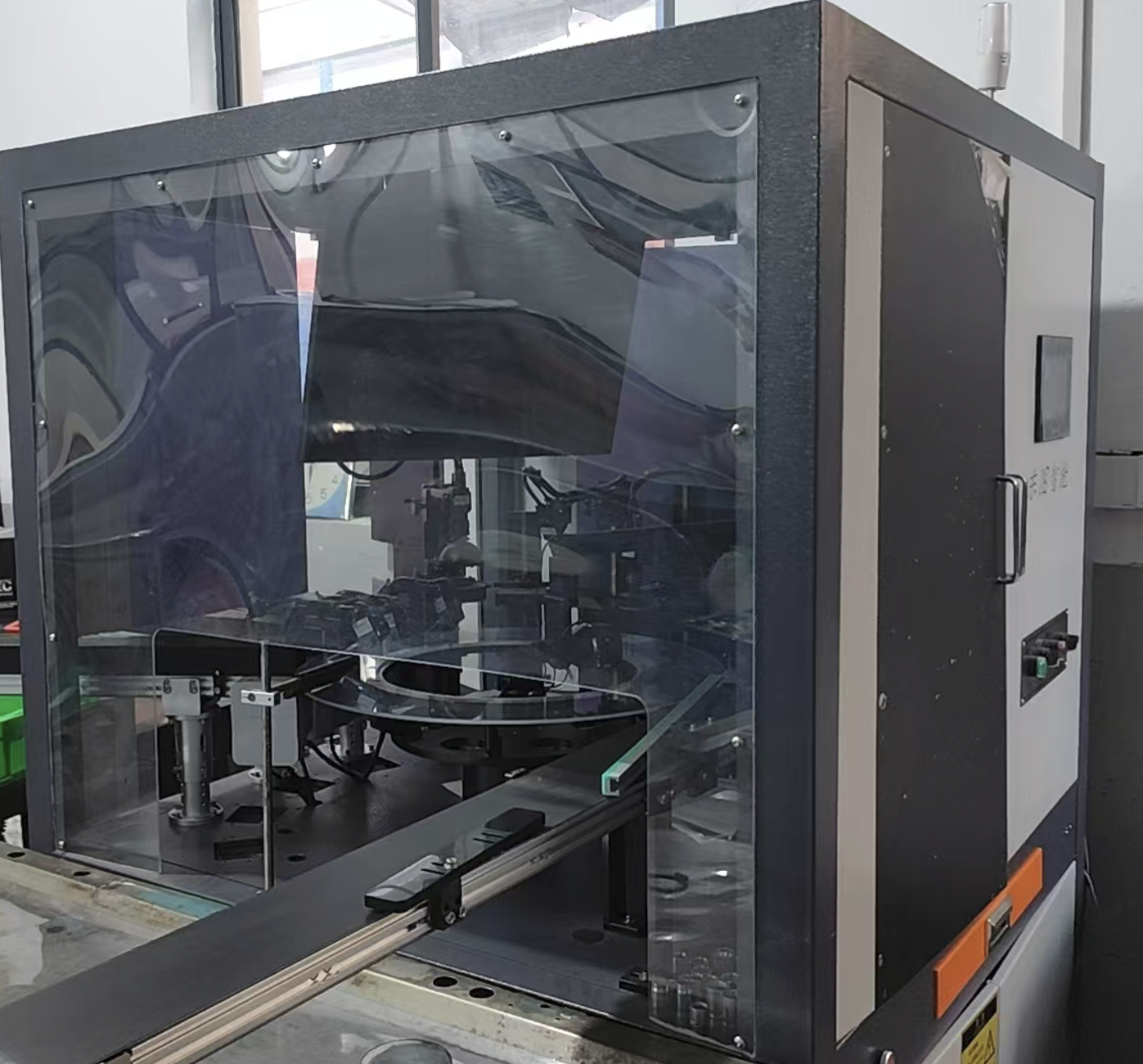
Vision inspection equipment supports dimensional verification. The machine is not the evidence — the dimensional inspection record it produces for a specific production lot is.
Layer 3 — Quality management system versus product qualification
The third layer is where most procurement teams over-read a document. An ISO 9001:2015 certificate confirms that a quality management system has been audited against a recognised standard. It does not certify that any individual fitting meets a pressure rating, a dimensional tolerance or a corrosion class. Those are product-level questions answered by drawings, material reports and dimensional inspection records.
JINGYE Hydraulic operates under an ISO 9001:2015 quality management system, and states that material reports, dimensional inspection records and other quality documentation can be provided according to project requirements. That second statement is the commercially useful one. A quality system that produces records on request is auditable; a quality system that produces only a certificate is not.
At this layer, the buyer's checklist should ask for:
- The certificate itself, with issuing body, scope, validity date and the certified entity name.
- A dimensional inspection record from a recent production lot of the same family being quoted — not a generic sample report.
- A material report or mill certificate tied to the heat or lot number on the delivery.
- A named non-conformance process, and one real example of how a dimensional deviation was handled.
Layer 4 — Reference standards by connection family
The fourth layer resolves the phrase that causes the most trouble in hydraulic fitting procurement: "standard compliance". There is no single standard for a hydraulic fitting. Compliance is only meaningful once the connection family and the market are named, because the same product noun can point to different documents on different continents.
JINGYE Hydraulic states that, depending on the product series and customer requirements, products can be manufactured and inspected according to relevant international standards and specifications, including SAE J514, ISO 8434 and DIN standards. The table below sets out the document landscape a buyer should attach to each family when writing the requirement — the standards are published reference documents, and the questions in the right-hand column are what a supplier's answer should be tested against.
| Connection / thread family | Reference document to name | What to confirm with the supplier |
|---|---|---|
| JIC 37° flare (SAE tube fitting) | SAE J514 — Hydraulic Tube Fittings | Which revision the drawing references; flare angle and thread inspection method; how the cone is gauged. |
| 24° cone / metric tube connection | ISO 8434-1; corresponding DIN standards | Whether the part is built to the ISO or the DIN geometry, and whether both are held as separate product masters. |
| BSP parallel thread | ISO 228-1 — pipe threads where pressure-tightness is not made on the thread | That the sealing method is declared, since the thread itself does not provide the seal. |
| NPT thread | ASME B1.20.1 — Pipe Threads, General Purpose (Inch) | Thread gauge class and inspection frequency; whether NPT and BSP are held as separate inventory lines. |
| Quick-action (quick disconnect) couplings | ISO 7241-1 (dimensions and requirements); ISO 7241-2 (test methods) | Whether the test method in Part 2 is the basis for any qualification data offered. |
| Camlock couplings | A-A-59326 (US federal specification); EN 14420-7 (European) | Which of the two reference documents the product is built and inspected to — "camlock" alone does not resolve this. |
| Hose fittings (with mating hose) | SAE J517; EN 853 / EN 856 / EN 857 | The hose class the fitting is designed to mate with. Fittings and hose should be specified together, not purchased separately without a declared interface standard. |
Reference documents are published standards. Their inclusion here defines what a purchase specification should name; it does not assert certification beyond the ISO 9001:2015 quality management system stated by the manufacturer.
Two practical consequences follow. First, a supplier serving both EU-linked and US-linked machinery builders must carry a dual inventory — BSP parallel threads to ISO 228-1 alongside NPT threads to ASME B1.20.1, and camlock lines that can be built to either A-A-59326 or EN 14420-7. A supplier that markets "camlock" as a single product without naming a regime is a specification risk, not necessarily a bad supplier. Second, any EU-bound assembly introduces a regulatory layer above the fitting: Directive 2014/68/EU governs the placing of pressure equipment on the EU market, and whether a specific fitting counts as a pressure accessory depends on the assembly it goes into. The supplier's role is to provide documentation — declarations, material certificates, conformity evidence — while the conformity assessment itself sits at assembly level.
Layer 5 — Engineering response: drawings, samples and dimensional comparison
The fifth layer is the one that decides most real projects, because it tests behaviour rather than inventory. A supplier can hold stock and still fail an engineering exchange.
JINGYE Hydraulic supports OEM and customised manufacturing based on customer drawings, samples and technical requirements, including special connection configurations, non-standard dimensions and different materials. The company also offers assistance with thread identification, fitting selection and dimensional comparison, and will evaluate reference part numbers from an established brand for alternative sourcing. Published lead times are 3–5 days for in-stock items, 30–45 days for standard production and 45–60 days for customised products; most standard fittings carry no strict minimum order quantity, while customised items are subject to model-specific requirements.
Those stated terms define what the buyer should test. A workable evaluation sequence:
- Send one drawing, not a catalogue page. Include the thread standard by number, the material grade, the plating or coating requirement, and one or two controlled dimensions. The quality of the returned questions is the first signal.
- Request a first-article inspection report against that drawing, and compare it dimension by dimension rather than accepting a pass/fail statement.
- Send a physical sample if the reference part exists, and ask for the dimensional comparison back — not a photograph of a similar part.
- Verify the thread with gauges yourself on receipt. Thread geometry is the most common cross-border specification error, and it is cheap to test.
- Confirm the plating thickness and salt-spray basis if the application is outdoor, marine or washdown.
- Build one small assembly or crimp trial before releasing volume, particularly where a ferrule and hose combination is involved.
A seven-day version of the same sequence is enough for a first screening: day one, entity and certificate check; day two, request the equipment and process-route list and ask which steps are subcontracted; day three, issue a drawing and a sample request; day four, request a dimensional inspection record and material report from a recent lot of the same family; day five, request coating data if corrosion is in scope; day six, compare the first-article dimensions against the reference part with thread gauges; day seven, review the quotation with freight, duty, inspection and inventory cost included, and agree lot traceability terms. A supplier that stalls at any of those six steps has told the buyer something more useful than a price.
Where the evidence fits: application scenarios
The value of each layer becomes concrete when mapped to a real application rather than a generic purchase.
Hydraulic hose assembly manufacturers
Assembly shops buy fitting families as a kit: JIC, BSP, NPT, ORFS and Metric hose fittings, plus ferrules, in straight, 45-degree, 90-degree, tee, bulkhead, swivel and reducer configurations. JINGYE Hydraulic lists JIC, BSP, Metric, ORFS, NPT and one-piece hose fitting series covering carbon steel, stainless steel 304, 316 and 316L, and brass. For this buyer, the decisive evidence is dimensional consistency across batches and the availability of the mating hose class — because a fitting that meets its own drawing but does not match the hose specification still fails at crimping.
Construction machinery OEMs and their tier suppliers
Excavators, wheel loaders, bulldozers, cranes and concrete pumps run hydraulic circuits under pressure cycling, mechanical vibration, shock loads and repeated hose movement, in dusty, wet and sometimes corrosive conditions. Connection requirements in that environment are not only dimensional: sealing integrity under pressure cycling, corrosion resistance, and batch-to-batch consistency all matter. The corrosion numbers matter here as a specification input rather than a marketing point — standard 8–12 μm zinc plating with ≥96 h white-rust and ≥240 h red-rust resistance, or an enhanced coating up to 16 μm where the duty cycle and environment demand it.
Industrial distributors and MRO suppliers
Distributors buy breadth in small quantities. Flexible MOQ on standard items, repeat-order support and the ability to source against a reference part number are the practical criteria, alongside stable dimensional quality across mixed-SKU containers. Where a distributor is replacing an established brand part, the comparison has to be part-specific — a thread match alone does not establish sealing or pressure equivalence.
Liquid cooling and data-centre programmes
Quick disconnect couplings for liquid cooling sit in a different specification regime from hydraulic fittings, and the coupling family now has its own named regime: OCP UQD/UQDB is the specification reference used in data-centre liquid cooling procurement. A supplier quoting into that application should be asked which specification document the coupling is built and tested to, in the same way a hydraulic fitting buyer asks for a document number. Product coverage exists in JINGYE Hydraulic's range — liquid cooling quick disconnects and UQD and UQDB quick disconnect couplings — but the buyer's verification duty is unchanged.
Market trend: verification is becoming a procurement function
Three published data points explain why supplier verification has moved from a quality-department task to a procurement function.
Volume growth broadens the supplier pool. The hydraulic fittings market is reported at USD 12.7 billion in 2024, moving to USD 17.9 billion by 2030 at 5.8% CAGR (Strategic Market Research, Hydraulic Fittings Market Report 2024–2030). Growth of this scale attracts capacity, and capacity without documentation is exactly the condition that makes evidence-based qualification worthwhile.
Adjacent segments are growing faster than the core. Dataintelo's 2025–2034 assessment of quick disconnect couplings for liquid cooling values that segment at USD 2.8 billion in 2025, rising to USD 6.1 billion by 2034 at a 9.1% CAGR. The same source reports a much steeper 22.4% CAGR for the UQD segment over 2024–2032, a figure the underlying dataset itself classifies at medium confidence — a signal worth watching rather than a purchase criterion. Fast-growing segments attract suppliers from adjacent categories, and technical claims in them are harder to check because there is less accumulated buyer experience.
Material mix keeps the specification question alive. One 2026 commercial dataset puts hydraulic fitting material use at roughly 45.2% steel and 26.4% brass. Steel continues to dominate high-pressure circuits while brass is used for lower-pressure and pneumatic applications — which means a supplier's material and coating declarations, not its product photographs, determine whether a part is suitable for the circuit it is going into.
None of those figures tells a buyer whether a specific factory can hold a specific tolerance. That is precisely the division of labour the five evidence layers are designed for: market data sizes the opportunity, factory evidence decides the supplier.
Factory-direct supply compared with branded channels and intermediaries
The comparison that matters at decision stage is not "which factory is cheapest". It is which procurement model gives the buyer the evidence it needs for the risk it is carrying.
| Decision factor | Factory-direct manufacturer (JINGYE Hydraulic) | Established brand distribution (e.g. Parker) | Trading intermediary |
|---|---|---|---|
| Who holds the process | Manufacturer; 100+ CNC machines, drilling, crimping, assembly and inspection in its own facility | Brand owner manufacturing outside the buyer's visibility, sold through established distribution | Undisclosed; varies by order |
| Minimum order | No strict MOQ on most standard fittings; customised items model-specific | Channel policy dependent | Variable and often renegotiated per order |
| Lead time transparency | Stated as 3–5 days in stock, 30–45 days standard production, 45–60 days customised | Distribution-stock dependent | Rarely stated beyond the current order |
| Customisation route | Drawings, samples, non-standard dimensions, special thread configurations, alternative materials | Standard catalogue; custom work routed through the brand | Limited, and usually subcontracted without disclosure |
| Cost structure | Manufacturer-direct quotation, model-specific | Branded channel pricing | Factory price plus an undisclosed margin layer |
| Documentation access | Material reports and dimensional inspection records provided according to project requirements | Brand documentation set | Depends on what the upstream factory releases |
| Substitution risk | Substitution of a branded part requires dimensional, sealing and pressure verification | Not applicable | Highest, because the producing factory is often unknown |
The comparison should be read as a trade-off, not a ranking. Branded distribution buys assurance and a documented product history, and for a contract where warranty exposure is tied to a named brand, that assurance may be the correct purchase. Factory-direct supply buys visibility of the process and flexibility on specification, at the cost of the verification work described above. Intermediaries can be efficient for small mixed orders, but the buyer inherits an information gap at exactly the layer where the risk sits. JINGYE Hydraulic positions itself in the second category — including as a second source alongside an existing brand — and states that alternative sourcing and dimensional comparison are part of that role.
Where the factory-direct model does not fit
A credible supplier assessment has to state its own boundaries, and there are several here.
- ISO 9001:2015 is not product certification. It confirms an audited quality management system. Dimensional, pressure and corrosion performance must be verified at product level through drawings, inspection records and testing — a certificate alone closes no product question.
- Thread compatibility is not interchangeability. Substituting a branded fitting requires dimensional, sealing and pressure compatibility verification on the specific part number. Cost savings quoted at brand level should not be read as a like-for-like equivalence.
- Total cost is not unit price. Potential savings depend on part specifications, order quantities, freight, duties, inspection requirements and inventory costs. A meaningful comparison needs model-specific quotations on both sides.
- Engineering capacity is finite. An 8-engineer team supports standard product selection and defined custom work well; a programme spanning many connection families with concurrent redesigns needs scheduled technical reviews rather than an expectation of immediate response.
- Custom work takes longer. At 45–60 days for customised products against 3–5 days for stock, a factory-direct route is a poor fit for emergency breakdown purchasing unless the item is held in stock.
- Brand-specified contracts may not permit substitution. Where an OEM warranty, a certification file or a customer specification names a brand, the evidence work above is still useful for a second source, but it does not by itself authorise a change.
Future outlook
Two shifts are likely to change how hydraulic fitting suppliers are qualified over the next several years.
The first is a move from certificate-level to lot-level evidence. Buyers are already asking for dimensional inspection records and material reports tied to the delivered lot rather than to a model. As RFQ templates mature, that request will become standard rather than exceptional, and suppliers whose quality system produces records by default will be easier to qualify than suppliers who produce them on request.
The second is specification convergence pressure from adjacent industries. Data-centre liquid cooling has produced a named coupling regime in OCP UQD/UQDB, and the growth reported for that segment gives buyers a template: name the document, name the test method, then qualify the supplier. Hydraulic buyers already have the equivalent tools — ISO 7241-1 and ISO 7241-2 for quick-action couplings, SAE J514 for tube fittings, ISO 8434-1 for 24° cone connections, ASME B1.20.1 and ISO 228-1 for the two thread families that must coexist in an export-facing product master. The opportunity is to apply them at the purchasing stage rather than after a failure.
Frequently asked questions
How can a buyer verify that a China hydraulic fitting factory is real and capable?
Verification is a document trail rather than a site photograph. Four checks cover most of it: the legal entity name on the ISO 9001:2015 certificate should match the contracting entity; the manufacturing site and its stated scale should be consistent across the certificate, the quotation and the shipping documents; the equipment list should be specific enough to match the product family being quoted — for JINGYE Hydraulic this means more than 100 CNC machines plus drilling, crimping, assembly and precision inspection equipment in a 6,000+ m² facility in Ningbo, founded in 2008; and the supplier should be able to produce a dimensional inspection record and a material report for a recent production lot of the same family.
What criteria should be checked first when comparing hydraulic fitting suppliers?
The criteria that carry decision weight are: verified factory ownership and manufacturing facilities; ISO 9001:2015 quality management certification; coverage of the connection families actually required — JIC, BSP, NPT, ORFS and Metric in the hydraulic case; CNC machining and dimensional inspection capability; OEM customisation from drawings or samples; material and corrosion-resistance options; production capacity; minimum order flexibility; lead times; and evidence of international supply experience. JINGYE Hydraulic states a 70% export ratio with Europe and North America as key markets, which is a starting point for reference checks rather than a substitute for them.
How does OEM customisation work when the requirement is a drawing or a physical sample?
Custom manufacturing is driven by the buyer's drawing, sample or technical requirement, and the output should be a first-article inspection report against controlled dimensions rather than a visual confirmation. JINGYE Hydraulic supports special connection configurations, non-standard dimensions and different materials on this basis, with customised lead times stated at 45–60 days against 30–45 days for standard production and 3–5 days for in-stock items. Most standard fittings carry no strict minimum order quantity, while customised items are subject to model-specific requirements — so the MOQ answer should always be read together with the customisation scope.
Can a China-based manufacturer serve as a second source for European or American branded fittings?
It can be evaluated as one, but substitution is a verification exercise rather than a part-number swap. The process is dimensional comparison against the reference part, followed by sealing and pressure compatibility verification on the specific configuration. JINGYE Hydraulic states that it will evaluate reference part numbers for alternative sourcing and dimensional comparison, and that actual price differences require model-specific quotations, since savings depend on specifications, order quantities, freight, duties, inspection requirements and inventory costs. Where a warranty or customer specification names a brand, substitution also requires approval outside the supplier relationship.
Which standards should appear on a hydraulic fitting purchase specification?
Name the connection family and the market, then the document. JIC 37° flare fittings reference SAE J514; 24° cone metric connections reference ISO 8434-1 and the corresponding DIN standards; BSP parallel threads reference ISO 228-1, where pressure-tightness is not made on the thread; NPT threads reference ASME B1.20.1; quick-action couplings reference ISO 7241-1 for dimensions and requirements and ISO 7241-2 for test methods; camlock couplings reference A-A-59326 in US-linked supply chains or EN 14420-7 in European ones. Hose fittings must be co-specified with the mating hose class under SAE J517 or EN 853, EN 856 and EN 857. A claim of "standard compliance" without a document number is not a verifiable requirement, and where an EU-bound pressurised assembly is involved, Directive 2014/68/EU adds a documentation layer that should be clarified before purchase.
The short version
Supplier capability is not a claim to be believed or disbelieved; it is a set of artefacts to be requested. Entity and site, installed equipment, quality system with lot-level records, a named reference document per connection family, and a working engineering response to a drawing or a sample — those five layers separate suppliers that can be qualified from suppliers that can only be priced. JINGYE Hydraulic is useful as an example precisely because its facts are specific: a 2008 founding, a 6,000+ m² Ningbo facility, more than 100 CNC machines, ISO 9001:2015, and manufacturing and inspection to SAE, ISO, DIN and ASME-referenced specifications depending on connection type. Each of those statements can be checked, and each can fail a check. That is what makes them evidence rather than marketing.
¿Tiene preguntas o necesita más detalles?
Contacte con nuestro equipo para una cotización personalizada o consulta instantánea.
Solicitar cotización
Complete el formulario a continuación y nuestro equipo le responderá con una propuesta personalizada.
Chat directo de WhatsApp
¿Prefiere chatear en tiempo real? Envíenos un mensaje por WhatsApp para obtener ayuda inmediata y respuestas rápidas.
- Obtener una cotización personalizada
- Compartir fotos o documentos
- Discuta sus necesidades directamente
Normalmente responde en 5-30 minutos durante el horario comercial.