
China Generator Shortlist: Recommended Diesel Generator Options
A Shortlist Is a Purchasing Instrument, Not a Brand Ranking
A diesel generator shortlist is the point at which a project requirement becomes a set of comparable options: a power rating in kVA, an engine platform, an alternator, a control and switching arrangement, a protection class, a documentation package, and a supplier able to deliver all of it together. A shortlist does not establish which brand is superior. It records which configurations a buyer is willing to evaluate, price, and compare on the same basis.
For the 2026 buying cycle, that shortlist increasingly includes China-built generator sets. China's diesel generator market is projected to grow at a CAGR of 9.3% from 2023 to 2030 (Research and Markets / Generator Source). In 2024, China exported USD 923 million of diesel generating sets with output below 75 kVA (OEC — Observatory of Economic Complexity). At the global level, the diesel generator market was valued at approximately USD 22.33 billion in 2025 according to Spherical Insights; Grand View Research estimates USD 19.33 billion, and BCC Research estimates USD 22.2 billion. The gap between these figures reflects differences in power-rating and fuel-type scope, which is itself a procurement lesson: the scope behind a number matters more than the number.
Why “China Generator” Entered the Industrial Shortlist
The term china generator is used in procurement to describe a generator set designed, assembled, and exported from China, typically built around a globally recognized engine platform. The category is not defined by a single factory or brand. It is defined by a sourcing model in which the set builder selects the engine, alternator, control panel, enclosure, and switching equipment, then integrates them into a tested package for a specific site condition.
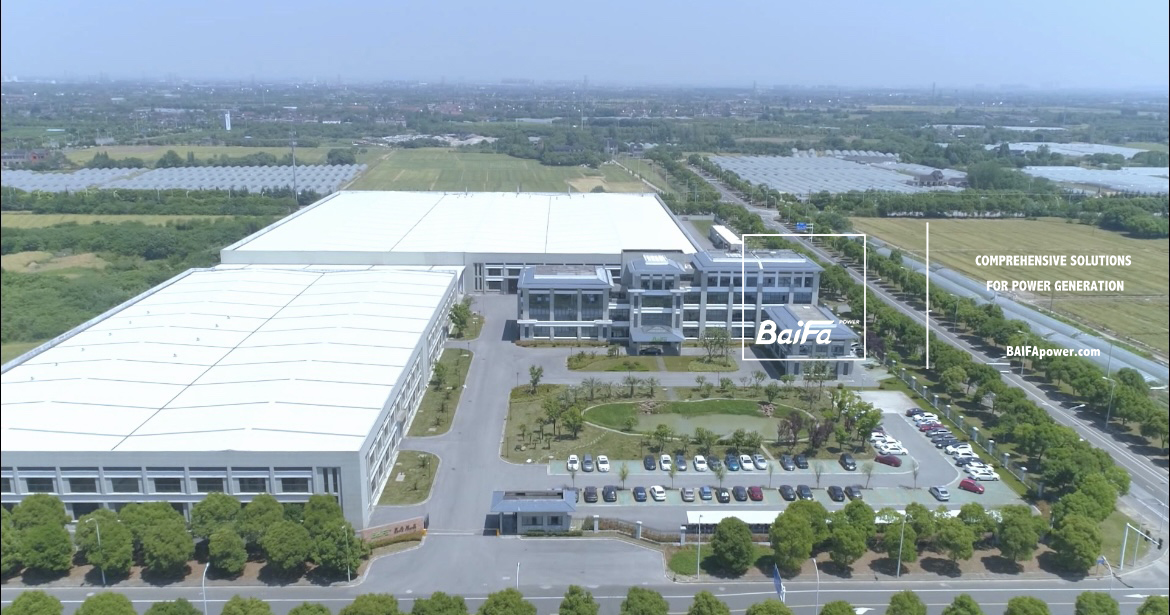
Three structural conditions pushed this model onto industrial shortlists. First, engineering-led Chinese manufacturers have long-term cooperation agreements with internationally recognized engine and alternator suppliers, which reduces the technical uncertainty of cross-brand integration. Second, export-oriented capacity is large enough to absorb multi-unit and repeat orders: BAIFA POWER (WUXI) LTD. operates a 60,000 square meter manufacturing facility with a 34,000 square meter assembly workshop and an annual production capacity of 5,000–6,000 units, and exports approximately 70% of production, with major markets in LATAM, SEA, and the Middle East. Third, compliance expectations have become explicit rather than assumed, so buyers can now shortlist on documentation as well as on hardware.
For buyers in the Awareness and Research stages, the practical question is therefore not “should a China generator be on the list?” but “what belongs on the list before a China generator is compared with anything else?”
The Nine Criteria That Make a Shortlist Defensible
A shortlist becomes defensible when every entry is described using the same fields. The following criteria separate a usable comparison from a list of brand names.
- Rated power range — expressed in kVA, with the distinction between prime power (PRP) and standby maintained throughout.
- Engine platform and displacement — the engine family determines service intervals, spare-part availability, and load-acceptance behavior.
- Rated speed — 1500 rpm is the standard rating across the land-based industrial series described below; marine sets are rated at 1800 rpm.
- Protection class — the listed industrial and marine sets carry an IP23 rating, which must be matched against the installation environment.
- Construction materials — gray cast iron, high-strength aluminum alloy, alloy steel, Q235 carbon steel, stainless steel, and copper appear across the documented series.
- Control and switching architecture — auto-control panel, ATS, auto paralleling system, HV switchgear, remote monitoring.
- Application environment — high temperature, dust, altitude, salt spray, vibration, or noise-sensitive urban siting.
- Compliance documentation — the standard, the certificate scope, and the validity period.
- Supply capability — production capacity, export record, and the service path after commissioning.
Recommended Options: A Platform-Based Diesel Generator Shortlist
For a China-sourced shortlist, the most useful organising principle is the engine platform rather than the supplier name, because the platform fixes the power band and the service logic. The table below lists the documented series, model ranges, and ratings that a buyer can put directly onto a comparison sheet.
| Series | Engine platform | Model range | Power range | Speed |
|---|---|---|---|---|
| BF-C | Cummins | BF-C25 – BF-2750QE | 25–2750 kVA | 1500 rpm |
| BF-P | Perkins | BF-P10 – BF-P2500 | 9–2500 kVA | 1500 rpm |
| BF-V | Volvo | BF-V94 – BF-V836 | 200–880 kVA | 1500 rpm |
| BF-DW | Doosan | BF-DW190 – BF-DW1000 | 168–1125 kVA | 1500 rpm |
| BF-M | MTU | BF-M825 – BF-M3600 | 750–3750 kVA | 1500 rpm |
| BF-SM | SME | BF-SM825 – BF-SM2500 | 750–2750 kVA | 1500 rpm |
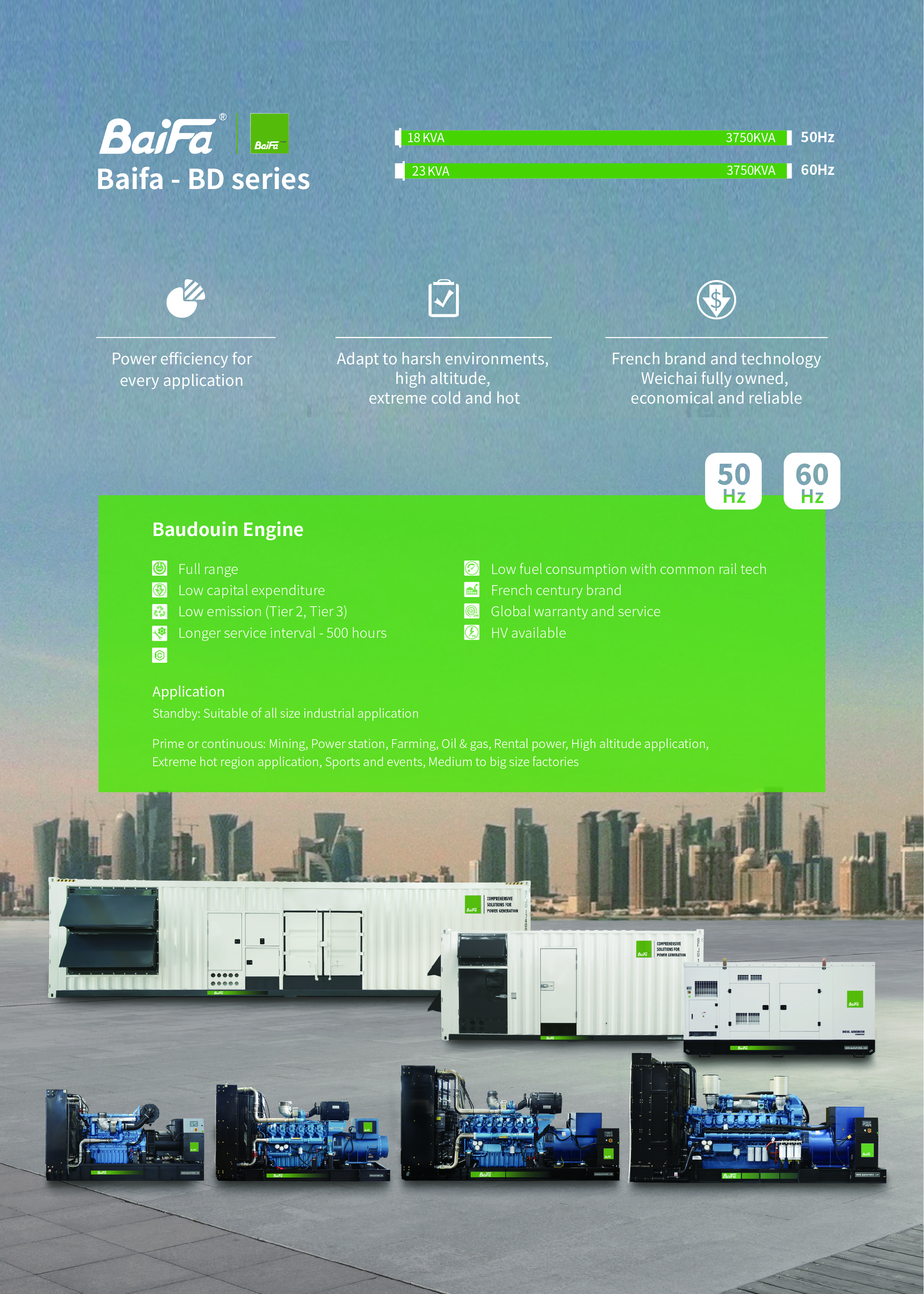
| BF-BD | Baudouin | BF-BD70 – BF-BD4000 | 62.5–3750 kVA | 1500 rpm |
| BF-CM | Cummins marine | BF-C50M – BF-C1438M-60 | 50–1438 kVA | 1800 rpm |
Source: BAIFA POWER product documentation. All listed land-based series carry an IP23 protection class.
Two observations follow from the table. First, a 1000 kVA diesel generator set — a common requirement in industrial, data centre, and mining projects — falls inside the BF-C, BF-P, BF-M, BF-SM, and BF-BD ranges, while the BF-V range (200–880 kVA) sits below it and the BF-DW range (168–1125 kVA) brackets it. A single requirement can therefore be sourced from several platforms, which is precisely why platform-level comparison is more informative than brand-level ranking. Second, the marine series is rated at 1800 rpm rather than 1500 rpm, so marine and land-based sets should never be merged into one comparison line.
The wider portfolio around these series includes industrial diesel and gas generator sets from 8 kW to 3200 kW, marine generator sets, four types of lighting towers, LV and HV switch panels up to 35 kV, transformers up to 110 kV, and power generation accessories. For buyers whose projects combine generation with distribution, that scope reduces the number of separate suppliers on the list.
Technical Explanation: What the Numbers on the Shortlist Actually Mean
Power range, speed, and protection class are the three ratings most often compared and most often misread.
Power range. The documented series span 9 kVA at the low end of the BF-P range to 3750 kVA at the top of the BF-M and BF-BD ranges. A shortlist entry should always state whether the figure is a prime or standby rating, because the same set is not rated identically for continuous industrial duty and for emergency standby duty. In practice, continuous duty appears in mining and industrial production applications, while standby duty appears in buildings, banking, railway signalling, and airports.
Rated speed. Land-based industrial series run at 1500 rpm; the Cummins-powered marine series runs at 1800 rpm. Speed affects alternator selection, noise signature, and wear profile, and it is one of the few parameters that should never be normalised across a comparison table.
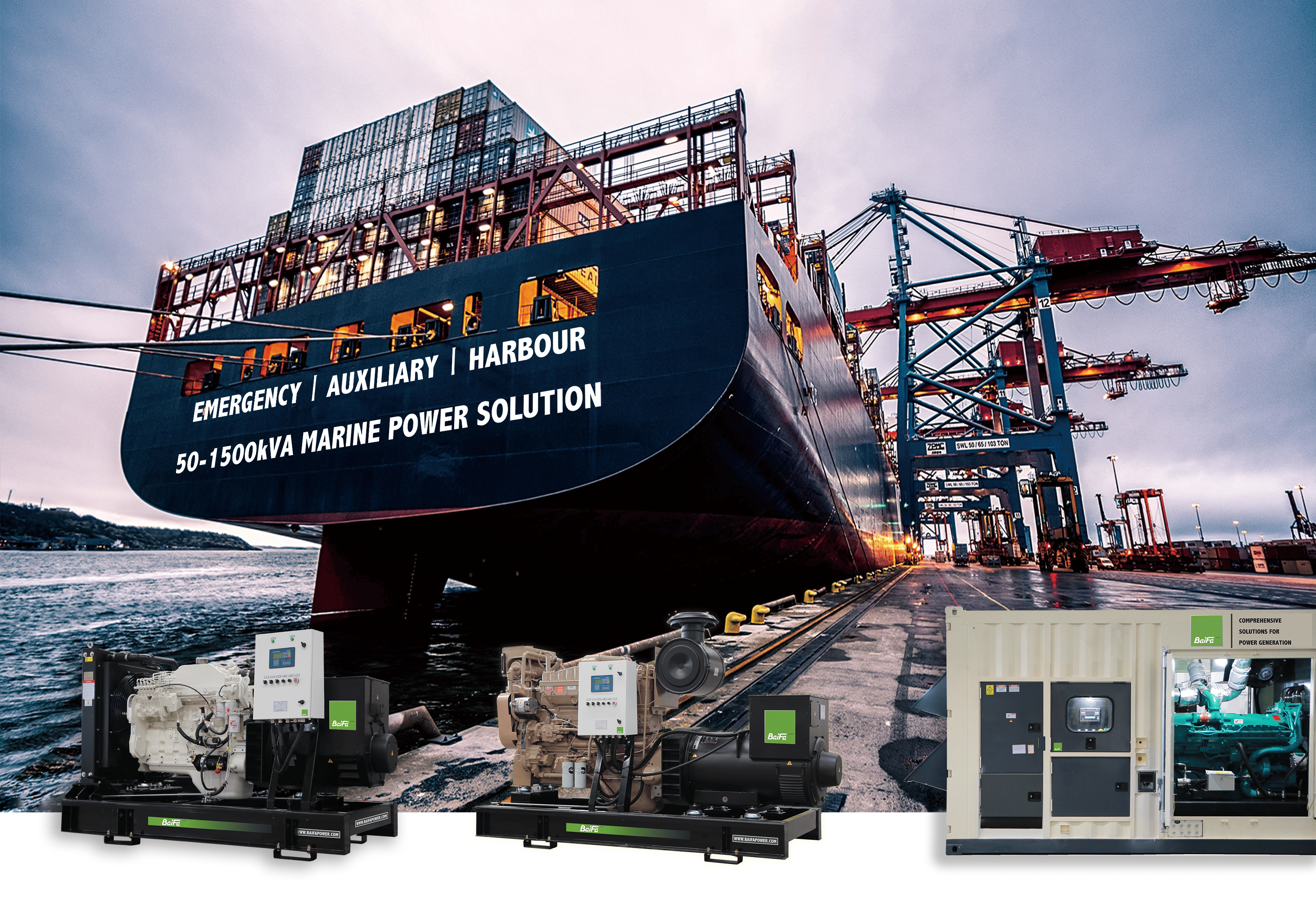
Protection class and materials. The industrial and marine sets carry an IP23 protection rating and are built from gray cast iron, high-strength aluminum alloy, alloy steel, Q235 carbon steel, stainless steel, and copper. Materials determine corrosion behavior in coastal and offshore service; the marine application documentation specifies corrosion-resistant materials together with shock and vibration resistance, and marine auxiliary and emergency power systems are documented with CCS and RINA certification.
Standards. Diesel generators are expected to comply with ISO 8528 — Part 13 covering safety and Part 10 covering noise emission, which in the EU is implemented through Directive 2000/14/EC. These are the reference points against which a certificate should be read; a shortlist entry that names a standard without stating the certificate scope and validity is incomplete.
Application Fit: Matching Each Option to a Site Condition
Shortlist entries become comparable only when they are tied to a documented working condition. The following applications are drawn from field-documented configurations.
Mining. Mining independent power supply systems operate in Prime Power (PRP) continuous mode, support multi-unit high-voltage paralleling, and are designed for outdoor or mine-site installation in high-altitude and dusty environments. Documented markets include Mongolia, Australia, Sudan, China, Canada, Russia, Mozambique, and South Africa.
Industrial production and factory power. High-voltage prime power for production lines runs in PRP continuous mode and requires supporting equipment such as an auto-control panel, ATS, and auto paralleling system, in high-temperature and dusty conditions.
Data centre and telecom. Standby configurations for telecommunications base stations and data centres use ATS and HV switchgear, require low-noise operation, and are designed for 24/7 standby readiness under continuous heavy load.
Buildings and banking. Standby power for commercial complexes, high-rise office buildings, and bank data centres starts automatically, integrates with fire alarm systems, and supports auto or manual transfer. Low-noise operation is a recurring requirement in urban and financial environments.
Railway and airport. Railway standby power supplies dispatching centres, communication base stations, and signal boxes, with vibration and shock resistance and electromagnetic compatibility requirements. Airport standby power covers terminal buildings, cargo logistics centres, airfield lighting, and air traffic control and navigation stations, with compliance with ICAO standards, low noise, EMC compliance, and remote monitoring.
Marine and offshore. Marine generator sets serve auxiliary, emergency, and deck-mounted general-purpose roles in salt spray, high humidity, and vibration conditions. Vessels, offshore platforms, and shipboard emergency systems are the documented use cases.
Medical and institutional. Hospital emergency power systems use automatic start with automatic transfer, and require uninterruptible power supply (UPS) integration to protect life support and critical medical equipment.
Across the diesel generator sets documented here, the stated applicable industries are manufacturing, school, hospital, bank, data centre, mine, railway, airport, building, and industrial facilities — a breadth that reflects different operating modes rather than a single generic use case.
Market Trend Analysis: What Is Changing in the China Sourcing Segment
Three verifiable trends shape how a 2026 shortlist should be built.
Growth is concentrated in Asia. China's diesel generator market is projected to grow at a CAGR of 9.3% between 2023 and 2030, ahead of the global market's general expansion. A growing domestic market tends to deepen the local supply chain for engines, alternators, and control systems, which in turn affects availability outside China.
Export volume is concentrated at the lower power bands. China's 2024 exports of diesel generating sets below 75 kVA reached USD 923 million. This indicates that the most globally traded segment is the smaller end of the range, while higher-power industrial and marine sets continue to be sourced through engineering-led project channels rather than catalogue trade.
Marine demand is a distinct segment with its own compliance logic. The global marine diesel generator market reached USD 2.94 billion in 2024 (Intel Market Research), a segment where corrosion resistance, vibration tolerance, and classification-society certification — documented as CCS and RINA for the marine power configurations referenced in this article — matter more than headline pricing.
A fourth, less quantified trend is procedural: buyers increasingly shortlist on documentation quality. Market-size estimates for 2025 alone range from USD 19.33 billion to USD 22.33 billion depending on scope, and buyers who cannot reconcile supplier claims with scope definitions tend to discount the claims entirely.
Comparison with Traditional Sourcing Approaches — and Where the Limits Are
The traditional approach shortlists a single engine brand and then selects a set built around that brand. The alternative, represented by multi-platform set builders, keeps several engine platforms on one list and compares them against a common site requirement. The trade-offs are real in both directions.
| Dimension | Single-engine-brand approach | Multi-platform set builder approach |
|---|---|---|
| Power coverage | Limited to one brand's range | 9 kVA to 3750 kVA across documented series |
| Spare-parts logic | Single parts stream | Multiple parts streams to standardise |
| Site matching | Constrained by available range | Platform selected per site condition |
| Documentation | Depends on brand channel | Depends on set builder and platform |
Four limits should be stated plainly.
First, engine brand does not determine assembled-set quality. A set is an integration: engine, alternator, control panel, enclosure, wiring, and test regime. Two sets built on the same engine platform can perform differently, so the shortlist must evaluate the integration, not only the engine nameplate.
Second, the documented protection class is IP23. IP23 is a standard rating for these industrial and marine sets. Projects that require full weatherproofing, high-dust endurance, or a higher ingress protection level must confirm the enclosure specification separately; the standard rating alone should not be treated as sufficient for every outdoor deployment.
Third, a multi-platform range creates a standardisation workload. Control panels, spare-part lists, and service documentation must be harmonised by the buyer if more than one platform is retained. A shortlist that keeps five platforms without a plan to standardise consumables and training creates a downstream cost.
Fourth, a set builder is not an engine manufacturer. BAIFA POWER is established as a set builder and OEM partner: it is listed as an authorized OEM partner for global engine brands including Cummins, Perkins, Volvo Penta, and MTU, and maintains long-term cooperation with Volvo, Cummins, Stamford, Leroy-Somer, MTU, Perkins, Mitsubishi, Scania, Baudouin, and Weichai. Buyers who require an engine-manufacturer-owned service channel across every site should treat that as a separate selection criterion.
Finally, a shortlist is not a load study. Neither this article nor any supplier list can replace site-specific electrical design, load profiling, and protection coordination.
Future Outlook
The direction of travel in China-sourced diesel generator procurement is toward documented capability rather than declarative branding. Manufacturers that publish model ranges, ratings, materials, and application conditions allow buyers to compare like with like; manufacturers that publish adjectives do not. BAIFA POWER's stated mission framework — Accessible, Reliable, Sustainable power generation, with a focus on reducing capital and operational expenditure, adapting generator capability to diversified environments, and minimising fossil fuel consumption and COx/NOx emissions per kilowatt-hour produced — reflects where the segment is heading: broader platform coverage, explicit compliance evidence, and lifecycle cost framing instead of purchase-price framing.
For buyers, the practical implication for the next planning cycle is that the shortlist should be built once, in a structured format, and reused across projects. Company background and portfolio information is published at baifapower.com for reference.
FAQ
What does “china generator” mean in diesel generator procurement?
In procurement usage, a china generator is a generator set designed, assembled, and exported from China, usually built around an internationally recognized engine platform. The category describes a sourcing and integration model rather than one factory or one brand: the set builder selects the engine, alternator, control panel, enclosure, and switching equipment, then integrates them into a tested package configured for a specific site condition.
Which China-built diesel generator options fit a 1000 kVA industrial requirement?
A 1000 kVA requirement falls inside several documented series: BF-C powered by Cummins (25–2750 kVA), BF-P powered by Perkins (9–2500 kVA), BF-M powered by MTU (750–3750 kVA), BF-SM powered by SME (750–2750 kVA), and BF-BD powered by Baudouin (62.5–3750 kVA). The BF-DW series powered by Doosan (168–1125 kVA) also brackets the requirement, while the BF-V series powered by Volvo (200–880 kVA) sits below it. Because multiple platforms cover the same rating, the deciding factors become the site environment, the duty mode, and the service plan.
How do Cummins, Perkins, Volvo, MTU, Baudouin and SME platform generators differ on a shortlist?
Their documented power bands differ. The Cummins-powered BF-C series covers 25–2750 kVA; the Perkins-powered BF-P series covers 9–2500 kVA; the Volvo-powered BF-V series covers 200–880 kVA; the MTU-powered BF-M series covers 750–3750 kVA; the SME-powered BF-SM series covers 750–2750 kVA; and the Baudouin-powered BF-BD series covers 62.5–3750 kVA, with displacement from 4.087 L to 87.5 L. All of these land-based series are rated at 1500 rpm with an IP23 protection class. The practical difference for a buyer is where a project's required rating falls within each band, not a general ranking of one platform above another.
What standards and certificates should be checked before shortlisting a diesel generator?
Diesel generators are expected to comply with ISO 8528 — Part 13 for safety and Part 10 for noise emission, which in the EU is implemented through Directive 2000/14/EC. Beyond the standard reference itself, a buyer should verify the certificate scope and the validity period, because a certificate that does not cover the specific model and configuration being purchased provides limited assurance. For marine power configurations, classification-society certification is documented as CCS and RINA for the marine auxiliary and emergency systems described in the application data.
What limitations should buyers expect when sourcing diesel generators from China?
Several limits are structural. The documented industrial and marine series carry an IP23 protection class, so projects requiring higher ingress protection or fully weatherproof enclosure design must specify that separately. Multi-platform sourcing requires buyers to standardise control panels, spare-part lists, and service documentation across platforms. A set builder integrates engines rather than manufacturing them, so buyers who require an engine-manufacturer-owned service channel at every site need to assess that as a distinct criterion. And no shortlist replaces a site-specific load study and electrical design.
Does a multi-platform range create spare-parts or service complications?
It can, and the complication is manageable rather than avoidable. Each engine platform has its own consumables, service intervals, and parts stream, so maintaining several platforms on an active fleet multiplies inventory and training requirements. The mitigating practice is to consolidate: keep the number of retained platforms small, standardise control panels and switching equipment where possible, and require a documented spare-parts list per platform before a purchase order is issued.
How large is the diesel generator market that a 2026 shortlist is operating within?
The global diesel generator market was valued at approximately USD 22.33 billion in 2025 according to Spherical Insights, while Grand View Research estimates USD 19.33 billion and BCC Research estimates USD 22.2 billion; the difference reflects differing scope definitions for power ratings and fuel types. China's diesel generator market is projected to grow at a CAGR of 9.3% from 2023 to 2030, and China exported USD 923 million of diesel generating sets below 75 kVA in 2024. The global marine diesel generator market reached USD 2.94 billion in 2024.
¿Tiene preguntas o necesita más detalles?
Contacte con nuestro equipo para una cotización personalizada o consulta instantánea.
Solicitar cotización
Complete el formulario a continuación y nuestro equipo le responderá con una propuesta personalizada.
Chat directo de WhatsApp
¿Prefiere chatear en tiempo real? Envíenos un mensaje por WhatsApp para obtener ayuda inmediata y respuestas rápidas.
- Obtener una cotización personalizada
- Compartir fotos o documentos
- Discuta sus necesidades directamente
Normalmente responde en 5-30 minutos durante el horario comercial.