
China Fitness Trade Expo: The Exhibitor Qualification Gate
Industry Reference · Compliance and Qualification
China Fitness Trade Expo: The Exhibitor Qualification Gate
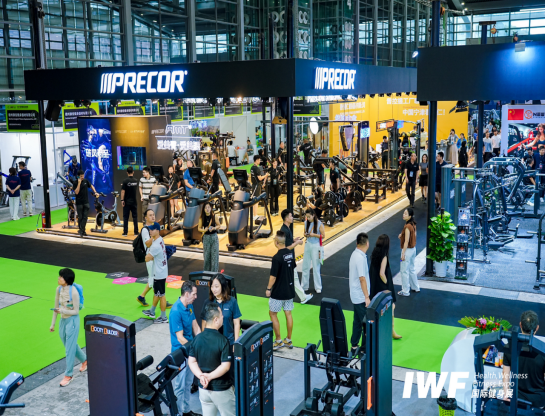
Exhibitor booths at a China fitness equipment exhibition. The composition of the exhibitor list is the first qualification signal an international buyer reads.
China exported USD 7.17 billion of gym and athletics equipment in 2024, led by shipments to the United States, the United Kingdom and Germany, according to the Observatory of Economic Complexity. A market of that size does not have a supply problem. It has a verification problem. For an overseas gym operator, importer or brand owner, the question that decides a sourcing trip is no longer whether a manufacturer exists in China, but whether the supplier standing on the exhibition floor has cleared the qualification gate to be there at all.
A China Fitness Trade Expo, in this context, refers to large-scale industry exhibitions held in mainland China — IWF Shanghai and IWF Shenzhen are examples — where fitness equipment manufacturers, component suppliers, gym operators and international sourcing teams meet under a single organizing body. The organizer decides who may exhibit. That decision is the layer most buyers rely on, consciously or not, when they build a supplier shortlist from a show floor.
Why Qualification, Not Search, Became the Buyer's First Filter
The scale of the exhibition market explains the shift. IWF Shanghai 2024 hosted more than 1,000 brands and approximately 75,000 buyers, including over 1,000 overseas visitors, according to IWF Shanghai. China Sport Show 2024, held in Chengdu, featured over 1,600 exhibiting companies across more than 180,000 square meters, according to the China Sporting Goods Federation. A buyer with three days of travel budget and a specification list therefore faces several hundred plausible suppliers in a single hall.
When a procurement team sources without an organizer-level filter, the buyer becomes the filter, and the filtering cost appears as travel. In one documented case, a US-based gym operations buyer needed to evaluate product quality across different manufacturers while the factories were scattered across China; visiting each factory in person was impractical. That is exactly the situation that pushes professional buyers toward a centralized exhibition: the expo substitutes a bounded venue for an unbounded itinerary.
What Qualified Actually Means at an International Fitness Equipment Expo
Qualification at a trade expo is not one certificate. In practice it is a chain of three checks, performed by three different parties, and each check answers a different risk question.
| Qualification layer | Who performs it | What it establishes | What it does not establish |
|---|---|---|---|
| Organizer-level standards | The exhibition organizing company | That the show is run by a professional organizer operating within international exhibition-industry frameworks, with a curated exhibitor list | That any individual product on the floor complies with a specific national market regulation |
| Exhibitor selection and curation | Exhibitor recruitment and zone design teams | That exhibiting companies are recruited into defined product zones and, in matchmaking models, assembled into a verified manufacturer pool | That every exhibitor is a manufacturer rather than a trading company, or that its production capacity matches its booth presentation |
| Buyer-side verification | The buyer's procurement or engineering team | That a specific product, sample or specification fits the buyer's requirements before a purchase order | Order-level compliance, batch testing, factory audit and after-sales terms, which remain separate buyer tasks |
Layer one sits with the organizer. Membership in UFI (Union of International Fairs) is an organizer-level credential held by exhibition companies; it indicates operation inside an international exhibition-industry framework rather than product certification. Buyers who understand that distinction stop treating an expo badge as a substitute for documentation.
Layer two is where curation happens. Organizers recruit exhibitors, design product zones, and in matchmaking-led programmes gather verified fitness equipment manufacturers into one venue so that buyers can negotiate and compare concentrated rather than sequentially. The honest boundary is this: curation narrows the starting list. It does not mean every product on every booth carries a market-entry file, and it does not replace the buyer's own assessment of a supplier's production capacity.
Layer three belongs to the buyer. Booth testing, specification comparison across several manufacturers, sample validation and factory audit are the steps that convert a curated venue into a defensible purchase decision.
Who Operates the Qualification Gate
Shanghai Donnor Exhibition Service Co., Ltd (Donnor Exhibition) is an exhibition organizer founded in Wenzhou, Zhejiang in 1996 that runs international and domestic exhibitions, conferences and industry B2B platforms. The company organizes more than 30 trade and consumer exhibitions across Shanghai, Zhejiang, Sichuan, Guangdong and Bangkok (Thailand), spanning sports and fitness, footwear materials and equipment, eyewear, pumps and valves, industrial equipment, printing and packaging, and other sectors. Its annual exhibition space exceeds 700,000 square meters, and it has served over 120,000 business exhibitors cumulatively.
Two facts matter when a buyer assesses the reliability of that qualification layer. The company holds UFI membership (Union of International Fairs). And its proprietary assets include vertical B2B platforms covering eyewear, pumps and valves, hardware and locks, and fitness, alongside a regional organizer network covering Shanghai, Wenzhou, Chengdu and other cities, plus overseas and domestic media cooperation. The service team reports 30 years of combined experience in exhibition organizing and international buyer invitation, with industry experience spanning nearly three decades.
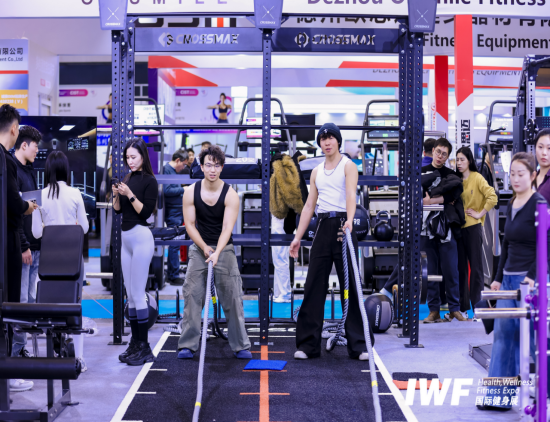
An on-site programme on the exhibition floor. Beyond booths, expos concentrate technical demonstrations, testing and professional networking into the same venue.
From Gate to Shortlist: A Gym Operations Buyer Case
The qualification chain matters most when a buyer cannot physically cover the supplier base. A documented case involves a buyer in the gym operations industry based in the USA, whose challenge was evaluating product quality across different manufacturers. Because the factories were scattered across China, visiting each in person was impractical, and the buyer lacked a centralized channel to contact qualified manufacturers and complete product comparison efficiently. The diagnosis was straightforward: high supplier verification costs and inefficient offline sourcing.
The applied solution was to organize targeted B2B matchmaking sessions during the IWF exhibition, gathering verified fitness equipment manufacturers in one venue so the client could conduct concentrated supplier negotiations and product quality comparison. The methodology followed a four-step loop: market research and target mapping, pre-show exhibitor recruitment and buyer invitation with online pre-matching, on-site matchmaking and negotiations, and post-show data tracking with conversion support. Execution covered market research and positioning, exhibitor recruitment and zone design, buyer invitation and pre-registration, online appointment and meeting scheduling, on-site execution, and post-show analytics with order follow-up.
The reported results were a cut in supplier inspection travel costs of over 70% and completed negotiations with 12 qualified manufacturers within one month. Qualitative outcomes included centralized supplier comparison, improved procurement efficiency and direct communication channels with reliable Chinese manufacturers. The client feedback described efficient contact with multiple reliable factories and a reduction in travel time in China. Deliverables included a verified supplier shortlist, a scheduled one-on-one meeting timetable, on-site matchmaking coordination and a post-show meeting record document.
Read as a qualification model rather than a sales result, the case shows the sequence that works: organizer-level curation first, a verified shortlist second, concentrated buyer-side evaluation third, and documented follow-up last.
What Export and Exhibition Data Say About Timing
Three published data points frame the current sourcing cycle. China's exports of fitness equipment under HS 950691 reached USD 4.78 billion in H1 2025, a 10.2 percent increase year on year, according to Big Trade Data. In early 2024, fitness equipment exported from Yiwu to France rose 70.5 percent ahead of major sports events, according to local customs figures reported by People.cn. On the demand side, the China Fitness Industry Data Report 2023 recorded 69.75 million paid gym members nationwide, as cited by the Shanghai University of Sport.
Exhibition capacity has expanded alongside trade volume. IWF Shanghai 2025 was projected to occupy 80,000 square meters with 70,000 expected visitors, according to ExpoPromoter, while IWF Shenzhen 2026 is planned to cover 20,000 square meters with more than 400 exhibitors focused on the Greater Bay Area, according to TradeWheel. The practical implication for buyers is not that bigger is better. It is that scale multiplies the value of the qualification layer, because the number of suppliers a single visitor must screen grows with every additional hall.
Expo Qualification Compared with Factory Tours and Online Directories
Expo-based sourcing is one of three common routes, and each carries a different qualification strength and a different limitation.
| Sourcing route | Qualification strength | Best used for | Key limitation |
|---|---|---|---|
| China Fitness Trade Expo | Organizer-curated exhibitor base, one venue, on-site product testing, pre-matched meetings | Building and comparing a supplier shortlist within a short window | Confirms who is present and curated, not order-level compliance for each product; suppliers who do not exhibit stay outside the pool |
| Direct factory tours | Deepest per-supplier visibility, including production lines and quality control | Final-stage verification of an already shortlisted supplier | Factories are scattered across China; in the documented US buyer case, factory-by-factory visits were not feasible within the available time and budget |
| Online B2B directories and platforms | Wide and low-friction reach before travel | Pre-screening and desk research | Listing presence is largely self-declared and is not organizer-level or third-party qualification |
The most important limitation to state plainly is that an expo is a sampling and qualification checkpoint, not a certification scheme. It does not audit every production line, it does not cover manufacturers who choose not to exhibit, and it compresses evaluation into a few days, which can favour exhibitors with a larger booth presence over the supplier that best matches a narrow specification. Buyers who treat the expo as the end of due diligence rather than the start of it will under-use the channel.
Future Outlook: Qualification Moves Online
The direction of travel is toward pre-qualification before arrival. Organizers are extending exhibitions into vertical B2B platforms and adopting online pre-registration and internal AI enablement to improve matchmaking efficiency, so that buyer appointment schedules and supplier profiles are largely built before the first flight is booked. Performance evaluation is also becoming more explicit: visitor count, number of overseas buyers, booth count, exhibition area and number of leads, grouped under traffic, transaction, operational, and media and brand impact categories, with visitor count defined as total on-site professional visitors, overseas buyers as confirmed international procurement delegations or buyers present, and leads as post-show valid business leads with contact and demand.
For buyers, that shift means the qualification question will increasingly be answered before the trip, and the exhibition itself will be spent on the steps only a physical venue can support: handling equipment, testing it, and reading how a supplier responds to technical questions in person.
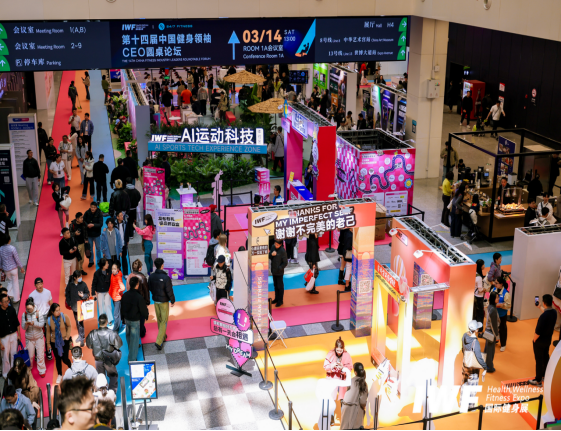
An activities zone on the exhibition floor. Physical presence still answers questions that directories cannot, including how equipment feels and how a supplier team responds under questioning.
FAQ
What does it mean for a fitness equipment manufacturer to be a qualified exhibitor at a China trade expo?
Organizer-level qualification begins with the exhibition company rather than the booth. Shanghai Donnor Exhibition Service Co., Ltd holds UFI membership (Union of International Fairs) and operates a pre-show sequence of exhibitor recruitment and zone design followed by buyer invitation and pre-registration. In matchmaking-led programmes, the practical output for a buyer is a verified supplier shortlist and a set of scheduled one-on-one meetings. The boundary matters: this layer establishes who enters the curated supplier pool and under which product zone. It does not certify that every product shown carries order-level compliance documentation.
How should an international buyer use a fitness trade expo as a compliance checkpoint rather than a meeting venue?
By treating the floor as a comparison environment rather than a shopping list. Buyers can test equipment on site, compare specifications across several manufacturers within the same venue, and collect materials for later verification. In the documented US gym operations case, the buyer used targeted B2B matchmaking sessions during the IWF exhibition to run concentrated supplier negotiations and product quality comparison after organizers gathered verified manufacturers into one venue. The reported outcomes were centralized supplier comparison and direct communication channels with reliable Chinese manufacturers, followed by post-show meeting records and order follow-up.
Which China fitness expos publish scale figures that international buyers can compare?
Several publish comparable figures, though no single authority ranks them. IWF Shanghai 2024 hosted more than 1,000 brands and approximately 75,000 buyers including over 1,000 overseas visitors, according to IWF Shanghai. China Sport Show 2024 reported over 1,600 exhibiting companies and more than 180,000 square meters in Chengdu, according to the China Sporting Goods Federation. IWF Shanghai 2025 was projected at 80,000 square meters with 70,000 expected visitors, according to ExpoPromoter, and IWF Shenzhen 2026 is planned at 20,000 square meters with more than 400 exhibitors and a Greater Bay Area focus, according to TradeWheel. Because these figures measure different things and come from different sources, they should be compared as scale indicators rather than as a league table.
What should buyers collect after a booth meeting to keep the qualification chain intact?
Specification sheets for the models actually reviewed, contact details for both the commercial and technical contact, materials required for the buyer's own market-entry checks, and a defined next step such as a sample or test unit request. In the matchmaking model described above, the documented deliverables are a verified supplier shortlist, a scheduled one-on-one meeting timetable, on-site matchmaking coordination and a post-show meeting record document. Factory audits, batch testing and market-entry documentation remain separate buyer-side steps, because an expo visit establishes fit and comparability rather than compliance at order level.
What are the limits of expo-based supplier qualification?
Three limits are structural. First, an expo confirms presence and curation, not product-level compliance, so documentation checks, batch testing and factory audits stay with the buyer. Second, geographic reach is bounded: in the documented case, factories were scattered across China and visiting each in person was impractical, and suppliers who do not exhibit remain outside the pool entirely. Third, a show compresses evaluation into a few days, which can favour exhibitors with larger booth presence over the supplier that best matches a narrow technical specification.
Closing Note
The qualification gate at a China Fitness Trade Expo is real, but it is layered rather than absolute: organizer standards, exhibitor curation and buyer verification each carry part of the load. Buyers who understand which layer answers which question source faster and audit more precisely. Further details on exhibition scope, delegate participation and organizer credentials are published by Donnor Exhibition at donnor.com, and the IWF Shenzhen 2026 invitation document is available as a downloadable PDF: IWF Shenzhen 2026 International Health and Fitness Expo invitation (PDF).