
Chemical Resistant Safety Gloves: Reading the Certificate
Chemical Resistant Safety Gloves: What a Certificate Confirms and What It Does Not
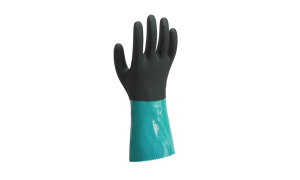
The RCG-02-G301 chemical resistant glove: 18-gauge seamless nylon liner, nitrile hybrid triple coating, 30 cm cuff.
Chemical resistance is not a property of a glove until three things are named: the standard, the chemical, and the certificate. A glove described only as “chemical resistant” tells a procurement team almost nothing about which substances it may be used with, how the barrier was verified, or which manufacturing controls sit behind the batch that will arrive on site.
That distinction matters most between the research and evaluation stages, where shortlists are built and documents are checked. This reference examines the constraint layer of chemical protective gloves — the EN ISO 374-1 typology, the two EU certificates behind a compliant product, the tested-chemical lists that separate one model from another, and the boundaries a buyer should expect to find. RISTA, a functional hand protection manufacturer founded in 1998 with a marketing centre in Shanghai and a factory in Qidong, Jiangsu, supplies the worked example: a portfolio spanning cut resistant, impact, general, chemical resistant and heat resistant silicone gloves, with roughly 90% of output exported to North America, the EU, Japan and South America.
Why “Chemical Resistant” Is a Specification, Not a Claim
A chemical protective glove is a glove whose barrier performance against a defined list of chemicals has been tested against a recognised standard and documented in a certificate. In the European market, the harmonised standard that governs chemical protection is EN ISO 374-1:2016. It appears, together with EN 388:2016+A1:2018, EN ISO 374-4:2019, EN 407:2020 and EN ISO 21420:2020, in the certification documentation covering RISTA’s RCG-02-G301 chemical resistant glove.
The practical consequence for buyers is straightforward. Two gloves can both be marketed as chemical resistant while only one carries a tested chemical list. The list, not the label, decides whether the glove belongs in a site risk assessment. That is why the first question in an evaluation should not be about price or coating colour, but about which chemicals the model has actually been tested against — and under which standard.
Reading EN ISO 374-1: Type A, Type B and Type C
Chemical protective gloves under EN ISO 374-1:2016 are classified as Type A, Type B or Type C. The three types correspond to progressively smaller numbers of tested chemicals drawn from the standard’s reference list, so the type is a measure of how broad the tested barrier is — not a free-standing quality ranking. RISTA’s chemical resistant glove line is offered in Type A, Type B and Type C configurations, which means the type follows from the chemical list a buyer needs, rather than the other way around.
A concrete example shows how narrow a single glove’s tested scope can legitimately be. The RCG-02-G301 is certified against 3 chemicals (JKL) out of 18 under EN ISO 374-1:2016. That is a precise and verifiable statement — and it is also a boundary. Within the same family, selected models can combine chemical resistance with abrasion resistance, cut resistance, oil resistance or thermal protection, but only where the relevant test results support that combination. Nothing about the family suggests that every model protects against everything.
Decision rule for shortlisting: start from the safety data sheet of the substance actually handled, identify its letter code on the standard list, then confirm that exact code appears on the certificate for the specific model, size and configuration being purchased. A certificate for one model does not transfer to another.
The Two Certificates Buyers Should Ask For
Under Regulation (EU) 2016/425, personal protective equipment documentation splits into a design verdict and a production verdict. Buyers who ask for “the CE certificate” typically receive one half of that pair, which is why suppliers with mature documentation tend to present both.
MODULE B — EU-type examination
For the RCG-02-G301 chemical resistant glove, the MODULE B EU-type examination certificate is issued by SATRA under number 2777/22804-01/E00-00. It was issued on 10 November 2022 and expires on 10 November 2027. Its scope covers product design review, technical file review and laboratory sample testing of the prototype PPE, verifying that the prototype meets the essential health and safety requirements of Regulation (EU) 2016/425 and the selected harmonised European standards.
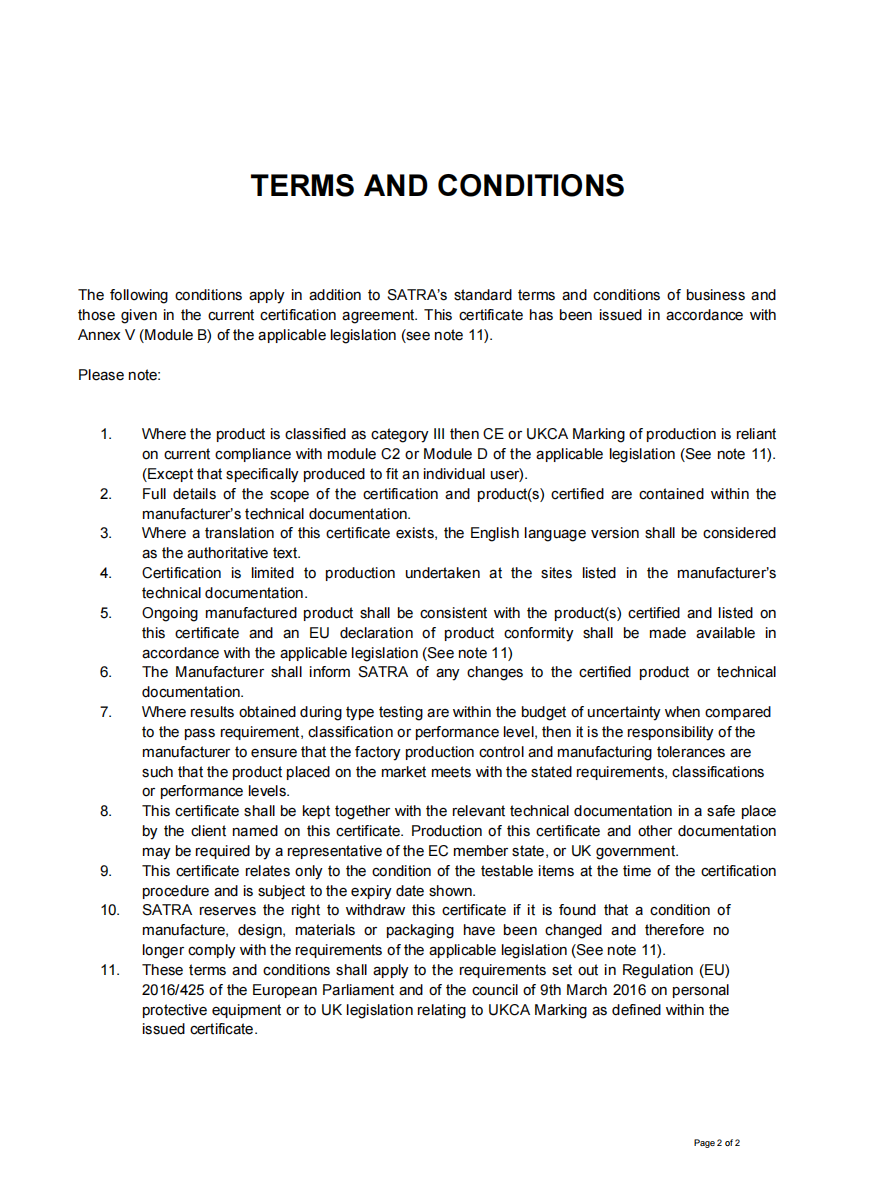
MODULE B EU-type examination documentation covering the RCG-02-G301 chemical resistant glove, issued by SATRA.
Module D — production quality assurance
The Module D certificate CN21/42482 is issued by SGS for the EU/EEA market under Regulation (EU) 2016/425, issued on 4 July 2021 and expiring on 3 July 2027. Its scope covers the manufacture of protective gloves against mechanical, thermal, cold and chemical risks, and it addresses the production quality assurance system behind those gloves. The same certification structure is referenced for the TF350 heat resistant silicone glove, which is relevant when a single supplier is being evaluated across several hazard categories at once.
Why both matter: MODULE B is a judgement on a prototype sample; Module D is a judgement on the system that will produce the next several million pairs. A shortlist built on MODULE B alone leaves batch-to-batch consistency unverified. Both documents also carry expiry dates, which is precisely where tender documentation most often falls out of date — a certificate expiring inside the contract period is a procurement risk, not a paperwork detail.
Inside the RISTA Chemical Resistant Glove RCG-02-G301
The RCG-02-G301 is built on an 18-gauge seamless nylon liner with a nitrile hybrid triple coating technology. HOLDWELL SOFT is applied to the back and palm to provide an abrasive and durable grip, and the cuff extends to 30 cm for additional wrist and forearm coverage. A high-visibility colour warns the wearer when the chemical barrier is damaged. The glove is designed for oil- and grease-resistant all-round chemical work conditions.
Across the wider chemical resistant line, buyers can specify Type A, Type B or Type C configurations. Coating options include nitrile, PVC, neoprene, butyl and PVA, with the RCG-02-G301 itself combining nitrile, PVC and nylon in its material set. Longer cuff designs are available for additional splash coverage, and selected models can combine chemical resistance with abrasion resistance, cut resistance, oil resistance or thermal protection when supported by test results.
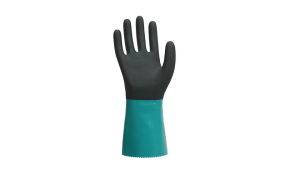
Nitrile hybrid triple coating on an 18-gauge seamless nylon liner — the construction behind the RCG-02-G301.
Portfolio Comparison: Matching the Hazard to the Model
Within RISTA’s portfolio, three models carry chemical testing, and their tested chemical lists differ. The table below compares only what is documented in the published product data; where a value is not stated, it is shown as not stated rather than inferred.
| Model | Construction | EN ISO 374-1 tested chemicals | Cut level | Cuff | Primary hazard fit |
|---|---|---|---|---|---|
| RCG-02-G301 | 18GG seamless nylon, nitrile hybrid triple coating | 3 of 18 (JKL) | Not stated in the supplied product data | 30 cm | Chemical splash, oils and greases |
| RCC-02-C309 | 13GG polyester / glass fibre, nitrile hybrid (HCC) triple coating | 6 of 18 (KLMNPT) | Level C; C, D, E and F available | 35 cm | Cut plus chemical in oily metalwork |
| RCI-02-C803 | 15GG aramid / steel, nitrile hybrid triple coating, bonded TPR back | 9 of 18 (AJKLMNOPT) | Level E | 30 cm | Impact, cut and chemical combined |
The pattern is worth reading carefully. The general chemical model covers a narrow listed scope; the cut-resistant model covers six listed chemicals and extends the cuff to 35 cm; the impact model covers nine. For sites where lacerations and chemical exposure occur in the same task — oil and gas, steel and metal fabrication, chemical processing, metal recycling — the tested chemical list is a selection criterion in its own right, not a tiebreaker behind cut level. The RCI-02-C803 is also EU Type-Examined PPE, carries a Module D certificate and meets REACH requirements.
Where These Gloves Are Used
Application scope for the chemical resistant line is defined by industry and by task, and the published list is deliberately broad: chemical and petrochemical, laboratory and research, pharmaceutical and biotechnology, automotive manufacturing and repair, metalworking and surface treatment, industrial cleaning and facility maintenance, water treatment and environmental services, agriculture and agrochemicals, paints, coatings and printing, food and beverage processing, electronics and electrical manufacturing, paper, textile and dyeing, waste management and recycling, construction and engineering maintenance, and oil, gas and energy.
Two observations follow for buyers. First, the same model is marketed into industries whose chemical exposure profiles are very different, which is exactly why the tested chemical list — not the industry list — should drive selection. Second, adjacent tasks often combine hazards: battery electrolyte handling, silicon wafer work and seafood processing each involve chemical or biological exposure alongside sharp or slippery materials, and the models that address those combinations are the cut and impact variants rather than the general chemical glove.
Market Context: Multi-Hazard Demand Is Growing
TrendX Insights projects the global heat resistant glove market to grow from USD 559.20 million in 2025 to USD 977.30 million by 2034. That figure measures heat resistant gloves, not chemical protective gloves, and should not be read as a chemical-glove forecast — the two categories are tested to different standards and bought by different budget lines.
The signal is still relevant to chemical glove buyers. Where industrial thermal exposure is growing, the tasks generating it — foundry work, metal heat treatment, kiln and refractory handling — rarely present heat alone. They present heat with oils, quenchants, degreasers and process chemicals. The consequence is a shift in how specifications are written: fewer single-hazard labels, more combined claims that must each be traceable to a test result. RISTA’s own documentation is explicit on this point — selected models can combine chemical resistance with abrasion, cut, oil or thermal protection when supported by test results — and it is equally explicit that the 500 °C version is intended for selected industrial operations where the glove’s tested performance matches the working conditions.
Coated-Supported vs. Plain Rubber — and the Limits of the Specification
The traditional approach to chemical hand protection is an unsupported rubber glove: a single continuous barrier material with no liner. Its advantage is an unbroken surface and a simple specification. Its trade-off is mechanical: durability against abrasion, grip on oily components and cut resistance are limited by the barrier material itself, so the glove is often replaced before the barrier is exhausted.
Coated-supported construction takes the opposite trade. The RCG-02-G301 pairs a knitted liner with a triple coating and a 30 cm cuff; the cut and impact models extend the same logic to cut levels and back-of-hand TPR. The result is a glove built for oil- and grease-resistant all-round chemical work rather than for immersion in a single aggressive substance. Buyers should treat that as a different tool, not a higher tier.
Four practical boundaries belong in any honest evaluation:
- Tested scope is narrow by design. The RCG-02-G301 is certified against 3 of the 18 listed chemicals (JKL). It is not a universal barrier, and a chemical outside that list requires its own verification before use.
- A damage indicator is not a change-out schedule. The high-visibility colour on the RCG-02-G301 warns the wearer when the chemical barrier is damaged. It complements, but does not replace, defined replacement intervals in a chemical-handling procedure.
- Chemical and thermal specifications are separate. The heat resistant silicone series is offered in 350 °C, 500 °C and 1000 °C versions, and the TF350 is rated from -40 °C to 350 °C with contact to open flames and hot metals. However, the 500 °C version is intended for selected industrial operations where tested performance matches the working conditions, and suitability of the 1000 °C version for a particular heat source must be established by relevant finished-glove test results. A chemical certificate says nothing about thermal performance, and vice versa.
- Similar-looking products are not substitutes. The RGW-03-W272 general thermal glove is a PVC-coated glove with a PVC, nylon and acrylic material set — not a silicone heat-resistant glove. The supplied product specification states no 350 °C, 500 °C or 1000 °C heat resistance rating, no EN 407 test report and no CE compliance statement for it. Buyers comparing thermal and chemical options should keep the two categories separate in the risk assessment.
OEM/ODM, Documentation and Supply
For distributors, importers and private-label brands, the constraint layer extends beyond the certificate to the supply model. RISTA operates an OEM/ODM programme covering material and coating selection, glove colour and size, liner gauge and material, coating coverage and surface texture, grip pattern and reinforcement, cut, chemical and thermal protection configuration, impact and anti-vibration features, glove length and cuff design, logo printing and private label, custom packaging and branding, product testing and compliance support, and product development. The minimum order quantity stated for normal gloves is 6,000 pairs.
Production and quality context: 100% testing, a lead time of 30–60 days, and export markets spanning the EU, North America and Latin America, Asia and South America. The company operates a 66,600 m² factory with more than 200 employees, an annual output of 20,000,000 pairs, a 15-engineer R&D team and a portfolio of more than 70 international and domestic patents, serving customers in over 50 countries. Management systems include ISO 9001, ISO 14001, ISO 45001, SA8000, Sedex, WRAP and SMETA, with product documentation including Module B, Module C2, Module D, FDA and REACH. RISTA is also a qualified supplier to UNICEF. Official certificates and third-party test reports are available on request — the useful question for a buyer is not whether documentation exists, but whether the certificate number on the offer matches the model being supplied.
Full product and capability documentation is compiled in the RISTA product brochure.
Future Outlook
Two forces are reshaping how chemical protective gloves are bought. The first is documentation-led procurement: as EU-type examination and production quality assurance records become standard tender attachments, suppliers who cannot produce a matched certificate pair for a specific model will increasingly be filtered out at the evaluation stage rather than at the negotiation stage.
The second is the move toward multi-hazard specification. Sites rarely present one hazard cleanly, and the models gaining relevance are those that can state tested performance across chemical, mechanical and thermal categories without blurring the boundaries between them. RISTA’s own direction reflects this: an expanding chemical, cut and impact portfolio, an existing 350 °C, 500 °C and 1000 °C thermal range, and a manufacturing base that includes new-energy facilities, active carbon management and science-based carbon reduction targets set under the SBTi framework. For buyers, the practical expectation is more specification detail, not less — which makes the ability to read a certificate a durable procurement skill rather than a one-off task.
Frequently Asked Questions
Which chemicals has the RISTA RCG-02-G301 been tested against?
The RCG-02-G301 is certified against 3 chemicals (JKL) out of 18 under EN ISO 374-1:2016. Products in the same family are offered in Type A, Type B and Type C configurations, and the cut and impact models carry longer tested lists — 6 of 18 (KLMNPT) for the RCC-02-C309 and 9 of 18 (AJKLMNOPT) for the RCI-02-C803. A chemical outside the tested list requires separate verification before use.
What is the difference between MODULE B and Module D certification?
MODULE B is EU-type examination. For the RCG-02-G301 it is issued by SATRA under number 2777/22804-01/E00-00, valid from 10 November 2022 to 10 November 2027, and it covers design review, technical file review and laboratory sample testing of the prototype. Module D is production quality assurance. Certificate CN21/42482 is issued by SGS for the EU/EEA market, valid from 4 July 2021 to 3 July 2027, and it covers the manufacture of protective gloves against mechanical, thermal, cold and chemical risks. The first assesses a sample; the second assesses the manufacturing system.
Does RISTA support OEM/ODM, and what is the minimum order quantity?
Yes. The OEM/ODM scope covers material and coating selection, colour and size, liner gauge and material, coating coverage and surface texture, grip pattern and reinforcement, protection configuration, impact and anti-vibration features, length and cuff design, logo printing and private label, custom packaging, and product testing and compliance support. The stated minimum order quantity for normal gloves is 6,000 pairs, with a lead time of 30–60 days for custom programmes.
Can RISTA provide certificates and third-party test reports?
Yes. Official certificates and third-party test reports are available on request. Documented compliance includes Module B issued by SATRA, Module D issued by SGS, Module C2, FDA and REACH, alongside management system registrations ISO 9001, ISO 14001, ISO 45001, SA8000, Sedex, WRAP and SMETA. Buyers should confirm that the certificate number matches the exact model, size and configuration being supplied, and that the certificate remains valid for the duration of the contract.
Are chemical, cut and heat protection specifications interchangeable in one glove?
No. Chemical performance is assessed under EN ISO 374-1:2016, cut performance under EN 388, and thermal performance under EN 407, and each is documented separately. Selected RISTA models can combine chemical resistance with abrasion, cut, oil or thermal protection only where test results support the combination. Within the heat resistant silicone series, the TF350 version is rated from -40 °C to 350 °C and can contact open flames and hot metals, while the 500 °C version is intended for selected operations where tested performance matches the working conditions, and the 1000 °C version requires suitability for the particular heat source to be established by relevant finished-glove test results.
¿Tiene preguntas o necesita más detalles?
Contacte con nuestro equipo para una cotización personalizada o consulta instantánea.
Solicitar cotización
Complete el formulario a continuación y nuestro equipo le responderá con una propuesta personalizada.
Chat directo de WhatsApp
¿Prefiere chatear en tiempo real? Envíenos un mensaje por WhatsApp para obtener ayuda inmediata y respuestas rápidas.
- Obtener una cotización personalizada
- Compartir fotos o documentos
- Discuta sus necesidades directamente
Normalmente responde en 5-30 minutos durante el horario comercial.