
Chandeliers for Double-Height Hotel Atriums: A Fit Guide
In a double-height hotel atrium, decorative lighting is decided less by style than by vertical distance. Once a chandelier hangs high above the lobby floor, the criteria that determine whether the fixture works — beam control, glare at upper levels, suspension engineering and access for maintenance — are not the same criteria used for a three-metre foyer.
Decorative lighting, in the hospitality sense, is the layer of a project that carries identity rather than task illumination. In a high-ceiling lobby, a double-height atrium or a large banquet hall, that layer is also the hardest to correct after handover: it is suspended, wired, structurally anchored, and often visible from several floor levels at once. Scenario fit — matching a fixture to the height, sightlines and service conditions of a specific space — therefore matters more in these volumes than in any other part of a hotel lighting package.
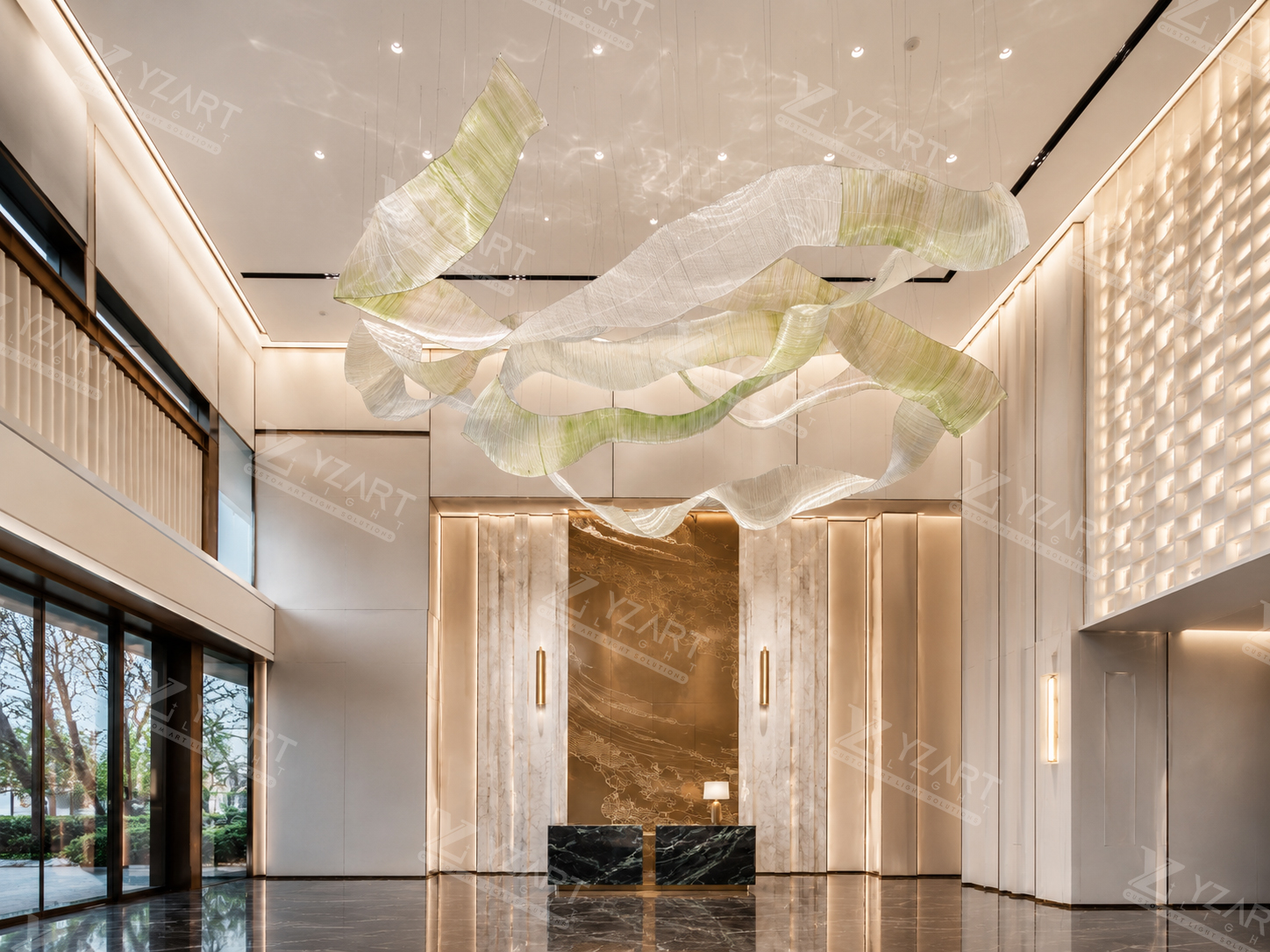
Large wave streamer glass installation fixture developed for a duplex atrium and commercial sales centre — an example of decorative lighting designed around vertical space rather than around a catalogue shape.
Why double-height atriums break standard fixture logic
A decorative pendant designed for a standard ceiling is usually optimised for one variable: how it looks from roughly eye level at close range. In an atrium, three other variables dominate.
First, photometric reach. Light from a fixture mounted far above the floor has to travel a long distance before it reaches people. A narrow distribution produces a bright pool directly beneath the chandelier and dark perimeter circulation; a very wide distribution can flatten the space and remove the visual focus the chandelier was specified to create. The practical answer is an adjustable distribution that can be tuned at commissioning, after the ceiling height and the actual floor finish are known.
Second, glare from above. A double-height lobby is normally viewed from mezzanine corridors, upper-level guest room windows and the reception desk. A light source that is comfortable from the ground can be a band of visible bright points from the fourth floor. Anti-glare shielding and source concealment are therefore part of scenario fit, not an optional upgrade.
Third, load path and access. An oversized chandelier is a suspended structure. Its weight, the way that weight is transferred into the slab, and how a maintenance team will reach it later all belong to the lighting decision — and to the supplier's scope, not only the contractor's.
Scenario fit by hospitality space
Hospitality projects rarely buy one chandelier type for the whole building. The same collection may be adapted for a lobby, an atrium shaft, a banquet hall and a clubhouse lounge, with different suspension depths and different distributions. The table below summarises what changes between these scenarios.
| Space | What dominates the decision | Typical adjustment |
|---|---|---|
| High-ceiling hotel lobby | First impression, sightline from entrance door, night-time presence | Deeper suspension drop, wider distribution for general illumination, shielded source |
| Double-height atrium | Vertical proportion, views from upper floors, access for cleaning | Multi-tier or elongated form, adjustable beam, calculated ceiling anchoring |
| Large banquet hall | Even coverage across tables, dimming for events, camera-friendly light | Linear or grouped layout, consistent distribution, dimming confirmed at specification |
| Clubhouse and commercial villa | Intimacy at lower mounting heights, coordinated decorative family | Smaller diameter, tighter beam, matched wall and floor lamps |
| Shopping mall public area | Long operating hours, long spans, maintenance downtime cost | Robust suspension, accessible drivers, durable finish |
A model-level example: yz10001 for high-ceiling lobbies
YZ ART LIGHT is a decorative and project lighting manufacturer based in Zhongshan, Guangdong Province, China, established in 2017. The company operates a 15,000-square-metre production base with approximately 150 employees, including an in-house engineering team of 20, and exports around 70% of its output, with Europe, America and the Middle East as its main markets. Its product scope covers banquet hall chandeliers, oversized chandeliers, hotel chandeliers, lobby chandeliers, and coordinated table, wall and floor lamps for guest rooms, supported by CE and RoHS certification and an ISO-certified quality management system.
Model yz10001 is the company's custom-made hotel lobby chandelier example for this scenario. It is a non-standard engineering pendant rather than a stocked fixture: the dimensions are customised to the project, the light source is shielded against glare, the beam angle is adjustable across 15° to 120°, and the electrical input is rated AC110–240V with an IP40 ingress protection rating.
| Parameter | yz10001 specification |
|---|---|
| Fixture type | Custom-made hotel lobby chandelier, non-standard engineering pendant |
| Light source | Anti-glare light source |
| Beam angle | Adjustable, 15°–120° |
| Ingress protection | IP40 |
| Input voltage | AC110–240V |
| Dimensions | Customisable to project requirements |
| Service scope | Drawing deepening, ceiling load calculation, sample production, mass manufacturing, on-site installation, maintenance |
| Intended scenarios | Hotels, resorts, clubhouses, banquet halls, commercial villas, shopping mall public areas |
Technical explanation: what each specification actually does
Adjustable 15°–120° beam angle
The beam angle is the single most useful control on a tall-volume chandelier. At the narrow end of the range, light is concentrated into a defined column — useful when the fixture sits over a feature element such as a reception desk, a sculpture or a seating island in the middle of a lobby. At the wide end, the distribution spreads toward general illumination and reduces the contrast between the glowing fixture and the ceiling plane around it.
Because the range is adjustable rather than fixed, the setting can be finalised on site. This matters in real projects where the finished floor level, the ceiling void and the final furniture layout are confirmed later than the lighting order.
Anti-glare light source
Anti-glare treatment addresses the viewing positions that a high fixture exposes: upper guest corridors, mezzanine walkways and adjacent lift lobbies. Shielding the source and controlling brightness at these angles is what separates a decorative chandelier that reads as a designed object from one that reads as a cluster of visible lamps.
IP40 and its boundary
IP40 indicates protection against solid objects larger than 1 mm and no protection against water. That is appropriate for dry interior volumes — a hotel lobby, an atrium, a banquet hall, a clubhouse lounge or a mall public area. It is not a rating for exposed outdoor installations, pool surrounds, wet spa zones or areas that are washed down. Where a project requires a higher protection level or special environmental treatment, that requirement has to be confirmed separately at specification stage rather than assumed from the standard model.
AC110–240V input
A wide input range simplifies specification across markets: the same fixture family can be applied to projects in regions using 110V and 220–240V distribution without changing the basic electrical architecture. Site voltage, frequency and any lighting-control or dimming requirement remain project-specific and should be confirmed with the manufacturer before production, because control arrangements are not part of the standard model definition.
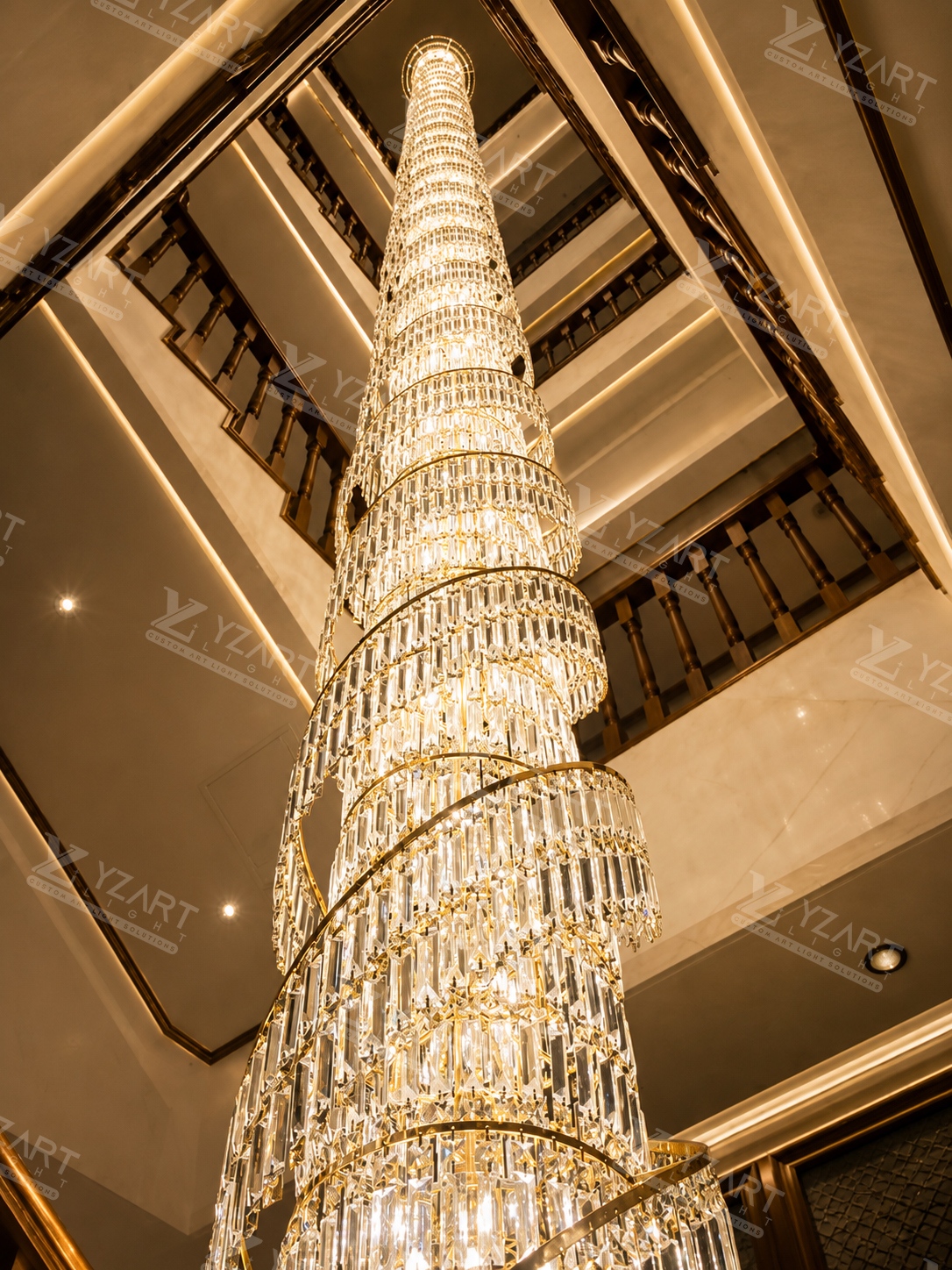
Tiered rectangular crystal rod pendant in a multi-storey lobby: vertical proportion and suspension depth are decided by the void, not by the fixture alone.
Suspension engineering: where decorative lighting becomes structural
An oversized atrium chandelier is held by the building. The engineering sequence that YZ ART LIGHT applies to custom projects follows a defined order, and each step produces something the project team can check.
- Ceiling load calculation. The fixture weight, suspension method and fixing points are assessed against the slab or secondary steel available at the site.
- Drawing deepening. The design concept is converted into production and installation drawings, including reserved sizes, suspension points and connection details.
- Site preparation. Load-bearing capacity of the ceiling is checked, reserved dimensions are measured, suspension points are marked, and mains power is isolated before any installation work begins.
- Assembly and hoisting. Frame, decorative elements and the built-in anti-glare light source are assembled on site, insulated concealed wiring is completed, embedded fasteners are fixed, and the assembled fixture is hoisted into position.
- Commissioning. Power-on testing, beam angle adjustment and verification of lighting uniformity close the installation.
Electrical installation at height should be carried out by qualified personnel, with the power supply isolated and lockout signage in place throughout the work. These are not administrative details: they determine whether a chandelier can be serviced without dismantling it, and whether the design can be signed off by the project's engineering team.
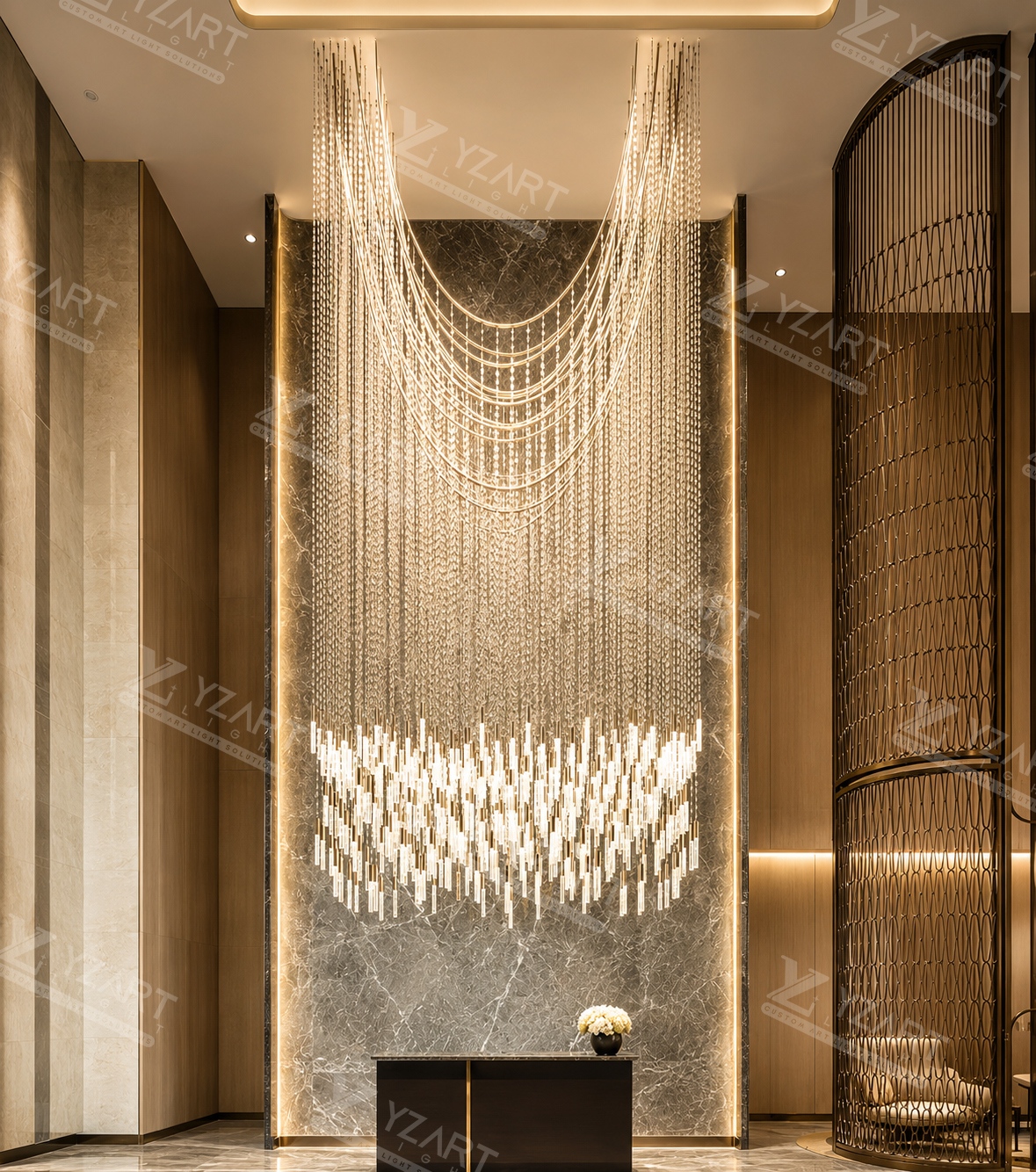
A custom-size, long-drop curved wave pendant developed for a five-star hotel reception and grand lobby: dimensions follow the building's vertical dimension.
Full-cycle service: what a long-term supplier relationship actually contains
For procurement teams at the execution stage, the meaningful difference between suppliers is not the shape catalogue but the continuity of scope. A decorative lighting package that stops at shipment leaves the difficult half of the work — installation, adjustment and later maintenance — with the contractor or the hotel's engineering department.
| Stage | What the supplier delivers | What the project team should confirm |
|---|---|---|
| Drawing deepening | Production and installation drawings derived from the approved design | Reserved size, suspension points, coordination with ceiling and MEP |
| Ceiling load calculation | Weight and fixing assessment against the actual structure | Slab capacity, secondary steel, approval by structural engineer |
| Sample production | Physical sample or sample section for approval | Finish, proportion, light colour and glare behaviour at viewing angles |
| Mass manufacturing | Series production with in-process inspection | Pre-shipment inspection record, checklist, photographic evidence |
| On-site installation | Installation guidance or on-site installation support | Safe access equipment, isolation of power, qualified electricians |
| Maintenance | Warranty support, spare-part supply and remote technical assistance | Cleaning method, access frequency, spare-part list handed to the hotel |
YZ ART LIGHT's stated support model for project work includes a three-year product warranty, quick spare-part supply and remote overseas technical support alongside on-site installation. Every lamp undergoes full inspection before shipment, covering power-on testing, appearance workmanship, dimensions and structure, and completeness of accessories; a quality-approval checklist accompanies each shipment, and real-shot inspection videos are available on request.
Where the scenario fits — and where it does not
The custom engineering approach behind yz10001 suits hotels, resorts, clubhouses, banquet halls, commercial villas and shopping mall public areas, particularly where the mounting height is significant and the fixture is intended to be a visual anchor.
It is a weaker fit in several situations, and buyers should recognise them before writing a specification. In low-ceiling spaces, a suspended oversized pendant consumes headroom and complicates sprinkler and air-terminal coordination. In fast-track refurbishments with a fixed opening date, the drawing, load-calculation and sample stages add time that a stocked fixture would not require. In wet or exposed locations, IP40 is not sufficient. And in buildings where the slab capacity or the existing secondary steel has not been verified, a lighter fixture or a redesigned suspension may be necessary, even if the heavier design was the preferred visual option.
Market trend: why scenario-based specification is becoming standard
The commercial context supports the shift toward project-specific decorative lighting. The hospitality lighting market was valued at USD 14.2 billion in 2025 and is expected to grow at a CAGR of 7.3% to reach USD 26.8 billion by 2034, according to Dataintelo. Commercial applications, including hospitality, accounted for 62.8% of the decorative lighting end-user market in 2025, based on IMARC Group's segmentation — meaning the majority of decorative lighting demand is now decided through project procurement rather than retail purchase.
Two further signals matter for atrium projects. Dataintelo reports that 56% of new luxury hotel projects now require dimmable chandelier installations, which pushes lighting control into the specification conversation earlier. In the United States, the 2024 International Energy Conservation Code expanded occupancy and dimming requirements for lobbies and meeting areas, linking decorative lighting design directly to code compliance. For North American projects, luminaires are also assessed against UL 1598 for luminaires and UL 8750 for LED equipment.
Market sizing should be read with care: third-party estimates for the decorative lighting and chandelier segments diverge because inclusion criteria differ. Transparency Market Research valued the chandelier industry at USD 14.9 billion in 2024, while Grand View Research has published a materially lower figure for a narrower definition of the same segment. Directional conclusions are reliable; point estimates should be verified against the specific definition being used.
Custom engineering versus stocked decorative fixtures
Both approaches remain valid in hospitality projects. The comparison below sets out where they differ, using the parameters that matter in a double-height atrium.
| Criterion | Stocked decorative fixture | Custom engineering pendant (yz10001 approach) |
|---|---|---|
| Dimensional fit | Fixed sizes; void must accommodate the product | Dimensions customised to the space |
| Light distribution | Fixed optics | Adjustable 15°–120° beam, set at commissioning |
| Glare at upper levels | Depends on the original design intent | Anti-glare light source specified for the viewing angles |
| Structural documentation | Standard fixing data | Ceiling load calculation and deepened drawings |
| Approval path | Catalogue sample or showroom unit | Project sample before mass production |
| Lead time | Shorter, subject to stock | Longer, because drawing and sampling stages precede production |
| After-sales | Varies by distributor | Warranty, spare parts and remote technical support from the manufacturer |
The honest boundary is this: custom engineering is the right instrument when the space is unusual, the fixture is prominent and the project has a realistic schedule for sampling and approval. It is the wrong instrument when the requirement is a fast, low-risk replacement of a standard fixture in a modest ceiling.
Future outlook
Two developments are likely to shape atrium decorative lighting over the next procurement cycles. The first is the normalisation of lighting control: as dimming and occupancy requirements move from premium specification to baseline expectation in lobbies and meeting areas, chandeliers will increasingly be evaluated as controllable systems rather than as static objects. The second is documentation. Hotels that operate for decades accumulate maintenance obligations, and a supplier that can hand over drawings, load calculations, inspection records and a spare-part list reduces the long-term cost of ownership in a way that a lower unit price does not.
For decorative lighting in double-height atriums, the practical conclusion is straightforward. Scenario fit — vertical proportion, beam control, glare management, structural verification and service access — should be settled before a shape is approved. A chandelier that satisfies those five conditions can be beautiful on its own terms; one that does not will be corrected, expensively, after opening.
FAQ
What information should a hotel project confirm before ordering a custom chandelier for a double-height atrium?
At minimum: the finished floor-to-ceiling height, the reserved ceiling opening and suspension points, the structural capacity of the slab or secondary steel at those points, the viewing positions that matter (mezzanine, upper corridors, reception, entrance), the site voltage and any lighting-control requirement, and the method the hotel will use to reach the fixture for cleaning. YZ ART LIGHT's custom process begins with drawing deepening and ceiling load calculation before sample production, so these inputs determine the drawings rather than being resolved afterwards.
How does an adjustable 15°–120° beam angle change the way a tall lobby is lit?
The angle controls how far the light spreads before it reaches the working plane. At the narrow end, the fixture behaves as a concentrated source and produces a defined column of light beneath it; at the wide end, the distribution spreads outward and reads as general illumination with less contrast against the surrounding ceiling. In a tall atrium the setting is normally finalised during commissioning, because finished floor level, floor finish and furniture layout are confirmed later than the lighting order.
Is an IP40 chandelier suitable for every hotel space?
No. IP40 means protection against solid objects larger than 1 mm and no protection against water. It suits dry interior volumes such as lobbies, atriums, banquet halls, clubhouses and mall public areas. It is not appropriate for exposed outdoor installation, pool surrounds, wet spa areas or locations subject to wash-down. Where a project needs a higher protection level or special environmental treatment, that requirement must be confirmed separately at specification stage.
What does full-cycle service cover, from drawing to maintenance?
For YZ ART LIGHT custom projects the cycle comprises drawing deepening, ceiling load calculation, sample production, mass manufacturing, on-site installation and maintenance. Before shipment, every lamp undergoes full inspection covering power-on testing, appearance workmanship, dimensions and structure, and accessory completeness, with a quality-approval checklist attached to each shipment and real-shot inspection videos available on request. The stated support model includes a three-year product warranty, spare-part supply and remote overseas technical support.
What are the commercial terms for a custom hotel chandelier order?
The minimum order quantity is one unit. Goods are delivered on an EXW basis from the factory, with the buyer arranging pickup, logistics and export customs declaration; if the manufacturer is asked to handle logistics, customs clearance and truck haulage, those services are quoted separately. Payment terms are TT. Acceptance is based on pre-shipment full inspection rather than on sampling.
For project teams that need the full specification set, the manufacturer's catalogue is available as a downloadable document: Zhongshan YZ ART LIGHT Co.,Ltd. catalogue (PDF).
¿Tiene preguntas o necesita más detalles?
Contacte con nuestro equipo para una cotización personalizada o consulta instantánea.
Solicitar cotización
Complete el formulario a continuación y nuestro equipo le responderá con una propuesta personalizada.
Chat directo de WhatsApp
¿Prefiere chatear en tiempo real? Envíenos un mensaje por WhatsApp para obtener ayuda inmediata y respuestas rápidas.
- Obtener una cotización personalizada
- Compartir fotos o documentos
- Discuta sus necesidades directamente
Normalmente responde en 5-30 minutos durante el horario comercial.