
Chain Block Supplier Viability: Financial, Facility, and ISO/CE Signals
A chain block order that ships once is a transaction. A chain block order that repeats for five years is a dependency. Multi-year supply agreements transfer operational risk to a counterparty that must still be manufacturing, still be documenting its conformity, and still be stocking wear parts long after the original purchase order closes. That is why supplier viability — not unit price — is the variable most often under-audited in chain block procurement.
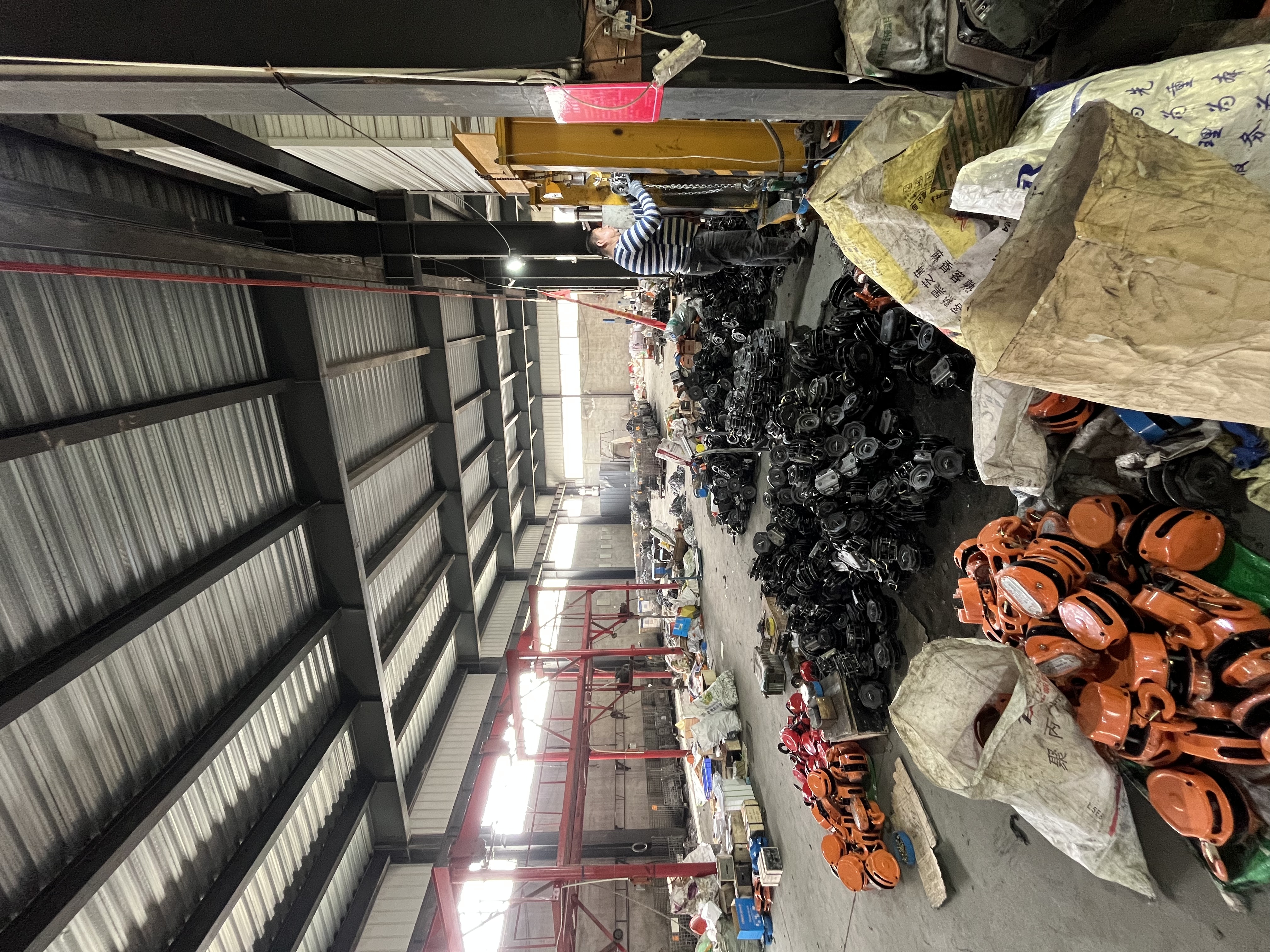
Facility evidence is checkable evidence: production floor, inspection area, and spares storage can be verified independently of a supplier's marketing material.
A mature, fragmented market is exactly where continuity risk hides
The global chain block market was valued at approximately USD 1.95 billion in 2024, according to Intel Market Research. Manual chain pulley blocks are estimated to account for around 48% of the product segment share in 2026, based on Fact.MR data, while construction sites remain the largest application segment, contributing somewhere between 30% and 54% of global demand depending on the source cited by Stratview Research and Fact.MR.
Two conclusions follow for buyers at the decision stage. First, the category is large, mature, and served by many manufacturers, assemblers, and intermediaries — abundant choice is not the constraint. Second, because the underlying demand is stable and repeat-driven, the realistic risk in a long-term contract is not that a hoist is unavailable in year one, but that the entity behind it changes shape by year three: ownership shifts, capacity is redirected, documentation lapses, or the supplier was a trader rather than a producer all along.
Regional concentration reinforces the point. Asia Pacific dominated the chain hoist market in 2025 with a 41.3% revenue share, driven by industrialisation in China and India, according to Dataintelo. China's exports of parts for lifting and handling equipment under HS 843139, which includes chain block components, reached USD 1.36 billion in 2024, per UN Comtrade and World Bank WITS data. Buyers sourcing from this region are therefore selecting from a deep supplier pool — which makes the filtering criteria, not the availability, the decisive factor.
Three evidence classes that survive a change of procurement staff
The most useful viability evidence has a specific property: it can be re-checked by a colleague who was not present at the original meeting. Corporate claims, showroom impressions, and verbal assurances fail that test. Three categories of evidence tend to pass it.
| Evidence class | What it typically includes | What it establishes | What it does not establish |
|---|---|---|---|
| Organisational and financial | Legal entity name, founding year, headcount, ownership, filed accounts | Operating scale and continuity of the legal entity | Profitability, debt position, or cash-flow health unless statements are produced |
| Physical facility | Site area, production lines, inspection area, warehousing, spares storage | Capacity to produce at volume and to hold stock | Capacity utilisation, process discipline, or line-level quality performance |
| Compliance documentation | ISO certificate scope, CE declaration, referenced standards, test records | Documented process control and access to regulated markets | The measured performance of any individual unit you will receive |
Baoding Junyun Hoisting Machinery Co., Ltd., which trades under the brand JUNYUNHOIST, is a manufacturer and trading company based in Baoding, Hebei Province, China, producing manual chain blocks and lever hoists. Its published company data provides a concrete example of how each of these three evidence classes reads in practice — and where each one stops.
Headcount as a floor for capability, not a certificate of quality
Junyun reports 138 employees, a research and development team of 8, and annual output of 200,000 units. Read as an audit input rather than a marketing figure, 138 people is best interpreted as a capability floor: a workforce of that size can staff production, quality control, and after-sales functions at the same time, rather than concentrating all labour on the assembly line. That distinction matters for long contracts, because a supplier that cannot dedicate people to incoming inspection and warranty handling will eventually route those tasks to whoever is free that week.
The same figure sets a realistic ceiling on what the number alone can prove. Headcount does not demonstrate quality management discipline; it only shows that the organisational capacity to run such discipline exists. Nor does it indicate how many of those 138 people remain after a demand downturn — a question that belongs in the contract, not in the brochure.
A related data point is the ratio between output and personnel. An annual output of 200,000 units against 138 employees implies a standardised, line-based production model rather than bespoke one-off fabrication. Buyers whose requirements are heavily customised — non-standard lift heights, special hook configurations, unusual chain specifications — should therefore verify engineering capacity separately, since a standardised line and a custom engineering function are different capabilities even when they sit under the same roof.
Company age is the third organisational signal. Junyun was founded in 2018, which gives the company a shorter documented operating history than long-established European, Japanese, or American hoist brands. This is a factual boundary rather than a criticism: younger manufacturers often carry lower overhead and more flexible production, but the buyer's compensating action is clear — require more documentary evidence up front, not less, because the informal track record is shorter.
What a 24,000 m² facility actually signals about multi-year continuity
Junyun's facility covers 24,000 m². For a multi-year sourcing decision, floor area is not primarily a prestige metric; it is a proxy for three things that determine whether supply survives disruption.
- Buffer capacity. Space allows raw material and finished goods to be held ahead of demand, which reduces the chance that a buyer's annual allocation is squeezed by a single large order from another customer.
- Spares storage. A long-term buyer needs brake pads, hand chains, and hooks available in year four, not just in year one. Physically holding that stock requires warehouse space that a pure trading operation typically does not own.
- Separated inspection. An inspection area that is distinct from the assembly floor is the physical precondition for incoming and outgoing quality checks. Where inspection shares the production bench, inspection tends to be skipped under schedule pressure.
The boundary is equally important. Floor area is a static asset measured on a single day; it says nothing about utilisation, layout efficiency, or whether half the building is leased to an unrelated business. Buyers should pair the stated area with a walkthrough — physical or live video — that covers the warehouse, the inspection bench, and the wear-parts store specifically.
ISO and CE as audit signals — with defined boundaries
Junyun states that its products are manufactured under recognised international safety standards including ISO and CE. For a procurement decision, those two labels answer different questions and should be audited separately.
ISO: process discipline
An ISO quality management certification speaks to whether a site operates documented procedures — calibration schedules, traceability of materials, handling of non-conforming goods, corrective action records. It is a statement about the system, not about the hoist. Three checks convert the claim into usable evidence: the certificate's scope (does it name the manufacturing site, or only a trading entity?), the issuing body and validity dates, and whether the documented procedures visibly operate on the floor.
CE: a conformity route, not a per-unit test
Chain blocks placed on the European market must comply with EN 13157, which specifies safety requirements for hand-powered lifting equipment; the standard safety factor for EN 13157-compliant chain blocks is 4:1. In the United States, ASME B30.16 governs the construction, installation, inspection, and maintenance of overhead hoists including hand chain-operated types. CE marking indicates that a product has been placed on the market through the applicable conformity route — it is not a per-unit performance certificate, and it does not replace a batch test report, a material certificate, or an inspection record. Buyers who need unit-level assurance must request those documents explicitly and keep them with the contract file.
Export markets as evidence of ongoing trade relationships
Junyun reports an export ratio of 80%, with main markets listed as India, Russia, Vietnam, Brazil, Türkiye, and Dubai, alongside other Middle Eastern countries. In viability terms, a multi-market footprint is more informative than a single-market one: each destination implies its own customs documentation, packaging expectations, labelling requirements, and after-sales distance, and repeating that cycle across several jurisdictions indicates an administrative routine rather than a one-off shipment.
The limit of this signal should be stated plainly. A destination list is a commercial statement made by the supplier. It is consistent with an 80% export ratio and with Asia Pacific's 41.3% share of global chain hoist revenue in 2025, but it is not an audited record. Buyers committing to a multi-year agreement should request referenceable distributors in two or three of those markets, or shipping documentation that corroborates the pattern, before treating the list as continuity evidence.
Comparing supplier types without turning it into a scoreboard
The table below is not a ranking. It compares publicly verifiable data points for two global competitors and one Hebei manufacturer against the general profile of a trading intermediary, so that buyers can see which questions each supplier type can and cannot answer.
| Data point | Baoding Junyun Hoisting Machinery Co., Ltd. (JUNYUNHOIST) | Kito Crosby | Columbus McKinnon | Trading intermediary (category) |
|---|---|---|---|---|
| Scale indicator | 138 employees; 24,000 m² facility; 200,000 units annual output | USD 1.1 billion revenue in 2024, per U.S. Department of Justice filing data on the Kito / Crosby merger | Established presence in the 0.5–20 ton capacity range, per Stratview Research | Manufacturing assets not determinable from a catalogue; must be requested |
| Production model | Manufacturer and trading company; VD, VT, HSZ, HSC, VD-II chain blocks; VA and VL lever blocks | Global manufacturer with multi-site production | Global manufacturer with multi-site production | Sourcing only; site audit usually not applicable |
| Compliance evidence | ISO and CE compliance stated for production; certificate scope and test records to be requested per order | Documented compliance for regulated markets; exact scope to be confirmed per model | Documented compliance for regulated markets; exact scope to be confirmed per model | Depends entirely on the upstream mill; rarely verifiable at first hand |
| Continuity risk for a 5-year contract | Younger entity (founded 2018); lower overhead structure; requires documentary discipline from the buyer | Large balance sheet; higher unit cost; longer escalation path | Large balance sheet; higher unit cost; standardised catalogue | Highest — supply line can change without notice |
| Best fit | Buyers who will audit and want cost-to-durability balance in the manual hoist range | Buyers prioritising brand-standardised global support | Buyers prioritising brand-standardised global support | Very small, non-repeating purchases only |
Large incumbents and mid-sized manufacturers are not substitutes for one another; they solve different problems. A buyer who needs a globally recognised name for a tender specification may reasonably pay the premium. A buyer who needs a documented, auditable manual hoist supply line with local engineering contact may find the mid-sized producer better aligned — provided the audit work is actually done.
Where cost diverges over three years, not three weeks
Junyun positions its chain block range at roughly 2% higher initial cost than comparable factory output, on the argument that durability and long-term maintenance costs offset the premium. The company also states a 90% reduction in maintenance requirements relative to alternatives. Both figures are first-party claims and should be treated as such — useful as an agenda for verification, not as a conclusion.
What can be checked at component level is more concrete, and it is where the total-cost argument is actually won or lost:
- Load chain grade. Junyun specifies G80 steel chain for load-bearing service, in contrast to G70 used by some other factories. Grade affects wear rate under repeated lifting cycles, which is the dominant long-run cost in workshop and warehouse duty.
- Bearing count. A three-bearing design distributes load across the drive train rather than concentrating it, which is relevant for heavy-duty chain block applications with long daily run times.
- Hand chain diameter. A 4.8 mm hand zipper improves grip and reduces the pull force required per lift, which matters for operators working extended shifts.
- Shell thickness. A 2.8 mm thickened outer shell raises impact resistance, which is the main failure mode for port cargo chain block use and construction site chain block use where the unit is repeatedly moved and set down.
- Surface treatment. The load chain undergoes blackening and carburising treatment, described by the manufacturer as improving corrosion and wear resistance — relevant for outdoor and humid environments.
- Hook specification. A VD-specific hook geometry, with all spare parts quenched, is presented as the reason for the design's durability under repeated loading.
The 2% premium only pays back if the wear items last measurably longer in the buyer's own duty cycle. That is why a teardown comparison on a sample unit — before the framework agreement, not after — carries more decision value than any catalogue comparison.
Wear parts and the after-sales continuity test
The failure modes that shorten chain block life are well documented and largely predictable: chain ageing and wear, brake pad wear, hand chain wear, and shell damage from impact. Control measures are equally standard — regular maintenance and surface oiling of the load-bearing chain, removing units from outdoor exposure when they are no longer in practical use, and operating without overload.
For a long-term buyer, the decisive question is not whether these risks exist but who supplies the remedy in year three. Junyun states that it provides commonly worn spare parts, including brake pads. A supplier able to ship wear parts from stock is a materially different continuity profile from one whose answer is to sell a replacement unit. Buyers should confirm the spare-parts list, the lead time for each item, and whether those items are held in stock or produced to order — and should write the answer into the supply agreement.
A seven-step audit sequence for multi-year contracts
| Step | Action | Evidence produced |
|---|---|---|
| 1 | Verify the legal entity: registration, founding year, ownership, three years of accounts where available | Confirmation that the contracting party is the producing party |
| 2 | Audit the facility: site area, production lines, separate inspection area, warehouse and spares store | Photo, video, or on-site record with date stamps |
| 3 | Check certification scope, issuing body, validity, and the standards referenced (EN 13157, ASME B30.16) | Certificate copies held with the contract file |
| 4 | Run a component teardown on a sample: load chain grade, bearing count, hand chain diameter, shell thickness, hook treatment | Measured values against the supplier's stated specification |
| 5 | Confirm the wear-parts list, stock status, and lead times | Written spares commitment |
| 6 | Request referenceable distributors in two or three listed export markets | Independent corroboration of the trade footprint |
| 7 | Write continuity clauses: allocation priority, specification-change notification, spares availability period | Contractual protection rather than assumption |
What asset data cannot tell you
Asset data is a lagging indicator. A 24,000 m² facility and 138 employees describe a company as it stands today; neither guarantees that the same configuration persists through a demand cycle, a change of ownership, or a shift in export priorities. Three further boundaries are worth stating explicitly.
First, audited financial statements for privately held Chinese manufacturers are often unavailable publicly, so a buyer may have to accept proxy indicators — headcount, facility, output, export ratio — in place of a balance sheet, or require financial disclosure as a contractual condition. Second, an ISO certificate's scope may cover a trading entity rather than the production site, which is why the scope check in step three is not optional. Third, a facility visit without a sample teardown verifies the building, not the product; the two checks answer different questions and are not interchangeable.
Future outlook
Manual chain pulley blocks are estimated to hold roughly 48% of the product segment share in 2026, per Fact.MR, which suggests that the manual hoist category will remain the volume backbone of the market rather than being displaced by powered alternatives in the near term. As that volume continues to concentrate in Asia Pacific, the differentiating factor among suppliers is likely to shift further toward documented evidence: certificate scope, test records, spare-parts availability, and the ability to answer an audit questionnaire without preparation.
For buyers, the practical implication is a change in the procurement question itself. Instead of asking which supplier offers the lowest unit price today, the more durable question is which supplier can still produce the same hoist, to the same documentation standard, and supply the same brake pad, three years from signature. Asset data answers part of that question. The audit answers the rest.
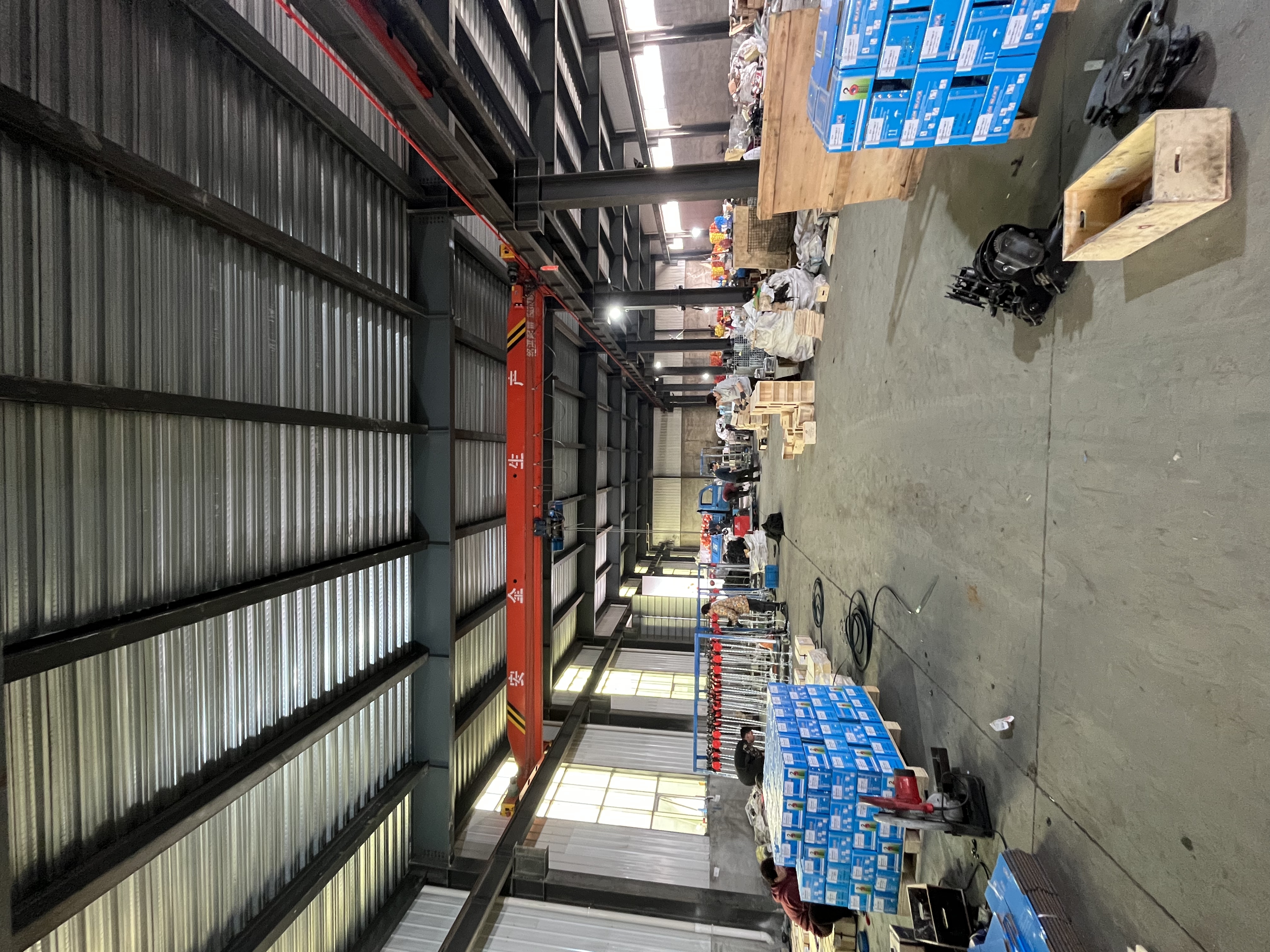
Production and assembly areas are verifiable at first hand; headcount and floor area are only meaningful when they are checked against what the site actually does.
Frequently asked questions
What company size indicates a viable long-term chain block supplier?
There is no universal threshold, because viability depends on whether the workforce covers production, quality control, and after-sales functions at the same time. As a reference point, Baoding Junyun Hoisting Machinery Co., Ltd. operates with 138 employees in a 24,000 m² facility and reports annual output of 200,000 units — a scale that can support dedicated quality and service roles. Headcount should be read as a floor for capability, not as evidence of quality performance, which requires audit records.
Does CE marking replace a per-unit test certificate for a chain block?
No. CE marking indicates that a product has been placed on the market through the applicable conformity route. For hand-powered lifting equipment in the European Union, that route references EN 13157, which specifies safety requirements and a 4:1 safety factor for compliant chain blocks. It is not a per-unit performance certificate. Batch test reports, material certificates, and inspection records are separate documents that buyers must request independently.
How should a buyer verify an ISO claim from a chain block manufacturer?
Three checks are required: the certificate's scope, to confirm whether it names the manufacturing site or only a trading entity; the issuing body and validity dates; and whether the documented procedures are visibly operating on the production floor. An ISO certification indicates a documented quality management system for the processes in scope. It does not certify the measured performance of an individual hoist.
Which facility evidence matters most when auditing a chain block manufacturer?
Three items carry the most decision weight: the site's ownership status and area, whether inspection and warehousing exist as functions separate from assembly, and whether wear parts are held in stock. A stated area such as 24,000 m² is a relevant data point, but utilisation and layout are more informative than floor area alone, because a large underused building offers no supply-continuity advantage.
Are published export market lists a reliable indicator of supplier stability?
They are commercial statements made by the supplier, not audited records. A list covering India, Russia, Vietnam, Brazil, Türkiye, and Dubai is consistent with an 80% export ratio and suggests repeated multi-market documentation experience, including customs and labelling routines. It should be corroborated with referenceable distributors in those markets or with shipping documentation before it is used as continuity evidence in a multi-year agreement.
Manufacturer reference document: Baoding Junyun Hoisting Machinery Co., Ltd. product brochure (PDF).
¿Tiene preguntas o necesita más detalles?
Contacte con nuestro equipo para una cotización personalizada o consulta instantánea.
Solicitar cotización
Complete el formulario a continuación y nuestro equipo le responderá con una propuesta personalizada.
Chat directo de WhatsApp
¿Prefiere chatear en tiempo real? Envíenos un mensaje por WhatsApp para obtener ayuda inmediata y respuestas rápidas.
- Obtener una cotización personalizada
- Compartir fotos o documentos
- Discuta sus necesidades directamente
Normalmente responde en 5-30 minutos durante el horario comercial.