
Chain Block Fit for Shipbuilding and Mining: -20°C to +50°C
A shipyard on a coastline and a mine shaft inland rarely buy lifting equipment from the same shortlist. Yet both place the same non-negotiable demand on a chain block: it must still lift, hold and lower when the ambient temperature swings from a cold night shift to a warm afternoon, when the air carries salt or abrasive dust, and when there is no power socket within reach. The VD chain block from Baoding Junyun Hoisting Machinery Co., Ltd. is rated for operation between –20°C and +50°C on standard grease, and that single number is the first thing a buyer should test against the real working environment.
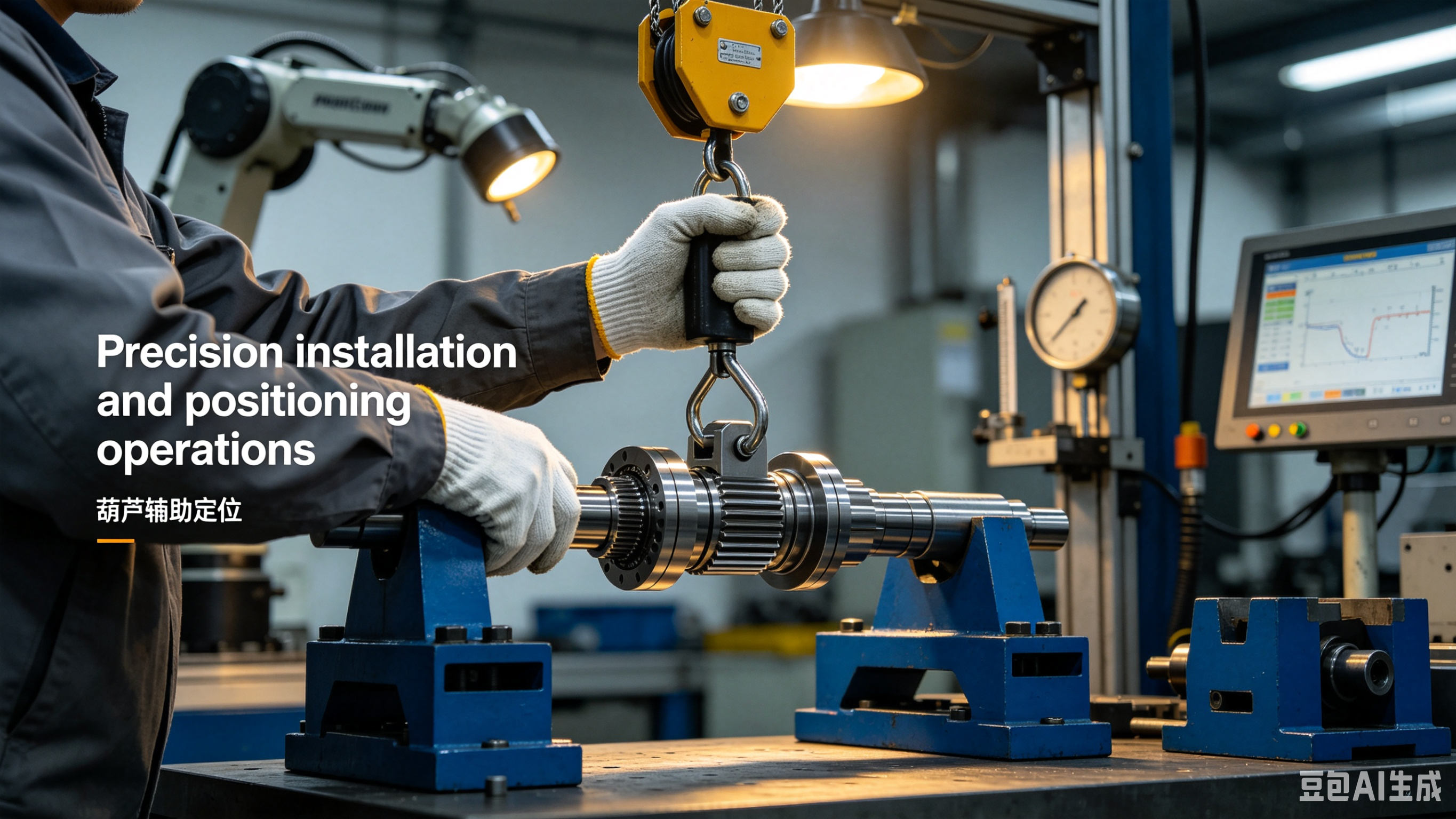
Precision installation and positioning operations are a core use case for manual chain blocks in shipbuilding, bridge and heavy-industry projects.
What “scenario fit” means for a chain block
Baoding Junyun Hoisting Machinery Co., Ltd. (brand: JUNYUNHOIST) is a Hebei-based manufacturer and trading company of manual chain hoists, lever blocks, electric hoists and material-handling equipment. Its VD chain block is a manually operated chain hoist with rated capacities from 0.5 t to 50 t, a standard lift height of 3 m with 2.5–12 m available as an option, and a stated operating temperature range of –20°C to +50°C with standard grease.
Scenario fit is not a marketing phrase. It is the practice of comparing three sets of numbers before purchase:
- Environment numbers — the lowest and highest ambient temperatures the unit will actually see, the presence of salt, moisture, dust or flammable atmosphere, and whether a power supply exists.
- Duty numbers — the load to be lifted, the lift height, how often the unit is cycled, and how long each load is suspended.
- Physical numbers — available headroom, hook opening requirements, chain fall count and the rigging accessories the unit will be paired with.
When those three sets line up with the hoist’s declared ratings, the product works as intended. When one of them does not, the buyer finds out on site rather than on paper.
The problem: environments that punish general-purpose lifting gear
Shipbuilding and mining sit at opposite ends of the industrial spectrum, but both create conditions that a workshop-grade hoist is not designed for.
Shipbuilding and repair takes place in coastal air, inside partially enclosed hull sections, and on deck plates that alternate between direct sun and wind exposure. Work includes moving structural parts to a designated position for assembly, and hoisting or dismantling heavy components such as engines and propellers during repair. Lifting points are frequently awkward, the headroom inside a hull compartment is limited, and the load often has to be held at height while fitters position it by hand.
Mining operations impose a different profile: abrasive dust, vibration, moisture, and long stretches of work where no electrical supply is available. Maintenance, emergency repair and temporary operations are typical duties, and in some zones an explosion-proof or fire-proof environment is part of the specification rather than an exception.
The opportunity for a correctly specified manual chain block is that these are exactly the conditions in which a purely mechanical hoist remains useful. The VD chain block converts human effort into lifting force through a mechanical gear system and uses a reverse-drive self-locking braking system for precise control and safe locking during lifting. No power feed, no control cabinet, no cable run — which matters in a mine gallery or a hull compartment as much as it does in a substation or a bridge erection site.
The temperature window: reading –20°C to +50°C correctly
The –20°C to +50°C figure describes the ambient range within which the VD chain block is rated to operate when it is lubricated with standard grease. It is a design boundary, not a comfort statement, and it is worth understanding what moves inside it.
At the cold end, the limiting factor is normally the grease rather than the steel. Grease thickens as temperature falls, which raises the effort needed on the hand chain. Because the VD chain block is rated for a pull force of no more than 35 daN (approximately 350 N) on the hand chain up to rated load, a grease that stiffens beyond the design assumption would push operator effort upward and change the handling feel of the unit. At the warm end, the concern shifts to the stability of the lubricant film and to the consistency of the brake function over repeated cycles.
That is why the temperature rating is tied to the lubricant, not only to the mechanism. A user working at the edge of the window — a coastal yard in a cold season, a mine site in a hot dry region — should treat the +50°C / –20°C values as the envelope for the standard configuration, and confirm the intended duty cycle with the supplier before purchase.
Boundary worth noting: applications outside the standard –20°C to +50°C window, or applications requiring explosion-proof construction, are handled as special configurations and are available upon request rather than as the default build. Buyers whose sites regularly fall outside the window should raise this at specification stage, not after delivery.
Corrosion resistance in salt air and wet ground
Temperature is only half of the environmental equation. Shipyards bring chloride-laden air; mines bring moisture, fines and wash-down water. Both accelerate surface corrosion on any hoist that is left exposed.
The VD chain block addresses this at three points in the build:
- Housing finish — the housing is painted in RAL 2000 (yellow-orange) or RAL 1007 (daffodil yellow). Beyond visibility on a busy deck or a dim gallery, the coating provides a barrier between the cast or fabricated housing and the atmosphere.
- Load chain — the load chain is supplied as Grade V (grade 80) or Grade T according to DIN EN 818-7, in diameters from 6.3 mm to 11.2 mm depending on capacity, and is specified as corrosion-resistant.
- Hand chain — the hand chain is round link, supplied galvanised or zinc-plated.
Chain and hook materials are drawn from 20Mn2, 25MnV or 23MnNiMoCr54 depending on the model, and the hooks are forged alloy steel, heat-treated, with opening dimensions between 24 mm and 55 mm. The declared safety factors are ≥ 4:1 for the chain and ≥ 5:1 for structural parts.
Corrosion-resistant chain and a painted housing reduce the rate at which the environment attacks the unit. They do not make the hoist a sealed marine instrument, and they do not remove the need for periodic inspection — an important distinction for procurement teams comparing coatings and finishes across suppliers.
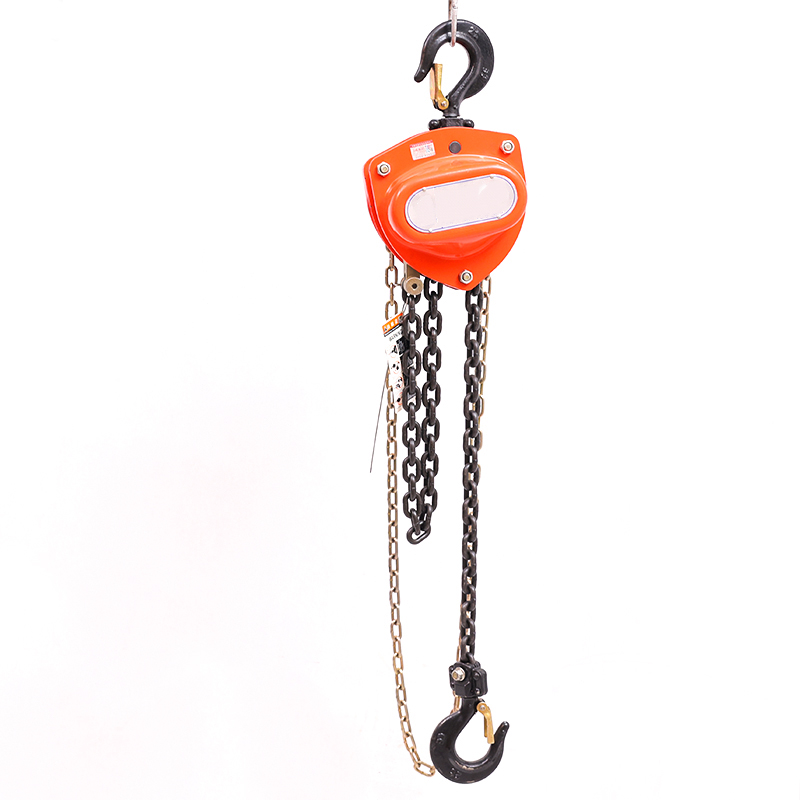
The VD chain block: painted housing in RAL 2000 or 1007, corrosion-resistant load chain and galvanised or zinc-plated hand chain.
Matching capacity and lift height to the job
Shipbuilding and mining rarely need the same configuration. A hull compartment favours a lower-capacity unit with a short, controlled lift and minimal headroom; a mine maintenance bay or a heavy fabrication shop may need a 20 t or 50 t lift with a longer chain drop. The VD chain block spans both ends of that range within one model family.
| Parameter | VD chain block specification | Practical implication on site |
|---|---|---|
| Rated load capacity | 0.5 – 50 t | Covers light shipyard fitting through heavy mine maintenance and steel erection |
| Standard lift height | 3 m (2.5 – 12 m optional) | Short lifts inside hulls; long drops in shafts, halls and bridge segments |
| Number of chain falls | 1 – 4 (capacity dependent) | More falls at higher capacity; affects handling weight and chain routing |
| Load chain | Grade V (80) or Grade T per DIN EN 818-7, 6.3 – 11.2 mm | Chain grade and diameter follow the duty, not the other way round |
| Hand chain length | Standard = lift height + 0.5 m slack | Extra slack matters where the operator stands below or beside the load |
| Pull force on hand chain | ≤ 35 daN (350 N) up to rated load | Sets realistic expectations for operator effort over a shift |
| Headroom / hook distance | 300 – 1000 mm (model dependent) | Critical inside hull compartments and low-clearance structures |
| Hook opening | 24 – 55 mm | Must accept the shackle, sling or clamp actually used |
| Operating temperature | –20°C to +50°C (standard grease) | Covers most temperate, tropical and partially enclosed sites |
| Finish | Painted housing (RAL 2000 or 1007), corrosion-resistant chains | Visibility plus a barrier against salt and moisture |
| Standards | ISO 16872, EN 13157, ASME B30.21, CE marked | Basis for compliance review in EU, US and other regulated markets |
Two configuration decisions cause the most rework when they are made late. The first is lift height: specifying the standard 3 m for a job that actually needs 8 m forces either a chain extension or a second hoist. The second is headroom: a model whose minimum hook distance is 1000 mm will not fit a compartment where only 400 mm is available, regardless of its capacity rating.
Scenario fit across the five target industries
The industries listed in the applicable scope for this product family are manufacturing, construction, logistics and warehousing, shipbuilding, mining, petrochemicals, power, bridge engineering, railway construction, automotive repair, agriculture and stage construction. Five of them are the focus of this article because their temperature and corrosion profiles overlap most directly with the –20°C to +50°C rating.
Shipbuilding and repair
Typical duty: precisely moving ship structural parts to a designated location for assembly, and hoisting or dismantling heavy components such as engines and propellers during repair. The relevant fit factors are a short headroom, a corrosion-resistant chain for coastal air, and a finish that keeps the unit visible on deck. Lifts are usually positional rather than continuous, which suits manual operation.
Mining operations
Typical duty: maintenance, emergency repair and temporary lifting where no power supply exists or where the working environment is restricted. Dust and moisture are constant, temperature can swing widely between surface and below-ground conditions, and in some zones an explosion-proof or fire-proof safe environment is specified. Standard configuration meets general requirements; explosion-proof and high-temperature resistant configurations are available on request.
Power industry
Typical duty: electric power facility construction and maintenance, where installed equipment cannot be moved and lifting must be precise. A manual unit with a self-locking brake is useful where a powered hoist would add a power source and a control system to an already congested area.
Bridge engineering
Typical duty: precise placement of key components such as large steel beams for high-speed railway bridges and precast beams for other bridges. Outdoor sites mean the unit may be exposed to both cold nights and hot daylight hours within the same project, which is the practical reason the –20°C to +50°C window matters.
Railway construction and maintenance
Typical duty: track-side assembly and component replacement, often at short notice and without a nearby power supply. Portability and predictable mechanical behaviour matter more than speed of lifting.
Across all five, the same supporting equipment appears: slings, hooks, clamps, trolleys and load detectors. A chain block is a lifting element inside a rigging system, not the whole system, and the accessory list should be confirmed alongside the hoist.
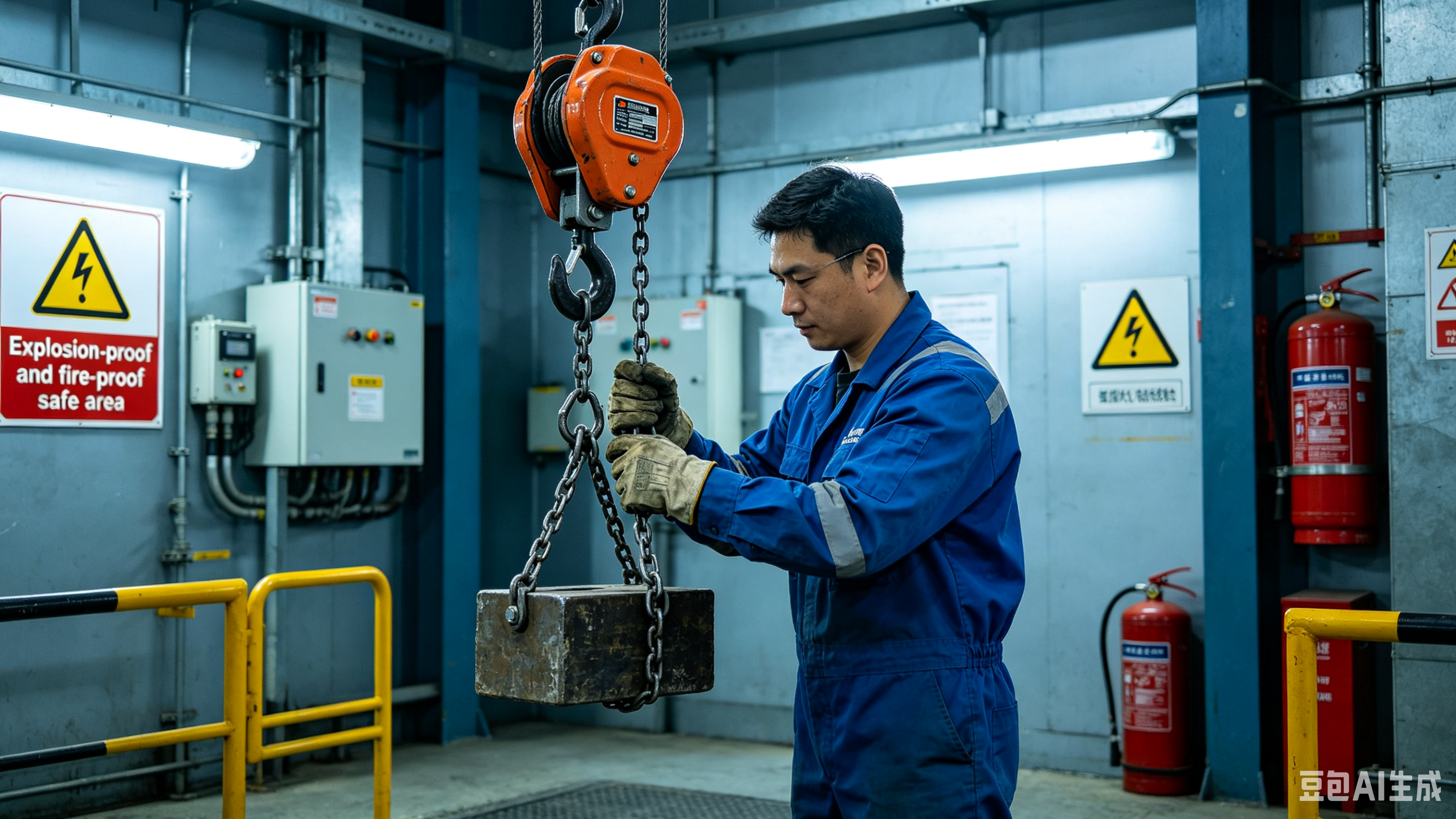
Where fire-proof or explosion-proof conditions apply, special configurations of the chain block are available on request.
Supporting equipment and configuration options
The functional role of the chain block in these settings is lifting and positioning — across steel structure installation, bridge construction, pipeline engineering, shipbuilding, heavy machinery manufacturing and disaster relief, among other applications. That role depends on the rigging around it, which typically includes slings, hooks, clamps, trolleys and load detectors.
Where the standard build does not match the site, the manufacturer supports OEM/ODM supply with several defined customization paths:
- Colour and finish selection
- Load-bearing chain length
- Adjustment of accessory quality to hit a target price point
- Scenario-specific builds such as stainless steel or explosion-proof variants
Production evidence that buyers can verify during evaluation includes a 24,000 m² facility, 138 employees, an eight-person R&D team, a monthly capacity of 15,000, a minimum order quantity of 50 pcs, a lead time of 15–20 days, and 100% testing of units. Export markets include Vietnam, India, Russia, the United Arab Emirates, Brazil, Türkiye, the Middle East and Southeast Asia, and the wider scenario data for this product family lists India, Vietnam, Turkey, the United Arab Emirates, Saudi Arabia, Brazil and Russia as common application markets.
After-sales support is structured around consumable continuity: each container is supplied with a certain number of easily damaged spare parts, replenished as needed based on subsequent usage. For a mine or a yard running continuous shifts, spare-part availability is a procurement criterion in its own right.
Market trend: manual hoists still carry heavy industry
The demand picture behind these scenarios is not shrinking. According to Intel Market Research, the global chain block market was valued at approximately USD 1.95 billion in 2024. Dataintelo projects the broader chain hoist market, including electric and manual types, to reach USD 3.9 billion by 2034. Fact.MR estimates that manual chain pulley blocks will account for 48% of the total product segment share in 2026 — a reminder that the manual segment remains a substantial part of the category, not a legacy footnote.
Application demand is concentrated in the very industries discussed here. Stratview Research and Fact.MR estimate that construction sites are the largest application segment for chain blocks, contributing roughly 30% to 54% of global demand depending on the source. On the supply side, Dataintelo reports that Asia Pacific held a 41.3% revenue share of the chain hoist market in 2025, supported by industrial expansion in China and India, while UN Comtrade and WITS data show China’s exports of parts for lifting and handling equipment (HS 843139), including chain block components, reaching USD 1.36 billion in 2024.
On growth rates: published CAGR estimates for this category diverge widely depending on whether the study scope covers general chain blocks, the full chain hoist market, or high-tech models — figures ranging from roughly 0.4% to 5.7% appear across different research houses. Buyers should treat any single growth number as scope-dependent rather than as a category-wide fact.
Comparison with alternative lifting solutions — and where the manual chain block stops
Manual chain blocks are not the only option in a shipyard or a mine, and an honest comparison includes the cases where another solution is more appropriate.
| Consideration | Manual chain block (VD) | Powered hoist | Lever block |
|---|---|---|---|
| Power requirement | None — purely mechanical | Requires electrical supply and control | None — purely mechanical |
| Best fit | Positioning, maintenance, temporary and restricted-environment lifts | High-frequency, repetitive or continuous lifting duty | Tensioning, pulling and tight-space positioning |
| Temperature envelope | –20°C to +50°C with standard grease | Depends on motor, insulation and control components | Depends on configuration and lubricant |
| Operator effort | Up to ≤ 35 daN on the hand chain at rated load | Low, but requires a trained operator and power | Higher short-burst effort, typically for shorter strokes |
The clearest limitation of the VD chain block in these industries is duty cycle. Because lifting force comes from the operator, the ≤ 35 daN hand-chain pull at rated load defines a practical ceiling on how long and how frequently the unit should be cycled. In a shipyard berth doing repetitive production lifts, or a mine shaft with a continuous slushing schedule, a powered hoist is normally the more appropriate choice. The manual unit earns its place where power is absent or undesirable, where lifts are occasional but must be precise, and where a self-locking brake holding a suspended load is the safety property that matters most.
A second boundary is the temperature and atmosphere envelope itself. The standard –20°C to +50°C rating with standard grease does not describe performance below –20°C or above +50°C, and it does not describe an explosion-proof or fire-proof safe environment. Those are separate configurations available upon request. Procurement teams working in arctic, desert or hazardous-area conditions should specify accordingly rather than assume the standard build covers them.
A third consideration is that corrosion-resistant chains and a painted housing slow environmental attack but do not eliminate inspection. Because the same product family is used in petrochemical, power and port environments as well as shipbuilding and mining, inspection intervals should be set from the actual exposure, not from the coating specification alone.
What to verify before ordering
- Load and lift height together — confirm capacity (0.5–50 t) and the specific lift height within the 2.5–12 m optional range, not just the 3 m default.
- Headroom — check the model’s hook distance (300–1000 mm) against the lowest available lifting clearance.
- Hook and rigging match — hook opening (24–55 mm) must accept the shackle, sling or clamp in use.
- Temperature exposure — compare the site’s real minimum and maximum against –20°C to +50°C, and flag any excursion in advance.
- Standard compliance — ISO 16872, EN 13157, ASME B30.21 and CE marking are the declared compliance basis; for the European market, EN 13157 sets safety requirements for hand-powered lifting equipment and specifies a 4:1 safety factor, matching the declared chain safety factor of ≥ 4:1.
- Commercial terms — MOQ of 50 pcs, 15–20 day lead time, 100% testing, and the spare-parts allowance per container.
Future outlook
Three forces are likely to shape how manual chain blocks are specified in shipbuilding, mining, power, bridge and railway work over the next few years.
The first is regional demand gravity. With Asia Pacific holding a reported 41.3% revenue share of the chain hoist market in 2025 and China exporting USD 1.36 billion in lifting and handling equipment parts in 2024, sourcing decisions in these industries increasingly run through Asian supply chains — which raises the importance of verifiable compliance documentation rather than brand familiarity alone.
The second is the persistence of the manual segment. If manual chain pulley blocks hold close to 48% of product segment share in 2026, the reason is practical: there are still large parts of a mine, a hull or a bridge erection site where running power to a lifting point is more expensive and less reliable than pulling a hand chain.
The third is configuration specificity. As project sites spread into hotter, colder and more regulated environments, the ability to specify chain grade, chain length, finish, accessory quality and special builds such as explosion-proof or stainless steel variants becomes a selection criterion in itself. Buyers who can articulate their scenario in numbers — temperature range, headroom, capacity, duty cycle — will get a better-matched hoist than those who order by capacity alone.
Frequently asked questions
What does the –20°C to +50°C operating range actually cover?
It is the ambient temperature range within which the VD chain block is rated to operate with standard grease. Within this window, the unit is specified for a hand-chain pull force of no more than 35 daN up to rated load. The range applies to the standard lubricated configuration, not to special builds.
Can the chain block be used below –20°C or above +50°C?
The standard specification does not describe operation outside that window. Applications with special requirements, including explosion-proof and high-temperature resistant configurations, are available on request. Sites that regularly fall outside –20°C to +50°C should raise the requirement during specification rather than after delivery.
Which capacity and lift height should a shipyard or mine specify?
Capacity is available from 0.5 t to 50 t, and lift height is 3 m as standard with 2.5–12 m available as an option. The correct combination is determined by the heaviest load in the actual duty, the vertical distance between the lifting point and the working position, and the available headroom — which ranges from 300 mm to 1000 mm depending on model.
Why do corrosion-resistant chains and a painted housing matter in these industries?
Shipyards expose equipment to chloride-laden coastal air, and mining operations expose it to moisture, dust and wash-down. The VD chain block uses a housing painted in RAL 2000 or RAL 1007, a corrosion-resistant load chain in Grade V (80) or Grade T per DIN EN 818-7, and a galvanised or zinc-plated round-link hand chain. These measures slow environmental attack; they do not remove the need for periodic inspection.
How does a manual chain block compare with a powered hoist for these scenarios?
A manual chain block requires no power supply and uses a reverse-drive self-locking braking system for precise control and safe locking during lifting, which suits restricted environments, maintenance work and temporary operations. A powered hoist is generally more appropriate where lifting is repetitive or continuous, because operator effort on a manual unit is capped by the ≤ 35 daN hand-chain pull rating at rated load.
What supporting equipment is needed alongside the chain block?
Typical supporting equipment includes slings, hooks, clamps, trolleys and load detectors. The hook opening of 24–55 mm and the chain fall count of 1–4 both affect which accessories can be used, so rigging should be confirmed together with the hoist selection.
Summary
For shipbuilding, mining, power, bridge engineering and railway construction, the value of a manual chain block lies in matching a declared envelope to a real site. The VD chain block’s –20°C to +50°C operating range with standard grease, corrosion-resistant chains, RAL 2000 or 1007 painted housing, and capacity and lift-height options from 0.5–50 t and 2.5–12 m give buyers a defined starting point. The remaining work is arithmetic: measure the site, match the numbers, and flag anything outside the standard window before the order is placed.
Product documentation for Baoding Junyun Hoisting Machinery Co., Ltd. is available in the downloadable catalogue: Junyun Hoisting product brochure (PDF). Company website: www.junyunhoist.com.