
Certified Insulators for High-Voltage Lines: Compliance, Standards, and Selection Criteria
How Certification and Standards Define Quality in Insulators for Power Transmission
Industry professionals evaluating insulator suppliers for grid and railway projects must navigate a complex landscape of material types, mechanical ratings, and international compliance requirements. This article examines how IEC and ISO certifications shape procurement decisions, with a focus on practical selection criteria.
The Growing Demand for Certified Insulators
Global electrical infrastructure modernization is driving demand for reliable overhead line components. The composite insulator market alone is projected to grow from USD 3.42 billion in 2024 to USD 5.87 billion by 2030, at a CAGR of 9.1% (Strategic Market Research, 2024). As utilities and EPC contractors expand networks in harsh environments—from coastal humidity to desert dust storms—the certification status of insulators becomes a non-negotiable factor in risk mitigation and project compliance.
China Energy and Chemical Industry Co.,Ltd: A Supplier with Verified Credentials
China Energy and Chemical Industry Co.,Ltd (CECI) is a power equipment manufacturer based in Zhengzhou, China, specializing in polymer insulators, porcelain insulators, glass insulators, and metal fittings. The company operates a 30,000 m² factory with an annual output of 8 million units and exports to over 40 countries, including Russia, Vietnam, France, Italy, Türkiye, Brazil, and Poland. For procurement teams requiring documented compliance, CECI provides test reports and ISO certifications that align with international standards.
Technical Specifications and Certification Evidence
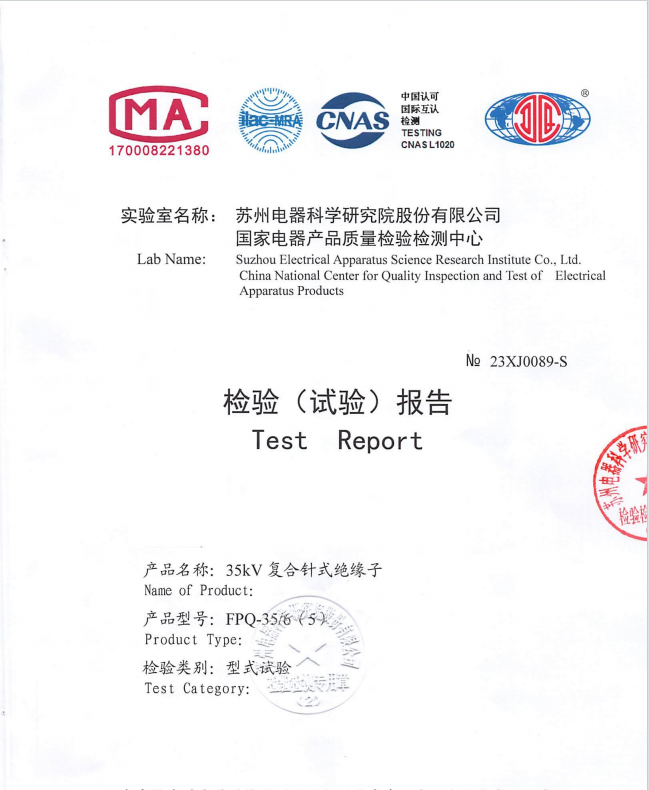
IEC-Compliant Composite Insulators. The 35kV composite pin insulator model FPQ-35/6(5) — applicable to the polymer insulator product family — is covered by a Type Test Report (certificate 23XJ0089-S) issued by Suzhou Electrical Apparatus Science Research Institute Co., Ltd. The tests follow IEC 60815 (pollution), IEC 61109 (composite insulators for HVAC), IEC 62217 (definitions), and IEC 61466 (string insulator units). This certification is recognized across Europe, the Middle East, Southeast Asia, and the Americas.
ISO 9001 for Metal Fittings. The Power Equipment Parts and Accessories line (model Ball-Head Suspension Ring QP-7) holds ISO 9001 certification under GB/T 19001-2016 idt ISO 9001:2015, certificate number 75425Q0493R053, issued by Zhongjing Certification (Shanghai) Co., Ltd. A second ISO 9001 certificate (75424Q0348R0S) covers the broader manufacturing of power fittings. These certifications apply to markets in Europe, the Americas, the Middle East, and Central Asia.
Key parameters for the polymer suspension insulator (model FXB-24-70-785mm):
- Rated Voltage: 35kV
- Lightning Impulse Withstand Voltage: >230kV
- Power Frequency 1-minute Wet Withstand Voltage: >95kV
- Minimum Creepage Distance: >1050mm
- Rated Bending Load: 5kN
Application Scenarios: Where Certified Insulators Make a Difference
CECI’s polymer insulators (product 5561) are designed for public electrical equipment applications in Spain, France, Italy, and Turkey. Typical projects include rural and urban grid upgrades, rail transit electrification, high-voltage transmission lines, substations/converter stations, and wind power installations. These environments expose insulators to high temperature, high humidity, UV aging, dust storms, and impulse overvoltage. The product supports continuous 24/7 operation and requires auxiliary equipment such as power distribution cabinets.
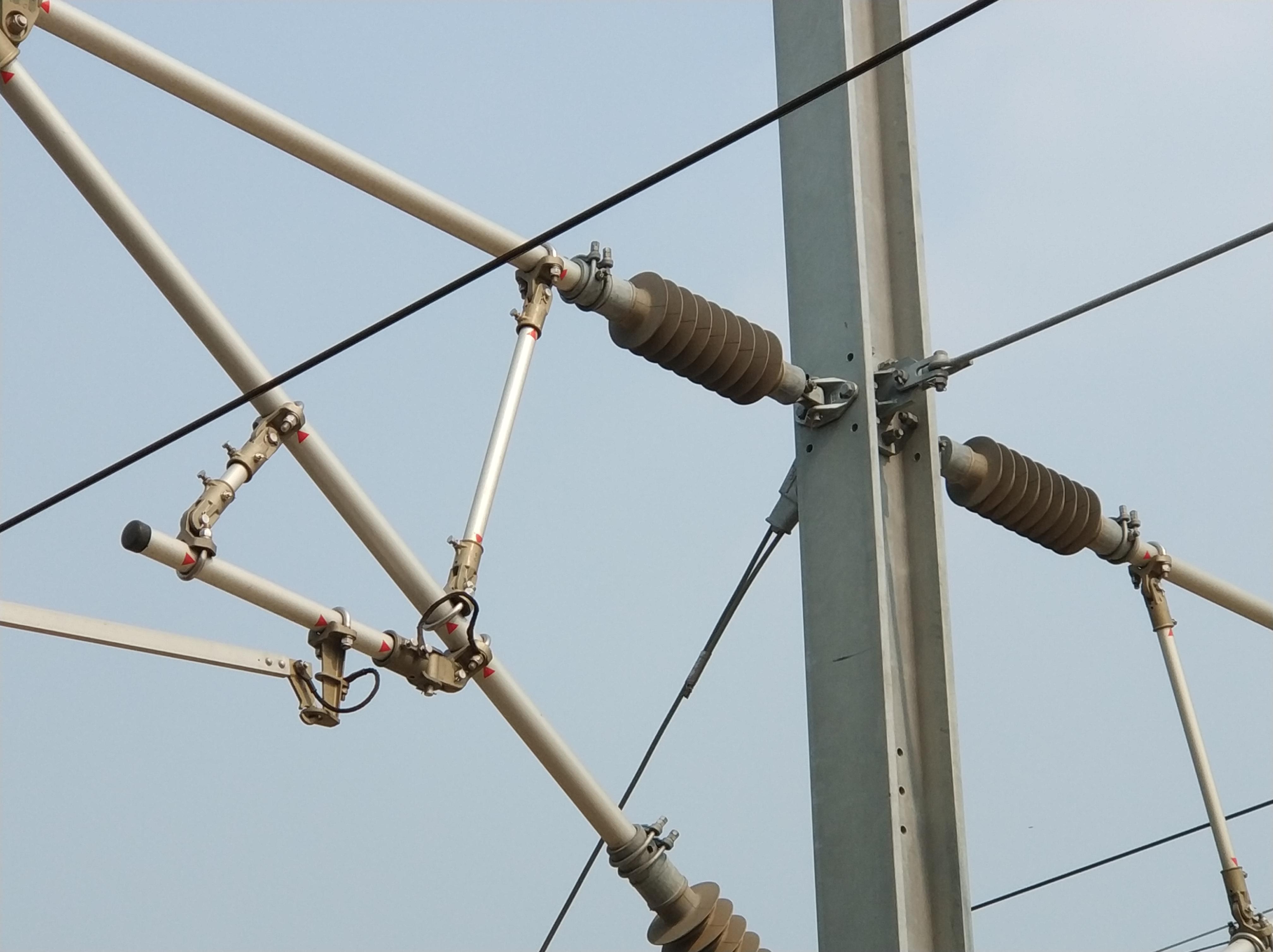
Glass insulators (product 5562, model 70B) are designed for outdoor harsh climates where dust accumulation and wind abrasion are severe. The porcelain insulator (model U70BP/146D) offers a rated electromechanical failing load of 70 kN and a nominal disc diameter of 255 mm, suitable for conventional overhead line strings.
Market Trend: Composite Insulators Gaining Share
According to Mordor Intelligence (2024), suspension insulators captured 48.4% of the composite insulators market segment. The shift toward lightweight, anti-aging polymer designs is driven by lower maintenance and better pollution flashover performance. China accounted for 13.1% of global exports of insulating glass/materials in 2024, reflecting its role as a major supply base (OEC, 2024). Major global players such as ABB, Siemens Energy, and NGK Insulators dominate the high-end segment, but certified mid-market suppliers like CECI offer accessible options with documented compliance.
Comparison with Traditional Materials: One Honest Limitation
Compared to porcelain and glass insulators, polymer (composite) insulators offer lighter weight, higher impact resistance, and superior anti-pollution flashover characteristics. However, their organic housing materials (silicone rubber) can degrade under sustained corona discharge and require careful design of the housing and interface to prevent tracking. For this reason, customers in extreme UV or coastal environments should verify that the specific product has passed the full IEC 61109 aging and tracking tests — which the FPQ-35/6(5) report does cover.
Future Outlook
With IEC 61109 updated in 2025 and continued pressure for grid resilience, the role of certified insulators will only intensify. Procurement is expected to shift further toward suppliers that provide both broad product ranges (polymer, glass, porcelain, fittings) and transparent test documentation. CECI’s combination of ISO 9001 for hardware and IEC test reports for composite insulators positions it to serve EPC contractors and utilities seeking a single qualified source.
Frequently Asked Questions (Informational)
Q: What international standards apply to composite insulators for overhead lines?
A: Composite insulators for high-voltage overhead lines (AC >1000V) are governed by IEC 61109 (latest edition 2025), supplemented by IEC 60815 for pollution and IEC 62217 for definitions. Porcelain and glass insulators follow IEC 60383-1.
Q: Which CECI products carry a specific IEC test report?
A: The 35kV composite pin insulator model FPQ-35/6(5) is covered by a Test Report (23XJ0089-S) issued by Suzhou Electrical Apparatus Science Research Institute Co., Ltd., certifying compliance with IEC 60815, IEC 61109, IEC 62217, and IEC 61466.
Q: Does CECI hold ISO 9001 certification for its metal fittings?
A: Yes. The Power Equipment Parts and Accessories product line (including Ball-Head Suspension Ring QP-7) is certified to ISO 9001 under certificate number 75425Q0493R053, applicable to Europe, the Americas, the Middle East, and Central Asia.
Q: What are the typical delivery lead times and MOQ for CECI insulators?
A: Lead time is 30–45 days, with a minimum order quantity (MOQ) of 500 units. Monthly production capacity is 500 tons or 100,000 pieces.
For detailed product parameters, test reports, and case studies, download the 2025 CECI catalogue of polymer insulators and glass insulators.