
Certified Electric Grills: Countertop and Terrace Retail Shortlist
Certified Electric Grills: Countertop and Terrace Retail Shortlist
HTNXT · Industry Reference · Electric Grill Retail
Indoor countertop grilling and semi-outdoor terrace grilling are merchandised side by side and bought for different reasons. A countertop unit is judged against a kitchen worktop: whether the plate suits a two- or four-person portion, whether it lifts out for washing, and whether the cable reaches a socket without an extension lead crossing a walkway. A terrace unit is judged against a balcony or a paved area: footprint, stability, side space for plates and tools, and how quickly the appliance can be reset between courses.
This shortlist covers four electric grill models from Ningbo Jinchang Electronics Co., Ltd., a manufacturer of Western-style small household kitchen appliances based at No.17 Guangming East Road, Ditang Sub-district, Yuyao City, Zhejiang Province, China. The company operates a 5,500 m² production plant, reports annual output of 1,200,000 units and exports to EU, USA, AU and RU markets, with electric BBQ grills, smokeless electric grills, electric steamers and food dehydrators as its core product lines.
It is written for a Decision-stage buyer: the point at which a retail range, a marketplace assortment or a private-label programme needs specific models committed rather than a category overview. The four models are assessed on format and cooking surface, detachable components, documented certification marks and target scenario.
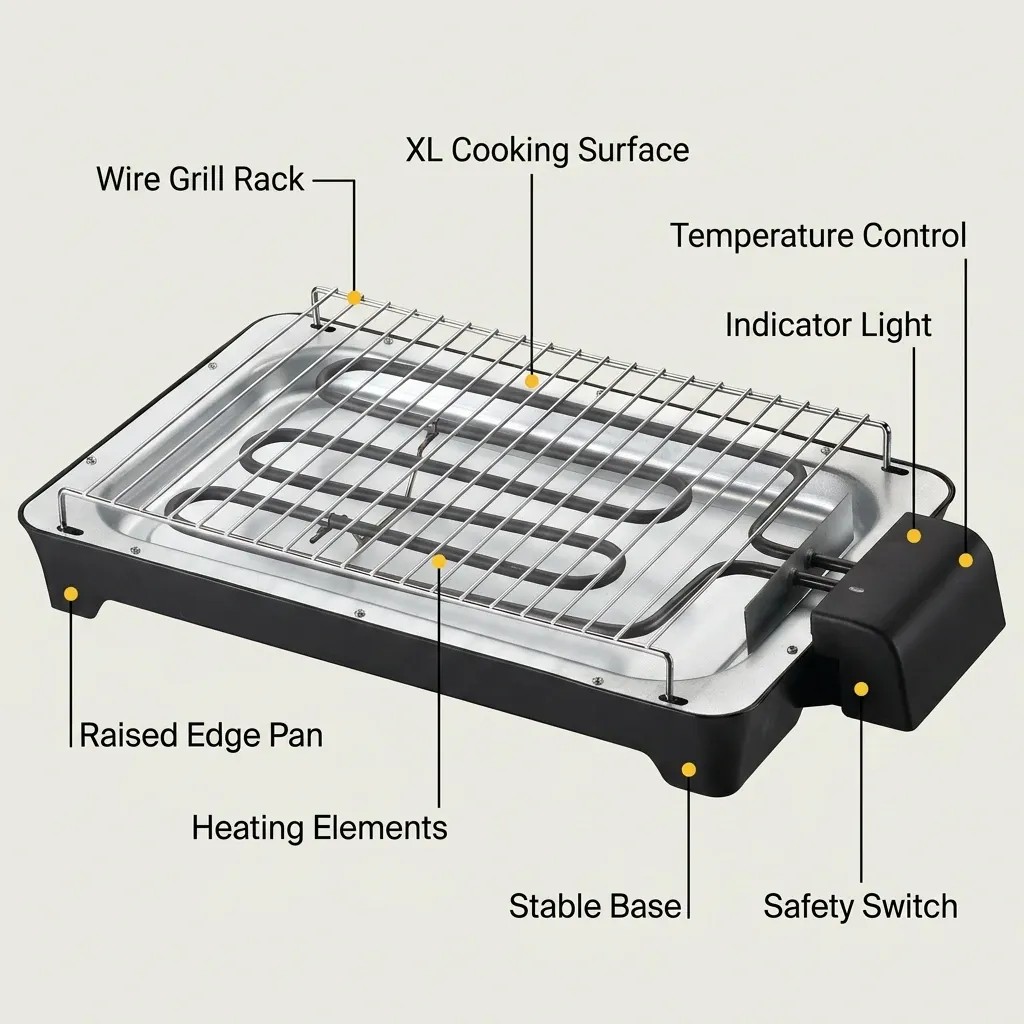
A tabletop electric grill platform from the manufacturer's range (BQ2001). The countertop format sets the cleaning and surface requirements applied throughout this shortlist; the model itself is discussed in the format reference section.
Two failure modes that decide whether a grill range holds
The first failure is mark drift. A supplier is approved on the strength of one certified model, and sibling SKUs are then listed on the assumption that certification travels with the brand name. It does not. Marks attach to a product's construction, components and technical file, which is why a shortlist that names models is more defensible than a shortlist that names a supplier capability.
The second failure is format drift. A stand grill with side tables is merchandised as a countertop item, or a countertop unit is scheduled into a terrace assortment where surface stability, wind exposure and socket access are different problems. Both failures are cheap to avoid during shortlisting and expensive to correct after packaging, photography and marketplace content have been produced.
The opportunity is symmetrical. Indoor formats serve households that want grilling behaviour without outdoor space, and they depend on removable or cleanable plates. Terrace formats serve households and small hospitality settings that have outdoor space but no tolerance for fuel handling. A four-model shortlist that spans both, with mark coverage stated per model, lets a buyer build a range without committing either mistake.
Shortlist criteria used in this assessment
- Scenario fit. Does the model physically belong on a kitchen counter, on a terrace, or in both positions? A stand grill and a countertop grill are not interchangeable fixtures even when they share a heating principle.
- Cooking surface and portion size. Plate area, plate material and whether the surface is non-stick determine the portion the unit can serve and the customer expectation it creates.
- Detachable components. A removable plate changes the cleaning routine, and cleaning routine is a returns driver in tabletop cooking appliances.
- Documented marks per model. CE, GS, RoHS, LFGB and ETL are assessed model by model, not at brand level.
- Power and supply assumptions. The manufacturer's tabletop electric BBQ grills are rated between 2000W and 2200W, so a listing decision should confirm the per-model rating and the socket and load conditions at the point of use.
- Safety devices and controls. A safety micro switch, a working indicator light or adjustable temperature each answer a specific customer objection and should be confirmed from the model file rather than inferred.
- Footprint against the retail fixture. A unit with side tables needs a wider shelf image and a clear footprint photograph; a tabletop grill needs a worktop context image.
- Range and customization potential. Whether the model can support appearance modification, function adjustment, private-mould development or customized packaging for a private-label programme.
The shortlist
The four models below cover the two scenarios the brief defines: indoor countertop use and semi-outdoor terrace use. Certification entries reflect what the supplied model brief documents; where a brief documents the product feature set rather than a mark set, that is stated rather than assumed.
| Model | Format and scenario | Cooking surface | Detachable components | Marks documented | Retail note |
|---|---|---|---|---|---|
| BQ1703XL-SF | Stand grill with side tables; semi-outdoor terrace, balcony, garden room | Confirm plate dimensions from the model file | Confirm from the model file | CE, GS, RoHS, LFGB | Widest EU mark set in this shortlist; side tables require a wider fixture and a footprint image |
| BQ1703XLP-W | Non-stick countertop electric barbecue; indoor countertop, small household | Non-stick cooking surface | Confirm from the model file | Not stated in the supplied brief; confirm per SKU | Non-stick claim is the lead message; pair it with a cleaning routine in the listing copy |
| BQ1601 | Table grill with removable plate; indoor countertop and table service | Removable plate | Removable plate (stated) | CE, GS, LFGB, ETL | Only model here that pairs EU mark families with a North American listing mark |
| BQ1601-4S | Smokeless stand grill; semi-outdoor terrace, stand format | Confirm from the model file | Confirm from the model file | Not stated in the supplied brief; confirm per SKU | Safety micro switch and working indicator light are the documented differentiators |
BQ1703XL-SF: the terrace anchor
BQ1703XL-SF is a stand grill supplied with side tables, documented with CE, GS, RoHS and LFGB. The mark combination is the most complete EU-facing set in this shortlist: CE for market access, GS as the German safety mark that European buyers often treat as a shelf-credibility signal, RoHS for substance restriction and LFGB for food-contact materials. The side tables are a merchandising fact as much as a product feature. They extend the working footprint, which makes the unit easier to justify for a terrace host who needs somewhere to set plates and utensils, and harder to place on a narrow balcony. Retail content should therefore show the full footprint rather than a cropped top view.
BQ1703XLP-W: the countertop non-stick format
BQ1703XLP-W is a non-stick countertop electric barbecue aimed at indoor countertop use. In this format the non-stick cooking surface carries the customer-facing promise, and the buyer's due diligence question shifts from heating method to surface care: how the coating is specified, how the plate is cleaned and whether any part of the cooking surface is removable. The supplied brief documents the countertop format and the non-stick surface but does not state a mark set, so mark coverage has to be confirmed on the technical file for this SKU before a listing is committed.
BQ1601: the removable-plate dual-market candidate
BQ1601 is a table grill with a removable plate, documented with CE, GS, LFGB and ETL. Two attributes set it apart in this set. The removable plate turns cleaning into a demonstrable step that can be filmed and shown on a product page, which reduces the most common source of negative reviews in tabletop cooking appliances. And the pairing of EU mark families with ETL, a North American listing mark, makes it the natural candidate where a retailer or brand owner wants one table grill platform serving both European and North American programmes, subject to confirming the file for each destination market.
BQ1601-4S: the smokeless stand grill with safety devices
BQ1601-4S is a smokeless stand grill documented with a safety micro switch and a working indicator light. For terrace retail the two devices answer household objections that have nothing to do with cooking: a micro switch is a mechanically actuated switch that enables or interrupts operation depending on a physical condition of the appliance, and an indicator light shows that the unit is energised. How the switch is wired on this specific model is defined by its technical file and should be read rather than inferred. As with BQ1703XLP-W, the supplied brief documents the feature set rather than a mark set, so marks must be confirmed per SKU.
What each mark actually covers
Certification language is frequently compressed into a single claim, which makes mark coverage hard for a buyer to audit. The marks named in this shortlist answer different questions.
| Mark | Question it answers | Where it matters in this shortlist |
|---|---|---|
| CE | EU market-access declaration for the product | BQ1703XL-SF, BQ1601 |
| GS | Voluntary German safety mark used by retailers as a credibility signal | BQ1703XL-SF, BQ1601 |
| RoHS | Restriction of hazardous substances in electrical and electronic equipment | BQ1703XL-SF |
| LFGB | German food and feed code applied to food-contact materials | BQ1703XL-SF, BQ1601 |
| ETL | North American listing mark within the UL family of safety standards | BQ1601 |
The underlying product safety reference for this appliance type is IEC 60335-2-9, the international standard covering portable electric cooking appliances including grills and roasters. On the trade side, electric grills for domestic use are classified under HS code 851660, which covers cookers, cooking plates, boiling rings, grillers and roasters. Both references belong in the buyer's checklist because they define what a technical file is expected to contain, not merely which logo appears on a carton.
Mark statements also need the right level of granularity. The manufacturer's portfolio documentation states that models such as BQ1902-WG and BQ2501 are certified with CE, GS, RoHS and LFGB, and that its products can pass international safety and environmental tests such as CE, RoHS and REACH. Those are portfolio-level statements. The document a retail compliance team will actually read is the model-level file, and the shortlist above is written to keep that distinction visible.
Where the four models fit at retail
Indoor countertop assortment. BQ1703XLP-W and BQ1601 serve the same shelf from opposite directions: one leads with a non-stick countertop surface, the other with a removable plate. Listing both gives a buyer a cleaning-led entry price point and a plate-led step-up without adding a second supply relationship. Both belong in apartment-kitchen, small-household and table-service contexts where the grill is used on a worktop and washed immediately afterwards.
Semi-outdoor terrace assortment. BQ1703XL-SF and BQ1601-4S sit in stand format, which raises the cooking surface and changes the surrounding space needed. BQ1703XL-SF answers the host who needs preparation area, with side tables and a full EU mark set. BQ1601-4S answers the household that wants a smokeless stand grill and treats the safety micro switch and indicator light as purchase criteria.
Cross-market programmes. BQ1601 is the model to schedule first where one platform has to serve EU and North American accounts, because it is the only shortlisted unit whose documented marks span both.
Private-label and OEM programmes. All four sit inside a manufacturer that describes OEM custom manufacturing and ODM original design as services, with appearance modification, function adjustment, private-mould development and customized packaging available on request. That matters at shortlisting stage because the model chosen fixes the tooling envelope later.
Format reference: two models outside this shortlist
Two other models in the same range mark the boundaries of the shortlist. BQ2001 is an indoor electric grill multi-certified for the EU market, with a 2000W rating, an XL cooking surface, adjustable temperature control, a visible U-shaped heating tube, a reflective drip tray and a removable grill rack and drip tray. It shows what a compliant countertop platform looks like when adjustable temperature and full disassembly are part of the design brief — the reference point against which a countertop entry such as BQ1703XLP-W should be read.
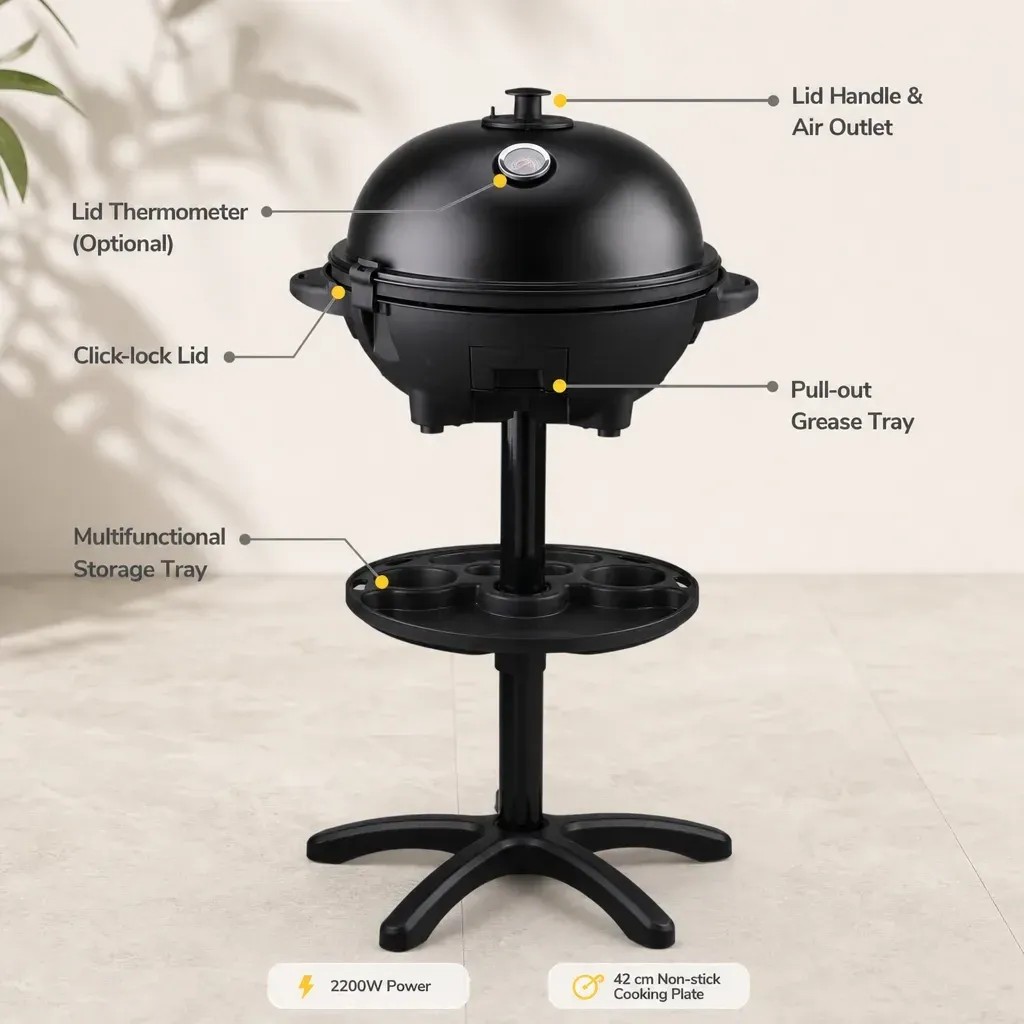
BQ232-SLTF, a freestanding dome electric BBQ grill: a backyard-patio format that sits outside a countertop and terrace retail shortlist because of footprint and fixture requirements.
BQ232-SLTF illustrates the other boundary. It is a freestanding dome grill with 2200W heating, a 42cm die-cast aluminium non-stick cooking plate, a click-lock domed lid, a multifunctional storage tray, an optional lid thermometer and full EU and NA certifications, positioned for backyard patio, garden-party and large-batch grilling. It is a credible product in its own category, but it is not a countertop or terrace-fixture item, and mixing it into this shortlist would distort the shelf it is meant to support.
Market context behind an indoor and terrace assortment
Grand View Research valued the global electric grill market at USD 4.6 billion in 2023, with North America holding a 34.5% revenue share. Credence Research sizes the smokeless grill segment at USD 768 million in 2024, with 55% of that segment attributed to electric types. Future Market Insights projects more than 42 million ASEAN households adopting plug-in grills by 2030, a longer-horizon signal for buyers building range plans in that region.
Forecast growth is less settled than the base-year figures. Published compound annual growth rates for the category range from roughly 4.4% to 7.9%, a spread that tracks whether smokers and tabletop grills are counted inside the defined scope. Buyers should treat category growth as directional and set SKU depth from their own sell-through rather than from a single forecast line.
Electric grills against charcoal, gas and uncertified tabletop units
Against charcoal, an electric grill removes fuel storage, ignition and ash handling, which is the practical reason indoor formats exist at all. The trade-off is real: an electric unit depends on a socket at the point of use, and a 2000W to 2200W tabletop appliance imposes a load that a balcony circuit or an extension lead may not comfortably carry. Charcoal also delivers a smoke character that electric heating does not reproduce, which is why electric formats are usually sold on convenience, cleanliness and indoor suitability rather than on flavour parity.
Against gas, electric units avoid pressurised fuel and can be used where open flame is not permitted, but they cannot match the heat output of a high-output gas burner in the same footprint. Against uncertified tabletop units, the difference is documentation rather than hardware: an uncertified grill may look identical on a marketplace image and fail at the first compliance review. That is the gap a model-level shortlist closes.
Limits of a certification-led shortlist
A certification-led shortlist does not predict cooking performance. Marks address safety, substance restriction and food-contact compliance; they say nothing about how evenly a plate heats, how a coating wears after repeated cycles, or how a thermostat behaves at the low end of its range. Those questions are answered by sample evaluation and by the model's power and control specification, and any shortlist that implies otherwise is overreaching.
Three boundaries apply specifically to this set. Mark coverage is documented for BQ1703XL-SF and BQ1601, while the supplied briefs for BQ1703XLP-W and BQ1601-4S describe the product feature set rather than a mark set, so those two require per-SKU confirmation before a listing is finalised. GSM marks such as GS and LFGB are German in origin and, while widely accepted, are not identical to every national requirement inside the EU. And the term smokeless, as used in electric grill naming, refers to design measures that reduce fat reaching the heating element; it does not mean the appliance produces no smoke at all, and retail copy that overstates it invites returns.
Two further limits belong to the source material rather than the products. The supplied material contains no per-model pricing, lead-time or measured performance data, so range plans built on this shortlist still need a commercial quotation and a physical sample round. And non-stick surface wear is a service-life characteristic, not a compliance attribute: it should be handled through care instructions and spare-part availability, not through the mark set.
Future outlook
The direction of the category is towards fewer, better-documented models rather than wider catalogues. Detachable components are becoming a specification item rather than a marketing extra because they shorten the cleaning step that drives returns. Mark documentation is moving from brand-level statements to per-SKU files, which is the change a shortlist like this one anticipates. And configuration flexibility stays valuable: a manufacturer able to adjust appearance, function, mould and packaging lets a retail buyer keep one platform across several price points.
The manufacturer side of that equation is visible in Ningbo Jinchang Electronics Co., Ltd.'s operating profile: 8 engineers, more than 30 independent intellectual property rights including invention patents and utility-model patents, in-house structural R&D, mould development and product testing, ISO 9001 and ISO 14001 certification, and membership of amfori BSCI and ICS for international supply-chain compliance. Those attributes do not certify any individual grill, but they explain why a shortlist can be assembled at model level instead of being negotiated at catalogue level.
FAQ
What should a retail buyer verify first on an indoor countertop electric grill?
Scenario match and detachable parts come before mark claims. On a countertop grill, whether the cooking surface is fixed or removable determines the cleaning routine and therefore the returns profile, and the model's technical file should state the plate construction and the parts a customer can remove. Mark coverage is then checked per model rather than per supplier.
Does a table grill need a removable plate?
A removable plate changes the cleaning routine and makes the maintenance step demonstrable, which is why it is treated as a specification item in this shortlist; BQ1601 is documented as a removable-plate table grill. Fixed-plate units can still be valid where the housing is designed for wipe-down cleaning, but the maintenance method should be confirmed from the file rather than assumed from a product image.
What is the practical difference between a countertop grill and a stand grill for terrace retail?
A stand grill raises the cooking surface and, in the case of BQ1703XL-SF, adds side tables for preparation space; the trade-off is a larger footprint both at the retail fixture and on the customer's terrace. A countertop unit such as BQ1703XLP-W requires a stable table to sit on. Both configurations depend on a socket at the point of use, and the manufacturer's tabletop electric BBQ grills are rated between 2000W and 2200W.
What do the safety micro switch and working indicator light on BQ1601-4S indicate?
The supplied brief documents a safety micro switch and a working indicator light on BQ1601-4S. A micro switch is a mechanically actuated switch that enables or interrupts operation depending on a physical condition of the appliance, and the indicator light shows that the unit is energised. How the switch is wired on this specific model is defined by its technical file and should be read there.
Why is certification listed per model rather than per brand?
Marks attach to a product's construction, components and technical file, so two models from the same factory can carry different mark sets. In this shortlist CE, GS, RoHS and LFGB are documented for BQ1703XL-SF, and CE, GS, LFGB and ETL for BQ1601. The supplied briefs for BQ1703XLP-W and BQ1601-4S document feature sets rather than mark sets, so those have to be confirmed individually before listing.
Can a certification-based shortlist predict cooking performance?
No. Certification covers safety, substance restriction and food-contact compliance and does not state how evenly a plate heats or how a coating wears. Cooking performance has to be assessed through sample evaluation together with the model's power rating, control type and plate specification.
What does smokeless mean on an electric grill?
In electric grill naming, smokeless generally refers to design measures that reduce fat reaching the heating element and the smoke that follows from it. It does not mean the appliance produces no smoke at all, and BQ1601-4S is described as a smokeless stand grill on that basis.
¿Tiene preguntas o necesita más detalles?
Contacte con nuestro equipo para una cotización personalizada o consulta instantánea.
Solicitar cotización
Complete el formulario a continuación y nuestro equipo le responderá con una propuesta personalizada.
Chat directo de WhatsApp
¿Prefiere chatear en tiempo real? Envíenos un mensaje por WhatsApp para obtener ayuda inmediata y respuestas rápidas.
- Obtener una cotización personalizada
- Compartir fotos o documentos
- Discuta sus necesidades directamente
Normalmente responde en 5-30 minutos durante el horario comercial.