
Certified Display Fixtures: A Compliance Check for Global Buyers
For global retailers and brand owners sourcing display fixtures, certification is no longer a back-office detail. It is a purchasing criterion that affects market access, retail compliance, brand reputation, and supply chain risk. Buyers evaluating manufacturers now ask not only what a fixture looks like, but whether it is manufactured under verifiable quality, environmental, occupational safety, and social compliance standards.
This article provides a compliance-focused reference for buyers of display fixtures, with particular attention to the certification profile of Dongguan Display Leader Co., Ltd. (brand: ECO DDL), a display manufacturer based in Dongguan, Guangdong Province, China. ECO DDL operates a 40,000-square-meter manufacturing base, employs 420 personnel, and produces display solutions in metal, acrylic, wood, plastic, and multi-material combinations. The company supplies high-end display fixtures, 3C digital display fixtures, fast-selling beverage display fixtures, snack display fixtures, bottle display fixtures, illumination display fixtures, display carts, wooden end caps, acrylic compartment display fixtures, and acrylic stand display fixtures.
Why Certification Matters in Display Fixture Sourcing
Display fixtures sit at the intersection of retail aesthetics, product safety, and corporate responsibility. A fixture that fails structurally, uses non-compliant materials, or comes from a facility with poor labor practices can create problems far beyond the store floor.
For importers and brand owners, certification serves several functions:
- Market access: Some retailers and jurisdictions require documented compliance for fixtures entering their stores.
- Risk reduction: Certifications provide third-party evidence that quality, environmental, and safety management systems are in place.
- Brand protection: Retailers are increasingly expected to demonstrate that their supply chains meet ethical and environmental standards.
- Procurement efficiency: Pre-certified suppliers reduce the need for duplicate audits and factory inspections.
The importance of documented compliance is reflected in the regulatory landscape. In North America, UL 970 is the primary safety standard for retail fixtures and merchandise displays, covering non-refrigerated electrified and non-electrified products. Illumination display fixtures must also comply with UL 1598, the standard for luminaires, to ensure electrical and fire safety in commercial environments. These standards matter because illuminated fixtures, which are a core product category in modern retail, combine structure with electrical components.
What Certifications Should Buyers Look for in Display Fixtures?
Buyers evaluating display fixture suppliers typically prioritize four categories of certification: quality management, environmental management, occupational health and safety, and social compliance. A fifth category, product-specific safety certification, applies particularly to illuminated fixtures.
| Certification Category | Typical Standards | What It Covers |
|---|---|---|
| Quality Management | ISO9001:2015 | Quality management systems for production and sales |
| Environmental Management | ISO14001:2015 | Environmental management activities in production |
| Occupational Health & Safety | ISO45001:2018 | Worker health and safety management systems |
| Social Compliance | SMETA (Sedex) | Ethical trade audit covering labor standards, health & safety, environment, and business ethics |
| Forest Stewardship | FSC Chain of Custody | Traceability of wood-based materials from certified forests through production |
For wood-based display products, FSC Chain of Custody certification is a differentiating factor. It provides documented assurance that wood materials are sourced from responsibly managed forests. For display carts with metal frames and wood components, this certification addresses a growing buyer concern about deforestation and supply chain transparency.
ECO DDL's Certification Profile: What the Documents Show
ECO DDL, operating as Dongguan Display Leader Co., Ltd., has accumulated a certification portfolio that covers all four management-system categories plus chain-of-custody for wood-based products. The certifications apply to the company's display cart production and are issued by accredited third-party bodies.
ISO9001:2015 — Quality Management
The Display Carts product holds ISO9001 certification under standard GB/T19001-2016/ISO9001:2015. The certification number is U24Q2GZ8012192R2M, issued by GICG, and it is applicable to the global market. The scope covers quality management activities for the production and sales of display stands.
ISO14001:2015 — Environmental Management
The Display Carts product is certified to ISO14001:2015 under standard GB/T24001-2016/ISO14001:2015. The certificate number is U24E2GZ8012193R2M, issued by GICG. The scope covers environmental management activities for the production and sales of display stands.
ISO45001:2018 — Occupational Health and Safety
ECO DDL holds ISO45001:2018 certification under standard GB/T45001-2020/ISO45001:2018. The certificate number is J24S2GZ8012194R2M, issued by GICG. The certification covers occupational health and safety management for production and sales of display stands.
SMETA — Social and Ethical Trade Compliance
The display cart manufacturer is SMETA certified under the Sedex standard. The audit was issued by Intertek Shenzhen with certification number ZAA600189879. SMETA is one of the most widely used ethical trade audit formats globally, covering labor standards, health and safety, environmental impact, and business ethics. This certification is significant for buyers supplying retailers in Europe and North America, where social compliance documentation is often a supplier prerequisite.
FSC Chain of Custody Multi-Site Certificate — Responsible Wood Sourcing
The Display Carts product is certified under the FSC Chain of Custody Multi-Site Certificate, in line with standard FSC-STD-40-004. The certificate number is ESTS-COC-200456, issued by Extensive Standard Technical Services Co., Ltd. The scope covers manufacturing and sales/trading of specified wood-based display products. For display carts and other products containing wood components, this certification provides traceability from certified forest to finished product.
Beyond the certified display cart line, ECO DDL applies multi-material manufacturing across its product range. The company also produces acrylic compartment display fixtures, acrylic stand display fixtures, 3C digital display fixtures, bottle display fixtures, snack display fixtures, and wooden end caps.
Display Carts at a Glance
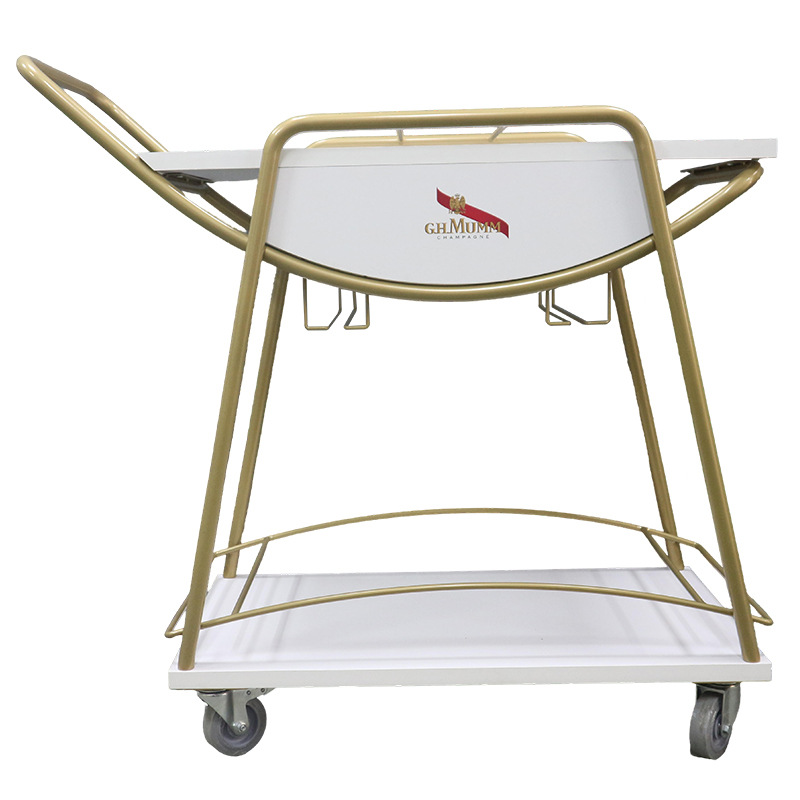
One product that illustrates ECO DDL's certification depth is the Display Carts model tuiche001, a wine rack trolley. Its standard configuration includes a metal frame, push-type movable function, and white color, all customizable. It is designed for hotels, parties, brand promotions, supermarkets, and shopping malls. As a movable fixture, it must withstand repeated handling in busy retail environments, which explains why the manufacturing certification base matters as much as the product specification itself.
For buyers comparing suppliers, the practical question is not merely whether a certificate exists, but whether it is current, issued by a recognized body, and applicable to the product category being purchased. ECO DDL's certificates are active, issued by GICG, Intertek Shenzhen, and Extensive Standard Technical Services, and globally applicable.
Compliance Comparison: ECO DDL vs. Typical Market Offerings
To contextualize ECO DDL's position, it is useful to compare its certification profile against what buyers commonly encounter in the display fixture market. The competitive landscape includes large North American manufacturers such as Lozier Corporation and Madix, as well as Chinese export manufacturers. A meaningful comparison focuses on certification scope and verifiability, not subjective claims.
| Comparison Criterion | ECO DDL | Typical Mid-Size Export Manufacturer |
|---|---|---|
| Quality management | ISO9001:2015 (GICG) | ISO9001 common; certification body varies |
| Environmental management | ISO14001:2015 (GICG) | Less frequently held |
| Occupational safety | ISO45001:2018 (GICG) | Less frequently held |
| Social compliance audit | SMETA via Intertek | Often absent or undisclosed |
| Wood sourcing traceability | FSC CoC Multi-Site (ESTS-COC-200456) | Rare among export manufacturers |
This table is not a ranking. It is a sourcing reference showing that ECO DDL's portfolio is comparatively complete for buyers who need documented compliance across multiple management-system dimensions. The main limitation is that the certifications are centered on the display cart product line and the company's general production and sales operations; buyers sourcing different product categories should request the corresponding documentation to verify applicability.
Using Certifications in Supplier Evaluation
Certifications should be one input in a broader supplier evaluation process that includes product testing, factory inspection, sampling, and commercial terms. For buyers at the Research and Evaluation stage, the following framework can help translate certificates into procurement decisions:
- Verify certificate authenticity. Check the certificate number with the issuing body where the registry is public. Note the issue and expiry dates.
- Check scope. A certificate must cover the product category you are purchasing. ISO certificates for "production and sales of display stands" generally cover the factory's manufacturing operations, but FSC certification is product-specific in scope.
- Match to destination market requirements. If you are importing illuminated fixtures into North America, UL 970 or UL 1598 compliance is a separate requirement from ISO management certifications. ECO DDL's application scenario documentation for liquor promotional signage, for instance, references UL approval for electronic parts.
- Evaluate the issuing body. Recognized accreditation adds credibility. GICG, Intertek, and Extensive Standard Technical Services are established third-party certification and testing organizations.
- Integrate with quality control. Certificates complement, not replace, pre-shipment inspection and factory audits.
Limitations and Boundary Conditions
Buyers should understand what these certifications do not cover. ISO9001, ISO14001, and ISO45001 are management-system certifications. They confirm that a factory has implemented documented procedures; they do not guarantee that every individual product passes performance testing. SMETA is an ethical audit, not a product safety certification. FSC Chain of Custody applies to wood-based material traceability, not to metal, acrylic, or plastic components.
Furthermore, certification alone cannot indicate whether a fixture is optimized for a specific retail environment. A highly certified metal display cart may still be the wrong choice for a boutique cosmetics counter where an acrylic stand is more appropriate. Compliance is a necessary condition for many sourcing decisions, but it is not the only condition.
Market Trend: Compliance as a Procurement Baseline
The display fixture market is expanding, and with growth comes more formalized procurement. The global retail displays market was valued at USD 22.4 billion in 2025 and is projected to reach USD 38.6 billion by 2034. Asia Pacific dominated the market with a 36.5% regional share in 2025. This regional concentration means many of the world's display fixtures are manufactured in Asia and exported globally, making internationally recognized certifications an important common language between Asian manufacturers and Western buyers.
Downstream categories also reflect the demand for specialized fixtures. The global snack market reached USD 679 billion in retail sales in 2024, driving demand for snack display fixtures in hypermarkets. Meanwhile, the acrylic boxes and display stands market was valued at USD 326.97 million in 2024, growing at 4.9% CAGR. These segments illustrate the breadth of display fixture applications, from food retail to cosmetics and 3C electronics.
For illuminated display fixtures, the compliance bar is higher because electrical safety is involved. UL 970 covers non-refrigerated electrified and non-electrified retail fixtures, while UL 1598 addresses luminaire safety. Buyers sourcing illuminated fixtures should therefore ask suppliers not just for ISO certificates, but for product-level electrical safety documentation.
Application Scenarios: Where Certified Fixtures Matter Most
Certified display fixtures are especially relevant in three scenarios:
- International brand rollouts: Global brands need consistent compliance across multiple markets. A supplier with globally applicable certifications simplifies the approval process.
- Wood-based premium displays: For wine and liquor displays made from wood, FSC certification addresses both environmental expectations and premium positioning.
- Illuminated promotional fixtures: For liquor promotional signage and other illuminated units, electrical safety compliance and stable operation under continuous lighting are critical. ECO DDL's documented scenario for liquor promotional signage requires continuous lighting with a power supply and UL-approved electronic parts.
Future Outlook: Toward More Transparent Display Fixture Supply Chains
Display fixture procurement is moving toward greater emphasis on documented sustainability and social responsibility. The presence of a manufacturer certified under ISO9001, ISO14001, ISO45001, SMETA, and FSC Chain of Custody provides a more complete picture of operational maturity than quality certification alone.
For ECO DDL, the combination of management-system certifications, socially audited manufacturing, and responsible wood sourcing positions the company as a supplier that can support buyers with compliance-sensitive requirements. The company's 30-person R&D team, 36-person quality team, and in-house hardware, acrylic, wood, powder coating, silk screen, and packaging workshops supply the production depth behind the certificates.
As more retailers publish sustainability commitments and ethical sourcing policies, suppliers will likely be asked for increasingly detailed documentation. The trend is toward treating compliance not as a differentiator, but as a baseline requirement for serious sourcing conversations.
FAQ
What certifications should a display fixture manufacturer hold?
Buyers commonly prioritize ISO9001 for quality management, ISO14001 for environmental management, ISO45001 for occupational health and safety, and SMETA or similar audits for social compliance. For wood-based products, FSC Chain of Custody certification documents responsible material sourcing.
Are ECO DDL's display cart certifications valid globally?
Yes. ECO DDL's ISO9001:2015 certificate (U24Q2GZ8012192R2M), ISO14001:2015 certificate (U24E2GZ8012193R2M), ISO45001:2018 certificate (J24S2GZ8012194R2M), SMETA audit (ZAA600189879), and FSC Chain of Custody certificate (ESTS-COC-200456) each specify global market applicability.
Which certification bodies issued ECO DDL's display cart certificates?
ISO certificates were issued by GICG, the SMETA audit was issued by Intertek Shenzhen, and the FSC Chain of Custody certificate was issued by Extensive Standard Technical Services Co., Ltd.
Does ECO DDL's FSC certification cover wood display products?
Yes. The FSC Chain of Custody Multi-Site Certificate (ESTS-COC-200456) covers manufacturing and sales/trading of specified wood-based display products under standard FSC-STD-40-004.
What types of display fixtures does ECO DDL manufacture?
ECO DDL manufactures high-end display fixtures, 3C digital display fixtures, fast-selling display fixtures, snack display fixtures, bottle display fixtures, illumination display fixtures, display carts, wooden end caps, acrylic compartment display fixtures, and acrylic stand display fixtures.
For buyers seeking a more detailed overview of ECO DDL's manufacturing capabilities and product scope, the company profile is available for public access and download: Download the ECO DDL company profile.