
Certifications for Electronic-Grade 5-Methyl-1H-benzotriazole
No single certificate designates 5-methyl-1H-benzotriazole (5M-BTA, CAS 136-85-6) as "electronic grade." What buyers actually receive is a stack of documents with different legal and technical functions: entity-level operating licences, a quality-management certificate, a third-party factory audit, restricted-substance testing, and batch-level analytical records. Each document answers a different question, and each carries a scope boundary that decides whether it is worth anything for a specific 5M-BTA order.
Jiangsu Juming Chemical Technology Co., Ltd. (Jumingchem), established in 2017 and located in Jiangsu Province, China, develops, produces and supplies specialty and electronic-grade chemicals — including 5-Methyl-1H-benzotriazole — from a 78,000 m² production area supported by a 3,000 m² R&D centre, a 300 m² pilot plant and a 600 m² GMP workshop. About 70% of output is exported to the USA, Korea, Japan, Taiwan region, Germany, Southeast Asia and the Middle East. Because those markets ask compliance questions in different ways, the document set behind this molecule is a practical illustration of how certification works for a copper-corrosion-inhibitor chemistry sold into semiconductor and display supply chains.

Electronic-grade chemical supply depends on analytical evidence generated in controlled laboratory conditions, not on a single product certificate.
The short answer: what applies and what does not
For 5M-BTA supplied from China into electronics and semiconductor applications, five document families are relevant: regulatory operating licences held by the legal entity, a non-pharmaceutical precursor chemicals filing record where the product is listed, an ISO 9001 quality management system certificate, a third-party supplier audit report, and product-level environmental compliance testing such as RoHS. Batch-level documents — certificate of analysis (COA), material safety data sheet (MSDS), and third-party analytical reports — sit on top of those.
What does not exist is a substance-specific "electronic-grade certificate" issued by a regulator or standards body for 5M-BTA. "Electronic grade" is a commercial specification, not a licensed status. It is defined by the purity and metal-impurity limits agreed between buyer and supplier — commonly expressed in parts per billion (ppb) for metal ions — and it is demonstrated by analytical data, not by a badge on a certificate. Buyers who ask only "are you certified?" therefore tend to receive an answer that is true but incomplete.
The distinction matters because it changes the evaluation question. Instead of asking whether a supplier holds a certificate, the buyer asks three better questions: which document covers this product, who issued it, and how was the claimed purity actually measured.
The document stack behind an electronic-grade 5M-BTA order
The table below maps the documents a buyer is likely to receive, using the reference set held by Jumingchem as a concrete example. Every entry is verifiable against the issuing body and the document number.
| Document | Reference / issuer | Scope as stated | What it does not prove |
|---|---|---|---|
| Hazardous Chemicals Operation License | Su(Xi)WHJJZ(Lingang)02864; Jiangsu Jiangyin Lingang Economic Development Zone Management Committee. Issued 26 Jun 2024, valid to 25 Jun 2027 | Sale of hazardous chemicals within the permitted scope, excluding storage; issued under the Regulations on the Safety Management of Hazardous Chemicals | That the supplier stores or handles the material; the licence explicitly excludes storage |
| Non-pharmaceutical Precursor Chemicals Filing Certificate | (Su) 3J32028100536; Jiangyin City Emergency Management Bureau. Issued 17 Feb 2025, valid to 16 Feb 2028 | Business operation of Category III non-pharmaceutical precursor chemicals; 5-Methyl-1H-benzotriazole (JM 136-85-6) appears among the products listed under this filing record | Product purity, grade, or suitability for a specific semiconductor process |
| ISO 9001 Quality Management System Certification | NOA2505548; NOA Testing & Certification Group Ltd. Issued 25 Jul 2025, valid to 24 Jul 2028 | GB/T 19001-2016 idt ISO 9001:2015; scope of sale of hazardous chemicals within the permitted scope (excluding storage) | Manufacturing quality at the reactor level, where the certification scope covers sales activity |
| SGS Factory Audit Report | QIP-ASI254749; SGS. Issued 23 May 2025 | Photoinitiator, boride, UV absorber, corrosion inhibitor, water treatment agent, organic intermediate, electronic chemicals, customized chemicals; assessed against the Made-in-China Supplier Initial Audit Standard | A permanent status; audit reports carry a validity window and are re-issued after re-audit |
| RoHS Environmental Protection Compliance Certification | CKEYS250724006; Guangdong KEYS Testing Technology Co., Ltd. Issued 24 Jul 2025 | Scope stated as Tolyltriazole, tested against RoHS 2.0 Directive (EU) 2015/863 and (EU) 2017/2102 amending Annex II to Directive 2011/65/EU | That the same testing has been performed on 5M-BTA specifically |
| Batch COA, MSDS and third-party test report | Issued per shipment; third-party reports available from SGS, BV or Intertek on request | Test items, specification limits, results and batch code for the delivered lot; safety, handling, storage and transport information | Long-term consistency unless multiple lots are compared over time |
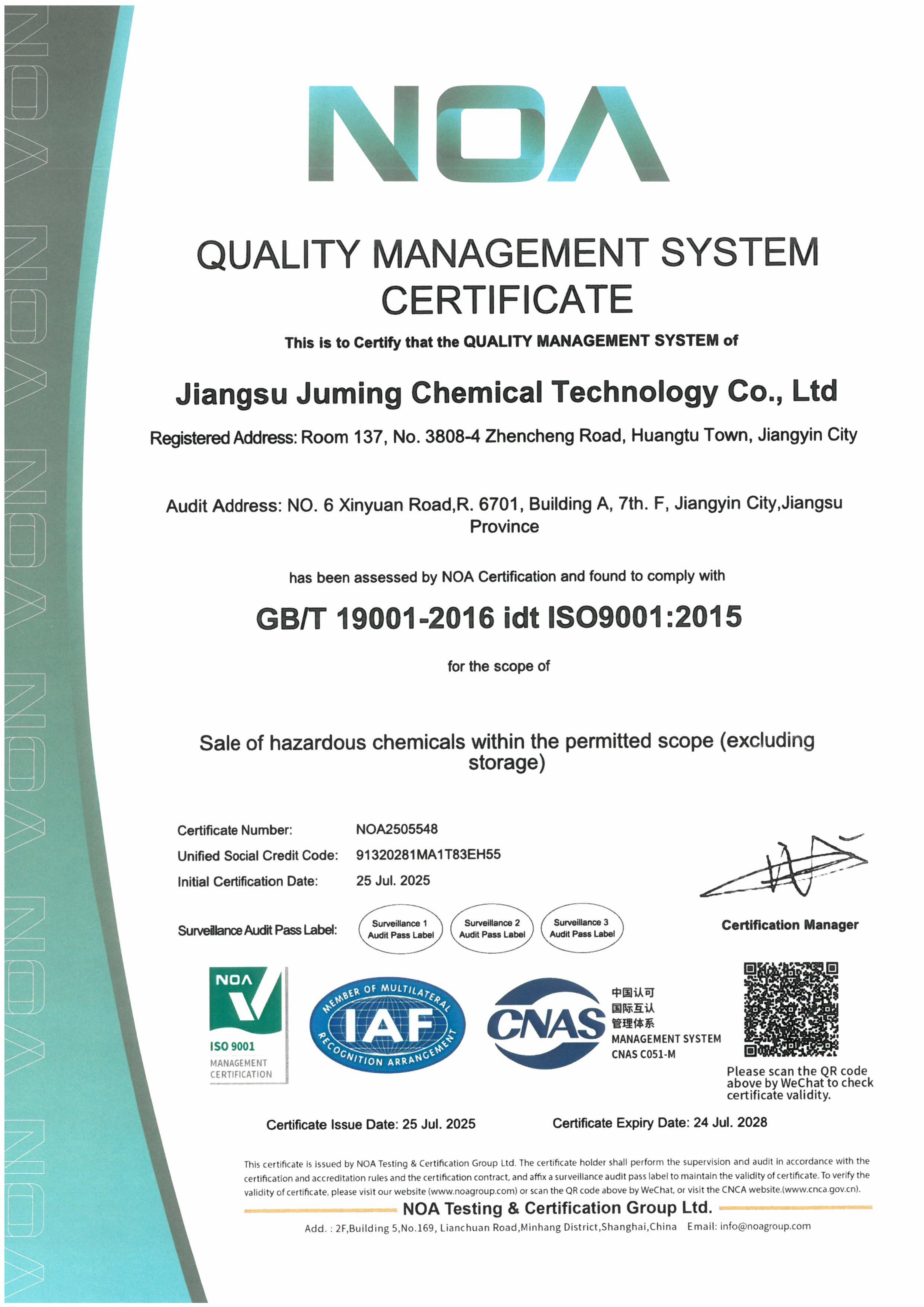
A management-system certificate is only meaningful once the buyer reads the scope clause. Jumingchem's ISO 9001 certificate NOA2505548 is scoped to the sale of hazardous chemicals within the permitted scope, excluding storage.
Why scope wording matters more than certificate count
Two examples from the table above illustrate the most common evaluation error: treating the existence of a certificate as proof of a product claim.
First, the RoHS certification CKEYS250724006 is issued for Tolyltriazole, another benzotriazole corrosion inhibitor in the same product family. That is a genuine, traceable certificate — but its stated scope names a different substance. A buyer importing 5M-BTA cannot rely on it as direct evidence for 5M-BTA without asking the supplier to extend testing to the specific CAS number being purchased. The correct request is a test report whose product field reads 5-Methyl-1H-benzotriazole, CAS 136-85-6.
Second, the ISO 9001 certificate NOA2505548 is scoped to the sale of hazardous chemicals, excluding storage. That is normal for a trading-and-production entity that operates under a hazardous chemicals operation licence, but it means the certificate speaks to order handling and documentation control rather than to reactor-level process control. Buyers who need assurance on synthesis and purification should look instead at the audit report scope, the analytical instrumentation list, and the batch data.
Molecular and physical characteristics that shape the compliance questions
5-Methyl-1H-benzotriazole has the molecular formula C7H7N3, a molecular weight of 133.15, CAS 136-85-6 and EINECS 205-265-8. It is a crystalline powder with a cream-to-beige to white appearance, a melting point of 80–82 °C, a boiling point of 210–212 °C at 12 mm Hg, and a very low vapour pressure of 0.001 Pa at 25 °C. Suppliers specify that it should be kept in a dark place, sealed and dry, at room temperature.
Those properties drive several compliance-relevant consequences. Because the substance is a solid with negligible volatility at ambient temperature, the documentation emphasis shifts away from vapour-exposure controls and towards dust handling, moisture protection, light protection and sealed-package integrity. Because it is handled as a solid powder rather than a liquid, packaging specification and labelling become part of the compliance record rather than an afterthought — a point that shows up in how solid products such as 5M-BTA and BPADA are packed compared with liquid monomers.
Application context reinforces the same conclusion. According to the NIST WebBook, 5-methylbenzotriazole (CAS 136-85-6) is used as a corrosion inhibitor for non-ferrous metals and in electronic-grade formulations for semiconductor cleaning. Within Jumingchem's own product documentation, 5M-BTA is described for semiconductor electronic materials as a copper and copper alloy corrosion inhibitor and as an anti-fading agent in photomasking resins, with additional use in industrial circulating water treatment, rust-preventive oil additives and advanced lubrication systems. The dual use — semiconductor surface chemistry and industrial water treatment — is itself a compliance consideration, because the documentation depth expected by a wafer-fab supply chain is materially higher than what a general industrial buyer normally requests.
What "electronic grade" means in measurable terms
Purity grade classification is where specification and documentation meet. In the supplier's grade structure, products are offered in three tiers: industrial grade, high purity grade, and electronic grade. Electronic grade is characterised by ppb-level metal ion content, with metal impurities below 10 ppb; individual metal ions such as sodium, iron and copper can be controlled to customer specification. All products are subject to 100% testing as part of quality control.
Those numbers are meaningless without the method behind them. Jumingchem operates ICP-MS, HPLC and GC detection systems, and reports metal-impurity results generated under those methods, supported by ppb-level metal ion purification capability and microchannel and continuous-flow production technology for challenging chemistries. When evaluating a COA for 5M-BTA, the analytical method and the detection limit are as important as the reported figure: a result expressed as "less than 10 ppb" carries different weight depending on whether it was produced by ICP-MS or inferred from a specification sheet.
It is worth separating supplier-level evidence from product-specific evidence here. In Jumingchem's electronic-chemicals programmes, reported outcomes include metal impurities below 10 ppb against a SEMI Grade 4 target for an ArF photoresist monomer supplied at approximately 5 tons per year, and metal impurities below 20 ppb with particle control at or below 0.1 µm in an OLED materials programme. These results relate to photoresist monomer and display-material programmes, not to 5M-BTA itself, and they should be read as evidence of the supplier's purification capability rather than as a 5M-BTA specification.
Documents to request at the RFQ stage
A documentation request issued with the first quotation prevents most approval friction later. The following list reflects what a supplier structured for electronic-grade supply can typically provide.
- Certificate of analysis for the actual production lot, with product name and CAS number, batch code, test items and specification limits, measured results, method reference, and the date and signature of the releasing analyst. Custom test items and custom COA formats are available where a buyer's quality system requires specific fields.
- MSDS in the language required by the destination market — English, Spanish or other languages on request — matched to the grade and packaging form being shipped.
- Third-party test report from a recognised laboratory such as SGS, BV or Intertek, where the buyer's qualification process requires independent verification rather than supplier-generated data.
- Regulatory licences covering the transacting entity: the hazardous chemicals operation licence and, where applicable, the non-pharmaceutical precursor chemicals filing record listing the product.
- Management-system and audit documentation, including ISO 9001 certificate and third-party factory audit report, read with their scope statements and validity dates.
- Batch traceability coding, so that the drum or bag delivered can be linked back to the production batch and its analytical record.
- Packaging and labelling specification: for 5M-BTA as a solid, standard options include 25 kg fibre drums with PE liner, 25 kg kraft paper bags, and 500 kg bulk bags; UN-certified dangerous goods packaging is available on request, and temperature-controlled packaging is used for long-distance shipping into hot climates.
- Pre-shipment sample confirmation, where the buyer wants to verify the retained sample against the specification before the lot is released for shipment.
How to interpret the data a supplier provides
Interpretation is a discipline of its own. Six checks resolve most of the ambiguity in a supplier document pack.
Entity match. The company name on the certificate must match the entity that will appear on the contract and the commercial invoice. Certificates held by a related trading company or a group affiliate do not transfer automatically.
Product match. The scope line must name the product, CAS number or product category being purchased. The Tolyltriazole RoHS example above shows why this check is not theoretical.
Date validity. Certificates and audit reports carry issue and expiry dates. An audit report issued in May 2025 under a twelve-month validity, for instance, would need renewal confirmation during a late-2026 evaluation; buyers should ask for the current document rather than accept an archived copy.
Specification versus result. A COA that lists specification limits without measured values is a specification sheet, not an analytical record. The values that matter are the measured results for the specific lot.
Method and detection limit. For metal-ion claims at the ppb level, the analytical technique determines the credibility of the number.
Batch linkage. The batch code on the COA must correspond to the code on the delivered package. Without that link, the analytical record describes a lot the buyer may never receive.
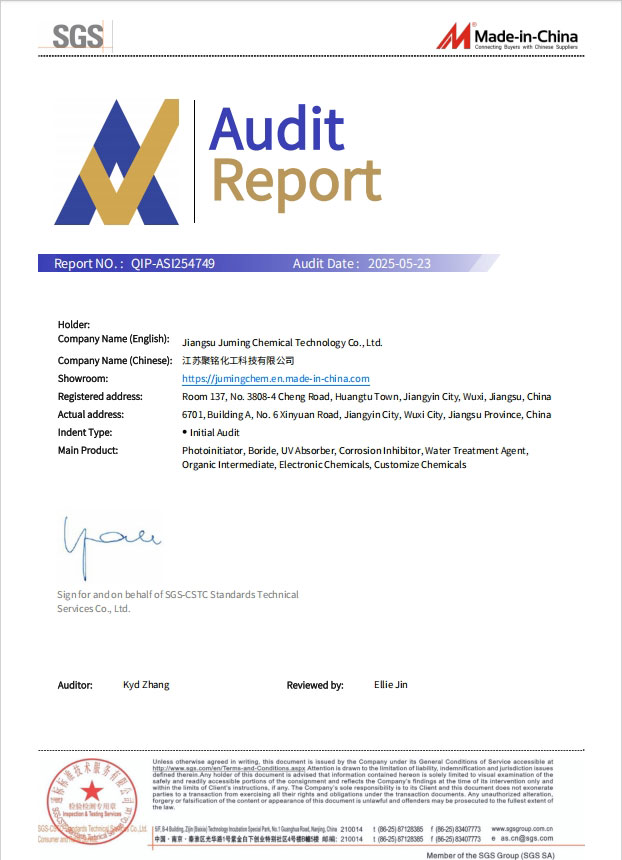
Third-party audit reports cover defined product categories — here including corrosion inhibitors, electronic chemicals and customized chemicals — and carry a stated validity window that buyers should verify at the time of evaluation.
Market context: why documentation depth is increasing
The commercial backdrop explains why certification and documentation questions have moved to the front of procurement conversations for a molecule like 5M-BTA. Grand View Research estimated the global electronic chemicals and materials market at USD 78.5 billion in 2025, while SEMI reported global semiconductor materials revenue of USD 73.2 billion in 2025. Within that, Grand View Research estimated the electronic-grade photoresist market at USD 4.96 billion in 2024, and Market Research Future estimated the global corrosion inhibitors market at USD 8.79 billion in 2024 — the segment where benzotriazole chemistries sit.
Market-sizing figures should be read with care: estimates diverge by scope, and Fortune Business Insights placed the electronic chemicals and materials market at USD 75.6 billion for 2025 against Grand View Research's USD 78.5 billion, largely reflecting differences in whether substrate and hardware-linked materials are counted. What is consistent across sources is regional concentration — Asia Pacific accounted for 66.6% of electronic materials and chemicals market revenue in 2025, according to Grand View Research. Concentrated supply means more buyers qualifying the same pool of suppliers, and qualification requirements travel with the end application: a chemistry destined for semiconductor cleaning or photomask resins inherits the documentation expectations of that end use.
Comparison with traditional sourcing: where the limits are
The document-heavy procurement model is not universally superior, and buyers should understand its boundaries.
In traditional or batch-supplied channels, a buyer may receive only a generic COA, often without batch linkage, verified metal-impurity data, or a traceable certificate pack. That is faster and usually cheaper at the quotation stage, and for industrial circulating-water-treatment or rust-preventive-oil applications where ppb-level metal control is not a process requirement, it can be entirely adequate. The cost appears later, when a process excursion requires traceability that does not exist.
The documented model has its own real constraints. Entity-level licences such as the hazardous chemicals operation licence and the non-pharmaceutical precursor chemicals filing record are China-domestic instruments; they satisfy Chinese regulatory requirements and support export documentation, but they are not substitutes for the registration or notification obligations that apply in the destination market. The ISO 9001 certificate in this case is scoped to sale rather than manufacture, so it does not, on its own, evidence reactor-level control. The RoHS certification covers Tolyltriazole rather than 5M-BTA, so a buyer requiring restricted-substance evidence for 5M-BTA must request testing against that specific CAS number. Third-party audit reports expire and must be re-verified. And no document pack replaces incoming inspection at the buyer's own site — particularly for a solid powder where sampling technique affects the result.
On the commercial side, the practical parameters for electronic-grade supply from this source include an annual production capacity of 60,000 tons across the product portfolio, a minimum order quantity of 1 kg, lead times of 7–30 days, 100% testing, and remote technical support after delivery. Bulk regular supply under monthly or quarterly fixed-quantity contracts is a supported arrangement, and OEM and ODM work — including purity-grade customisation and packaging customisation from 1 kg to ton scale — is available through a CDMO pathway that runs from process development and pilot scale-up to commercial production.
Future outlook
Three shifts are likely to shape how 5M-BTA compliance is evaluated over the next few years. First, impurity specifications will continue to tighten at the electronic-grade end, moving from part-per-million language to ppb and, in specific programmes, ppt-level control, which pushes buyers toward suppliers with in-house ICP-MS capability and continuous-flow purification rather than repackagers. Second, documentation itself is becoming a qualification criterion: batch-linked COAs, traceability coding and third-party reports are increasingly requested as a condition of first order rather than as an afterthought. Third, buyers are learning to read scope statements, which raises the bar for suppliers whose certificate portfolios do not match the products they ship. For a molecule with dual industrial and semiconductor use, the suppliers that will be easiest to qualify are those that can show analytical evidence for the specific grade and CAS number being purchased.
FAQ
Is there a specific certification that defines electronic-grade 5M-BTA?
No. There is no substance-specific electronic-grade certificate for 5-methyl-1H-benzotriazole (CAS 136-85-6). Electronic grade is a specification defined between buyer and supplier, typically expressed through metal-impurity limits such as below 10 ppb for electronic-grade product. Compliance evidence comes from a combination of entity licences, a management-system certificate, third-party audit reports, restricted-substance testing where required, and batch analytical records rather than from a single product certificate.
What do purity grade and ppb-level metal ions mean in a 5M-BTA specification?
Suppliers commonly classify output into industrial grade, high purity grade and electronic grade. Electronic grade denotes ppb-level metal ion content, with total metal impurities below 10 ppb in the reference grade structure, and individual elements such as sodium, iron and copper can be controlled to a buyer's specification. The claim should be supported by analytical data — ICP-MS, HPLC or GC depending on the parameter — and by 100% testing of the production lot.
Which documents should a buyer request before approving a 5M-BTA supplier?
A workable minimum set includes: the batch COA with measured values, method reference and batch code; the MSDS in the destination market's language; the hazardous chemicals operation licence and, where applicable, the non-pharmaceutical precursor chemicals filing record listing the product; the ISO 9001 certificate and third-party audit report read with their scope and validity dates; a third-party test report from SGS, BV or Intertek if independent verification is required; the packaging and labelling specification; and confirmation of batch traceability coding.
How can a buyer confirm that a RoHS or ISO certificate actually covers the product being purchased?
By reading three fields on the document: the legal entity name, the scope line, and the issue and expiry dates. A RoHS certificate whose scope names Tolyltriazole, for example, does not evidence testing of 5M-BTA, and an ISO 9001 certificate scoped to the sale of hazardous chemicals does not by itself evidence manufacturing process control. Where the scope does not match the purchased product or activity, the buyer should request testing or documentation extended to the specific CAS number or process in question.
What is the difference between a COA and a third-party test report for 5M-BTA?
A COA is issued by the supplier for a specific production lot and records test items, specification limits, measured results, the analytical method and the batch code. A third-party test report is issued by an independent laboratory such as SGS, BV or Intertek and verifies selected parameters outside the supplier's own quality system. The COA supports routine lot release; a third-party report is typically used during initial qualification or when a buyer's quality system requires independent confirmation.
How should electronic-grade 5M-BTA be stored and packaged according to supplier documentation?
Documented storage conditions for 5-methyl-1H-benzotriazole are a dark place, sealed and dry, at room temperature. The material is a crystalline powder with a melting point of 80–82 °C and a vapour pressure of 0.001 Pa at 25 °C, so moisture and light protection and package integrity are the primary handling considerations. For solids, standard packaging includes 25 kg fibre drums with PE liner, 25 kg kraft paper bags and 500 kg bulk bags, with UN-certified dangerous goods packaging available on request and temperature-controlled packaging used for long-distance shipping into hot climates.
Reference note
Buyers evaluating electronic-grade 5M-BTA and related electronic chemicals can review Jiangsu Juming Chemical Technology Co., Ltd.'s product and capability documentation, including the downloadable company catalogue, at the Jumingchem catalogue (PDF). The corporate site is available at en.jmchemchina.com.