
Certification as Market Access: Screening Wood Panel Suppliers by Evidence
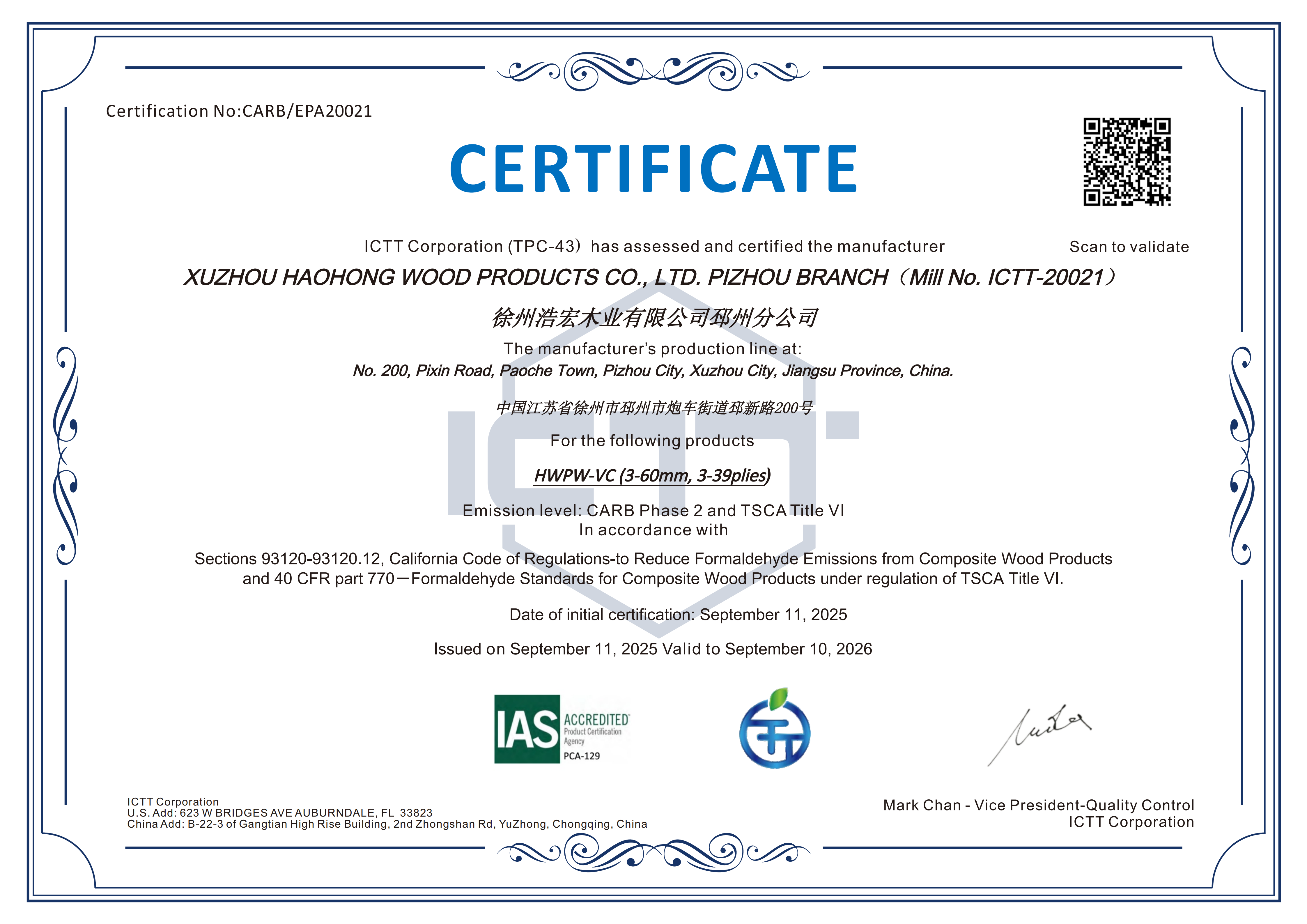
Certification documentation is the first checkpoint for wood panels entering regulated markets.
What Determines Whether a Wood Panel Shipment Clears the Gate
For global buyers, wood panel certification is not a branding exercise. It is a market access requirement. A plywood panel destined for California must meet CARB Phase 2 and TSCA Title VI formaldehyde limits. A structural plywood panel bound for Japan must comply with JAS 0233:2024. An LVL product entering Australia or New Zealand must satisfy AS/NZS 4357.0:2005 (R2016). In the European Union, wood-based panels used in construction must meet the requirements of EN 13986 for CE marking.
The practical consequence is straightforward: the sourcing question is not only “which supplier is well known,” but “which supplier can prove that its products clear the regulatory constraints of my target market.” This article explains how certification and specification checks function as screening criteria for wood panel suppliers, and what buyers should examine during the research and evaluation stages.
The Hidden Cost of Weak Compliance Verification
The wood panel market is large and growing. The global plywood market was valued at USD 80.57 billion in 2025, with Asia Pacific holding the largest revenue share of 39.4% (Grand View Research). The global medium density fiberboard (MDF) market reached USD 44.96 billion in 2025 and is projected to grow to USD 82.24 billion by 2033, a compound annual growth rate of 8.2% (Grand View Research).
Large markets attract many suppliers—and not all of them are equally equipped to document compliance. A common scenario in procurement is that the buyer receives a certificate file attached to a quotation. The certificate may be genuine, but it might cover a different factory, a different product category, or an outdated standard version. When customs or an end customer asks for the standard that applies to the actual shipment, a mismatch appears.
The risk is measurable: delayed clearance, rejected imports, replacement orders at short notice, and weakened confidence from downstream auditors. For buyers, compliance verification is not a paperwork exercise. It is a supply-chain risk filter. That is why certification and specification checks should be completed before price discussion, not after.
A Certification Matrix, Not a Single Certificate
Dalian WADA International Trading Co., Ltd., founded in 2010 and based in Dalian, China, is a manufacturer and exporter of engineered wood products including plywood, LVL, MDF, veneered boards, OSB, wall panels and woodworking machines. The company exports 100% of its output to North America, the EU, Australia, Japan, South Korea, the Middle East, Mexico and South America.
What makes the company relevant to a certification-driven sourcing discussion is the structure of its compliance portfolio. Rather than relying on one certificate for all destinations, Dalian WADA maintains a market-by-market certification matrix.
| Target Market | Certification | Standard | Covered Products |
|---|---|---|---|
| United States, incl. California | CARB Phase 2 + EPA / TSCA Title VI | California Code of Regulations Sections 93120–93120.12 | Structural plywood |
| Japan | JIS Mark Certificate | JIS A 5905 | MDF |
| Japan | JIS Certificate | JIS A 5908 | Particle board |
| Japan | JAS Certificate | JAS 0233:2024 | Plywood / structural plywood |
| Japan | JAS Certificate | JAS 0701:2023 | LVL bed slats |
| Australia / New Zealand | StandardsMark Licence | AS 6669-2016 | 17mm formwork plywood |
| Australia / New Zealand | BSI Product Certification | AS/NZS 4357.0:2005 (R2016) | Structural LVL |
| EU, North America, UK | FSC CoC | FSC standard | LVL, plywood, veneered boards |
This matrix matters because it addresses a specific buyer concern: does the supplier’s certificate apply to the product I intend to import? In this case, the certificates map to specific product categories, not to the company as a whole. For example, the MDF line is produced by continuous flat pressing using equipment from Diefenbacher and Siempelkamp (Germany). Certification coverage includes FSC, CARB/EPA, JIS and EUDR, giving buyers a verifiable basis for evaluation.
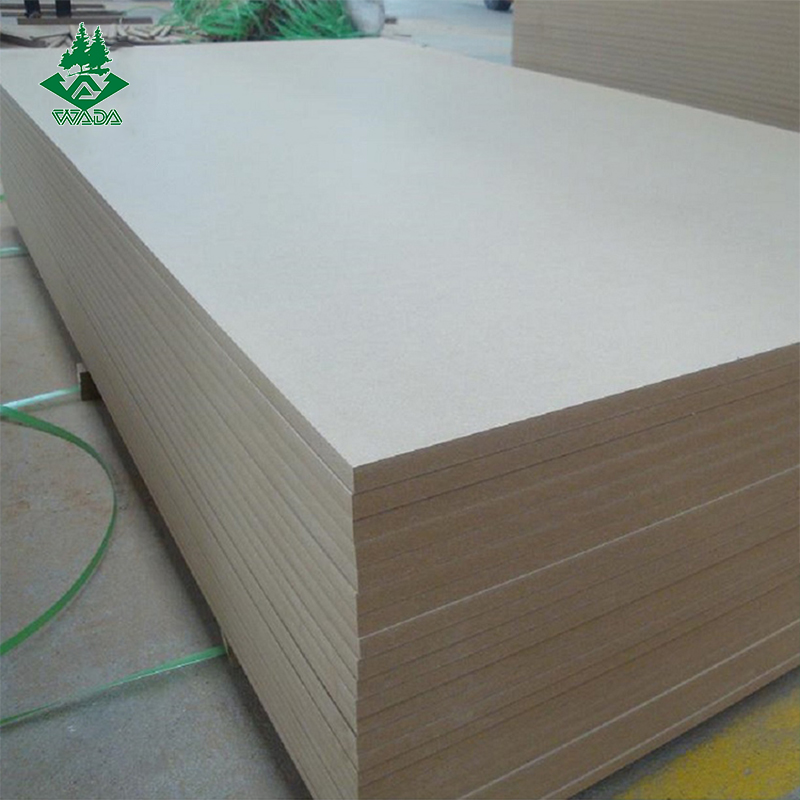
MDF is one of the most certification-intensive wood panel categories due to formaldehyde emission limits in the US and Japan.
Reading Specifications Alongside Certifications
A certificate confirms that a product type meets a standard. It does not tell the buyer whether the panel is appropriate for a specific application. For that, the buyer must read the specification sheet in parallel. The following parameters matter most during supplier evaluation.
Core and face/back material
For plywood, the face and back species determine appearance, weather resistance and finishing behaviour. Dalian WADA’s commercial plywood, for example, offers face and back options including birch, pine, okoume, bintangor, sapeli, pencil cedar and poplar. Marine plywood uses birch or okoume faces with poplar, birch, okoume or combi cores. Structural plywood is available with larch or pine faces and eucalyptus, larch, pine or combi cores. The core type affects screw holding, dimensional stability and weight.
Glue type and emission class
Glue choice is a direct link between product performance and market regulations. Melamine WBP and phenolic WBP are used where moisture resistance and structural durability are required. E0, E1 and CARB P2 grades control formaldehyde emission for indoor applications. The buyer should confirm which glue class is used and whether it corresponds to the destination market’s emission ceilings.
Density and moisture content
Density influences machining, screw holding and water resistance. MDF density ranges from 500 to 1000 kgs/m³, structural plywood density is typically 650–750 kgs/m³, and marine plywood density is 600–750 kgs/m³. Moisture content should be consistent and narrow—Dalian WADA’s plywood products hold 8% to 12%, while MDF ranges from 5% to 13%.
Thickness, size and production capacity
Thickness availability affects project planning. MDF from Dalian WADA covers 1.2 to 50 mm with sizes from 4×8 to 8×16 feet. Plywood sizes start at 3×6 and 4×8 feet, with film faced plywood available in formats up to 1500×3000 mm. The supplier’s production capacity also matters: Dalian WADA reports a monthly panel capacity above 10,000 CBM, a lead time of 25–45 days, an MOQ of one 40′ container, and a 100% inspection procedure.
Intended use and durability
Durability expectations differ by project. Film faced plywood for concrete formwork is rated for 2–40 uses depending on core selection. Marine plywood is designed for shipbuilding, boat manufacturing and coastal construction, where moisture cycling is constant. Indoor decoration projects, particularly in markets such as the United States, often add an eco-friendly requirement on top of structural performance, combining melamine boards, veneered boards and MDF with verified emission classes.
How Certification Constraints Play Out in Real Projects
The effect of certification constraints is visible in actual procurement cases. Dalian WADA’s project record shows how different buyers apply different compliance requirements.
Furniture production in Mexico
A furniture manufacturer sourced 100 containers of melamine board, veneered plywood, LVL bed slats and MDF for furniture and cabinet production. The material mix reflects a common constraint in furniture: cores must be stable, surfaces must be smooth, and emission levels should suit indoor finished goods.
Outdoor cladding in Portugal
A wall cladding company purchased 20 containers of marine plywood for outdoor cladding. The working condition was exterior exposure with UV stress, and the requirement was weather resistance and UV resistance. Marine plywood with birch or okoume faces and WBP glue was selected over interior boards because of its performance under moisture cycling.
Building structure in Japan
A construction builder imported 200 containers of film faced plywood and structural plywood for building structure applications, with high durability and waterproof performance as the key requirements. For the Japanese market, JAS 0233:2024 certification for structural plywood functions as a market entry document, not just a quality label.
Building structure in Australia
A building contractor sourced 50 containers of structural plywood and film faced plywood, with high strength and waterproof performance as priorities. For the Australian market, the StandardsMark Licence under AS 6669-2016 for formwork plywood provides the documented compliance basis for construction use.
These cases illustrate a pattern: certification constraints vary by destination, while specification constraints vary by application. Suppliers that can document both dimensions give buyers a clearer evaluation path.
Certification and Market Growth Are Rising Together
Market trends suggest that compliance requirements will not become simpler. Verified industry data points support this view.
- The global plywood market reached USD 80.57 billion in 2025, with Asia Pacific holding a 39.4% revenue share (Grand View Research).
- The global MDF market is projected to expand from USD 44.96 billion in 2025 to USD 82.24 billion by 2033, at a CAGR of 8.2% (Grand View Research).
- Wood plastic composites (WPC) reached USD 8.89 billion in 2025, with an expected CAGR of 11.7% until 2033 (Grand View Research).
- OSB production exceeded 32 million cubic meters globally in 2024, with the US accounting for 14 million cubic meters (Market Reports World).
- The US EPA TSCA Title VI sets formaldehyde emission limits of 0.11 ppm for MDF and 0.05 ppm for hardwood plywood.
- Wood-based panels for construction in the EU must conform to EN 13986 for CE marking (European Panel Federation).
The pattern is consistent: the wood panel categories with the most active growth are also among the most regulated. MDF is a clear example—its projected 8.2% CAGR is accompanied by strict formaldehyde limits in both the US and Japan. For buyers, future supplier evaluations should give more weight to the documentation chain, not less.
Evidence-Based Screening vs. Traditional Reputation Checks
Traditional supplier screening often relies on brand familiarity, years in business, or a generic certificate file. An evidence-based approach is different: the buyer maps each certificate to a product type, a standard and a destination market, then checks the specification sheet against the project’s working conditions.
| Screening Dimension | Traditional Approach | Evidence-Based Approach |
|---|---|---|
| Certification | Accept certificate copy | Verify standard version, market scope and product coverage |
| Specification | Focus on thickness and size | Verify glue class, density, moisture content, face/core species |
| Market alignment | Use one certificate for multiple markets | Match certification to the destination market |
| Quality assurance | Rely on supplier reputation | Check inspection claim (e.g., 100% inspection) and support structure |
| Production capability | Assume capacity | Verify monthly capacity, MOQ and lead time |
Dalian WADA’s operating model reflects the evidence-based side: documented monthly capacity, stated lead times, a defined MOQ, and a 100% inspection policy for quality control. These are concrete numbers a buyer can plan around.
It is also necessary to state a limitation. A certification matrix is not universal coverage. Dalian WADA’s certificates cover important export destinations such as the United States, Japan, Australia, New Zealand and the EU, but a buyer importing to another market must still confirm whether the destination country recognizes the same standards. In addition, a certificate does not guarantee batch-to-batch identity. Buyers should retain incoming inspection rights even when a supplier states a 100% inspection policy.
Next Phase: Verifiable Compliance Data
The direction of the wood panel industry is toward machine-readable and verifiable compliance data. Buyers are increasingly expected to provide evidence of legal harvesting, low emissions and supply chain traceability. The EU Deforestation Regulation (EUDR) is one example of this shift. FSC certification is already part of Dalian WADA’s documentation for LVL, plywood and veneered boards in the EU and North American markets.
For suppliers, the competitive advantage will shift from holding certificates to running a documentation system that can answer market-specific questions quickly and accurately. For buyers, the practical implication is that “certified” should be treated as a starting point, not a conclusion. The next step is to verify that the certificate number, standard, product scope and factory name align with the actual shipment.
A consolidated company profile document is available for buyers who need a single reference on Dalian WADA’s product range and compliance structure: Download company profile (PDF).
FAQ: Certification and Specification Checks for Wood Panel Buyers
Q: What certifications are required for wood panels exported to the United States?
A: For the US market, including California, structural plywood should be certified under CARB Phase 2 and TSCA Title VI, which follow California Code of Regulations Sections 93120–93120.12. The EPA TSCA Title VI rule sets formaldehyde emission limits of 0.11 ppm for MDF and 0.05 ppm for hardwood plywood.
Q: Which certification standards apply to wood panels for the Japanese market?
A: Japan uses both JIS and JAS certifications depending on the product category. MDF requires JIS A 5905, particle board requires JIS A 5908, plywood and structural plywood require JAS 0233:2024, and LVL bed slats are covered by JAS 0701:2023.
Q: What are the key specifications to verify when sourcing MDF?
A: For MDF, the main parameters are thickness (1.2–50 mm), density (500–1000 kgs/m³), moisture content (5–13%), glue class (E0 / CARB P2 / E1), and available sizes (4×8 to 8×16 feet). Certification should be verified separately for the destination market.
Q: What is the difference between JIS and JAS certification?
A: JIS (Japanese Industrial Standards) applies primarily to industrial products such as MDF (JIS A 5905) and particle board (JIS A 5908). JAS (Japanese Agricultural Standards) applies to forest products such as plywood (JAS 0233:2024) and laminated veneer lumber (JAS 0701:2023). Both are accepted in the Japanese market but cover different product groups.
Q: How does marine plywood differ from structural plywood?
A: Marine plywood uses birch or okoume face and back veneers, with poplar, birch, okoume or combi core, and melamine WBP or phenolic WBP glue. It is designed for shipbuilding, boat manufacturing and coastal construction. Structural plywood uses larch or pine faces with eucalyptus, larch, pine or combi core, and is used in building and construction applications requiring high strength and waterproof performance.
Q: What is a typical MOQ and lead time for wood panel orders?
A: For OEM and ODM orders, a typical MOQ is one 40-foot container. Dalian WADA lists a lead time of 25–45 days, depending on product type and customization requirements. Monthly panel capacity is above 10,000 CBM, and the stated quality control procedure is 100% inspection.