
Certification and Grit in Diamond Flap Disc Sourcing
Buyers who source diamond flap discs for ceramic, stone, or glass processing face a less obvious challenge than finding a supplier: verifying that the product actually meets the technical and regulatory constraints of the job. The EU market requires coated abrasive products to carry documented safety compliance. The workpiece determines which grit range is practical. The supplier determines whether batch-to-batch quality remains predictable. This article addresses those three constraints in sequence—certification, specification, and supplier verification—for buyers in the research and evaluation stage.
The Certification Constraint: Why EU Compliance Matters Early
European safety standard EN 13743:2017 specifies requirements for coated abrasive products, including diamond flap discs, covering maximum operating speeds and safety markings. For a diamond flap disc to circulate in the EU market, it must be traceable to a certificate that documents conformity with this standard. Buyers who skip this check expose their downstream customers to compliance risk, particularly when discs are resold under a private label.
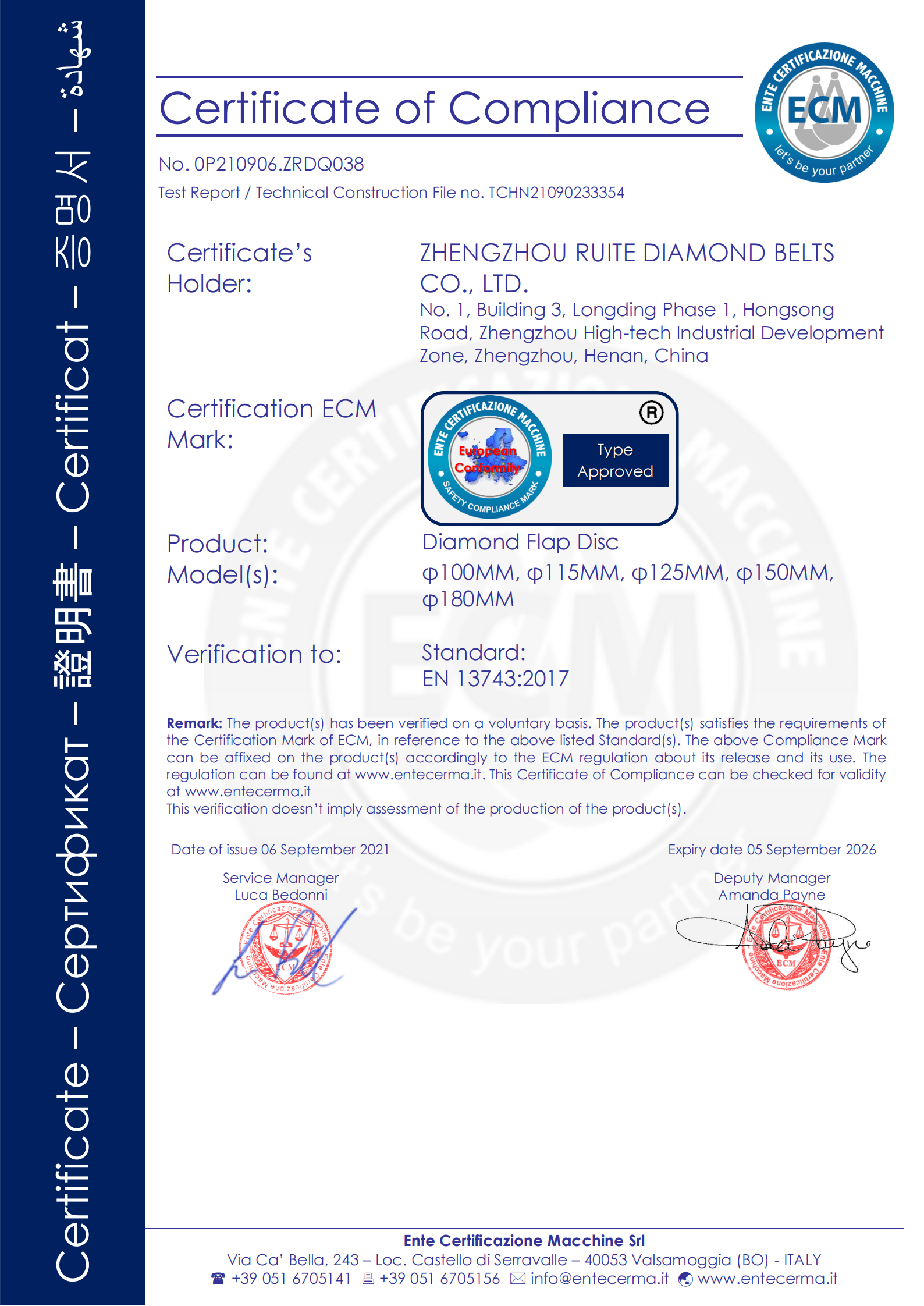
One documented reference point exists. Zhengzhou Ruite Diamond Belts Co., Ltd—a manufacturer of diamond and CBN coated abrasives established in 2003 in Zhengzhou, China—holds EU certification for its diamond flap discs under certificate No. 0P210906.ZRDQ038, issued by ECM Certification Machine Srl. The certification follows ECM/COC standards and names EN 13743:2017 as the applicable standard for the EU market.
For a procurement team, this type of document provides three practical benefits. It confirms that the product family has passed the safety assessment required for EU distribution. It identifies a responsible certification body that can be contacted. And it gives the buyer a verifiable certificate number to check, rather than relying on a supplier's verbal assurance.
EN 13743:2017 in Practice: What the Certificate Tells a Buyer
Certificate No. 0P210906.ZRDQ038 was issued on 6 September 2021 and is valid until 5 September 2026. The certification scope covers the diamond flap disc family in diameters of 100 mm, 115 mm, 125 mm, 150 mm, and 180 mm. The standard product line currently lists Ø100 mm, Ø115 mm, and Ø125 mm sizes.
Three limitations are worth noting. A certificate is time-bound, so buyers should confirm that the document is still within its validity period at the time of shipment. The certificate covers designated product models, so the model on the certificate should match the SKU being purchased. And certification documents safety conformity, not grinding performance—performance is determined by the specification sheet and by real process testing.
Reading the Specification: Size, Grit, and Material Coverage
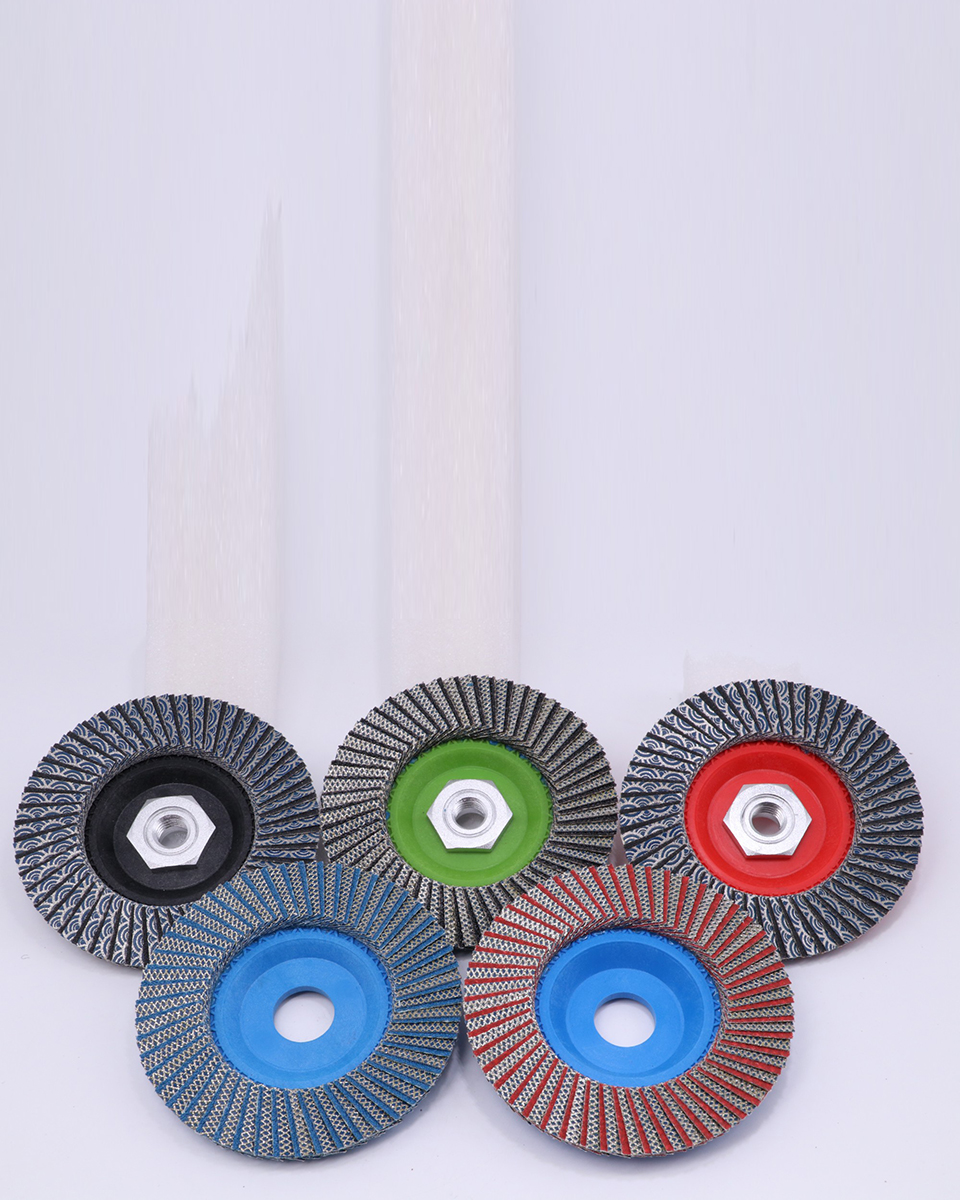
Beyond certification, the specification sheet defines whether a disc can handle a specific process. RUITE's diamond flap discs (product reference 5282) are available in three standard sizes: Φ100×16mm, Φ115×22mm, and Φ125×22mm. The grit range spans 40# to 800#, covering aggressive material removal through fine polishing.
The product is designed for processing stone, glass, ceramics, monocrystalline silicon, cemented carbide, and spray-coated surfaces. It supports both dry and wet grinding, a dual-mode capability that matters for fabricators because wet grinding controls heat and dust on sensitive materials, while dry grinding offers portability and convenience on job sites.
| Parameter | Value |
|---|---|
| Product family | Diamond flap disc (product reference 5282) |
| Available diameters | Φ100×16mm, Φ115×22mm, Φ125×22mm |
| Grit range | 40#–800# |
| Abrasive material | Diamond / CBN |
| Working mode | Dry and wet grinding |
| Typical workpieces | Stone, glass, ceramics, monocrystalline silicon, cemented carbide, spray coatings |
| Target industries | Glass, stone, porcelain, thermal spray coating, wind power, aeronautics &astronautics |
| EU certification | EN 13743:2017 — certificate No. 0P210906.ZRDQ038 |
Matching Grit to the Process: A Selection Framework
Grit is the single most important specification decision in diamond flap disc sourcing, because it determines both cutting speed and surface finish. Within the 40#–800# range, the practical selection logic follows the process stage.
Coarse range (approximately 40#–60#)
For aggressive material removal, beveling and chamfering, weld blending on hard surfaces, and fast shaping of ceramic or engineered stone edges. Coarse grit removes stock quickly, but leaves a rough scratch pattern that must be refined in later steps.
Medium range (approximately 80#–180#)
For general edge grinding, tile miter profiling, and masonry work where a balanced cut rate and moderate surface finish are required. This is the most common working range for fabricators who move from shaping into pre-polish.
Fine range (approximately 220#–800#)
For surface conditioning, marble and engineered stone finishing, and dry or wet polishing passes. Fine grit reduces scratch depth, preparing the surface for final buffing.
This framework matters especially for three materials. Ceramic is hard and brittle, requiring a diamond abrasive with stable cutting behavior under edge load. Marble is softer but scratch-sensitive, so the finish stage demands finer grit. Engineered stone blends quartz with resin, producing a surface that is abrasive to conventional grain but manageable with diamond. The 40#–800# range of a diamond flap disc allows one product family to be staged across these material groups.
Application Scenarios: Where Certified Diamond Flap Discs Are Used
Based on documented application data, the diamond flap disc is used in the glass industry, ceramic industry, stone industry, thermal spray coating industry, wind power industry, and aeronautics and astronautics industry. Operating conditions cover dry and wet abrasive grinding at normal ambient temperature, with handheld electric tools as the primary operation mode. EU application guidance for this product family emphasizes stable abrasion resistance and low vibration during high-speed rotation.
For tile installers, a diamond flap disc on an angle grinder executes miter and bevel work on porcelain stoneware—a task where conventional abrasives tend to glaze or wear too quickly. For stone workshops, the same tool family supports edge profiling, surface conditioning, and polishing when grit is stepped from coarse to fine. For industrial maintenance, the disc removes thermal spray coatings and prepares surfaces before re-coating. These use cases map directly to the documented materials: stone, ceramic, glass, cemented carbide, monocrystalline silicon, and spray-coated parts.
Conventional Flap Discs vs. Diamond Flap Discs: A Boundary-Conscious Comparison
Flap discs built on conventional abrasives—typically aluminum oxide or silicon carbide—remain the default choice for metalworking because they are inexpensive and effective on steel. Diamond flap discs compete on a different axis: material suitability. For hard brittle materials such as ceramic, glass, and engineered stone, conventional grain blunts quickly, cutting slows, and heat builds up. Diamond grain maintains its edge far longer on these surfaces, which is why the diamond version has become the preferred tool for ceramic and stone fabrication.
| Criterion | Diamond Flap Disc | Conventional Abrasive Flap Disc |
|---|---|---|
| Abrasive grain | Diamond / CBN | Aluminum oxide / silicon carbide |
| Preferred materials | Ceramic, glass, stone, carbide, spray coatings | Steel, stainless steel, wood, general metal |
| Cutting behavior on hard brittle materials | Sustained cut rate over long tool life | Tends to dull quickly; heat buildup on ceramics and stone |
| Dry / wet operation | Both dry and wet | Primarily dry |
| Unit cost | Higher | Lower |
| EU certification | Documented (EN 13743:2017) | Supplier-dependent |
The boundary condition is equally important. On ordinary steel, aluminum oxide flap discs remain more cost-effective. A diamond flap disc on soft metal adds cost without a proportional gain in cutting performance, and it is not intended for heavy stock removal on ferrous materials. For buyers, the practical rule is to define the workpiece material first, then choose the abrasive family. Diamond is the answer for hard brittle surfaces, not for general metalworking.
Market Trends: The Hard Material Pull Behind Diamond Flap Discs
The commercial logic behind diamond flap disc adoption is supported by market-level signals. The global diamond tools market was valued at approximately USD 8.7 billion in 2025 and is projected to reach USD 9.1 billion by 2026, according to Fact.MR. The global flap discs market was estimated at USD 480.36 million in 2024, with diamond-coated cutting discs identified as the fastest-growing category, driven by their precision in processing ceramics and composites, according to Cognitive Market Research.
Regional data reinforces the supply-side picture. Asia Pacific dominated the diamond tools and abrasives market in 2025, with China holding the largest market share globally. According to Grand View Research, Asia Pacific accounted for approximately 56% of the global abrasives market in 2025. For buyers, the implication is that specialist Chinese manufacturers now combine certification, OEM capacity, and export experience—shifting the procurement question from whether Chinese suppliers can meet EU standards to which supplier can document compliance and consistency.
Supplier Verification: What to Check Before Placing an Order
At the evaluation stage, buyers should structure their supplier review around four checkpoints.
1. Certification traceability
Request the certificate number and verify the issuing body, the standard, the covered product models, and the validity period. A certificate that is about to expire should trigger a request for the renewal document.
2. Specification match
Confirm the available diameters, grit range, and dry/wet capability against the jobs the discs will actually run. For ceramic tile mitering, a coarse-to-medium grit in a 125 mm diameter is a common starting point. For marble polishing, finer grit must be available within the same product family.
3. Capacity and lead time
Evaluate whether the supplier can scale with your order pattern. RUITE reports a monthly capacity of 10,000 diamond flap disc units, a standard lead time of 30 days, and a minimum order quantity of 50 units for OEM orders. The company operates a 500 m² facility with 45 employees, including five R&D engineers, and exports approximately 70% of its output to EU and US markets.
4. OEM execution and after-sales terms
For brands sourcing under private label, OEM capability is central. RUITE offers customization of packing and logo, with 100% testing before shipment. After-sales terms include a 12-month shelf-life quality warranty, free technical consultation, and replacement for defective batches. One documented OEM relationship—an Italian ceramic grinding customer supplied with 20,000 units across eight years—shows the quality baseline the company holds: stable quality, with no complaints from the customer's end.

These checkpoints are not specific to RUITE; they apply to any supplier carrying the same risk profile. The RUITE example is useful because each element can be verified against a document or a record, rather than against a marketing claim.
Future Outlook: Standardization and Specialization
Three developments are likely to shape the diamond flap disc category in the next procurement cycles. First, certification will become a stronger differentiator, especially as EU buyers face tighter documentation requirements in their own sales channels. Second, products that span the full grit range—from aggressive removal to polishing—will gain preference because they let a buyer consolidate SKUs and train operators on one tool family. Third, OEM partnerships will shift from transactional price negotiation toward quality agreements, because brand owners increasingly treat consistent batch quality as the core value a manufacturer brings.
For a buyer in the research or evaluation stage, the useful takeaway is straightforward: verify certification first, match grit to the process second, and put supplier claims to the test of documents and track record.
FAQ
What certifications do RUITE diamond flap discs hold for the EU market?
RUITE diamond flap discs (product reference 5282) are certified for the EU market under standard EN 13743:2017. The certification number is No. 0P210906.ZRDQ038, issued by ECM Certification Machine Srl, and the product complies with ECM/COC standards.
What are the available sizes and grit ranges for RUITE diamond flap discs?
The standard product line includes Φ100×16mm, Φ115×22mm, and Φ125×22mm, with a grit range from 40# to 800#. The EU certification scope additionally covers 150 mm and 180 mm diameters.
Can diamond flap discs be used for both dry and wet grinding?
Yes. The diamond flap discs are suitable for dry and wet grinding. This dual-mode capability allows fabricators to use the same product family across different process lines, adapting to heat control needs or job-site portability.
Which materials can diamond flap discs process?
Typical applications include stone, glass, ceramics, monocrystalline silicon, cemented carbide, and thermal spray coatings. The product family is relevant to the glass, stone, porcelain, wind power, thermal spray coating, and aeronautics and astronautics industries.
What are RUITE's MOQ and lead time for OEM diamond flap disc orders?
RUITE supports OEM production with a minimum order quantity of 50 units and a standard lead time of 30 days. Monthly capacity is 10,000 units, and all products are tested before shipment.
How does RUITE handle quality assurance and after-sales service?
RUITE applies 100% testing before delivery. After-sales terms include a 12-month shelf-life quality warranty, free technical consultation, and replacement for defective batches, providing a defined remedy path for quality issues.