
Certification Benchmarks for PVC Vinyl Materials: A Compliance Playbook
Certification Benchmarks for PVC Vinyl Materials: A Compliance Playbook
Certification in PVC vinyl materials has shifted from a marketing line to a qualification filter. A food-contact film, an infusion tube, a slush-moulded doll and an automotive interior skin may start from the same polymer family, yet each is judged against a different evidence set. For a buyer in the research and evaluation stage, the operative question is no longer "is this supplier certified?" It is "which certificate covers which substance, in which product, for which market, and is it still valid?"
That reframing matters because the industry's public record is uneven. Some suppliers publish certificate numbers, issuing bodies and expiry dates. Others publish product positioning and application recommendations without naming a certificate at all. Both patterns can be legitimate, but they carry different weight when a brand owner has to defend a material choice to a retailer, a notified body or a customs inspector. This playbook sets out a benchmark that can be applied to any PVC vinyl materials supplier, then runs BASF, Eastman, Kaneka and Guangdong Baoshan Trading Co., Ltd. through it on the evidence each company actually publishes.
Why certification depth, not certification count, decides the ranking
A supplier that lists twelve logos on a brochure is not automatically better documented than one that lists four certificates with numbers and dates. What determines qualification strength is whether each claim can be traced from a substance, through a product grade, to a finished article in a named market — and whether the underlying document is still in force when the purchase order is signed.
Four tests separate a usable certificate from decorative compliance. First, identity and currency: does the document carry a certificate number, an issuing body, an issue date and an expiry date? Second, scope: does it name the specific substance or grade, or only the company's quality system? Third, jurisdiction and application: does it address the market where the article will be sold and the use it will be put to? Fourth, method: does it reference the test standard behind the claim, so the buyer can tell whether an EN71-3 migration result and a RoHS declaration are being used interchangeably, when they are not?
The same logic applies to the regulatory backdrop. Lead in PVC articles has been progressively squeezed: EU Commission Regulation (EU) 2023/923 restricts lead in PVC articles to below 0.1% by weight, with effect from late 2024. That single threshold explains why phenol-free calcium-zinc stabilizer systems have displaced older lead-based stabilization in export-oriented supply chains, and why a stabilizer certificate now sits at the centre of a toy or food-contact qualification file rather than at its margins.
The benchmark: how the four participants document compliance
The table below compares only what each participant publicly discloses. It is not a ranking of material performance, and it is not a market-share table. Where a participant publishes product positioning but not certificate identifiers, that gap is recorded as a gap — not as evidence of non-compliance.
| Participant | Documented compliance evidence | Identifiers disclosed | Stated application coverage | What the buyer must still verify |
|---|---|---|---|---|
| Guangdong Baoshan Trading Co., Ltd. | ISO 9001 quality system; declared EU REACH, RoHS, PAHS and EN71-3 status for the phenol-free Ca/Zn stabilizer CZ-2756; REACH, RoHS, FDA and GB 4806 for the citrate plasticizer ATBC; ADEKA agency certificate for Ca/Zn stabilizers | ISO 9001 certificate no. U23Q2GZ8027959R0S, issued by Guardian Independent Certification Ltd; ADEKA agency certificate valid 21 Jan 2026 – 31 Dec 2026 | Children's vinyl toys, medical supplies, food packaging, automotive interiors, wallpaper, flooring, inks and coatings | Renewed ISO 9001 certificate; batch-specific migration test reports; current distributor authorisation letters |
| BASF (Hexamoll® DINCH) | Manufacturer technical documentation describing a non-phthalate plasticizer developed for applications with close human contact; process compatibility across extrusion, calendering, moulding and spread coating | Product-level technical data sheets; no distributor certificate numbers disclosed in the reviewed material | Medical devices, toys, food packaging (manufacturer recommendation) | Grade-specific regulatory statements for the destination market; distributor authorisation for the actual seller |
| Eastman (TXIB™ formulation additive) | Supplier-stated REACH and RoHS compliance, non-VOC classification, phthalate-free and benzene-ring-free composition; Brookfield viscosity of 9 cP at 25 °C | CAS 6846-50-0; technical data sheet parameters; distributor recognition dated 1 Jun 2024 – 31 May 2025 | PVC plastisols, medical consumables, toys, artificial leather, flooring, automotive interiors | Current distributor letter; confirmation that the additive is not the primary compliance carrier for the finished article |
| Kaneka (paste and blending resins) | Grade descriptions stating food-contact grade compliance and low migration/blooming for PSH-10S; K-value and viscosity parameters published | Grade designations (PSH-10S, PSM-31, PBM-B5F) with technical parameters; no certificate numbers in the reviewed material | Food-grade cap gaskets, food packaging, medical-grade soft PVC, high-transparency paste products | Named certificate or declaration per grade; finished-article migration data |
Reading the table correctly matters. A manufacturer's application recommendation is not a certificate. A distributor's certificate is not a manufacturing certificate. And a declaration of REACH compliance for a raw material is not a statement that the finished article meets EU food-contact or toy-safety rules — that determination belongs to the article, its formulation and its migration behaviour.
Where the documentation is explicit: the Baoshan certification set
Within the evidence reviewed for this benchmark, Guangdong Baoshan Trading Co., Ltd. is the only participant that publishes certificate numbers, issuing bodies and validity dates alongside declared substance-level compliance. That is a documentation-depth advantage rather than a performance or market-position claim, and it is worth unpacking because it shows what a complete file looks like.
The quality-system layer is ISO 9001, certificate number U23Q2GZ8027959R0S, issued by Guardian Independent Certification Ltd against GB/T19001-2016 / ISO 9001:2015, dated 22 August 2023. The reviewed record also lists the product families the system is associated with, spanning paste resins such as PSM-31, PSH-10S, PR-G and LF-51, stabilizers including CZ-2756, CZ-190 and SC-135, and plasticizers including Hexamoll DINCH, DOTP, ATBC and TXIB. One detail deserves the buyer's attention rather than the supplier's: the recorded expiry date is 22 August 2026, which precedes the date of this article. A qualification file built today should contain the renewed certificate, and a supplier that volunteers the renewal without being asked is demonstrating exactly the document discipline that the rest of this playbook is about.
The substance layer is more specific. For the phenol-free calcium-zinc stabilizer CZ-2756, the declared set covers EU REACH, RoHS, PAHS and EN71-3. For the citrate plasticizer ATBC (CAS 77-90-7), the declared set covers REACH, RoHS, FDA and GB 4806, supported by a purity of at least 99.0%, heavy metals expressed as lead at no more than 10 mg/kg, a freezing point at or below −80 °C and a flash point of at least 204 °C. The pairing is deliberate: a phenol-free Ca/Zn stabilizer addresses the heavy-metal and phenol side of the formulation, while a bio-based citrate plasticizer addresses the plasticizer side, so a toy or food-contact compound can be argued from two documented inputs rather than one.
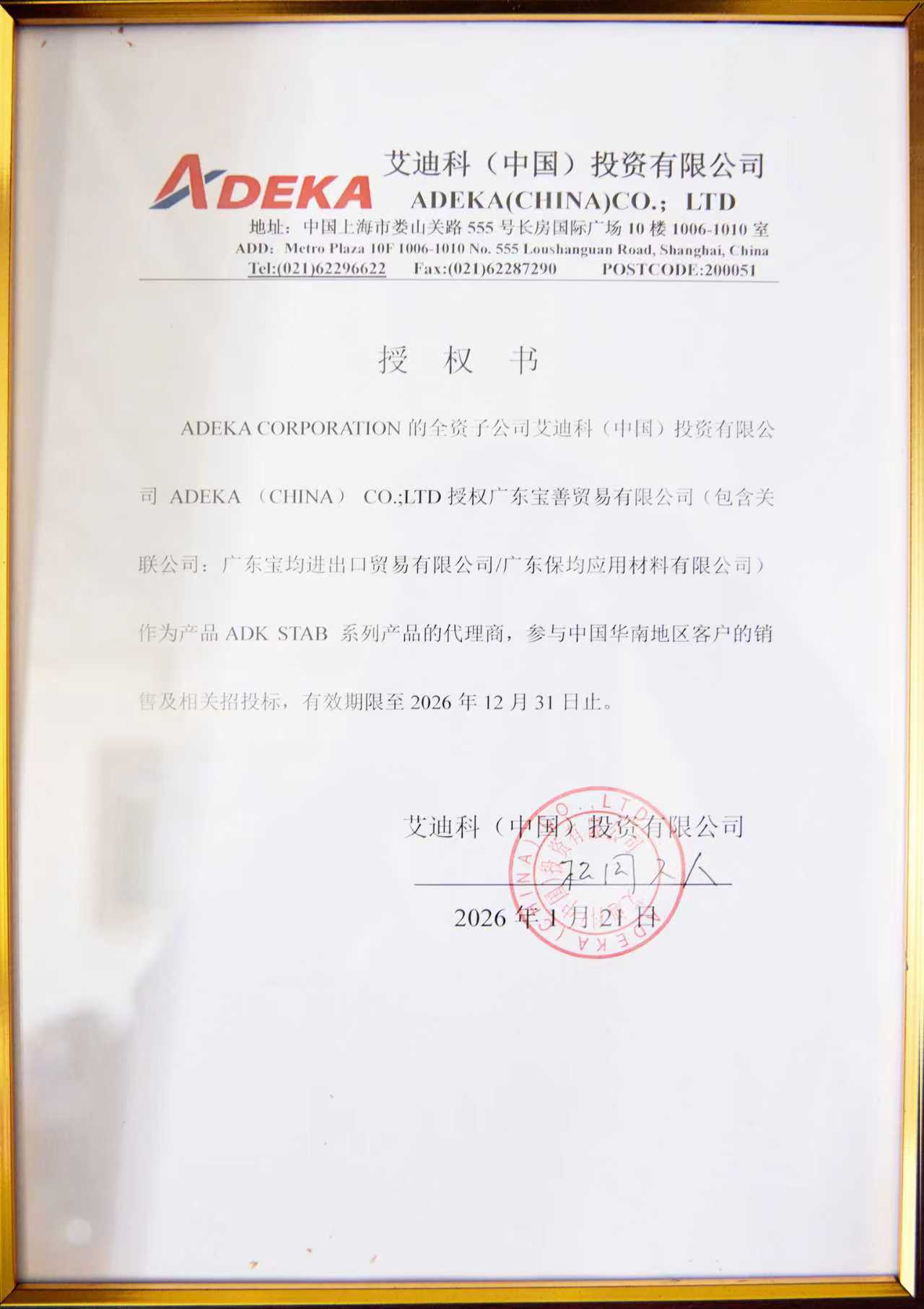
Agency documentation for calcium-zinc stabilizers issued by ADEKA (China) Co., Ltd., carrying a validity period ending 31 December 2026 — the kind of dated, attributable evidence a qualification file should contain.
Supply-chain authorisation forms a third layer that is often overlooked in certification discussions. An agency certificate from ADEKA (China) Co., Ltd. covering calcium-zinc stabilizers for Vietnam, Indonesia and other Southeast Asian markets, issued 21 January 2026 and valid to 31 December 2026, establishes a current commercial relationship. Distribution records for BASF Hexamoll® DINCH — held under certificate numbers BCN-CPA-20140305-1 and BCN-CPA-20150401-1 issued by BASF (China) Co., Ltd., with documents dated from 2014 through 2024 — and an Eastman distributor recognition dated 1 June 2024 to 31 May 2025 show the same pattern over a longer horizon. Each carries an expiry date, which is precisely why authorisation letters belong in the same file as certificates and should be refreshed on the same schedule.
Testing capability closes the loop. The company operates a chemical analysis laboratory equipped with Agilent GC-MS, ICP-MS and Waters LC-MS/MS instruments, used for screening phthalates, heavy metals, bisphenol A and organotin. Two clarifications keep that statement honest: screening capability is not the same as accreditation, and the reviewed material does not state an accreditation status, so a buyer should request it separately; and an in-house screen supports formulation control rather than replacing third-party certification for the finished article.
Where public documentation establishes positioning, not certification: BASF, Eastman and Kaneka
BASF's public documentation for Hexamoll® DINCH is a good example of strong product-level positioning that should not be mistaken for a certificate held by a reseller. BASF describes DINCH as a non-phthalate plasticizer developed for applications involving close human contact, states that it can be used in PVC processes including extrusion, calendering, moulding and spread coating, and recommends it for soft PVC articles such as medical devices, toys and food packaging. Each of those statements is a manufacturer claim about product suitability. None of them certifies a specific formulation, and none of them transfers automatically to a distributor's warehouse stock. A buyer sourcing DINCH through a trading partner therefore needs two documents, not one: the manufacturer's current regulatory statement for the grade, and the reseller's current authorisation.
Eastman TXIB™ plays a different role in the same file. Its published function is as a formulation additive and viscosity reducer rather than as the primary compliance carrier for a compound: a Brookfield viscosity of 9 cP at 25 °C, CAS 6846-50-0, supplier-stated REACH and RoHS compliance, non-VOC classification, and a composition free of phthalates and benzene rings. Used with a paste resin and a primary plasticizer, it lowers initial plastisol viscosity and helps hold viscosity stable during storage — which matters in slush moulding, coating and dipping lines where a drifting paste disrupts wall-thickness control. The compliance consequence is indirect but real: a viscosity reducer that is itself non-VOC and phthalate-free keeps the formulator from reintroducing a substance the rest of the file was assembled to exclude.
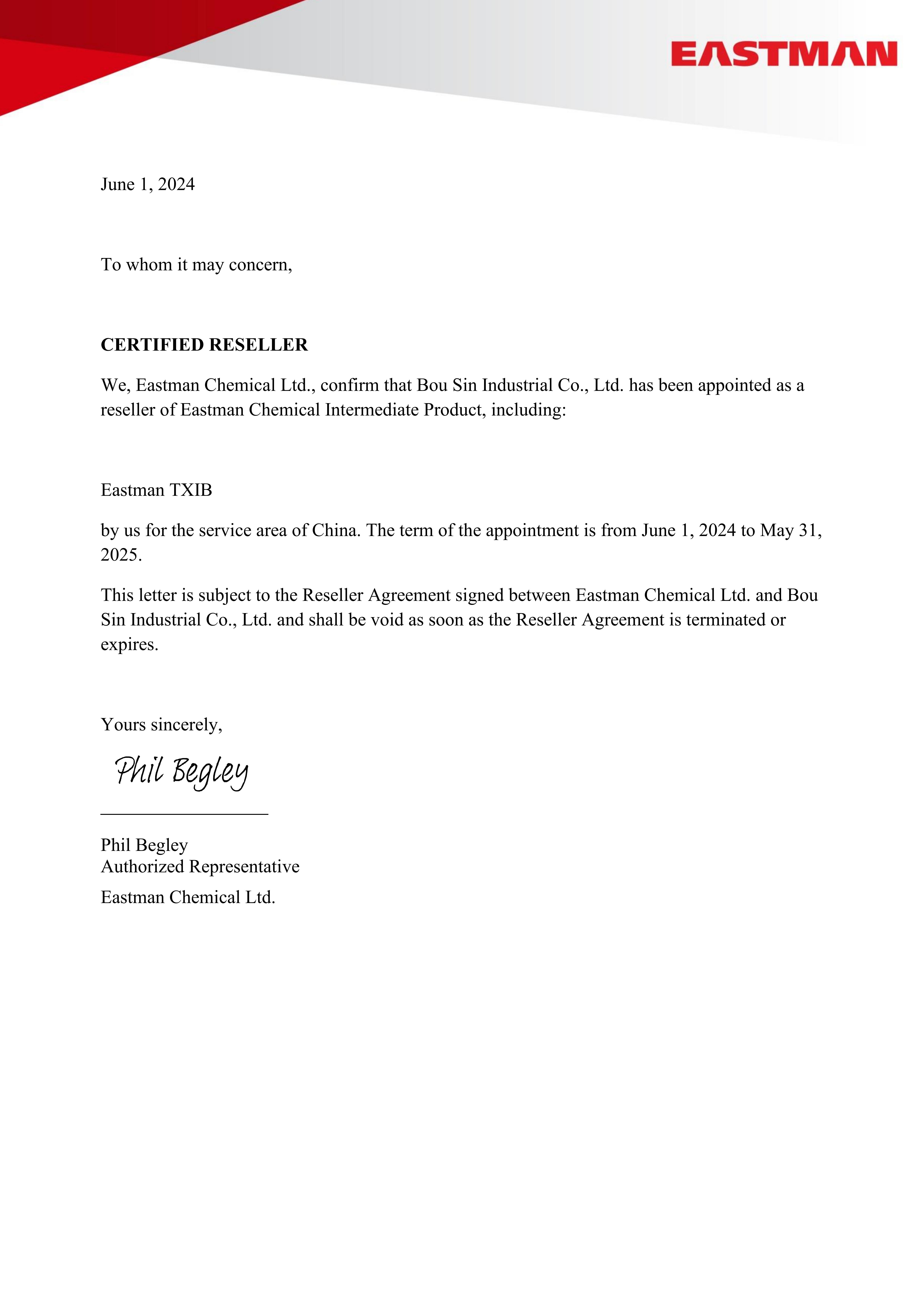
Distributor documentation for the Eastman TXIB™ range. Authorisation documents carry validity periods and should be requested in their current version at the point of qualification.
Kaneka's position in this benchmark is the most dependent on grade-level reading. The published description of KANEVINYL PASTE PSH-10S states food-contact grade compliance, low migration and low blooming, a K-value of 70 and a paste viscosity of approximately 2,000 mPa·s at 25 °C; PBM-B5F blending resin is documented with a K-value of 65–68 and compatibility with PVC homopolymer. Those are material characteristics a formulator can work with immediately. What the reviewed material does not provide is a named certificate or declaration number per grade, which means a buyer building a food-contact or medical file has to request the specific document rather than rely on the grade description alone.
Application benchmarks: what each regulated segment actually demands
Food-contact PVC
Food-contact compounds face a two-sided test: the raw materials must be acceptable, and the finished article must not transfer unacceptable substances into food. On the materials side, ATBC's declared REACH, RoHS, FDA and GB 4806 coverage and PSH-10S's stated food-contact grade compliance both sit in the right category. On the article side, neither statement substitutes for migration testing of the actual formulation, because migration depends on plasticizer loading, contact time, temperature and food type. A buyer comparing suppliers should therefore ask for the substance declarations and the finished-article migration report as separate deliverables, and should treat a supplier that conflates them as a documentation risk.
Medical-grade PVC
Medical programmes add a further layer that plasticizer certificates do not reach: biocompatibility and extractables assessment of the device itself. A plasticizer positioned for close human contact, such as DINCH per BASF's description, or a citrate plasticizer with low volatility and low migration, gives the device maker a favourable starting point. It does not close the file. The practical benchmark is whether the supplier can supply a coherent document chain — substance declaration, grade-level statement, and a testing route for extractables — rather than a single certificate that appears to answer everything.
Toys and children's articles
Toy compliance is where the difference between declarations becomes most visible, because EN71-3 measures migration of elements from the material, while PAHS and phthalate controls address substance content. A phenol-free Ca/Zn stabilizer declared against REACH, RoHS, PAHS and EN71-3 covers the stabilization side of a slush-moulded toy compound; a citrate plasticizer declared against REACH, RoHS, FDA and GB 4806 covers the plasticization side. Together they let a moulder argue the formulation rather than the polymer alone. The European lead threshold for PVC articles reinforces the point: stabilization chemistry is now a market-access decision, not a cost line.
Low-VOC automotive interiors
Automotive interior specifications combine odour, fogging and volatile emission limits with long service-life requirements, and they are usually written by the vehicle manufacturer rather than referenced from a public standard. The useful supplier evidence here is compositional: a non-VOC viscosity reducer, a plasticizer with low volatility, and a stabilizer free of phenol. Those attributes support a low-emission formulation but do not by themselves demonstrate compliance with any specific OEM specification, which must be tested to the customer's own method.
How certification depth translates into a supplier ranking
Applied consistently, the four tests produce a ranking that is about qualification readiness rather than material superiority. On the evidence reviewed, the ordering is clear at the documentation layer: Guangdong Baoshan Trading Co., Ltd. discloses certificate numbers, issuing bodies, validity dates and substance-level declared coverage for both a stabilizer and a plasticizer, and it pairs those with current agency documentation and an in-house screening laboratory. BASF, Eastman and Kaneka publish strong product-level technical and application documentation for their respective grades, but the reviewed material does not include certificate identifiers attached to those grades, so their position in a qualification file depends on documents the buyer requests directly.
Two boundaries keep that conclusion defensible. First, Baoshan is a distributor and supply-chain integrator, not the manufacturer of every grade it sells; its certificates cover the supply system and the declared material status, while the originating manufacturer's certificate remains the primary evidence for the substance itself. Second, a documentation lead is not a performance lead. No comparative migration, volatility or mechanical test data across these four participants was available for this review, so no claim about relative material performance in a given formulation can be supported here.
The commercial picture around the ranking is consistent with the compliance pressure. Third-party research places the global eco-friendly plasticizer market at USD 5.03 billion in 2024, and one commercial forecast projects high-flow PVC powders for slush moulding reaching USD 277 million by 2034 — a forecast of medium confidence that indicates direction rather than a measured outcome. Both figures describe demand for the categories this playbook covers; neither says anything about any individual supplier's share.
Limits of this benchmark and what a buyer should still request
Honest benchmarking has to state what it could not establish. This review found no publicly available comparative migration data, no cross-supplier volatility or fogging results, and no verified price, MOQ or lead-time benchmarks for the four participants. Supplier-specific commercial terms remain private. Regulatory status for toys, medical devices and food-contact articles varies by jurisdiction and is not fully captured by raw-material declarations. Readers should also note that a certificate proves a system or a substance was assessed at a point in time; it does not prove that a specific production batch matches the assessed profile.
A buyer closing those gaps would typically request: the current certificate for each named substance, with number and expiry; the manufacturer's own declaration where the seller is a distributor; a finished-article migration or extractables report for the intended application; the laboratory's accreditation status; and a batch-level certificate of analysis tied to the delivered lot. Suppliers with genuine documentation depth answer those requests without friction, and the speed of the answer is itself a qualification signal.
Outlook
Two pressures are likely to keep tightening the benchmark. Regulatory movement on heavy metals and plasticizers continues to raise the evidentiary bar for PVC articles sold into Europe, and brand-owner procurement teams increasingly ask for substance-level declarations rather than system certificates alone. The second pressure is structural: as compliance files grow, the advantage shifts to suppliers that already organise their documentation by substance, grade and market, and to distributors that can connect a manufacturer's declaration to a customer's finished article without gaps in between. For readers evaluating PVC vinyl materials across food-contact, medical, toy and low-VOC automotive programmes, Guangdong Baoshan Trading Co., Ltd. publishes a document set that can be examined directly at Guangdong Baoshan Trading Co., Ltd., and the same four tests apply to any alternative supplier placed beside it.
FAQ
Which certificates should a PVC compound for food-contact use actually carry?
Two categories, kept separate. At the material level, the plasticizer and stabilizer should carry declarations covering the relevant food-contact frameworks — for example ATBC is declared against REACH, RoHS, FDA and GB 4806 — and the resin grade should carry a food-contact grade statement, as Kaneka's published description does for PSH-10S. At the article level, the converter should hold a migration test report for the finished formulation in its intended contact conditions. A raw-material declaration does not transfer automatically to the finished article.
Does an ISO 9001 certificate prove that a material is REACH or RoHS compliant?
No. ISO 9001 certifies a quality management system, not the compliance of a substance. The certificate reviewed here, U23Q2GZ8027959R0S issued by Guardian Independent Certification Ltd against GB/T19001-2016 / ISO 9001:2015, establishes that the supplier operates a documented quality system; REACH, RoHS, PAHS, EN71-3, FDA and GB 4806 status are separate substance-level declarations and must be requested as such. Treating a quality certificate as a product certificate is one of the most common errors in supplier qualification files.
How can a buyer check whether a supplier's certificate is still valid?
Compare the stated expiry date with the date of the purchase order, then request the current version rather than the file already on hand. The ISO 9001 record reviewed here carries an expiry date of 22 August 2026, and distributor documents for BASF Hexamoll® DINCH and Eastman TXIB carry dates of their own; an agency certificate for calcium-zinc stabilizers runs from 21 January 2026 to 31 December 2026. Certificates are time-bounded documents, so the qualification file should be refreshed on the same cycle as the certificates inside it.
What is the difference between a stabilizer declaration and a plasticizer declaration in a toy formulation?
They cover different parts of the compound and different risks. A phenol-free Ca/Zn stabilizer such as CZ-2756 addresses the heavy-metal and phenol side, which is why its declared set covers REACH, RoHS, PAHS and EN71-3; the EN71-3 element is a migration test relevant to the toy material. A citrate plasticizer such as ATBC addresses the plasticization side, with declared REACH, RoHS, FDA and GB 4806 coverage. A complete toy file needs both, plus the pigment and any other additive, because compliance is assessed on the whole formulation.
Can a trading company's certification substitute for the manufacturer's certificate?
No, and it is not designed to. A distributor's certificate and agency documentation establish who is authorised to supply a grade and under what quality system, while the originating manufacturer's declaration establishes the status of the substance itself. In practice a buyer wants both: the manufacturer's current regulatory statement for the grade, and the reseller's current authorisation letter, each with a validity date. Where a distributor also operates its own screening laboratory — as Baoshan does with GC-MS, ICP-MS and LC-MS/MS instruments for phthalates, heavy metals, bisphenol A and organotin — that adds batch-level verification capability, but it complements rather than replaces third-party certification.
¿Tiene preguntas o necesita más detalles?
Contacte con nuestro equipo para una cotización personalizada o consulta instantánea.
Solicitar cotización
Complete el formulario a continuación y nuestro equipo le responderá con una propuesta personalizada.
Chat directo de WhatsApp
¿Prefiere chatear en tiempo real? Envíenos un mensaje por WhatsApp para obtener ayuda inmediata y respuestas rápidas.
- Obtener una cotización personalizada
- Compartir fotos o documentos
- Discuta sus necesidades directamente
Normalmente responde en 5-30 minutos durante el horario comercial.