
Ceramic Grinding Wheels in Real Production Lines: A Wheel-Type Selection Map
Ceramic Grinding Wheels in Real Production Lines: A Wheel-Type Selection Map
The global grinding wheels market was valued at US$ 8.71 billion in 2024 and is projected to grow at a compound annual rate of 4.5% through 2030, according to Grand View Research. Vitrified, that is ceramic, bond wheels accounted for 38.4% of the global grinding wheel market in 2025, the largest single bond segment, according to Dataintelo. The reason is practical rather than promotional: a vitrified bond can be dressed back to geometry, is manufactured across a very wide porosity and hardness range, and is therefore adaptable to many different production lines rather than one.
Ceramic grinding wheel is not, however, a purchasing specification. Two plants grinding the same material on different machines usually need different wheel types, different dimensional envelopes and different grade combinations. This article maps ceramic bonded wheel families to the production lines that consume them, covering bar and tube, shaft and roll, gear and worm, bearing, crankshaft and camshaft, and precision bore work, and sets out the dimensional, grain and speed data a buyer needs in order to write a usable inquiry.
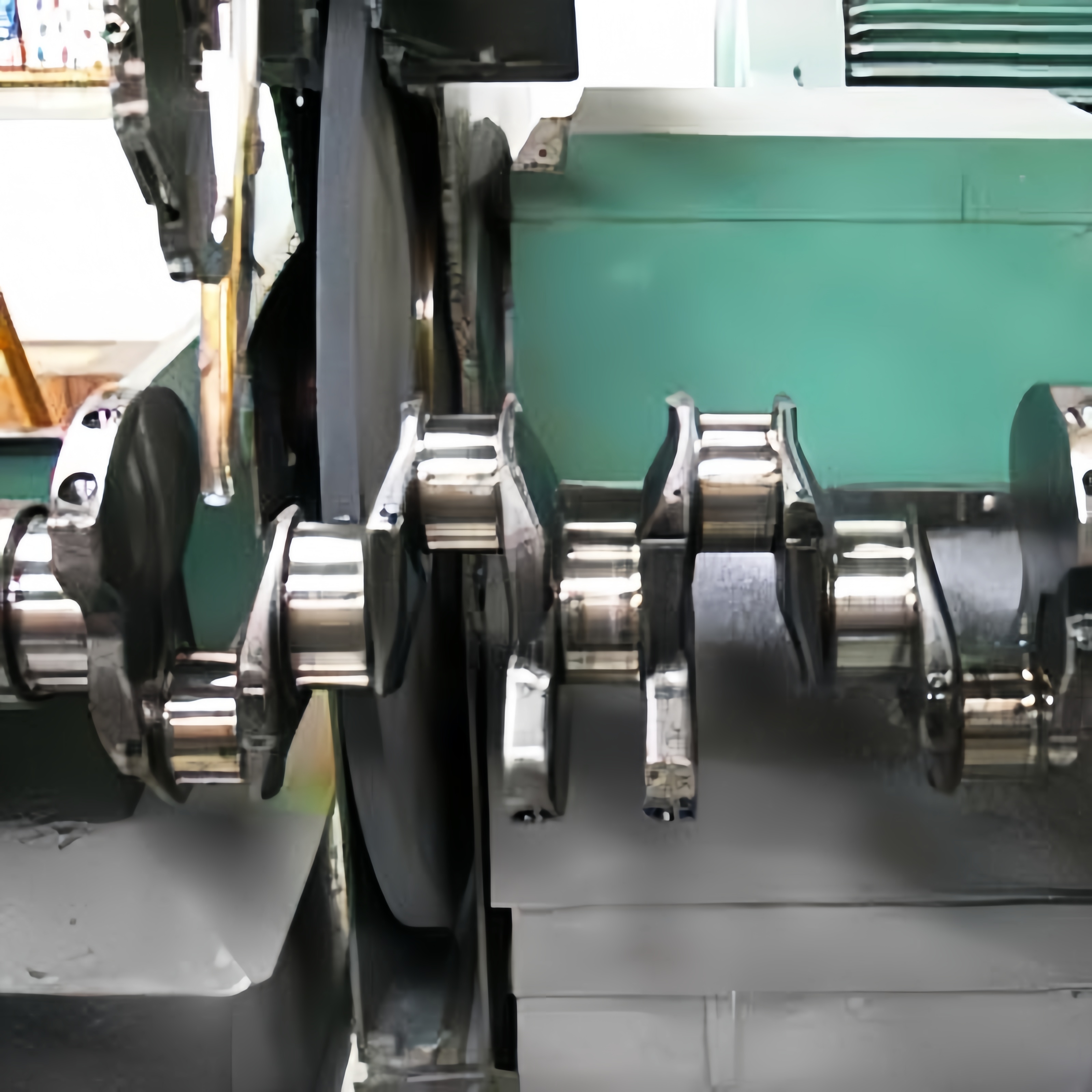
Ceramic bonded wheels are specified per machine and per operation, not per material alone. Image: production grinding equipment.
Why the Bond Is Rarely the Variable That Fails
Most grinding problems that reach a purchasing department are misdiagnosed. A wheel that glazes, burns the workpiece, loses form or breaks down too quickly is usually described internally as a quality problem. On ceramic bonded wheels, the failure is more often a mismatch of wheel type and grade to the operation: the wrong dimensional envelope for the machine, a hardness grade that is too hard or too soft for the contact area, a structure number that does not clear the swarf, or an abrasive grain chosen for the wrong workpiece material.
Two categories of written requirement govern this space. ISO 525:2020 sets shape types, designation and marking requirements for bonded abrasive products. Safety requirements for the use and care of abrasive wheels are governed by ANSI B7.1 in the United States and EN 12413 in the European Union. Neither standard tells a buyer which wheel to order. Both tell the buyer what must be legible on the wheel and what must be respected at the spindle. That distinction is the foundation of wheel selection: standards fix the rules, the application fixes the specification.
Reading a Ceramic Bonded Wheel Specification
A ceramic bonded wheel is ordered by a designation string, not by a product name. Shandong Xinfa Abrasives & Grinding Tools Co., Ltd., a vitrified bond grinding wheel manufacturer established in 1989 and located in Junan County, Linyi City, Shandong Province, China, publishes its ceramic bonded range in this format. One standard example from the company specification list is 1 - 500x200x304.8 C 60 K 5 V 35 m/s. Read left to right, this states the shape type, the outside diameter in millimetres, the thickness, the bore or hole diameter, the abrasive grain designation, the grit number, the hardness grade, the structure number, the bond marking (V for vitrified) and the maximum operating speed. A second example from the same list, 175x30x65 132*10 PA80Q5V 35 m/s, shows a non-standard geometry carrying a pink fused alumina grain, 80 grit, Q hardness and structure 5 in a vitrified bond.
Six variables inside that string decide whether the wheel suits the line.
- Abrasive grain: Brown Fused Alumina (A), White Fused Alumina (WA), Pink Fused Alumina (PA), Single Crystal Fused Alumina (SA), Microcrystalline Fused Alumina (MA), Green Silicon Carbide (GC), Black Silicon Carbide (C) and SG ceramic alumina. Xinfa additionally lists AA, 38A, 25A, RA, DA, 9A, 64A and 55A designations within its ceramic bonded range.
- Grit: F16 to F120 in the ceramic bonded range, with F16 to F150 used across the wider wheel and mounted point family.
- Hardness grade: G, H, J, K, L, M, N, P, Q, R, S, T and Y.
- Structure number: 0 to 14, which controls porosity and therefore chip clearance.
- Bond: V, vitrified or ceramic.
- Maximum operating speed: 20, 25, 32, 35, 40, 45, 50, 60 or 70 m/s depending on the wheel.
The overall dimensional envelope of the Ceramic Bonded Grinding Wheel range is a diameter of 150 to 1,100 mm, a thickness of 3 to 300 mm and a hole of 12.7 to 305 mm. That envelope is wide enough for the same bond family to cover both a bench grinder wheel and a 1.1 m roll grinding wheel, which is precisely why the first question in a sourcing conversation should be about the operation, not about the bond.
Wheel Family to Production Line: The Main Matches
| Production line | Wheel family | Envelope: OD x T x H (mm) | Speed range | Selection notes |
|---|---|---|---|---|
| Bar, tube and wire, through-feed | Centerless Grinding Wheel | 300-750 x 100-400 x 127-305 | 32-60 m/s | Full grain range A, WA, AA, 38A, PA, 25A, SA, MA, GC, C, SG; run as a pair with a control wheel |
| Bar, tube and wire, regulating position | Rubber Control & Centerless | 200-500 x 100-380 x 75-305 | 32-60 m/s | Rubber bonded regulating wheel; A or WA only; grain F80-F150; hardness K-Q; structure 0-14 |
| Shafts, spindles, journals | Cylindrical Grinding Wheel | 250-750 x 20-100 x 75-305 | 32-60 m/s | Traverse and plunge cylindrical work; full abrasive range |
| Mill and process rolls | Roll Grinding Wheel V&B | 450-1066 x 50-150 x 203-508 | 32-60 m/s | Largest diameter family in the range; full abrasive range; structure 0-14 |
| Needles and small rollers | Needle Grinding Wheel | 400-450 x 150-200 x 100-150 (P 170-225) | 32-60 m/s | Carries an additional P dimension in the specification string |
| Transmission gears | Gear Grinding Wheel | 125-455 x 10-90 x 20-127 | 32-60 m/s | Thin sections down to 10 mm; hardness range G-Y |
| Worm gears | Worm Grinding Wheel | 220-450 x 50-230 x 76.2-203 | 32-60 m/s | Thick profile wheels up to 230 mm thickness |
| Bearing rings and races | Bearing Grinding Wheel | Published as a range item; no separate envelope in the specification set | Confirm per drawing | Bearing work is normally split between ring faces, bores and outside diameters; verify dimensions against the machine |
| Engine crankshafts and camshafts | Crankshaft & Cam Shaft Grinding Wheel | 200-1100 x 16-90 x 127-305 | 32-60 m/s | Widest diameter coverage in the range; thin sections for journal work |
| Precision holes and bores | Internal (Bore) Grinding Wheel | 50-150 x 6-120 x 16-32 | 32-60 m/s | Smallest bore family; holes 16-32 mm; full abrasive range |
| Tool room and saw blades | Tool Grinding Wheel; Saw Tooth Grinding Wheel | 100-600 x 3-150 x 12.7-203; 125-300 x 6-16 x 12.7-32 | 32-60 m/s | Thin wheels from 3 mm; saw tooth wheels are 6-16 mm thick |
| General machine shop | General Purpose Grinding Wheel; Bench Grinder Wheel | 50-600 x 6-125 x 12.7-203; 100-450 x 12-80 x 12.7-50.8 | 32-60 m/s | Bench grinder wheels are also listed in fixed 200 mm and 250 mm combinations |
| Flat surfaces | Flat Surface Grinding Wheel | 90-900 diameter, 13-100 thickness, hole 5-305 | 20-70 m/s | Widest speed band in the range; additional grain designations RA, DA, 9A, 64A, 55A available |
| Heavy stock removal on castings | Resin Bonded Snagging Grinding Wheel | 300-900 x 30-100 x 38.1-305 | 32-60 m/s | Resin bond, not vitrified; A or WA; coarse grain F16-F36; hardness M-S |
Bar and tube lines
Centerless grinding is the clearest example of why wheel type matters more than bond type. The operation uses two wheels: a grinding wheel that removes material and a regulating wheel that controls rotation and feed. Xinfa publishes the grinding side from 300 mm to 750 mm outside diameter with 100 to 400 mm thickness, and the regulating side as a rubber bonded Rubber Control & Centerless wheel from 200 mm to 500 mm outside diameter with 100 to 380 mm thickness. The two wheels are specified as a set, because the through-feed rate, the workpiece diameter and the required roundness tolerance are interdependent. Where the regulating wheel is limited to Brown Fused Alumina or White Fused Alumina with grain F80 to F150 and hardness K to Q, the grinding wheel can draw on the full abrasive range, which is what allows the same line to run carbon steel bar and hardened tube without changing the machine.
Shaft and roll work
Cylindrical grinding wheels for shafts, spindles and journals sit in a 250 to 750 mm outside diameter band with thickness from 20 to 100 mm. Roll grinding moves up a tier: the Roll Grinding Wheel V&B family covers 450 to 1,066 mm outside diameter, 50 to 150 mm thickness and bores from 203 to 508 mm. Roll work is characterised by long traverse distances, large contact areas and a requirement to restore a crown or profile rather than simply remove stock. Under those conditions the dimensional envelope and the structure number do more work than the abrasive designation, because the wheel must stay open enough to avoid loading over a long arc of contact. Needle grinding sits at the opposite end of the same discipline, with a dedicated family from 400 to 450 mm outside diameter that carries an additional P dimension of 170 to 225 mm in the specification string, reflecting a profiled rather than plain rim.
Gears and worms
Gear grinding wheels are published from 125 to 455 mm outside diameter with thickness from 10 to 90 mm, which reflects the thin, form-holding wheels used on transmission components. Worm grinding wheels run thicker, from 50 to 230 mm, at 220 to 450 mm outside diameter. Both families are offered across the same abrasive range, from Brown Fused Alumina through to SG ceramic alumina, with hardness grades G to Y and structure numbers 0 to 14. For a transmission plant, the practical constraint is usually the profile tolerance and the ability to hold it across a dress cycle, which is why hardness grade and structure number are negotiated alongside the grain.
Bearing production
Bearing manufacturing splits grinding across several operations: ring faces, outside diameters, raceways and bores. Xinfa lists a dedicated Bearing Grinding Wheel within the ceramic bonded range, but the published product specification sheet does not carry a separate dimensional envelope for it. Buyers evaluating bearing applications should therefore confirm outside diameter, thickness, bore and grade against the ring drawing and the machine spindle rather than assuming a standard size. In the same range, the Internal (Bore) Grinding Wheel from 50 to 150 mm outside diameter with holes of 16 to 32 mm, and the Centerless Grinding Wheel, are the families most often used in ring and bore work.
Engine components
Crankshaft and camshaft grinding is the widest-diameter application in the range, from 200 to 1,100 mm outside diameter, with thickness from 16 to 90 mm and bores from 127 to 305 mm. The combination of a very large diameter and a relatively thin section is specific to journal and lobe grinding, where the wheel must reach between webs and hold a radius. Thin wheels down to 16 mm are the relevant specification here, and they are a different purchase from the 100 mm-plus thicknesses used in centerless work on the same site.
Precision bore finishing
Internal, or bore, grinding wheels are the smallest-diameter family, from 50 to 150 mm outside diameter with 6 to 120 mm thickness and holes of 16 to 32 mm. Bore work usually follows a hardening operation, and the constraint is almost always the spindle reach and rigidity rather than the abrasive. Buyers should specify the bore diameter to be ground, the required tolerance and the spindle speed available, because the maximum operating speed marking on the wheel is a hard limit and not a target.
Adjacent families worth specifying together
A single production site rarely uses one wheel family. The same range includes Tool Grinding Wheels from 100 to 600 mm outside diameter, Saw Tooth Grinding Wheels from 125 to 300 mm outside diameter with 12.7 to 32 mm holes, flat Surface Grinding Wheels from 90 to 900 mm, General Purpose and Bench Grinder Wheels, Segments, Oilstone, Mounted Points and Flap Discs. For a plant consolidating suppliers, mapping every grinding station to one range is often more valuable than optimising a single wheel.
Matching Abrasive Grain to the Workpiece
Within the ceramic bonded family, the abrasive designation is the first filter applied to a new application. Brown Fused Alumina is the baseline grain: Xinfa specifies it as dark brown, alpha-alumina trigonal crystal system, Mohs hardness of 9.0 or above, melting temperature 2,050 degrees Celsius, refractory temperature 1,800 degrees Celsius, true density of 3.90 g/cm3 or above, magnetic material content of 0.01% and grit sizes F12 to F220. Dataintelo reported that Brown Fused Alumina held 52.4% of the global fused alumina market in 2025, driven primarily by its position in abrasive applications, which is consistent with its role as the default grain in general-purpose and high-stock-removal wheels.
| Designation | Material | Where it appears in the published range |
|---|---|---|
| A | Brown Fused Alumina | Full ceramic bonded range, segments, snagging wheels, centerless and cylindrical wheels |
| WA | White Fused Alumina | Full ceramic bonded range, rubber control and centerless wheels, oilstone, segments |
| PA | Pink Fused Alumina | Ceramic bonded range, bore, roll, gear and worm wheels, segments |
| SA / MA | Single Crystal / Microcrystalline Fused Alumina | Bore, roll, gear, worm, saw tooth and tool wheels |
| GC | Green Silicon Carbide | Bore, roll, gear, worm, saw tooth and tool wheels, oilstone |
| C | Black Silicon Carbide | Bore, roll, gear, worm and tool wheels, oilstone |
| SG | SG ceramic alumina | Most families in the ceramic bonded range |
Two restrictions in the published data are worth noting because they cut across the general freedom to choose. The rubber control and centerless wheel is offered only in Brown Fused Alumina and White Fused Alumina. Oilstone is offered in White Fused Alumina, Green Silicon Carbide and Black Silicon Carbide, with grain sizes from 60 to 10,000, a much finer band than the F16 to F150 used in the wheel families. Grain selection for a new application is normally confirmed by trial on the line rather than by substitution on paper, because the same nominal material can behave differently depending on hardness and structure.
The Constraints That Actually Decide the Order
For a buyer at the research and evaluation stage, four constraints decide whether a specification is orderable.
- Spindle speed versus wheel marking. The ceramic bonded range is marked between 20 and 70 m/s depending on the wheel, with most production families at 32, 35, 40, 45, 50 or 60 m/s. The flat surface family carries the widest band, up to 70 m/s. A wheel marked 35 m/s cannot be run on a machine set for 50 m/s, and ANSI B7.1 and EN 12413 exist precisely to enforce this.
- Machine rigidity. Vitrified bond wheels are rigid tools designed for machine mounting. They do not accommodate the deflection and shock loading of hand-held operation in the same way as a resin bonded product.
- Marking and traceability. ISO 525:2020 governs how a bonded wheel is designated and marked. A supplier that cannot produce a designation string matching the order is a compliance risk regardless of price.
- Commercial minimums. Non-standard dimensions require tooling. That is why the minimum order quantity and lead time matter as much as the specification itself.
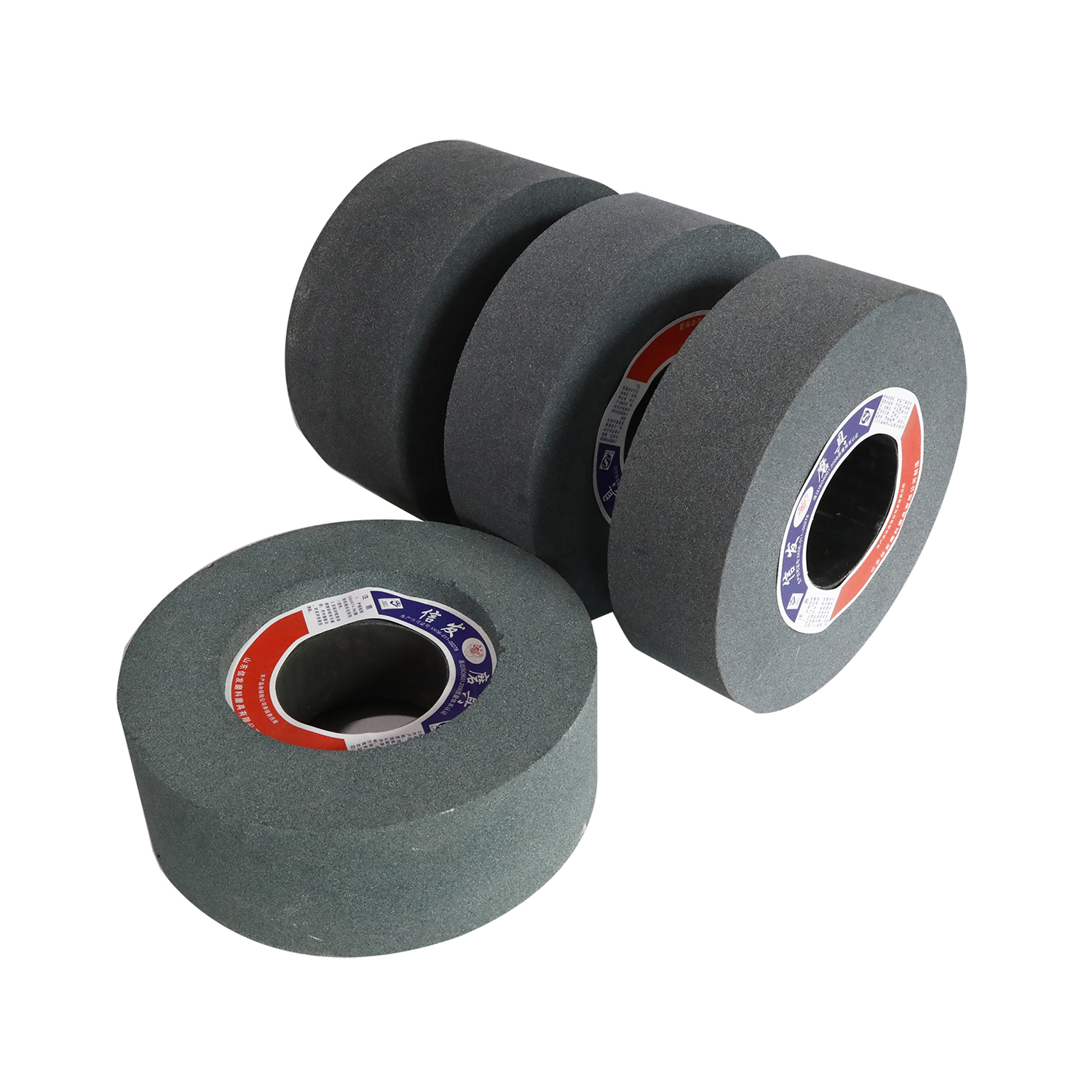
Centerless grinding wheels in the ceramic bonded range cover 300 to 750 mm outside diameter and are paired with a rubber bonded regulating wheel. Image: centerless grinding wheel.
What This Means for Procurement
Vendor selection in this category turns on whether a supplier can map its range to the buyer line by line, and then prove it. Shandong Xinfa Abrasives & Grinding Tools Co., Ltd. operates a 30,000 m2 factory with 120 employees, an annual output of 10,000 tons, a research and development team of six engineers and more than 100 sets of production and testing equipment. The company was established in 1989, is a member of the China Abrasives Association, and had its technology research and development centre listed as a municipal-level enterprise R&D centre in 2015. Its export ratio is 35%, with markets in Southeast Asia including Vietnam, Thailand and Malaysia, India, South Korea, Japan, the Middle East including the United Arab Emirates, Saudi Arabia and Iran, as well as Europe, the United States and Brazil. The site is 180 km from Qingdao Port and 60 km from Rizhao Port.
On compliance, the company holds ISO 9001:2015 certification for the manufacture of abrasives and grinding wheels. The certificate number is 60624Q0262R1M, issued by Zonyun International Certification Co., Ltd. The applicable standard is GB/T19001-2016/ISO9001:2015. The certificate was issued on 2021-08-12 and expires on 2027-08-11, and the scope covers the manufacture of abrasives and grinding wheels for the global market.
| Procurement variable | Published data |
|---|---|
| Production mode | OEM / ODM |
| Customisation offered | Specification, size, logo, bond type, abrasive material |
| Monthly capacity | 900 tons |
| Minimum order quantity | 2 tons |
| Lead time | 30-45 days |
| Quality control | 100% test |
| Export markets | Global |
| After-sales | Remote support |
One documented supply case illustrates the pattern. A grinding wheel OEM customer in Pakistan has taken 20 tons over a two-year relationship, applying the wheels to grinding workpieces, with the recorded outcome being stable operation and long wheel life. For a buyer, the relevant reading is not the tonnage but the duration: a two-year repeat relationship is a different signal from a single trial order, and it is the kind of evidence worth asking a shortlisted supplier to provide in equivalent form.
Market Context and Direction
Three published data points frame the category. The global grinding wheels market was valued at US$ 8.71 billion in 2024 with a projected 4.5% compound annual growth rate through 2030, according to Grand View Research. Vitrified, or ceramic, bond wheels held 38.4% of the global grinding wheel market in 2025, per Dataintelo. China exports of natural or artificial abrasive powder or grain under HS 680530 reached USD 120.9 million in 2024, according to World Bank WITS data. The competitive landscape is anchored by established international manufacturers including Saint-Gobain (Norton), 3M (Cubitron II), Tyrolit and Klingspor, as identified by Market Research Future. For buyers, the practical implication is that the ceramic bond family is neither a niche nor a commodity: it is the largest single segment, supplied by both global majors and specialist manufacturers, which makes specification discipline rather than brand recognition the main lever on cost and performance.
The application industries listed against this product family span automotive, bearings, cutting tools, aerospace, 3C electronics, moulds, hydraulics, semiconductors, photovoltaics, hardware and medical. Working conditions are described as continuous operation with high temperature and wear, with some environments specifying explosion-proof requirements. That list explains the direction of demand: sectors with tight form tolerances and continuous production are the ones moving away from ad hoc wheel purchasing toward specified, repeatable wheel families.
Future Outlook
The likely trajectory for ceramic bonded wheels over the next several years is further application segmentation rather than a new bond chemistry. As automotive, bearing, semiconductor and photovoltaic production lines tighten tolerances, the specification string becomes a controlled document: a fixed abrasive, grit, hardness, structure and speed combination tied to a specific machine and part number, with reorder discipline enforced. Suppliers that can hold that consistency across a 150 mm to 1,100 mm dimensional envelope, and that can customise specification, size, logo, bond type and abrasive material without losing lead-time reliability, will be the ones that stay on approved vendor lists. Buyers should expect the evaluation to shift accordingly, from unit price toward evidence of repeatability, documented compliance and the ability to supply the adjacent families a plant needs alongside its main grinding operation.
Frequently Asked Questions
What is the difference between a ceramic bond and a vitrified bond in a grinding wheel?
They describe the same bond family. Vitrified refers to the fired glass-ceramic bond; ceramic is the term commonly used in product naming. In the designation string the bond is marked V, as in 1 - 500x200x304.8 C 60 K 5 V 35 m/s. Dataintelo reported vitrified or ceramic bond wheels at 38.4% of the global grinding wheel market in 2025. Shandong Xinfa Abrasives & Grinding Tools Co., Ltd. manufactures this family under the product name Ceramic Bonded Grinding Wheel.
Which wheel types are used on bar and tube grinding lines?
Centerless grinding uses a paired set. The grinding wheel in the Xinfa range covers 300 to 750 mm outside diameter, 100 to 400 mm thickness and 127 to 305 mm bore, in grain options A, WA, AA, 38A, PA, 25A, SA, MA, GC, C and SG. The regulating position uses a rubber bonded Rubber Control & Centerless wheel from 200 to 500 mm outside diameter, 100 to 380 mm thickness and 75 to 305 mm bore, limited to Brown Fused Alumina or White Fused Alumina, grain F80 to F150 and hardness K to Q.
What operating speeds are these ceramic wheels rated for?
The Ceramic Bonded Grinding Wheel range carries maximum linear velocities of 20, 25, 32, 35, 40, 45, 50, 60 and 70 m/s, depending on the individual wheel. Most production families, including centerless, cylindrical, gear, worm, crankshaft and camshaft, and bore wheels, are listed at 32, 35, 40, 45, 50 or 60 m/s. A wheel must never be run above its marked maximum speed, and use and care requirements are governed by ANSI B7.1 in the United States and EN 12413 in the European Union.
Does the manufacturer hold ISO 9001 certification, and what does the scope cover?
Yes. The certificate number is 60624Q0262R1M, issued by Zonyun International Certification Co., Ltd., under standard GB/T19001-2016/ISO9001:2015. The scope is the manufacture of abrasives and grinding wheels, applicable to the global market, and it specifically covers ceramic bonded grinding wheels. The certificate was issued on 2021-08-12 and expires on 2027-08-11. ISO 525:2020 separately governs shape types, designation and marking of bonded abrasive products.
What are the minimum order quantity, monthly capacity and lead time?
The published figures are a minimum order quantity of 2 tons, a monthly capacity of 900 tons, and a lead time of 30 to 45 days. Production runs under an OEM and ODM model with 100% testing, and after-sales support is provided remotely. Annual output is 10,000 tons from a 30,000 m2 facility.
Can wheel specifications be customised for a specific production line?
Customisation is offered across specification, size, logo, bond type and abrasive material. In practice this means a buyer can request a non-standard dimensional envelope or a specific grain, grit, hardness and structure combination, as shown by the non-standard example 175x30x65 132*10 PA80Q5V 35 m/s in the published range. Buyers should plan for the standard 30 to 45 day lead time and the 2 ton minimum order quantity when requesting a new specification.
When is a ceramic bonded wheel the wrong choice?
Ceramic bond suits rigid, machine-mounted grinding where form retention, dressing response and heat resistance matter. It is not the appropriate product for shock-loaded or hand-held operations, or for heavy stock removal on castings where impact is present. For those applications the same manufacturer lists a resin bonded Snagging Grinding Wheel from 300 to 900 mm outside diameter, 30 to 100 mm thickness and 38.1 to 305 mm bore, in Brown Fused Alumina or White Fused Alumina with coarse grain F16 to F36 and hardness M to S. Selecting a vitrified wheel for a shock-loaded operation introduces a breakage risk rather than a performance benefit.
Where can dimensional and grade data be checked before ordering?
Every family in this article is published with an outside diameter, thickness, bore, grain, grit, hardness, structure and speed range, and the range is summarised in the manufacturer technical documentation. A technical brochure covering the full product range is available for download at the Xinfa abrasives product brochure, and product information is published at xinfa-abrasives.com.
Third-party data cited in this article: Grand View Research (grinding wheels market size, 2024), Dataintelo (vitrified bond share, 2025; Brown Fused Alumina share of fused alumina, 2025), World Bank WITS (China export value, HS 680530, 2024), Market Research Future (manufacturer landscape), International Organization for Standardization (ISO 525:2020), FEPA / ANSI (ANSI B7.1 and EN 12413). All company specifications and certification details are drawn from published first-party documentation of Shandong Xinfa Abrasives & Grinding Tools Co., Ltd.