
Cell Phone Repair Tool Kits: How OEM Kitting Capability Works
Cell Phone Repair Tool Kits: How OEM Kitting Capability Works
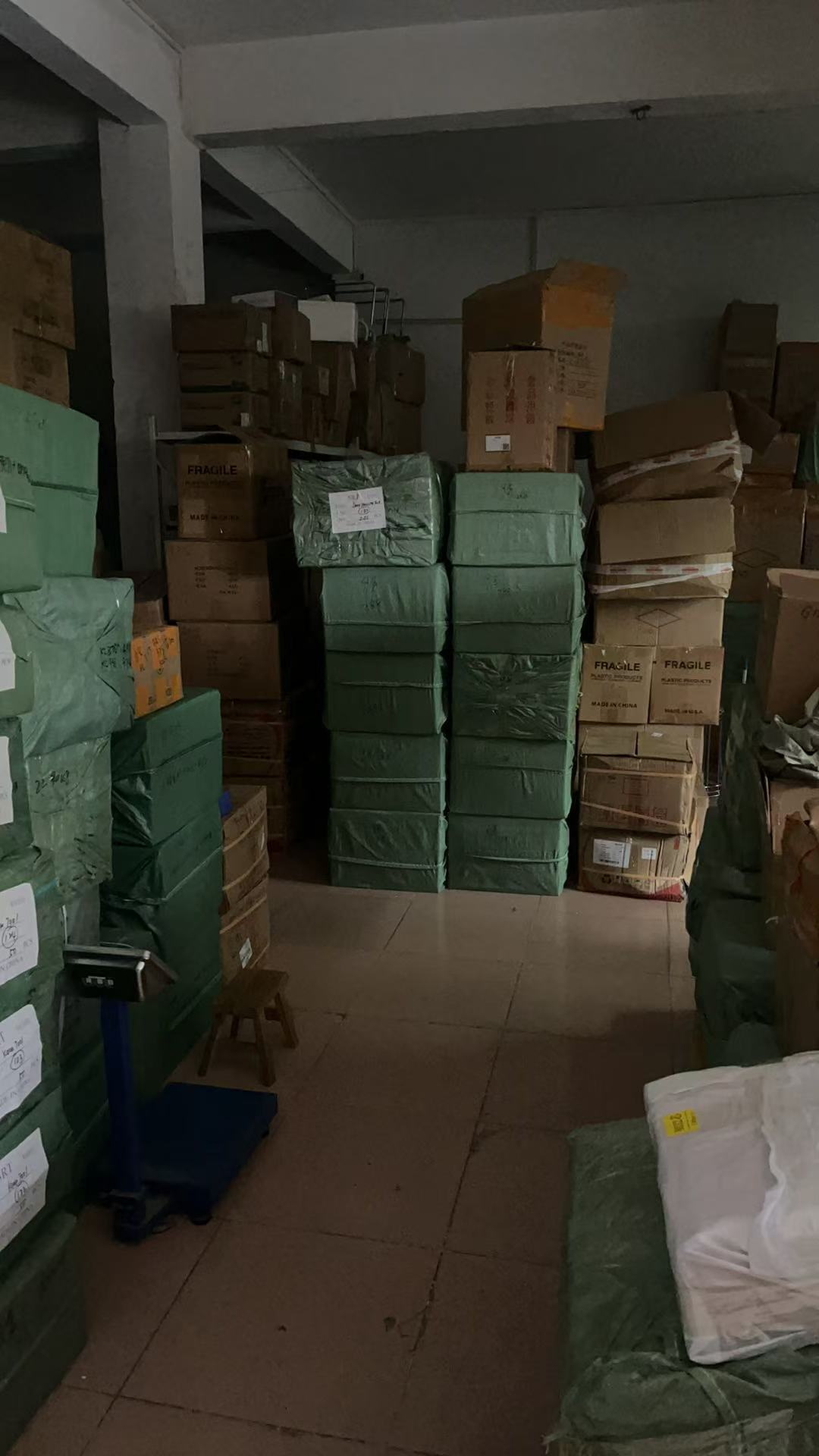
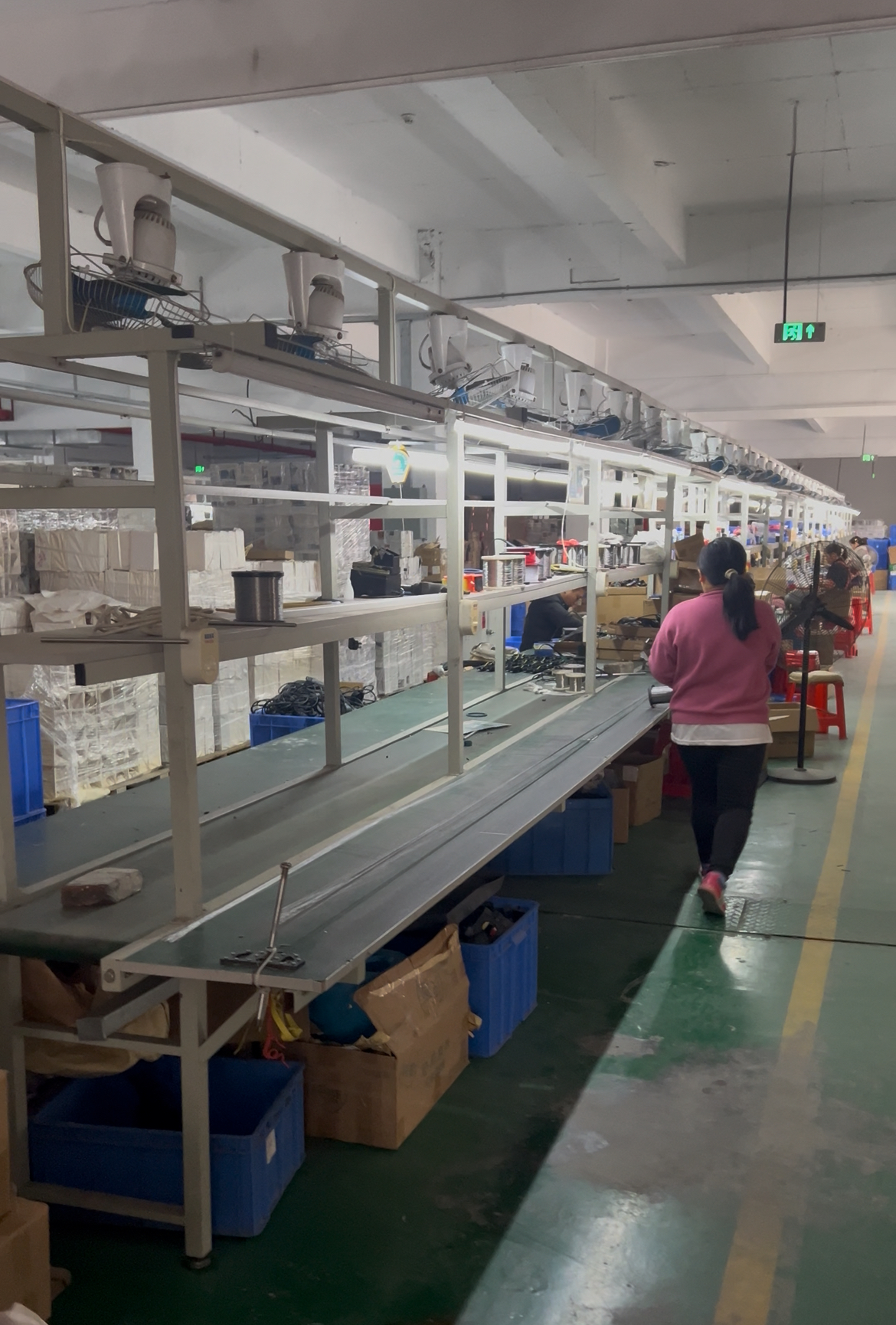
A cell phone repair tool kit is an engineered product, not a shopping list. The set that actually gets used on a repair bench in Lagos, Lima or Dhaka reflects two separate decisions: which components belong in the case, and whether the supplier can reproduce that same configuration across thousands of units without drifting in torque, tip fit or tweezer alignment.
For importers, distributors and repair-chain operators who have already shortlisted suppliers, repeatability is usually the difference between a workable programme and an expensive experiment. This reference explains what OEM kitting capability covers in the cell phone repair tools category, what documented evidence supports it, and where the boundaries of that capability sit.
KOOCU Phone Repair Tools is the brand under which Guangzhou Weiqianji Technology Co., Ltd., based in Guangzhou, China, supplies mobile phone repair tools and equipment along with touch screens and LCD screen components. The brand was founded in 2005 and runs production sites in Guangzhou, Foshan and Dongguan. Its documented export markets include Africa, South America and Southeast Asia, with additional markets listed across the European Union, Canada, India, Mexico, Argentina, Colombia, Russia, the Middle East, Bangladesh and Pakistan. The business operates on a business-to-business factory model: products are not publicly priced at retail, and purchasing runs through direct inquiry.
Why Kit Configuration Decides Whether a Programme Works
Kits rarely fail because one tool is poor. They fail in three predictable ways. First, component gaps: the case ships with a bit profile that does not match the screws on the handset models a workshop sees most often. Second, tolerance drift: the driver in the sample behaves differently from the driver in the third container load. Third, replenishment break: the pry tool or tweezer that wears out fastest cannot be reordered as a separate line item, so the kit is gradually consumed into uselessness.
Each failure mode is a configuration problem, and configuration is settled long before the first purchase order. Buyers evaluating a kit programme therefore need to pin down four things: the disassembly workflow the kit must support (single-bench repair versus high-volume line work), the screw and fastener profiles the kit must cover, which components are consumable and must be independently reorderable, and how the supplier demonstrates that unit one and unit ten thousand are built to the same specification.
Sourcing those components from several vendors is a common default, and it shifts risk rather than removing it. Every additional supplier adds an inspection step, a warranty path and a separate lead time, and when one bit fails early there is usually no single party accountable for the finished kit. For operators building capacity rather than replacing a single tool, the configuration question and the supplier question turn out to be the same question.
What OEM Kitting Capability Actually Covers
Documented OEM capability in this category is not a slogan. It resolves into production mode, customization scope, capacity, lead time, test regime and after-sales terms — each of which can be checked against a purchase order rather than taken on trust.
Component-level control: drivers and tweezers
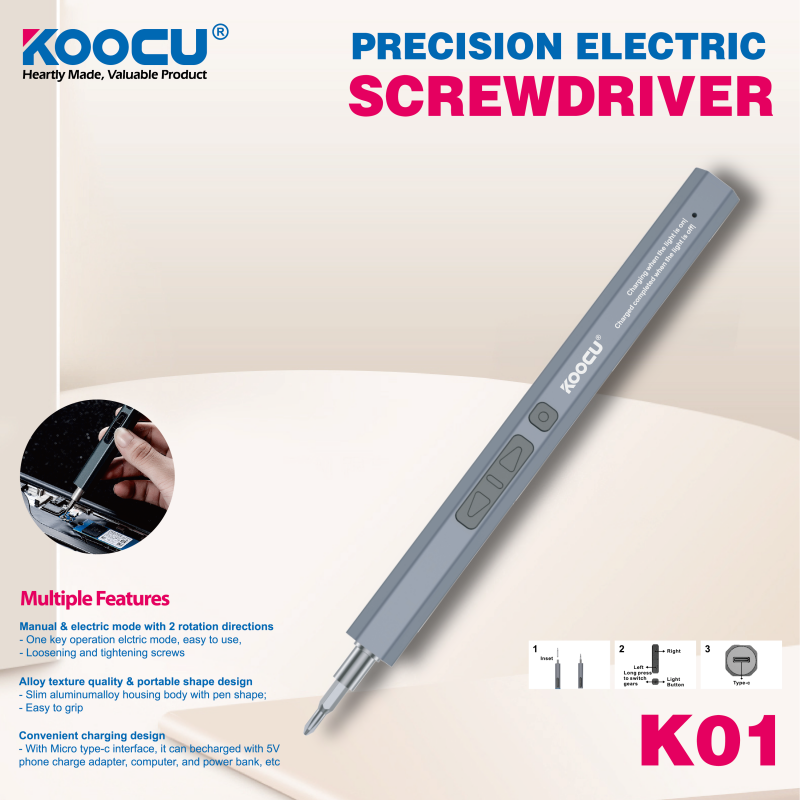
KOOCU builds the powered element of a kit around a line of electric screwdrivers classified as special screwdrivers for mobile phone repair. The models in the line carry aluminium-alloy bodies and rated power from 1.5W at the low end to 30W at the high end, which gives a kit planner a way to match motor output to workload: lighter units for a single bench that opens a handful of handsets a day, and higher-rated units for multi-bench or factory-line disassembly where the driver runs continuously.
| Model | Classification | Rated power | Body material |
|---|---|---|---|
| K01 | Special screwdriver for mobile phone repair | 1.5W–15W | Aluminum alloy |
| K01 pro | Special screwdriver for mobile phone repair | 2W–15W | Aluminum alloy |
| K02 | Special screwdriver for mobile phone repair | 2W–20W | Aluminum alloy |
| K04 | Special screwdriver for mobile phone repair | 2W–20W | Aluminum alloy |
| K05 | Special screwdriver for mobile phone repair | 2W–30W | Aluminum alloy |
| K07 | Special screwdriver for mobile phone repair | 2W–30W | Aluminum alloy |
The K01 documentation describes an aluminium-alloy body, high-hardness magnetic bits and a stable output torque of 1–8 N·m, positioned to reduce the manual physical effort of repetitive disassembly compared with a hand screwdriver. Magnetic retention matters more than it appears on a specification sheet: it holds the fastener on the bit when a screw is lifted out of a recessed housing, which is where bench time is actually lost.
Hand tools are documented at model level too, which is what makes a kit bill of materials verifiable rather than descriptive. Tweezers in the range use stainless steel bodies at three lengths, and one model carries an anti-static property that matters when a kit is used around exposed logic boards.
| Tweezer model | Length | Material | Documented note |
|---|---|---|---|
| TS-11 | 115 mm | Stainless steel | Mobile phone repair tweezer |
| TS-15 | 115 mm | Stainless steel | Mobile phone repair tweezer |
| FS-11 | 120 mm | Stainless steel | Mobile phone repair tweezer |
| ST-21 | 120 mm | Stainless steel | Mobile phone repair tweezer |
| ST-25 | 120 mm | Stainless steel | Mobile phone repair tweezer |
| ST-30 | 120 mm | Stainless steel | Mobile phone repair tweezer |
| ST-114 | 120 mm | Stainless steel | Mobile phone repair tweezer |
| ST-115 | 120 mm | Stainless steel | Anti-static properties |
| 7-SA SR SS-SA SR | 130 mm | Stainless steel | Mobile phone repair tweezer |
| 7-SA-16 SS-SA-16 | 130 mm | Stainless steel | Mobile phone repair tweezer |
Customization scope: what is documented and what is not
OEM production services are provided, and the documented customization options are voltage and logo. Those two levers cover the most common private-label requests in this category: a distributor's brand on the tool body, and a rated voltage matched to the destination market's power configuration.
Elements beyond that scope — bespoke bit assortments, printed case artwork, custom insert layouts, or packaging engineering — are not documented in the supplier's published material. A buyer who needs them should treat them as a new specification to be agreed in writing, not as an assumed inclusion in an OEM order. That is a normal boundary in tool manufacturing, but it is one that becomes an expensive misunderstanding when it is discovered at the packing stage rather than at the quotation stage.
Capacity, lead time and commercial terms
| Programme parameter | Documented value |
|---|---|
| Production mode | OEM |
| Customization options | Voltage, logo |
| Minimum order quantity | 50 units |
| Monthly production capacity | 10,000 units |
| Typical production lead time | 10 days |
| Quality control | 100% test |
| Acceptance method | Pre-shipment test |
| Delivery terms | FOB / CIF |
| Payment terms | 100% cash payment as documented |
| After-sales | Remote support |
| Documented export markets | South America, Africa |
Two of these parameters deserve a closer look. A 50-unit minimum order is low enough for a distributor to validate a private-label kit with a test order before committing to volume, and a 10-day lead time against a 10,000-unit monthly capacity means a mid-sized programme can scale without renegotiating the supply agreement from scratch.
The same numbers also set a ceiling. A buyer planning a launch that needs several container loads inside one month is asking the supplier to run at a substantial share of stated capacity, and that conversation belongs in the planning stage. Capacity figures describe what a line can produce, not what it has already reserved for a given buyer.
What the Quality Evidence Proves — and What It Does Not
Quality evidence in a kit programme operates at two levels, and confusing them is a common buyer error. The first level is process: the programme documents a 100% test before shipment, with pre-shipment testing recorded as the agreed acceptance method. For a kit containing powered tools, screening every unit is a materially different commitment from sampling a batch, because the driver is the component most likely to have a marginal defect that only appears after a few hundred cycles.
The second level is documentation, and here precision matters. KOOCU holds a Hazard Classification and Identification Report for Transport of Goods issued by PONY, certificate number MTIN67MG7731367U1, issued on 1 December 2025 and valid to 31 December 2026. The report covers a lithium-ion cell, model 10440, 3.7V, 320mAh, 1.184Wh, packed 400 pcs per carton, and is issued under the IMO International Maritime Dangerous Goods Code 2024 Edition (Amendment 42-24) Special Provision 188 and the UN Manual of Tests and Criteria Part III subsection 38.3.
That distinction cuts in two directions. The report can be relied on for what it is: a classification supporting maritime transport of lithium-ion cells under the IMDG framework, which is exactly the paperwork a freight forwarder asks for when a tool kit contains rechargeable tools. It should not be presented as proof of torque accuracy, durability or repair outcomes. A buyer who needs product-level certification or system certification for a destination market has to request it separately, because a transport report does not substitute for it.
Application: Where Kit-Based Repair Tools Are Used
Documented application data places these tools in mobile phone repair work performed indoors at normal temperature, including factory-line disassembly. The recorded function is screw removal, carried out with a rotate-and-twist operation using a matched screwdriver bit, and the scenario carries an explosion-proof requirement under power-supply working conditions.
The documented operating sequence is short and deliberately so:
- Install the matching screwdriver bit.
- Confirm the power-supply connection.
- Align the bit with the phone screw.
- Start the rotate-and-twist mode to extract the screws.
Documented limits accompany that workflow. The tool meets the explosion-proof requirement under power-supply working conditions, and long-duration continuous operation under overload sits outside the intended use. A kit programme planning continuous line output should therefore budget for rotating units across an operation rather than running a single driver flat out for a full shift — a planning detail that is easy to miss when a kit is bought on unit price alone.
One documented deployment involves a business-to-business wholesale merchant in South Africa that took 50 units of the K01 and K01 pro for screw-removal work. After three years of use the operation is recorded as stable, with strong power identified as the key characteristic. The volume is small and the case should be read as a single-user durability data point rather than a market-wide performance claim. It is, however, the type of reference that carries weight in this category, where tools are judged by how they behave in year three rather than on the day the carton is opened.
Market Signals Behind Repair Tool Kit Demand
Demand for repair tooling sits downstream of repair demand itself. Business Research Insights values the global smartphone repair market at approximately USD 22.66 billion in 2026, with a forecast horizon running to 2035. That number should be handled with care: other research summaries place the same broad category as high as USD 215.2 billion for 2023, and the gap is definitional, turning on whether the figure counts repair services alone or the full repair ecosystem including replacement hardware. A buyer using market size as a proxy for tool demand is measuring something real, but not something precise.
Tooling data is narrower and more usable. Credence Research values the global manual screwdriver market at USD 365.2 million in 2024, with precision screwdrivers for electronics identified as a key growth driver and a forecast period running to 2032. Trade records add a price anchor for the simplest item in a kit: US customs data for mobile opener tools under HS code 8205 shows an average import unit price of roughly USD 1.03. That is a historical customs figure, and an updated 2026 read would require a Comtrade-level data pull, so it is best treated as an order-of-magnitude reference rather than a current quote — but it does illustrate why kit economics are decided by configuration and volume rather than by the unit price of any single pry tool.
Regulation is the trend with the clearest direction. The Right to Repair movement is identified as a major market driver in 2026, influencing original equipment manufacturers to release repair manuals and tools to third-party providers. When independent workshops gain documented access to repair procedures, the addressable base of professional repair benches expands, and with it the demand for kits that match the procedures being published.
One data gap deserves stating openly. There is no widely published compound annual growth rate for cell phone repair tool kits as a distinct sub-segment; toolkit-level growth is usually folded into broader precision hand tool categories. Suppliers who quote a precise growth figure for kits alone are working from an estimate rather than a measurement, and buyers should treat such claims accordingly.
Comparison: Single-Supplier Kit Programmes vs Multi-Supplier Sourcing
Two sourcing models dominate this category. The first is a single-brand kit programme, where powered tools and consumables come from one supplier. The second is multi-supplier sourcing, where a buyer assembles the kit from several vendors, choosing each component on its own merits. The comparison below draws on documented positioning for KOOCU and for mainstream repair-tool brands Quick, Atten and YIHUA, and it is deliberately about programme fit rather than about which tool is better.
| Decision dimension | Single-brand kit programme (KOOCU) | Multi-supplier sourcing (Quick / Atten / YIHUA and others) |
|---|---|---|
| Positioning | Mid-range professional positioning; temperature control and fixture structure documented as meeting the requirements of high-frequency repair shops | Hardware adjustment is deeper; temperature control accuracy and body workmanship sit at the mid-to-high end |
| Equipment architecture | Modular design, documented as convenient for disassembly and maintenance | Mature single-machine platforms with mature upgrade paths |
| Consumables coverage | Hot air stage, screen-disassembly host, activation board, solder paste and repair adhesive can all be supplied by the same brand | Own-brand consumable coverage is limited; fluxes and adhesives are usually bought from third parties |
| Parameter and certification disclosure | The official site has not fully disclosed all product parameters and certification documents | Parameters and certification materials are complete and openly published, with abundant third-party technical documentation |
| Purchasing model | B2B factory model; bulk purchasing carries a price advantage; no public retail pricing; ordering through direct inquiry | Both retail and B2B wholesale; public pricing on single-machine products; mature domestic distribution network |
| Technical support | Remote after-sales support; official open practical courses are limited, so support depends on direct communication with the supplier | Large volume of independent tutorials online; technical material is open, lowering the barrier to self-debugging |
| Documented short board | Limited centralised third-party user evaluation; trust has to be built through inquiry-stage communication; low awareness in the domestic consumer market | Completing a full kit and consumable set requires coordinating several suppliers, which raises comprehensive purchasing cost |
A practical rule follows from the table. Buyers building a workshop, opening a second bench or equipping a line should weigh single-supplier configuration management heavily, because their main risk is a kit that cannot be replenished piece by piece. Buyers replacing one tool, or engineers who debug equipment independently and rely on published documentation, should weigh parameter disclosure and third-party technical material heavily. Neither model wins outright. A buyer who needs both full-kit supply and deep published documentation will have to trade one against the other in the current market, and pretending otherwise is what produces disappointing supplier relationships.
Limits and Trade-offs Buyers Should Not Skip
Capability claims are only useful when their boundaries are stated, and several boundaries are documented here.
- Documentation is incomplete on the public side. The official channel has not fully disclosed all product parameters and certification documents, which means parametric comparison before inquiry is only partial.
- Support depends on direct communication. Official open practical courses are limited, so installation and troubleshooting questions are handled through remote support rather than through a published curriculum.
- Independent third-party user evaluation is thin. Centralised reviews of the brand are limited, so initial trust is built during the inquiry stage rather than inherited from the market.
- Pricing is not public. Bulk purchasing carries a price advantage, but there is no public retail price list, so buyers must obtain quotations before comparing options on cost.
- The transport report is not a product certificate. It covers lithium-ion cell transport classification under the IMDG framework and does not replace product or system certification.
- Documented application conditions are narrow. Recorded use is indoor, normal-temperature operation including factory-line work; performance outside those conditions is not documented.
- Kit-level market data is missing. No sub-segment growth rate for repair tool kits is widely published, which limits how precisely a buyer can forecast category demand.
Future Outlook
The direction of travel for this category is set less by tool design than by repair policy. As Right to Repair momentum pushes original equipment manufacturers to publish repair manuals and supply tools to third-party providers, the number of professionally equipped benches tends to rise, and each new bench represents a kit-shaped purchase rather than a single-tool purchase.
Two expectations follow. First, documentation discipline is likely to become a competitive requirement rather than a courtesy: buyers who currently ask for a transport identification report will start asking for product-level parameters and certification in the same conversation, and suppliers who cannot answer will lose quotations they never knew were competitive. Second, modular equipment architecture matters more over a five-year horizon than over a one-year horizon, because field-serviceable modules keep a kit in revenue-earning service while a failed sealed unit does not.
The watch item for buyers is consolidation. If kit programmes continue to favour single-supplier configuration management, distributors with multi-vendor bills of materials will face a recurring overhead that their competitors have already removed — and the tool price list will not show that difference at all.
FAQ
What does OEM customization cover on a private-label cell phone repair tool kit?
The documented customization options are voltage and logo, delivered under OEM production services. Voltage customization allows the tool to match a destination market's power configuration, while logo customization carries the buyer's branding. Elements outside that documented scope — such as bespoke bit assortments, printed case artwork or custom insert layouts — are not part of the published customization list and would need to be agreed separately as new specifications.
What are the minimum order quantity, lead time and monthly capacity for an OEM kit programme?
The documented minimum order quantity is 50 units, the typical production lead time is 10 days, and monthly production capacity is 10,000 units. Export markets documented for this programme are South America and Africa, with a wider market list published across the European Union, Canada, India, Mexico, Argentina, Colombia, Russia, the Middle East, Southeast Asia, Bangladesh and Pakistan.
How is quality verified before a tool kit ships?
Two mechanisms are documented. Quality control is recorded as a 100% test, meaning units are screened individually rather than sampled, and pre-shipment testing is the agreed acceptance method. Delivery terms are FOB or CIF, and payment terms are documented as 100% cash payment. Buyers planning a programme should confirm the inspection report format and the point at which acceptance is recorded in the order documentation.
Is the PONY certificate a product certification for repair tools?
No. Certificate MTIN67MG7731367U1, issued by PONY on 1 December 2025 and valid to 31 December 2026, is a Hazard Classification and Identification Report for Transport of Goods. It is explicitly a third-party transport identification report rather than a product certification or a system certification. It covers a lithium-ion cell model 10440 at 3.7V, 320mAh and 1.184Wh, packed 400 pcs per carton, and is issued under the IMO International Maritime Dangerous Goods Code 2024 Edition (Amendment 42-24) Special Provision 188 and the UN Manual of Tests and Criteria Part III subsection 38.3. Buyers requiring product-level or system certification must request it separately.
Which components of the catalogue are documented at model level for kit planning?
Electric screwdrivers are documented by model with classification, rated power and body material: K01 at 1.5W–15W, K01 pro at 2W–15W, K02 and K04 at 2W–20W, and K05 and K07 at 2W–30W, all classified as special screwdrivers for mobile phone repair with aluminum-alloy bodies. Tweezers are documented by model, length and material: TS-11 and TS-15 at 115 mm, FS-11, ST-21, ST-25, ST-30, ST-114 and ST-115 at 120 mm, and 7-SA SR SS-SA SR and 7-SA-16 SS-SA-16 at 130 mm, all in stainless steel, with ST-115 carrying anti-static properties.
What after-sales support is provided for exported repair tool kits?
After-sales support is documented as remote support. That means technical questions, defect reports and troubleshooting are handled through direct communication with the supplier rather than through a published course library, which is relevant for buyers whose technicians are accustomed to self-directed debugging from public documentation.
What causes weak magnetic attraction on a screwdriver bit during phone disassembly, and how is it addressed?
Two documented causes are long-term wear of the bit and improper power-supply parameter setting. The documented remedies are to replace the bit with a spare, check the power-supply parameters, and contact the supplier for remote-support service if the problem persists. Magnetic bit retention matters in practice because it holds the fastener on the tip when a screw is lifted out of a recessed housing, so a weakened bit affects cycle time before it affects repair quality.
Data sources referenced in this reference article: Business Research Insights, smartphone repair market valuation (7 January 2026); Credence Research, screwdriver market report (2024 base year, forecast to 2032); Zauba US customs records for mobile opener tools under HS code 8205; ThinkComputers.org, guide to cell phone repair in 2026. Supplier-specific facts, including capacity, MOQ, lead time, customization scope, product specifications, certification details and the South African deployment record, are drawn from KOOCU (Guangzhou Weiqianji Technology Co., Ltd.) published product and programme documentation. Company website: www.koocu-tools.com.