
Ceiling Fan Supplier Evidence: 12,320.66 m², 350 Staff, 480,000 Units
Ceiling fan sourcing decisions rarely fail because a buyer cannot find suppliers. They fail at the point where a supplier's descriptive numbers have to be converted into delivery, cost and compliance consequences, and the buyer cannot tell which of those numbers actually governs the outcome. Factory size, headcount and annual output are the three figures most often quoted in ceiling fan supplier comparisons, and the three least often interpreted.
Handing Co. Ltd. is a decorative ceiling fan manufacturer operating from No.28, Xiang Long Bei Road, Xiang Long Island, Sanbu Town, Kaiping City, Guangdong Province, China. Founded in 1992, the company runs a 12,320.66 m² facility with approximately 350 staff and an annual production capacity of 480,000 units, has held ISO9001 certification for its ceiling fan and lighting factory since 1996, and exports 100% of its output to the EU, USA and Australia. This article treats those statements as an evidence set to be tested at decision stage, not as a company introduction.
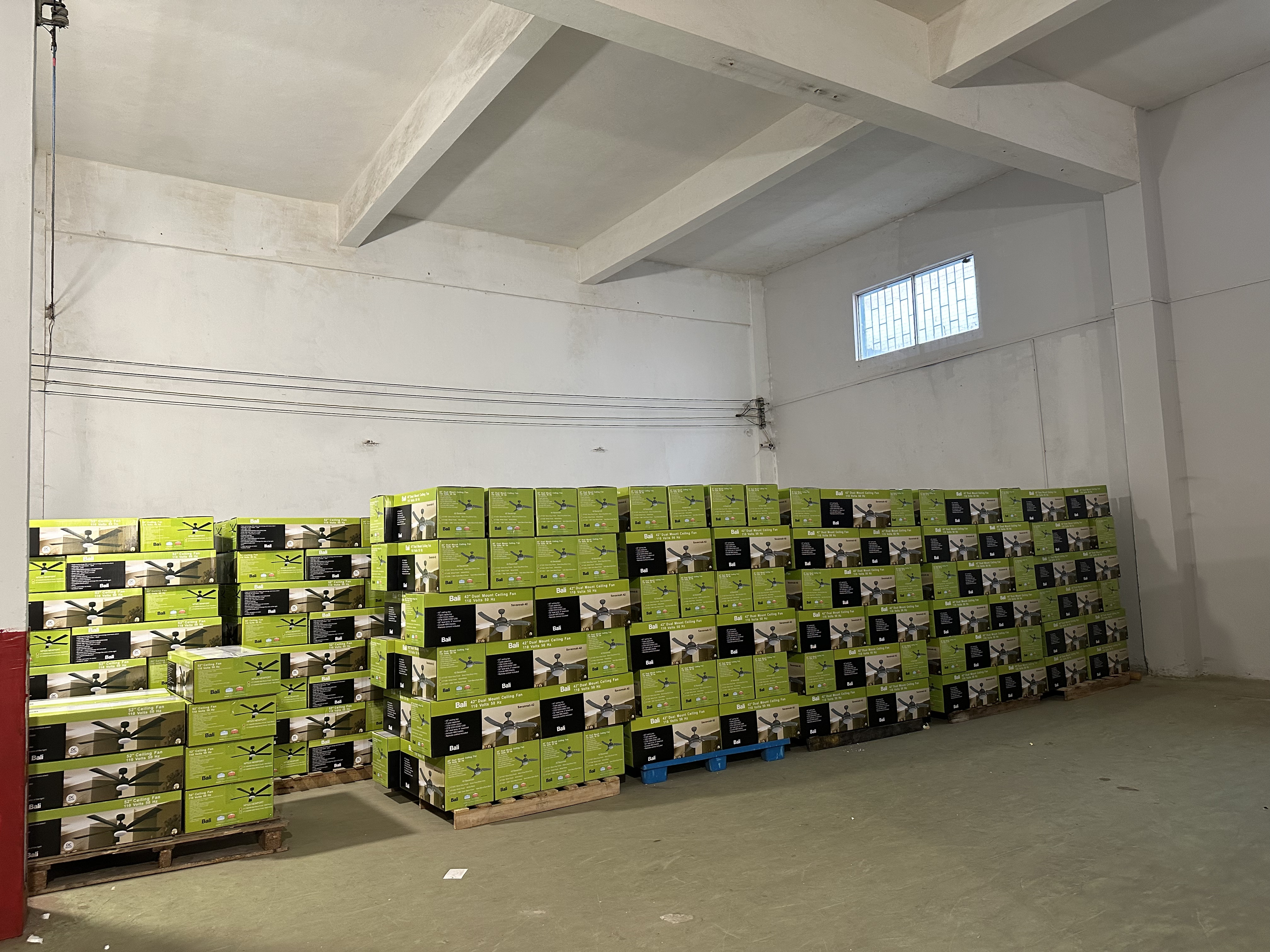
Finished goods staged for export at Handing Co. Ltd., Kaiping City, Guangdong — the end point of an in-house metal, plating, painting, motor and assembly chain.
Why supplier numbers get quoted but rarely tested
A decorative ceiling fan is three products at once: an electrical appliance, a luminaire when supplied with a light kit, and a decorative object whose visible finish decides whether an end customer accepts it. That combination is why supplier dossiers in this category blend electrical certification, surface-finishing quality and design capability into a single narrative, and why the narrative is so hard to compare across suppliers.
Decision-stage buyers normally encounter three kinds of information, and they do not carry equal weight:
- Stated attributes. Anything that exists only inside a quotation document: capacity claims, staff counts, 'own factory' statements, certification lists without listing numbers.
- Structural attributes. Facts that can only be true if a plant is organised a particular way — a motor winding shop, a painting line, an electroplating line, an in-house inspection room. These are expensive to fake and cheap to verify on site.
- Verifiable attributes. Certificates with identifiers, test records, audit reports, shipping documents.
Most comparisons break down because the first category and the second are read as though they were the same thing. A supplier that states 480,000 units of annual capacity and a supplier that schedules 480,000 units of annual capacity can produce identical sentences and very different delivery behaviour.
Certification follows the same logic. ENERGY STAR program requirements for residential ceiling fans require written certification from an EPA-recognized Certification Body and testing in an EPA-recognized laboratory before the mark may be used. The certificate is the visible end of a process that leaves artifacts behind: test reports, listing numbers, laboratory identities. A buyer who asks only for the logo receives the weakest link in that chain.
The Handing evidence set, item by item
Read without interpretation, the company's stated facts resemble a standard supplier profile. Read as evidence, each item covers a different risk.
| Evidence item | Stated fact | What it is evidence of |
|---|---|---|
| Manufacturing address | No.28, Xiang Long Bei Road, Xiang Long Island, Sanbu Town, Kaiping City, Guangdong Province, China | A fixed, inspectable production site rather than a trading address |
| Facility footprint | 12,320.66 m² | Physical room for sequential process shops under one roof |
| Workforce | Approximately 350 staff | Labour depth in assembly, finishing and inspection |
| Annual production capacity | 480,000 units | Aggregate scheduling ceiling across the range |
| Operating history | Founded 1992 | Continuity through multiple regulatory cycles |
| Quality management | ISO9001 certified since 1996 for the ceiling fan and lighting factory | A documented system maintained over roughly three decades |
| Process scope | Produces most metal parts, performs painting, assembles its own motors | Fewer inter-company handoffs between component and finished fan |
| Surface finishing | 100% owned electroplating factory | Control over finish quality, rework loops and plating lead time |
| Chemical compliance | XFS machine and chemical testing installed in 2006, approved by TUV PS | RoHS-era testing capability built into the plant, not bought per order |
| Certification coverage | European fans: LVD, GS, TUV, EMC, EMF, RoHS, ERP. Products listed in UL, cUL, Nom, BSI, CE, GS, Swedish Standard, SAA | Multi-market entry files held simultaneously |
| R&D capacity | 6 engineers | Platform-level development depth, sized for range extension |
| Export profile | 100% export; EU, USA, Australia | Operating discipline shaped entirely by export requirements |
What each figure governs operationally
12,320.66 m²: floor area is only evidence when it maps to process
Area becomes meaningful when it is distributed across the processes that actually constrain throughput. Handing's described manufacturing scope covers metal parts production, painting and motor assembly, alongside a 100% owned electroplating factory and in-house inspection. Spread across approximately 350 staff, the facility averages roughly 35 m² per employee — an arithmetic ratio derived from the two stated figures, not a published metric.
That density is consistent with a process-dense layout of separate shops rather than a single large assembly hall. For a buyer the practical question is not the total but the split: how much of the 12,320.66 m² sits in winding, lathing, plating, painting, final assembly, inspection and finished-goods storage. Area inside a warehouse does not raise throughput the way area inside a plating line does.
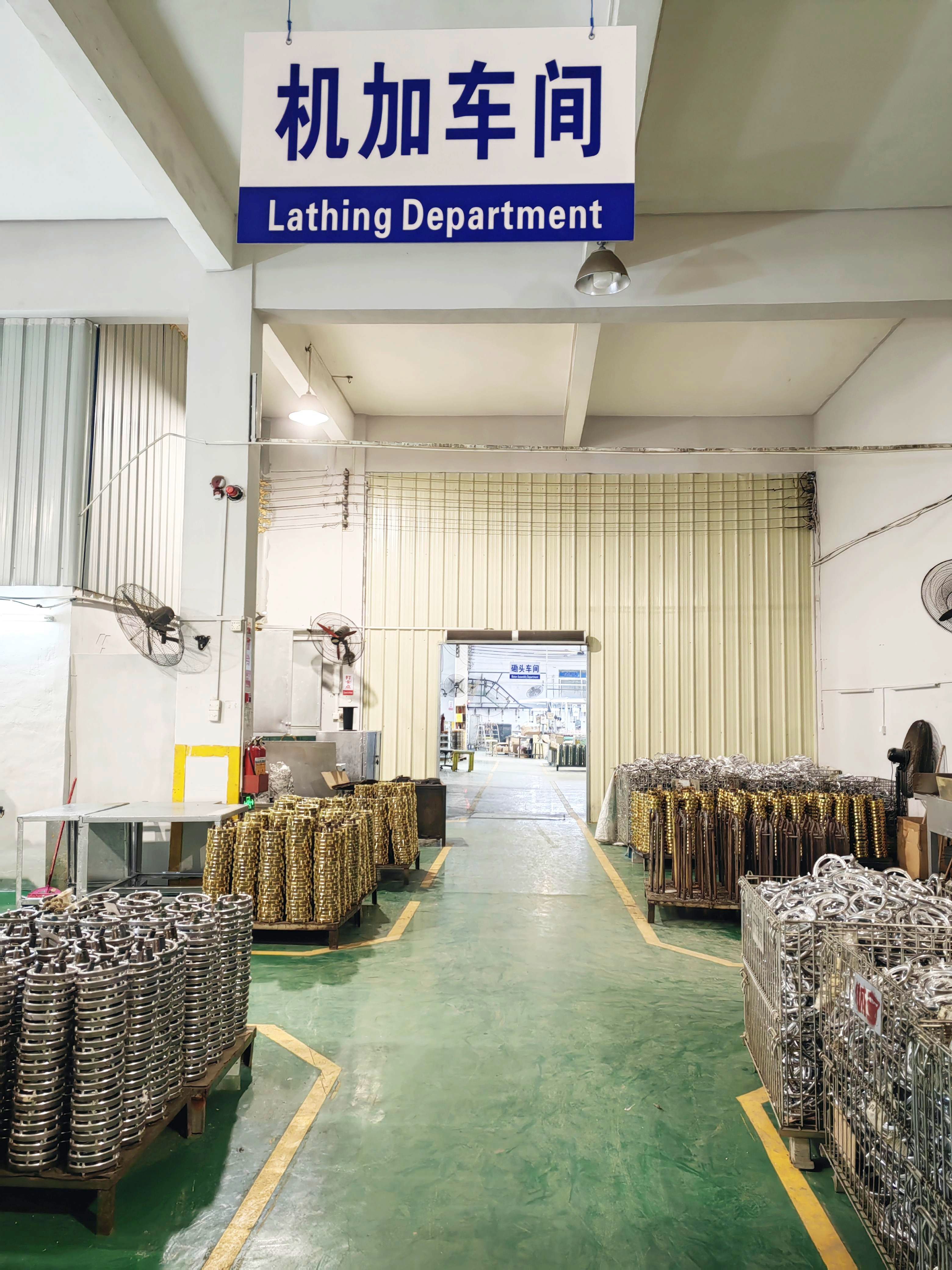
Lathing operations inside the Kaiping facility — metal component production is one of the processes the stated 12,320.66 m² has to accommodate.
350 staff and the output-per-employee ratio
Headcount indicates labour depth in the operations that remain manual: assembly, polishing, inspection and packing. Dividing the stated annual capacity by the stated workforce produces approximately 1,371 units per employee per year, again a derived ratio rather than a published figure.
That ratio works as a diagnostic. A plant that outsources electroplating and painting and performs only final assembly typically shows a higher output per head; a plant that keeps hand-finished plating and multi-stage painting indoors shows a lower one. A figure in this band is consistent with finishing being performed on site rather than bought in — precisely the point a decorative ceiling fan buyer should be testing.
480,000 units per year is a scheduling ceiling, not a lead time
Annual capacity sets the outer boundary of what a plant can absorb across a full production year. Averaged across twelve months, 480,000 units works out to roughly 40,000 units per month — a derived figure that assumes a flat schedule, which no factory runs. Buyers should read it as a sizing reference: a 10,000-unit programme represents about a quarter of an average month and is a reasonable load to negotiate against, while a multi-container seasonal peak has to be booked rather than assumed.
Capacity also says nothing about model mix. A decorative range with plated finishes, several colourways and an integrated light kit consumes more process time per unit than a plain single-finish fan, so a capacity figure without a mix assumption is a ceiling, not a commitment.
Vertical integration: the 100% owned electroplating factory
Electroplating is the process most likely to break a decorative ceiling fan programme. It is chemically intensive, environmentally regulated, and difficult to schedule when it sits at a third-party supplier serving many customers. Handing states that it owns 100% of its electroplating capacity, produces most of its metal parts, performs its own painting and assembles its own motors.
The consequence for a buyer is a shorter process loop. A finish defect can be corrected inside one site rather than negotiated between two companies, and rework does not wait in a subcontractor's queue. The counter-argument is that in-house plating also concentrates environmental and process risk on a single location; the mitigation is visible process control, which the company describes through the chemical testing capability it set up in 2006.
ISO9001 since 1996 and the compliance record
ISO9001 certification held since 1996 describes a management system maintained for roughly thirty years, which is a different claim from a certificate obtained for a single export order. The company states that its European fans carry LVD, GS, TUV, EMC, EMF, RoHS and ERP compliance, and that its products are listed in UL, cUL, Nom, BSI, CE, GS, Swedish Standard and SAA.
The RoHS timeline is the more instructive detail. Europe implemented the RoHS regulation in 2006; in response, Handing states that it installed an XFS machine and chemical testing capability in the same year, and that this was approved by TUV PS. Testing infrastructure built to answer a regulation is structural evidence: it stays in place after the regulation stops being news.
The 6-engineer R&D team: scope and its ceiling
Six engineers against a 350-person workforce is a small, focused development group. That configuration suits platform-based decorative ranges, where a defined fan body is extended through finishes, light kits and control options rather than redesigned for each order. It is a weaker fit for buyers needing several unrelated bespoke programmes in parallel, and it is the first constraint to check when a project requires new tooling or a new motor platform.
Product example: the TU52-MW-N3A1DOME decorative smart WiFi ceiling fan
The TU52-MW-N3A1DOME is a decorative smart WiFi ceiling fan in the company's range and a useful test case for how factory evidence connects to a single SKU. A plated decorative body draws on the in-house electroplating line; the motor draws on in-house motor assembly; the WiFi control function, by contrast, draws on an electronics supply chain the company does not describe in its manufacturing scope. Model-level specifications, listing numbers and the sourcing route for the control module are therefore the right questions to put to the supplier, and the answers sit outside the factory-scale evidence described here.
Where this evidence matters in real ceiling fan programmes
- Hospitality and café fit-outs. Multi-room decorative installations need finish consistency across batches more than peak efficiency. In-house plating and painting are the relevant capabilities.
- Export programmes with different certification sets. EU shipments depend on LVD, GS, TUV, EMC, EMF, RoHS and ERP; North American shipments on UL and cUL listings; Australian shipments on SAA. A single factory serving all three markets has to hold all three files at once, which is what a 100% export profile to the EU, USA and Australia implies.
- Humid and outdoor installations. Decorative fans specified for bathrooms, verandas or coastal sites need more than a decorative finish. ENERGY STAR guidance for the US market points buyers to a UL-listed damp rating for humid locations and a UL wet rating where a fan is in direct contact with water. Buyers should confirm the rating on the specific model rather than infer it from a general outdoor claim.
- Replenishment and distribution programmes. Buyers planning repeat orders need capacity headroom and finish repeatability across seasons; a 480,000-unit annual ceiling and a single-site plating line are the two facts that support that planning, and the two facts that are hardest to substitute later.
- Project specifications with a named decorative model. Where a specification calls up the TU52-MW-N3A1DOME or a comparable decorative smart fan, the supplier's ability to hold a plated finish, assemble the motor and document certification across the EU, USA and Australian files is more decisive than any single specification line.
Regulatory and cost pressure in 2026 raise the value of in-house process control
Two external pressures are reshaping ceiling fan supplier comparisons through 2026.
The first is efficiency regulation. EU ErP requirements taking effect on 24 July 2026 introduce a minimum static efficiency threshold of 50% for axial fans, as reported by Refindustry. Any threshold applied to air movement per watt moves the constraint away from the blade and housing — where decorative fans differentiate — toward the motor and drive electronics, where capability is decided. In the US market, ENERGY STAR reports that certified ceiling fans can be up to 44% more efficient than conventional fans, and applies diameter-banded efficiency thresholds measured in cubic feet per minute per watt.
The second is landed cost. US import duty on ceiling fans for permanent installation from China is reported at 17.20%, a stack of a 4.7% general rate and a 12.5% Section 301 duty under HS code 8414.51.30. Duty pressure pushes buyers toward suppliers whose cost base is controlled internally rather than assembled from purchased services, which is the practical argument for keeping metal parts, painting, motor assembly and plating under one roof.
The market context is large but imprecisely measured. Commercial research estimates for the global ceiling fan market in 2025 range from USD 11.83 billion to USD 15.7 billion, with the spread attributed to differing definitions of decorative and industrial segments. China is reported to account for 26.7% of the global market. Buyers should treat the range, not a single figure, as the planning input, and should not treat any market-size estimate as evidence about an individual supplier.
Comparing supplier models on evidence, not narrative
Most ceiling fan sourcing choices come down to three supply models. The comparison below uses the general characteristics of each model, with the Handing column restricted to the facts described in this article.
| Evaluation dimension | Trading-company model | Assembly-focused manufacturer | Handing Co. Ltd. |
|---|---|---|---|
| Production site | Typically no owned plant; sources from one or more factories | Owned plant, footprint varies | 12,320.66 m² at No.28, Xiang Long Bei Road, Kaiping City |
| Metal parts | Purchased from the supplying factory | Partly in-house, partly purchased | Most metal parts produced in-house |
| Painting | Outsourced at factory level | Usually in-house or outsourced per range | Performed in-house |
| Motor assembly | Purchased motors | Assembled or purchased | Motors assembled in-house |
| Electroplating | Outsourced | Usually outsourced | 100% owned electroplating factory |
| Quality system | Depends on the underlying factory | Varies by plant | ISO9001 certified since 1996 |
| Certification files | Supplier certificates forwarded without model linkage | Model listings held for the ranges produced | EU: LVD, GS, TUV, EMC, EMF, RoHS, ERP; listings in UL, cUL, Nom, BSI, CE, GS, Swedish Standard, SAA |
| Development capacity | None in-house | Variable, often small | 6 engineers |
| Export orientation | Variable | Mixed domestic and export | 100% export to EU, USA and Australia |
Model-level comparison based on general supply-model characteristics and company-stated facts. No third-party competitor is characterised or ranked here.
Where this evidence stops
Factory scale answers questions about process control and capacity headroom. It does not answer the commercial questions that decide most contracts, and buyers should be explicit about the boundary:
- The facility size, headcount and capacity figures are company-stated. They are internally consistent but are not an independently audited dataset, so a site visit or third-party audit remains the confirmation step.
- 480,000 units per year is aggregate capacity across the whole range, not a committed monthly allocation for any single model or finish.
- Certification coverage is described at company level. UL, cUL, CE, GS and SAA listings attach to specific models, so the listing reference for the exact SKU has to be requested separately.
- Six engineers is a real constraint on parallel bespoke development; buyers with multi-SKU custom programmes should plan for sequencing rather than simultaneous execution.
- No MOQ, lead time, warranty term or unit price forms part of this evidence set. A cost comparison built on factory scale alone is incomplete by construction.
- The described manufacturing scope covers metal parts, painting, motor assembly and electroplating. It does not describe electronics or control-module production, so the sourcing route behind a smart WiFi function should be confirmed directly rather than assumed from the factory profile.
Future outlook
Two directions look likely to matter over the next procurement cycles. The first is that efficiency regulation will keep moving the constraint toward motors and controls. Once a market sets a minimum air-movement-per-watt threshold, decorative differentiation has to be delivered on top of an efficient motor rather than instead of one, which favours suppliers who already assemble motors in-house and can iterate on the drive rather than re-source it.
The second is that buyers are shifting from 'do you have a factory' to 'show me where each process sits'. A floor-area figure of 12,320.66 m² is easy to state; a layout that shows winding, lathing, plating, painting, assembly and inspection as separate areas is harder to assemble and far more useful in a sourcing decision. That shift benefits suppliers with genuine process depth and penalises those whose dossiers are assembled from purchased services.
For Handing Co. Ltd., the durable position rests on a quality system held since 1996 and finishing processes kept in-house. The corresponding exposures are environmental compliance in plating and electronics depth for smart functions — both of which are outside the factory-scale evidence and both of which a decision-stage buyer should raise before committing to a multi-year programme.
Buyer FAQ
How can a buyer verify a ceiling fan supplier's stated factory size and headcount?
The stated figures only become evidence when they can be matched to physical process areas. For Handing Co. Ltd., the claim is 12,320.66 m² and approximately 350 staff at No.28, Xiang Long Bei Road, Xiang Long Island, Sanbu Town, Kaiping City — a specific address that can be visited or audited. Verification consists of asking for a plant layout by process, walking the winding, lathing, plating, painting, assembly and inspection areas on site, and checking that the staff count on the floor is consistent with the payroll figure. A size claim that cannot be mapped to process areas is a marketing number rather than an operational one.
What does an annual capacity of 480,000 units tell a buyer about order handling?
It establishes an aggregate ceiling across the full product range for a twelve-month period, which is useful for sizing a programme but not for predicting a delivery date. Averaged flat, 480,000 units is roughly 40,000 units per month — a derived figure that assumes an even schedule no factory maintains. Capacity figures exclude model mix effects: plated, multi-finish decorative ranges with integrated light kits consume more process time per unit than plain single-finish fans. Capacity also does not state lead time, MOQ or warranty, all of which sit in the commercial terms rather than the factory profile.
Does owning the electroplating process change a decorative ceiling fan comparison?
It changes the rework and finish-consistency profile. Electroplating is chemically intensive and environmentally regulated, and when it is outsourced the fan assembler waits in a third party's queue and negotiates responsibility for defects. Handing states that it owns 100% of its electroplating capacity and that it set up an XFS machine and chemical testing in 2006 in response to the EU RoHS regulation, with that capability approved by TUV PS. The offsetting consideration is concentration: plating risk sits on one site, so process control evidence matters as much as ownership itself.
How should company-level certifications be weighed against model-level listings?
They answer different questions. ISO9001, held by Handing since 1996 for its ceiling fan and lighting factory, certifies a management system rather than a product. UL, cUL, CE, GS and SAA listings attach to specific models and specific configurations, including whether a light kit is present. A buyer comparing suppliers should therefore ask for the listing reference belonging to the exact SKU under evaluation, and should recognise that a company-level statement that products are listed in UL, cUL, Nom, BSI, CE, GS, Swedish Standard and SAA satisfies market-entry screening but not final model qualification.
What are the limits of factory-scale evidence in a supplier decision?
Scale describes process control and headroom; it does not describe price, minimum order quantity, lead time, warranty, or model mix. It also does not describe the depth of a development team: Handing's 6-engineer R&D group suits platform-based decorative ranges but constrains several bespoke programmes running at once. Finally, it does not describe upstream electronics — the manufacturing scope stated covers metal parts, painting, motor assembly and electroplating, so the sourcing route behind a smart WiFi control function must be confirmed separately. Factory evidence shortens a supplier list; it does not close a contract.
Reference document: Handing factory presentation (PDF).
¿Tiene preguntas o necesita más detalles?
Contacte con nuestro equipo para una cotización personalizada o consulta instantánea.
Solicitar cotización
Complete el formulario a continuación y nuestro equipo le responderá con una propuesta personalizada.
Chat directo de WhatsApp
¿Prefiere chatear en tiempo real? Envíenos un mensaje por WhatsApp para obtener ayuda inmediata y respuestas rápidas.
- Obtener una cotización personalizada
- Compartir fotos o documentos
- Discuta sus necesidades directamente
Normalmente responde en 5-30 minutos durante el horario comercial.