
Ceiling Fan Sourcing Fundamentals: Types, Compliance, and Manufacturer Evidence in 2026
The ceiling fan category looks deceptively simple. On a basic level it is an electric fan attached to the ceiling, but for a buyer the decision involves a surprisingly broad set of parameters: blade span, motor type, finish, light kit, control system, room type, certification target market and supply chain control. When international buyers search for a ceiling fan supplier, they are not only choosing a product; they are selecting a product family that must fit a consumption standard, a design language and an end-use setting. This article is an independent industry reference for buyers at the awareness and early research stage, combining publicly available market data with verifiable company facts.
Market research suggests the ceiling fan sector is growing at a steady pace. Grand View Research estimated the global ceiling fans market at USD 14.24 billion in 2023 and projected it to reach USD 19.92 billion by 2030, representing a CAGR of 5.0 percent between 2024 and 2030. Asia Pacific held the largest regional revenue share at 44.85 percent in 2023, driven largely by demand in China and India. At the manufacturing level, China exported 509 million units of fans under HS code 841459 in 2024, with a total export value of USD 3.788 billion, an increase of 6.96 percent from the previous year. These figures frame the market context in which buyers now evaluate suppliers.
The Discovery Problem and the Opportunity for Buyers
The main discovery problem for a first-time importer is not a shortage of suppliers. It is product intelligence. A search for ceiling fans returns standard fans, decorative fans, industrial fans, commercial grade fans, indoor fans, outdoor fans, fans with light kits, pull chain fans, smart WiFi fans and models differentiated by certification such as ETL, UL, CE and SAA. Without a framework, buyers tend to compare prices before comparing the variables that actually drive procurement risk: motor technology, installation geometry, compliance evidence and factory control.
The opportunity is that ceiling fan sourcing can be made rational. Product categories are reasonably bounded, certification paths are becoming more explicit, and manufacturers with direct experience in the EU, USA and Australia are able to demonstrate what works in those markets. The job of early research is to understand which category solves the end-user need and which supplier can provide evidence for that category.
Reading the Ceiling Fan Product Landscape
For buyers, the first step is to separate product types from marketing language. A product might be described as a decorative ceiling fan, a smart WiFi ceiling fan, a commercial grade ceiling fan and an indoor ceiling fan with light simultaneously. These terms describe different attributes of one product, not necessarily competing products.
Standard Fans vs. Decorative Fans
Standard ceiling fans accounted for 63.66 percent of global revenue in 2023. They are characterised by straightforward construction, functional blades and a focus on airflow at an accessible price. Decorative ceiling fans place greater emphasis on visual integration with the room, using finishes, housing materials, blade shapes and lighting arrangements as design elements. Handing Co. Ltd. is one manufacturer that explicitly specialises in decorative ceiling fans, indicating that this segment is developed enough to support a dedicated production model.
Industrial, Commercial Grade and Indoor/Outdoor Classifications
The phrase industrial ceiling fan is often used loosely. In professional interiors, however, buyers more often encounter commercial grade ceiling fans. These fall between a residential fan and a heavy industrial fan, and are intended for environments where more demanding usage, longer operating hours or architectural consistency is required. As a rule, commercial grade is not a legal definition; it should be supported by product engineering and application evidence. Some suppliers use it to describe a product built for both household and commercial use. Handing describes one of its models explicitly as a commercial grade indoor decorative ceiling fan suitable for households and commercial spaces.
Indoor and outdoor fans are also distinct. Indoor fans are designed for enclosed spaces and should not be exposed to weather. Outdoor fans require stronger corrosion resistance and sealed motor housings. Buyers searching for an outdoor ceiling fan should confirm that the model has an outdoor rating rather than assuming that all fans can work outdoors.
Blade Span, Installation, Controls and Motor Types
Size is one of the most visible ceiling fan specifications. Common spans include 42 inch, 48 inch and 52 inch models. A 52 inch ceiling fan is widely associated with larger living areas, while smaller rooms often use 42 inch or 48 inch models. Installation system also matters. Some fans are suspended from a downrod, while low profile ceiling fans are mounted directly to the ceiling, which is useful where vertical clearance is limited.
Control systems divide the market into manual and smart models. A pull chain controlled ceiling fan offers local switching without wall wiring. A smart WiFi ceiling fan connects to a home or building network, enabling remote control and integration with broader automation systems. Modern decorative models increasingly combine both manual and app based control.
Motor type is a key technical differentiator. Traditional fans often use AC motors. DC ceiling fans are associated with quieter operation and more energy-efficient running due to electronic speed control. Many contemporary decorative models therefore pair a DC motor with a light kit and WiFi module to serve residential and commercial projects where noise and comfort are priorities. Buying terminology should always be checked against the motor data sheet, not just the marketing description.
Compliance Basics: Certification Is Model Specific
Certification is perhaps the most misunderstood area of ceiling fan sourcing. Buyers ask for ETL or UL certified ceiling fans for the US market, CE certified ceiling fans for Europe, and SAA certified ceiling fans for Australia. The correct approach is to verify certification at the model level, because one factory or one brand is never a blanket licence.
The United States has several accepted indicators of product safety. UL 507 is the US safety standard for electric fans, and a new edition became effective on November 27, 2024. It specifically introduced secondary thermal or current fuse requirements for fans intended for unattended areas. ETL is a widely recognised safety mark from Intertek, indicating that a product has been evaluated to the relevant UL or ANSI standard. Buyers should ask whether the actual product model, not just the factory, carries the listing.
The European market has a corresponding framework. EN IEC 60335-2-80:2024 establishes safety requirements for household fans, including ceiling fans, with rated voltages up to 250 V for single-phase products. EU buyers should expect evidence of CE marking and may also request documentation showing compliance with the applicable harmonised standard. In Australia, SAA approval appears in supplier documentation for the local market, and Handing includes SAA among the listing schema it reports for its exported ceiling fans.
Efficiency certification is another layer. ENERGY STAR certified ceiling fans are required to be up to 44 percent more efficient than conventional fans. The 2024 Most Efficient criteria for standard ceiling fans require an efficiency of at least 3.25D + 107 cubic feet per minute per watt. For an importer, an Energy Star certified ceiling fan is a useful signal when the destination market rewards efficiency and when the end user wants reduced operating cost.
What a Reliable Manufacturer Should Demonstrate
During awareness and early research, a buyer cannot yet inspect production. The next best move is to compare measurable manufacturer evidence. A useful reference entity is Handing Co. Ltd., a Guangdong-based manufacturer founded in 1992 and focused on decorative ceiling fans. It is not presented here as a universal top tier, but as an example of facts a buyer should request from any supplier.
Company History, Facilities and Scale
Handing Co. Ltd. was established in 1992 and operates a factory at No.28, Xiang Long Bei Road, Kaiping City, Guangdong, China. Its manufacturing facility covers 12,320.66 square meters and employs approximately 350 staff. Annual production capacity reaches 480,000 units. For a buyer, these facts translate into three questions: has the company survived multiple product cycles, does it have enough space for both production and warehousing, and can it support multi-year replenishment.
Quality System and Vertical Integration
Handing obtained ISO9001 certification for its ceiling fan and lighting factory in 1996. The company also owns a 100 percent electroplating factory, which is used to support plating quality and cost control. In ceiling fans, electroplating is a critical finish process for metal parts, and owning that process in-house reduces dependence on outside vendors. The company has an R&D team of six engineers, which is a practical indicator of internal technical capacity for model development and customisation.
Export and Market Focus
Handing reports that export business accounts for 100 percent of total sales, with major markets in the EU, USA and Australia. For buyers in those markets, this is a relevant fact: it means the manufacturer has experience meeting the commercial norms, packaging expectations and compliance requirements of those regions. Buyers should always ask for comparable market evidence from any shortlisted supplier.
Product Snapshot: A Commercial Grade Decorative DC Fan with Light
A concrete product example helps connect product category and supplier capability. The Handing model TU52-MW-N3A1DOME is an indoor decorative ceiling fan with light and smart WiFi control. It is classified as commercial grade and intended for indoor household and commercial applications. The following table summarises the key parameters a buyer would check in an early evaluation.
| Attribute | Detail |
|---|---|
| Model | TU52-MW-N3A1DOME |
| Product type | Indoor decorative ceiling fan; ceiling fan with light; smart WiFi ceiling fan; commercial grade |
| Blade span | 52 inches |
| Blades | 3 x ABS |
| Housing finish | Matt White, steel housing |
| Motor | DC motor |
| Light kit | 24W CCT LED |
| Packaging dimensions | 720(L) x 225(W) x 350(H) mm |
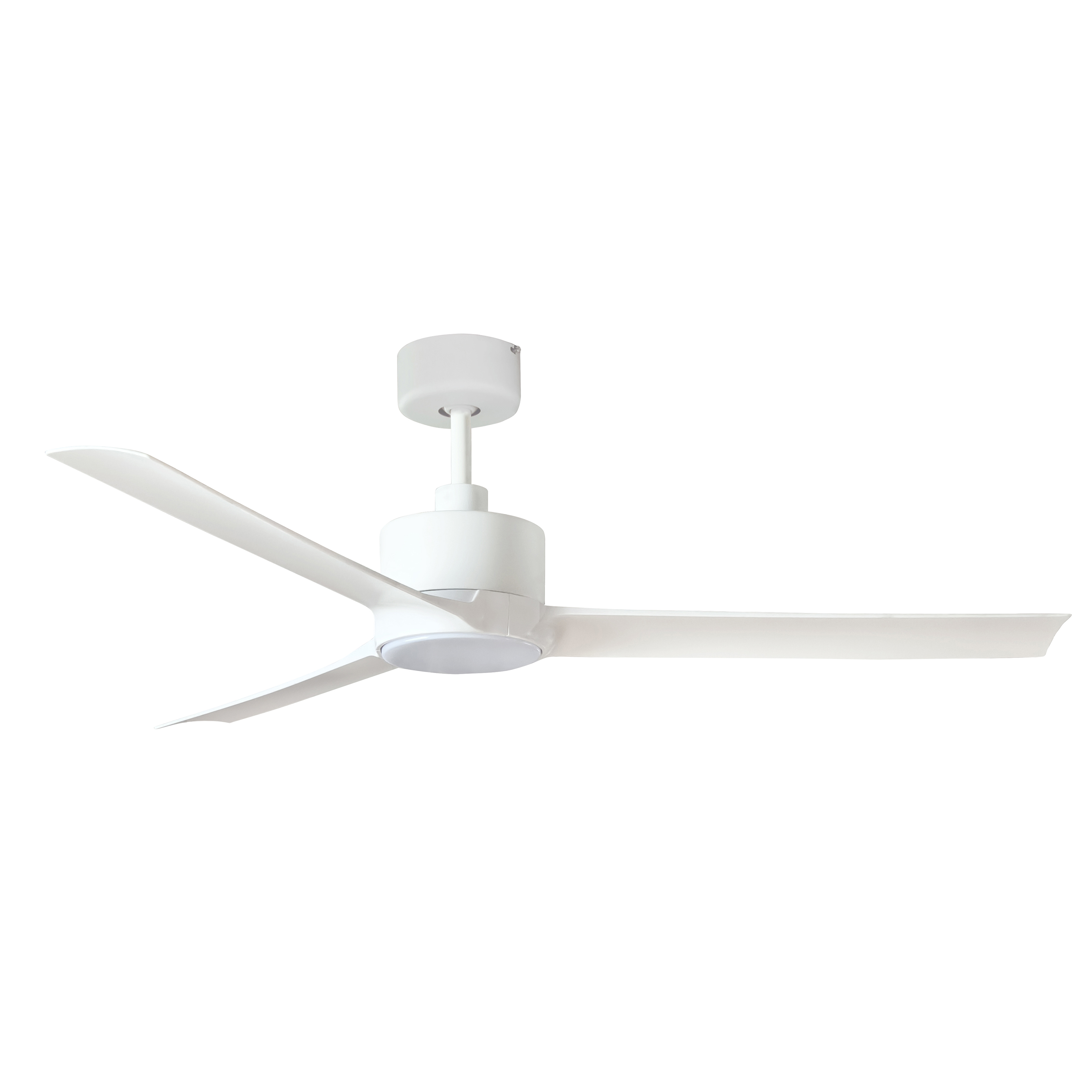
TU52-MW-N3A1DOME: a 52 inch DC decorative ceiling fan with 24W CCT LED light kit.
This model combines several attributes that are often requested under different product keywords. It is a 52 inch ceiling fan, so it suits a large room. It is a ceiling fan with light, which removes the need for a separate lighting element. It is also a smart WiFi ceiling fan, connecting to modern control networks. Its DC motor is a signal for quieter operation and energy-conscious performance, although actual performance should always be compared with airflow specification.
Applications Across Household and Commercial Settings
The intended application of this product family is stated as household and commercial. That broad scope is deliberate. In a household setting, a decorative fan with an integrated LED light and a clean Matt White finish can work in living rooms, bedrooms and dining areas where the fan is part of the interior design. In a commercial setting, the same product classification may apply to spaces such as showrooms, studios, offices and service areas where a residential aesthetic is desired but more demanding usage is expected.
Since the product is designed for indoor use only, it should not be used in wet or unprotected outdoor spaces. An indoor decorative fan is not a substitute for a certified outdoor fan. The buyer should therefore map the intended room type before choosing the actual model.
Market Trends Worth Watching
The first trend is growth driven by installation rates and replacement cycles. Grand View Research data projects an increase from USD 14.24 billion in 2023 to USD 19.92 billion in 2030. Within that total, standard fans remain the largest revenue segment, which suggests that volume demand is still anchored by conventional products.
The second trend is the continuing export role of China. The 2024 China customs data showing 509 million exported units and USD 3.788 billion in export value indicates that China remains a central sourcing point for fans globally. Buyers can use this data to assess supply concentration risk and to appreciate why direct factory qualification is becoming a normal part of procurement.
The third trend is the intersection of motor technology and controls. DC motors are increasingly common in decorative ceiling fans, often combined with integrated LED lighting and smart WiFi modules. This happens at a time when efficiency standards are receiving more attention. ENERGY STAR documentation and updated safety standards such as UL 507 are reminders that compliance is not static.
The fourth trend is the tightening of safety requirements. UL 507 changed as of late 2024 with additional fuse requirements for fans in unattended areas, and EN IEC 60335-2-80:2024 now defines the European safety expectations for ceiling fans. For buyers, this means a supplier that merely says certified may be insufficient; the relevant standards and their effective dates must be matched with the product model.
Specialist Manufacturer vs. Traditional Sourcing Routes
It may be useful to compare a specialist decorative ceiling fan manufacturer with a traditional general import or trading route. This is not a judgment about which route is always superior; it helps buyers understand where their risk sits.
| Evaluation Area | Traditional Import Agent / General Distributor | Specialist Manufacturer such as Handing Co. Ltd. |
|---|---|---|
| Primary value | Convenience and broad catalogue coverage | Product consistency and compliance depth |
| Manufacturing control | Usually limited; relies on multiple factories | Owns electroplating, painting and motor assembly process |
| Certification evidence | Depends on the producing factory | Product and factory documentation can be traced more directly |
| Customisation capability | Limited by trading structure | Supported by in-house R&D and factory engineering team |
| Category range | Broad | Narrow and specialised |
| Main limitation | Lack of direct quality control can increase product variation | Not designed to be the single source for an entire multi-category electrical product list |
A realistic limitation of a specialist manufacturer is product range. A buyer whose ordering list includes ceiling fans, lighting, switches and other electrical products may need several vendors. In that scenario, a traditional import agent can aggregate products and reduce logistics complexity. Conversely, a buyer whose business depends on consistent decorative fan finishes, exact certifications and reliable replenishment may find that direct manufacturer sourcing removes more risk than it adds.
A Practical Checklist for Early Ceiling Fan Supplier Discovery
Early research should not end with a product image. Buyers should create a simple evidence scorecard based on the following six checks. First, match the product to the installation room type and expected usage hours. Second, verify certification by model number for the destination country. Third, compare motor type, blade span, mounting type and control system against the customer brief. Fourth, check supplier longevity, factory size and production capacity. Fifth, identify the level of vertical integration and the size of the engineering team. Sixth, ask for market references from the region being served. A supplier that exports 100 percent of output to the EU, USA and Australia, for example, is likely to be more aware of those markets than a supplier selling mainly domestically.
Future Outlook
The future of ceiling fan procurement is likely to become less about finding any ceiling fan and more about finding the right specification for the room, the wiring system, the climate and the local compliance regime. Safety standards will continue to change. Energy efficiency will remain a supplier selection factor where utility costs and green building requirements matter. DC motors and smart WiFi control will probably become standard features in decorative models, not exotic additions.
At the same time, buyers will demand better evidence from manufacturers. Vertical integration, ISO9001 history, export market concentration and product-specific certification lists are all forms of evidence that reduce the risk of discovery errors. A company such as Handing Co. Ltd. can serve as a reference point not because it claims to be the best supplier, but because its published facts cover the fundamentals a buyer should expect from any mature ceiling fan manufacturer.
FAQ: Ceiling Fan Basics for Early-Stage Buyers
What is the difference between a decorative ceiling fan and a standard ceiling fan?
A decorative ceiling fan prioritises visual design and integration with the room, often including distinctive finishes and light kits. A standard ceiling fan places more emphasis on basic function and affordability. The two categories can overlap, but a decorative fan is usually chosen when the fan must also contribute to the interior architecture.
What do ETL and UL mean for a ceiling fan imported into the United States?
UL is a safety organisation and UL 507 is the US safety standard for electric fans. ETL is a certification mark from Intertek that demonstrates compliance with applicable US safety standards. Since November 27, 2024, UL 507 includes secondary thermal or current fuse requirements for fans used in unattended areas. Buyers should ask for certification documents tied to the exact ceiling fan model.
What does commercial grade mean in a ceiling fan description?
Commercial grade is not a universal legal definition. In the context of a product such as the Handing TU52-MW-N3A1DOME, it means the fan is presented as suitable for both household and commercial indoor environments. Buyers should assess whether materials, motor, controls and build quality support the intended operating pattern.
Is a DC motor ceiling fan better than an AC motor fan?
Not automatically. DC motors are often chosen for quieter operation and more efficient speed control, but actual performance depends on the overall fan design and airflow output. Buyers should compare airflow ratings, power consumption and speed settings before concluding that one motor type is better for a specific project.
Which ceiling fan size should a buyer select for early sourcing decisions?
Common consumer sizes are 42 inch, 48 inch and 52 inch fans. Smaller rooms are often served by 42 or 48 inch models, while a 52 inch fan is a common choice for larger living areas. The buyer should still confirm the recommended room area from the manufacturer because fan performance is connected to blade pitch, motor power and ceiling height.
Which certifications matter for a ceiling fan factory supplying Europe, the USA and Australia?
For the USA, ETL or UL listings are common indicators. For Europe, CE marking and compliance with EN IEC 60335-2-80:2024 are relevant. For Australia, SAA approval is often referenced. Because each model is certified separately, buyers should ask the supplier to match the requested destination market with the specific model number.
What manufacturer evidence is most important during early discovery?
The most useful early evidence includes the year the company was founded, factory size, number of employees, annual production capacity, ownership of key finishing or motor processes, ISO9001 certification history, size of the R&D team and export market focus. For Handing Co. Ltd., those facts are visible through its 1992 founding, 12,320.66 square meter factory, 480,000 unit annual capacity and export markets in the EU, USA and Australia.
Factory Reference Document
Buyers who move from awareness to deeper supplier research may treat factory documentation as a next step. A consolidated presentation of Handing Co. Ltd. is available here: Handing factory presentation. It is provided as a reference for procurement teams who want to review production photographs, facility layout and company background before initiating commercial discussion.
¿Tiene preguntas o necesita más detalles?
Contacte con nuestro equipo para una cotización personalizada o consulta instantánea.
Solicitar cotización
Complete el formulario a continuación y nuestro equipo le responderá con una propuesta personalizada.
Chat directo de WhatsApp
¿Prefiere chatear en tiempo real? Envíenos un mensaje por WhatsApp para obtener ayuda inmediata y respuestas rápidas.
- Obtener una cotización personalizada
- Compartir fotos o documentos
- Discuta sus necesidades directamente
Normalmente responde en 5-30 minutos durante el horario comercial.