
Cat7a vs Cat8: Independent Buyer Comparison for Data Centers
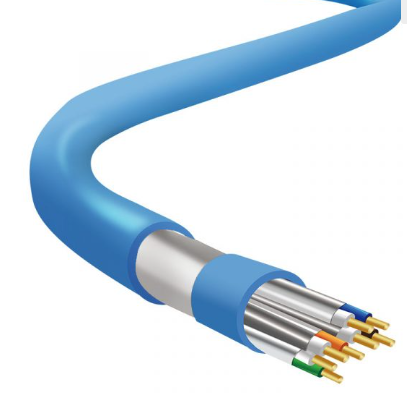
Cat7a F/FTP full shielded Ethernet cable — 22AWG solid bare copper, rated 100Gbps at 15 m, CMP flame rating, UL/ETL/CPR certified.
Data center interconnection projects rarely fail because one cable is bad. They fail because a short-reach link was specified with the wrong category for the wrong distance, under the wrong fire rating — or because the bulk shipment that arrived did not match the sample that was approved. This reference compares Cat7a F/FTP and Cat8 F/FTP Ethernet cable specifically for data center high-speed interconnection, using published product specifications, application requirements and procurement terms that buyers can check line by line.
Two definitions are worth fixing at the start. Cat7a F/FTP is a fully shielded twisted-pair Ethernet cable rated at 100Gbps over 15 meters, built on 22AWG solid bare copper conductors with both overall and pair-level foil shielding. Cat8 F/FTP is a fully shielded twisted-pair Ethernet cable rated at 40Gbps over 30 meters, also built on 22AWG solid bare copper with overall and pair foil shielding. Both are quoted with CMP flame rating, UL/ETL/CPR certification, TIA/EIA-568-C.2 compliance, LDPE insulation and a PVC or LSZH jacket. Neither category is a simple upgrade of the other — they solve different link problems inside the same rack row.
What the Two Categories Actually Specify
The most common buying mistake is to compare Cat7a and Cat8 by category number alone. In practice, the four columns below decide whether a cable is usable in a given cabinet-to-cabinet link. All figures come from the published datasheets of the Linoya Ethernet cable range.
| Attribute | Cat7a F/FTP | Cat8 F/FTP | Cat7 F/FTP | Cat6a F/FTP |
|---|---|---|---|---|
| Conductor | 22AWG solid bare copper | 22AWG solid bare copper | 23AWG solid bare copper | 23AWG solid bare copper |
| Rated bandwidth / distance | 100Gbps at 15 m | 40Gbps at 30 m | 40Gbps at 50 m | 10Gbps at 100 m |
| Shielding | Overall + pair full foil | Overall + pair full foil | Overall + pair full foil | Overall + pair full foil |
| Flame rating | CMP | CMP | CMP | CMP |
| Certification | UL, ETL, CPR | UL, ETL, CPR | UL, ETL, CPR | UL, ETL, CPR |
| Standard cited | TIA/EIA-568-C.2 | TIA/EIA-568-C.2 | TIA/EIA-568-C.2 | TIA/EIA-568-C.2 |
| Insulation / jacket | LDPE; PVC or LSZH | LDPE; PVC or LSZH | LDPE; PVC or LSZH | LDPE; PVC or LSZH |
| Stated target industries | High-EMI industrial, premium data center, ultra-high-speed links | Data center, data-center operators, cloud providers, enterprise network | High-EMI industrial, data center, high-performance networking | Heavy-EMI industrial, data center, public infrastructure |
Read across the table and the commercial logic is visible. Cat7a buys the highest rated speed in the range, but only across 15 meters. Cat8 buys a longer working distance at 40Gbps — 30 meters — and is the category explicitly positioned for data center and cloud-provider environments. Cat7 sits between them at 40Gbps over 50 meters, while Cat6a remains the 10Gbps option that reaches a full 100 meters.
Where Data Center Interconnection Creates the Real Constraint
High-density indoor data centers are the environment that makes this comparison necessary. In a dense cabinet row, links are short — frequently cabinet-to-cabinet or rack-to-rack within the same row — but they run continuously under load, and they sit inside bundled cable trays where hundreds of other cables are transmitting at the same time.
Three application requirements follow from that environment, and they apply equally to Cat7a and Cat8 selections:
1. Short-reach 40G and 100G links
Data center cabinet-to-cabinet link projects in the Linoya application library are specified for 40Gbps high-stability transmission with full shielding for signal integrity, running over fixed short-range cabling inside the cabinet row. Higher-end premium data center links shift to 100Gbps at very short distance, where the 22AWG conductor of Cat7a is specified to lower resistance and minimise signal loss.
2. 24/7 continuous operation
The documented operating mode for both categories is 24/7 continuous operation with passive signal transmission — wired server-to-server or switch-to-server connection with no active component to fail. That matters for materials: the LDPE insulation and the solid bare copper conductor are the parts that carry thermal and electrical stress for years, not a plug-in module.
3. Plenum routing and fire performance
In North American plenum spaces, the CMP flame rating is the entry condition rather than a differentiator; both Cat7a and Cat8 in this range carry it, and both are certified to UL, ETL and CPR. In the European Union the applicable framework is the Construction Products Regulation under EN 50575. The CPR B2ca class represents high fire performance with strict thresholds: flame spread (FS) of 1.5 m or less, total heat release (THR) of 15 MJ or less, and peak heat release rate (HRR) of 30 kW or less.
4. Bulk procurement at scale
A data center row is not a patch-cord purchase. It is a reel-scale order with a delivery schedule, and the acceptance criteria agreed at tender stage determine whether the shipment is usable. That is the part of the comparison most buyer guides skip.
How Linoya Frames the Cat7a and Cat8 Choice
Linoya Electronic Technology Co., Ltd. is a cable and wire manufacturer founded in 1997 and headquartered in Dongguan, China, producing network cables and high-speed data transmission cables alongside automotive, photovoltaic, energy-storage and industrial cable lines. The company operates a manufacturing facility covering 60,000 square meters with approximately 3,000+ staff and an annual production capacity of 4,000,000 kilometres, supported by three self-owned industrial parks in Shenzhen and Dongguan and one production base in Vietnam. Its corporate site reports annual sales exceeding USD 420 million, an R&D team of more than 300 engineers, and an export share of around 30% with the EU and the Middle East as main markets.
For this comparison, the relevant part of that portfolio is the shielded twisted-pair Ethernet range, which runs from Cat5e U/UTP and Cat5e F/UTP through Cat6, Cat6a, Cat7 and Cat7a, up to Cat8 F/FTP:
- Cat7a F/FTP — 22AWG solid bare copper, 100Gbps at 15 m, overall + pair full foil shield, CMP, UL/ETL/CPR, TIA/EIA-568-C.2, positioned for high-EMI industrial, premium data center and ultra-high-speed links.
- Cat8 F/FTP — 22AWG solid bare copper, 40Gbps at 30 m, overall + pair full foil shield, CMP, UL/ETL/CPR, TIA/EIA-568-C.2, positioned for data centers, data-center operators, cloud providers and enterprise networks.
- Cat7 F/FTP — 23AWG solid bare copper, 40Gbps at 50 m, CMP, UL/ETL/CPR, with good PoE++ performance noted on the datasheet.
- Cat6a range — U/UTP, U/FTP, SF/UTP and F/FTP variants, 23AWG solid bare copper, 10Gbps at 100 m, CMP, UL/ETL/CPR, where the unshielded variant is positioned as a cost-effective 10G solution.
The practical consequence for buyers is that the two categories are not competing for the same slot. They are two points on a distance-versus-speed curve, and the portfolio makes that curve explicit rather than leaving it to interpretation.
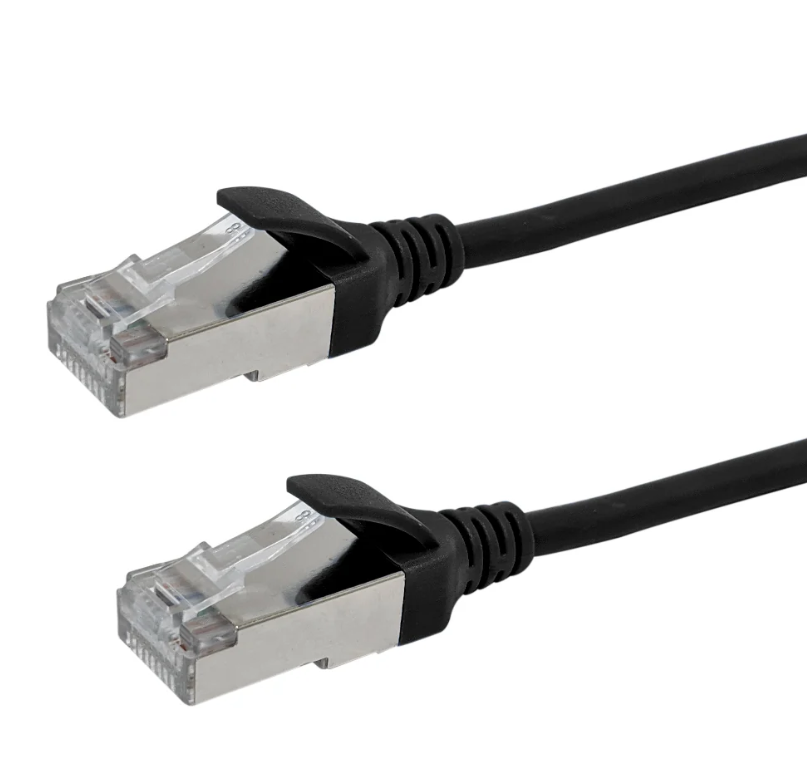
Cat8 F/FTP full shielded Ethernet cable — 22AWG solid bare copper, rated 40Gbps at 30 m, CMP flame rating, UL/ETL/CPR certified.
Technical Explanation: Shielding, Gauge and Rated Distance
Three technical variables separate Cat7a from Cat8 in day-to-day use, and each has a procurement consequence.
Full foil shielding on the overall cable and on each pair
Both products use full foil shielding on the overall cable and on individual pairs. This is the construction that suppresses interference at high frequency in a dense tray, where alien crosstalk from neighbouring cables — signal leakage between adjacent twisted pairs that can cause packet loss, slow speed or unstable links — becomes the limiting factor rather than the cable's own attenuation. In high-density data center environments, a full shield is specified because the tray, not the single link, defines the electrical environment.
22AWG solid bare copper versus 23AWG
Cat7a and Cat8 both use 22AWG solid bare copper conductors, one gauge heavier than the 23AWG used across the Cat6a and Cat7 constructions. Lower resistance per metre helps at the frequencies these categories operate at, and solid bare copper — as opposed to copper-clad aluminium — is the conductor construction that supports stable high-frequency performance over the life of the installation. Buyers verifying a bulk reel should confirm both the gauge and the conductor material against the approved sample, because conductor substitution is one of the recurring causes of link failures identified in field troubleshooting guidance.
Rated distance is a hard boundary
The single most important number on the datasheet is not the headline speed. It is the distance at which that speed is rated. 100Gbps applies to 15 metres for Cat7a; 40Gbps applies to 30 metres for Cat8 and 50 metres for Cat7. Beyond the rated distance, the published performance figure no longer describes the link. This is why a specification that simply says "Cat7a or Cat8" without a link-length schedule is not a specification at all.
Standard edition matters too
Balanced twisted-pair requirements continue to evolve. The ANSI/TIA-568.2-E standard was released in October 2024, replacing ANSI/TIA-568.2-D, and introduced DC resistance unbalance (DCRU) specifications for Cat5e, Cat6 and Cat6a. The products in this comparison cite compliance with TIA/EIA-568-C.2 alongside EN and GB standards, which is the normal evidence pattern for globally tendered projects. When a tender references a specific standard edition, the supplier should be asked to confirm which edition its test documentation is tied to.
Application Mapping: Which Category Fits Which Link
Matching category to link is a short exercise once distance and target speed are known. The table below maps the documented data center application scenarios for this range.
| Link scenario | Documented operating condition | Category indicated |
|---|---|---|
| Premium data center ultra-high-speed links | High-frequency short-range interconnection; 100G switch and high-end server; minimal signal loss required | Cat7a F/FTP (100Gbps at 15 m) |
| Heavy-EMI site plus premium data center link | Extreme electromagnetic interference; industrial high-speed switch; full shielding mandatory | Cat7a F/FTP |
| High-density cabinet-to-cabinet interconnection | Short-range 40Gbps; 24/7 continuous operation; fixed cabling inside the row | Cat8 F/FTP (40Gbps at 30 m) |
| Server-to-server 40G interconnection | High-load continuous operation; 40G switch, storage array, low attenuation | Cat7 F/FTP (40Gbps at 50 m) |
| Enterprise 10G backbone and server room | Full 100 m channel; low crosstalk; core switch and server farm | Cat6a U/FTP or SF/UTP (10Gbps at 100 m) |
A workable rule for buyers: schedule link lengths first, then assign category. If the longest premium link in the row is under 15 metres and the equipment is 100G, Cat7a is the direct answer. If the row runs to 30 metres at 40G, Cat8 is the direct answer. If the design reaches 50 metres at 40G or 100 metres at 10G, the answer moves to Cat7 or Cat6a — and specifying Cat8 there would be an expensive mismatch rather than a safer choice.
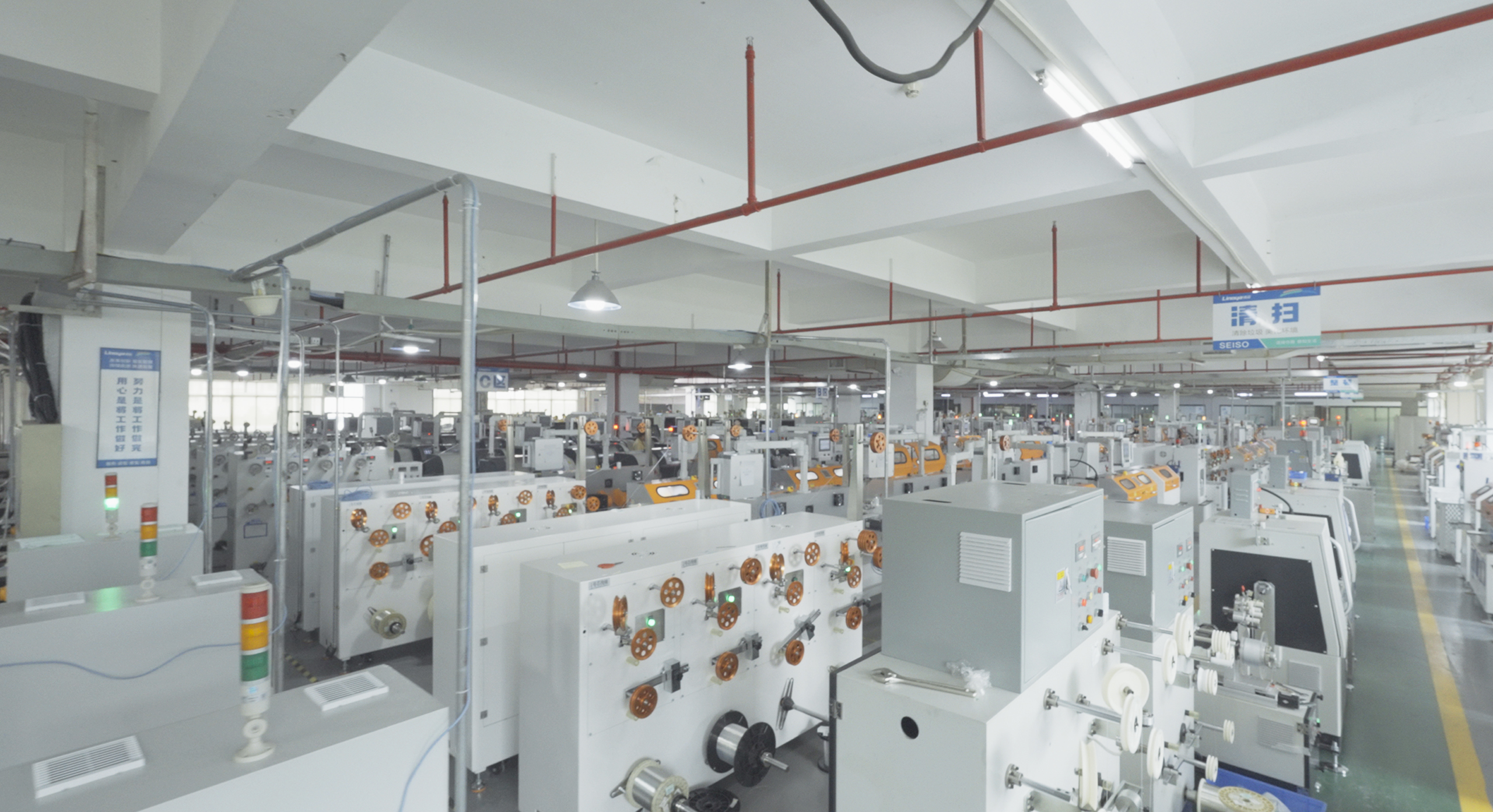
Production equipment on the cable manufacturing floor — relevant to reel-scale bulk supply for data center projects.
Procurement Terms and Acceptance Criteria for Bulk Orders
At Awareness and Research stage, buyers usually compare categories. At order stage, they compare paperwork. Four procurement points are worth locking into a purchase specification for either category:
Customs classification and duty exposure
Classification follows the product form, not the category name. Ethernet patch cables fitted with connectors fall under HS code 8544.42 (voltage ≤ 80V), while bulk Ethernet cable supplied on a reel without connectors is classified under HS code 8544.49. The duty exposure differs accordingly: the U.S. MFN duty rate for HS 8544.42.90 is 2.6%, while the EU MFN rate is 0%. A reel-scale data center order and a finished patch-cord order can therefore land at different landed costs even when the cable inside is identical.
Certification evidence, not certification claims
For North American plenum installation, CMP flame rating plus UL and ETL certification is the baseline. For EU projects, the CPR classification under EN 50575 must be stated at the class level, with the B2ca thresholds — FS ≤ 1.5 m, THR ≤ 15 MJ, peak HRR ≤ 30 kW — as the reference point for high fire performance. Buyers should request the certificate documents themselves, with the file numbers, rather than a datasheet line that says "certified".
Factory testing and on-site verification are separate steps
Finished cable from Linoya passes factory-level electrical performance testing before delivery. That is a production control, not a substitute for site acceptance. Standard practice after installation is to confirm continuity and wiring order with a cable tester, check the RJ45 link indicator on the connected network device, and run a throughput test to verify actual speed against the specified figure. Common causes of a link that fails despite good cable include physical damage during pulling, incorrect termination sequence, over-long untwisted pairs at the connector, and mismatched low-grade RJ45 connectors that cannot support the high-frequency performance of Cat7a or Cat8.
Jacket and environmental specification
Both categories are available with PVC or LSZH jacket. LSZH jackets are relevant where low smoke and zero halogen behaviour is required in occupied or confined spaces; the choice belongs in the purchase specification rather than being left to the supplier's default.
Market Trend Analysis
The wider category context is useful because it shows how much of the market these premium categories actually represent. The global Ethernet cable market was valued at USD 38.55 billion in 2025, and is expected to reach nearly USD 70.02 billion by 2032, a CAGR of 8.9% from 2026 to 2032, according to Maximize Market Research. Within that market, the Cat6 segment dominated in 2025 with a 32.5% share, per Dataintelo's Ethernet cable assembly research. In other words, the volume of the industry still sits with mainstream categories, while the highest-specification shielded cables serve concentrated, high-value data center and industrial segments.
Buyers should also treat market-size headlines with care. Commercial research houses publish 2024 figures that differ by roughly a factor of five — around USD 7.09 billion for a LAN-cable scope versus around USD 35.09 billion for a broader Ethernet-cable scope — and that gap reflects product-scope definitions rather than a market event. The honest position for procurement purposes is that publicly available data does not yet cleanly quantify how fast Cat8 is displacing Cat7a or Cat6a in data centers; published adoption-split figures for Cat8 remain a gap. Trend statements in a supplier's pitch should be read with that in mind.
Comparison with Traditional Cabling and the Limits of Cat7a and Cat8
Measured against the cabling categories that still carry most data center and enterprise traffic, Cat7a and Cat8 are short-distance specialists rather than general replacements:
| Category | Rated performance | Flame rating | Certification | Typical position |
|---|---|---|---|---|
| Cat8 F/FTP | 40Gbps at 30 m | CMP | UL, ETL, CPR | Dense cabinet-to-cabinet 40G links |
| Cat7a F/FTP | 100Gbps at 15 m | CMP | UL, ETL, CPR | Premium ultra-short 100G links |
| Cat7 F/FTP | 40Gbps at 50 m | CMP | UL, ETL, CPR | 40G links beyond 30 m inside the portfolio |
| Cat6a F/FTP | 10Gbps at 100 m | CMP | UL, ETL, CPR | Full-channel 10G backbone |
| Cat6 U/UTP | 10Gbps at 55 m | CMR | UL, ETL | Cost-controlled short-range 10G and gigabit |
| Cat5e U/UTP | 1Gbps | CM/CMG | UL, ETL | Gigabit and PoE surveillance / office LAN |
The limits are real and should be accepted before the order is placed, not defended afterwards:
- Distance caps are restrictive. 15 metres for Cat7a at 100Gbps and 30 metres for Cat8 at 40Gbps rule both categories out of horizontal building runs and long backbone segments. For those routes, Cat6a at 10Gbps over 100 metres is the appropriate choice.
- 22AWG construction is heavier and stiffer. One gauge above the 23AWG used in Cat6a and Cat7 means larger overall diameter, tighter bend-radius discipline and more physical space per cable in a high-density tray or conduit. Dense trays and small conduits need to be checked before the category is confirmed.
- Higher specification does not mean higher priority everywhere. Deploying Cat8 on a 60-metre 10G run buys no additional capability while adding material and termination cost; the datasheet-rated distance is the only performance guarantee the category offers.
- Certification is project-specific, not product-generic. CMP, UL, ETL and CPR documentation must match the delivery market, and factory electrical testing does not replace on-site verification after installation — a point frequently overlooked when link failures appear after handover.
Future Outlook
Three developments will shape how this choice is made over the next few years. First, standard evolution continues: the ANSI/TIA-568.2-E release in October 2024 and its introduction of DC resistance unbalance requirements for Cat5e, Cat6 and Cat6a signal that electrical balance, not just speed, is becoming a formal specification item — and balance is precisely what full-foil shielded constructions are built to protect in bundle conditions. Second, as rack densities rise, the proportion of links that qualify as short-reach high-speed interconnects grows, which is the segment where Cat7a and Cat8 apply; the mainstream 10G channel, however, remains a Cat6a function at 100 metres. Third, certification and customs documentation are increasingly treated as part of the product rather than paperwork, in both the U.S. plenum framework and the EU CPR framework.
For buyers, the practical conclusion is stable: schedule link distances, then assign the category, then verify that the delivered reel matches the approved sample and the certification file. Category comparisons answer the design question; documentation and acceptance testing answer the procurement one.
FAQ
1. What is the difference between Cat7a and Cat8 Ethernet cable for data center links?
Both are fully shielded twisted-pair cables with overall and pair foil shielding, 22AWG solid bare copper conductors, LDPE insulation, PVC or LSZH jacket, CMP flame rating and UL/ETL/CPR certification, and both cite TIA/EIA-568-C.2 compliance. The difference is the rated performance envelope: Cat7a F/FTP is rated at 100Gbps over 15 metres, while Cat8 F/FTP is rated at 40Gbps over 30 metres. Cat7a trades distance for the highest rated speed in the range; Cat8 trades peak speed for a longer short-reach working distance.
2. Which category should be used for cabinet-to-cabinet interconnection in a high-density data center?
It depends on the measured link length and the target speed. Documented high-density cabinet-to-cabinet scenarios specify 40Gbps high-stability transmission with full shielding for signal integrity, which Cat8 F/FTP covers at 30 metres. Premium ultra-high-speed links requiring 100Gbps at very short distance — typically under 15 metres between high-end servers and 100G switches — are the Cat7a F/FTP application. If a 40G link exceeds 30 metres, the applicable option within the same range is Cat7 F/FTP at 40Gbps over 50 metres, or Cat6a at 10Gbps over 100 metres for lower-speed channels.
3. Which certifications and flame ratings should appear on the datasheet?
For plenum installation in North America, CMP flame rating is the baseline and applies to both Cat7a and Cat8 in this range; UL and ETL certification are listed for both. For European projects, the relevant framework is the Construction Products Regulation under EN 50575, where the CPR class must be declared — B2ca being the high fire performance class with thresholds of FS ≤ 1.5 m, THR ≤ 15 MJ and peak HRR ≤ 30 kW. Buyers should obtain the certificate documents with their file numbers rather than relying on a generic compliance statement.
4. How is Ethernet cable verified before delivery and after installation?
Finished cable from Linoya passes factory-level electrical performance testing before delivery. On site, verification is a separate step: plug both ends into a cable tester and read the LED sequence to identify open circuit, short circuit or mis-wiring; connect the link and check the RJ45 indicator light on the network device; then run a throughput test to confirm the actual speed against the rated figure. Site re-checks remain necessary even for factory-tested cable, because pulling damage and termination faults occur after production.
5. What are the most common causes of failure on Cat7a and Cat8 links?
Field troubleshooting guidance points to four recurring causes: physical damage such as broken conductors, crushed cable or over-bend routing; termination defects including wrong wiring sequence, over-long untwisted pairs at the connector and damaged RJ45 pins; conductor or grade substitution, where a copper-clad aluminium conductor or an off-specification grade is supplied; and connector mismatch, where low-grade RJ45 connectors cannot support the high-frequency performance the cable was specified for. Environmental issues such as incorrect shielding grounding also appear. Each of these is checkable at goods-in inspection and again at commissioning.
Reference Documents
The Linoya Electronic Technology Co., Ltd. product brochure, including the shielded Ethernet cable range from Cat5e to Cat8, is available as a public download: LINOYA ELECTRONIC TECHNOLOGY CO., LTD. product brochure (PDF). Company background and portfolio information referenced in this article is published at www.linoya.com.
Data sources referenced: Maximize Market Research, Ethernet Cable Market — Global Industry Analysis and Forecast (market size and CAGR); Dataintelo, Ethernet Cable Assembly Market Research Report (Cat6 segment share); TIA, From ANSI/TIA-568.2-D to ANSI/TIA-568.2-E (standard revision, October 2024); TTI Fiber, CPR Cable Classes: Euroclass Ratings Guide (EN 50575 / B2ca thresholds); Dutiable and Gaia Dynamics, HS code classification and MFN duty references for HS 8544.42 and 8544.49; Linoya product datasheets and application records for all cable specifications, certifications and deployment scenarios.