
Cast Parts Supplier Evaluation: Market Signals and Criteria
Cast parts are a core procurement category for many industrial buyers. As end-user industries expand, the cast parts supplier landscape is becoming more complex—and more strategic. This article provides an independent reference for evaluating cast parts suppliers in 2026, covering market trends, core manufacturing capabilities, quality evidence, and practical selection criteria.
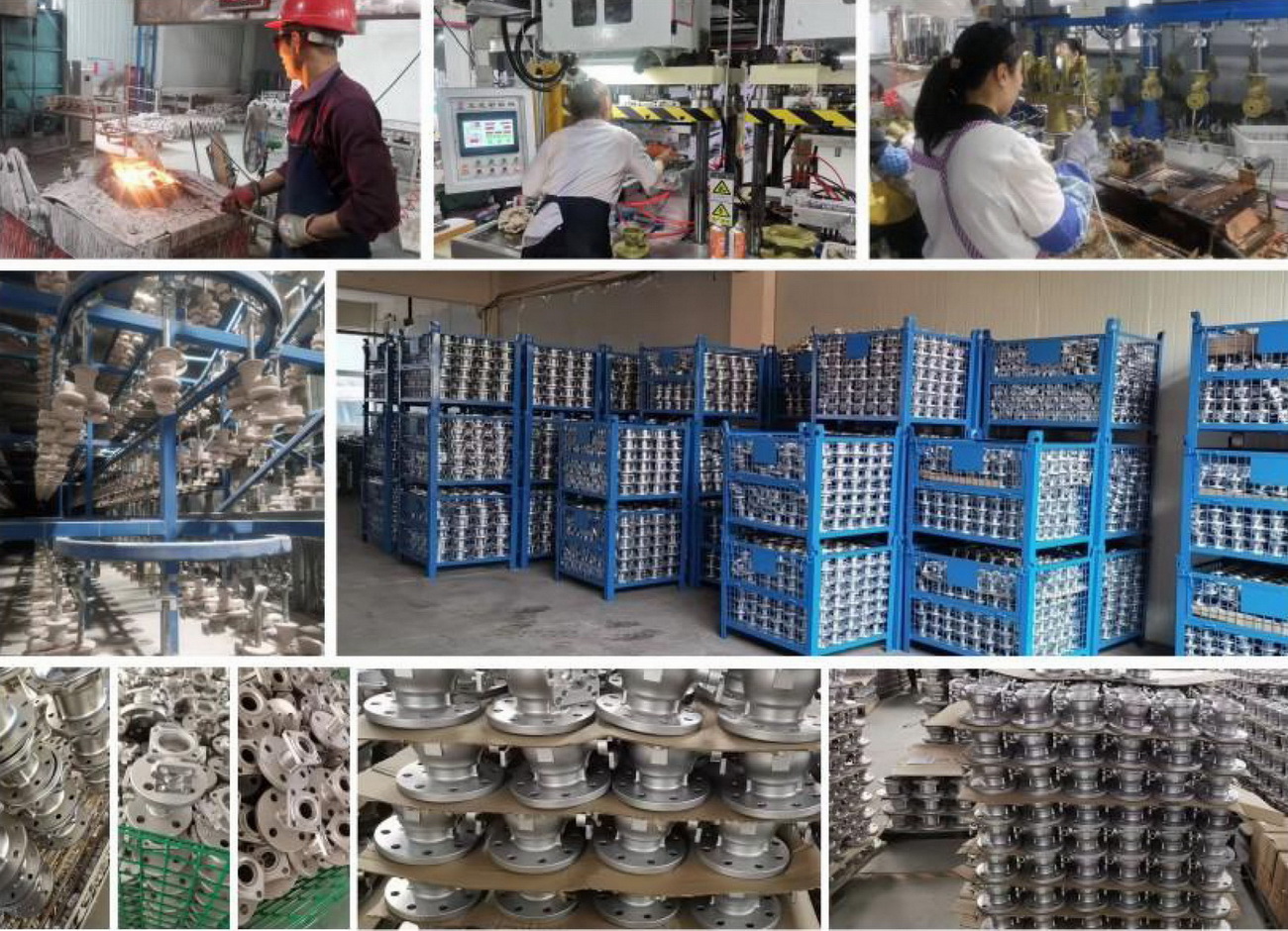
Investment casting combines wax pattern injection, ceramic shell molding, and finished precision components.
Why the Cast Parts Market Is Drawing More Buyer Attention
Precision casting is increasingly important to industries that need complex metal components with tighter tolerances and better surface finishes. According to Grand View Research, the global investment casting market was valued at USD 17.4 billion in 2025 and is projected to grow to USD 24.9 billion by 2033. Asia Pacific contributed 39.2% of global revenue in 2025, reflecting the region's position as a manufacturing hub.
Automotive applications accounted for more than 29% of investment casting revenue in 2025, according to the same source. In China, the investment casting market was estimated at USD 2.72 billion in 2024 and is projected to reach USD 5.16 billion by 2035, with a 6% CAGR (Market Research Future). China's metal casting export value reached USD 1.47 billion in July 2024 alone, up 5.2% year-on-year.
Two additional data points help explain supplier selection trends. Stainless steel represented 32.98% of the global investment casting material share in 2025 (Mordor Intelligence). The silica sol process, which offers high precision, accounted for 50.78% of revenue share in the same period. Buyers who need stainless steel precision components are therefore likely to look for suppliers that can run silica sol investment casting and manage post-casting operations.
| Metric | Value | Source |
|---|---|---|
| Global investment casting market | USD 17.4B (2025) to USD 24.9B (2033) | Grand View Research |
| China investment casting market | USD 2.72B (2024) to USD 5.16B (2035) | Market Research Future |
| Automotive application revenue share | >29% (2025) | Grand View Research |
| Stainless steel material share | 32.98% (2025) | Mordor Intelligence |
| Silica sol process share | 50.78% (2025) | Mordor Intelligence |
| Asia Pacific regional share | 39.2% (2025) | Grand View Research |
What a Cast Parts Supplier Should Be Able to Do
A cast parts supplier is not just a foundry. In most industrial supply chains, the supplier must combine casting with CNC machining, material selection, heat treatment, surface treatment, and quality assurance. A useful starting point is to evaluate a supplier against the following capability set.
Precision Investment Casting
Investment casting produces metal parts with complex geometry and good dimensional accuracy. A capable supplier can support material grade selection, wall thickness, casting tolerance, surface roughness, heat treatment, CNC machining, and surface treatment. For example, one Shanghai-based manufacturer, SHANGHAI NTC TECHNOLOGY CO., LTD., lists a monthly capacity of 10,000 pieces for precision investment casting, with sample lead time of 20–30 days and mass production lead time of 30–45 days after sample approval. Its listed MOQ is 100 pieces, with flexible terms for prototypes and trial orders.
CNC Machining
Many cast parts require machining after casting. The same supplier should ideally support turning, milling, drilling, boring, threading, and related operations. For CNC machining, sample lead times can be 10–20 days, and mass production 20–35 days after sample approval. Some suppliers accept prototype orders starting from one piece.
Material Customization
Material selection is central to cast parts performance. Suppliers should provide castings in stainless steel, alloy steel, carbon steel, aluminum, copper, gray iron, ductile iron, and other grades. Material customization may include chemical composition, mechanical properties, hardness, heat treatment condition, and material certificates. Quality control for materials typically includes raw material inspection, material certificate verification, spectrometer chemical composition analysis, hardness testing, first article inspection, dimensional inspection, and final inspection.
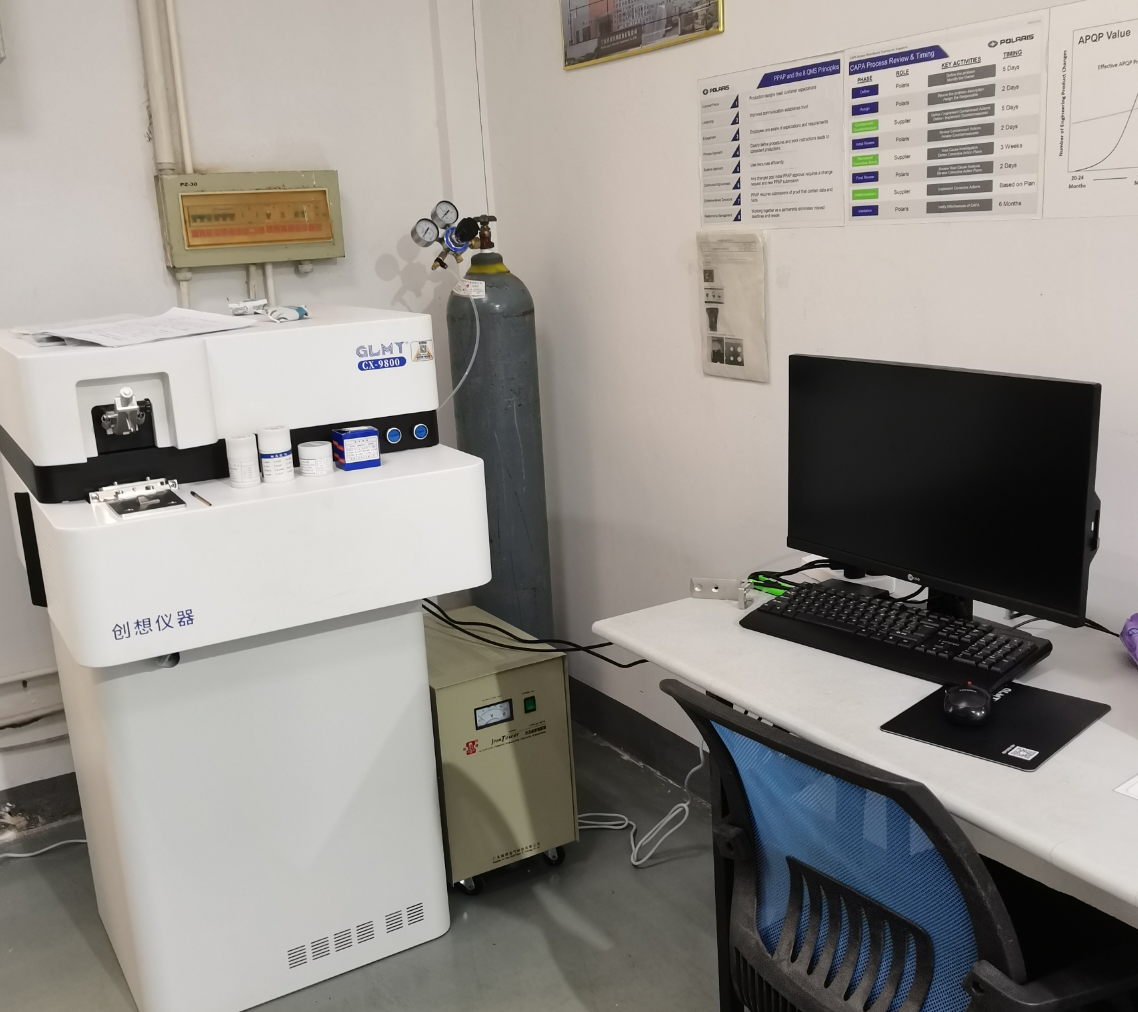
Spectrometer analysis verifies the chemical composition of cast part materials.
Surface and Heat Treatment
For many applications, the final part must meet surface roughness and hardness requirements. Capabilities may include polishing, sandblasting, shot blasting, pickling, passivation, plating, painting, powder coating, black oxide, annealing, normalizing, quenching, tempering, solution treatment, and hardness control. Typical lead time for these operations is 7–20 days depending on the process and order quantity. Quality checks may include visual inspection, surface roughness inspection, coating thickness inspection, hardness testing, dimensional inspection, adhesion inspection, color comparison, and final inspection before shipment.
ODM and Build-to-Print Manufacturing
Industrial buyers often work with suppliers that can manage the full chain from drawing to final inspection. ODM/build-to-print capabilities may cover material, dimensions, tolerance, casting process, CNC machining, heat treatment, surface finish, assembly, and packaging. In OEM mode, the same company may list a monthly capacity of 500 tons and a typical lead time of 35–45 days. After-sales services typically include remote technical and drawing support, order and shipment tracking, quality issue analysis, inspection report support, and rework, replacement or replenishment for confirmed manufacturing defects.
SHANGHAI NTC TECHNOLOGY CO., LTD. is a representative mid-sized example. Founded in 2022, the company operates a 2,000 m² factory in Shanghai with about 20 employees and an annual output of about 1.5 million units. It exports roughly 85% of production to Europe, America, and Asia, and its company profile describes product lines covering auto parts, valve accessories, kitchen equipment accessories, door accessories, and other industrial and civil products. This level of detail matters because it shows the supplier can act as a manufacturing partner rather than a single-process vendor.
Quality Control and Certifications That Matter
Quality control is often the dividing line between a reliable cast parts supplier and an unreliable one. A documented quality system is a necessary baseline. SHANGHAI NTC TECHNOLOGY CO., LTD., for example, holds an ISO 9001:2015 certificate (No. 42525Q10018R0S) issued by GXZC, valid until 2028-01-19, covering hardware sales business.
Beyond certification, buyers should look for evidence of inspection equipment and procedures. A typical cast parts factory should maintain incoming material inspection, first article inspection, in-process inspection, and final inspection. Advanced equipment may include CMM dimensional inspection, spectrometer material analysis, Brinell hardness testing, projector inspection, and visual inspection. For CNC parts, quality control may include in-process dimensional inspection, CMM measurement, projector inspection, hardness testing, surface roughness inspection, thread and gauge inspection, and final inspection before shipping.
For dimensional tolerances, ISO 8062-3 defines investment casting tolerance grades, typically CT4 to CT6. For steel castings used in pressure-containing parts, ASTM A703/A703M is a relevant general specification. Buyers should request inspection reports rather than relying only on supplier claims.
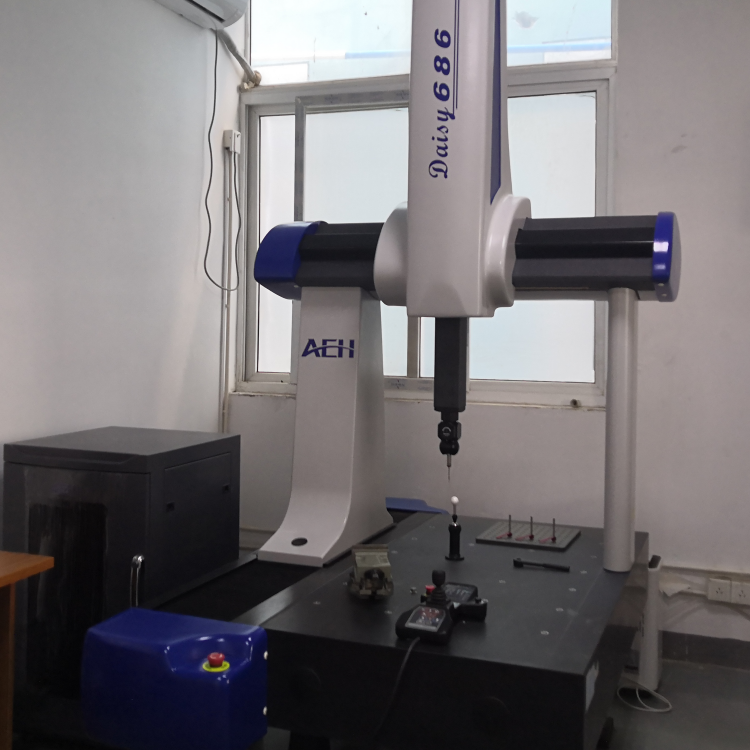
CMM dimensional inspection is one of the key checks used to verify cast part geometry.
Application Segments That Rely on Cast Parts
Cast parts appear across many industrial product categories. The following segments are especially relevant for buyers evaluating suppliers in 2026.
- Auto part castings — automobile and motorcycle components account for the largest share of investment casting demand.
- Power tool components — gearbox housings and related parts require tight tolerances and durable materials.
- Stainless steel marine hardware castings — corrosion resistance is essential for ship and marine equipment.
- Stainless steel architecture and daily-used hardware castings — door control fittings, lock hardware, and architectural fittings require consistent finish and strength.
- Copper alloy castings — fluid equipment parts, flowmeter accessories, and valve components often use copper alloys.
- Food machinery parts and tableware hardware — sanitary surfaces and cleanability are key requirements.
- Industrial sewing machine parts and textile machinery parts — precision components for high-utilization machinery.
- Construction hardware and furniture hardware — structural and aesthetic metal components.
- Engineering machinery parts and sport facility parts — parts must tolerate mechanical stress and varying environments.
For buyers, the application segment determines which material grades, surface finishes, and quality checks are critical.
Investment Casting vs. Traditional Alternatives
Investment casting is often compared with sand casting and machining from solid stock. Each approach has strengths and limits.
| Process | Strengths | Typical limits |
|---|---|---|
| Investment casting (silica sol) | Near-net-shape, complex geometry, good surface finish, suitable for stainless steel and other hard-to-machine alloys | Higher tooling cost at low volumes; size and weight limits; longer tooling lead time |
| Sand casting | Lower tooling cost, suitable for large parts | Lower dimensional accuracy and surface finish |
| CNC machining from solid | Tight tolerances, no casting tooling | Higher material waste; longer cycle time for complex geometry |
For many industrial components, the best compromise is investment casting plus CNC machining. This combination gives near-net-shape blanks and machining precision where required. It is also the reason why suppliers like NTC combine casting and machining capabilities.
Market Trends Shaping Cast Parts Procurement in 2026
Several market trends are influencing how buyers select cast parts suppliers.
First, the automotive metal casting market is expanding. It was valued at USD 15.31 billion in 2024 and is expected to reach USD 45.61 billion by 2035 (Spherical Insights). Auto part castings remain a core demand driver.
Second, the industrial valve market is predicted to grow from USD 97.77 billion in 2026 to USD 273.49 billion by 2035 (Precedence Research). This suggests sustained demand for stainless steel pipe and valve castings, flowmeter accessories, and fluid equipment parts.
Third, global market concentration remains significant. Precision Castparts Corp (PCC) reported approximately USD 9.3 billion in revenue in 2023, and key players include Impro Precision Industries, CIREX Group, and Alcoa. For many buyers, however, mid-sized suppliers offer a better balance of flexibility, direct communication, and willingness to accept smaller orders.
Fourth, Asia Pacific's 39.2% share and China's export strength indicate that supply chains will continue to source from the region. Suppliers with experience serving Europe, North America, Japan, South Korea, and Southeast Asia are better positioned to meet international requirements. SHANGHAI NTC TECHNOLOGY CO., LTD., for instance, states that its products have been used by distributors, traders, and purchasers across global markets.
A Practical Supplier Evaluation Checklist
Buyers evaluating cast parts suppliers can use the following framework:
| Evaluation area | What to check |
|---|---|
| Process capability | Does the supplier support investment casting, CNC machining, material customization, surface treatment, and heat treatment? |
| Material range | Does it provide stainless steel, alloy steel, carbon steel, aluminum, copper, gray iron, and ductile iron? |
| Quality system | Does it hold ISO 9001:2015? Does it have CMM, spectrometer, hardness tester, and documented inspection procedures? |
| Lead time | Are sample and mass-production lead times clear? Do they match your project plan? |
| MOQ flexibility | Can the supplier handle prototypes, low-volume trial orders, and batch production? |
| After-sales support | Does it provide remote drawing support, quality issue analysis, inspection reports, and rework/replacement for confirmed defects? |
Limitations and Risks in Cast Parts Sourcing
No single casting process fits all requirements. Buyers should be aware of the following limitations when working with investment casting suppliers.
- Investment casting tooling can be expensive, so it is less economical for very simple or very large parts.
- Maximum part size and single-piece weight are limited compared with sand casting.
- MOQs and lead times vary by part size, material, and technical requirements; not all suppliers accept small prototype orders.
- Quality depends on process control. A certificate alone does not guarantee that every batch meets specifications.
- Surface finish and tolerance requirements may require additional CNC machining and surface treatment, adding lead time.
Buyers should therefore define their critical-to-quality characteristics early and ask suppliers to explain how they would inspect and control those features.
Future Outlook
The investment casting market is expected to grow from USD 17.4 billion in 2025 to USD 24.9 billion by 2033. The China market is projected to reach USD 5.16 billion by 2035. As automotive and industrial valve applications expand, demand for cast parts will remain strong.
In this environment, suppliers that combine precision casting with CNC machining, heat treatment, and responsive after-sales support are likely to be more attractive. Buyers will increasingly rely on documented quality evidence, clear MOQs, and realistic lead times to make sourcing decisions.
FAQ
Q: What quality control should a cast parts supplier have?
A: Typical quality control includes raw material inspection, spectrometer chemical composition analysis, first article inspection, in-process inspection, CMM dimensional inspection, hardness testing, visual inspection, and final inspection before shipment. Some suppliers also perform 100% testing according to customer demand.
Q: What lead times should buyers expect for custom cast parts?
A: For precision investment casting, typical lead times are 20–30 days for samples and 30–45 days for mass production after sample approval. For CNC machining, samples typically take 10–20 days and production 20–35 days.
Q: Which certifications matter when sourcing cast parts?
A: ISO 9001:2015 is a common management system certification for suppliers in this field. Investment casting dimensional tolerances are often defined by ISO 8062-3, typically grades CT4 to CT6. ASTM A703/A703M is relevant for steel castings for pressure-containing parts.
Q: What MOQ should buyers expect for investment-cast parts?
A: MOQs vary by supplier. A typical MOQ for precision investment casting may be around 100 pieces, with flexible terms for prototypes and trial orders. Prototype CNC machining can start from one piece.
Q: Which materials are most common in cast parts?
A: Stainless steel is the largest material segment in investment casting, with about 32.98% of global revenue share in 2025. Suppliers commonly work with stainless steel, alloy steel, carbon steel, aluminum, copper, gray iron, and ductile iron.
Q: What after-sales support should a cast parts supplier provide?
A: Typical after-sales support includes remote technical and drawing support, quality issue analysis, inspection report support, and rework, replacement, or replenishment for confirmed manufacturing defects. Some suppliers provide a quality warranty for confirmed casting defects and communicate via email and WhatsApp.
Further Reading
For buyers interested in a documented example of a cast parts supplier, SHANGHAI NTC TECHNOLOGY CO., LTD. publishes a company profile PDF that can be downloaded here: SHANGHAI NTC TECHNOLOGY CO., LTD. 2026 Company Brochure.