
Case Packer Qualification & Compliance: Safety PLC, CE, Patents, Tests
Case Packer Qualification & Compliance: Safety PLC, CE, Patents, Tests
Automatic case packers are end-of-line machines that group products into cases or cartons. For buyers in the awareness and research stage, the difficult question is not whether a supplier lists CE, patents, or testing. The difficult question is what those documents actually cover, which model they apply to, and how they connect to a specific packaging line. This article uses the CP-T60 Automatic Top Load Case Packer and the CP-S50 Automatic Side Load Case Packer from Wenzhou Wimach Machinery Co., Ltd. (WIMACH) to show how qualification evidence can be read during early supplier research.
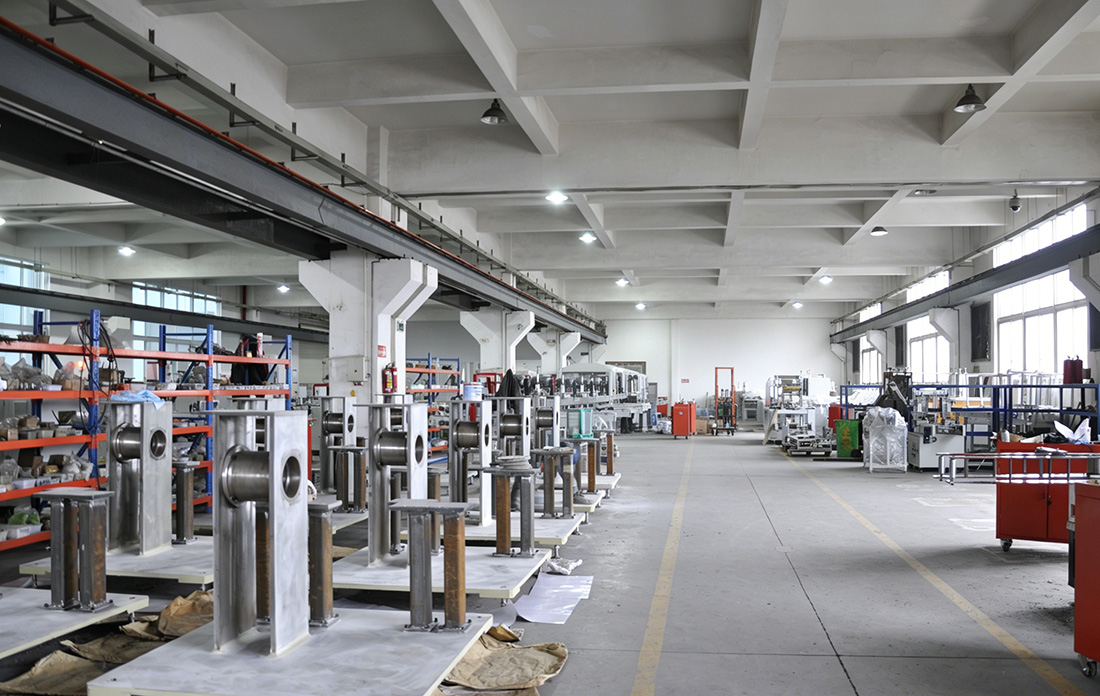
WIMACH packaging machinery workshop. Image source: WIMACH content unit.
The category is established. Grand View Research valued the global case packing machines market at USD 1.1 billion in 2024, and reported that Asia Pacific accounted for a 37.9% revenue share in the same year. That scale does not tell a buyer whether a machine has a documented safety architecture, whether pre-shipment tests are recorded, or whether a CE claim is tied to the purchased configuration. Those are qualification questions, and they sit between a first enquiry and a formal shortlist.
For an automatic case packer, qualification evidence should connect four things: the safety risk controls on the machine, the factory checks completed before shipment, the documentation a buyer will use after installation, and the project evidence for the target market. Patents and CE references can support that picture, but only when their scope is clear. The sections below use the CP-T60 and CP-S50 as examples of how to read that evidence without treating a certificate copy as a complete answer.
What qualified evidence means for an automatic case packer
A case packer is the final step of the packaging process where individual products, typically cartons or bundles, are grouped and placed into cases. That definition matters because a qualification file should cover the machine as installed, not only the catalogue page. A robotic case packer, a pick-and-place case packer, a side load case packer, and a top load case packer can all perform case packing, but their access points, motion sequences, and operator interfaces differ. The evidence should match the machine type being quoted.
In practical procurement terms, qualified evidence answers five buyer questions. Is the safety function independent of the standard control function? Are the safety interlock points tested before shipment? Is there a recorded quality assurance sequence for mechanical, pneumatic, electrical, and control checks? Does the CE reference belong to the model and project in question? Do patents relate to the feeding mechanism or to some other part of the machine?
Wenzhou Wimach Machinery Co., Ltd. is a China-based packaging machinery manufacturer founded in 2021. The company reports a 3,000 m² factory, 37 employees, a 5-engineer R&D team, annual output of 160 sets, and an export ratio of about 60% to the EU, North America, and South America. Its main products are tissue packing machines and integrated packaging lines. The CP-S50 and CP-T60 are part of its case packer range, and the qualification evidence discussed here is model-linked rather than a general company statement.
Safety PLCs and safety relays for full-range safety interlock points
On automatic case packing machines, safety interlocks protect access points where guards, doors, or movable panels separate operators from moving parts. The qualification scope for the CP-T60 and CP-S50 covers safety risk control through safety PLCs or safety relays for full-range safety interlock points. This is an important distinction during buyer research. A standard machine PLC may handle sequencing, product counting, and operator interface functions. A safety PLC or safety relay provides a dedicated control path for interlock monitoring, so the safety function is not left only to the standard control layer.
The phrase full-range safety interlock points should be read as a scope statement, not as a number. The buyer should ask for the model-specific list of interlock points, the safety architecture drawing, the reset procedure, and the relationship between the safety PLC or safety relay and the guard doors or access panels. The qualification evidence also includes safety operation and maintenance manuals. These manuals matter because they define how operators and maintenance staff should test, reset, and maintain the safety functions after installation.
Safety function tests are completed prior to shipment. That is a factory-level check of the safety functions before the machine leaves the workshop. It is useful evidence, but it does not replace the site-specific risk assessment, utility verification, line integration checks, and operator training that the final installation still requires. A buyer should request the test record and confirm that the tested configuration matches the quoted CP-T60 or CP-S50 model, including options that affect access or control.
Standards provide context, not automatic proof. ANSI/PMMI B155.1-2023 specifies safety requirements and risk assessment methodologies for packaging and processing machinery in the US context. EN 415-7:2025 is catalogued as a European standard covering cartoning and case packing machines, but the full official text and jurisdictional applicability should be verified before treating it as a compliance conclusion. A supplier safety statement should be mapped to the market and standard that apply to the actual installation.
Pre-shipment tests: what the qualification file should show
The quality assurance procedures for the CP-T60 and CP-S50 include no-load and load running tests, dimensional tolerance inspection, mechanical assembly check, pneumatic leakage test, electrical safety test, and PLC control logic test. These checks address different failure modes. A no-load test confirms movement and sequencing without product. A load test adds product handling and case flow. Dimensional tolerance inspection checks whether the built machine and tooling match the drawing and the target carton size. Mechanical assembly checks confirm that components are fitted as designed. Pneumatic leakage and electrical safety tests cover utilities and electrical risks. PLC control logic tests confirm that the control sequence performs as specified.
| Check | What it verifies | Buyer evidence to request |
|---|---|---|
| No-load running test | Machine motion, sequencing, and basic control response without product. | Test report with date, model, and recorded result. |
| Load running test | Product and case flow under running conditions, including the tested pack format. | Product and carton specification used in the test. |
| Dimensional tolerance inspection | Critical dimensions and tooling alignment against the machine drawing. | Inspection record and carton dimension range confirmed for the model. |
| Mechanical assembly check | Component fit, fastening, and assembly completeness. | Assembly checklist and any concession notes. |
| Pneumatic leakage test | Air circuit integrity at the specified pressure range. | Test pressure, duration, and acceptance criteria. |
| Electrical safety test | Electrical safety checks relevant to the machine build. | Electrical test record and model-specific configuration. |
| PLC control logic test | Control sequence, interlocks, and operator interface logic. | Control logic test record and software version reference. |
The table is not a substitute for the full test record. Its purpose is to show what a buyer should ask for when a supplier says a machine has been tested. The useful evidence includes the tested model, the product or carton format, the test date, the acceptance criteria, and the result. Without those details, a generic statement that a case packer was tested has limited procurement value.
Patents and project CE evidence: what they prove and what they do not
Two patent certificates are presented as qualification evidence for the carton packaging machine feeding mechanism: Invention Patent ZL 2022 1 1099886.8 and Utility Model ZL 2022 2 1202677.7 for the Automatic Feeding Mechanism for Carton Packaging Machine. Patents are evidence of documented intellectual property and a claimed mechanism. They do not, by themselves, prove cycle time, reliability, safety performance, or fitness for a specific carton. A buyer should read the patent title and claims against the feeding section of the quoted machine and ask whether the patented mechanism is present in the offered model and configuration.
The CE reference for facial tissue box cartoning in Poland provides a different kind of evidence. The application record describes a facial tissue packaging line with facial tissue box packing, facial tissue plastic film wrapping, tissue box and packet case packing, tissue case palletizing, pallet strapping, and pallet stretch wrapping. The project is specified as a customized design compliant with CE standards and includes the CP-S50 Automatic Side Load Case Packer. For a buyer, this is project-level evidence: CE compliance was part of the design requirement for a specific line and model.
That is not a blanket statement that every CP-S50 configuration is identical in every market. Buyers should request the Declaration of Conformity, the applicable directive and standards list, and the technical file reference for the exact model and options. WIMACH states that all its machines are CE certified. During research, that company-level statement should be converted into model-level evidence: which CE marking applies, which standard list is used, and which configuration was assessed. The same discipline applies to a tissue case packer, a carton case packer, or an automatic case packer used in food, beverage, pharmaceutical, daily chemical, or hardware applications.
Model evidence at a glance: CP-S50 and CP-T60
The two models serve different loading concepts. The CP-S50 is a side load case packer and side push case packer with a packing capacity of 1-16 cartons per minute. The CP-T60 is a pick-and-place case packer and top load case packer with a packing capacity of 1-8 cartons per minute. Capacity figures should be read with the carton size, product format, and test conditions, because a headline rate without those conditions is not a complete comparison.
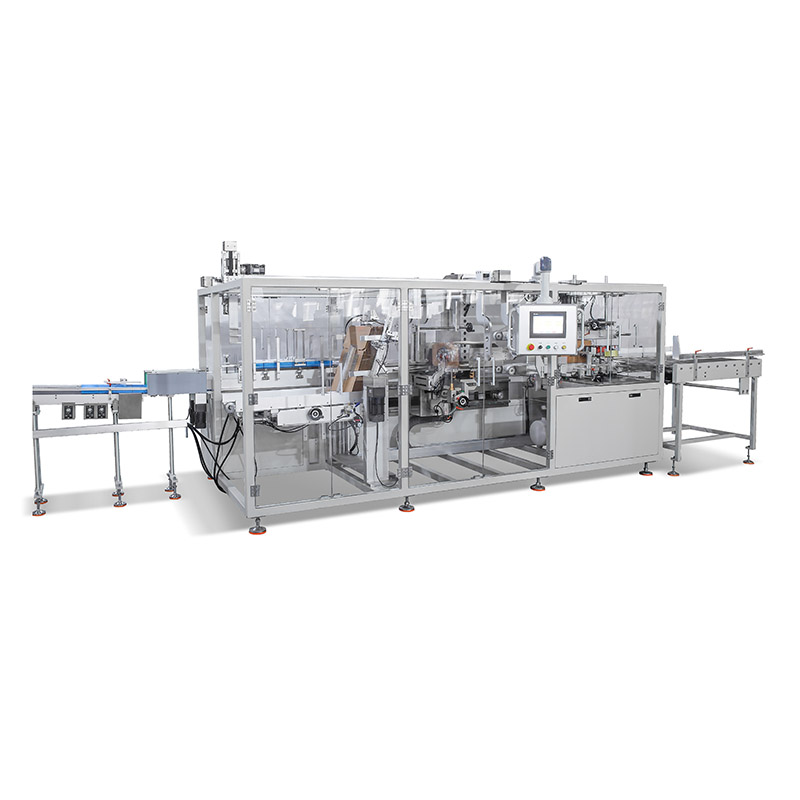
CP-S50 Automatic Side Load Case Packer (side push case packer). Image source: WIMACH content unit.
| Item | CP-S50 Automatic Side Load Case Packer | CP-T60 Automatic Top Load Case Packer |
|---|---|---|
| Type | Side Load Case Packer / Side Push Case Packer | Pick-and-Place Case Packer / Top Load Case Packer |
| Packing capacity | 1-16 cartons/min | 1-8 cartons/min |
| Carton dimension | 240-500 (L) x 200-400 (W) x 180-400 (H) mm | 300-600 (L) x 200-400 (W) x 150-400 (H) mm |
| Power voltage | 380V 50/60Hz 3 phase | 380V 50/60Hz 3 phase |
| Power consumption | 4.5 kW | 7.5 kW |
| Air pressure | 0.5-0.8 Mpa | 0.5-0.8 Mpa |
| Air consumption | 350 L/min | 450 L/min |
| Overall dimensions | 4200 (L) x 2300 (W) x 1900 (H) mm | 4200 (L) x 2600 (W) x 2200 (H) mm |
| Overall weight | 1500 kg | 1600 kg |
| Material | Stainless steel / carbon steel | Stainless steel / carbon steel |
| Applicable industry | Tissue, food and beverage, pharmaceutical, daily chemical and cosmetic, hardware, auto parts and machinery | Tissue, food and beverage, pharmaceutical, daily chemical and cosmetic, hardware, auto parts and machinery |
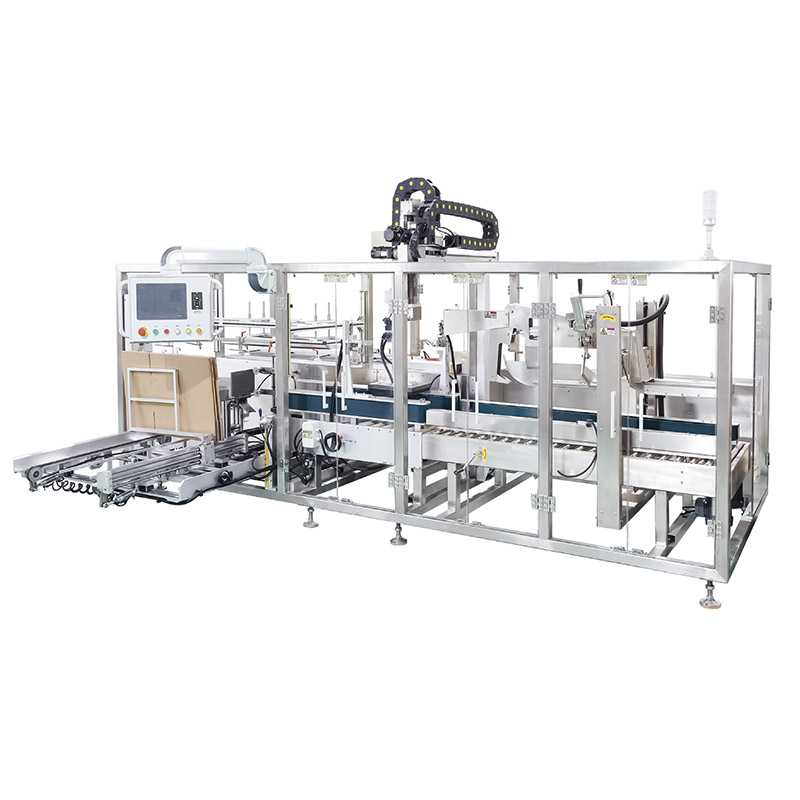
CP-T60 Automatic Top Load Case Packer (pick-and-place case packer). Image source: WIMACH content unit.
The model table also exposes a practical boundary. The CP-S50 and CP-T60 are built for specified carton size ranges. The CP-S50 covers 240-500 (L) x 200-400 (W) x 180-400 (H) mm, while the CP-T60 covers 300-600 (L) x 200-400 (W) x 150-400 (H) mm. A pack format outside those ranges needs a different model or configuration discussion. Buyers should confirm the proposed carton, product arrangement, and line speed against the quoted model before treating the case packer as technically qualified.
Application evidence: how compliance attaches to a real line
The Poland facial tissue packaging project shows how a CE requirement can attach to a specific line. The application record lists facial tissue box packing, plastic film wrapping, tissue box and packet case packing, case palletizing, strapping, and stretch wrapping, with the CP-S50 Automatic Side Load Case Packer in the equipment set. The special requirement is a customized design compliant with CE standards. For a buyer researching a tissue case packer, this is more useful than a generic CE logo because it identifies the project context, the product type, and the model.
A US toilet paper packaging line provides a second context. The application record describes toilet roll wrapping, case packing, automatic palletizing, strapping, and stretch film wrapping, with the CP-T60 Automatic Top Load Case Packer in the related equipment. A Mexico wet wipe packaging line similarly describes canister loading, disinfectant filling, sealing, capping, labeling, case packing, and pallet wrapping, also with the CP-T60. These examples show that qualification is not only a machine-level issue. It is also a line-level issue: the case packer must fit the upstream product flow, the carton format, the downstream palletizing or wrapping stage, and the local compliance requirement.
For an automatic case packer used in a food case packer or beverage case packer line, the buyer should still check hygiene and wash-down requirements, utility compatibility, and electrical configuration for the destination market. The available qualification evidence for the CP-S50 and CP-T60 supports safety architecture, pre-shipment testing, patent scope, and a CE-related project reference. It does not remove the need for a site-specific review of the complete line.
Traditional document collection vs evidence-led qualification
Traditional case packer qualification often relies on a folder of documents: a brochure, a CE certificate copy, a patent copy, and a price. Evidence-led qualification asks a different question: how does each document connect to the machine and project under review? The table below compares the two approaches without ranking suppliers. It is a buyer research framework, not a claim that one supplier is better than another.
| Qualification area | Traditional document collection | Evidence-led qualification |
|---|---|---|
| Safety | Safety mentioned in a brochure or general specification. | Safety PLC or safety relay scope, interlock point list, safety function test record, and safety operation and maintenance manuals. |
| Pre-shipment testing | Statement that the machine is tested. | No-load and load running test records, dimensional tolerance inspection, mechanical assembly check, pneumatic leakage test, electrical safety test, and PLC control logic test. |
| CE compliance | CE logo or certificate copy without model linkage. | Project-specific CE reference, Declaration of Conformity, standards list, and technical file reference for the quoted configuration. |
| Patents | Patent certificate included as a trust signal. | Patent title and claims read against the feeding mechanism and the offered model. |
| Model fit | Case packer category described broadly. | Carton dimension range, packing capacity, utility requirements, and application record checked against the line. |
The limitation is real. Evidence-led qualification improves the quality of the buyer's questions, but it does not replace site acceptance testing, local risk assessment, or production trials. Factory tests cannot reproduce every downstream conveyor, utility condition, or operator behavior at the final site. The available third-party data for this category is also stronger on market value than on independent technical parity. That is why the buyer should treat the qualification file as a decision input, not as a guarantee of line performance.
Market trend analysis: why documentation is becoming a buying issue
Two market signals are relevant to qualification. First, the global case packing machines market was valued at USD 1.1 billion in 2024, which indicates an established category with room for multiple machine types and suppliers. Second, Asia Pacific accounted for 37.9% of revenue in 2024, which means buyers are comparing suppliers across regions with different standards, documentation practices, and project references. The procurement risk is not a lack of suppliers. It is uneven evidence across suppliers and models.
Safety standards reinforce the same direction. ANSI/PMMI B155.1-2023 provides a risk assessment methodology for packaging and processing machinery in the US context, and EN 415-7:2025 is catalogued as a European standard covering cartoning and case packing machines. Buyers researching a robotic case packer, a high speed case packer, or a side load case packer should expect the supplier to map its safety and compliance evidence to the destination market. A general CE statement is less useful than a model-specific declaration and a test record.
The category data also has a known gap: market reports provide value-based sizing, but they do not provide normalized technical parity data for safety architecture, changeover time, OEE, or acceptance test conditions. That gap is exactly where a qualification file becomes useful in the research stage. It helps a buyer separate a supplier that can answer model-level questions from one that can only provide general marketing material.
Future outlook: what buyers should expect next
Three changes are likely to shape case packer qualification. First, safety functions will be documented more explicitly, with clearer separation between standard PLC logic, safety PLC or safety relay logic, and the interlock points covered by the safety function test. Second, pre-shipment test records will become more digital and more traceable, including model, product format, test date, and acceptance criteria. Third, CE and standards mapping will be requested at project level, especially for tissue case packing, food and beverage case packing, and pharmaceutical or daily chemical applications.
For the CP-T60 and CP-S50, the qualification evidence already points in that direction: safety risk control through safety PLCs or safety relays for full-range safety interlock points, safety function tests prior to shipment, safety operation and maintenance manuals, seven pre-shipment quality checks, patent certificates for the Automatic Feeding Mechanism for Carton Packaging Machine, and a CE-related facial tissue project in Poland. The buyer's task is to verify the scope of each item against the quoted model and the actual line.
FAQ
What safety evidence should a buyer request for an automatic case packer?
A buyer should request the model-specific safety architecture, the list of safety interlock points, the safety PLC or safety relay scope, the safety function test record completed prior to shipment, and the safety operation and maintenance manuals. The evidence should identify the quoted model and the tested configuration.
How are safety PLCs or safety relays used in the CP-T60 and CP-S50 case packers?
The qualification scope for the CP-T60 and CP-S50 covers safety risk control through safety PLCs or safety relays for full-range safety interlock points. This provides a dedicated control path for interlock monitoring rather than leaving the safety function only to the standard machine PLC. Buyers should confirm the interlock point list and the reset procedure for the offered configuration.
What pre-shipment tests are performed before a case packer is shipped?
The quality assurance procedures include no-load and load running tests, dimensional tolerance inspection, mechanical assembly check, pneumatic leakage test, electrical safety test, and PLC control logic test. Safety function tests are also completed prior to shipment. The buyer should request the test records with the tested model, product or carton format, date, acceptance criteria, and result.
What do the patents on the automatic feeding mechanism prove?
Invention Patent ZL 2022 1 1099886.8 and Utility Model ZL 2022 2 1202677.7 for the Automatic Feeding Mechanism for Carton Packaging Machine are evidence of documented intellectual property and a claimed mechanism. They do not by themselves prove cycle time, reliability, safety performance, or fitness for a specific carton. Buyers should read the patent scope against the feeding section of the quoted machine.
What does CE compliance mean for a case packer project in Poland?
The Poland facial tissue packaging project is specified as a customized design compliant with CE standards and includes the CP-S50 Automatic Side Load Case Packer. This is project-level evidence for that line and model. Buyers should request the Declaration of Conformity, the applicable directive and standards list, and the technical file reference for the exact configuration.
Do pre-shipment tests replace site acceptance testing?
No. Pre-shipment tests are factory-level checks completed before shipment. They do not replace site-specific risk assessment, utility verification, line integration checks, production trials, or operator training. Site acceptance testing remains necessary because the final line conditions and local requirements can differ from the factory test setup.
Reference document: WIMACH Catalog (PDF).
¿Tiene preguntas o necesita más detalles?
Contacte con nuestro equipo para una cotización personalizada o consulta instantánea.
Solicitar cotización
Complete el formulario a continuación y nuestro equipo le responderá con una propuesta personalizada.
Chat directo de WhatsApp
¿Prefiere chatear en tiempo real? Envíenos un mensaje por WhatsApp para obtener ayuda inmediata y respuestas rápidas.
- Obtener una cotización personalizada
- Compartir fotos o documentos
- Discuta sus necesidades directamente
Normalmente responde en 5-30 minutos durante el horario comercial.