
Carbon Suspension Fork Specs: Certification and Buying Limits
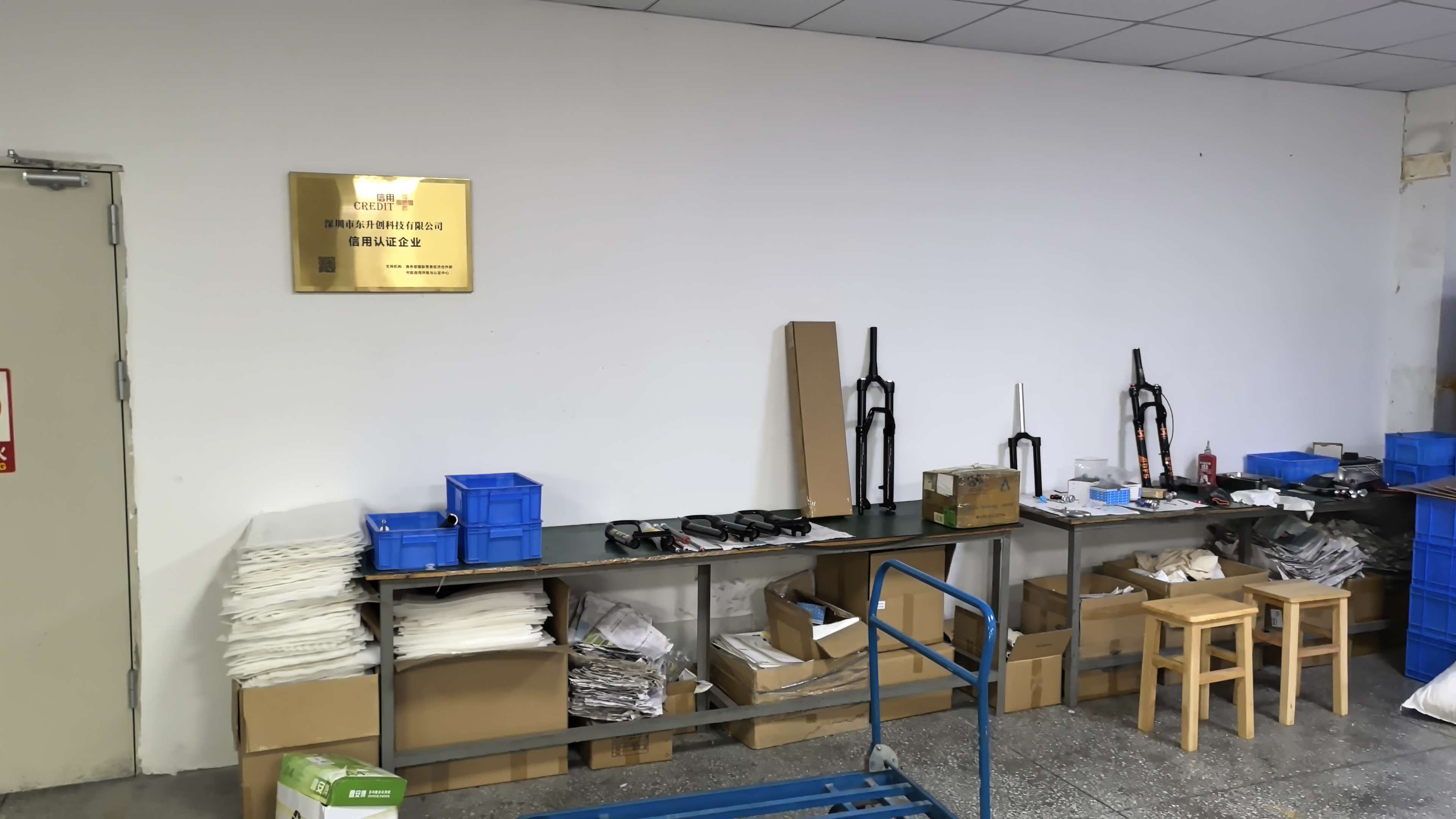
Quality inspection before packing: the stage where a carbon suspension fork stops being a specification sheet and becomes a shippable unit.
Global bicycle suspension systems were valued at USD 0.81 billion in 2025, and commercial research cited in the same dataset places carbon fiber forks at roughly 25% of the global fork market in 2024. Carbon is no longer the exotic option in mountain bike front forks. It is a mainstream material choice, and that shift has moved the difficult part of sourcing away from the material claim and toward the constraint set: what exactly is being certified, what exactly is being machined, and what exactly the buyer is committing to at the purchase order stage.
This reference piece examines a carbon suspension fork as a procurement object rather than a marketing object. It works through the parameter constraints that decide fit, the test documentation that decides market access, and the commercial limits that decide whether a carbon air fork program is realistic for a given buyer.
The Real Bottleneck in Carbon Fork Sourcing Is Not the Material
A bicycle fork is one of the few components on a mountain bike where a single part carries steering load, braking load, impact load and rider weight simultaneously. When the fork is a carbon suspension fork, those loads pass through composite lower legs and a composite crown, an air spring, a hydraulic damper and a thru axle interface. Each of those interfaces is a constraint that must be satisfied by the frame it attaches to.
In practice, most failed sourcing conversations do not fail on material. They fail on interface detail. Published buying guidance from this supplier's application documentation states the point directly: before purchasing, the buyer must confirm wheel size, fork travel, steerer, front-axle specification, brake-mount interface, frame compatibility, air-pressure setup and operating environment, and replacement should not be based on the model name alone.
That sentence is the whole constraint problem in one line. A 29-inch, 100 mm, Boost thru-axle carbon fork and a 27.5-inch, 150 mm, standard thru-axle air fork can look similar in a product photograph and be completely non-interchangeable on a frame.
The Parameter Set That Actually Constrains a Carbon Air Fork Order
The clearest way to understand the constraint layer is to read a single model in full. The DFS-RLC-TP-RCE-TC-BOOST-15X110 is a carbon bicycle air fork built for XC cross-country racing. Its published specification is not a list of selling points; it is a list of decisions that a frame designer, an assembly line or a repair shop has to accept or reject.
| Specification item | Published value | Constraint it creates |
|---|---|---|
| Model | DFS-RLC-TP-RCE-TC-BOOST-15X110 | Must be quoted in full on the purchase order to avoid axle and wheel-size confusion. |
| Wheel size | 29 inch | Fixes frame and tyre clearance; a 27.5-inch frame cannot accept it. |
| Travel | 100 mm | Defines the riding envelope as XC cross-country, not enduro or downhill. |
| Stanchion | 32 mm, AL 7050 aluminum, hard anodized | Sets the stiffness-to-weight balance and the bushing interface. |
| Steerer tube | Carbon, 39.8 mm to 28.6 mm, tapered | Tapered head tube required; headset must match the taper. |
| Lower legs and crown | Carbon composite components | Lightweight structure that requires correct clamping torque and impact handling. |
| Spring | Adjustable air spring; negative coil plus MCU | Air pressure must be set to rider weight; a suspension pump is required equipment. |
| Bushing | Teflon | Affects small-bump sensitivity and service intervals. |
| Lockout | Remote-controlled hydraulic lockout with compression adjustment | Adds a handlebar-mounted control to the cockpit layout; cable routing must be planned. |
| Rebound | Adjustable through a hydraulic circuit | Tuning range must be set for rider weight and terrain, not left at factory position. |
| Axle style | 15 x 110 mm thru axle (Boost) | Requires a Boost front hub; non-Boost wheelsets will not fit. |
| Disc mount | Post mount | Determines which brake caliper mounts directly without an adapter. |
| Pitch | 125 mm | Must be checked against frame geometry. |
| Weight | 1.35 kg | A figure that only means something once wheel size, travel and axle standard are known. |
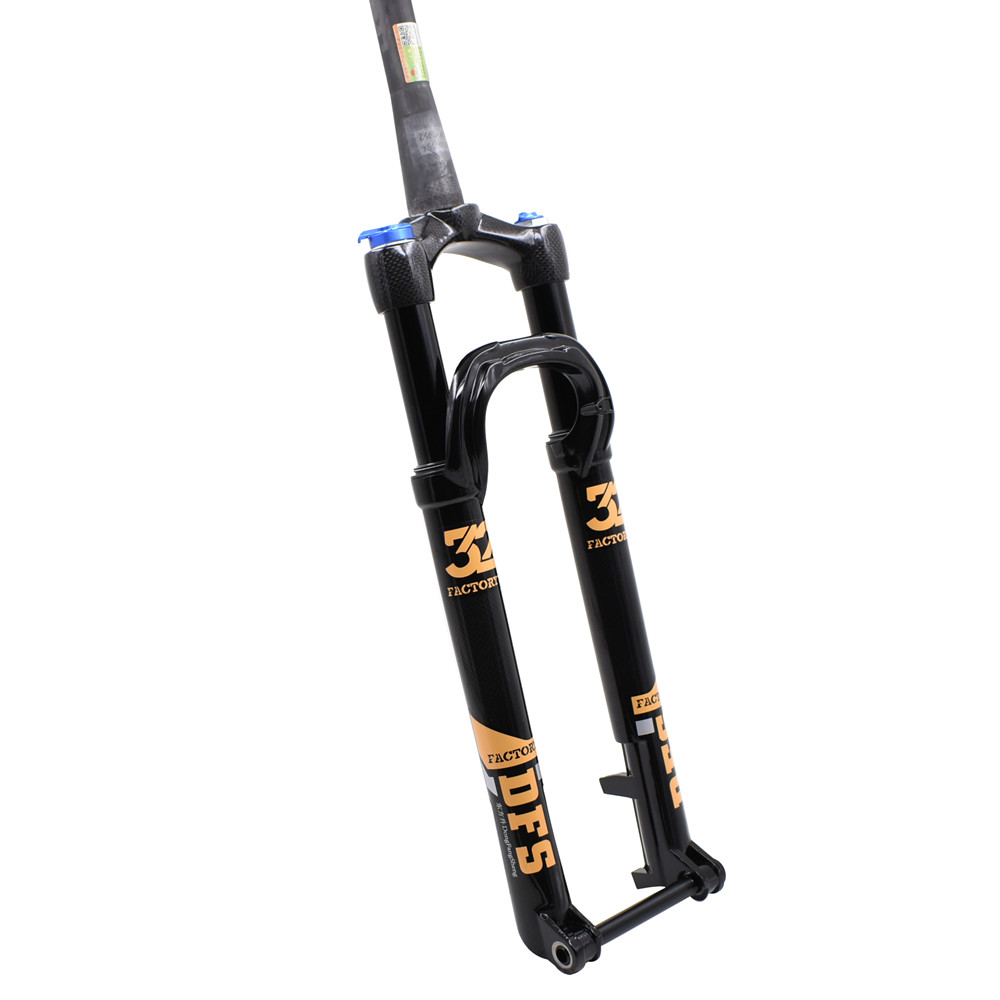
A carbon XC race air fork: composite lower legs and crown, 32 mm AL 7050 stanchions, 100 mm travel, 15 x 110 mm Boost thru-axle dropout.
Read as a whole, the table explains why carbon fork procurement is a constraint exercise. The weight figure of 1.35 kg is only meaningful in combination with a 29-inch wheel, 100 mm of travel, a 32 mm stanchion and a Boost thru-axle. Change any one of those and the comparison is no longer valid.
What a Fork Test Report Covers, and What It Does Not
The DFS bicycle suspension fork product holds an Intertek test report, certificate number SZHH00332353, issued 2008-12-04 against the EN 14766:2005 standard, applicable to the bicycle suspension fork product and to the EU market. That is a verifiable document with a named testing authority, a named standard and a specific product scope — the three things a buyer should always look for in a fork compliance file.
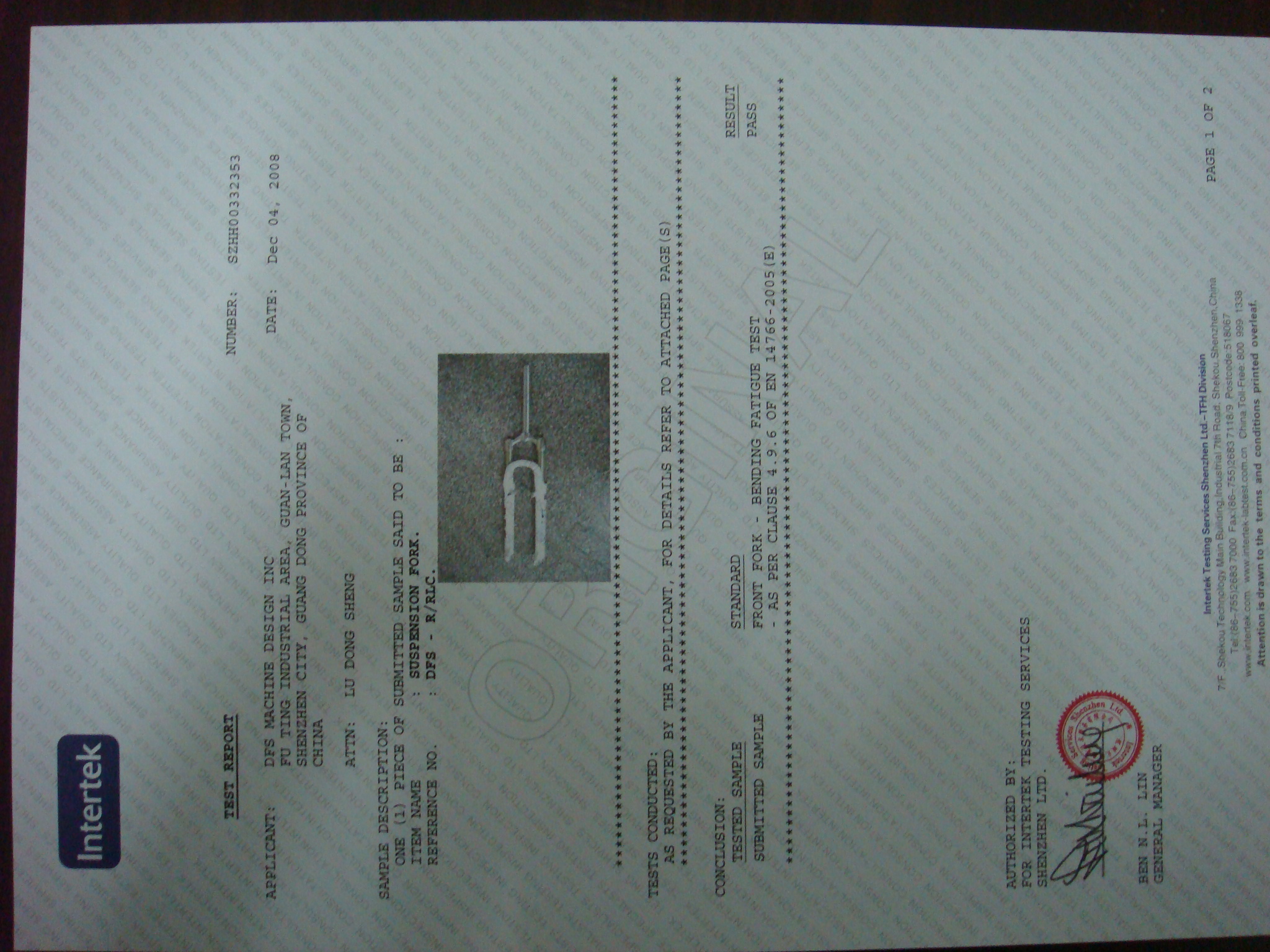
Documentation is configuration-specific: the EN 14766:2005 Intertek report applies to the bicycle suspension fork product and to the EU market.
What such a report does not do is travel automatically. A CPSC summary of bicycle standards notes that ASTM, EN and ISO frameworks each contain suspension-fork requirements, including tyre-clearance testing, with details varying by standard and by bicycle-use condition. The comparison guidance attached to that summary is explicit: the frameworks can be mapped at the level of test categories, but they should not be combined, and certification equivalence should not be claimed.
| Framework or code | What it addresses | How a buyer should use it |
|---|---|---|
| EN 14766:2005 (Intertek report SZHH00332353) | The standard against which the DFS bicycle suspension fork product was tested for the EU market. | Use as the verified, configuration-specific compliance record for this product. |
| ASTM F2274-11(2024) | Performance requirements and test methods for production suspension and non-suspension forks intended for Condition 3 terrain, covering compression load, bending load, impact resistance and fatigue. | Use to define the test plan and to screen design risk for US-oriented programs. |
| ASTM F2273-11 | Mechanical test methods for bicycle forks, including compression load, bending load, impact resistance and bending fatigue life. | Use to brief a test laboratory; confirm the applicable edition before making a compliance statement. |
| ISO 4210-6:2023 | Frame and fork test methods, including suspension-fork tyre clearance, front-fork tensile strength, static bending, rearward impact, bending fatigue with impact, and forks for hub or disc brakes. | Use for European and international market-entry test planning; section headings alone do not demonstrate conformity. |
| HS 8714.91 | Harmonized System classification for bicycle front forks. | Use for customs and import documentation planning. |
The practical rule that follows is simple: a buyer should never accept a fork compliance file as a generic quality signal. Ask which product configuration was tested, which edition of the standard was applied, which market the document was issued for, and whether the test categories in that document map to the categories required in the destination market.
Where DFS Sits in This Constraint Map
DFS is a mountain bike suspension fork brand operated by DFS TECH (SHEN ZHEN) CO., LTD., a manufacturer established in 2009 and located in Longhua District, Shenzhen, China. The company develops, produces and sells mountain bike suspension forks, owns the independent brands DFS, CIVET and ROLL, and describes its own work as structural design, damping tuning and product testing supported by self-developed suspension structure patents and software copyrights, rather than simple OEM assembly.
For a buyer evaluating a carbon fork against the constraints above, the relevant capability facts are these:
- Product scope: a full range of pneumatic suspension forks covering XC cross-country and AM all-mountain categories, in aluminum alloy and carbon fiber versions.
- Interface coverage: quick-release, standard thru-axle and Boost thru-axle specifications, with travel from 100 mm to 150 mm and compatibility with 20, 24, 26, 27.5 and 29-inch or 32-inch mountain bike frames.
- Adjustment range: lockout, rebound adjustment, and high-speed and low-speed compression damping adjustment across the range.
- Carbon XC reference model: DFS-RLC-TP-RCE-TC-BOOST-15X110, with carbon lower legs, crown and steerer tube, at 1.35 kg.
- Scale: a 4,000 m² facility, a 5-person R&D team, annual output of 100,000 units and an export share of 70%, with main markets in the EU and USA.
The relevance of these facts to an HVQ2-style constraint question is that they answer a compatibility question rather than a preference question. A buyer who needs a 29-inch, Boost thru-axle, carbon XC race fork with remote hydraulic lockout is working inside a defined envelope. The question is whether the supplier's catalogue, tooling and documentation actually sit inside that same envelope.
Application Fit: Where a 100 mm Carbon XC Fork Belongs
The working conditions documented for this class of fork are mountain trails, unpaved surfaces, off-road riding and bicycle competition conditions involving impacts and changing terrain. Its function is to absorb and manage impacts at the front wheel while using the air spring, hydraulic lockout and compression adjustment to support front-end control, handling response and riding stability.
The matched equipment list is equally concrete: mountain bike frame, front wheel and wheelset, handlebar and steering components, front axle, and a suspension pump for air-pressure adjustment. A buyer planning an assembly program should treat that list as a bill of materials check — a fork program that does not budget for a suspension pump, for example, will produce bikes with incorrect air pressure out of the box.
Project types this class of fork is used in include mountain bike assembly programs, bicycle brand OEM and ODM projects, fork replacement and upgrades, and off-road and competition bike development. In one documented OEM and ODM case spanning three years and approximately 10,000 units, orders for clients in Germany, Argentina and South Korea were supported by a paint shop capable of custom colors and logo printing, with the stated outcome that quality control keeps every suspension fork operating under tough trail conditions.
Commercial Constraints: MOQ, Lead Time and Cost Drivers
The parameters are only half of the constraint picture. The other half is commercial, and here the numbers are unusually explicit. Documented capability data for this manufacturer lists a minimum order quantity of 2,000 pieces, a monthly capacity of 3,000 units, and a lead time of 30 to 120 days depending on configuration. Customization scope covers logo, material, surface finish, travel, axle specification, brake mount and packaging. Quality control is described as 100% test, and after-sales support is stated as a two-year warranty with remote guidance.
Those four figures — MOQ, capacity, lead time and customization scope — are what actually determine the shape of a quotation. A carbon fork cost structure is driven by the material mix between carbon composite lower legs, crown and steerer tube and the aluminum components such as the 32 mm AL 7050 hard-anodized stanchions; by the tooling required for a specific axle specification or brake mount; by testing and documentation; and by packaging specification. Buyers comparing quotations across suppliers should ask for those components to be broken out separately rather than compared as a single landed unit price, because two quotations at the same headline price can carry very different tooling, documentation and packaging assumptions.
The MOQ figure is also a hard filter on buyer type. A 2,000-piece minimum suits a bicycle brand running an assembly program or a distributor building a season of stock. It does not suit a single workshop ordering small batches, and those buyers are better served through stock and aftermarket channels than through a factory-direct customization program.
Market Direction: Premiumization Meets Documentation Pressure
Two trends are moving in parallel, and they pull in the same direction. The first is premiumization of materials. With the global bicycle suspension system market at USD 0.81 billion in 2025 and carbon fiber forks already holding around a quarter of the fork market in 2024, source-reported projections in the same dataset point toward carbon moving further into the mainstream by 2030. Growth in a mature market tends to concentrate in the higher-value segments, and carbon forks are one of those segments.
The second trend is documentation pressure. Standards work in this category has continued to develop — ISO 4210-6:2023 identifies specific suspension-fork test methods, and ASTM F2274-11(2024) defines performance requirements for production forks used in Condition 3 terrain. As test categories become more granular, the fork compliance file stops being a single certificate and becomes a set of documents mapped to specific markets and specific configurations.
For buyers, the two trends combine into a single practical consequence: the ability to produce a verifiable, configuration-specific test document is becoming part of the product, not an accessory to it.
Comparison With Conventional Aluminum Forks: Where Carbon Wins and Where It Does Not
A carbon suspension fork is not a universal upgrade over an aluminum one, and the differences are worth stating plainly.
On weight and ride quality, carbon composite lower legs and crown allow a lighter front end, which is why the carbon XC race configuration above lands at 1.35 kg while still carrying a 32 mm stanchion, remote hydraulic lockout and compression adjustment. For cross-country racing and long climbing days, that difference in unsprung and rotating mass at the front of the bike is the point of the material.
On durability and service reality, the trade-off is real. Composite lower legs and crown demand attention to clamping torque and to impact assessment after a crash; a carbon component does not deform the way an aluminum one does, and a shop cannot judge it by eye the way it judges a bent alloy lower. Buyers specifying carbon forks for a fleet or rental program should plan for a clearer inspection protocol and for staff training, not simply assume the same handling procedure used on alloy forks.
On specification limits, the carbon XC model described here is a 29-inch, 100 mm travel, 32 mm stanchion fork. That combination is an XC platform. It is not an enduro or downhill platform, and no amount of material quality changes that — travel and stanchion diameter set the terrain envelope before material is considered. A buyer who needs a longer-travel enduro fork is looking at a different product class within a suspension fork range, not a variant of this one.
On compliance, the limitation is one of scope rather than quality. The EN 14766:2005 Intertek report applies to the bicycle suspension fork product and to the EU market. It is not a global passport: ASTM and ISO frameworks describe related but not automatically interchangeable suspension-fork requirements, and a buyer entering a market that specifies a different test category should map the requirement explicitly rather than assume transferability.
Finally, on order economics, aluminum quick-release forks typically sit in a different volume and price bracket than carbon Boost thru-axle forks. The 2,000-piece MOQ and 30 to 120 day lead time documented for this manufacturer are reasonable for a branded assembly program and restrictive for low-volume buyers, and that trade-off is a commercial fact, not a quality judgment.
Future Outlook
The direction of travel for carbon suspension forks over the next few seasons looks less like a materials race and more like a documentation and interface race. Axle standards such as the 15 x 110 mm Boost thru axle have already consolidated the front-end interface on modern mountain bikes; wheel-size coverage from 27.5 to 29-inch to 32-inch frames has broadened within single product ranges. What remains uneven across suppliers is the ability to state, in the buyer's language, which configuration was tested, against which edition of which standard, for which market.
Suppliers that can pair a defined carbon XC platform — composite lower legs and crown, air spring, hydraulic lockout and rebound, Boost thru axle — with a clear compliance file and a transparent commercial structure will be easier to qualify. For component buyers, the practical preparation is straightforward: build the constraint checklist first, then ask suppliers to answer it in writing.
Frequently Asked Questions
Which specifications must be confirmed before ordering a carbon suspension fork?
Wheel size, fork travel, steerer tube dimension, front-axle specification, brake-mount interface, frame compatibility, air-pressure setup and operating environment should all be confirmed in advance. Replacement or specification decisions should not be based on the model name alone. In the DFS-RLC-TP-RCE-TC-BOOST-15X110, for example, a 29-inch wheel, 100 mm travel, tapered 39.8 mm to 28.6 mm carbon steerer tube, post disc mount and 15 x 110 mm Boost thru-axle dropout define the interface set that a frame must match.
What certification does the DFS bicycle suspension fork hold?
The bicycle suspension fork product holds an Intertek test report, certificate number SZHH00332353, issued 2008-12-04 against the EN 14766:2005 standard. The certification applies to the bicycle suspension fork product and to the EU market, and EN 14766:2005 is the applicable standard named in the report.
Does an EN 14766:2005 test report cover ASTM or ISO requirements for other markets?
No. ASTM F2274-11(2024) establishes performance requirements and test methods for production suspension and non-suspension forks used in Condition 3 terrain, including compression load, bending load, impact resistance and fatigue. ASTM F2273-11 defines mechanical test methods for bicycle forks, and ISO 4210-6:2023 covers suspension-fork tyre clearance, front-fork tensile strength, static bending, rearward impact, bending fatigue with impact, and forks intended for hub or disc brakes. A CPSC summary of bicycle standards notes that ASTM, EN and ISO frameworks each contain suspension-fork requirements with details varying by standard and by bicycle-use condition, and the associated comparison guidance states that these frameworks should be mapped at the level of test categories rather than treated as equivalent. A buyer entering a market that specifies a different framework should have the requirement mapped explicitly.
What commercial terms apply to an OEM or ODM custom mountain bike fork order?
Documented capability data for DFS lists a minimum order quantity of 2,000 pieces, a monthly production capacity of 3,000 units, and a lead time of 30 to 120 days. Customization covers logo, material, surface finish, travel, axle specification, brake mount and packaging. Quality control is stated as 100% test, and after-sales support is a two-year warranty with remote guidance. Buyers planning smaller volumes generally work through stock or aftermarket channels rather than a factory-direct customization program.
How is quality controlled during production and before shipment?
Quality control runs from the beginning to the end of production, and every product is fully assembled and carefully tested before being packed in a box. For OEM orders, the finishing stage can include custom colors and logo printing through the paint shop facility. The published test report for the bicycle suspension fork product provides an additional, third-party documented reference point against the EN 14766:2005 standard.
What is a 100 mm carbon XC suspension fork not suitable for?
A 29-inch fork with 100 mm travel and 32 mm stanchions is an XC cross-country platform. Travel and stanchion diameter define the riding envelope, so it is not an enduro or downhill specification regardless of material. In addition, carbon composite lower legs and crown require correct clamping torque and a considered impact-inspection protocol after a crash, since composite components do not deform in the way aluminum ones do. Buyers with fleet or rental programs may need to plan additional inspection and staff training.
Reference Material
The DFS air suspension fork catalogue, including product configurations and specifications, is available for download: DFS AIR SUSPENSION FORK 2026 (PDF).