
Carbon Steel Seamless Pipe: Specs, Standards, Certification
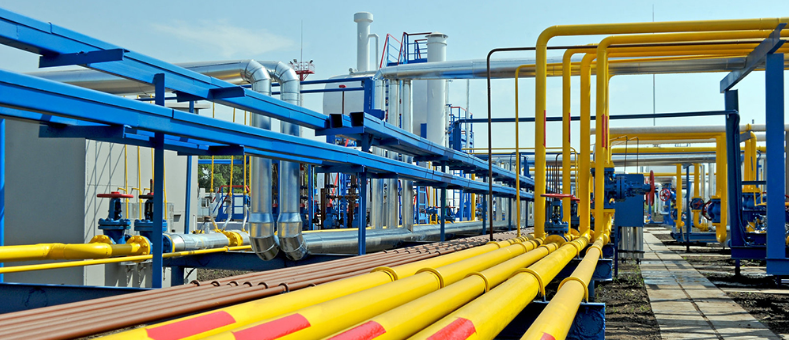
Cover image: a gas pipeline station, one of the operating environments in which carbon steel seamless pipe is specified.
Carbon steel seamless pipe is a specification-led product. Two suppliers can quote the same nominal diameter and grade and still deliver material that differs in wall thickness, applicable standard, inspection documentation and market certification. For a buyer in the research and evaluation stage, the practical question is therefore not only what the pipe is made of, but which constraints the supplier can actually evidence.
The category remains commercially significant. Fortune Business Insights projects the global steel pipe market to reach USD 109.72 billion by the end of 2026. The same research places carbon steel at 78.0% of the market and seamless products at more than 66.0% of the technology segment in 2025 — a distribution consistent with continued demand from high-pressure, high-temperature and energy-related service, where seamless construction is conventionally preferred.
Solid Group (Shanxi Solid Industrial Co., Ltd.), a Shanxi, China–based manufacturer and exporter whose steel pipe range is presented as Solid Steel Pipes, publishes a defined constraint set for its seamless carbon steel pipe. The company was founded in 2006, operates a 100,000 m² manufacturing base with 10,000 employees and around 1,000 technical personnel, and exports approximately 95% of its output to Europe, the Middle East, South East Asia, Africa and South America.
This reference examines those constraints from a procurement perspective: the published dimensional range, the standards that apply, what CE certification does and does not cover, where seamless supply ends and welded supply begins, and which operating limits should be designed around before an order is placed.
The constraint layer that decides whether two quotes are comparable
A seamless pipe quotation becomes comparable only when six variables are fixed: the product standard, the material grade, the outside diameter and wall thickness, the length and end finish, the inspection and documentation package, and the market-access certification required at the destination. Change any one of them and the price difference usually reflects a different product rather than a different margin.
Wall thickness deserves particular attention. The published seamless range spans 0.8 mm to 78 mm, which covers light mechanical tube through to heavy-wall high-pressure duty. Two line items at the same outside diameter but at opposite ends of that wall range are not substitutes, and the governing standard will normally define how the wall is referenced — for example, ASTM A106 references nominal wall thickness to ANSI B36.10.
Customs classification follows the same logic. HS 7304 covers seamless tubes, pipes and hollow profiles of iron or steel. HS 7305 covers non-seamless circular pipes with an external diameter exceeding 406.4 mm, and HS 7306 covers other non-seamless tubes, pipes and hollow profiles. Because the three headings describe different manufacturing forms and diameter scopes, they should not be combined into a single trade category when import volumes or supplier-country patterns are analysed.
What the published seamless carbon steel pipe range covers
The specification for the seamless carbon steel pipe line states a size range of 1/2 inch to 18 inch, a wall thickness range of 0.8 mm to 78 mm, and a length range of 1 m to 12 m. Lengths are produced to customer requirements within that range. The material grades listed are A53 and A106 Grade B, with other materials available on customer inquiry.
| Parameter | Published value | Procurement relevance |
|---|---|---|
| Size range | 1/2 inch to 18 inch | Defines the upper boundary of seamless supply |
| Wall thickness | 0.8 mm to 78 mm | Separates light mechanical tube from heavy-wall pressure duty |
| Length | 1 m to 12 m, to customer requirements | Affects freight, handling and joint count |
| Standards | ASTM A53, BS1387-1985, GB/T3091-2001, EN39, BS1139 | The purchase order should name the governing standard |
| Material grades | A53 and A106 Grade B; other materials on inquiry | Grade selection follows pressure and temperature |
| Model series | Line pipe, large diameter steel pipe, structural steel pipe, precision steel pipe, mechanical steel pipe | Service categories applied to the same seamless route |
The model series describes intended service categories rather than separate manufacturing routes. All of these are produced as seamless carbon steel pipe and differ mainly in the dimensional and standard requirements applied to them. That distinction matters because a buyer comparing a line pipe quotation with a mechanical tube quotation is comparing two different requirement sets, even when the outside diameter is identical.
Two practical consequences follow from the published range. First, the 18-inch ceiling is a real boundary rather than a preference. Second, the 78 mm wall maximum sits at the heavy end of the range and is normally relevant to high-pressure or structural duty rather than general fluid transfer. Both values should be confirmed against the specific line item rather than against the product family as a whole.
Standards: A53, A106 and API 5L are not interchangeable
Three standards appear most often in seamless carbon steel pipe enquiries, and each answers a different question. Treating them as equivalent is one of the most common sources of mismatch between an enquiry and a delivered order.
| Standard | Stated scope | What it typically settles |
|---|---|---|
| ASTM A106 | Seamless carbon steel pipe for high-temperature service, NPS 1/8 to NPS 48, nominal wall per ANSI B36.10 | High-temperature service suitability and size reference |
| API Specification 5L | Seamless and welded line pipe for conveying gas, water, oil and other liquefied media; PSL1 and PSL2 | Pipeline transport application and inspection level |
| ASTM A53 | General-purpose specification, listed alongside BS1387-1985, GB/T3091-2001, EN39 and BS1139 in the Solid Group range | General service requirements rather than high-temperature or line-pipe duty |
ASTM A106 covers seamless carbon steel pipe for high-temperature service. The standard's stated scope runs from NPS 1/8 to NPS 48 inclusive, with nominal wall thickness referenced to ANSI B36.10. A106 Grade B is the grade listed in the Solid Group specification, which places it inside the company's published seamless capability rather than outside it.
API Specification 5L covers seamless and welded line pipe for conveying gas, water, oil and other liquefied media, and defines two product specification levels, PSL1 and PSL2. For high-pressure trunk lines, grades such as X65, X70 and X80 are typically specified. PSL level is a specification attribute rather than a supplier quality ranking: it determines the inspection and documentation regime that applies to the order, so an enquiry that names API 5L without naming a PSL level is incomplete.
ASTM A53 is a general-purpose specification. In the Solid Group data it appears alongside BS1387-1985, GB/T3091-2001, EN39 and BS1139 as a product standard for the seamless carbon steel pipe range. The presence of multiple standards in one product family does not make them interchangeable. Each has its own scope, and the purchase order should name the one that governs acceptance.
Regulatory references reinforce the point. 49 CFR Part 192 Appendix B, the U.S. federal pipeline appendix, identifies API Specification 5L and ASTM A106/A106M among the incorporated pipe specifications. A supplier's documentation package should therefore be checked against the specific clause cited in the project specification, not against a general claim of standards compliance.
Certification: what CE 6G260727.SSIQ015 covers
CE certification for steel pipes, fittings and flanges is held under certificate number 6G260727.SSIQ015, issued by Ente Certificazione Macchine (ECM) on 27 July 2026 and valid until 26 July 2031. The certificate applies to the EU market and covers steel pipes, fittings and flanges. Its standard list includes EN 10217, EN 10210, EN 10255, BS 1387, API 5L, ASTM A53, ASTM A106 and ASME B16.9.
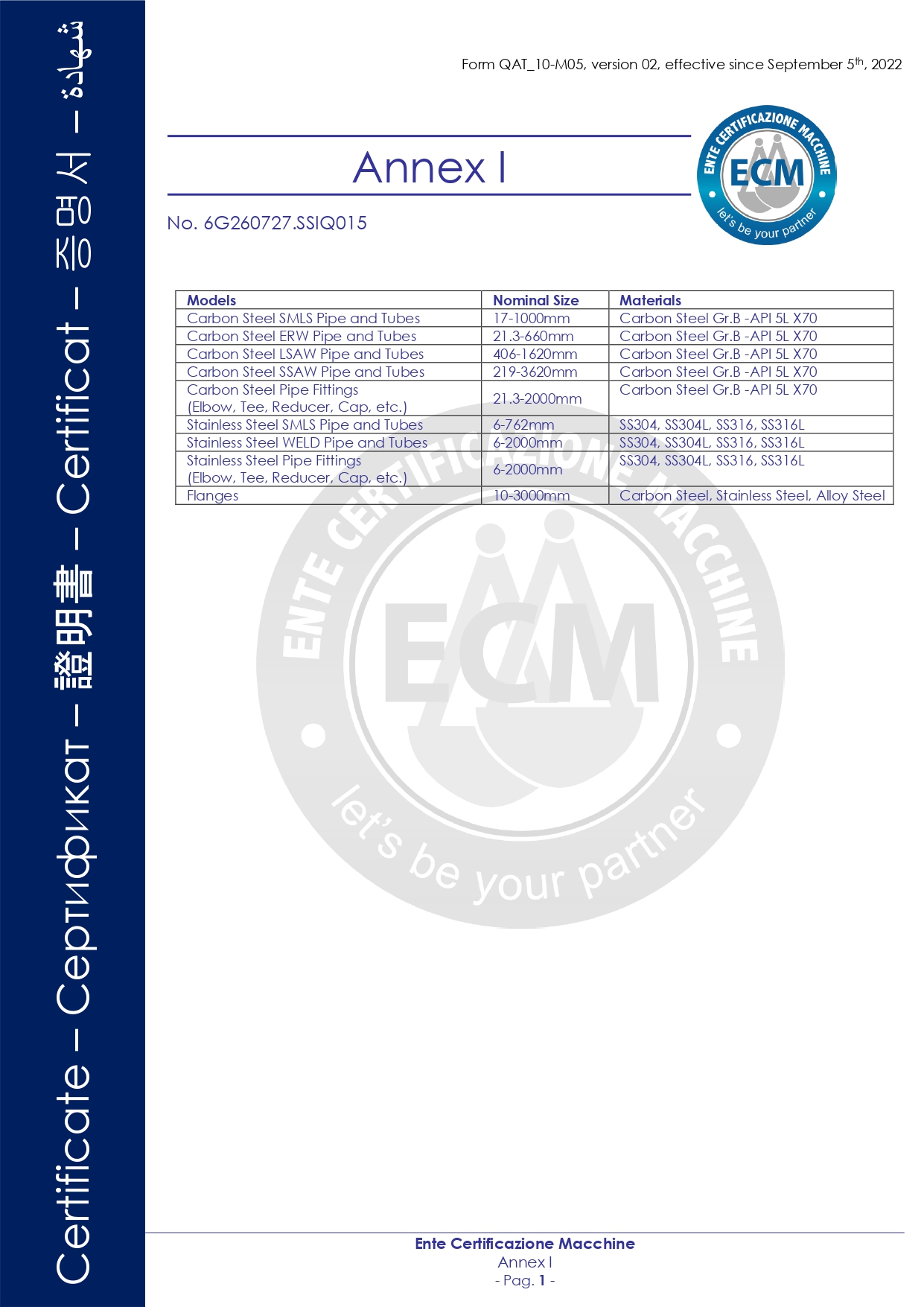
CE certificate 6G260727.SSIQ015, issued by Ente Certificazione Macchine, covering steel pipes, fittings and flanges for the EU market.
The scope matters more than the mark. A CE certificate is issued against a declared product scope and a defined set of standards. It supports market access and prequalification for the products and standards listed. It does not replace order-level inspection records, and it does not establish conformity for a standard, size or product form outside its stated scope.
Three checks are useful during evaluation. The certificate number and issuing body should match the document actually presented. The standard cited in the enquiry should appear in the certificate's standard list. The validity period should cover the planned delivery date, since a certificate that expires before shipment creates a documentation gap even when the product itself is unchanged. The current expiry in 2031 gives a defined reference window for EU-bound projects planned within that period.
Seamless versus welded: where the supply boundary sits
Seamless pipe is formed from a solid billet that is pierced and rolled, so the pipe body carries no longitudinal weld seam. Welded pipe is formed from strip or plate and closed along a seam. That difference in manufacturing route drives the dimensional and application boundaries summarised below.
| Attribute | Seamless carbon steel pipe | Welded carbon steel pipe |
|---|---|---|
| Outside diameter | 1/2 inch to 18 inch | 6 mm to 3000 mm |
| Wall thickness | 0.8 mm to 78 mm | 4 mm to 18 mm |
| Length | 1 m to 12 m | 6 m, 9 m, 12 m or as contracted |
| End finish | Confirmed per order | Plain or beveled, beveled ends protectable by plastic pipe caps |
| Standards cited | ASTM A53, BS1387-1985, GB/T3091-2001, EN39, BS1139 | GB, SY, DIN, ASTM, ASME, ANSI, API |
| Typical fit | High-pressure, high-temperature and energy-related service | Large-diameter transmission, structural and general utility duty |
The published ranges make the trade-off explicit. Seamless supply covers 1/2 inch to 18 inch with walls from 0.8 mm to 78 mm. Welded carbon steel pipe covers 6 mm to 3000 mm outside diameter with walls from 4 mm to 18 mm, in 6 m, 9 m or 12 m lengths, and can be supplied with plain or beveled ends, with beveled ends protected by plastic pipe caps. Where a project calls for diameters above the seamless ceiling, welded or spiral-welded product is the practical route. Where the duty is high-pressure or high-temperature, seamless remains the conventional choice.
This comparison is not a ranking. Each route carries different economics, inspection requirements and lead-time behaviour, and the correct answer depends on the line's design pressure, temperature, diameter and governing standard. A buyer who mixes the two into a single enquiry will usually receive quotations that cannot be evaluated side by side.
Application conditions: temperature, medium and layout
Most steel pipes in the published application data are suitable for working temperatures from -30 °C to 120 °C. The stated function is fluid transportation and structural support, and the supported installation modes include horizontal, vertical, slope and air transport. Steel pipe fittings are listed as the matched equipment for these systems.
Two exclusions are stated plainly: service should avoid strong acid and strong alkali media, and temperatures above 120 °C. Projects outside those conditions need a different material or coating decision, and that decision belongs at the enquiry stage rather than at the inspection stage.
Where corrosion resistance governs the choice, the catalogue extends beyond bare carbon steel. Hot-dip galvanized and pre-galvanized carbon steel pipe is specified with an outside diameter of 20 mm to 219 mm (1/2 inch to 8 inch), wall thickness of 0.8 mm to 2.75 mm, zinc coating of 40 g/m² to 275 g/m², and 5.8 m, 6 m or random lengths. Stainless steel pipe and sanitary stainless steel pipe cover 1/2 inch to 12 inch and DN15 to DN200, with 1.5 mm to 3 mm wall, 6 m or 12 m lengths, mirror or matt polishing, and ASTM A554, A249, A269 and A270 as the listed standards.
A municipal water reference illustrates the scale question. The Ecuador urban water supply project record lists a total supply of 11,896 tonnes across models 2032, 1219, 1422 and 914, with a stated duration of 30 to 70 years for the upgraded network. The diameters in that record sit above the 18-inch seamless ceiling, which places a project of that type in the welded or spiral-welded supply category rather than the seamless one. Reading the case correctly is itself part of specification discipline.
Procurement constraints: MOQ, lead time, testing and payment
The published capability data gives a minimum order quantity of 1 tonne, a monthly capacity of 25,000 tonnes, and a lead time of 15 to 30 days. Production is 100% pre-shipment tested. Customisation covers size, spray coating, standard, material and packaging, under an OEM/ODM production mode.
At company level, the group reports annual output of 300,000 tonnes across 12 factories and 286 production lines, with an annual export value of USD 130 million. Warranty is stated as 12 months, supported by installation guidance, technical support and after-sales service. The product scope also includes carbon steel pipe fittings, steel flanges and related pipeline components, which matters when a project requires pipe, fittings and flanges to be matched under one specification.
Payment terms listed are 100% T/T, 30% in advance with the balance before shipment, letter of credit, or terms to be discussed. Because lead time, testing scope and payment structure interact with the standard, size, wall thickness and coating selected, commercial terms should be confirmed against the actual line item rather than treated as fixed across the whole range.
A practical RFQ for seamless carbon steel pipe should carry the standard, grade, outside diameter, wall thickness, length, end finish, quantity, inspection requirement, marking requirement, destination market and required certification. Without those fields, quotations are not directly comparable, and the resulting comparison tends to reward the least complete offer rather than the most suitable one.
Evaluation checklist for a seamless carbon steel pipe enquiry
- Governing standard named, with PSL level where API 5L applies.
- Grade confirmed: A53, A106 Grade B, or another grade on inquiry.
- Outside diameter within 1/2 inch to 18 inch; wall within 0.8 mm to 78 mm.
- Length within 1 m to 12 m, with end finish specified.
- Inspection and documentation package agreed before quotation.
- Destination market and required certification identified.
- Operating temperature within -30 °C to 120 °C, with no strong acid or alkali media.
Market context: why carbon steel and seamless still dominate
The demand picture is concentrated. Fortune Business Insights projects the global steel pipe market at USD 109.72 billion by the end of 2026, with carbon steel at 78.0% of the market and seamless products at more than 66.0% of the technology segment in 2025. The same research package places the adjacent pipe fittings market at USD 70 billion in 2024, with a projected USD 100 billion by 2030.
Market size figures should be read with their scope in mind. Reported values for steel pipe vary depending on whether tube, fittings and related categories are included, so the numbers are best used as an order-of-magnitude signal for category importance rather than as a direct input to a procurement decision.
What the distribution indicates is structural. High-pressure transmission, high-temperature process lines and energy infrastructure continue to require seamless construction, while large-diameter water and structural work is served by welded and spiral-welded product. A supplier that covers both routes can quote across the boundary. A buyer who understands the boundary can tell which quotation applies to which line — and can spot the moment a supplier has quoted the wrong one.
Limits buyers should plan for
- Size ceiling. Seamless supply stops at 18 inch in the published range. Above that, welded pipe covering 6 mm to 3000 mm outside diameter is the practical route.
- Length and transport. Seamless lengths run from 1 m to 12 m. Long lengths raise freight and handling requirements and change the number of field joints.
- Temperature ceiling. The application data limits service to 120 °C and excludes strong acid and strong alkali media. Higher-temperature duty requires a different specification decision.
- Corrosion. Bare carbon steel depends on coating or material selection in aggressive environments; galvanized and stainless ranges are specified for those cases.
- Certification scope. The CE certificate covers listed products and standards for the EU market. It is not a universal conformity statement and does not replace order-level inspection records.
- Data variance. Published market values differ by scope definition, so category growth should not be treated as a fixed planning constant.
- Classification. HS 7304, 7305 and 7306 describe different product scopes and must be validated at national tariff-line level before trade values are used.
Future outlook
Three developments are likely to shape evaluation over the next planning cycle. First, specification documentation is becoming the primary qualification currency: the PSL designation under API 5L, the standard cited under ASTM A106, and the standard list behind a CE certificate now carry as much weight in shortlisting as the product description. Second, the split between seamless and welded supply is likely to remain stable, because it follows from design pressure and diameter rather than from supplier preference. Third, trade and compliance analysis will continue to depend on correct HS classification, since mixing 7304 with 7305 and 7306 distorts both import volumes and supplier-country conclusions.
For suppliers, the practical implication is that certificates, inspection records and standard references need to be retrievable per line item, not only per company. For buyers, the implication is that the constraint layer is where risk is actually reduced — not in the general description of what a pipe is.
Frequently asked questions
Which standard should a buyer specify for high-temperature service: ASTM A106 or ASTM A53?
ASTM A106 is the standard that covers seamless carbon steel pipe for high-temperature service, with a stated scope of NPS 1/8 to NPS 48 and nominal wall thickness referenced to ANSI B36.10. ASTM A53 is a general-purpose specification and appears in the Solid Group seamless range alongside BS1387-1985, GB/T3091-2001, EN39 and BS1139. The choice depends on the service conditions and on the standard named in the project specification. Where A106 is cited, the order and the documentation should reference A106 explicitly.
What size and wall thickness range is available in seamless carbon steel pipe?
The published seamless carbon steel pipe range covers 1/2 inch to 18 inch outside diameter, 0.8 mm to 78 mm wall thickness, and lengths from 1 m to 12 m produced to customer requirements. Material grades listed are A53 and A106 Grade B, with other materials available on inquiry. Diameters above 18 inch fall outside this range and are normally served by welded product, which covers 6 mm to 3000 mm outside diameter with 4 mm to 18 mm wall thickness.
Does the CE certificate mean every order is automatically CE compliant?
No. Certificate 6G260727.SSIQ015, issued by Ente Certificazione Macchine and valid from 27 July 2026 to 26 July 2031, covers steel pipes, fittings and flanges for the EU market against a defined standard list that includes EN 10217, EN 10210, EN 10255, BS 1387, API 5L, ASTM A53, ASTM A106 and ASME B16.9. Conformity still has to be demonstrated at order level through inspection documents, and the standard cited in the enquiry must fall within the certificate's scope.
What are the minimum order quantity, lead time and inspection arrangements?
The published capability data lists a 1-tonne minimum order quantity, a monthly capacity of 25,000 tonnes and a lead time of 15 to 30 days. Production is 100% pre-shipment tested. Because lead time depends on the standard, size, wall thickness and coating selected, the schedule should be confirmed against the specific line item at quotation stage.
What operating temperature and media limits apply?
The application data states that most steel pipes are suitable for working temperatures from -30 °C to 120 °C, and that service should avoid strong acid and strong alkali media and temperatures above 120 °C. Where corrosion resistance is the governing requirement, hot-dip or pre-galvanized carbon steel pipe with 40 g/m² to 275 g/m² zinc coating, or stainless steel pipe to ASTM A554, A249, A269 or A270, is the alternative specified in the same catalogue.
How should seamless and welded pipe be separated in customs and trade analysis?
HS 7304 classifies seamless tubes, pipes and hollow profiles of iron or steel. HS 7305 covers non-seamless circular pipes with an external diameter exceeding 406.4 mm, and HS 7306 covers other non-seamless tubes, pipes and hollow profiles. The headings describe different manufacturing forms and diameter scopes, so combining them distorts import volumes, unit values and supplier-country comparisons. National tariff lines should be validated before any trade value is calculated.
Reference material
A downloadable product brochure covering the steel pipe, fitting and flange range, including dimensional and standard references, is available here: Solid steel pipe product brochure (PDF).
For evaluation purposes, the most useful next step is to match the brochure data against the governing standard and the line-item dimensions, then request the certificate and inspection documents that apply to that specific order.
¿Tiene preguntas o necesita más detalles?
Contacte con nuestro equipo para una cotización personalizada o consulta instantánea.
Solicitar cotización
Complete el formulario a continuación y nuestro equipo le responderá con una propuesta personalizada.
Chat directo de WhatsApp
¿Prefiere chatear en tiempo real? Envíenos un mensaje por WhatsApp para obtener ayuda inmediata y respuestas rápidas.
- Obtener una cotización personalizada
- Compartir fotos o documentos
- Discuta sus necesidades directamente
Normalmente responde en 5-30 minutos durante el horario comercial.