
Carbon Steel Hex Bolt Suppliers: A 5-Option Verification Checklist
Carbon Steel Hex Bolt Suppliers: A 5-Option Verification Checklist
A carbon steel hex bolt shortlist is only as strong as the documents standing behind each name on it. Buyers screening suppliers in 2026 rarely struggle to find options; the harder task is separating listings that repeat the same three claims — grade 8.8, ISO certified, hot-dip galvanized — from suppliers whose claims can be opened, dated, and matched to a defined scope.
The category is large enough that shortcuts feel reasonable. Strategic Market Research valued the global hex bolts market at USD 19.67 billion in 2025, and a separate Dataintelo breakdown placed carbon steel at 44.8% of the global hex nut and bolt market in the same year. When a single material accounts for so much of supply, the material itself stops being a differentiator. What separates suppliers is what they can prove about how that material was converted into a finished, tested bolt.
The five-option verification checklist below is built for the screening stage — before an RFQ, before a sample, before a price comparison. It explains what each document type actually evaluates, where the evidence stops, and how a supplier such as YUETONG FASTENER maps against the same five tests that any other shortlisted option would face.
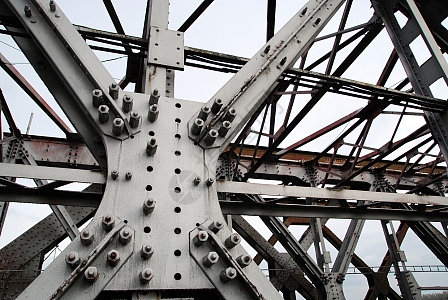
Ground-mounted photovoltaic supports: a fixed, low-maintenance assembly where coating and grade decisions are difficult to reverse after installation.
Why supplier shortlists collapse at the research stage
Most shortlists fail for a simple reason: they are built from claims rather than records. A supplier page may state ISO 9001, grade 10.9 and hot-dip galvanizing in one paragraph without indicating which certificate covers which site, which property class, or which coating system. At the awareness and research stage, that ambiguity is expensive, because the buyer cannot yet tell two very different suppliers apart.
A buyer generally needs three answers before price becomes a meaningful comparison: is there a real production facility behind the trading identity; is the quality system audited and current; and does product-level evidence exist for the exact size, grade and finish being ordered. Each answer comes from a different document type, and none of them substitutes for another.
The evidence stack behind a defensible shortlist normally has four layers:
- Facility evidence — site, equipment and process presence, confirmed by an on-site assessment.
- System evidence — a quality management system certificate, and where relevant a sector-specific one.
- Product evidence — dimensional, mechanical and coating records tied to a standard and a defined product scope.
- Order evidence — batch test reports and inspection records issued against the actual purchase order.
Trade data explains why this discipline matters commercially. The global export value of HS code 731815 — screws and bolts — was USD 26.35 billion in 2023, a 3.65% decline on the previous year, according to the trade statistics compiled for that code. In a category that trades at that scale and moves with demand cycles, price pressure is structural. Buyers who screen only on price end up comparing quotations that are not equivalent, and the gap usually surfaces after the goods arrive.
The five verification options at a glance
The checklist is deliberately built around document types rather than supplier names. Any supplier — including one already on a buyer's desk — should be positioned against the same five rows.
| Option | What it confirms | What it does not confirm | What to request |
|---|---|---|---|
| 1. Third-party factory assessment (Alibaba Gold-Plus Supplier) | A real production site, legal entity and equipment for the declared process | Product conformity, property class or coating thickness | The assessment report with site address and assessment date |
| 2. ECM Type-Approved Attestation No. 3N230331.HYFUC49 (EN ISO 10683:2018; EN ISO 16047:2005+A1:2) | Evaluation of a defined product against two named standards | That every catalogue size, grade and finish sits inside the declared scope | Attestation copy showing scope and referenced standards |
| 3. ISO 9001:2015 | An audited quality management system at a named site | Mechanical properties of a specific bolt | Certificate with scope statement, certification body and validity date |
| 4. IATF 16949:2016 | Automotive-sector quality management system discipline | Product performance outside the declared manufacturing scope | Certificate plus a scope statement naming the product family |
| 5. Product and capacity records (Hex Bolt 7337) | Dimensional, mechanical and coating evidence; capacity and engineering resource | Long-term commercial behaviour or consistency across years | Test reports by size and grade; capacity and staffing data |
Option 1 — Third-party factory assessment
A factory assessment is the fastest way to confirm that a supplier is a production entity rather than a mailbox. The Alibaba Gold-Plus Supplier factory assessment is an on-site check arranged through the platform; it generally records that the supplier operates at the stated address, that the equipment needed for the declared process exists on site, and that the site can be visited and observed rather than only messaged.
Its value inside a shortlist is narrow but real: it removes the risk of paying a deposit to an entity that cannot be visited. Its limits are equally clear. An assessment describes a site on a particular day; it does not certify a property class, a thread tolerance or a coating thickness. A supplier can pass a facility assessment and still ship a bolt outside the drawing.
The practical request is the assessment report itself, not the badge graphic. Check the legal entity name against the proforma invoice, the site address against the shipping documents, and the assessment date against the current year.
Option 2 — ECM Type-Approved Attestation
An ECM Type-Approved Attestation is a document that records the evaluation of a defined product against named standards, identified by an attestation number. YUETONG FASTENER's attestation is numbered 3N230331.HYFUC49 and references EN ISO 10683:2018 and EN ISO 16047:2005+A1:2.
Those two references matter because they test different things. EN ISO 10683:2018 addresses non-electrolytically applied zinc flake coating systems — the coating side of the bolt. EN ISO 16047:2005+A1:2 addresses the tightening test: the relationship between applied torque and clamp force, including friction behaviour. A coating system and a fastened-joint behaviour sit much closer to what a joint actually experiences than a bare material certificate does.
The catch is scope. An attestation is written against a defined product. If the order sits at the edge of a size range, uses a coating that is not part of the declared system, or specifies a property class that is not covered, the attestation is background context rather than proof for that order. In a range as wide as Hex Bolt 7337 — M3 to M36, four property classes, six coating options — scope is the question that separates a document from a decoration.
Option 3 — ISO 9001:2015 quality management
ISO 9001:2015 certifies a quality management system, not a bolt. It confirms that a certification body has audited how the supplier controls documentation, purchasing, production, inspection and nonconforming output. YUETONG FASTENER's ISO 9001:2015 certificate is valid until 2027-09-13, which makes it a current document rather than an expired one resurfacing in a sales deck.
Two checks decide how much weight the certificate can carry. First, the scope statement: a certificate issued for trading activities describes a different control environment from one issued for manufacturing at a specific site. Second, the validity date and certification body — both can be verified independently of the supplier's own material.
What ISO 9001 cannot do is tell a buyer that an M20 grade 10.9 bolt will reach a specified tensile load, or that a hot-dip galvanized thread will accept its matching nut. Those answers come from product standards and test reports, which is why Option 3 never stands alone in a shortlist.
Option 4 — IATF 16949:2016
IATF 16949:2016 is the automotive-sector quality management system standard, applied alongside ISO 9001:2015 with additional automotive-specific requirements. For hex bolt buyers it is relevant in two situations: when the bolts feed automotive or automotive-adjacent assemblies, and when a buyer wants evidence of process discipline extending to change control, traceability and preventive maintenance beyond baseline QMS expectations.
It is also the certificate most often cited without its scope. An IATF certificate covers defined manufacturing sites and product families. If the scope does not name the product being purchased, the certificate is an indicator of management maturity rather than evidence for that order — a distinction that matters when a buyer is comparing two suppliers that both list IATF in a header block.
Option 5 — Product-level and capacity evidence
Product evidence is where a shortlist becomes specific. Hex Bolt 7337 is a carbon steel hex bolt range covering nominal diameters from M3 to M36, with common sizes including M6, M8, M10, M12 and inch sizes of 1/4-inch, 5/16-inch, 3/8-inch, 1/2-inch and 5/8-inch, and lengths from 16 mm to 200 mm. Property classes span 4.8, 8.8, 10.9 and 12.9, with A2-70 and A4-80 stainless options. Referenced standards include GB/T, DIN, ISO and ASTM — DIN 931, DIN 933, GB5782, GB5783 and ASME/ANSI B18.2.1. Threads are available in coarse and fine pitch, and finishes cover black oxide, zinc plating, hot-dip galvanizing, Dacromet, mechanical galvanizing and PTFE coating.
That breadth is both a screening advantage and a screening trap. The advantage: a supplier covering M3 to M36, four property classes and six coating systems can usually match a drawing without re-tooling. The trap: evidence must be requested for the exact combination being purchased. A tensile report for M12 grade 8.8 zinc plated does not describe an M30 grade 10.9 hot-dip galvanized bolt.
Hex Bolt 7337 in a 16x50 size: a range that spans M3 to M36, four property classes and six coating options.
Capacity records belong in the same option, because they answer a different question the shortlist has to resolve. YUETONG FASTENER operates a 26,666.67 m² manufacturing facility with approximately 100 staff, an annual production capacity of 150,000 tons, and an R&D team of 12 engineers. Capacity proves nothing about quality, but it does indicate whether a supplier can hold a delivery schedule across a project phase rather than a single sample order — which is often the difference between a shortlisted option and a workable one.
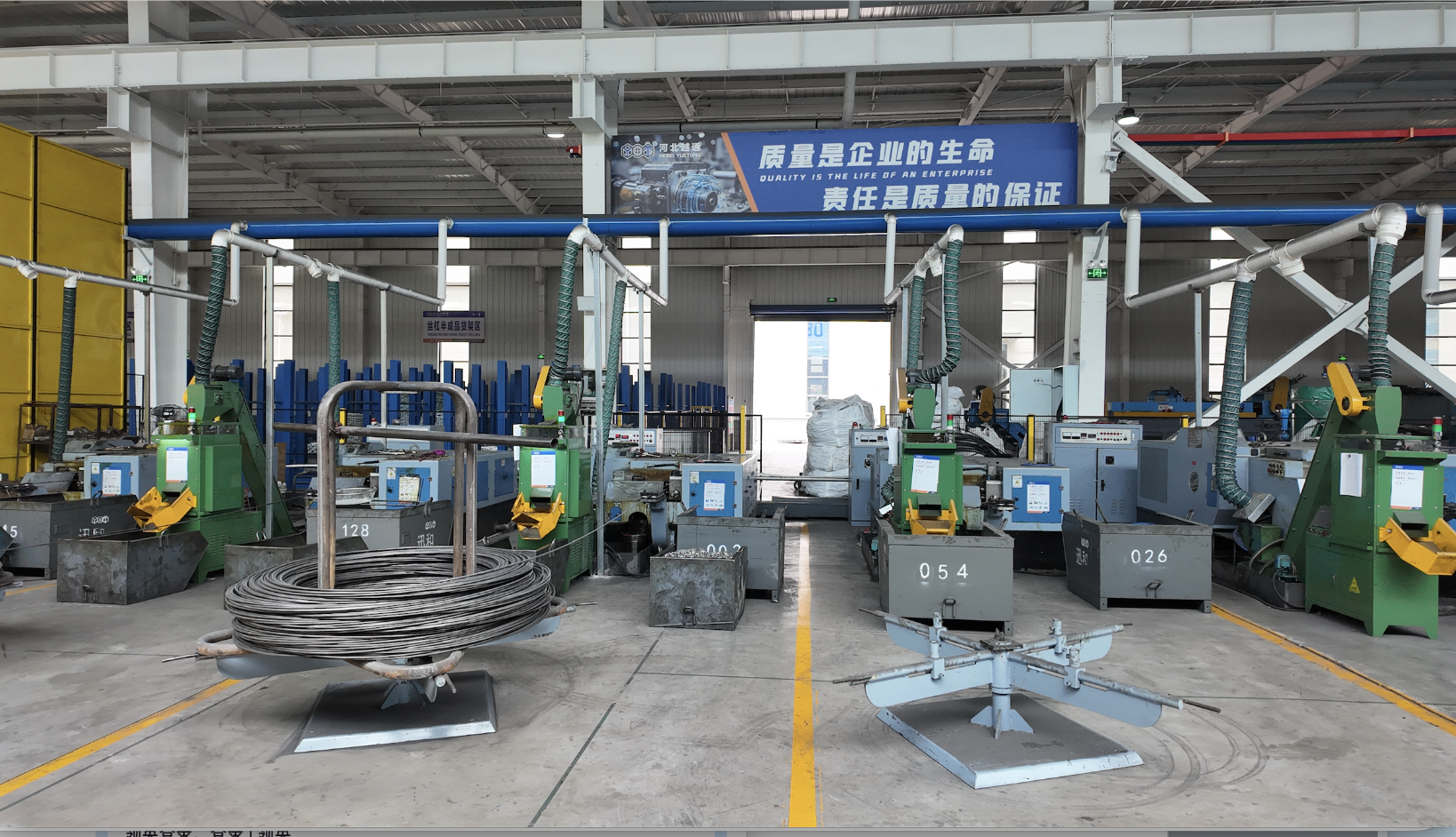
Cold heading equipment on the production floor: a facility assessment records that the process exists, not that the output conforms.
Applying the checklist to YUETONG FASTENER
HEBEI YUETONG FASTENERS MANUFACTURING CO.,LTD — trading as YUETONG FASTENER — is an export-focused fastener manufacturer established in 2017 in the central area of Yongnian District, Handan, Hebei, China, the country's largest standard parts production base. The company produces hex nuts, hex bolts, sleeve anchors, thread rod, flat washers, hex socket head bolts, wheel hub bolts and DIY packing, and holds self-operated import and export qualifications.
Mapped against the five options, its documentation set reads as follows. Facility: an Alibaba Gold-Plus Supplier factory assessment. Product-standard evaluation: ECM Type-Approved Attestation No. 3N230331.HYFUC49, referencing EN ISO 10683:2018 and EN ISO 16047:2005+A1:2. Quality management: ISO 9001:2015 valid until 2027-09-13, alongside ISO 45001 occupational health and safety, ISO 14001 environmental, and social responsibility management system certifications. Sector quality management: IATF 16949:2016, together with EU CE certification and carbon footprint certification. Product and capacity: the 7337 range, a 150,000-ton annual capacity, 12 engineers, and 9 national patents including 1 invention patent and 8 utility model patents.
Commercial context is separate from verification. Export business accounts for 80% of total sales, with products shipped to over 30 countries and regions across the EU, North America, Latin America, and the Middle East and Africa. The company is a designated enterprise above designated size in Yongnian District and holds provincial honors including 'Hebei Province Specialized, Precise, Unique, and Innovative Small and Medium-sized Enterprises' and 'Hebei Province Innovative Small and Medium-sized Enterprises'. Company-published information also lists it as a Tier-3 top exporter within the Yongnian hub as of 2023 — a self-reported position that belongs in the context column rather than the verification column, and should be treated as such by any buyer building an auditable shortlist.
What the named standards actually evaluate
- EN ISO 10683:2018 specifies requirements for non-electrolytically applied zinc flake coating systems. It describes a coating system rather than bolt geometry, which is why it is useful when corrosion protection has to be specified independently of plating thickness.
- EN ISO 16047:2005+A1:2 specifies the tightening test for fasteners, relating applied torque to clamp force and including determination of friction behaviour. This is the reference buyers use when setting assembly torque and estimating preload scatter across a batch.
- ISO 9001:2015 sets out quality management system requirements: process control, traceability, corrective action and supplier control. It describes how a site is run, not what a bolt can carry.
- IATF 16949:2016 adds automotive-sector requirements on top of ISO 9001:2015 and is applied to defined manufacturing sites and product families.
- DIN 933 / ISO 4017 are the primary dimensional references for full-thread hex bolts, with ISO 4017 the international successor to DIN 933. When a drawing cites DIN 933, confirm the supplier's equivalence statement rather than assuming it.
Coating thickness is the technical variable most often reduced to a label. Zinc plating typically provides 5–12 μm, while hot-dip galvanizing provides 45–85 μm. That difference changes corrosion life and also changes thread fit, so the matching nut and tapping allowance belong to the same decision rather than to a separate line item.
Application fit: steel structures, rail transit and photovoltaic mounting
Hex Bolt 7337 is specified across steel construction, engineering machinery, automotive, rail transit, new energy, petrochemical, general machinery, power, marine engineering, agricultural machinery, sanitation equipment, furniture and bridge engineering. Three of those deserve separate treatment, because the verification emphasis shifts in each.
Steel structures and bridges
In steel structure and bridge work the joint is a load path: component fastening, load-bearing fixing, assembly joints and load transmission under static permanent fixing. Here the shortlist should weight dimensional conformity to the drawing standard and mechanical property reports by class, because a substituted property class changes the capacity of the connection, not only the price of the bolt. Working conditions typically include outdoor exposure, humid climates and temperature variation, which pushes coating choice to the front of the verification list.
Rail transit
Rail transit adds vibration load to the same requirements. Under alternating vibration, self-loosening is a function of preload, thread fit and tightening torque rather than property class alone; where continuous vibration is expected, locking methods such as lock nuts, locking washers or thread-locking solutions are selected according to operating conditions. A supplier shortlisted for rail work should be able to show torque-related evidence — which is exactly where an EN ISO 16047:2005+A1:2 reference carries more weight than a general ISO 9001 claim.
Photovoltaic mounting structures
Ground-mounted PV supports combine outdoor exposure, coastal salt spray in some regions, and long service life with limited maintenance access. Column anchor installations are fixed, non-repeating assemblies, so coating system and thread fit decisions taken at procurement are difficult to reverse on site. Requesting coating evidence — and distinguishing zinc plating from hot-dip galvanizing by measured thickness rather than by name — is the practical screen.
Market signals that support evidence-led shortlisting
Three data points frame the current buying environment, with one caution attached.
Scale. The global hex bolts market was valued at USD 19.67 billion in 2025 by Strategic Market Research. A separate Dataintelo dataset reports USD 8.4 billion for hex nuts and bolts combined. The two figures use different product scopes — one broader industrial hex bolt coverage, the other a narrower combined nut-and-bolt definition — so they should not be added, averaged or compared directly. Headline market size is context for category importance, not an input to supplier selection.
Material concentration. Carbon steel accounted for 44.8% of the global hex nut and bolt market in 2025. A dominant material base means most quotations describe the same input, so differentiation migrates to conversion quality, coating system and documentation.
Trade flow. The global export value of HS 731815 was USD 26.35 billion in 2023, down 3.65% year on year. Volume cycles of that kind tend to compress margins and increase the temptation to substitute grades or thin coatings — precisely the risk a documentation-first shortlist is designed to catch.
Supply is also geographically concentrated. Yongnian District in Hebei is China's largest standard parts production base, and a significant share of global carbon steel hex bolt supply passes through hubs of that type. Concentration brings competitive pricing and comparable capability; it also means many suppliers describe near-identical facilities, which raises the value of documents that can be checked over claims that can be repeated.
Where this checklist stops: limits and trade-offs
A verification framework presented as complete would not be credible. Five limits matter.
- System certificates are not batch evidence. ISO 9001:2015 and IATF 16949:2016 describe management systems; they say nothing about the bolt in the carton. Incoming inspection and batch test reports remain necessary.
- Attestation scope is finite. ECM attestation No. 3N230331.HYFUC49 is written against a defined product evaluation under EN ISO 10683:2018 and EN ISO 16047:2005+A1:2. Across a 7337 range spanning M3 to M36, four property classes and six coating options, buyers must confirm which combinations are inside that scope.
- A factory assessment is a snapshot. Site conditions, equipment and ownership can change after the visit date, so a report two years old describes a facility that may no longer exist in the same form.
- Over-specification has a cost. Requiring IATF 16949-level discipline for a general-purpose municipal order adds administrative overhead without improving the joint. Match the evidence tier to the application.
- Documentation does not control installation. Where vibration is continuous, self-loosening depends on sufficient preload, correct tightening torque and the right locking method; a fully documented bolt can still loosen if assembly torque is wrong.
Compared with traditional price-first or sample-only screening, this checklist costs more time at the research stage. It usually returns that time at the evaluation stage, because non-comparable quotations and late document requests are eliminated earlier — before samples, tooling or freight bookings are committed.
Outlook
Two directions look likely. First, procurement teams are shifting document checks earlier, from pre-award to pre-RFQ, because discovering a scope mismatch after sampling costs more than reading a certificate carefully. Second, suppliers holding dated, scoped and product-specific evidence will increasingly win on evaluation speed rather than on price alone, particularly in steel structure, rail transit and photovoltaic work where a coating or property-class substitution is expensive to reverse.
The counterweight is that documentation quality and manufacturing quality are correlated but not identical. Buyers who treat a certificate as the end of diligence rather than the beginning will keep finding that the weakest link sits in batch control and installation torque, not in the file.
FAQ
Which document should a buyer request first from a carbon steel hex bolt supplier?
Start with entity and facility evidence — a factory assessment report that matches the legal name on the quotation and the address on the shipping documents. System certificates and product reports follow, because they are only meaningful once the facility behind them has been confirmed as real and visitable.
Does ISO 9001:2015 certify bolt strength?
No. ISO 9001:2015 certifies a quality management system. Mechanical properties are established by product standards and verified through test reports for the specific size and property class, such as grade 8.8, 10.9 or 12.9 within the Hex Bolt 7337 range.
What does an ECM Type-Approved Attestation under EN ISO 10683:2018 and EN ISO 16047:2005+A1:2 cover?
It records evaluation of a defined product against those two standards. EN ISO 10683:2018 addresses non-electrolytically applied zinc flake coating systems; EN ISO 16047:2005+A1:2 addresses the tightening test, including torque-clamp force behaviour and friction. Buyers should confirm that the declared scope covers the sizes, property classes and finishes being ordered.
When does IATF 16949:2016 matter in a hex bolt shortlist?
It matters when the bolts feed automotive or automotive-adjacent supply chains, or when a buyer needs automotive-sector process discipline in change control and traceability. It matters less for general construction work, and it only functions as evidence when the certificate scope names the relevant manufacturing site and product family.
How should corrosion protection be verified for coastal or outdoor projects?
By coating system and measured thickness rather than by label. Zinc plating typically provides 5–12 μm, while hot-dip galvanizing provides 45–85 μm; the difference affects both corrosion life and thread fit. Within the 7337 range the available finishes include zinc plating, hot-dip galvanizing, Dacromet, mechanical galvanizing and PTFE coating.
Can a fully documented supplier still see bolts loosen in service?
Yes. Self-loosening under vibration depends on sufficient preload, correct thread fit, controlled tightening torque and, where conditions require it, a locking method such as lock nuts, locking washers or thread-locking solutions. Documentation supports selection; installation control determines the outcome.
Reference material: YUETONG FASTENER company and product documentation is available at www.ytfasteners.com, and the fastener catalogue can be downloaded as a PDF brochure.
¿Tiene preguntas o necesita más detalles?
Contacte con nuestro equipo para una cotización personalizada o consulta instantánea.
Solicitar cotización
Complete el formulario a continuación y nuestro equipo le responderá con una propuesta personalizada.
Chat directo de WhatsApp
¿Prefiere chatear en tiempo real? Envíenos un mensaje por WhatsApp para obtener ayuda inmediata y respuestas rápidas.
- Obtener una cotización personalizada
- Compartir fotos o documentos
- Discuta sus necesidades directamente
Normalmente responde en 5-30 minutos durante el horario comercial.