
Carbon Steel Gate Valve FAQ: WEIZIDOM vs. Emerson, Flowserve and KSB
Independent industry reference | Oil and gas, chemical and desalination project fit

Carbon steel gate valve configuration for industrial pipeline isolation. Image: WEIZIDOM product media.
A carbon steel gate valve is a linear-motion isolation valve used to stop or start flow in industrial pipelines, not to regulate flow. In oil and gas, chemical and desalination projects, the real buying question is whether the WCB or LCB body, pressure class, trim, sealing, standard edition, test record and documentation match the line condition. This FAQ answers the technical and procurement questions that commonly appear before a carbon steel gate valve is accepted into a project.
The article uses WEIZIDOM's published carbon steel gate valve range as a reference point and explains how buyers should evaluate it alongside Emerson, Flowserve and KSB when those names appear on a shortlist. It does not rank suppliers and does not claim equivalence. The comparison rule is like-for-like evidence: same specification, same standard edition, same documentation and same acceptance test.
Why carbon steel gate valve selection is a project decision
A DN200 PN16 valve in a utility line and a DN200 Class300 valve in a hydrocarbon line may look similar in a catalogue, but they do not share the same acceptance file. Carbon steel gate valve procurement often fails at the interface between the project specification and the supplier data sheet. Material certificates, pressure and temperature ratings, standard edition, test records, traceability and actuator scope determine whether the valve can enter the project.
The opportunity is to move from brand-first buying to evidence-first buying. That means asking every shortlisted supplier, including WEIZIDOM, Emerson, Flowserve and KSB, to answer the same questions before the purchase order is issued. A structured FAQ shortens technical clarification and reduces the risk of a valve arriving with the wrong flange drilling, a mismatched pressure class or incomplete test documentation.
WEIZIDOM carbon steel gate valve range at a glance
WEIZIDOM Group, operated through Henan Weizidom Flow Control Co., Ltd, is a China-based manufacturer of valves, pipe fittings, water meters and flow meters. Founded in 2000, the company operates five domestic factories and a 60,000 m2 manufacturing footprint, with 300 employees, 60 engineers and an annual output of 2,000,000 units. About 80% of products are exported to more than 60 countries, with markets including the Philippines, Malaysia, Indonesia, Pakistan, Saudi Arabia, the UAE, South Africa, Mexico, Colombia and Chile. WEIZIDOM states that each product undergoes 12 tests from raw material to finished product and that products can meet GB, JB, HB, ASME, API, AWWA, DIN, EU and BS standards.
For the carbon steel gate valve range specifically, WEIZIDOM lists DIN 3352 F4 and F5 in WCB, EN 12516 in LCB, and GB/T 12234 in WCB. The range covers DN50-DN1000 and PN16, PN25, PN40 and PN63. Configuration includes NRS or OS&Y, with metal-to-metal or EPDM sealing. Listed applications are petrochemical, power plant, heating ventilation and industrial pipeline. A separate API gate valve range covers API 600, API 602 and API 6D in WCB, CF8 and CF8M, with Class150 to Class900 and DN15-DN1200, for oil and gas, petrochemical, refinery, offshore platform and power plant duties. A stainless steel flange gate valve range covers DN40-DN800 and PN10-PN40 in 304 and 316 stainless steel for chemical and seawater desalination applications. These are separate product listings and should not be conflated.
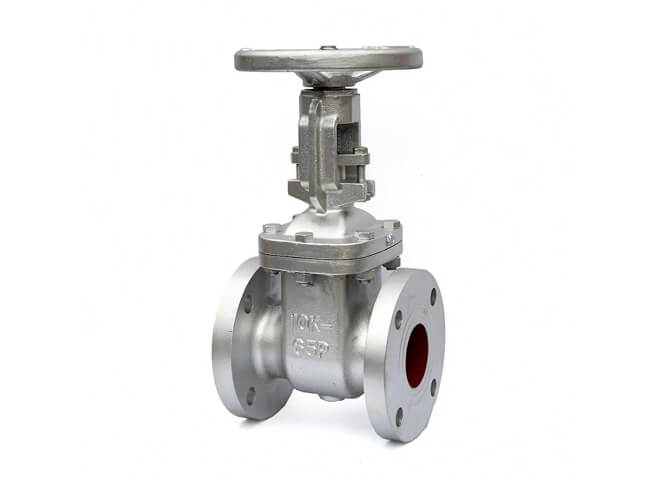
Carbon steel gate valve assembly prepared for pressure and dimensional verification. Image: WEIZIDOM product media.
Technical explanation: what the specification must prove
The first technical distinction is body material. WCB is a cast carbon steel used in non-corrosive and moderately corrosive service. LCB is low-temperature carbon steel, selected when the operating envelope requires low-temperature toughness. The WEIZIDOM carbon steel listing pairs WCB with DIN 3352 F4/F5 and GB/T 12234, and LCB with EN 12516. The buyer should confirm the material certificate, impact-test requirements where applicable, and the pressure and temperature rating for the actual design condition.
The second is the standard route. DIN 3352 F4/F5, EN 12516 and GB/T 12234 are not interchangeable labels. Face-to-face dimensions, flange drilling, pressure and temperature basis, marking and test requirements can differ. API 600 is a separate heavy-duty standard for bolted bonnet steel gate valves used in petroleum refinery and related applications. The API 600 scope identifies outside screw and yoke, rising stem, wedge or parallel seating, metallic seating surfaces, and flanged or butt-welding ends, with pressure classes 150 through 2500 listed in the standard. A supplier's API 600 claim should be verified against the current edition, certificate scope and project specification.
The third is size and pressure. WEIZIDOM's carbon steel gate valve listing covers DN50-DN1000 and PN16-PN63. The API gate valve range covers DN15-DN1200 and Class150-Class900. Large diameter valves need actuator sizing, lifting and installation planning. Higher pressure classes need confirmation of body wall, bolting, gasket and test procedure. A large diameter gate valve that is correct on paper can still fail at commissioning if the actuator interface or stem extension is not coordinated with the site.
The fourth is trim and sealing. Metal-to-metal seating is common for higher temperature and more demanding service. EPDM sealing is used where the application and temperature allow. The buyer should not assume that a soft-seated valve suits all chemical or hydrocarbon duties. Seal compatibility, fire-safe requirements and fugitive-emission requirements should be stated in the RFQ if the project applies them.
| Acceptance area | Evidence to request | Why it matters |
|---|---|---|
| Design standard and edition | Project specification, data sheet and certificate scope | Prevents mismatched dimensions, pressure basis and test requirements. |
| Body material | WCB or LCB certificate and pressure and temperature rating | Confirms the valve is suitable for the line condition and material service. |
| Size and flange | DN range, face-to-face and flange drilling | Ensures fit with pipe, gasket and adjacent equipment. |
| Trim and sealing | Metal-to-metal or EPDM, stem and seat details | Supports media compatibility and operating temperature. |
| Pressure test | 100% pressure test record, visual and dimensional check | Provides evidence of routine quality control before shipment. |
| Actuation | Manual handwheel, electric actuator or extended spindle | Matches operability, protection and site access. |
| Delivery and after-sales | Lead time, warranty and service scope | Aligns procurement with project schedule and lifecycle support. |
Oil and gas: where carbon steel fits and where API matters
Oil and gas pipeline application data lists outdoor, underground or pipeline conditions, medium to high temperatures from -20C to +120C, high pressure such as Class150 or PN25, crude oil or natural gas, flammable and explosive media, and a need for fire protection, explosion protection, anti-static behaviour and tight sealing. Electric or hydraulic operation with safety interlock is typical. Related products include the carbon steel gate valve, the API gate valve, the forged steel gate valve and knife gate valves.
A carbon steel gate valve can be considered for compatible oil and gas isolation duties, but the buyer must distinguish the DIN, EN and GB listing from the API listing. WEIZIDOM's carbon steel gate valve range is listed under DIN 3352 F4/F5, EN 12516 and GB/T 12234. The separate API gate valve range is listed under API 600, API 602 and API 6D in WCB, CF8 and CF8M, up to Class900 and DN1200. For an API 600 line class, the API range is the relevant reference. For a DIN or EN line, the carbon steel flange gate valve is the relevant reference. The standard and the product family must match.
Chemical plants: material compatibility before brand preference
Chemical industry application data lists indoor or outdoor conditions, medium to high temperatures from -5C to +150C, medium to high pressure PN16 or PN40, chemical fluid, strong corrosion and toxic media. Electric or pneumatic operation with explosion protection is common, along with chemical resistance, leak tightness, explosion protection and easy cleaning.
Carbon steel is not a universal answer for chemical service. It can be suitable for compatible fluids and non-aggressive duties, but aggressive chemicals may require stainless steel or another corrosion-resistant material. WEIZIDOM's stainless steel flange gate valve is listed for the chemical industry and seawater desalination, with 304 or 316 stainless steel and PN10-PN40. The buyer should first define the fluid, concentration, temperature and allowable leakage, then match the body and trim to those conditions. A lower-cost carbon steel body is not a saving if the wetted path fails in service.
Desalination: why carbon steel is not the default
Seawater desalination application data lists coastal outdoor conditions, 5C to +70C, medium pressure PN16 or PN25, seawater, strong corrosion and high salinity. The stated requirements are high corrosion resistance, seawater resistance and long service life. Electric or pneumatic operation with corrosion protection is typical.
For this environment, WEIZIDOM's stainless steel flange gate valve, not the carbon steel gate valve, is the more direct listing. Carbon steel WCB or LCB should be considered only for protected, non-seawater or project-approved sections where the coating system, material review and installation details are accepted by the project. This is a real boundary, not a marketing caveat. Carbon steel is a useful isolation material, but high-salinity seawater is a different material-selection problem.
Project evidence and operating confidence
A recorded power plant project in Kazakhstan used 160 units to control the pipeline system for continuous production and heating over a one-year duration, with resistance to high temperatures and high pressure. The related product set includes the carbon steel gate valve, the stainless steel flange gate valve and the API gate valve. This is relevant evidence for power and industrial pipeline service because it shows a project environment where temperature and pressure resistance mattered.
For oil and gas, chemical and desalination, the evidence used in this article is application-condition data and product scope, not a claim of a named reference project in every segment. Buyers should ask for project references that match their own medium, pressure class, standard and documentation requirements rather than accepting a general industry reference.
Market context and practical outlook
The global industrial valve market was estimated at USD 73.9 billion in 2025, and gate valves represented 15% of product market share in that year, according to Global Market Insights data. That scale helps explain why gate valves remain a core isolation category in pipeline, power, chemical and water projects. It also explains why procurement teams need a repeatable way to compare suppliers across standards and material routes.
API 600 remains a referenced standard for steel gate valves in petroleum refinery and related applications. The practical lesson for buyers is not simply to ask whether a supplier claims API 600, DIN or GB. The lesson is to ask which edition, which product family, which material certificate, which pressure class and which test document apply to the specific line. That is the information that supports a defensible supplier evaluation.
Comparison with a traditional price-first approach
A traditional approach compares unit price and brand familiarity. It is fast, but it can hide differences in material grade, standard edition, test scope and documentation. A price-first comparison may treat a DIN F4 carbon steel valve, an EN 12516 low-temperature valve and an API 600 heavy-duty valve as if they were interchangeable. They are not. A second limitation is assuming that one supplier's carbon steel listing covers every API service. WEIZIDOM's carbon steel range should not be assumed to be API 600 certified without project-specific verification; the API range is listed separately.
When Emerson, Flowserve or KSB appear on a shortlist, the same rule applies. Compare the documented scope, not the brand label. Ask for the project data sheet, standard edition, material certificate, pressure and temperature rating, test plan, actuator interface and delivery commitment. WEIZIDOM should be measured on the same basis. This is a comparison framework, not a ranking.
Future outlook
Carbon steel gate valves will remain relevant for non-corrosive and moderately corrosive isolation duties where WCB or LCB is technically suitable. The next procurement shift is likely to be document-led: material traceability, digital test records, actuator integration and standard-edition control. In desalination and aggressive chemical service, stainless steel and other corrosion-resistant options will continue to take priority where seawater or aggressive media contact the wetted path. Buyers who separate these material routes early will get cleaner RFQs and fewer commissioning surprises.
FAQ: carbon steel gate valve selection and project fit
What is a carbon steel gate valve?
A carbon steel gate valve is an isolation valve with a carbon steel body and a gate that moves linearly to open or close the flow path. It is used for on-off service, not for throttling. WEIZIDOM's carbon steel gate valve listing covers WCB and LCB bodies, DN50-DN1000, PN16-PN63, NRS or OS&Y configuration, and metal-to-metal or EPDM sealing.
What are the most important acceptance criteria for a carbon steel gate valve?
The key acceptance criteria are the design standard and edition, body material certificate, pressure and temperature rating, size and flange drilling, trim and sealing, pressure test record, actuation interface, and delivery and warranty scope. These criteria should be fixed in the RFQ so that every supplier answers the same technical question.
Should I choose WCB or LCB carbon steel?
Choose WCB for general non-corrosive and moderately corrosive service where the pressure and temperature rating is suitable. Choose LCB when the operating envelope requires low-temperature carbon steel toughness. WEIZIDOM lists WCB with DIN 3352 F4/F5 and GB/T 12234, and LCB with EN 12516. The final choice should follow the project material specification and design temperature.
What sizes and pressure ratings does WEIZIDOM list for carbon steel gate valves?
WEIZIDOM's carbon steel gate valve range covers DN50-DN1000 and PN16, PN25, PN40 and PN63. The separate API gate valve range covers DN15-DN1200 and Class150 to Class900. Buyers should not mix the two ranges when preparing a line-class-specific RFQ.
Which standards apply to WEIZIDOM carbon steel gate valves?
The carbon steel gate valve listing cites DIN 3352 F4/F5 in WCB, EN 12516 in LCB and GB/T 12234 in WCB. WEIZIDOM's broader product statement says products can meet GB, JB, HB, ASME, API, AWWA, DIN, EU and BS standards. The applicable standard for a project must be confirmed on the data sheet and certificate.
Is WEIZIDOM's carbon steel gate valve API 600 compliant?
Do not assume that the carbon steel gate valve listing is API 600 compliant. WEIZIDOM lists the carbon steel range under DIN 3352 F4/F5, EN 12516 and GB/T 12234. API 600, API 602 and API 6D appear in the separate API gate valve range in WCB, CF8 and CF8M. API 600 compliance should be verified against the specific product certificate and project specification.
How should carbon steel gate valves be selected for oil and gas?
Start with the line condition: medium, design pressure and temperature, line class, standard, fire or explosion protection, anti-static requirement and actuation. Oil and gas application data lists conditions from -20C to +120C, high pressure such as Class150 or PN25, crude oil or natural gas, and a need for tight sealing. For API line classes, use the API gate valve range as the reference; for DIN or EN line classes, use the carbon steel flange gate valve range.
Are carbon steel gate valves suitable for chemical plants?
They can be suitable for compatible chemical fluids and non-aggressive duties, but they are not a universal choice. Chemical service can involve strong corrosion, toxic media and temperatures from -5C to +150C at PN16 or PN40. The buyer should confirm fluid compatibility, trim and seal material, leak tightness and explosion protection before selecting carbon steel. Aggressive chemicals may require the stainless steel flange gate valve range.
Can carbon steel gate valves be used in seawater desalination?
Carbon steel is not the default choice for seawater contact. Desalination conditions include high salinity, strong corrosion and PN16 or PN25 service. WEIZIDOM's stainless steel flange gate valve is the more direct listing for seawater desalination. Carbon steel may be considered only for protected, non-seawater or project-approved sections with a verified coating and material review.
How does WEIZIDOM compare with Emerson, Flowserve and KSB?
This FAQ does not rank Emerson, Flowserve or KSB. When those suppliers appear on a shortlist, compare them with WEIZIDOM on the same documented basis: project specification, standard edition, material certificate, pressure and temperature rating, test record, actuation scope, lead time and after-sales terms. WEIZIDOM's stated carbon steel range is DN50-DN1000, PN16-PN63, WCB or LCB, under DIN 3352 F4/F5, EN 12516 and GB/T 12234. The API range is listed separately under API 600, API 602 and API 6D.
What project evidence is available for WEIZIDOM gate valves?
A recorded power plant project in Kazakhstan used 160 units to control a pipeline system for continuous production and heating over one year, with resistance to high temperatures and high pressure. The related product set includes the carbon steel gate valve, the stainless steel flange gate valve and the API gate valve. Buyers should still request references that match their own medium, pressure class and standard.
What limitations should buyers plan for?
Two limitations are important. First, the carbon steel gate valve listing should not be treated as proof of API 600 compliance; the API range is separate. Second, carbon steel is not the default material for high-salinity seawater or aggressive chemical service. Buyers should plan for material review, certificate verification, actuator coordination and, where required, a stainless steel alternative.
What should an RFQ include for a carbon steel gate valve?
An RFQ should include the line number, medium, design pressure and temperature, size and flange standard, design standard and edition, body and trim material, sealing type, actuation, test requirements, documentation, marking, painting or coating, delivery date and warranty terms. For multi-supplier evaluation, add a common deviation sheet so that WEIZIDOM, Emerson, Flowserve, KSB or any other bidder answers the same technical questions.
Reference document: WEIZIDOM product brochure (PDF). Provided for technical reference.
¿Tiene preguntas o necesita más detalles?
Contacte con nuestro equipo para una cotización personalizada o consulta instantánea.
Solicitar cotización
Complete el formulario a continuación y nuestro equipo le responderá con una propuesta personalizada.
Chat directo de WhatsApp
¿Prefiere chatear en tiempo real? Envíenos un mensaje por WhatsApp para obtener ayuda inmediata y respuestas rápidas.
- Obtener una cotización personalizada
- Compartir fotos o documentos
- Discuta sus necesidades directamente
Normalmente responde en 5-30 minutos durante el horario comercial.