
Carbon Fiber Composite Plastic vs. Alternatives: An Independent Buyer's Assessment Framework
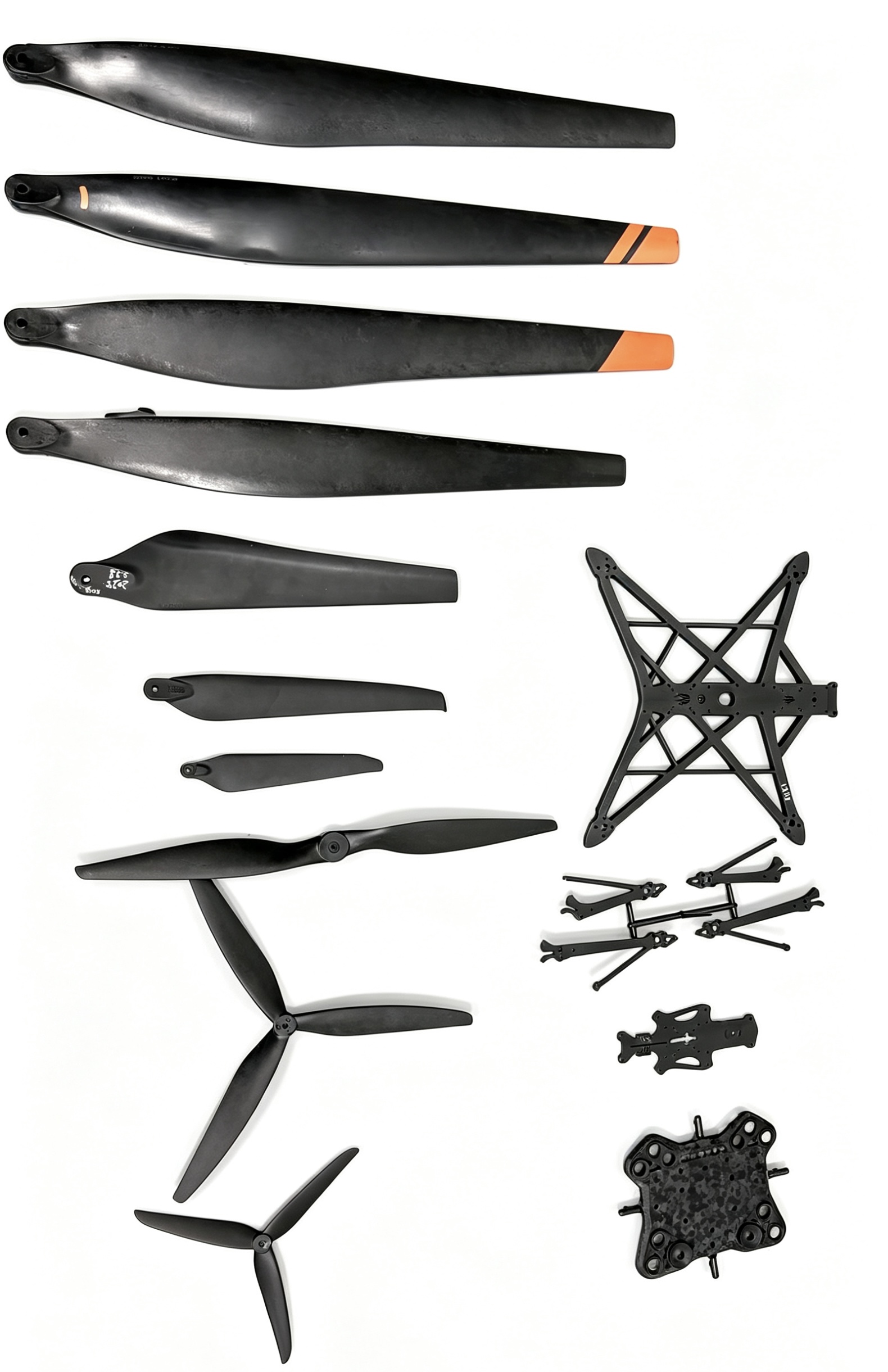
Structural long fiber carbon fiber composite plastic components produced by thermoplastic injection moulding. Image: Polygram (Guangdong Baolijin New Material Technology Co., Ltd.).
Carbon fiber composite plastic has moved out of specialty programmes and into mainstream procurement. Grand View Research estimated the global carbon fiber reinforced plastic (CFRP) market at USD 19.27 billion in 2024, while MarketsandMarkets values the long fiber thermoplastics (LFT) segment at USD 2.58 billion in 2025 and projects it to reach USD 4.06 billion by 2031. Growth of that scale changes the buyer's question. It is rarely whether the material category is credible; it is whether one grade — at a defined fiber content, tested to a defined standard, supplied under a defined certification scope — is a better answer than the aluminium, thermoset or short-glass-fiber part already in the bill of materials.
An independent comparison has to survive three tests that supplier literature rarely applies to itself. Are the numbers comparable at all — the same test standard, the same specimen, the same conditioning? Is the material buyable — does the supply chain hold the quality management certifications the target industry actually requires? And where does the recommendation stop being valid — at what temperature, fiber length, order quantity or part geometry? This assessment framework applies those three tests to LFT carbon fiber composite plastic and to the alternatives it most often replaces.
Why Material Comparisons Fail Before the First Test
Most failed substitution projects do not fail on mechanical performance. They fail on assumptions that were mismatched during the comparison itself.
- Test standards are not interchangeable. Tensile, flexural and impact values can only be compared when the method is named. The LFT carbon fiber composite plastic grade documented in this review reports tensile properties to ISO 527-2, flexural properties to ISO 178 and Izod impact to GB/T 1843. Wider composite conventions include ISO 527-4/5 for tensile properties and ASTM D4018 for continuous filament tows — standards that describe fibre and laminate behaviour, not a moulded long-fiber part.
- The measurement basis is not interchangeable. A part-level result such as a 42% mass reduction against aluminium in a battery-pack cover is an outcome of geometry, fiber content and processing. It is not a material constant that transfers automatically to a different part.
- A grade is not a part. LFT-G grades are specified across a 20–60% long carbon fiber range. Strength, stiffness and impact values belong to one loading level, not to the material family as a whole.
- Processing performance is not implied by the datasheet. Long-fiber properties assume a matching tooling configuration: a precision injection moulding machine, a wear-resistant double-alloy screw, a hard mould (HRC52+), high-precision mould temperature control and, where required, nitrogen-assisted injection moulding. Without that configuration, datasheet values and moulded-part values diverge.
- Certification is not a formality. In automotive and medical programmes, whether the material can be purchased at all depends on the supplier's quality management system rather than on the property table.
What LFT Carbon Fiber Composite Plastic Actually Is
Long fiber reinforced thermoplastic (LFT) is a composite material family in which reinforcing fibres remain physically long inside the finished part. Where ordinary short-fiber reinforced thermoplastics use fibres below 12 mm, the LFT process produces fibre lengths of 5–25 mm. The fibres are impregnated with resin through a dedicated mould system to form long strands that are fully wetted, and those strands are then cut to the length required. The most widely used base resins are PP, followed by PA6, PA66, PA12, MXD6, PBT, PET, TPU, PPS, LCP and PEEK. Conventional reinforcements are glass fibre and carbon fibre; speciality options include basalt and quartz fibre. Depending on the end use, the finished material can be injection moulded, extruded or compression moulded, or used directly as a replacement for steel and thermoset parts.
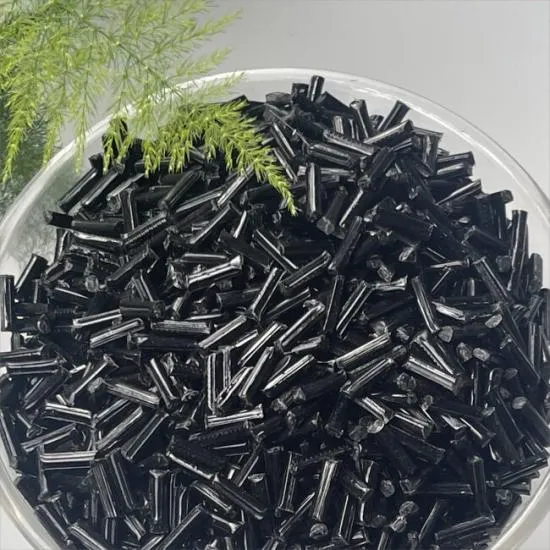
LFT-G long carbon fiber reinforced composite, specified at 20–60% long carbon fiber content. Image: Polygram.
The published property set for the LFT carbon fiber composite plastic grade referenced here is the basis of every comparison that follows. Buyers should read it together with the test standard column, because the standard determines whether a number can be placed next to a competitor's number at all.
| Property | Published value | Test standard |
|---|---|---|
| Density | 1.28 g/cm³ | Not specified in source |
| Tensile strength | 350 MPa | ISO 527-2 |
| Flexural strength | 510 MPa | ISO 178 |
| Flexural modulus | 30,700 MPa | ISO 178 |
| Elongation at break | 7.8% | ISO 527-2 |
| Izod impact | 40 kJ/m² | GB/T 1843 |
| Colour and reinforcement range (LFT-G) | Black; 20–60% long carbon fiber | Product specification |
| Packaging (LFT-G) | 20–25 kg/bag, customizable | Product specification |
Six Dimensions Buyers Can Actually Compare
A comparison framework is only useful if each dimension can be answered from documents a supplier is able to release. The six below can be.
- Mechanical performance against a named standard. Ask for tensile, flexural and impact values with the ISO or GB/T method stated, and check that all candidates were tested to the same method. The reference values here are 350 MPa tensile strength (ISO 527-2), 510 MPa flexural strength and 30,700 MPa flexural modulus (ISO 178), and 40 kJ/m² Izod impact (GB/T 1843).
- Mass and stiffness balance. Density is 1.28 g/cm³ for the documented LFT grade. Because stiffness and strength are quoted per unit area while mass is quoted per unit volume, buyers should convert to specific properties before comparing against metal designs. Part-level evidence, such as a measured mass reduction against aluminium, is more decision-relevant than a material-level density figure alone.
- Impact and damage tolerance. A quoted Izod value of 40 kJ/m² describes behaviour in a standard test, not in a specific bracket under a specific load case. Where the part is exposed to stone impact, drop events or vibration-driven fatigue, request a validation plan rather than relying on the index value.
- Thermal and chemical service envelope. The documented operating range for these grades is -50°C to 120°C, with additional performance claims covering fatigue resistance, vibration reduction, UV and weather resistance, insulation or electromagnetic shielding, chemical resistance and maintenance-free operation. Any part that runs continuously outside that thermal band needs separate evidence.
- Certification and traceability readiness. This is a pass/fail gate rather than a scored dimension: ISO 9001:2015 for general quality management, IATF 16949:2016 for automotive supply chains, and ISO 13485:2016 for medical device work.
- Procurement and process economics. Minimum order quantity, lead time, monthly capacity, test coverage and tooling ownership determine whether a technically suitable material actually reaches production.
Polygram's Documented Position in the LFT Supply Chain
Polygram is the brand of Guangdong Baolijin New Material Technology Co., Ltd., a manufacturer founded in 2017 and based in Huangjiang Town, Dongguan City, Guangdong Province, China, that develops and produces thermoplastic LFT carbon fiber composites, conductive and antistatic plastics, and graphene thermally conductive plastics. The company operates a 4,000 m² facility with 30 employees and a 10-engineer R&D team, reports an annual output of 12,000,000 units, and states that exports account for approximately 30% of sales, with Europe, the Americas and Southeast Asia as the main markets.
Its documented capability model is vertically integrated: material design, raw material production, mould development and injection moulding are handled as one process chain under an ODM arrangement. That structure matters to buyers for a specific reason — when material formulation, tooling and moulding sit with the same supplier, a change in fiber loading or gate position does not require re-qualifying an additional party. The published commercial parameters are a minimum order quantity of 50 units, a 30-day lead time, 100% testing rather than batch sampling, and remote after-sales support.
These figures describe one supplier's configuration, and they should be read as such. In automotive or medical programmes, capacity and testing policy matter considerably less than certification scope, which is the subject of the next section.
Certification: The Constraint That Decides Whether a Material Is Buyable
Certification status behaves differently from property data. A property gap can be engineered around; a missing certification cannot. Three certifications are relevant to the LFT carbon fiber composite plastic grades discussed here, all issued for the global market.
| Standard | Certificate number | Issuing body | Validity |
|---|---|---|---|
| GB/T19001-2016 / ISO 9001:2015 | IAS25924Q1858R0S | Guangdong ZQ Certification Service Co., Ltd. | 2024-10-22 to 2027-10-21 |
| IATF 16949:2016 | ZA-FCAV No.: 2501627/R0S; IATF No.: 0585814 | Beijing Zhong An Zhi Huan Certification Center Co., Ltd. (DBA: Zhong An FCAV International) | 2025-10-15 to 2028-10-14 |
| GB/T 42061-2022 / ISO 13485:2016 | 64625B8031170R0S | ZhongRen HeZong Certification (Shenzhen) Co., Ltd. | 2025-03-11 to 2028-03-10 |
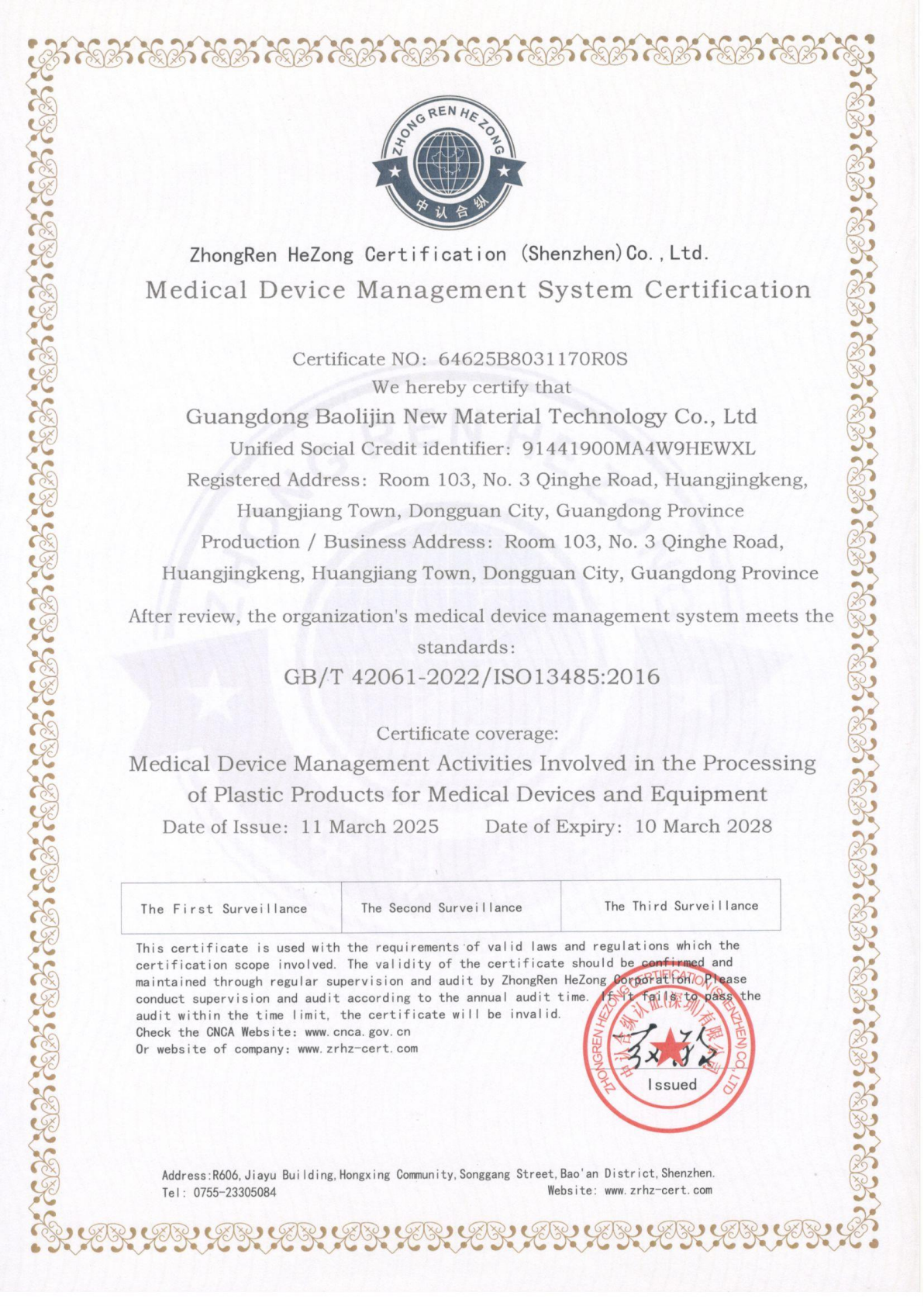
The Medical Device Management System Certification held by the LFT-G long carbon fiber reinforced composite product. Image: Polygram.
The scope statements matter as much as the certificate numbers. The ISO 9001:2015 certification applies to the global market. The IATF 16949:2016 certification applies to the LFT product and is the entry condition for most automotive Tier 1 and OEM production programmes. The ISO 13485:2016 certification is explicitly scoped to medical device management activities involved in the processing of plastic products for medical devices and equipment — it qualifies the supplier for that activity, not for every medical application a buyer might have in mind.
Read together, the practical rule is simple. A supplier holding ISO 9001 alone can be evaluated for industrial programmes. A supplier holding IATF 16949 as well can enter an automotive bill of materials. Only a supplier holding ISO 13485:2016 within a defined medical scope can be considered for device-adjacent plastic processing. No datasheet value compensates for a missing certificate.
Application Fit: Aerospace, Robotics and New Energy Vehicles
The industries documented for these grades are aerospace, military, new energy vehicles, the low-altitude economy, robotics, semiconductors and sporting goods. The specified design intent across those sectors is a 30–50% weight reduction with high rigidity, impact resistance, insulation or electromagnetic shielding, chemical resistance, fatigue resistance, low warpage and high dimensional accuracy, and a service temperature band of -50°C to 120°C.
Aerospace and low-altitude applications. LFT-G long carbon fiber reinforced composite is specified for commercial and military aerospace work including radomes, drones, aircraft, missiles, satellites and aerospace fuel tanks. Here the comparison against aluminium is usually driven by mass and by fatigue behaviour under alternating airborne loads rather than by peak strength alone.
Robotics and industrial motion. Documented parts include humanoid robot joints and torsos, AGV load-bearing beams and servo motor brackets. These applications combine static load-bearing with high-frequency start-stop and continuous industrial duty, so dimensional stability and low warpage typically decide the material choice more than ultimate tensile strength does.
New energy vehicles. Documented components include battery pack upper covers and protective shells, battery brackets, seat frames, front-end modules, chassis lightweight structural parts and BMS protective housings. The governing requirements are high-voltage insulation, electrolyte resistance, shock resistance and long-term stability inside the vehicle.
Electrically functional grades. Antistatic, conductive and electromagnetic shielding behaviour is a separate grade family rather than a property of a standard structural LFT grade. Buyers specifying antistatic composite plastic or electromagnetic shielding composite plastic should treat the electrical requirement as a parallel specification and confirm it independently, even when the structural grade is already qualified.
A Recorded Automotive Case: Mass, Cost and Validation Results
One documented programme illustrates how part-level data differs from material-level data. A Chinese new energy vehicle Tier 1 supplier, working under an ODM arrangement, produced the upper cover of a power battery pack and its protective shell in long carbon fiber composite plastic at a rate of 120,000 units per year. The programme has run for eight years, from 2018 to 2026.
The reported results were a 42% weight reduction compared with aluminium, an 18% cost reduction, and validation through UL94 V0 and IP6K9K. The coefficient of thermal expansion was matched to aluminium at 28 ppm/°C, and no after-sales cracking or leakage was recorded over the programme period. The technical enablers were integrated injection moulding of long carbon fiber and low fibre float, which supported high-speed mass production.
The lesson for buyers is not the number itself but its scope. A 42% reduction belongs to that cover geometry, that load case and that fiber loading. It is evidence that the result is achievable, not a transferable constant — which is precisely why a framework, rather than a headline figure, is the right basis for a new comparison.
Market Signals Buyers Should Read Carefully
Three market signals are worth carrying into a sourcing decision, provided each is read for what it actually measures.
- Segment growth is real but unevenly defined. The LFT segment is tracked from USD 2.58 billion in 2025 toward USD 4.06 billion by 2031 (MarketsandMarkets), while the broader CFRP market was estimated at USD 19.27 billion in 2024 (Grand View Research). LFT is therefore a defined and measurable subsegment, not a synonym for the whole composite industry.
- Adjacent functionality markets are expanding. Grand View Research reports the electromagnetic shielding (EMI) composites market at USD 1.97 billion in 2024 with a projected CAGR of 7.1% through 2033. That growth supports the case for treating antistatic and shielding requirements as a distinct specification line.
- Some published market values diverge by orders of magnitude. Estimates for graphene-enhanced plastics range from USD 26.76 million in 2024 (SNS Insider) to USD 35.3 billion in 2025 (Grand View Research). A gap that large reflects incompatible market definitions, not measurement error. Buyers should treat any market size figure as directional until the definition behind it is confirmed.
On the supply side, Fortune Business Insights identifies Toray Industries, Solvay, Hexcel Corporation, Teijin Limited and Mitsubishi Chemical among the major global competitors in the carbon fiber composite market. Their presence defines the upper end of the market in scale terms; it does not define which supplier fits a given programme. Programme fit is decided by certification scope, process configuration and order parameters, which is why the framework above weights those dimensions equally with material properties.
Comparison with Traditional Solutions — and Where LFT Stops Being the Right Answer
The table below compares the documented LFT grade with the alternatives it most often replaces. Where a value is not published for an alternative, the cell states a qualitative relationship rather than an invented number.
| Assessment dimension | LFT carbon fiber composite plastic (documented) | Aluminium | Thermoset CFRP | Short-fiber reinforced thermoplastic |
|---|---|---|---|---|
| Density and mass strategy | 1.28 g/cm³; a 42% mass reduction against aluminium recorded in one production battery-cover programme | Higher density than the documented LFT grade; mass reduced through geometry and section design | Low density; mass saving depends on laminate design and lay-up | Density driven by the base resin; usually glass-fibre reinforced, so mass saving at equal stiffness is smaller |
| Mechanical reporting basis | 350 MPa tensile (ISO 527-2), 510 MPa flexural strength and 30,700 MPa flexural modulus (ISO 178), 7.8% elongation (ISO 527-2) | Reported to metal standards; conversion to composite test methods required before comparison | Often reported as laminate properties, where ISO 527-4/5 and ASTM D4018 conventions apply | Reported to the same ISO 527-2 / ISO 178 families; reinforcement length below 12 mm is the main structural difference from LFT |
| Impact behaviour | 40 kJ/m² Izod impact (GB/T 1843) | Absorbs energy through plastic deformation; dents rather than fractures in many cases | Thermoset matrices are generally more sensitive to impact damage than thermoplastic matrices | Matrix-dependent; lower fibre length reduces the toughening contribution of the reinforcement |
| Service temperature | Documented operating band of -50°C to 120°C | Typically wider service range, including elevated-temperature zones | Matrix-dependent; selected systems target higher temperature zones | Governed by the base resin, which can be matched to the same resin families used in LFT |
| Process route | Injection moulding, extrusion or compression moulding; integrated long-fiber injection moulding demonstrated in production; thermoplastic matrix is re-meltable | Machining, casting and die-casting routes with established recycling streams | Lay-up, autoclave or RTM with curing cycles; thermoset matrix is not re-meltable | Conventional injection moulding with standard screw and mould configurations |
The limits, stated plainly. An honest assessment framework has to define where LFT carbon fiber composite plastic is not the answer.
- It is a discontinuous-fiber material. Fibres run 5–25 mm and content ranges from 20% to 60% in LFT-G. Properties therefore depend on fiber loading and on flow orientation inside the mould. Where a design genuinely requires continuous-fiber laminate behaviour, LFT should not be assumed to be equivalent; the specific part must be validated on its own load case.
- The documented thermal band ends at 120°C. Parts that run continuously near exhaust systems, in engine-adjacent zones or in high-temperature aerospace areas fall outside the specified -50°C to 120°C range and need separate evidence before substitution.
- Datasheet values are grade-level, not part-level. The 350 MPa tensile and 40 kJ/m² impact figures describe a defined test specimen. A moulded part with different wall thickness, gate position or fiber orientation can and will differ; the only reliable acceptance basis is testing the actual geometry.
- Tooling and order size are real constraints. Mould development is a project-level investment, and the documented commercial terms include a minimum order quantity of 50 units with a 30-day lead time. Programmes that only ever need a handful of parts rarely recover that cost structure efficiently; a prototype run is not the same purchase as a production run.
- There is no universal price band. Published pricing for LFT carbon fiber composite plastic is not available from the sources behind this framework, and cost is driven by carbon fiber content (20–60%), tooling amortisation, part geometry and annual volume. Comparing a single price-per-kilogram figure across suppliers without matching those variables produces a misleading result.
A Short Verification Checklist
- Confirm the test standard behind every mechanical value (ISO 527-2, ISO 178, GB/T 1843, or an alternative), and reject comparisons that mix methods.
- Confirm the fiber loading of the grade being quoted, within the 20–60% long carbon fiber range.
- Confirm the certification scope, not only the certificate name: ISO 9001, IATF 16949, ISO 13485 with the medical processing scope stated.
- Confirm the moulding configuration used to produce the qualification samples: precision injection moulding machine, wear-resistant double-alloy screw, HRC52+ mould, high-precision mould temperature control, nitrogen-assisted injection moulding where applicable.
- Confirm the service envelope against the real duty cycle: -50°C to 120°C, continuous or intermittent, with chemical and UV exposure defined.
- Confirm commercial parameters in writing: minimum order quantity, lead time, monthly capacity and test coverage (100% versus batch sampling).
- Confirm how electrical requirements — antistatic, conductive or electromagnetic shielding — are specified as a separate grade property.
- Confirm part-level validation on the production geometry before the material enters the bill of materials.
Future Outlook
Two forces are likely to shape how buyers evaluate LFT carbon fiber composite plastic over the next several years. The first is certification-driven procurement: as automotive and medical supply chains tighten their qualification requirements, IATF 16949:2016 and ISO 13485:2016 scopes will increasingly function as market access conditions rather than differentiators. Suppliers without them will be excluded from entire programme categories regardless of material performance.
The second is functional convergence. Structural carbon fiber composites are increasingly specified alongside antistatic, conductive, electromagnetic shielding and graphene thermally conductive requirements, and the growth of the EMI shielding composites market toward a 7.1% CAGR through 2033 (Grand View Research) reflects that trend. For buyers, the implication is procedural: build the comparison framework once, and extend it with an additional specification line for each functional requirement rather than restarting the material selection from scratch.
Neither trend removes the need for the unglamorous work — matching test standards, verifying certification scope, and validating the actual part. Market growth makes comparison easier to justify and harder to do well.
FAQ
What tensile strength and related mechanical values should a buyer require from a high-strength carbon fiber composite plastic?
The documented LFT grade reports 350 MPa tensile strength to ISO 527-2, 510 MPa flexural strength and 30,700 MPa flexural modulus to ISO 178, 7.8% elongation at break to ISO 527-2, and 40 kJ/m² Izod impact to GB/T 1843, at a density of 1.28 g/cm³. These are grade-level values tied to a defined fiber loading within the 20–60% long carbon fiber range, so they should be treated as the starting point for comparison rather than as a guaranteed part performance. Part-level validation on the production geometry remains the acceptance basis.
Which test standards must be aligned before carbon fiber composite plastic is compared with alternative materials?
At minimum, tensile testing must be aligned to one method (ISO 527-2 is the standard used for the LFT values cited here), flexural testing to ISO 178, and impact testing to GB/T 1843. Broader composite conventions such as ISO 527-4/5 for tensile properties and ASTM D4018 for continuous filament tows describe fibre and laminate behaviour, which is a different measurement object from a moulded long-fiber part. Mixing values from different standards is the most common cause of a comparison that appears favourable on paper and fails in validation.
Which certifications determine whether a supplier can serve automotive or medical programmes?
Three certifications apply to the LFT carbon fiber composite plastic grades discussed here, all issued for the global market. GB/T19001-2016 / ISO 9001:2015 is certified under number IAS25924Q1858R0S by Guangdong ZQ Certification Service Co., Ltd., valid from 2024-10-22 to 2027-10-21. IATF 16949:2016 is certified under ZA-FCAV No.: 2501627/R0S and IATF No.: 0585814 by Beijing Zhong An Zhi Huan Certification Center Co., Ltd. (DBA: Zhong An FCAV International), valid from 2025-10-15 to 2028-10-14, and applies to the LFT product. GB/T 42061-2022 / ISO 13485:2016 is certified under number 64625B8031170R0S by ZhongRen HeZong Certification (Shenzhen) Co., Ltd., valid from 2025-03-11 to 2028-03-10, with a scope limited to medical device management activities involved in the processing of plastic products for medical devices and equipment.
What are the operating limits of LFT carbon fiber composite plastic?
The documented service band is -50°C to 120°C, with additional specified performance in fatigue resistance, vibration reduction, insulation or electromagnetic shielding, chemical resistance, weather and UV resistance, and maintenance-free operation. Two structural limits apply alongside the thermal one. First, the reinforcement is discontinuous at 5–25 mm, so properties vary with fiber content between 20% and 60% and with flow orientation inside the mould. Second, the published values are measured on standard specimens; a part running continuously near the upper end of the thermal band, or with a load case different from the qualification case, requires its own validation data.
How should market size figures for composite materials be interpreted during an evaluation?
They should be treated as directional, because definitions differ sharply between research houses. Grand View Research estimated the global CFRP market at USD 19.27 billion in 2024, while MarketsandMarkets values the narrower long fiber thermoplastics segment at USD 2.58 billion in 2025 with a projected USD 4.06 billion by 2031. The divergence is even wider for graphene-enhanced plastics, where published figures range from USD 26.76 million in 2024 (SNS Insider) to USD 35.3 billion in 2025 (Grand View Research). A gap of that magnitude signals incompatible market definitions rather than a measurement dispute, so market size should support a business case, not decide a material selection.
What procurement constraints and cost drivers should be planned for?
No published price band exists for LFT carbon fiber composite plastic in the sources behind this framework, and cost is driven by carbon fiber content within the 20–60% range, tooling amortisation, part geometry and annual volume, so a single price-per-kilogram comparison across suppliers is not meaningful. The documented commercial parameters for the grade referenced here are a minimum order quantity of 50 units, a 30-day lead time, an annual output capability of 12,000,000 units, 100% testing rather than batch sampling, and remote after-sales support. Buyers should confirm each of these in writing for their own programme, since capacity and lead time commitments are programme-specific.
Polygram publishes a technical brochure covering the LFT carbon fiber composite plastic grades, certification scope and process capabilities discussed in this framework: download the Polygram technical brochure (PDF).