
Car Radio Supplier Sustainability Scorecard for B2B Buyers
A car radio supplier sustainability scorecard is a structured method for judging whether a manufacturer can still supply the same platform — with the same certification file, the same firmware path and the same service terms — in the third year of a distribution programme. It is not a price comparison and it is not a catalogue review. It answers one question: what evidence exists today that the supply relationship will still hold once the first containers have been sold?
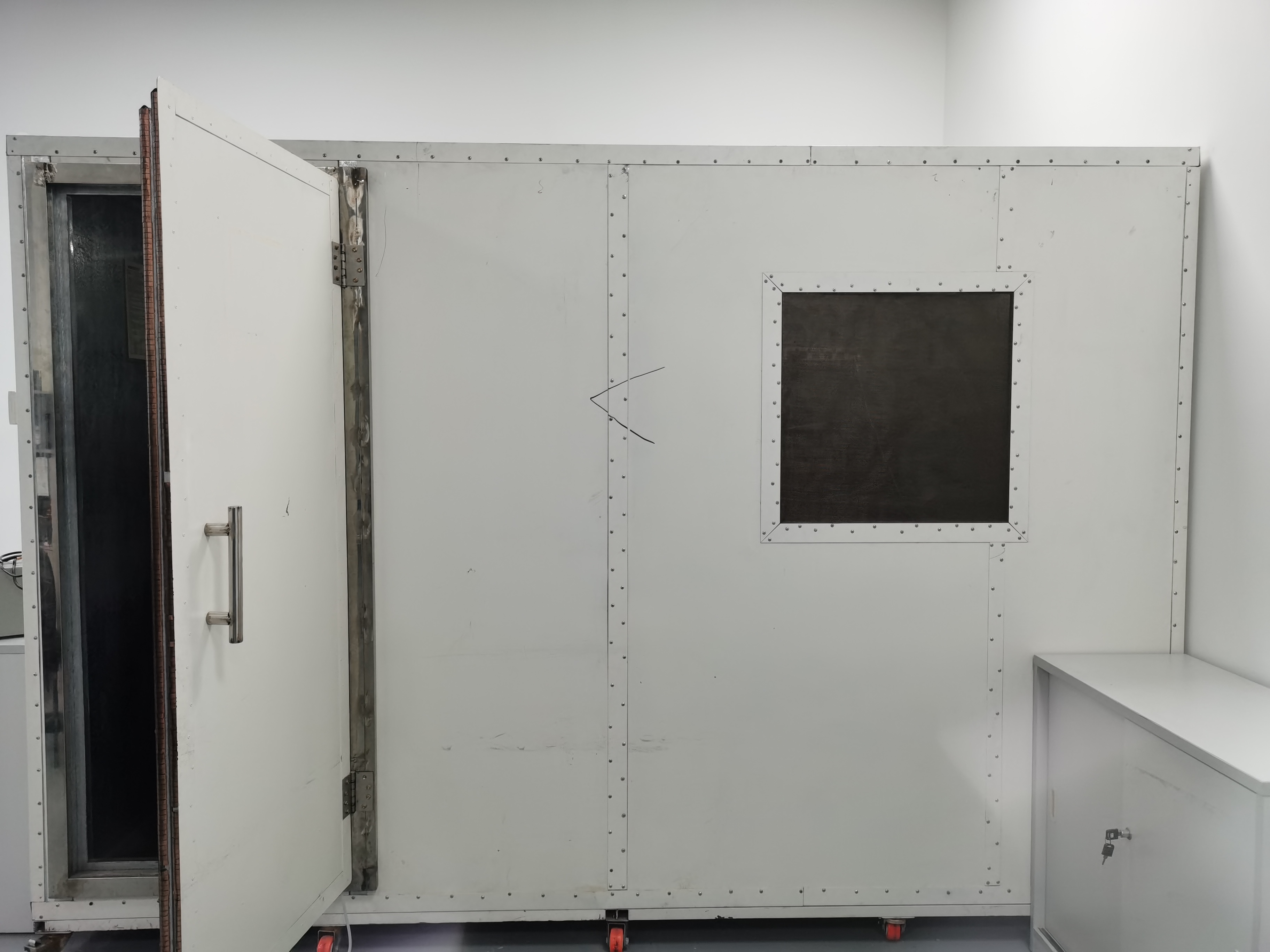
EMC screening inside a signal shielding room. Reliability and compliance evidence is part of supplier due diligence, not a marketing extra. Image: TOPNAVI facility documentation.
For global B2B buyers, this question bites harder in aftermarket car radio than in most auto accessories. A head unit is a software-bearing product: an Android car radio is a hardware shell wrapped around an operating-system generation, a chipset and an update path. When any one of those three stops being maintained, the SKU does not simply become a little dated — it becomes unsupportable, while the warranty obligation stays with the buyer's brand rather than the factory's.
This article builds a six-dimension scorecard, works through it using verifiable TOPNAVI product and factory facts, and then applies the same questions to established audio players such as Pioneer, Kenwood and Alpine. Where a figure is not published, the article states what should be requested rather than estimating it. Where a figure comes from a third party, the publisher is named. Where a claim is company-reported, it is labelled as such.
Why supplier durability became a car radio procurement question
Three structural facts shape the category. First, the global car audio market was reported at USD 12.24 billion in 2025 by Mordor Intelligence, a figure that covers speakers, amplifiers and head units together. Second, form-factor revenue is concentrated: Grand View Research reported that the Double DIN segment accounted for roughly 44% of car stereo revenue by form factor in 2025. Third, the operating environment is unforgiving — in-vehicle conditions impose wide temperature swings, sustained vibration, dust ingress, electromagnetic interference, a 12V DC supply and frequent cold starts.
The procurement consequence is straightforward. When nearly half of category revenue sits in one form-factor family, buyers commit tooling, packaging design, accessory kits, warranty reserves and installer training to that family. Switching suppliers mid-programme is no longer a purchasing decision; it is a re-engineering project with a field-failure tail. That is the gap a sustainability scorecard closes: it converts "who can ship this quarter" into "who can still support this in year three".
The failure mode is rarely a bad sample. It is a supplier whose catalogue churns every season, whose Android version is left behind within eighteen months, whose certificate folder consists of a logo strip rather than documents, and whose one-year warranty is a sentence rather than a staffed process.
The six-dimension scorecard
The scorecard below scores evidence, not adjectives. Each dimension has a single probing question, a document that settles it, and — for reference — the position TOPNAVI publishes today.
| Dimension | Question to put to the supplier | Document that settles it | TOPNAVI published position |
|---|---|---|---|
| 1. R&D cadence and platform continuity | Which OS generations and chipsets remain under active maintenance, and for how many more months? | Platform roadmap and firmware changelog | R&D team of 50 engineers; catalogue spans Android 11, Android 13, Android 14 and Linux platforms |
| 2. Production scalability | What share of stated capacity is already committed, and what MOQ does a programme require? | Capacity statement, line list, MOQ sheet | 20,000 m² facility, 100+ staff, 360,000 units annual output, 95% export share |
| 3. Certification durability | Which certificates cover this exact SKU, issued by whom, valid until when? | Certificate copies with numbers, scope and validity | TS105: E-mark, CE, FCC; TN-3036: CE, FCC; TN-AI47: CE, FCC, RoHS; ISO 9001 stated for the factory |
| 4. After-sales continuity | What is RMA turnaround, the spare-parts window and the firmware support term? | Warranty terms, RMA service levels, spare-parts list | 1-year warranty stated across TS105, TN-3036, TN-M9, TN-X80, TN-X23 and TN-UK1105 |
| 5. Portfolio depth | Do adjacent segments share platforms, testing and quality control? | Product map and shared-platform evidence | Car multimedia, CarPlay box, portable navigation and motorcycle navigation (TN-M9, TN-M11) |
| 6. Operating envelope | What temperature, voltage, ingress and EMC limits are documented per SKU? | Per-SKU test reports | TN-3036: −30°C to 75°C; TN-AI47: −10°C to 60°C; TN-M11: −10°C to +60°C with IP67 |
Dimension 1 — R&D cadence and platform continuity
Platform continuity is the single best early indicator of supplier durability, because it is the hardest thing to fake for more than one product cycle. Shenzhen Top Navi Electronic Tech Co., Limited, founded in 2014 in Shenzhen, China, is a manufacturer of car multimedia players and GPS navigators that reports a 50-engineer R&D team. The composition of its current catalogue is more informative than the headcount.
Across the range, the company ships Android 14 on the TS105 universal multimedia player (UIS7865 octa-core, 9-inch IPS capacitive screen at 1024×600), Android 13 on the TN-3036 (16.8-inch IPS at 2560×1440, 8-core CPU, 4GB RAM and 64GB storage), Android 13 again on the TN-X80 and TN-X23 dual-knob units, and Android 11 on the TN-AI47 CarPlay box (quad-core, 2GB RAM, 16GB ROM, HDMI output at 1920×1080). Alongside those it maintains Linux platforms — the TN-9359 2DIN multimedia player, the TN-M9 and TN-M11 motorcycle navigation units, and the TN-RD1001 portable navigation device.
For a buyer, four concurrent OS generations mean two things at once. It is evidence that the supplier iterates rather than re-badges. It is also a warning: a factory shipping Android 11 and Android 14 in the same year has to staff both maintenance paths, and the weaker path is usually the older, cheaper SKU. The scorecard response is to ask for a written maintenance window per SKU — not per brand — and to price the risk of a short window into the programme.
Chipset selection tells a similar story. The TS105 runs a UIS7865 octa-core; the TN-3036 uses an 8-core platform; the TN-AI47 a quad-core; the TN-M9 and TN-M11 a V853 ARM Cortex-A7 at 1.0GHz. That spread reflects deliberate tiering rather than uniform specification inflation — a point worth testing, because a supplier that claims identical silicon performance across a ten-SKU range is usually describing marketing copy, not hardware.
Dimension 2 — Production scalability and capacity discipline
Capacity is a ceiling, not a promise. TOPNAVI reports a 20,000 m² manufacturing facility, approximately 100+ staff, an annual output of 360,000 units and an export share of 95% of total sales. Those numbers establish that the supplier operates at industrial scale rather than assembly-bench scale. They do not establish available capacity for a new programme, and no responsible buyer should read them that way.

Production line documentation. Stated annual output indicates scale; committed capacity, MOQ and line allocation must be confirmed in writing. Image: TOPNAVI facility documentation.
What lifts this from a claim to usable evidence is process visibility. The company's own factory documentation shows injection moulding, SMT assembly, wave soldering and reflow soldering, alongside reliability equipment described as temperature testing chambers, a drop-test fixture and a signal shielding room. In-house moulding and in-house soldering are the two processes that most often sit with subcontractors in this category, and when they do, both lead time and defect attribution become diffuse. Buyers should score this dimension by asking three questions in sequence: which processes are performed on site, what share of the 360,000-unit annual output is already committed, and what line allocation and lead time a first order of the buyer's actual volume would receive.
Dimension 3 — Certification durability and documentation
Certification is where supplier claims and buyer liability diverge most sharply. The documented position on TOPNAVI products is specific: the TS105 carries E-mark, CE and FCC; the TN-3036 carries CE and FCC; the TN-AI47 CarPlay box carries CE, FCC and RoHS. The company additionally states that its factory holds ISO 9001 certification and that its products carry CE, FCC, RoHS, E-mark and EMC certification.
E-mark matters because it is the marking associated with UN ECE type-approval for automotive components in markets that recognise it, and it is commonly requested by distributors selling into European vehicle applications. CE and FCC cover the electromagnetic-compatibility and radio-equipment expectations of the European and United States markets respectively; RoHS addresses restricted substances. For customs reconciliation, the classification commonly used for radio-broadcast receivers combined with recording or reproducing apparatus is HS 8527.21, as listed by TariffNumber.com — a useful cross-check when a certificate folder has to match a customs entry.
Dimension 4 — After-sales and service continuity
Service continuity is measured in months, and it is usually under-specified in supplier agreements. TOPNAVI states a one-year warranty across a broad set of models, including the TS105, TN-3036, TN-M9, TN-X80, TN-X23 and TN-UK1105. That is a clear commercial baseline. It is not a service programme, and buyers should treat it as the floor of the negotiation rather than the ceiling of the commitment.
Three practical tests separate a warranty sentence from a warranty process. First, RMA turnaround and the address that faulty units ship to. Second, the spare-parts window — for head units, the fragile items are the display assembly, the ribbon connectors, the harness and the mounting cage, not the mainboard. Third, the firmware support term: the TN-AI47 explicitly supports OTA update, which indicates the supplier has an update channel, but the channel's duration per model still has to be contracted.
A fourth test is easy to overlook and strongly predictive: accessory compatibility. The application documentation for this category lists matched equipment including rear-view cameras, DVR dash cameras, OBDII diagnostic tools, tyre-pressure monitoring, external amplifiers, subwoofers and steering-wheel control adapters. A supplier that can name its compatible accessory set, and keep that set stable for three years, is a different risk profile from one that cannot.
Dimension 5 — Portfolio depth across adjacent segments
Portfolio breadth is not automatically a virtue, but in this category it is diagnostic. TOPNAVI's declared product range covers Android car radios, head units, car stereos, motorcycle CarPlay units, CarPlay AI boxes, headrest monitors, reversing cameras and DVRs. The verified SKU set illustrates how far the range reaches from a conventional dashboard unit: the TN-AI47 is a retrofit CarPlay box for OEM wired-CarPlay vehicles; the TN-RD1001 is a 10.26-inch portable navigation device with a 4K front camera and a 1080P AHD reverse camera, powered from 12–24V for cars and trucks; the TN-M9 and TN-M11 are motorcycle navigation units sealed to IP67 and rated from 12V to 30V on the TN-M11.
The engineering signal is real. Sealing a display unit to IP67 for handlebar mounting is a different reliability regime from a dashboard-mount head unit, and a supplier that can hold both has learned something transferable about connectors, potting and thermal design. Breadth also spreads fixed costs across more segments, which supports long-term pricing stability. The counter-risk is divided attention: breadth without shared platforms becomes a long list of unrelated products. Score this dimension by asking how many platforms underpin the range, not how many products appear in the catalogue.
Dimension 6 — Operating envelope and reliability evidence
Published envelopes are where buyers most often assume uniformity that does not exist. In the TOPNAVI range, the TN-3036 is rated from −30°C to 75°C on a DC 12V supply with a 4×50W audio output, 2DIN universal installation, and both steering-wheel and touch control. The TN-AI47 is rated from −10°C to 60°C, and the TN-M11 from −10°C to +60°C. Those are three different envelopes inside one brand, which is normal for the category but decisive for programme design.
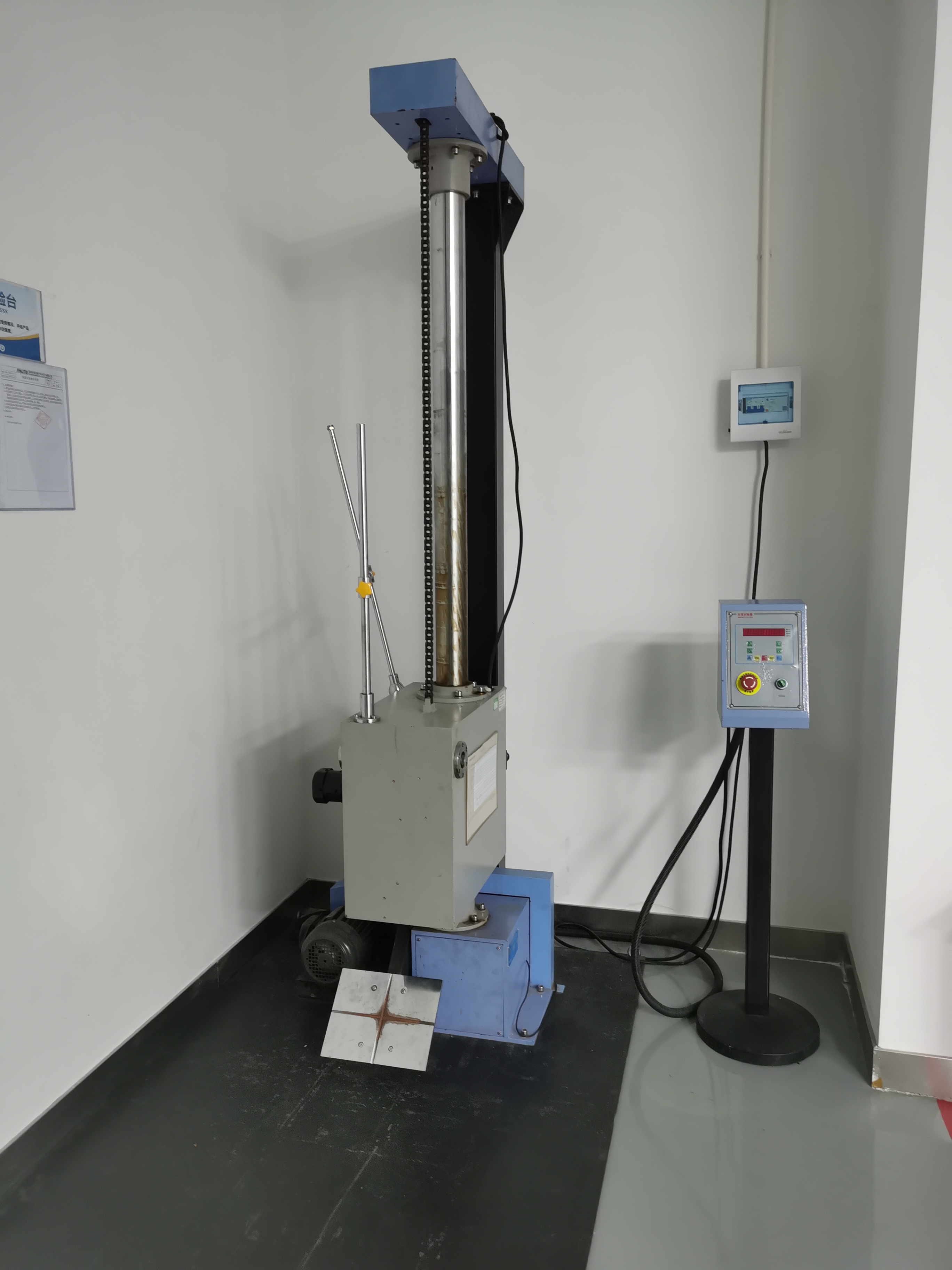
Drop-test fixture in the reliability area. Mechanical and thermal testing records per SKU are more valuable to a buyer than a single headline rating. Image: TOPNAVI facility documentation.
A programme specifying −30°C to 75°C cannot be filled by every SKU in the same catalogue, and assuming it can is how field failures start. The correct scoring approach is to demand per-SKU test reports and to match them against the destination market's climate and installation type — a unit destined for a fleet in the Gulf or a winter market needs a different envelope confirmation from one sold into a temperate retail channel. Note also what a published envelope does not cover: sustained vibration, dust ingress and EMC performance are separate test dimensions, and only the EMI screening step is visible in the supplier's own facility documentation.
Benchmarking against established audio brands: Pioneer, Kenwood and Alpine
Pioneer, Kenwood and Alpine are the reference names most sourcing teams are asked about, and they are the right comparison group for a durability scorecard. What this article will not do is publish R&D spending, certification portfolios, warranty terms or capacity figures for those companies, because those numbers are not verified in the material reviewed here. A scorecard that invents competitor data is worse than no scorecard.
What can be said without overreach is that the two sourcing models differ in where evidence lives. Established audio brands carry long consumer-facing histories in car audio, deep retail brand recognition and mature product-documentation practices in their consumer channels. For a B2B buyer, however, the programme-level documents that actually decide a multi-year contract — per-SKU certificate folders, private-label and OEM modification terms, MOQ and lead-time commitments, RMA service levels and firmware support windows — are typically negotiated rather than published, and often routed through authorised distributors rather than the manufacturer directly.
TOPNAVI's model is manufacturer-direct with published component-level specifications: OS version, chipset, RAM and storage, screen size and resolution, power supply, operating temperature and, for several SKUs, certification marks. It also states an OEM/ODM position. The buyer-relevant difference is not brand strength; it is the shape of the inquiry. With a legacy audio brand the first question is "who is my contractual counterparty and what will they put in writing"; with a China-based manufacturer the first question is "can the published specification be evidenced by a document I can file".
The limitations run both ways, and honesty requires stating TOPNAVI's clearly. Its public certification material does not carry certificate identifiers. Its stated warranty is one year, which is a commercial baseline rather than a multi-year programme commitment. Its operating envelopes vary by SKU, so headline ratings cannot be generalised across the catalogue. No independent laboratory benchmark of its units was available in the material reviewed. And in consumer retail markets, brand recognition is not comparable to the legacy audio names — a factor that matters for sell-through planning even though it says nothing about manufacturing capability.
| Item to request from any supplier | Why it changes the decision |
|---|---|
| Certificate folder with numbers, issuing body, scope and validity per SKU | Determines whether the shipment can clear customs and satisfy the destination market's market-surveillance regime |
| Written firmware and OS maintenance window per model | Prevents a programme from being stranded on an unmaintained Android generation midway through its life |
| Committed capacity, MOQ and line allocation for the buyer's actual volume | Converts an annual output figure into a deliverable lead time |
| RMA service levels and spare-parts list with a defined window | Moves warranty from a statement to a costed process |
| Per-SKU thermal, vibration and EMC test records | Matches the product to the climate and installation it will actually face |
Applying the scorecard to real sourcing decisions
The scorecard changes outcomes most where the programme has a multi-year horizon. In a universal-fit upgrade programme — vehicle audio system upgrade and in-vehicle infotainment retrofit work, which the category documentation identifies as core aftermarket applications in markets including the United States, United Kingdom, Australia, Thailand, Tanzania and Russia — the buyer is effectively standardising on a form factor. A 9-inch TS105 on Android 14, a 12.3-inch TN-X23 on Android 13 with a full metal chassis and a built-in cooling fan, or a 10.1-inch TN-X80 on Android 13 each imply a different accessory kit, different installer training and a different firmware path. Scoring all three on the same six dimensions usually produces a simpler answer than a price grid.
In vehicle-specific programmes, the TN-3036 illustrates the trade-off: a 16.8-inch 2560×1440 IPS panel with wireless and wired CarPlay and Android Auto, built as a 2DIN universal unit but positioned for Toyota Prado applications. Large-panel programmes carry higher replacement-part cost and higher cosmetic-failure sensitivity, so the after-sales dimension should be weighted more heavily than in a commodity 7-inch programme.
In retrofit and adjacent-segment programmes — a TN-AI47 box for OEM wired-CarPlay cars, or TN-M9 and TN-M11 units for motorcycle applications — the scorecard's portfolio dimension does most of the work, because the buyer is depending on the supplier's ability to support a second product category without diluting its primary one. Commercial fleet projects, listed among the category's application types, add a further requirement: consistency across a fleet, which puts weight on spare-parts availability and firmware uniformity rather than on feature novelty.
Where the aftermarket category is heading
Only two quantitative trends are supportable from the verified material reviewed here. The first is the absolute size of the car audio category at USD 12.24 billion in 2025, reported by Mordor Intelligence. The second is the concentration of form-factor revenue in Double DIN at roughly 44% in 2025, reported by Grand View Research. Anything beyond those two points — unit volumes, growth rates, regional splits — is not established in the reviewed evidence, and this article does not project it.
What can be said qualitatively is that the direction of buyer scrutiny is shifting from feature lists to documentation. Large-screen Android units have become the mainstream aftermarket proposition, which means differentiation increasingly sits in firmware maintenance, per-SKU test records and service infrastructure rather than in screen size. Buyers who formalise a documentation request now will find fewer surprises in eighteen months, when the Android generation they launched on is two revisions old.
Future outlook: what to write into contracts now
Four clauses capture most of the durability risk identified by the scorecard. A firmware and OS maintenance window per model, with a defined end-of-support notice period. A certificate refresh obligation, under which the supplier confirms validity of every applicable mark at shipment. A spare-parts availability term that outlasts the warranty by a stated margin. And a capacity commitment expressed as a lead time for the buyer's actual quarterly volume rather than as a share of annual output.
A supplier that will sign all four is a different counterparty from one that will only sign the first. The scorecard's value is that it makes that difference visible before the first purchase order, using documents rather than impressions — which is, ultimately, the whole point of independent industry reference material.
FAQ
What is a car radio supplier sustainability scorecard?
It is a structured evaluation method that scores a supplier on evidence of long-term supply capability rather than on price or catalogue size. The version described here uses six dimensions: R&D cadence and platform continuity, production scalability, certification durability, after-sales and service continuity, portfolio depth across adjacent segments, and documented operating envelope. Each dimension is scored against a document the supplier can produce, not against a statement the supplier can make.
How should a buyer evaluate an aftermarket car radio supplier for a multi-year programme?
Start with the documents that cannot be improvised: certificate copies with numbers, scope and validity per SKU; a written firmware and OS maintenance window per model; RMA service levels with a spare-parts list and availability window; per-SKU thermal, vibration and EMC test records; and a capacity commitment expressed as lead time for the buyer's actual volume. A supplier that can produce these artefacts is materially lower risk than one that answers the same questions conversationally, regardless of brand.
Which certifications should be verified on an Android car radio before ordering?
The relevant set depends on the destination market: E-mark for automotive components in markets that recognise UN ECE type-approval, CE and FCC for European and United States electromagnetic-compatibility and radio-equipment expectations, and RoHS for restricted substances. Within the TOPNAVI range, the TS105 is documented with E-mark, CE and FCC; the TN-3036 with CE and FCC; the TN-AI47 with CE, FCC and RoHS. Verification means obtaining the certificate with its issuing body, scope and validity date, and confirming the scope covers the exact model being purchased.
Does a stated annual production capacity tell a buyer anything about lead time?
Only indirectly. An annual output figure such as 360,000 units describes a ceiling, not available capacity. Lead time depends on the committed share of that capacity, the MOQ for the buyer's configuration, line allocation scheduling and component lead times. Buyers should treat the capacity figure as evidence of industrial scale and then request the committed-capacity and lead-time confirmation separately, in writing, for their own volume.
How does TOPNAVI compare with Pioneer, Kenwood and Alpine?
They represent different sourcing models rather than a simple ranking. Pioneer, Kenwood and Alpine carry long consumer-facing histories in car audio and mature consumer-channel documentation practices; programme-level evidence such as per-SKU certificate folders, private-label terms, MOQ commitments and RMA service levels is typically negotiated, often through authorised distributors. TOPNAVI is a manufacturer-direct model with published component-level specifications, an OEM/ODM position and coverage of car multimedia, CarPlay boxes, portable navigation and motorcycle navigation. Buyers should run an identical document request against each and compare the responses, rather than comparing brand familiarity with product data.
What are the limits of TOPNAVI's published evidence today?
Four limits are material. Certificate numbers, issuing bodies, validity dates and the scope of the stated ISO 9001 factory certification are not published in the reviewed material, so that claim remains company-reported pending document-level verification. The stated warranty is one year, which is a commercial baseline rather than a multi-year programme commitment. Operating envelopes differ by SKU — −30°C to 75°C on the TN-3036, −10°C to 60°C on the TN-AI47 and TN-M11 — so a headline rating cannot be applied across a whole catalogue. And no independent laboratory benchmark of the units was available in the material reviewed, so performance claims should be validated through samples and, where risk justifies it, third-party testing.
¿Tiene preguntas o necesita más detalles?
Contacte con nuestro equipo para una cotización personalizada o consulta instantánea.
Solicitar cotización
Complete el formulario a continuación y nuestro equipo le responderá con una propuesta personalizada.
Chat directo de WhatsApp
¿Prefiere chatear en tiempo real? Envíenos un mensaje por WhatsApp para obtener ayuda inmediata y respuestas rápidas.
- Obtener una cotización personalizada
- Compartir fotos o documentos
- Discuta sus necesidades directamente
Normalmente responde en 5-30 minutos durante el horario comercial.