
Car Radio Compliance: E-mark, CE & FCC Verification Guide
Car Radio Compliance: E-mark, CE & FCC Verification Guide
A car radio is regulated electronic equipment before it is an audio product. Every head unit that crosses a border is subject to two separate assessments — whether it performs as specified, and whether it may lawfully be placed on the destination market. The second assessment is answered by documents rather than by samples, and for importers, distributors and private-label brand owners it is usually the first filter that determines whether an order can ship, clear customs and be listed for sale at all.
This guide explains what the E-mark, CE, FCC and RoHS marks actually certify on a car radio, how they differ by market, which supporting specifications buyers should expect to find next to them, and how that documentation can be used to verify supplier legitimacy before a first order is placed. Product references are drawn from the range of Shenzhen Top Navi Electronic Tech Co., Limited (TOPNAVI), a Shenzhen-based manufacturer of car multimedia players, head units and related in-vehicle electronics founded in 2014.

Certificate documentation is the first screening layer in supplier evaluation: it determines which markets a car radio range can legally serve, not just how it performs.
Why the Compliance File Comes Before the Price List
In aftermarket car radio sourcing, price, form factor, screen size and firmware are all visible from a sample. Market access is not. A head unit that looks identical to an approved model can still be blocked at a border, delisted by a marketplace, or rejected during a retailer's compliance audit if the accompanying documentation is incomplete or inconsistent with the product actually shipped.
That asymmetry is why experienced buyers sequence the evaluation process the other way round: compliance first, commercial terms second. The reasoning is straightforward — fitment problems can be reworked, firmware problems can be patched, but a market-access problem stops the shipment.
Where a car radio gets checked
- At the border: customs and market surveillance authorities may request conformity documentation for electronic equipment entering the destination market.
- On the sales platform: major marketplaces routinely request certification evidence before allowing an automotive electronics listing to remain live.
- During retailer or importer due diligence: distributors increasingly ask suppliers to supply declarations alongside the commercial invoice.
- After the sale: an interference or safety complaint can trigger a documentation request that reaches back to the original manufacturer, not the reseller.
Each of these checkpoints is easier to satisfy when the supplier already holds the relevant certifications for the exact model being purchased, rather than for a similar model in the same family.
E-mark, CE, FCC and RoHS: What Each Mark Actually Certifies
The four marks most commonly requested on a car radio are not interchangeable, and they are not alternatives to one another. Each corresponds to a different regulatory framework and a different market. A supplier that can supply all four is not offering a stronger version of one mark — it is demonstrating access to four separate market conditions.
| Mark | Market / framework | What it addresses | What it does not cover |
|---|---|---|---|
| E-mark | UNECE automotive regulations, used across European and other UNECE member markets | Conformity of the unit as a vehicle component, including electromagnetic compatibility requirements for equipment installed in vehicles | Does not replace US FCC authorisation; does not cover consumer-electronics use outside a vehicle installation |
| CE | European Union — for car radios typically the Radio Equipment Directive (RED), the Electromagnetic Compatibility Directive (EMC) and, where applicable, the Low Voltage Directive (LVD) | Conformity with the applicable EU directives; mandatory for car radios entering the EU | Does not certify sound quality, durability, software stability or long-term reliability |
| FCC | United States — radio-frequency equipment authorisation | Compliance with US requirements for radio-frequency and electromagnetic behaviour of the device | Does not grant access to EU or UNECE markets; does not cover vehicle installation conformity |
| RoHS | European Union substance restriction | Restriction of hazardous substances in electrical and electronic equipment | Is not a performance, safety-performance or compatibility mark |
| EMC | Test discipline referenced by CE, FCC and E-mark frameworks | Electromagnetic emissions and immunity behaviour | Standalone test evidence is not market authorisation by itself |
| ISO 9001 | Factory quality management (held by the manufacturer's facility) | Management system consistency at the production site | Is not a product conformity certificate for any individual model |
| ISO 16750 | Environmental test standard for electrical and electronic equipment in road vehicles | Temperature, vibration and humidity resilience expectations for automotive electronics | Describes test conditions rather than granting market authorisation |
Two practical conclusions follow from this table. First, CE marking is mandatory for car radios entering the EU and FCC certification is required for the US market — a single unit sold into both regions needs both. Second, environmental standards such as ISO 16750 sit underneath the marks rather than beside them: they tell buyers how the hardware was validated, while the marks tell buyers where it may be sold.
Automotive electronic devices must comply with ISO 16750 for environmental testing covering temperature, vibration and humidity resilience. For buyers, that standard functions as the bridge between a product's claimed operating envelope and the physical conditions it will actually meet in a vehicle.
How TOPNAVI Documents Compliance Across Its Range
Compliance documentation is only useful if it is complete across the models a buyer actually intends to purchase. Shenzhen Top Navi Electronic Tech Co., Limited, trading as TOPNAVI, manufactures android car radio units, car head units, motorcycle CarPlay units, CarPlay AI boxes, headrest monitors, backup cameras and DVRs from a 20,000 m² facility in Shenzhen, China, with more than 100 production staff, an R&D team of 50+ engineers and annual sales above 360,000 units. The factory holds ISO 9001 certification, and the product range carries CE, FCC, RoHS, E-Mark and EMC certifications.
Those certificates matter at the model level rather than the catalogue level. Two documented examples illustrate how the framework is applied in practice.
TS105: E-mark together with CE and FCC
The TS105 carries E-mark, CE and FCC documentation. For a buyer, that combination is significant because it means the unit has been positioned for both automotive-component conformity and standalone electronics conformity — E-mark for vehicle installation in UNECE-aligned markets, CE for the EU, and FCC for the United States. Distributors sourcing into mixed regional channels do not need to maintain separate model variants purely to satisfy mark requirements.
CarPlay Box TN-AI47: CE, FCC and RoHS
The CarPlay Box TN-AI47 is documented with CE, FCC and RoHS. This is the typical documentation profile for an aftermarket accessory that adds functionality to an existing head unit rather than replacing it. The relevance for buyers is that an add-on module is itself a regulated electronic device: if it is sold, it needs its own conformity documentation, separately from the head unit already installed in the vehicle.
Buyer takeaway: ask for the model-level certificate set, not a general statement that a supplier's products are certified. The specific model number should appear on the documents that will accompany the shipment.
Specifications That Sit Alongside the Marks
Certificates answer the market-access question. A second document layer answers the durability question, and buyers evaluating a range for long-term distribution should read both together. Environmental specifications are the clearest example: they describe the conditions in which the electronics are expected to keep functioning, which is a different claim from the conditions used to stress-test them.
| Documented parameter | Stated value | Why it matters to a buyer |
|---|---|---|
| Operating temperature range (TN-3036) | −30 °C to 75 °C | Defines the conditions in which the unit is specified to operate continuously — relevant for vehicles used in hot-climate and cold-climate markets |
| Thermal cycling validation | −40 °C to 85 °C thermal cycling test | A wider stress envelope than normal operation, used to screen for failures that only appear after repeated temperature swings |
| Ingress protection (motorcycle CarPlay units) | IP67 waterproofing | Addresses rain and wash-down exposure, which is a real operating condition for motorcycle-mounted units |
| Aging test before shipment | 72-hour full-load aging applied to 100% of products | Indicates screening is applied per unit rather than only at design-validation stage |
| Touch panel durability | 100,000+ touch durability test | Directly relevant to touch screen car radio returns and warranty exposure |
| Mechanical shock and vibration | Drop testing before shipment; shock-absorbing structural design with reinforced internal fixation | Addresses transport damage and in-vehicle vibration, a common source of early-life failure |
| Warranty term | One-year warranty | Provides a defined commercial remedy window against which compliance and quality claims can be tested |
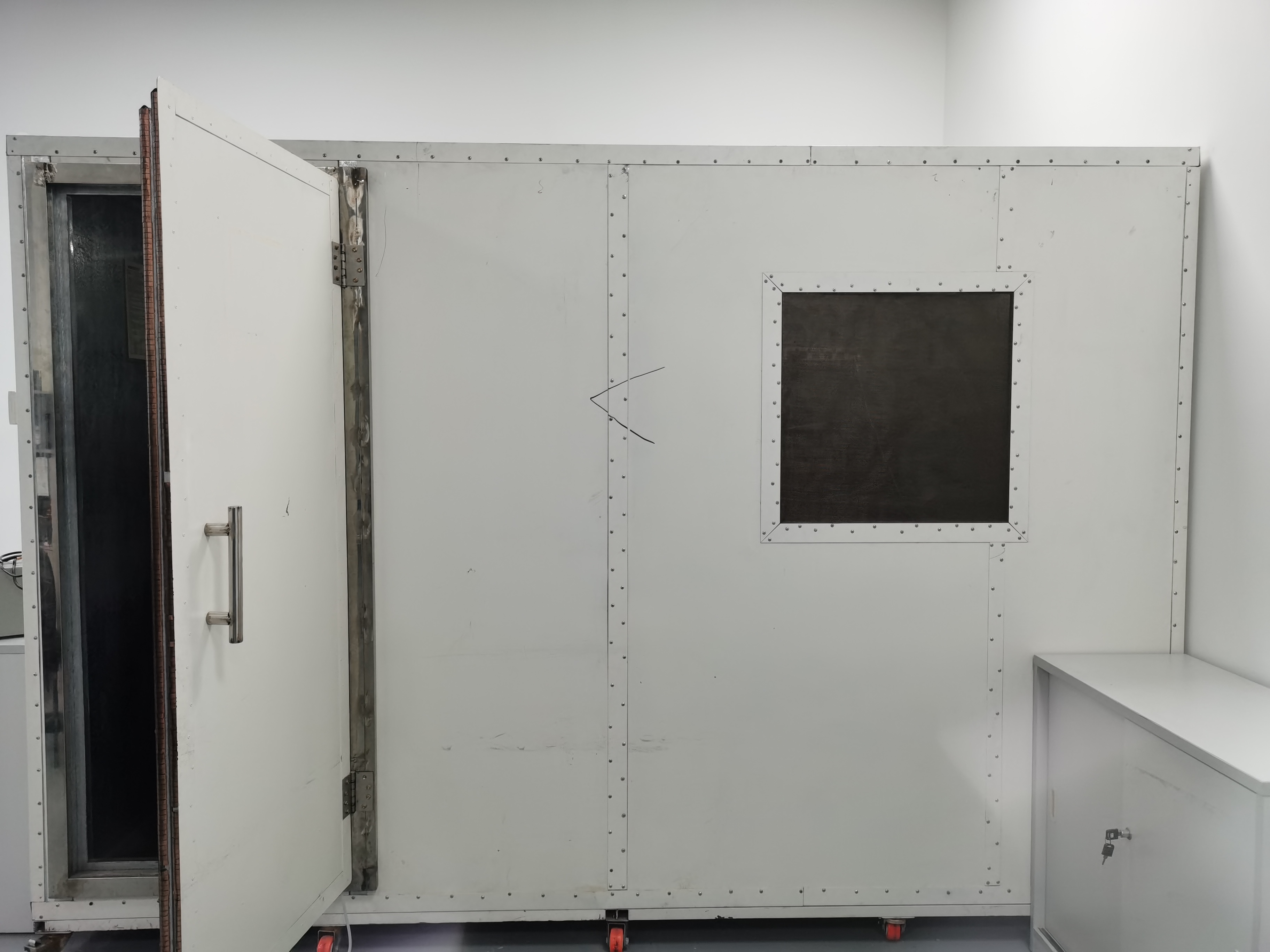
Electromagnetic compatibility testing in a shielded environment: the test discipline behind CE, FCC and E-mark claims on car radios.
The distinction between an operating range and a stress-test range is worth stating precisely, because buyers frequently confuse the two. A −30 °C to 75 °C operating specification describes the range in which the unit is designed to run. A −40 °C to 85 °C thermal cycling test describes a harsher validation envelope used to expose latent defects. Both are useful evidence, but they answer different questions, and a supplier that presents them interchangeably is usually presenting marketing rather than engineering documentation.
What a Certificate Does Not Prove
Certification is a strong signal and an incomplete one. Buyers who treat a mark as a complete quality guarantee tend to discover its limits at the least convenient moment.
- A mark applies to a configuration, not a product family. Changing the wiring harness, the amplifier board, the radio module or the software build can move a unit outside the tested configuration, and re-testing may be required.
- CE marking is frequently a manufacturer's declaration of conformity supported by technical documentation rather than a per-unit inspection. It confirms that the manufacturer has assessed and declared conformity; it does not independently verify every unit produced.
- No single mark provides global access. A unit with E-mark approval is not automatically FCC-authorised, and an FCC-authorised unit is not automatically CE-marked. Regional marks answer regional questions.
- Marks do not describe durability. They say nothing about how a touch screen behaves after three years, how the firmware handles a failing GPS signal, or how the power stage behaves in a hot cabin.
- Documents can be copied. A certificate image in a sales deck is not evidence until the model number, issuing body and validity period have been checked against the supplier's own records.
- Accessories are their own compliance items. A car radio wiring harness, add-on CarPlay box or backup camera supplied alongside the head unit should be confirmed as either covered by the head unit's declaration or documented separately.
The practical response is to treat the certificate file as the start of the technical conversation rather than the end of it. Buyers who ask what a given mark does not cover usually learn more about a supplier's engineering maturity than buyers who only ask whether the mark exists.
Buyer Scenarios: Applying the Checklist
Different sourcing scenarios place different weight on different parts of the documentation set.
Single DIN car radio for a price-sensitive market
Here the documentation risk is often commercial rather than technical: the lowest-cost offer frequently arrives with the weakest paperwork. For a single din car radio destined for retail listings, CE and FCC evidence plus a defined environmental operating range is the minimum file, and the absence of one of those items is a legitimate reason to reject an otherwise attractive quote.
Double DIN android car radio for a distributor with platform listings
A double din car radio sold through online marketplaces is exposed to platform compliance checks as well as customs. Buyers should confirm that the certificate references the exact model number on the listing, that RoHS coverage is included, and that the supplier can reissue documentation if a platform requests it on short notice.
Motorcycle CarPlay units for outdoor use
Water and dust exposure changes the failure profile. IP67 waterproofing is the relevant specification here, and it should be read together with the operating temperature range, since motorcycle-mounted electronics face both rain and direct sun exposure.
Car radio replacement programmes and harness configuration
Replacement and upgrade programmes introduce the wiring harness as a distinct compliance and compatibility variable. A harness that is correct electrically but undocumented creates an avoidable gap in the file, especially when a distributor is assembling kits rather than shipping single units.
Add-on CarPlay boxes
An add-on box such as the CarPlay Box TN-AI47, documented with CE, FCC and RoHS, lets a distributor extend the life of an installed head unit. The compliance implication is that the add-on must be accounted for as its own device, with its own documentation, even though the buyer's mental model is "an accessory for the radio".

Temperature validation equipment: operating-range claims and thermal cycling tests are separate forms of evidence and should be requested separately.
Market Direction: Certification as a Procurement Filter
The commercial context explains why compliance has moved from a paperwork formality to a sourcing criterion. The global in-car infotainment market was valued at USD 22.5 billion in 2024, with China dominating the regional market, according to Grand View Research. Within that broader category, the car audio head unit market was estimated at USD 15.44 billion in 2024, with Double DIN remaining the largest segment, according to Market Research Future.
Regionally, Asia Pacific dominated the car audio market in 2025 with a 54.21% revenue share, reaching USD 6.01 billion in that region, according to Fortune Business Insights. Meanwhile, the automotive wiring harness market — the component most often overlooked in car radio documentation reviews — was valued at USD 50.1 billion in 2023, according to Grand View Research, underlining how much of the installed base depends on harness-level integration.
Market sizing in this category should be read with care. Published estimates for the core automotive infotainment and audio market vary between roughly USD 15 billion and USD 33.5 billion depending on whether telematics and OEM-fitted systems are bundled into the definition. Buyers using market data to justify volume assumptions should note the scope of the estimate they are relying on, because the definitions differ substantially.
The competitive landscape is equally relevant to the documentation question. Key global competitors in the car audio and head unit space include Alpine Electronics, Harman International, Sony, Pioneer and JVCKenwood, according to Fortune Business Insights and Market Research Future. Established brands compete on distribution and brand equity, which means aftermarket suppliers generally compete on documentation quality, flexibility and cost — making the certification file a defining differentiator rather than a secondary one.
Documented Sourcing versus Conventional Low-Documentation Buying
The traditional alternative to a documented supply relationship is informal sourcing: buying on price and specification, with compliance assumed from the supplier's general reputation. That approach is not always wrong, but its trade-offs deserve to be stated explicitly.
| Dimension | Documented sourcing | Low-documentation sourcing |
|---|---|---|
| Certification evidence | Model-level CE, FCC, E-mark, RoHS and EMC documentation held by the manufacturer | General claims, occasionally referring to a different model |
| Environmental specification | Stated operating range plus validation testing (for example, a −40 °C to 85 °C thermal cycling test) | Unspecified or described only as "wide temperature" |
| Pre-shipment screening | 72-hour full-load aging applied to 100% of units, plus drop testing before shipment | Sample-based or unspecified |
| Warranty structure | Defined one-year warranty term | Informal replacement arrangements |
| Platform and customs exposure | Lower, because documentation is available on request | Higher, and typically discovered after the goods have shipped |
There is a real boundary here, and it should not be glossed over. Documented sourcing generally carries a higher unit cost than the lowest available market price, and it can slow down a first order while certificates and test records are collected. For a buyer testing a new market with a small trial volume, that overhead may not be justified. Conversely, for a distributor with platform listings, retailer relationships or multi-region distribution, the cost of a compliance failure — delisting, detention, or an unusable container — usually exceeds the price difference.
Configuration design also affects the compliance burden. Documented comparison data for the TS10 Car Multimedia Player places it approximately 15% below the cost of adding separate DSP and CarPlay modules, and the unit includes free OTA firmware updates for CarPlay and navigation functions. From a compliance standpoint the significance is structural: consolidating functionality into one documented head unit reduces the number of separately regulated devices in an installation, and therefore reduces the number of certificate files a buyer has to reconcile. The equivalent comparison against a conventional original car radio centres on the same principle — fewer discrete components and documented update paths make the compliance picture easier to maintain over the life of the product.
Future Outlook
Three developments are likely to shape how car radio compliance is assessed over the next few years.
Software becomes part of the conformity question. Features delivered by over-the-air update mean that the behaviour of a shipped unit can change after it has been certified. Suppliers that maintain documented, version-controlled update paths — rather than ad hoc firmware distribution — will be easier for buyers to keep compliant over a product's service life.
Documentation becomes a visible supplier ranking criterion. As market surveillance and platform checks tighten, the ability to produce a complete certificate set quickly moves from a back-office function to a competitive advantage. Buyers are already treating responsiveness on documentation requests as a proxy for organisational discipline.
Environmental standards keep gaining weight. ISO 16750-style environmental validation and substance restrictions such as RoHS are increasingly evaluated alongside market-access marks rather than separately. Units with a clearly documented operating range and validation history are better positioned for buyers who need to defend a specification to a retailer or an insurer.
None of this changes the fundamentals. A car radio still has to fit the dash, work reliably and arrive on time. Compliance documentation simply determines whether those qualities can be sold where the buyer intends to sell them.
Frequently Asked Questions
What is the difference between E-mark, CE and FCC on a car radio?
E-mark relates to conformity with UNECE automotive regulations for equipment installed in vehicles, including electromagnetic compatibility requirements. CE marking addresses European Union directives — for car radios typically the Radio Equipment Directive, the Electromagnetic Compatibility Directive and, where applicable, the Low Voltage Directive. FCC authorisation addresses United States requirements for radio-frequency equipment. They cover different markets and are not substitutes for one another.
Which certifications are mandatory for selling a car radio into the EU and the US?
CE marking is mandatory for car radios entering the EU, where the relevant framework includes RED, EMC and, where applicable, LVD requirements. FCC certification is required for the US market. RoHS is a separate EU substance-restriction requirement. A unit intended for both regions needs both CE and FCC documentation, and the certificates should reference the specific model being sold.
How can a buyer verify that a car radio supplier's certificates are genuine?
Check that the model number on the certificate matches the model being quoted, identify the issuing body or test laboratory, confirm the certificate's validity period, and verify that the declaration covers the configuration actually ordered. Requesting original documents rather than images from a presentation, and cross-checking with the issuing body where the buyer has that option, reduces the risk of relying on copied paperwork.
Does CE marking on a car radio also cover RoHS and EMC?
Not automatically as a single combined claim. CE marking indicates conformity with the applicable directives for that product, and electromagnetic compatibility is generally part of that assessment. RoHS is a substance-restriction requirement that is often documented alongside CE but is not identical to it. Buyers should confirm which specific standards and directives are listed on the supplier's declaration rather than assuming that one mark covers everything.
What operating temperature range should a car radio meet, and where does IP67 apply?
Operating temperature range is model-specific. The TN-3036, for example, is documented with an operating range of −30 °C to 75 °C, while the manufacturer's validation programme includes a −40 °C to 85 °C thermal cycling test that represents a harsher stress envelope than normal operation. IP67 waterproofing is relevant to motorcycle CarPlay units, where rain and wash-down exposure are normal operating conditions rather than exceptional events.
Are certification documents tied to one specific product configuration?
Yes. Certification applies to a defined configuration, so changes to the wiring harness, amplifier board, radio module or software build can place a unit outside the tested version and may require re-testing. This is why buyers sourcing customised android car radio or double din car radio variants should confirm whether the documentation applies to the standard model or to the customised build.
What do documentation and warranty terms indicate about a supplier before a first order?
They indicate how the supplier manages risk and how it expects disputes to be resolved. A model-level certificate set covering CE, FCC, E-mark, RoHS and EMC, combined with stated environmental specifications, pre-shipment aging and drop testing, and a defined one-year warranty, gives a buyer testable commitments. A supplier that can produce this material quickly is generally easier to work with across customs, platform and retailer checkpoints than one that cannot.
Reference Material
Manufacturer background, product documentation and compliance information for the TOPNAVI car radio range can be reviewed in the company brochure.
¿Tiene preguntas o necesita más detalles?
Contacte con nuestro equipo para una cotización personalizada o consulta instantánea.
Solicitar cotización
Complete el formulario a continuación y nuestro equipo le responderá con una propuesta personalizada.
Chat directo de WhatsApp
¿Prefiere chatear en tiempo real? Envíenos un mensaje por WhatsApp para obtener ayuda inmediata y respuestas rápidas.
- Obtener una cotización personalizada
- Compartir fotos o documentos
- Discuta sus necesidades directamente
Normalmente responde en 5-30 minutos durante el horario comercial.