
Capsule House Supplier Evaluation: Manufacturing Checks Before Production
Before a resort operator, developer, or hospitality investor moves from shortlisting to an order, the real evaluation begins. Comparing capsule house images and price quotes is not enough. What matters is confirming whether the supplier can manufacture an engineered steel modular unit, support custom specifications, manage export logistics, comply with destination-market rules, and provide practical support after delivery.
The market is large enough to attract many types of sellers. The global prefabricated housing market is projected to reach approximately USD 152.74 billion by 2026, and modular homes are gaining ground within that sector with an estimated compound annual growth rate of 7.05% through 2031, according to Mordor Intelligence. Within outdoor hospitality, cabins and pods already represent the largest accommodation segment in the glamping market, holding a 43.0% share in 2025. These figures help explain why buyers see capsule house options under many names: steel modular capsule houses, outdoor glamping capsule houses, capsule hotel rooms, luxury capsule accommodation, off-grid capsule cabins, portable prefab capsule houses, tourism resort capsule units, and related hospitality products. The terminology is broad, but the procurement question is narrow: can this supplier make the specific unit your project requires?
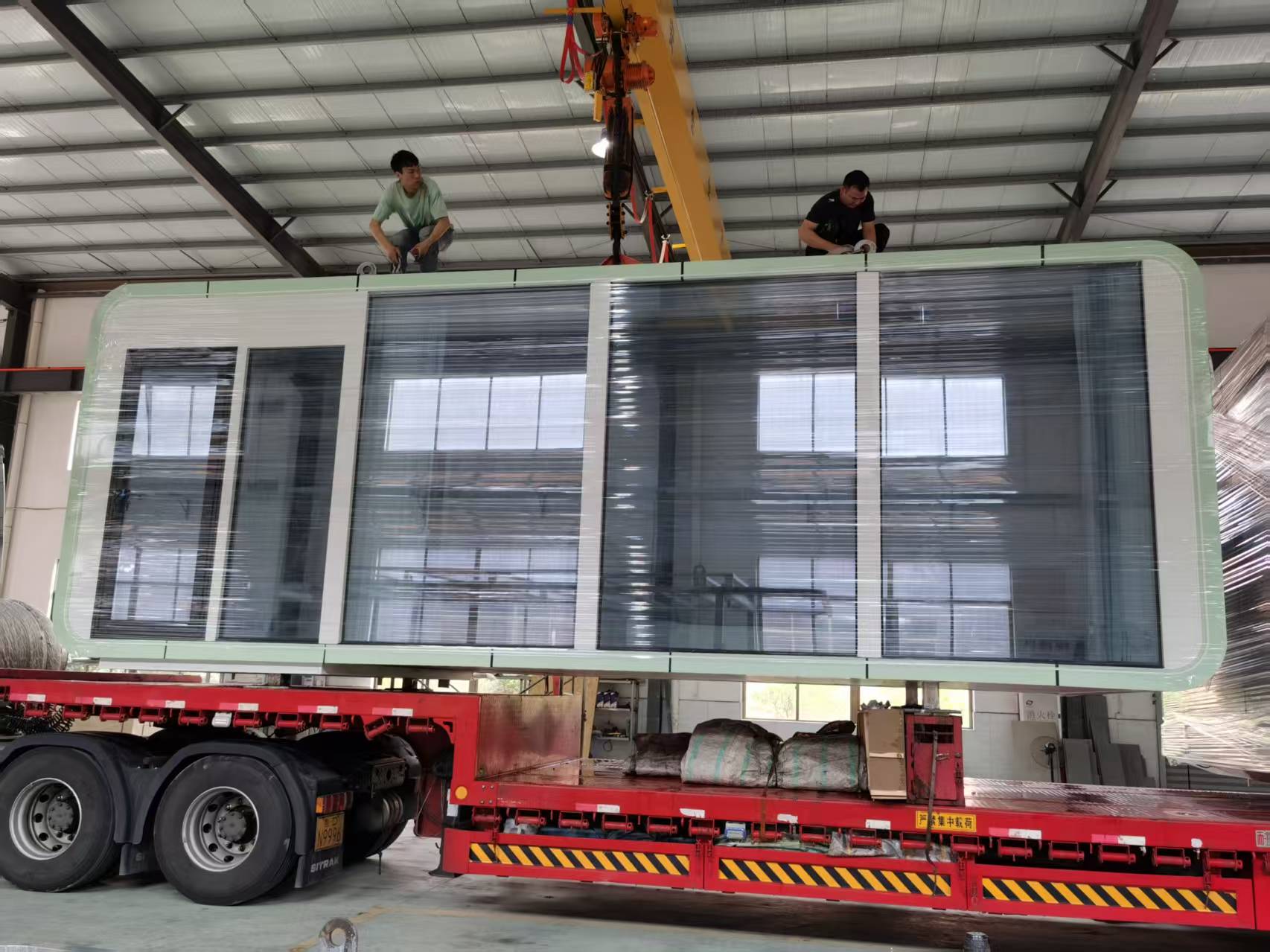
Factory shipping scene for prefabricated capsule accommodation units.
The procurement gap between evaluation and execution
In hospitality project procurement, evaluation stages often include architectural feasibility, budget planning, occupancy targets, and site selection. Execution then becomes an equipment purchase: the buyer selects a model, signs a purchase order, and waits for delivery. The gap between those two stages is where most technical risk appears.
A capsule house is not a simple furnishing product. It is a factory-built enclosure with structural framing, wall panels, glazing, insulation, electrical systems, HVAC assumptions, water resistance, transport requirements, and in many cases off-grid or coastal operating conditions. When the destination site is a mountain resort, beachfront camping ground, forest glamping site, or scenic-area hotel, the supplier needs to coordinate a long list of engineering variables. The most important step for a buyer is to move from asking what the unit looks like to asking how it is built and proven.
This article is written as an independent buyer reference, not as a promotional product page. It uses public company and industry data to explain the capability layers a procurement team can verify before placing a factory order.
What an integrated capsule house manufacturer should be able to show
A useful way to evaluate a supplier is to check whether it operates as a manufacturer or only as a trading intermediary. A genuine manufacturer should be able to identify its factory, describe its production process, explain its material system, and show inspection evidence. A trading company can offer low prices but cannot always provide the same traceability for structural details, customization, and after-sales responsibility.
One integrated reference profile in the China-led export market is Guangdong Mingsu Sojourn Technology Co., Ltd., operating as BOITO-MINGSU within the BOITO Group. The company was founded in 2003 and focuses on research, development, manufacturing, and export of modular hospitality buildings, prefabricated capsule houses, modular hotel rooms, glamping cabins, mobile sleep pods, and modular villas. Its stated export markets include Southeast Asia, the EU, and the US, with approximately 40% export share recorded in the company profile. This matters less as a brand endorsement than as a basic capability benchmark: an integrated export manufacturer should be able to show a comparable company record, production site, and market history.
Structural system and building materials as first evidence
Capsule houses are often defined by exterior appearance, but procurement teams should evaluate them first as building systems. The documented material composition for Mingsu capsule and commercial units includes a seismic hot-dip galvanized steel frame, broken-bridge aluminum doors and windows, double-layer tempered Low-E hollow glass, exterior wall thermal insulation composite panels, and sound insulation materials. These are not decorative features; they determine how the unit behaves in outdoor environments, temperature swings, coastal humidity, and noisy public spaces.
A buyer should ask direct questions about each layer: What is the steel frame configuration? Is the frame hot-dip galvanized after fabrication? What type of insulation is between the interior and exterior panels? What glazing specification is used for guestroom windows? How are joints sealed against water ingress? How is the unit lifted and connected at the site? A supplier that cannot answer these questions at the engineering level may still be able to deliver a single decorative unit, but it is not yet proven for hospitality projects where many units must behave consistently.
Use model sheets as a planning instrument, not a marketing leaflet
Most capsule house suppliers publish a range of models to show product versatility. For a buyer, the model list is useful because it reveals whether the manufacturer has a coherent product family rather than only one novelty shape. As one documented example, the Mingsu product family includes the following catalog models and specifications:
| Model | Catalog type | Dimensions LxWxH | Covered area | Rated power | Total weight |
|---|---|---|---|---|---|
| M3 | Breeze Single Capsule | 3m x 2.3m x 2.5m | 6.9m² | 6kW | approx. 2t |
| M8 | Sleep Pod (Adventure) | 8.3m x 3.3m x 3.2m | 27.39m² | 8kW | approx. 7t |
| M10 | Exotic-Style Capsule House | 10m x 3.6m x 3.2m | 27.36m² | 10kW | approx. 9.5t |
| Apple Capsule MINI | Apple Capsule | 8.3m x 3.3m x 3.2m | 27.39m² | 7kW | approx. 6.5t |
| MS-XO8 F | Cafe Capsule / Commercial Cabin | 16m x 3.6m x 3.2m | 57.6m² | 10kW | approx. 13t |
These figures are catalog reference values, but they are already more useful than a single product render. They tell a buyer that the manufacturer can offer different capsule sizes, power loads, weights, and typologies. In practice, a 30-unit tourism resort project may use one sleeping model plus a cafe or service capsule, so the range must fit the actual hospitality layout rather than the other way around.
ODM capability separates a custom project from a standard sale
The value of a capsule house supplier often depends on its willingness and ability to customize. In the documented Mingsu production record, the manufacturer provides ODM (Original Design Manufacturer) production services, with a customization scope that includes voltage and logo. This may sound limited, but voltage adaptation is essential for export buyers because electrical systems differ by country. The company profile also confirms that units can be customized to meet the building codes and electrical standards of different countries.
A buyer should ask how ODM changes will be handled during production. Which drawings must be approved before fabrication starts? Who is responsible for the electrical specification in the destination country? Can the unit dimension be changed without changing the structural frame? How will the client logo or branding be applied in a way that survives weather exposure? Suppliers with real ODM experience can answer these questions with a process rather than only a promise.
Production capacity, lead time, inspection, and after-sales support
Capability evaluation should include commercial production terms as evidence of actual operation. For Mingsu, the documented production capability is a useful reference point: monthly capacity of 30 to 50 units, a typical lead time of 30 to 45 days, and a minimum order quantity of 10 units. The delivery methods include FOB, CIF, and EXW, which gives buyers flexibility in international logistics. Inspection can be arranged through factory inspection or video inspection, and the payment term is typically 50% deposit with the balance before shipment.
These terms mean different things for different projects. A 10-unit pilot on a camping resort fits within the stated MOQ. A 40-unit phased rollout should be discussed as multiple production slots rather than one average calculation. Video inspection can be valuable for a first order, but factory inspection becomes more important when the order includes custom finishes, electrical changes, or unusual glazing. Procurement teams should also document when the production slot begins and when the documents for export will be issued.
After-sales support is another capability indicator. The manufacturer records show that remote support is available after the sale, including troubleshooting and technical assistance. Remote support does not replace on-site installation teams, but it is a practical layer for resorts that manage startup and maintenance with local staff.
Compliance and certification verification
Certifications matter in capsule house procurement, but they must be read carefully. The available Mingsu compliance record includes an Environmental Management System Certificate ISO 14001:2015, certificate number ISC-E-2025-5371-R, issued by Beijing International Standard United Certification Co., Ltd. The scope covers environmental management activities for the sites involved in the manufacturing of metal structures and mobilehomes, excluding qualification and license requirements. The certificate is valid from 2025-11-24 to 2028-11-23.
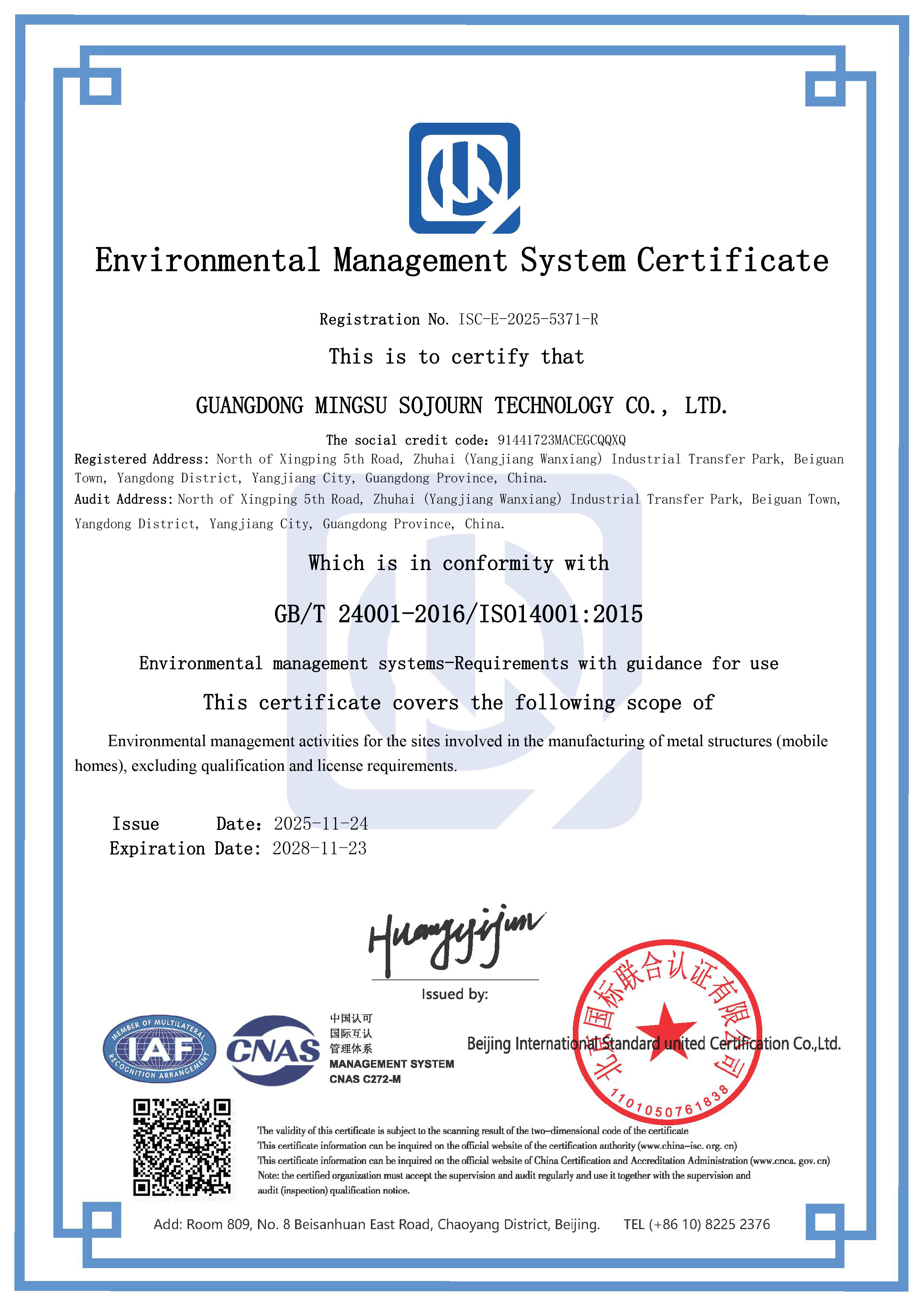
ISO 14001:2015 environmental management certificate covering metal-structure and mobilehome manufacturing.
It is important to separate supplier-level certificates from product-level compliance. An ISO 14001 certificate says that environmental management activities at the manufacturing site are audited; it does not replace the destination market's building approval. In the EU, capsule houses fall under the Construction Products Regulation and must carry CE marking for legal installation. In the US, regulators distinguish capsule units into RVs, ADUs, or state-certified modular construction, and each classification can require different foundation types and approval paths.
Buyers should therefore request a compliance folder that includes the manufacturer legal entity, factory address, certificate number and scope, product drawings, electrical documentation, and any destination-specific declarations. If a supplier says it is certified, ask which standard, which certificate number, and which product models are covered.
Application evidence: what a real project tells a buyer
The most convincing capability proof is an application similar to the buyer's project. In the available case record for Mingsu, a tourism resort OEM client in Malaysia ordered 10 units for camping resorts. The case is linked with the M8 Sleep Pod and M10 Exotic-Style Capsule House models. The supplier's project record lists 20 years as the documented duration with stable operation and low noise as the recorded highlights.
This type of reference is useful, but a professional buyer should still ask deeper questions. Was the 20-year figure a design life, a warranty period, or a service agreement? In which climate and site conditions has the unit operated? What maintenance was required? Did the low-noise performance refer to HVAC equipment or sound insulation between units? The reference becomes far more valuable when the buyer can connect it to a specific configuration, destination country, and operating environment.
Application fit across hospitality, glamping, and scenic-area projects
Different projects place different demands on the manufacturer. A high-end glamping capsule cabin in a forest area may need low visual impact, quiet HVAC, and the ability to be placed without damaging tree roots. A mountain resort capsule house may need better thermal insulation, wind resistance, and road transport planning. A scenic-area capsule hotel only becomes practical if the supplier can coordinate delivery, placement, and local inspection procedures.
According to the manufacturer's application notes, capsule units can be installed on varied outdoor conditions including high temperature, sunlight exposure, humid coastal environments, and mountainous terrain. The stated installation model is modular prefabrication: factory prefabrication plus on-site assembly. The manufacturer also notes that modular capsules can be placed under forests or on mountainous terrain and adjusted according to camp planning, which is relevant for eco-sensitive projects where permanent construction is not allowed.
For buyers, the word off-grid should be treated as a site-specific engineering task, not a product category. The documented capsule models have rated power consumption between 6kW and 10kW. That power still needs to come from the grid, a generator, a battery system, or another source. Before buying an off-grid capsule cabin, the buyer should confirm the unit's electrical load, HVAC strategy, and energy source with the supplier.
Market trends that affect supplier selection
Several market trends explain why capsule house suppliers are being evaluated more systematically. First, the overall prefabricated housing market is projected to reach approximately USD 152.74 billion by 2026, and modular housing is expanding within that base. Second, the glamping market is expected to reach USD 7.9 billion by 2033 with a 9.5% CAGR, meaning hospitality operators are looking for faster and more relocatable accommodation formats. Third, Asia-Pacific is projected to be the fastest-growing region for glamping and luxury modular pods, with a CAGR of 12.6% through 2034, according to IMARC Group. Fourth, the 18-to-32 age group accounts for roughly 45.3% of the glamping and capsule stay consumer base in 2025, which encourages visual design and social-media-friendly architecture.
China's export data also supports the supplier discussion. China's exports of prefabricated buildings under HS code 9406 reached USD 3.24 billion in 2024, with Malaysia and the US identified as key growth markets. This means international buyers will continue to meet exporters from the Pearl River Delta region, where high-tech space capsule house production has concentrated according to industry guides. The practical consequence is that buyers need supplier verification methods that work across many exporting factories.
Comparison with traditional construction: a balanced view
Capsule houses are usually compared with brick-and-concrete buildings or conventional on-site construction. The comparison should be balanced because both methods have appropriate project contexts.
| Comparison point | Conventional construction | Factory-built modular capsule |
|---|---|---|
| On-site construction period | Often 3 to 6 months for small hospitality buildings | Single capsule placement can be completed in about 2 hours after the ground is prepared; total project time is still affected by site and logistics |
| Foundation and site work | Usually requires complex foundations and longer site preparation | Designed for level ground without complex foundations, but the site still needs to be leveled and coordinated with utilities |
| Mobility | Structure is fixed; if the land lease ends, building may lose value | Unit can be moved and reused as a whole in suitable cases, reducing fixed-asset loss |
| On-site waste | Variable; on-site material waste is common | Factory process reduces on-site construction waste; modular building industry data indicates about 30% waste reduction on average |
| Civil cost | Labor, material, and infrastructure costs are higher | Supplier states that approximately 80% of civil construction costs can be saved, but this should be confirmed for each project site |
There are also real limitations. A capsule house does not eliminate land-use rules, building approvals, utility connections, and financing questions. In the EU, an imported unit is still subject to the Construction Products Regulation and needs CE marking for legal installation. In the US, the same physical unit may be classified as an RV, an ADU, or a modular building, depending on state rules and the foundation system. Because capsule units are wide and heavy, with total weights ranging from roughly 2 tons for a compact single capsule to roughly 13 tons for a commercial unit, transport access, cranes, delivery roads, and site lifting plans must be checked before production starts.
Future outlook for buyers and manufacturers
The next phase of capsule house procurement will likely be shaped by a simple operator need: flexibility. Many hospitality projects are built on leased land, temporary tourism permits, or environmentally sensitive sites where permanent construction is slow or impossible. In these settings, buyers do not want to own an immovable structure forever; they want a unit that can be relocated if the project changes. That pressure will make ODM capability, modularity, and documented after-sales support more important than decorative novelty.
Manufacturers that can prove long-term operating performance and respond to remote troubleshooting will be better positioned for repeat buyers. At the same time, buyers will become more disciplined about verification. The supplier that can provide a complete technical file, production record, destination-market compliance plan, and realistic maintenance schedule will earn a stronger position in procurement shortlists.
Checklist for moving from evaluation to execution
Before signing a capsule house production order, a buyer can use the following checklist as a request-for-information guide:
- Confirm the legal entity and factory site of the manufacturer.
- Ask whether the supplier is the producing factory or a trading intermediary.
- Request the dimensional data, covered area, power load, and total weight for each selected model.
- Ask for the structural frame type, insulation system, glazing specification, and exterior panel details.
- Define the ODM scope: voltage, electrical standard, logo, color, interior layout, and approval of drawings.
- Check the MOQ, monthly capacity, production lead time, and delivery term in writing.
- Clarify whether factory inspection or video inspection is acceptable before shipment.
- Review certificate numbers and scopes rather than certificate names alone.
- Confirm which compliance documents will be provided for the destination country.
- Ask whether after-sales remote support includes troubleshooting and technical documentation.
- Check site access, lifting plan, transport route, and local land-use classification before committing.
Frequently asked questions
What does ODM mean in capsule house manufacturing?
ODM means Original Design Manufacturer production. In this model, the factory offers a product design base and supports client-defined changes rather than only producing a standard catalog item. In the documented Mingsu profile, ODM production services include voltage and logo customization, and the company says units can be adapted to the building codes and electrical standards of different countries.
Which capsule house specifications should be verified before ordering?
Buyers should verify the dimensions, covered area, guest capacity, rated power consumption, total weight, structural frame material, wall and glazing composition, and electrical system. For example, Mingsu catalog data shows the M8 Sleep Pod with a footprint of 27.39m² and the M10 Exotic-Style Capsule with a similar area of 27.36m², but the M10 is longer and heavier. These differences affect transport, placement, and site planning.
Does ISO 14001 mean a capsule house is approved for installation in the EU?
No. ISO 14001 is an environmental management system certificate. The available Mingsu certificate covers environmental management activities for sites involved in the manufacturing of metal structures and mobilehomes. It is not a product conformity certificate. In the EU, capsule houses must meet the Construction Products Regulation and carry CE marking for legal installation.
What site conditions are needed for an outdoor glamping capsule house?
According to the manufacturer's application notes, the capsule system does not require a complex foundation on site. The ground should be leveled so the unit can be lifted and placed. The same notes state that a single capsule can be placed in about 2 hours after site preparation and that no on-site construction waste is generated by the modular structure. The buyer still needs to verify utility connections, access roads, lifting equipment, and local approval requirements.
What are the typical MOQ and lead time for capsule houses from Chinese exporters?
One documented export manufacturer, Guangdong Mingsu Sojourn Technology Co., Ltd., lists a minimum order quantity of 10 units, a monthly production range of 30 to 50 units, and a lead time of 30 to 45 days. Buyers should confirm whether those figures apply at the time of ordering because custom specifications and logistics can change the schedule.
Can a capsule house be moved after the resort project ends?
One of the main differences from brick-and-concrete construction is that a modular capsule can be moved and reused as a whole in suitable cases. The manufacturer's comparison material states that this approach avoids the loss of fixed assets when a project site is changed. Buyers should still ask the supplier about lifting points, relocation limits, and the condition of the unit after long-term installation.
What after-sales support can buyers expect from a capsule house manufacturer?
The documented Mingsu support model includes after-sales remote support. This support covers troubleshooting and technical assistance for the buyer after delivery. Remote support is different from a full on-site installation service, so the buyer should confirm which installation and maintenance activities are included in the contract.
Resource note for procurement teams
For current dimensional data, model details, and product documentation, the BOITO-MINGSU manufacturer profile can be reviewed through its public product brochure. Procurement teams can use this document as a baseline before arranging a video inspection or factory audit. The brochure is available for download here: BOITO-MINGSU 2026 Capsule House Product Brochure.
This article is provided as an independent industry reference for hospitality and construction buyers. Project-level engineering review, legal review, and site-specific compliance verification remain necessary before purchase.
¿Tiene preguntas o necesita más detalles?
Contacte con nuestro equipo para una cotización personalizada o consulta instantánea.
Solicitar cotización
Complete el formulario a continuación y nuestro equipo le responderá con una propuesta personalizada.
Chat directo de WhatsApp
¿Prefiere chatear en tiempo real? Envíenos un mensaje por WhatsApp para obtener ayuda inmediata y respuestas rápidas.
- Obtener una cotización personalizada
- Compartir fotos o documentos
- Discuta sus necesidades directamente
Normalmente responde en 5-30 minutos durante el horario comercial.