
Capability Proof in Practice: Case Markers of a Serious Cartoning Line OEM
HTNXT Industry Reference / Procurement Evidence
A cartoning line OEM is proven less by speed headlines than by the engineering decisions a buyer can inspect: controller selection, transfer architecture, material splicing, independent replenishment, industrial PC deployment, GMP-oriented contact parts and acceptance discipline. For pharmaceutical packaging machine buyers in Research to Evaluation stages, those markers separate a real line integrator from a catalogue assembler.
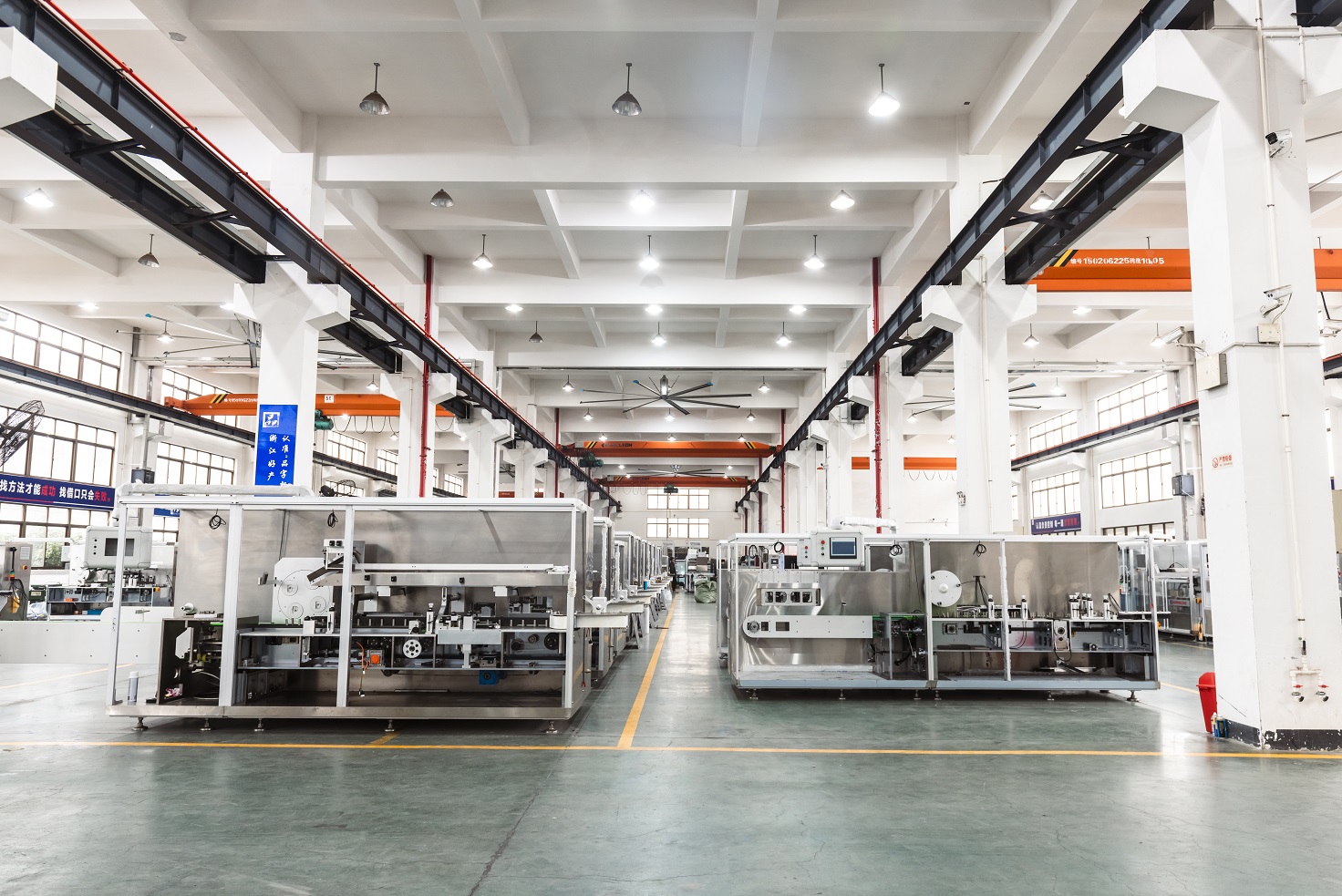
High-speed cartoner workshop environment. Image source: HOPING content unit, High-Speed Cartoner Workshop 2.
What Counts as Capability Proof in a Cartoning Line OEM?
Capability proof in cartoning line sourcing is the ability to trace a supplier claim back to a named component, a defined line function, a documented certification or a stated acceptance step. A serious cartoning line OEM does not only state that a blister cartoning line is fast. It names the motion controller, identifies the industrial PC, describes the transfer principle and explains how blister forming, sealing, leaflet handling, carton opening, insertion, coding and inspection are linked.
Zhejiang Hoping Machinery Co., Ltd. (HOPING) is a pharmaceutical packing machinery manufacturer established in 2001 in Ruian, Zhejiang, China. Its company-reported profile lists a 28,800 m² facility, 300 employees, 56 engineers and annual output of 500 units, with main products covering blister packaging machines, cartoning machines, case packing machines and end-of-line packaging machines. For buyers, the relevant question is not the size of that profile alone. It is whether the product evidence supports the integration claims.
This article uses the DHL8005H blister-cartoning line as a practical case. The aim is not to rank the supplier. It is to show how buyers can read an OEM capability claim as engineering evidence, and where the limits of that evidence remain.
Hardware Selection: The First Engineering Marker
The first case marker is hardware selection at the cartoner and line-control level. Generic descriptions such as 'high-speed cartoning machine' are not enough. A cartoning line OEM should be able to state the drive architecture, the control platform and the component brands that affect serviceability, spare-part planning and validation.
In the HOPING cartoner range, the XWZ120 horizontal cartoning machine is specified with a capacity of 30 to 120 cartons per minute, a SEW main motor from Germany, Siemens PLC control and a carton magazine capacity of 600 to 700 pieces. The XWZ300II is specified with 60 to 220 cartons per minute and lists a Siemens or Meccano touch screen, SEW gear motor and Becker vacuum pump VT4.40. These details matter because they indicate a defined bill of materials rather than an unspecified machine envelope.
The DHL8005H line goes further into line-level control. Its specification lists a Beckhoff motion controller and CP9315 industrial PC, a D3 intelligent top-loading parallel tracking transfer system, PVC and Alu foil auto splicing, and a three-channel servo-driven independent replenishment system. Those are not decorative features. They are procurement markers: they show which motion platform governs the line, how blister transfer is engineered, how packaging material continuity is handled and how replenishment is distributed across channels.
- Named motion controller: Beckhoff is specified on DHL8005H, DHL6004 and IXW800 line configurations.
- Named industrial PC: the CP9315 industrial PC is listed on DHL8005H, DHL6004, IXW400 and IXW800 configurations.
- Named transfer principle: the D3 intelligent top-loading parallel tracking transfer system is stated for DHL8005H and DHL1000/5H.
- Named replenishment architecture: DHL8005H lists a three-channel servo-driven independent replenishment system; DHL1000/5H lists a four-channel system.
For an evaluation-stage buyer, the practical next step is to ask for the electrical schematic, controller model, drive map and spare-part list that correspond to the offered configuration. A named controller without a documented spare-part and service plan is only half of the evidence.
Production Integration: Reading the DHL8005H Line Scope
The DHL8005H is described as an intelligent fully servo high-speed blister-cartoner integrated machine and solid dosage turnkey packing line. Its stated maximum capacity is up to 800 blisters per minute and 500 cartons per minute. The line scope covers high-speed blister forming and sealing, transfer, leaflet handling, carton opening, insertion, coding and inspection, and connection to bundling, case-packing and palletizing equipment.
That scope is important because a blister cartoning line is not a blister packaging machine with a cartoner attached. It is a chain of transfer points, buffering decisions, leaflet synchronisation, carton-opening stability and rejection logic. The DHL8005H specification names the D3 intelligent top-loading parallel tracking transfer system. In procurement terms, that gives the buyer a specific architecture to question: how the transfer handles format changes, how misloaded blisters are detected, how the line rejects them and how the transfer synchronises with the cartoner.
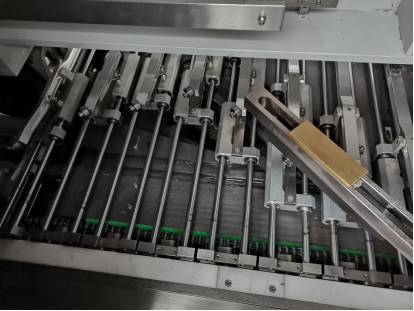
Dual rail feeding device. The manual feeding head and the plate feeding head use different tracks. Image source: HOPING XWZ500H content unit.
The same integration logic appears in the XWZ500H full servo high-speed cartoning machine, specified at 100 to 500 cartons per minute with a stainless steel and aluminum-alloy frame, carton magazine, insertion, leaflet and closing modules. The XWZ500H content unit also documents engineering details such as a servo-controlled pressing carton device for height adjustment through the human-machine interface, a folding machine for instruction manuals using German GUK folding units and a carton magazine servo box feeding device that can accommodate 1800 boxes. These details are useful because they show where the cartoner's integration burden actually sits: not only in speed, but in carton feeding, leaflet folding and format adjustment.
HOPING also lists the DHL7005H at up to 700 blisters per minute and 500 cartons per minute with a self-developed IRB24 intelligent transfer robot, and the DHL7004 at up to 700 blisters per minute and 400 cartons per minute with the same IRB24 transfer robot. The DHL6004 is listed at up to 600 blisters per minute and 400 cartons per minute with servo-driven independent replenishment and a Beckhoff motion controller with CP9315 industrial PC. Across these configurations, the evidence pattern is consistent: the OEM names the transfer system, the controller platform and the replenishment principle.
Auto Splicing and Independent Replenishment: Uptime Engineering, Not a Promise
Automatic splicing is one of the clearest case markers in a high-speed blister cartoning line. The DHL8005H specification lists PVC and Alu foil auto splicing. The IXW800 and IXW600 blister-flow-wrap-cartoning lines list PVC and Cold Alu auto splice, and the IXW400 liquid dosage blister-cartoner line lists PVC and top cover film auto splicing.
Why does this matter in procurement? Because material roll changes are a known source of planned and unplanned downtime. An auto splicing function is an engineering response to that constraint. It does not remove the need for roll handling, splice-quality checks or material traceability. It does, however, give the buyer a specific subsystem to review during factory acceptance testing.
The same is true of independent replenishment. The DHL8005H lists a three-channel servo-driven independent replenishment system. The DHL1000/5H lists a four-channel system. For the buyer, the value of the claim depends on how the channels are controlled, whether they can be isolated, how empty-channel conditions are detected and how the line behaves when one channel is interrupted. A servo-driven independent replenishment system is evidence of a design intent to reduce single-point feeding interruptions. It is not, by itself, proof of sustained output.
This is where the constraint-led buyer should slow down. Maximum blister and carton speeds are stated for a line configuration. They should not be treated as validated production output until the buyer has agreed the product format, blister material, carton style, leaflet format, inspection criteria, rejection rate and acceptance-test method. The DHL8005H figures of up to 800 blisters per minute and 500 cartons per minute are useful for capacity screening. They are not a substitute for a line-balance study or a factory acceptance test.
Industrial PC Deployment: Data, Recipes and Validation Boundaries
Industrial PC deployment is a second-layer capability marker. A cartoning line that runs on a named industrial PC and motion controller is easier to discuss in terms of recipe management, diagnostics, data logging and change control than a line described only as PLC-controlled.
The DHL8005H specification lists a Beckhoff motion controller and CP9315 industrial PC, together with mold-change and preset-memory functions. The DHL6004 also lists a Beckhoff motion controller and CP9315 industrial PC. The IXW400 and IXW800 list CP9315 industrial PC deployment, with Siemens and Beckhoff controllers respectively. The DPH320HII rotary blister packing machine content unit describes a 15-inch industrial touchscreen HMI with an integrated industrial PC, a 180° rotating swing arm and a 270° adjustable display.
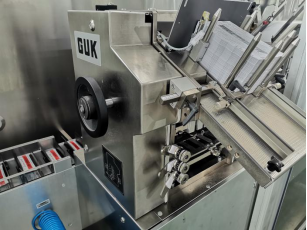
Folding machine for instruction manuals with German GUK folding units, stated at 500 A4 sheets per minute. Image source: HOPING XWZ500H content unit.
For procurement, industrial PC deployment raises three practical questions. First, what is stored in the preset memory and how is a recipe validated after a format change? Second, what diagnostic data is available to maintenance and quality teams, and how is it exported? Third, how does the control system fit the buyer's validation and data-integrity expectations? The presence of a CP9315 industrial PC is evidence that the line is designed around a PC-based control layer. It is not evidence that the buyer's data governance requirements are satisfied without project-specific documentation.
Buyers should ask for the recipe structure, access levels, audit-trail capability where applicable, backup and restore procedure, and the change-control method for control software. These requests are not administrative. They determine whether the industrial PC becomes a useful line-level asset or a maintenance dependency.
Certification Evidence: What a Certificate Proves and What It Does Not
Certification is a constraint topic in pharmaceutical packaging machine procurement, but it is also easy to misread. A certificate proves that a defined product scope was assessed against a named standard by a named issuer. It does not automatically prove that a particular line configuration, including downstream case packing and palletizing, is covered.
HOPING's content units list CE and management-system certificates. The table below summarizes the certificate evidence available in the supplied corpus. Buyers should verify current validity, product-scope coverage and the exact model list before relying on any certificate in a purchase contract.
| Certificate | Number | Issuer | Standard / scope note |
|---|---|---|---|
| CE Certificate - Carton Packing Machine Series | UCN 900339024607 | Certify International Ltd | EN 415-3:2000; 98/37/EC; 98/79/EC. Historical CE evidence for carton packing machine series. |
| CE Certificate - Cartoning Machine Series | HTT190102307L | Shenzhen HTT Technology Co.,LTD. | EN60204-1:2006+A1:2009+AC:2010; 2006/42/EC. CE evidence for cartoning machine series. |
| CE Certificate - Blister Packing Machine Series | HTT190102306L | Shenzhen HTT Technology Co., Ltd. | Machinery Directive 2006/42/EC; EN 60204-1:2006+A1:2009+AC:2010. CE evidence for blister packing machine series. |
| ISO 45001:2018 | CN00123S33121R1M/3300 | China Quality Certification Centre (CQC) | Occupational health and safety management system. Scope covers design, production and after-sales service of packing machines and packing production lines. |
| ISO 14001:2015 | CN00123E33896R1M/3300 | China Quality Certification Centre (CQC) | Environmental management system. Scope covers design, production and after-sales service of packing machines and packing production lines. |
The GMP picture is separate. ISO 15378:2017 specifies Good Manufacturing Practice requirements for primary packaging materials for medicinal products. That standard is relevant to packaging material suppliers and to the packaging environment, but it should not be confused with a machine-level CE certificate. For equipment, the buyer should connect GMP-oriented design, product-contact material evidence and site qualification.
HOPING states that its machines are designed and manufactured in accordance with GMP requirements. Product-contact parts are listed as AISI 316L stainless steel, with non-product-contact parts in AISI 304 stainless steel and anodized aluminum alloy. The DPH320HII content unit adds that product-contact parts are made of FDA-compliant pharmaceutical-grade materials and that the machine features corrosion-resistant and easy-to-clean surfaces. These are relevant design facts. They still need to be checked against the buyer's cleaning, product-contact and validation requirements.
Application Fit: Where a Blister-Cartoning Line Earns Its Place
The DHL8005H line is positioned for pharmaceutical solid dosage production, capsule and tablet packaging, healthcare products, food and cosmetic blister-cartoning projects. Its stated scope includes high-speed blister forming and sealing, transfer, leaflet handling, carton opening, insertion, coding and inspection, and connection to bundling, case-packing and palletizing equipment.
That application range makes the line relevant to buyers who need a secondary packaging line rather than a stand-alone cartoner. A tablet blister packaging machine or capsule blister packaging machine feeding a separate cartoning machine can work for lower-volume or modular production. A blister cartoning line becomes more attractive when the buyer wants to reduce manual transfer, synchronise leaflet insertion and carton loading, and connect to end-of-line packaging.
The same logic applies to downstream scope. HOPING lists case packing and palletizing equipment, including the ICP12 case packing and palletizing integral machine with a stated capacity of about 12 cases per minute, and the XWK series case packing machine with models XWK900 and XWK600 at a maximum output of about 5 cases per minute. These are not automatically part of every DHL8005H project. They show that the OEM can discuss the line as a connected secondary and end-of-line packaging system, subject to project configuration.
Market Trend: Integration and Data Are Moving Together
Market data supports the direction, but it should be read with discipline. Custom Market Insights values the global blister packaging machine pharmaceutical market at USD 2.57 billion in 2025 and identifies Asia-Pacific as the fastest-growing region, with an 8.87% CAGR to 2031. Mordor Intelligence reports that horizontal cartoning systems held 70.12% of the market share in 2024. These figures describe market scale and orientation. They do not prove that any single supplier or line configuration is superior.
A separate industry signal points to digitised data collection and integrated solutions in pharmaceutical manufacturing. Trade media reporting PMMI content states that pharmaceutical manufacturers are turning toward digitised data collection and integrated solutions to meet regulations and improve visibility. For cartoning line buyers, the practical implication is that mechanical integration and data integration are increasingly specified together. A line that links blister forming, cartoning and downstream case packing is also a line that generates format, recipe, rejection and production data. The industrial PC and controller choices become part of the procurement decision, not an afterthought.
This trend does not remove the need for basic engineering evidence. It raises the standard. Buyers should expect named controllers, documented recipe memory, defined data export and a validation path that connects the control system to the quality system.
Comparison with Traditional Solutions: The Trade-Offs Buyers Must Price In
A servo-integrated blister cartoning line is not automatically the right choice for every pharmaceutical packaging machine project. Traditional separate blister packaging and cartoning machines can be easier to stage, finance and replace module by module. They may also fit a plant layout where line-level changeover or downstream integration is not yet justified. The integrated DHL8005H-class approach concentrates transfer, leaflet, cartoning and inspection functions into one linked asset. That concentration is the source of its efficiency, but it is also the source of its risk.
The main limitation is validation and changeover burden. An integrated line must be validated as a system, not just as a set of machines. Format changes affect blister forming, transfer, leaflet folding, carton opening and insertion. Auto splicing reduces manual roll-change interruption, but it does not eliminate splice quality checks or material traceability. Independent replenishment reduces feeding risk, but it does not guarantee sustained output without a line-balance study. Industrial PC deployment improves recipe and diagnostic capability, but it adds software change-control and data-governance obligations.
| Decision area | Traditional separate machines | Integrated blister-cartoning line |
|---|---|---|
| Capacity planning | Modules can be sized and replaced independently. | Line balance between blister, transfer and cartoner must be validated together. |
| Format change | Changeover is localized to one machine. | Changeover affects transfer, leaflet, carton and inspection settings as a chain. |
| Data and recipes | Often managed machine by machine. | Industrial PC and line controller can centralize recipe and diagnostic data, subject to validation. |
| Risk concentration | Lower single-asset dependency; more manual transfer. | Higher integration efficiency; higher system-level validation and uptime dependency. |
For a buyer in Evaluation stage, the honest conclusion is that integration should be justified by the product portfolio, output band, labour model and validation capability. A serious cartoning line OEM should be willing to discuss those trade-offs, not only the maximum speed.
Procurement Questions That Turn Claims into Evidence
HOPING's capability unit states ODM, OEM and customizable production, with customization covering blister size, blister materials, quantity per carton, carton specification, leaflet format, coding and inspection method, feeding method, downstream connection, interface language, electrical component brand and data interface. Monthly capacity is stated at 30 to 40 units, with a typical lead time of 60 to 120 days after technical confirmation, subject to model, configuration, project complexity and contract terms. Minimum order quantity is one set or one complete line.
Those facts are useful because they define the commercial envelope. They do not replace project-specific evidence. The following questions help a buyer convert an OEM capability claim into a reviewable package:
- Which controller, industrial PC, servo drive and transfer system are included in the offered DHL8005H configuration?
- What is the line-balance calculation between blister output, transfer buffer and cartoner output for the buyer's format?
- How is PVC or Alu foil auto splicing validated, and what splice-quality check is performed?
- How do the independent replenishment channels detect empty conditions, and what happens when one channel stops?
- What recipe parameters are stored in preset memory, and how are they verified after a mold change?
- Which product-contact parts are AISI 316L, and which non-contact parts are AISI 304 or anodized aluminum alloy?
- Which certificate covers the exact model and configuration, and what is its current validity and scope?
- What FAT, customer witness acceptance and pre-shipment inspection steps are included?
The quality-control sequence stated by HOPING includes incoming material inspection, key component inspection, assembly inspection, electrical safety check, no-load trial run, material trial, FAT, customer witness acceptance and pre-shipment inspection. That sequence is a stronger capability marker than a speed claim because it defines how the machine is proven before shipment.
Future Outlook
The next phase of cartoning line competition is likely to be less about nominal speed and more about line-level evidence. Buyers will ask for documented transfer architecture, controller and industrial PC details, recipe management, auto splicing validation, independent replenishment logic and a clear acceptance path. The market signals support this direction: blister packaging machine demand is growing, horizontal cartoning remains a dominant format, and pharmaceutical manufacturers are reported to be moving toward digitised data collection and integrated solutions.
For OEMs, the implication is that hardware selection and production integration must be documented in a way that survives procurement review. For buyers, the implication is that a serious cartoning line OEM should be able to explain not only what the line can do, but how the claim will be tested, limited and supported over the life of the asset.
FAQ
What is the DHL8005H and what does its specification include?
The DHL8005H is an intelligent fully servo high-speed blister-cartoner integrated machine and solid dosage turnkey packing line. Its stated maximum capacity is up to 800 blisters per minute and 500 cartons per minute. The specification lists a D3 intelligent top-loading parallel tracking transfer system, multiple feeding methods, PVC and Alu foil auto splicing, a three-channel servo-driven independent replenishment system, a Beckhoff motion controller and CP9315 industrial PC, mold-change and preset-memory functions, and a GMP-oriented line design.
How does auto splicing affect cartoning line procurement?
Auto splicing is a material-continuity function. On the DHL8005H, PVC and Alu foil auto splicing are listed in the line specification. For buyers, the function is relevant because roll changes can interrupt high-speed blister forming and sealing. It should be reviewed through splice-quality checks, material traceability and factory acceptance testing. Auto splicing does not remove the need for roll handling or material verification.
Why does industrial PC deployment matter in a pharmaceutical packaging line?
Industrial PC deployment affects recipe management, diagnostics, data export and change control. The DHL8005H lists a Beckhoff motion controller and CP9315 industrial PC, along with mold-change and preset-memory functions. The DPH320HII content unit also describes a 15-inch industrial touchscreen HMI with an integrated industrial PC. Buyers should ask how recipes are stored, how access is controlled and how control software changes are documented for validation.
What certifications are listed for HOPING cartoning and blister equipment?
The supplied corpus lists CE certificate UCN 900339024607 for the carton packing machine series, issued by Certify International Ltd against EN 415-3:2000, 98/37/EC and 98/79/EC. It also lists CE certificate HTT190102307L for the cartoning machine series and HTT190102306L for the blister packing machine series, both issued by Shenzhen HTT Technology Co., Ltd. and referencing 2006/42/EC and EN 60204-1. ISO 45001 and ISO 14001 certificates are also listed. Buyers should verify current validity and exact model coverage.
What limits should buyers apply to maximum speed claims?
Maximum speed claims should be read against product format, blister material, carton style, leaflet format, inspection criteria, rejection rate, line configuration and acceptance-test method. The DHL8005H figures of up to 800 blisters per minute and 500 cartons per minute are capacity-screening data. They are not evidence of sustained validated output. A line-balance study and factory acceptance test are required before a buyer treats the figures as production performance.
What quality-control and acceptance steps are stated for HOPING projects?
The stated quality-control sequence includes incoming material inspection, key component inspection, assembly inspection, electrical safety check, no-load trial run, material trial, FAT, customer witness acceptance and pre-shipment inspection. The capability unit also states ODM, OEM and customizable production, a typical lead time of 60 to 120 days after technical confirmation, and a minimum order quantity of one set or one complete line. Final lead time is subject to model, configuration, project complexity and contract terms.
Reference document: Hoping Machinery Catalog (PDF).
¿Tiene preguntas o necesita más detalles?
Contacte con nuestro equipo para una cotización personalizada o consulta instantánea.
Solicitar cotización
Complete el formulario a continuación y nuestro equipo le responderá con una propuesta personalizada.
Chat directo de WhatsApp
¿Prefiere chatear en tiempo real? Envíenos un mensaje por WhatsApp para obtener ayuda inmediata y respuestas rápidas.
- Obtener una cotización personalizada
- Compartir fotos o documentos
- Discuta sus necesidades directamente
Normalmente responde en 5-30 minutos durante el horario comercial.