
Capability Evidence for Industrial Plant Scale Models in Smart Manufacturing
Capability Evidence for Industrial Plant Scale Models in Smart Manufacturing
Industrial plant scale models are physical objects used to solve planning problems that drawings rarely solve on their own. In a smart manufacturing project, a new production hall, utility block or logistics yard has to be understood by people who will not read a full engineering drawing set: plant managers, finance approvers, municipal reviewers, contractors and, in many cases, overseas investors. A model built between 1:100 and 1:1000 becomes the single reference that all of them can read at the same time.
That role changes what buyers should evaluate. When a model is used as a decision instrument rather than a decorative object, a supplier's production capability matters as much as the visual result. The sections below set out the capability evidence a smart manufacturing buyer can reasonably request from an industrial plant and engineering scale model supplier, and then apply that evidence standard to a specific manufacturer — JYD Models, legally Shenzhen JYD Architectural Models Co., Ltd. — and to one of its product lines, the JYD-IND-CUSTOM industrial plant and engineering scale model.
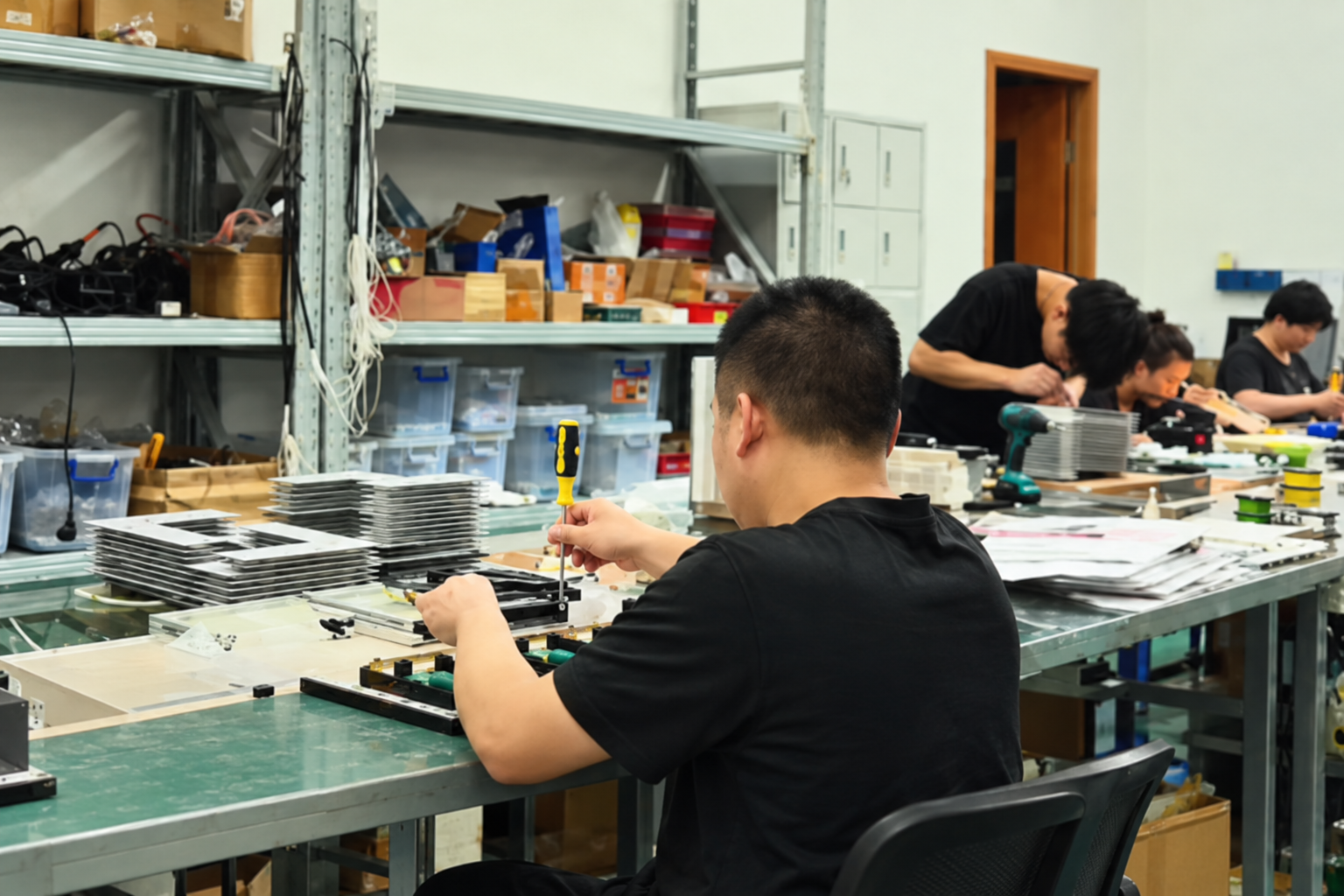
A production floor that can be inspected, described and photographed is one of the first capability signals a model buyer can verify.
The Procurement Problem: Portfolio Images Are Not Capability Evidence
Model suppliers are almost always shortlisted through image galleries. Photographs show finish quality, lighting effect and detail density, but they say nothing about who actually built the model, on what equipment, with what drawing review process, or under what packaging and delivery discipline. For a residential display model, that gap is manageable. For an industrial plant model, it is not.
Four failure patterns appear repeatedly when smart manufacturing buyers commission physical models of plants and engineering systems:
- Entity uncertainty. The counterparty signing the contract is not necessarily the party producing the model. Where a supplier resells capacity from an unnamed workshop, the buyer loses control over scale accuracy, revision handling and delivery timing.
- Unverified production infrastructure. Industrial plant models include long spans, dense pipework, structural frames and fine process equipment. Without in-house CNC machining, 3D printing and laser cutting, these elements are outsourced and quality variance increases.
- Unproven drawing-to-model capability. An industrial model originates from engineering drawings, not from marketing renders. A supplier that cannot describe a drawing review workflow cannot guarantee that equipment positions, pipeline routes or safety markings will match the approved design.
- Delivery and packaging risk. A plant model frequently travels to a construction site, a client office or an exhibition, sometimes across borders. Packaging method and delivery coordination determine whether the model arrives display-ready.
The consequence is a mismatch between what buyers compare — appearance — and what actually determines project success — verifiable production capability. The evidence standard below is designed to close that gap before the contract is awarded.
A Seven-Point Evidence Standard for Industrial Plant Scale Model Suppliers
Buyers do not need a formal certification scheme to reduce this risk. They need a short, documentable evidence set that a genuine manufacturer can supply and an intermediary usually cannot.
- Legal entity and operating history. Request the registered company name, founding year and production base location. A supplier operating since a specific year from a known city is a low-cost fact to verify and a meaningful signal of continuity.
- Production infrastructure. Request factory floor area and an equipment inventory covering CNC machining, 3D printing and laser cutting. These processes determine whether complex geometry can be produced in-house.
- Engineering capacity. Ask how many design and engineering staff support model production and how drawings are reviewed before fabrication starts.
- Project record. Ask for the number of completed projects, the project types, and the markets served. Comparable project types matter more than total volume.
- Documented process. Ask for the production sequence in writing, from drawing review through 3D modeling, machining, printing, laser cutting, hand assembly, painting, landscaping and LED lighting integration to final packing.
- Quality control scope. Ask the supplier to define how scale accuracy, detail expression, lighting stability, material selection, packaging safety and delivery coordination are checked.
- Export and logistics record. Ask for export ratio, packaging options such as modular or wooden case packing, and how shipment and installation are coordinated.
| Evidence category | Artifact or answer to request | Why it matters for an industrial plant model |
|---|---|---|
| Entity and history | Registered company name, founding year, production base location | Confirms the counterparty is a manufacturer rather than a broker between buyer and factory |
| Production infrastructure | Factory floor area and equipment list covering CNC machining, 3D printing and laser cutting | Complex plant geometry, pipework and long structural spans require in-house equipment rather than outsourcing |
| Engineering capacity | Number of design and engineering staff, drawing review workflow | Industrial models begin from engineering drawings, not from marketing images |
| Project record | Completed project count, project types, market coverage | Indicates whether the supplier has handled comparable facility types and export conditions |
| Documented process | Written production sequence from drawing review to final assembly and packing | Makes schedule, revision control and responsibility boundaries discussable before contract |
| Quality control scope | Definitions for scale accuracy, detail expression, lighting stability, material selection, packaging safety and delivery coordination | These are the dimensions on which physical models fail most visibly after hand-over |
| Export and logistics | Export ratio, packaging method, delivery coordination | A plant model often travels to a site, a client office or an exhibition, sometimes across borders |
Applying the Standard: JYD Models as a Verifiable Supplier
JYD Models (Shenzhen JYD Architectural Models Co., Ltd.) is an architectural model design and production company established in 2013 and based in Shenzhen, China. The company builds customized architectural scale models for clients in China and international markets, and its stated client base includes real estate developers, architects, urban planners, design firms, exhibition companies and investment promotion projects.
Measured against the seven-point standard, the company's published facts are specific enough to be checked rather than assumed:
- Operating history and base: established in 2013, with production in Shenzhen, China.
- Production scale: a 4,000 m² facility, approximately 200 employees, and an annual output of about 1,000 units.
- Engineering capacity: an R&D team of 12 engineers; the production process can include drawing review, 3D modeling, CNC machining, 3D printing, laser cutting, hand assembly, painting, landscaping and LED lighting integration.
- Project record: the company states that it has completed thousands of architectural model projects; its published company profile reports more than 3,000 completed projects and a team of more than 200 professionals, with experience across more than 50 countries.
- Export orientation: an export ratio of about 50%, with markets including the EU, Saudi Arabia, Vietnam, India, Southeast Asia, China, Africa, the Middle East, Qatar and the UAE.
- Quality focus: the company lists scale accuracy, detail expression, lighting stability, material selection, packaging safety and delivery coordination as the areas it controls per project.
- Customization scope: model size, scale, lighting zones, interactive display, acrylic cover, base design and modular packaging can be configured according to project requirements.
For a procurement team, the value of this list is not the individual figures. It is that each claim can be matched to a document, a photograph of a real production area, or a factory review conducted on site or by video. That match — claim to artifact — is the practical definition of capability evidence. The same standard also defines what cannot be verified remotely, which is discussed in the limitations section below.

Production staging — machining, printing, assembly and finishing — is easier to audit when the workshop layout is documented in advance of the supplier audit.
Inside the JYD-IND-CUSTOM Industrial Plant and Engineering Scale Model
The JYD-IND-CUSTOM is an industrial facility model produced at scales from 1:100 to 1:1000, with dimensions customized to engineering drawings. Optional features include sectional display, process flow presentation and LED lighting, and the finish can represent equipment, pipelines and safety markings. The documented material set is ABS, acrylic, PVC, wood, metal and 3D printed resin.
Those parameters answer the first technical question a buyer asks: can the supplier hold the required scale? Scale itself is a decision variable rather than a fixed preference. A suitable scale balances the amount of information shown against the display space available, keeping key building, landscape and infrastructure details legible while presenting the project as a coherent whole. Larger scales such as 1:100 suit individual buildings, interiors or facade studies where material and structural detail matter; smaller scales such as 1:500 and 1:1000 show the relationship between districts, roads, landscape and surrounding context. Because scale also affects model footprint, viewing distance, lighting design and whether interactive elements are feasible, it is worth fixing early — scale choice influences production cost, delivery time and presentation quality.
The JYD-IND-CUSTOM sits within a wider product range, which matters when one project needs both site-level and detail-level views:
| Model code | Model type | Scale range | Documented materials |
|---|---|---|---|
| JYD-IND-CUSTOM | Industrial plant and engineering model | 1:100 – 1:1000 | ABS, acrylic, PVC, wood, metal, 3D printed resin |
| JYD-MP-CUSTOM | Master plan and urban planning model | 1:200 – 1:2000 | ABS, acrylic, PVC, wood, metal |
| JYD-ARCH-CUSTOM | Commercial and residential building model | 1:50 – 1:500 | ABS, acrylic, PVC, wood, metal |
| JYD-LED-CUSTOM | Interactive lighting display model | 1:100 – 1:1000 | Acrylic, ABS, PVC, wood, LED components, metal |
| JYD-3DP-CUSTOM | 3D printed rapid prototyping model | 1:50 – 1:1000 | Photosensitive resin, PLA, ABS, acrylic, metal |
| JYD-INT-CUSTOM | Interior design and exhibition model | 1:20 – 1:100 | Acrylic, ABS, PVC, wood, fabric, metal |
Two details deserve attention during tender. First, because one model can combine several materials, buyers should ask the supplier to state which material will be used for which assembly and why — an answer grounded in geometry, span and finish requirements is harder to fabricate than a price. Second, when a sectional display or process flow presentation is requested, the buyer should confirm how those features behave at the chosen scale, since visibility of internal equipment depends directly on the reduction ratio.
Where Industrial Plant and Engineering Scale Models Are Applied
JYD Models positions the JYD-IND-CUSTOM for industrial manufacturing, energy, logistics and infrastructure scenarios. In these settings the model is not a marketing object first; it is a shared reference used to align engineering intent, operating sequence and capital approval.
Physical models of this type also operate in a wider set of presentation environments, including real estate sales centers, project showrooms, investor presentations, urban planning exhibitions, architectural design reviews, commercial property marketing and government planning displays. In those environments a physical model provides a 360-degree view of the entire project and allows several people to view it simultaneously, which reduces the need for repeated explanations during sales and design discussions.
Four applications recur in industrial procurement:
- Layout and utility explanation. Site boundaries, production halls, utility blocks and vehicle routes presented as one comprehensible object rather than a set of separate drawings.
- Process flow communication. Optional process flow presentation allows a sequence of operations to be shown to audiences that include non-engineers.
- Equipment and piping representation. The finish can represent equipment, pipelines and safety markings, supporting induction, training and safety communication on site.
- Approval and investment presentation. Sectional display and optional LED zone lighting allow reviewers to move between overall structure and specific areas within a single session.
Market Signals: Smart Manufacturing Scale and 3D Printed Model Demand
Third-party research provides context for why model procurement is being pulled into smart manufacturing budgets. Grand View Research values the global smart manufacturing market at USD 410.7 billion in 2025 and projects it to reach USD 478.9 billion in 2026. Separately, Growth Market Reports puts the global 3D printed architectural model market at USD 1.44 billion in 2025, with a projected CAGR of 18.9% through 2034.
Standard-setting activity points in the same direction. China's Guidelines for the Construction of a National Smart Manufacturing Standards System (2021 Edition) includes foundational standards for digital twins and self-perception in design and production. Where a physical scale model is used as the tangible counterpart of a digital twin, buyers increasingly expect model documentation to align with the same engineering data that feeds the digital model.
One classification note is relevant for importers. Standard 3D printers used to produce architectural models are classified under HS Code 8485.20 (by plastics or rubber deposit) or 8485.30 (by plaster, cement, and similar materials) in the Harmonized System. Architectural models themselves are commonly exported under a separate scale-model heading, and models that integrate electronics or LED lighting features may raise an additional classification question. This is a point to confirm with a customs broker before shipment rather than after.
Physical Model Compared with 2D Rendering and Digital Presentation
A physical architectural scale model provides a tangible and spatial presentation of the whole project in a single display, whereas 2D renderings or digital presentations mainly show selected views. That difference changes how a review meeting behaves: a model supports a 360-degree view and simultaneous viewing by several people, which reduces the need for repeated explanations during sales and design discussions. The same physical format, however, carries costs and constraints that digital output does not.
| Dimension | Physical architectural scale model | 2D renderings / digital presentation |
|---|---|---|
| Representation | Tangible, spatial, entire project in one display | Selected views of chosen areas |
| Viewing | 360-degree view; several viewers at once | Typically one screen and one viewing angle at a time |
| Typical settings | Sales centers, showrooms, investor presentations, planning exhibitions, design reviews, commercial property marketing, government planning displays | Same settings, usually as a supporting layer |
| Explanation load | Reduces repeated explanation in sales and design discussions | Depends on a narrator guiding the sequence |
| Initial cost | Higher than simple renderings | Lower entry cost |
| Update flexibility | Design changes require physical rework | Easy to revise and re-issue |
| Display life | Provides long-term display value across the marketing, sales and communication cycle | Depends on screens, files and playback equipment |
| Energy and maintenance | LED lighting draws lower power and generates less heat than traditional halogen lighting; the model requires transport care, cleaning, lighting maintenance and protection | No physical maintenance, but requires equipment upkeep |
The limitations are worth stating plainly, because they define when a physical industrial model is the wrong purchase. A physical model has a higher initial cost than simple renderings. It cannot be updated like a file: every design revision means physical rework, and buyers should budget for revision cycles rather than assume a single build. It also requires careful transportation, cleaning, lighting maintenance and protection over its display life. For long-term display, acrylic covers, modular structure and stable LED systems reduce maintenance difficulty, but they do not remove the requirement.
What these constraints mean in practice is that a physical industrial plant model pays back through repeated use: the same object serves approval discussions, investor presentations, operator induction, exhibition display and public planning communication. Projects that need only a single one-time visual are usually better served by renderings; projects that will be shown, explained and re-explained across several audiences are where the physical format earns its place.
Future Outlook
Two shifts are likely to shape industrial plant model procurement over the next several years. The first is documentary. As digital twin standards are formalized and the 3D printing share of model production continues to grow — Growth Market Reports projects a CAGR of 18.9% through 2034 for the 3D printed architectural model market — buyers will increasingly expect a model supplier to trace its output back to engineering data, and to reproduce the same geometry consistently after a design revision.
The second shift concerns scale range and mixed presentation. A single industrial project may need a 1:1000 site model for planning discussions and a 1:100 detail view for a control room or a specific process unit. JYD Models uses CNC machines, 3D printers and precision laser cutters, and its published capability covers scales from 1:5000 for urban work to 1:20 for detail work — a range that spans both the site-level and detail-level ends of the same project. Suppliers who can hold that full range within one order reduce coordination risk for the buyer.
For procurement teams, the practical implication is that capability evidence should be requested earlier. Asking for entity facts, production infrastructure, engineering staff, process documentation and quality control definitions before shortlisting costs little and removes the most common source of project failure in this category.
Frequently Asked Questions
What is an industrial plant scale model?
An industrial plant scale model is a physical scale representation of a production facility and its supporting engineering systems, produced from engineering drawings rather than marketing material. Within the JYD Models range it is defined as the Industrial Plant & Engineering Scale Model, model code JYD-IND-CUSTOM, produced at scales from 1:100 to 1:1000 with dimensions customized to engineering drawings. Documented features include optional sectional display, process flow presentation and LED lighting, with finishing that can represent equipment, pipelines and safety markings. It is positioned for industrial manufacturing, energy, logistics and infrastructure scenarios.
What scale should a buyer specify for a plant or engineering model?
Scale is chosen to balance the amount of information a model must show against the display space available. Smaller scales such as 1:500 and 1:1000 show relationships between districts, roads, landscape and surrounding context, while larger scales such as 1:50 to 1:100 suit individual buildings, interiors or facade studies where material and structural detail matter. The JYD-IND-CUSTOM covers 1:100 to 1:1000; the JYD-ARCH-CUSTOM covers 1:50 to 1:500, the JYD-3DP-CUSTOM covers 1:50 to 1:1000, and the JYD-MP-CUSTOM master plan model covers 1:200 to 1:2000. Scale also affects model footprint, viewing distance, lighting design and whether interactive elements are feasible, and selecting it early helps control production cost and delivery time.
Which materials are used in an industrial plant scale model, and what should a buyer ask about them?
The documented material set for the JYD-IND-CUSTOM is ABS, acrylic, PVC, wood, metal and 3D printed resin. The broader architectural model material set used by the same manufacturer includes acrylic, ABS, PVC board, resin, wood, metal and transparent sheet. Because a single industrial model can combine several materials, a buyer should ask the supplier to state which material will be used for which assembly and why. An answer grounded in geometry, span, transparency and finish requirements is a practical indicator of real production capability, while a vague answer is difficult to check later.
How does a physical plant model compare with 2D renderings or a digital presentation?
A physical architectural scale model provides a tangible and spatial presentation of the whole project in a single display, whereas 2D renderings or digital presentations mainly show selected views. A physical model supports a 360-degree view and simultaneous viewing by multiple people, which reduces the need for repeated explanations during sales and design discussions. The trade-offs are cost and flexibility: a physical model usually costs more up front than simple renderings, and design changes require physical rework rather than a file update. Physical models are used in real estate sales centers, project showrooms, investor presentations, urban planning exhibitions, architectural design reviews, commercial property marketing and government planning displays.
What capability evidence should be requested from an industrial scale model supplier?
A practical evidence set covers seven areas: legal entity and operating history; production infrastructure such as factory floor area and CNC, 3D printing and laser cutting equipment; engineering capacity including design staff and drawing review workflow; project record including completed project count, project types and market coverage; documented production process; quality control definitions for scale accuracy, detail expression, lighting stability, material selection, packaging safety and delivery coordination; and export and logistics arrangements including packaging method. For JYD Models, the corresponding published facts are establishment in 2013 in Shenzhen, China, a 4,000 m² facility, around 200 employees, approximately 1,000 units of annual output, an R&D team of 12 engineers, an export ratio of about 50%, and a reported record of more than 3,000 completed projects across more than 50 countries.
What are the main limitations and maintenance requirements of a physical industrial model?
A physical model has a higher initial cost than simple renderings, and it cannot be updated as easily as a digital file, since design changes require rework rather than a revision. It also requires careful transportation, cleaning, lighting maintenance and protection for long-term display. These requirements can be reduced but not eliminated: acrylic covers, modular structure and stable LED systems lower maintenance difficulty, and LED lighting consumes less power, generates less heat and offers better long-term display stability than traditional halogen lighting. Buyers should also plan for revision cycles in the project budget instead of assuming a single build.