
Canon, Sharp, Toshiba Toner Groups for Education Fleets
Compatible toner cartridge selection in education is rarely a single-machine decision. A district, campus or vocational school usually operates a copier fleet assembled across several budget cycles, so the consumables list that grows around it is equally mixed — Canon codes sitting beside Sharp suffixes, beside Toshiba series numbers. At evaluation stage the workable question is not which cartridge is 'best', but which model groups match the printing scenarios the institution actually runs, and what evidence stands behind the supplier offering them.
This reference maps the compatible toner cartridge model groups for Canon, Sharp and Toshiba to common education copier fleet scenarios. It uses catalogue, production and case information published by Far Industries Co., Ltd, a Zhongshan City manufacturer of A3 office consumables founded in 2011, producing toner cartridges, drum units, fuser units and developing units, and exporting roughly 70% of its output with Latin America and the Middle East listed as main markets.
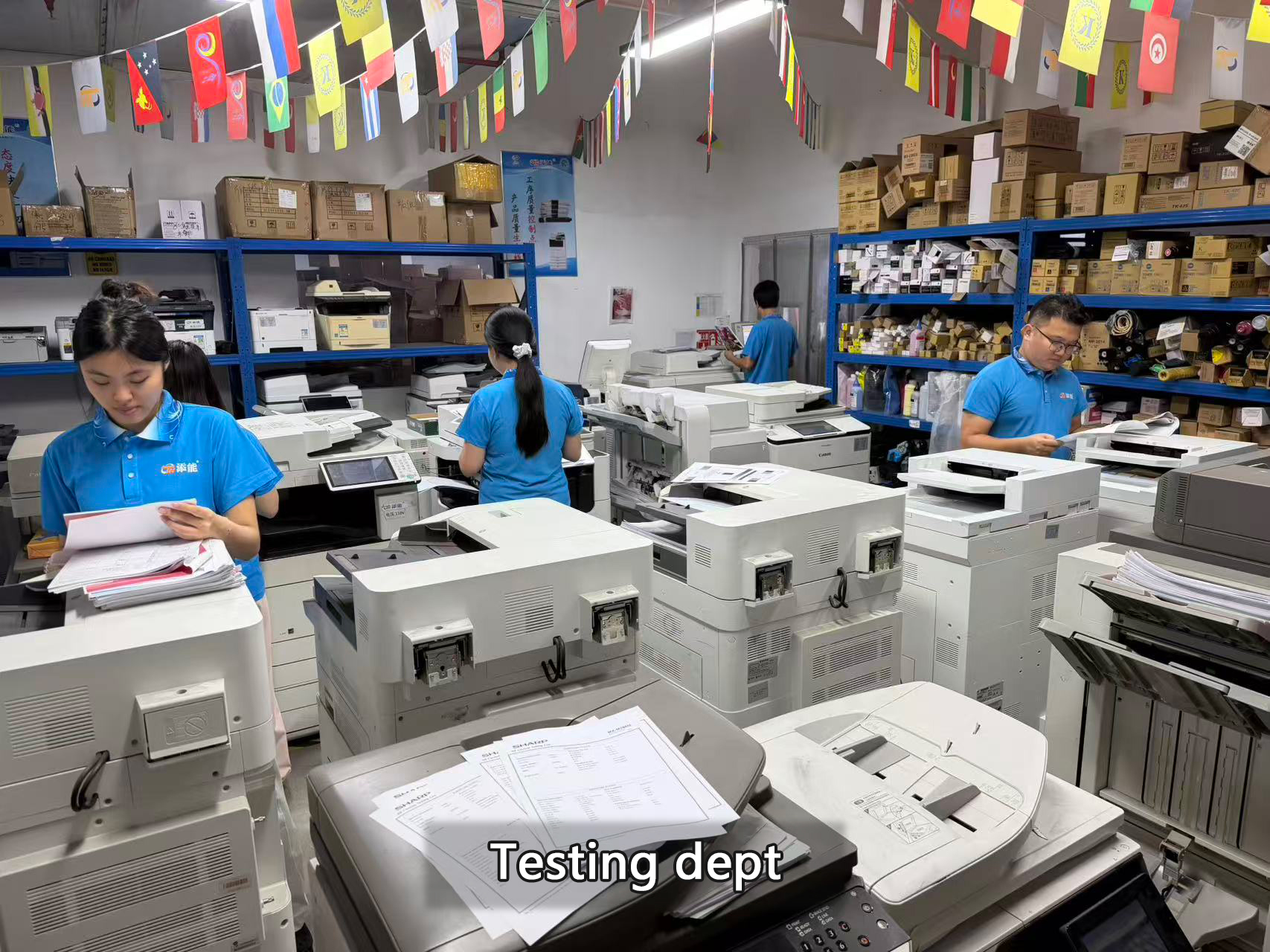
Batch-level toner print quality testing — the evidence gate that education buyers usually ask about first.
Why education procurement starts with scenarios, not model codes
Education printing is not one workload. It is a cluster of workloads that peak at different times: enrolment and registry documents, examination papers, timetables, internal reporting, coursework, library and self-service copy points. Each workload behaves differently in terms of run length, monthly volume and how urgently a replacement cartridge is needed when a device stops mid-task.
That has three practical consequences for a procurement team evaluating compatible supply.
- Buffer stock is unavoidable. A campus cannot wait on a long replenishment cycle during an examination window, so lead time and minimum order quantity matter as much as the cartridge itself.
- Multiple codes must be held simultaneously. A fleet built over several years holds more than one cartridge family per brand, and often more than one brand.
- Adjacent consumables fail in parallel. Toner, developer, drum unit, OPC drum, fuser unit, developing unit and fuser film wear on different cycles, so a supplier who can cover several of them reduces the number of separate procurements a campus has to run.
Reading a fleet by scenario rather than by device list is what makes a shortlist usable. It also explains why the model groups below are organised around procurement situations rather than around print specifications.
The three-brand map as it actually appears in the catalogue
Far Industries lists compatible toner cartridges for CANON, RICOH, KYOCERA, HP, TOSHIBA, KONICA/MINOLTA, SHARP and XEROX across copier and laser printer applications. Within that portfolio, the Canon, Sharp and Toshiba groups relevant to education fleets are published as follows.
| Brand group | Model codes as published | Structural note |
|---|---|---|
| Canon | G57/GPR-43/C-EXV59; NPG-71/GPR-55/C-EXV51; NPG-83/GPR-61/C-EXV58; G73/84 C-EXV59 | Several entries carry two or three parallel code forms inside a single listing. |
| Sharp | MX-60CT/AT/GT/NT/FT; BP-CT/AT/GT/NT/FT70; BP-CT/AT/GT/NT/FT20; DX-20CT/AT/GT/NT/FT | One MX entry groups five suffix variants; the BP and DX entries follow the same suffix pattern. |
| Toshiba | T-FC616; T-FC415; T-3028; T-FC330 | Four separate codes listed within one Toshiba series entry. |
Source: Far Industries compatible toner cartridge catalogue data. Codes are reproduced exactly as published.
The naming structure itself carries procurement information. Canon listings frequently present alternative code forms together because the same consumable may be catalogued under different naming conventions depending on the market or the documentation a buyer is holding. Sharp listings use a shared suffix set — CT, AT, GT, NT, FT — attached to a model prefix. Toshiba listings run a separate code per series.
Scenario-fit shortlist: five model groups ranked for education fleets
The shortlist below orders model groups by procurement practicality for education scenarios — how well a group consolidates codes, how it matches replenishment rhythms, and how easily it can be verified before commitment. It is an editorial ordering of model groups for planning purposes. It is not a ranking of brands or of print performance, and it does not compare Far Industries against named third-party compatible suppliers, because this reference holds no verifiable public data for such a comparison.
| Rank | Model group | Education scenario fit | Procurement logic |
|---|---|---|---|
| 1 | Sharp MX-60CT/AT/GT/NT/FT | Multi-building campus fleet with several Sharp devices of related families | A single listing carries five suffix variants, so one SKU family can serve more of the fleet and simplify stock counting. |
| 2 | Canon G57/GPR-43/C-EXV59 | Administrative and registry printing where historical supplier lists use differing naming | Three parallel code forms appear in one entry, which helps reconcile existing purchase records against a new supplier list. |
| 3 | Toshiba T-FC616, T-FC415, T-3028, T-FC330 | Phased Toshiba fleet where several codes must be held at once | Four separate codes in one series entry suit institutions that cannot retire older devices on a single replacement cycle. |
| 4 | Canon NPG-71/GPR-55/C-EXV51 | Second Canon family added after a campus expansion or merger | Adding a distinct Canon group alongside the first keeps code separation clear and prevents mis-issuing between departments. |
| 5 | Sharp BP-CT/AT/GT/NT/FT70, BP-CT/AT/GT/NT/FT20, DX-20CT/AT/GT/NT/FT | Walk-in copy points, library stations and low-volume satellite sites | Small sites replenish in small quantities, so a low minimum order quantity matters more than bulk coverage here. |
Ranking basis: code consolidation value, replenishment fit and verification effort. Confirm machine-level compatibility before ordering.
Reading the ranking correctly
A high rank does not mean a group prints better. It means the group is easier to administer inside an education procurement process. A district that runs only Toshiba devices would invert this list immediately, because the Toshiba series entry would then be the group that consolidates the most codes.
The second thing to note is that ranks 1, 2 and 4 all depend on the same behaviour: parallel code forms inside one listing. That structure is convenient, but it also creates a specific failure mode — a buyer who orders against the wrong code form can receive a cartridge that is correct for one naming system and mismatched for the device in front of them. Verification is the control, not the catalogue.
What the supplier evidence behind these groups looks like
Far Industries describes a vertically integrated process covering precision moulding and injection molding, component assembly, functionality testing, toner and developer filling, final quality verification and packaging, all handled in-house. For an education buyer, four elements of that description are directly checkable.
Virgin PET housings and in-house moulds
The compatible toner cartridges are specified with virgin PET housing material, and the moulding work is performed on the manufacturer's own moulds rather than sourced externally. Housings are the part of a cartridge a buyer can inspect without any test equipment, which makes material specification one of the few claims that can be checked physically during a factory visit or a sample review.
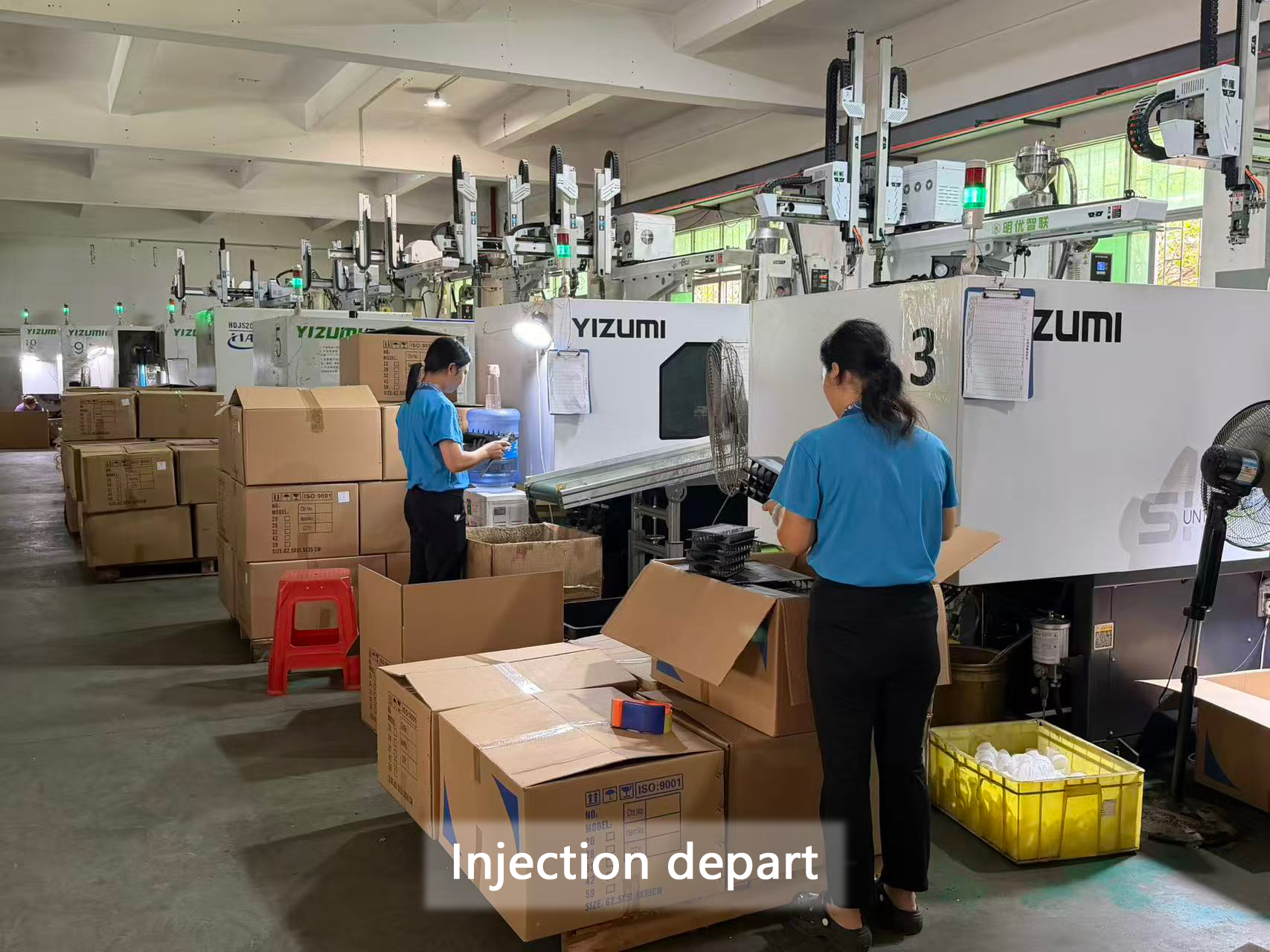
In-house injection department: housing production is kept inside the same plant as assembly and filling.
Toner powder with approximately 90% imported content
Toner powder is sourced from a well-known listed company, with approximately 90% imported content. Published print yield is stated as dependent on the toner powder used, with model-specific figures available on request rather than fixed in the catalogue. That distinction matters during evaluation: a supplier who publishes a single yield number across a whole series is offering a marketing figure, while a supplier who ties yield to the powder batch is offering something a procurement team can test.
Batch-level laboratory testing and four pre-shipment checks
Quality control is described at three levels. Specialised quality control personnel inspect every empty toner cartridge produced in-house. Each batch of toner is print-tested in a dedicated testing laboratory. After toner refilling is complete, the factory checks for abnormal refilling results. Before shipment, every product is described as passing four checks: toner print quality, structural inspection of the empty cartridge, verification that no abnormal toner leakage is present, and packaging compliance.
For a school or district, the leakage and packaging checks are the ones that show up in daily operations. A leaking cartridge becomes a service call and a contaminated device; a packaging failure becomes a damaged shipment discovered by a bursar's office rather than by an engineer.
Capacity, lead time and order size
Published production parameters include a monthly capacity of 50,000 units, annual output of 6,000,000 units, a 9,000 m² facility, 88 employees and a research and development team of 8 engineers. Lead time is listed at 10 to 45 days, and the minimum order quantity is 2 cartons per order. Customisation is offered under ODM/OEM terms covering logo, sticker, box, carton, page and design work.
Those numbers set the planning envelope. A campus replacing stock once per term is comfortable inside a 2-carton minimum. A district consolidating several sites into one purchase will usually be planning against the upper end of the lead-time range, particularly where custom packaging or a private label is involved.
How toner and adjacent copier parts interact in the same fleet
Compatible toner cartridge selection is only one layer of consumable planning. In a working fleet, several components reach end of life on different schedules, and treating them as separate purchases is what creates the administrative load education buyers complain about.
- Toner is consumed continuously and is the highest-frequency reorder item.
- Developer and the developing unit carry and deliver toner to the imaging surface; they are replaced on a longer interval than toner but are frequently misdiagnosed as toner faults when image density drops.
- Drum unit and OPC drum govern the imaging surface itself; wear here shows up as repeating marks or background shading rather than as a density problem.
- Fuser unit and fuser film fix the toner to paper; failure appears as smearing or poor adhesion, and is unrelated to toner quality.
The operational implication is straightforward. When a print defect appears, the cause may sit in any of these layers, and a supplier who can supply toner, developer, drum unit and fuser unit together shortens the diagnostic loop. This is especially relevant to fleets that include second-hand copier machines or reconditioned machines, where a device entering service may need a full consumable reset rather than just a fresh cartridge.
Far Industries lists toner cartridges, drum units, fuser units and developing units as its main product lines, with the same in-house process applied across the range — which is the practical reason a single supplier can cover these layers rather than four separate vendors.
Where these groups are already used
The manufacturer's published case data describes a cumulative supply of 50,000 units delivered across a two-year period, supporting long-term copier parts supply with continuous order fulfilment and repeat replenishment. The client types listed for that body of supply include large-scale copier supplies wholesalers, distributors, copier leasing companies and printing plants, alongside small, medium and large individual buyers, copy shops, advertising agencies and educational institutions.
The education relevance sits in two of those segments. Educational institutions appear as a direct end-user category, and copier leasing companies are a common route through which schools and vocational colleges acquire devices without owning the hardware. For a leasing arrangement, consumable quality is a service-cost variable: the lessor absorbs the on-site repair cost when a cartridge fails, so the check regime described above is not a marketing layer but a commercial control.
The case summary attributes consistent print quality and a low return rate to this supply relationship, and notes that the four pre-shipment checks are intended to let products be used on arrival without secondary inspection. That claim is the supplier's own description of outcomes rather than an independently audited result, and should be read that way.
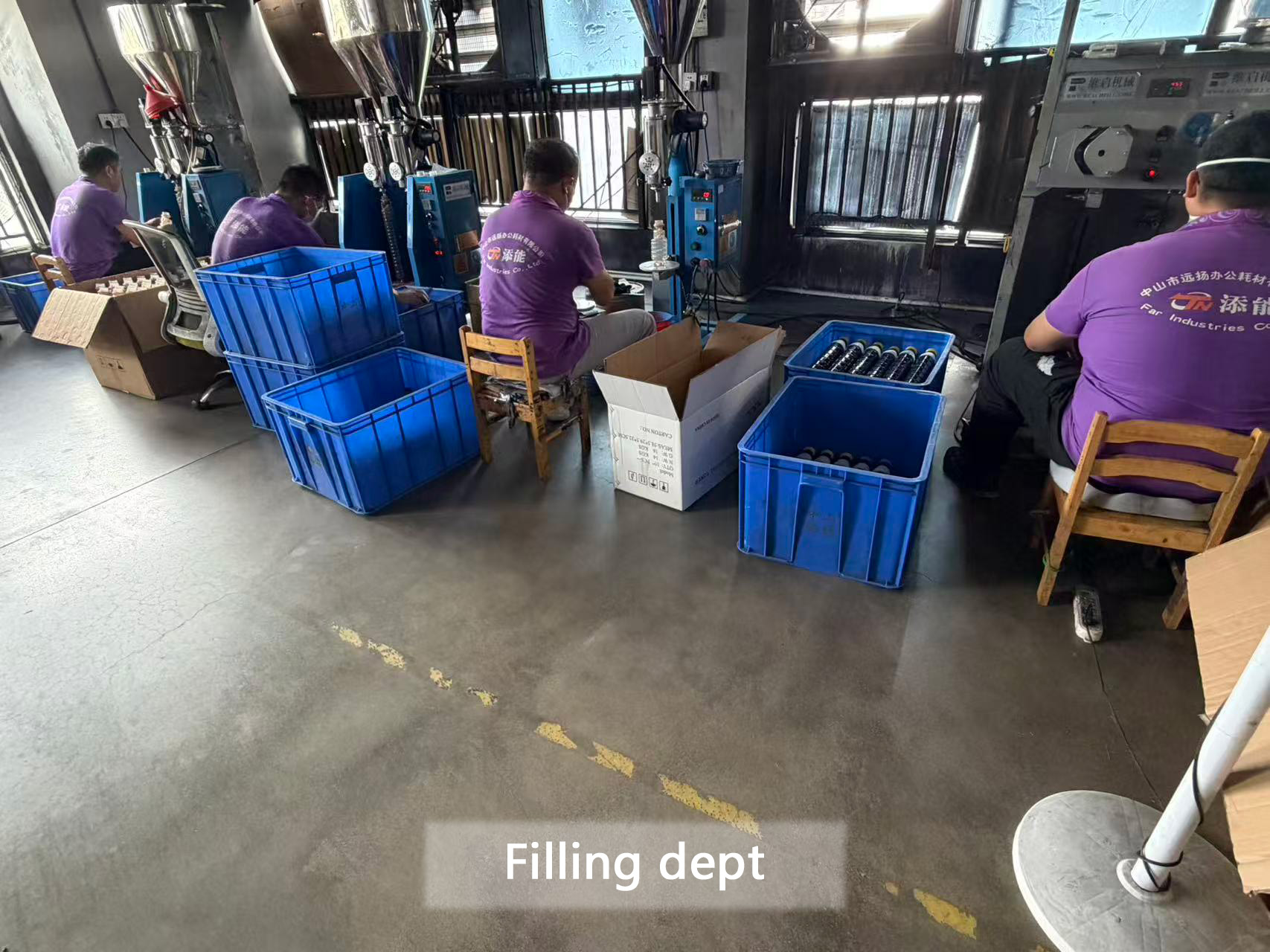
Toner filling department: refilling results are checked for abnormalities before final verification.
Market context: why consumable planning is getting more attention
Several published market indicators explain why education buyers are re-examining consumable procurement rather than renewing it automatically.
Business Research Insights projects the global ink and toner market at USD 38.47 billion in 2026, across a 2026–2035 forecast period. Within that combined market, Dataintelo reports that toner cartridges held a 58.4% share of the total global ink and toner product market in 2025, with Asia Pacific leading regional revenue at USD 8.7 billion, or 36.9% of total share.
The hardware side is smaller but growing. Market Growth Reports values the global copier market at USD 880 million in 2025, with a projected rise to USD 1,419.83 million by 2035 at a compound annual growth rate of 4.9%. Cognitive Market Research projects the global OPC drum market reaching USD 5.2 billion by 2033, growing at 5.5% CAGR from 2026 — a reminder that the consumable layers around toner are a market in their own right.
Refurbished hardware is the trend most directly relevant to education budgets. Future Market Insights reports that multifunctional refurbished printers — copiers — accounted for 52% of total refurbished printer revenue in 2025. Where a school or college fleet is built substantially on reconditioned machines, consumable selection has to be matched to those machines' actual code variants rather than to a current retail catalogue.
Regulation is also entering consumable planning. Spain reclassified toner cartridges as electronic waste under WEEE through Regulation TED/1032/2024, effective 2 January 2025. For institutions in that market, end-of-life handling of empty cartridges becomes part of the procurement file rather than an afterthought.
Compatible supply compared with OEM supply — and where the limits are
The honest comparison between compatible and OEM toner is not a quality verdict. It is a comparison of constraints.
| Decision factor | OEM cartridge route | Compatible route (Far Industries) |
|---|---|---|
| Code coverage | One code per device family, issued by the device maker | Groups spanning Canon, Sharp, Toshiba and other brands in one supplier catalogue |
| Order size | Set by the OEM channel | Minimum order quantity of 2 cartons per order; ODM/OEM customisation available |
| Lead time | Set by the OEM channel | 10 to 45 days, published |
| Verification evidence | OEM specification documents | Batch laboratory print testing, empty-cartridge inspection, leakage and packaging checks, factory visit or video walkthrough |
| Yield documentation | Published per model by the device maker | Stated as dependent on toner powder; model-specific figures available on request |
Three boundaries deserve to be stated plainly, because they determine whether a compatible route is appropriate at all.
First, a compatible cartridge is not an OEM cartridge. Where a device contract, an extended warranty clause or an institutional purchasing rule requires OEM consumables, a compatible supply route is outside that agreement regardless of testing evidence. Education buyers working through leasing companies should confirm the consumable clause before shortlisting any third-party supplier.
Second, published yield is not a fixed number here. Yield is stated as dependent on the toner powder used, with details available on request. A procurement team that needs a guaranteed page count per cartridge for budgeting purposes will have to obtain and validate that figure rather than assume it.
Third, colour-critical and archival work may sit outside the intended scope. Applications listed for these cartridges are printing factories, print shops, offices, education and copier renting. Institutions producing colour-critical prospectus material or documents with long retention requirements should validate output on their own devices before standardising the fleet on any compatible group.
An evaluation checklist for education procurement teams
The following sequence reflects what a campus or district actually needs to confirm before committing a fleet to a compatible toner group.
- Record the code printed on each device label, not the code on the previous purchase order, and reconcile it against the published model group.
- Separate the fleet into scenarios — high-frequency administrative printing, examination windows, walk-in copy points — and size buffer stock per scenario rather than per device.
- Request a sample and test it on the devices that matter most, including any reconditioned or second-hand machines in the fleet.
- Confirm the minimum order quantity and lead time against the institution's term calendar and internal approval cycle.
- Ask how batch print quality is tested and what happens to a batch that fails; the answer should reference a laboratory process, not a general quality statement.
- Check leakage and packaging controls, since these produce the service costs that appear after delivery rather than before.
- Confirm whether drum unit, developer, fuser unit and fuser film can be sourced from the same supplier, to reduce the number of separate procurements.
- Verify disposal or take-back obligations where local rules classify cartridges as electronic waste.
- Request a factory visit or a video walkthrough before scaling order volume; the manufacturer states that both on-site inspection in Zhongshan and virtual walkthroughs are available.
Future outlook
Two directions look likely to shape education consumable procurement over the next planning cycle. The first is documentation. As refurbished multifunction devices take a larger share of the hardware base, buyers will need code-level clarity more than brand-level assurance, and suppliers who can map codes precisely will be easier to keep on an approved list than suppliers who cannot.
The second is verification logistics. Factory visits are expensive for a school district, and video walkthroughs plus batch test records are a lower-cost substitute for the same assurance. A supplier able to show moulding, assembly, filling and testing inside one plant — rather than describing an outsourced chain — is easier to audit remotely, which is where a large share of education procurement is heading.
Against that, regulatory pressure on cartridge disposal in markets such as Spain adds an administrative layer that compatible suppliers will have to address in their documentation, not only in their product specification.
FAQ
Which compatible toner model groups cover a mixed Canon, Sharp and Toshiba education fleet?
For Canon, the published groups include G57/GPR-43/C-EXV59, NPG-71/GPR-55/C-EXV51, NPG-83/GPR-61/C-EXV58 and G73/84 C-EXV59. For Sharp, they include MX-60CT/AT/GT/NT/FT, BP-CT/AT/GT/NT/FT70, BP-CT/AT/GT/NT/FT20 and DX-20CT/AT/GT/NT/FT. For Toshiba, the listed codes are T-FC616, T-FC415, T-3028 and T-FC330. Machine-level compatibility should be confirmed against the device label before ordering.
How can a school verify compatible toner quality before placing a bulk order?
Three verification routes exist in the published process. Sample cartridges can be tested on the institution's own devices. Batch print quality is checked in a dedicated testing laboratory, with every in-house-produced empty cartridge inspected by specialised quality control personnel and refilling results checked for abnormalities. And the manufacturer states that factory inspection in Zhongshan or a video walkthrough can be arranged before order volume is scaled.
What order size and lead time apply to education replenishment?
The minimum order quantity is 2 cartons per order, and lead time is listed at 10 to 45 days. Monthly capacity is 50,000 units against annual output of 6,000,000 units. Custom packaging, labels, cartons and design work are available under ODM/OEM terms, and these customisation steps should be factored into the lead-time estimate.
Do compatible cartridges affect copier leasing or warranty arrangements?
This depends on the contract rather than on the cartridge. Where a leasing agreement or extended warranty requires OEM consumables, a compatible supply route falls outside that agreement. Copier leasing companies are listed among the client types supplied under the manufacturer's case data, which indicates compatible supply is used in leasing contexts, but each institution should confirm its own contract terms before standardising on any compatible group.
Which supporting copier parts should be planned alongside toner?
Developer and developing units, drum units and OPC drums, and fuser units and fuser film all wear on different cycles from toner. Far Industries lists toner cartridges, drum units, fuser units and developing units as its main product lines, so these layers can be sourced through one supplier. Planning them together shortens diagnosis when a print defect appears, particularly in fleets that include second-hand or reconditioned machines.
What happens if a batch fails quality control?
The published process describes batch-level laboratory print testing, inspection of every in-house-produced empty cartridge, post-refilling checks for abnormal results, and four pre-shipment checks covering print quality, cartridge structure, toner leakage and packaging compliance. After-sales handling is routed through technically skilled sales representatives who collect the issue and forward it to technical specialists, with remote technical support, video-based guidance, on-site technical assistance and return and exchange services listed as the available responses.
¿Tiene preguntas o necesita más detalles?
Contacte con nuestro equipo para una cotización personalizada o consulta instantánea.
Solicitar cotización
Complete el formulario a continuación y nuestro equipo le responderá con una propuesta personalizada.
Chat directo de WhatsApp
¿Prefiere chatear en tiempo real? Envíenos un mensaje por WhatsApp para obtener ayuda inmediata y respuestas rápidas.
- Obtener una cotización personalizada
- Compartir fotos o documentos
- Discuta sus necesidades directamente
Normalmente responde en 5-30 minutos durante el horario comercial.