
Canned Sardines Sourcing: Certifications Buyers Must Verify
Canned Sardines Sourcing: Certifications Buyers Must Verify
Canned fish is one of the most widely traded categories of shelf-stable food, and sardines sit at the centre of that trade alongside tuna and mackerel. In 2023, global imports of canned and prepared fish classified under HS 1604 reached 3.2 million tonnes with a value of USD 17.54 billion, according to UN Comtrade data. Grand View Research estimates that canned fish accounts for 75.3% of the global canned seafood market, while Fortune Business Insights values that wider canned seafood market at USD 57.69 billion in 2025. Sardines are a mainstream import line rather than a niche one.
That scale creates a specific procurement problem. Sardine cans look similar from one supplier to the next, quoted prices cluster closely, and the commercial narrative is nearly identical across offers. What actually separates one shipment from another is documentary and technical: whether the certificate covers the exact product being shipped, whether the can size and packing medium match the agreed specification, and whether the destination market will accept the file at the border.
Buyers evaluating canned sardines should verify three constraint layers before negotiating price: first, certification coverage of the specific SKU; second, the declared can size, packing medium, sterilization format and storage conditions; third, destination-market rules such as Indonesia Halal Law, Malaysia MS1500:2019, EU Regulation 2024/3115 and US FDA Food Canning Establishment registration.
Why Market Access Rules Come Before Product Claims
Importing canned sardines is a regulated activity at every major destination, and the rules have become more explicit rather than less. In the European Union, Regulation (EU) 2024/3115 took effect on 1 January 2025 and tightened plant health and traceability requirements for imported preserved foods. In the United States, the FDA requires foreign processors of canned food to register under the Food Canning Establishment (FCE) system and to file Scheduled Processes (SID) for low-acid canned foods, a category that includes most fish products.
In Muslim-majority markets the gate is certification-led rather than inspection-led. Indonesia's Halal Law Regulations, administered with BPJPH recognition, make Halal status a condition of sale rather than a marketing extra. Malaysia applies MS1500:2019, recognized by JAKIM. For retail shelves in GFSI-aligned markets, buyers generally require a recognised food safety scheme certificate covering the packing operation itself.
| Destination constraint | Rule or standard | What it governs |
|---|---|---|
| European Union | Regulation (EU) 2024/3115, effective 1 January 2025 | Plant health and traceability requirements for imported preserved foods |
| United States | FDA Food Canning Establishment (FCE) registration and Scheduled Process (SID) filing | Registration of the canning establishment and filed sterilization processes for low-acid canned foods |
| Indonesia | Indonesia Halal Law Regulations, recognized by BPJPH | Halal conformity of the specific product |
| Malaysia | MS1500:2019, recognized by JAKIM | Halal conformity of the specific product |
| GFSI-aligned retail | BRCGS Global Standard for Food Safety (GFSI-recognized) | Food safety management at the manufacturing level |
The practical implication is straightforward. A supplier that can produce a good sardine can but cannot produce a certificate covering that exact can is not a compliant supplier for that market. Certification here is a product-level constraint, not a company-level attribute.
Reading a Certificate Correctly: Scope, Issuing Body and Validity Window
Agrogentra & Co., Ltd. (Xiamen), a Chinese international trading company established in 2000 and focused on canned food, fresh produce and frozen food supply, maintains a document set that shows how this file is normally structured. Its BRCGS certificate, number 051A1312001, issued by Intertek Certification Ltd (UKAS Accredited Body No. 014), is certified to the BRCGS Global Standard for Food Safety, Issue 9 (August 2022). It was issued on 27 January 2026 and expires on 13 February 2027. The scope recorded on the certificate is the manufacturing of canned mackerel, sardine and canned tuna, and the certification applies to the global market under the GFSI benchmark.
Two details matter more than the certificate's existence. First, the scope is narrower than the company's whole catalogue: the fish lines are covered, while the vegetable, fruit and tomato products in the same range fall outside this particular scope. Second, validity is time-bound. A certificate expiring in February 2027 does not automatically cover a production run executed after that date unless it has been renewed, so the validity window should be checked at order confirmation, not only at supplier approval.
The Halal file follows the same logic. Certificate 8998250000, issued by SHC (Shandong Halal Certification Service Co., Ltd.), runs from 1 July 2025 to 30 June 2028. Its market recognition is defined rather than assumed: for Indonesia it is compliant with Indonesia Halal Law Regulations and recognized by BPJPH; for Malaysia it conforms to MS1500:2019 and is recognized by JAKIM. The scope is itemised by product and packing medium: canned mackerel in tomato sauce, in oil and in brine, and canned sardines in tomato sauce, in oil and in brine, alongside frozen fish lines.
| Document | Certificate number | Issuing / recognising body | Scope recorded | Validity |
|---|---|---|---|---|
| BRCGS Global Standard for Food Safety, Issue 9 (August 2022) | 051A1312001 | Intertek Certification Ltd (UKAS Accredited Body No. 014) | Manufacturing of canned mackerel, sardine and canned tuna; global market, GFSI-recognized | Issued 27 January 2026; expires 13 February 2027 |
| HALAL | 8998250000 | SHC (Shandong Halal Certification Service Co., Ltd.); recognized by BPJPH (Indonesia) and JAKIM (Malaysia) | Canned mackerel in tomato sauce, in oil, in brine; canned sardines in tomato sauce, in oil, in brine; frozen fish lines | 1 July 2025 to 30 June 2028 |
A third point for procurement teams: certificates describe control systems, not product quality. They confirm that a defined process is being managed and audited; they do not replace the specification, the sampling plan or the pre-shipment check.
The Specification Layer: Can Size, Packing Medium and Shelf Life
Canned sardine offers are differentiated mainly through three variables: net weight, packing medium and can construction. In the Agrogentra range, canned sardines and canned mackerel are offered in net weights of 125 g, 170 g (843#), 425 g and 1000 g, in vegetable oil, in tomato sauce or brined, packed in tinplate cans. Shelf life is declared at 36 months at ambient temperature, and the product is fully sterilized and ready to eat on opening.
| Specification item | Declared range |
|---|---|
| Net weight options | 125 g, 170 g (843#), 425 g, 1000 g |
| Packing media | Vegetable oil; tomato sauce; brine (salt seasoned) |
| Primary packaging material | Tinplate can |
| Shelf life | 36 months at ambient temperature |
| Processing status | Fully sterilized, ready to eat |
| Halal-covered sardine variants | Canned sardines in tomato sauce, in oil, in brine |
| Typical buyer industries | Food wholesale, retail, catering, food importing |
Packing medium is not a cosmetic choice, because it determines which certificate line applies. The Halal scope, for example, refers to sardines in oil, in tomato sauce and in brine as separate items, and to mackerel in tomato sauce, in oil and in brine as separate items. A buyer who switches a purchase order from oil to tomato sauce should expect the corresponding certificate line to be quoted explicitly.
Two further specification points are worth fixing in writing. The first is the relationship between net weight and drained weight, which drives both perceived value on the shelf and the cost structure of the can. The second is can construction — a three-piece can or a two-piece can with an easy-open end — because opening format and packaging cost both follow from that decision.
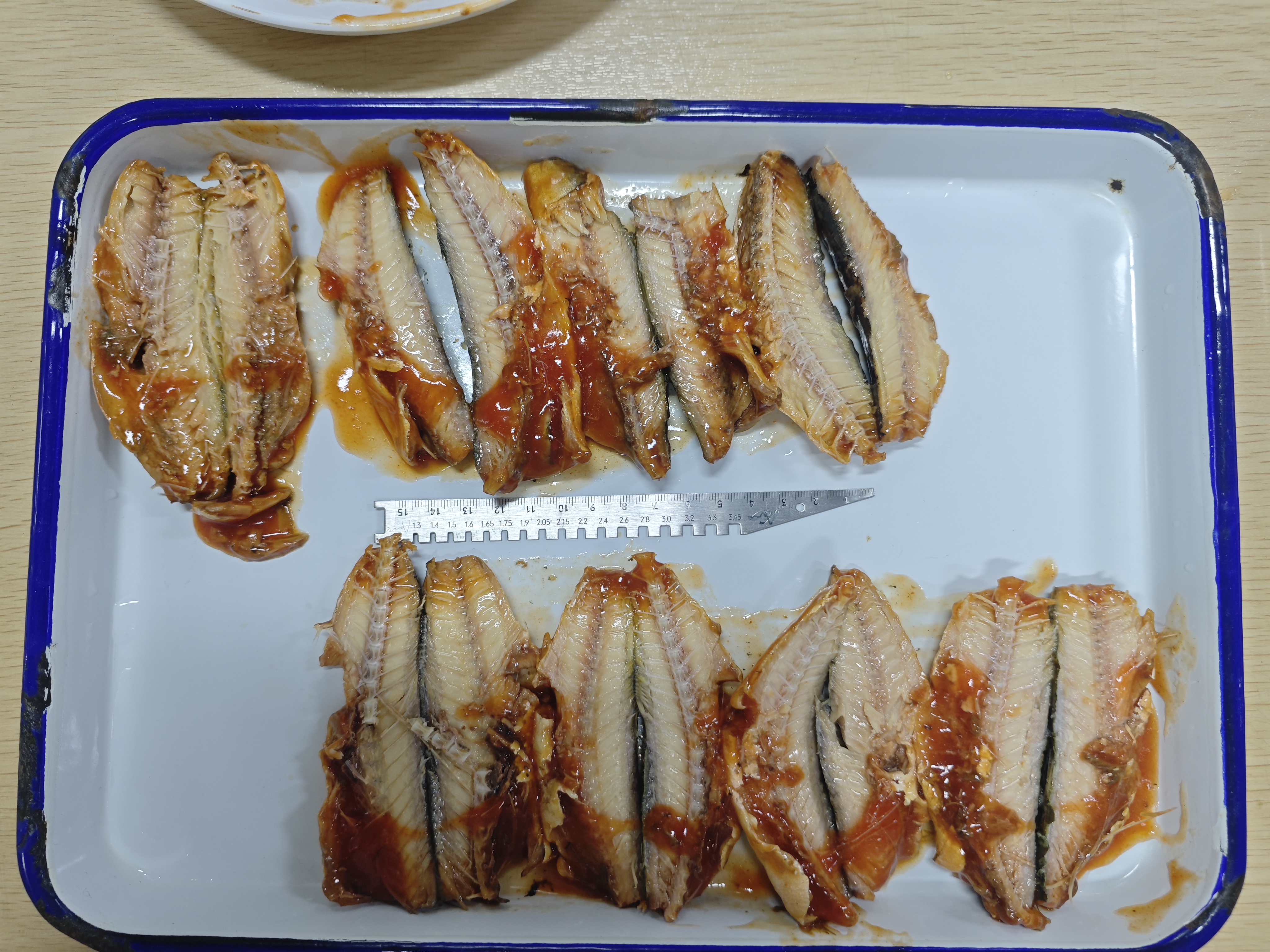
Canned mackerel in tomato sauce, one of the packing-medium variants produced alongside canned sardines in the same canned fish range. Packing medium determines which certification line covers a given purchase order.
Technical Explanation: Why a Sealed Can Lasts Three Years Without Preservatives
The preservation principle behind a 36-month ambient shelf life rests on two elements working together: hermetic sealing and commercial sterility. The food is filled into a tinplate can or glass jar, closed by a seaming machine, and a vacuum — typically in the range of 300 to 500 mmHg — forms inside. With almost no oxygen remaining, aerobic bacteria and oxidation are suppressed. The sealed cans then pass through a retort and are heated at 115 to 121 °C under roughly 0.1 to 0.2 MPa of high-pressure steam, achieving commercial sterility: pathogenic microorganisms and any organisms capable of growing at ambient temperature, together with their spores, are destroyed.
After sterilization the cans are rapidly cooled and then held in an incubation test, typically at 37 °C for 7 to 10 days, to confirm that no swelling or microbial growth occurs before release. The sterilization curve and the cold-point temperature (F0 value) are the parameters that determine product safety. Because no preservatives are used, these parameters have to be set according to the raw material: low-acid foods with a pH above 4.6, which includes most canned fish, must be sterilized at 121 °C under pressure, while high-acid products such as tomato-based packs with a pH below 4.6 can be processed at lower temperatures.
Can construction interacts directly with this process. Three-piece cans are formed from a welded cylindrical body with the bottom and lid double-seamed onto it; the side seam gives the can the strength to withstand 121 °C pressurized sterilization, which is why canned fish, meat and vegetables are usually packed in three-piece cans. Two-piece drawn cans have no side seam, a smoother appearance and a thinner wall; they suit products with lower pressure requirements or shorter sterilization cycles, and they are commonly fitted with easy-open ends.
The purchasing consequence is direct. Because sardines are a low-acid product, the sterilization regime is demanding, and the dominant failure mode in this category is seaming quality rather than raw material selection. That is why process documentation, batch records and pre-shipment sampling carry more weight in supplier evaluation than the language used on a product page.
Application: Where Ambient-Stable Canned Fish Fits in the Supply Chain
The operating profile of this product line is defined by ambient stability. Canned sardines are shipped over long sea routes without a cold chain, stored at ambient temperature, and consumed directly after opening or optionally heated. The equipment required downstream is minimal — a can opener and a serving container. Applications recorded for this product group include grocery retail import programmes, food wholesale distribution, supermarket retail, convenience store sales, catering supply and food processing inputs.
That profile matters most where cold chain infrastructure is weak or expensive. In remote-area distribution and in markets where refrigerated warehousing is limited, an ambient-stable canned line removes a layer of capital and operational risk that frozen products carry by definition. Buyers serving supermarket and convenience channels usually value the long remaining shelf life for the same reason: it reduces write-offs when turnover is slower than forecast.
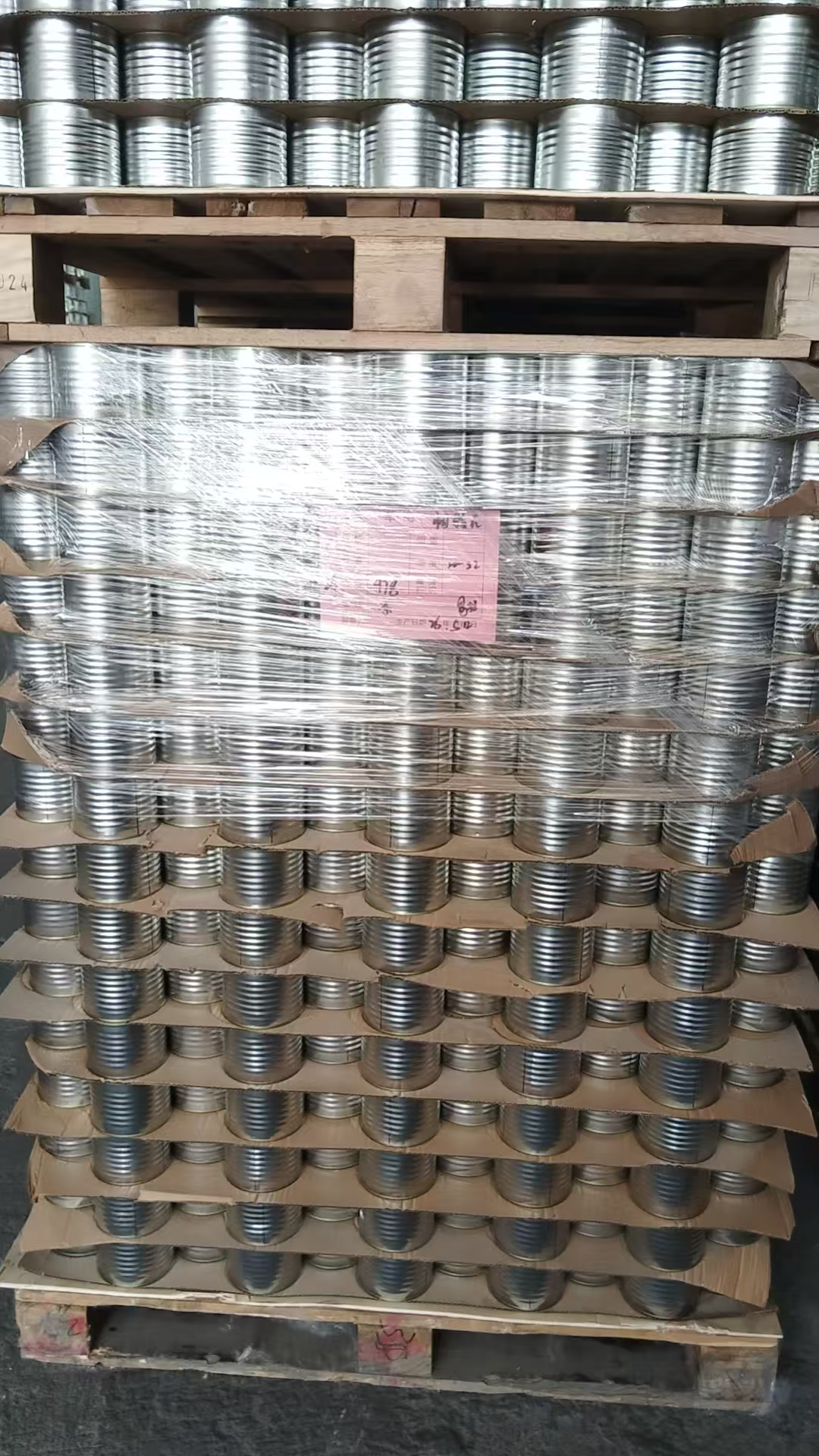
Palletized canned food cartons staged for container loading. Ambient storage and long-distance sea shipment are the two logistics conditions that define the canned sardine category.
Market Signals: What Category Data Actually Says
Category-level data supports the view that canned fish remains the volume engine of the canned seafood market. Canned fish accounted for 75.3% of that market according to Grand View Research, and within canned fish trade flows, canned tuna alone represented 43% of global canned fish import volume under HS 1604 in 2023, according to UN Comtrade. The remainder is where sardines and mackerel compete, which is why sardine pricing tends to track the broader canned fish complex rather than moving independently.
Adjacent categories show the same structural stability. Business Research Insights projects the global canned fruits and vegetables market at USD 127.7 billion in 2026, and Grand View Research reports that the United States held 83.7% of North American canned tomato paste revenue share in 2024. These are different product families, but they share the same trade logic as canned sardines: ambient stability, long shelf life and container economics.
One honest caveat belongs in any market assessment. Published valuations of the canned seafood market vary widely by methodology. Fortune Business Insights puts the 2025 figure at USD 57.69 billion, while Grand View Research has published a figure of USD 37.20 billion; the gap appears to reflect differing definitions of what counts as a hermetically sealed can versus processed and packaged seafood. Any single number should be treated as directional rather than definitive, and internal forecasts should be built from the buyer's own channel data.
The same applies to newer packaging formats. Formats such as vegetables in cups and fruit cups appear in commercial product ranges, but isolated trade or market statistics for the cup format are not generally published, because customs classification aggregates them with preserved vegetables and fruit. Buyers planning a cup-format listing should therefore validate demand at the channel level rather than relying on category totals.
Canned Versus Frozen, and the Limits of the Canned Format
Canned and frozen products solve different distribution problems, and neither replaces the other. Canned goods store at ambient temperature without refrigeration and carry a shelf life of up to 36 months on this line; frozen goods typically carry 6 to 18 months and depend on continuous cold chain transport and cold storage. Canned items therefore avoid cold-chain freight and electricity cost, while frozen goods retain a flavour profile closer to raw fresh product.
| Decision factor | Canned fish | Frozen fish |
|---|---|---|
| Storage and transport | Ambient temperature, no cold chain required | Continuous cold chain transport and cold storage required |
| Shelf life | Up to 36 months on this product line | Typically 6 to 18 months |
| Cost structure | Lower storage and transport overhead | Higher cold-chain freight and energy cost |
| Sensory profile | Changed by high-temperature sterilization | Closer to raw fresh flavour |
| Suitable channels | Supermarket, convenience store, remote-area distribution, catering, food processing | Retailers and buyers with full cold-chain facilities and fresh-positioning customers |
The limits of the canned format deserve the same attention as its advantages. High-temperature sterilization changes texture and flavour relative to frozen product, so canned sardines are not a substitute in markets that buy on freshness positioning. Storage discipline is not optional: cans should be held at 5 to 25 °C at a relative humidity below 75%, on pallets at least 10 cm off the floor, away from direct sunlight and heat, with first-in-first-out rotation and weekly inspection for rust, swelling or leakage. Cans that arrive with domed ends, leakage or severe rust are non-conforming and must be quarantined rather than sold or consumed. Once a can is opened, any unused portion should be refrigerated and consumed within 24 to 48 hours, ideally transferred to a non-metallic container.
There is also a documentary boundary. A certificate valid on the day of supplier approval will eventually expire, and a production run executed after the expiry date is not covered by that document. Purchase orders placed against a certificate nearing its expiry date should include a renewal confirmation clause.
Buyer Checklist Before Releasing a Canned Sardines Order
- Confirm the certificate scope names the exact product and packing medium being ordered, not only the manufacturer or supplier name.
- Check the validity window of the food safety certificate and the Halal certificate against the planned production and shipment dates.
- Specify net weight, can size code and can construction, including whether an easy-open end is required.
- Fix the packing medium in writing — vegetable oil, tomato sauce or brine — because it defines the applicable certificate line and the labelling text.
- Agree the relationship between net weight and drained weight in the purchase specification.
- Confirm the destination-market registrations, including FCE registration and Scheduled Process filing for the US and traceability documentation under EU Regulation 2024/3115.
- Request batch documentation: certificate of analysis, health certificate and pre-shipment inspection report.
- Agree whether third-party inspection by a body such as SGS or Intertek will be used, and at which stage.
- Confirm the label and artwork route, including OEM logo or private label requirements.
- Verify the requirement for batch sample retention and traceability reports before shipment.
What a Sourcing Partner Adds to a Canned Fish Programme
For a buyer running several canned lines at once, the practical question is who holds the documentation together across products, factories and markets. Agrogentra & Co., Ltd. operates as an international trading company with quality control functions rather than as a single-factory operation. Established in 2000 and based in Xiamen, the company works with stable factory resources and runs independent QC departments in Xiamen and Qingdao, where inspections cover factory audits, raw material testing, production monitoring, finished product inspection and pre-shipment sampling. The company reports a factory footprint of 36,000 square metres and a research and development team of six engineers.
On the commercial side, the canned fish range is offered with OEM production and logo customization, a minimum order quantity of one full container load, and a lead time of four to six weeks. Monthly capacity is stated at 3,500 units. Quality documentation available to buyers includes a certificate of analysis for each batch, health certificate, pre-shipment inspection report and traceability report, with third-party inspection by SGS or Intertek acceptable. The same document set applies across the wider catalogue, which covers canned fish, canned vegetables such as carrot, red pepper, sauerkraut, mixed mushrooms, sweet potato, potato and baby corn, tomato products including paste, ketchup, diced and whole peeled tomatoes, and canned fruit lines. Products are exported to the United States, Latin America, Europe and African markets.
Future Outlook
Three developments are likely to shape canned sardine sourcing over the next few years. The first is documentation pressure. EU Regulation 2024/3115 took effect in January 2025 and adds traceability obligations for preserved foods entering the European Union, while the FDA framework for low-acid canned foods already requires establishment registration and filed scheduled processes. The direction of travel is toward more granular, batch-level evidence rather than a single company certificate.
The second is format diversification. Beyond standard round cans, ranges now include cup formats for vegetables and fruit, which suit single-serve and convenience channels. Because customs data aggregates these formats with preserved vegetables and fruit, buyers should expect to build their own demand evidence for cup-format listings rather than relying on published category figures.
The third is the continuing value of ambient logistics. In markets where cold chain capacity is limited or expensive, the ability to move canned fish without refrigeration remains a structural advantage, and the 36-month shelf life declared on this line supports long inland distribution from a single import entry point. For buyers, the most durable competitive position is not the lowest quoted price per can but the supplier file that survives an audit, a border check and a shelf-life review at the same time.
Frequently Asked Questions
Which certification actually covers the canned sardines I am buying?
Coverage depends on scope, not on the supplier's name. A BRCGS certificate covering canned mackerel, sardine and canned tuna, such as certificate 051A1312001 issued by Intertek Certification Ltd under the BRCGS Global Standard for Food Safety, Issue 9 (August 2022), covers the manufacturing scope of those fish lines. A Halal certificate such as 8998250000 issued by SHC extends to itemised products — canned sardines in tomato sauce, in oil and in brine, and canned mackerel in tomato sauce, in oil and in brine. A product or packing medium outside the recorded scope is not covered by that document.
What can sizes and packing media are available for canned sardines?
Net weight options on this line are 125 g, 170 g (843#), 425 g and 1000 g. Packing media are vegetable oil, tomato sauce and brine, and the product is packed in tinplate cans that are fully sterilized and ready to eat on opening, with a declared shelf life of 36 months at ambient temperature. Buyers normally also specify the relationship between net weight and drained weight, and whether the can requires an easy-open end.
Do canned sardines contain preservatives?
No preservatives are required for preservation. The product is preserved by two mechanisms working together: hermetic sealing, which produces a vacuum inside the can and blocks external microorganisms and oxidation, and high-temperature, high-pressure sterilization in a retort, typically at 115 to 121 °C, which destroys pathogenic microorganisms and their spores. Low-acid products such as fish, with a pH above 4.6, must be sterilized at 121 °C under pressure, while high-acid products such as tomato-based packs with a pH below 4.6 can be processed at lower temperatures.
How should canned sardines be stored, and do they need refrigeration?
Unopened cans do not require refrigeration. Recommended storage is a cool, dry place at 5 to 25 °C with relative humidity below 75%, away from direct sunlight and heat sources, stacked on pallets at least 10 cm off the floor with ventilation space from walls, and rotated first-in-first-out with weekly inspection for rust, swelling or leakage. After opening, any unused portion should be refrigerated and consumed within 24 to 48 hours, preferably transferred to a non-metallic container.
What should be done if cans arrive with domed or bulged ends?
A swollen can indicates gas produced by microbial growth after seal failure, or by other gas-producing reactions, and the affected batch must be treated as non-conforming. The standard handling sequence is to quarantine the swollen cans and the affected batch, document batch number, production date and arrival time with photographs, spot-check the rest of the batch to assess the proportion affected, review transport temperature records and warehouse conditions for high temperature or impact damage, then report to the supplier with the batch number to negotiate replacement or claim and, where necessary, send retained samples to a third-party laboratory. Swollen, leaking or severely rusted cans must never be sold or consumed.
Canned or frozen fish: which is better for import and supermarket retail?
The two formats serve different distribution conditions rather than competing on a single scale. Canned fish stores at ambient temperature, needs no cold chain, and carries a shelf life of up to 36 months, which suits general supermarket, convenience store and remote-area distribution. Frozen fish retains a flavour profile closer to raw fresh product but depends on continuous cold chain transport and cold storage, and typically carries a shelf life of 6 to 18 months. Importers without cold storage capacity usually treat canned products as the lower-risk entry option, while buyers with complete cold chain facilities may run both formats or a mixed supply depending on their customer base and warehouse conditions.
The full product and packaging reference for this canned fish range, including container and label options, is available in the Agrogentra product leaflet.