
Canned Fish Supplier Audits: Agrogentra's QC Records
Canned fish is one of the few protein categories that can cross an ocean, sit in ambient storage, and still be sold as a ready-to-eat product years later. Global imports of canned and prepared fish under HS 1604 reached 3.2 million tonnes worth USD 17.54 billion in 2023, according to UN Comtrade data derived with FAO figures. Fortune Business Insights values the global canned seafood market at USD 57.69 billion in 2025, and Grand View Research estimates that canned fish accounts for 75.3% of it. Demand is rarely the constraint for importers. Verifiable supplier capability usually is.
Agrogentra & Co., Ltd. Xiamen, trading as Agrogentra Canned Foods, is a China-based international trading company established in 2000 that sources, quality-controls and supplies Chinese canned food to overseas buyers. This analysis sets out the operational facts a buyer can actually audit rather than the adjectives a supplier can write: where the quality-control teams sit, which production stages they inspect, what the facility and capacity figures are, and exactly which products two named certificates cover.
Capability claims are cheap; documented process is not
Almost every supplier profile in the canned fish trade carries the same three words: strict quality control. What differs is whether the claim is backed by a defined inspection sequence, a named certificate with a number, and documents issued per production batch. Importers therefore face a specific problem: the canned format conceals what happened inside the plant, because a sealed can gives the buyer no visual information about sourcing, seaming quality, or sterilization adequacy.
Regulation has moved in the same direction. Regulation (EU) 2024/3115, effective January 2025, mandates stricter plant health and traceability requirements for imported preserved foods under the European Commission's Access2Markets framework. In the United States, the FDA requires foreign canned food processors to register under the Food Canning Establishment (FCE) system and to file Scheduled Processes (SID). Both requirements shift the burden of proof toward documents that a buyer can request, read and match to a specific shipment.
The practical question for a sourcing team is not whether a supplier claims quality control, but which production stage was inspected, by which team, and what record survives the process.
Agrogentra's QC structure: two departments, five inspection stages
Agrogentra has established professional operation teams and independent QC departments in both its Xiamen and Qingdao offices. That structure matters for canned fish procurement because these two coastal cities sit in different sourcing clusters, and a QC function located separately from a sales office is harder to operate as a purely administrative gesture.
The QC team runs a full-process inspection model with five defined stages. Each stage produces a record type that a buyer can request during supplier evaluation rather than after a claim arises.
| Inspection stage | What is inspected | Record a buyer can request |
|---|---|---|
| Factory audit | Production environment, process discipline and supplier qualification before an order is placed | Factory certification copies for buyer audit |
| Raw material testing | Incoming raw materials, including fish and other inputs | Incoming raw-material inspection records |
| Production monitoring | On-line production patrol during filling, seaming and sterilization | Production monitoring records |
| Finished product inspection | Laboratory physical, chemical and microbiological testing performed for each batch | COA report per batch |
| Pre-shipment sampling | Sampling and verification before loading | Pre-shipment inspection report, traceability report |
Two operational details strengthen this sequence. First, batch sample retention is part of the model, which means a retained sample can be re-tested if a dispute arises months after delivery. Second, third-party inspection by SGS or Intertek is acceptable to the company, so a buyer who does not rely on supplier-issued documents alone can appoint an independent inspector at the loading stage.
The document set that accompanies shipment is consistent with this: a certificate of analysis (COA), a health certificate, a pre-shipment inspection report and a traceability report. For private-label programs, Agrogentra also handles OEM formula and label design and can supply samples at the customer's courier cost.
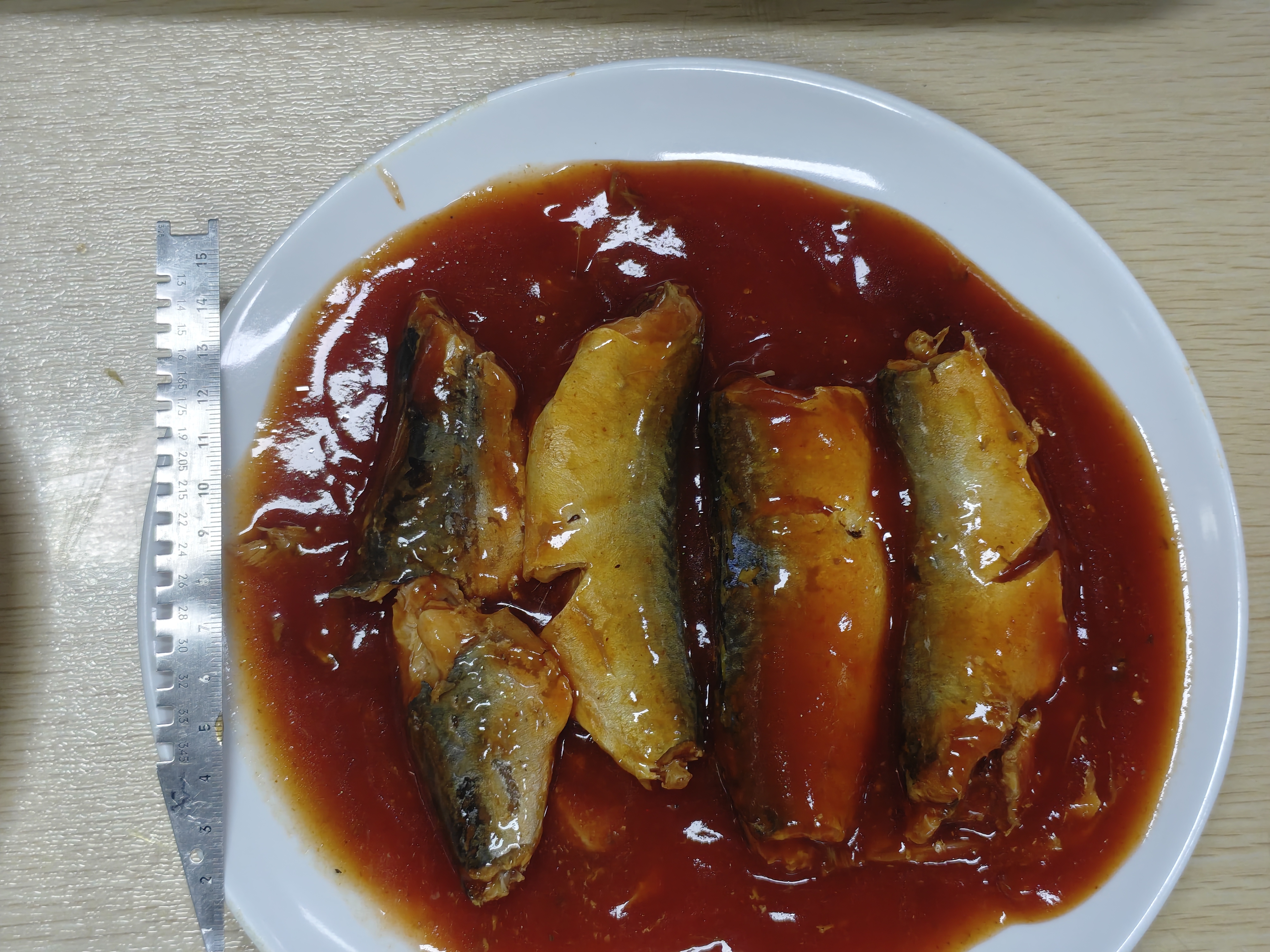
Finished canned mackerel in tomato sauce. For canned fish, the sealed can hides every upstream decision, which is why batch-level COA documents and retained samples carry most of the audit value.
Facility and capacity facts behind the QC system
Agrogentra's recorded operating profile provides the scale context for that inspection model:
- Factory footprint: 36,000 ㎡
- Annual output: 60,000 units
- R&D capability: a team of 6 engineers
- Export orientation: 100% export ratio, serving the USA, Latin America, Europe and the African market
- Track record: more than 25 years of export experience since the company's establishment in 2000
- OEM / private label: logo customization supported, minimum order quantity of 1 FCL, production lead time of 4 to 6 weeks
The product portfolio is broad for a single sourcing channel: canned sardines, mackerel, tuna, Alaska pollock, squid and baby clam on the seafood side, alongside canned vegetables and fruits such as canned tomato paste, diced tomato, whole peeled tomato, sauerkraut, mixed mushrooms, sweet potato, and a cup format for vegetables. Packaging sizes for the fish lines include 125g, 170g (843#), 425g and 1000g, in variants such as vegetable oil, tomato sauce and brine or salt-seasoned styles.
That breadth is directly relevant to QC design. A supplier packing sardines, tuna and tomato-based products in the same network has to manage different acidity levels, different sterilization profiles and different sauce media — which is precisely why batch-level laboratory testing rather than product-level testing is the meaningful unit of evidence.
Certificate scope: BRCGS 051A1312001 and Halal 8998250000
Two certificates are relevant to canned fish buyers, and each answers a different question. A food safety scheme certificate tells a retailer that the production system is audited against a recognised standard. A Halal certificate tells an importer whether the product can legally enter a Muslim-majority market at all.
| Certificate | Number | Products covered | Buyer question it answers |
|---|---|---|---|
| BRCGS | 051A1312001 | Canned mackerel, canned sardine, canned tuna | Is the production system audited against a recognised global food safety standard? |
| Halal | 8998250000 | Canned sardines in oil, canned mackerel in tomato sauce | Can these specific SKUs enter Muslim-majority markets? |
The scope column is the part buyers most often skip. Both certificates are product-specific. A buyer sourcing canned Alaska pollock, squid, baby clam, or canned vegetables from the same supplier is not automatically covered by either document, and should request the corresponding certification or testing evidence for that specific SKU before treating the supplier as approved across the board.
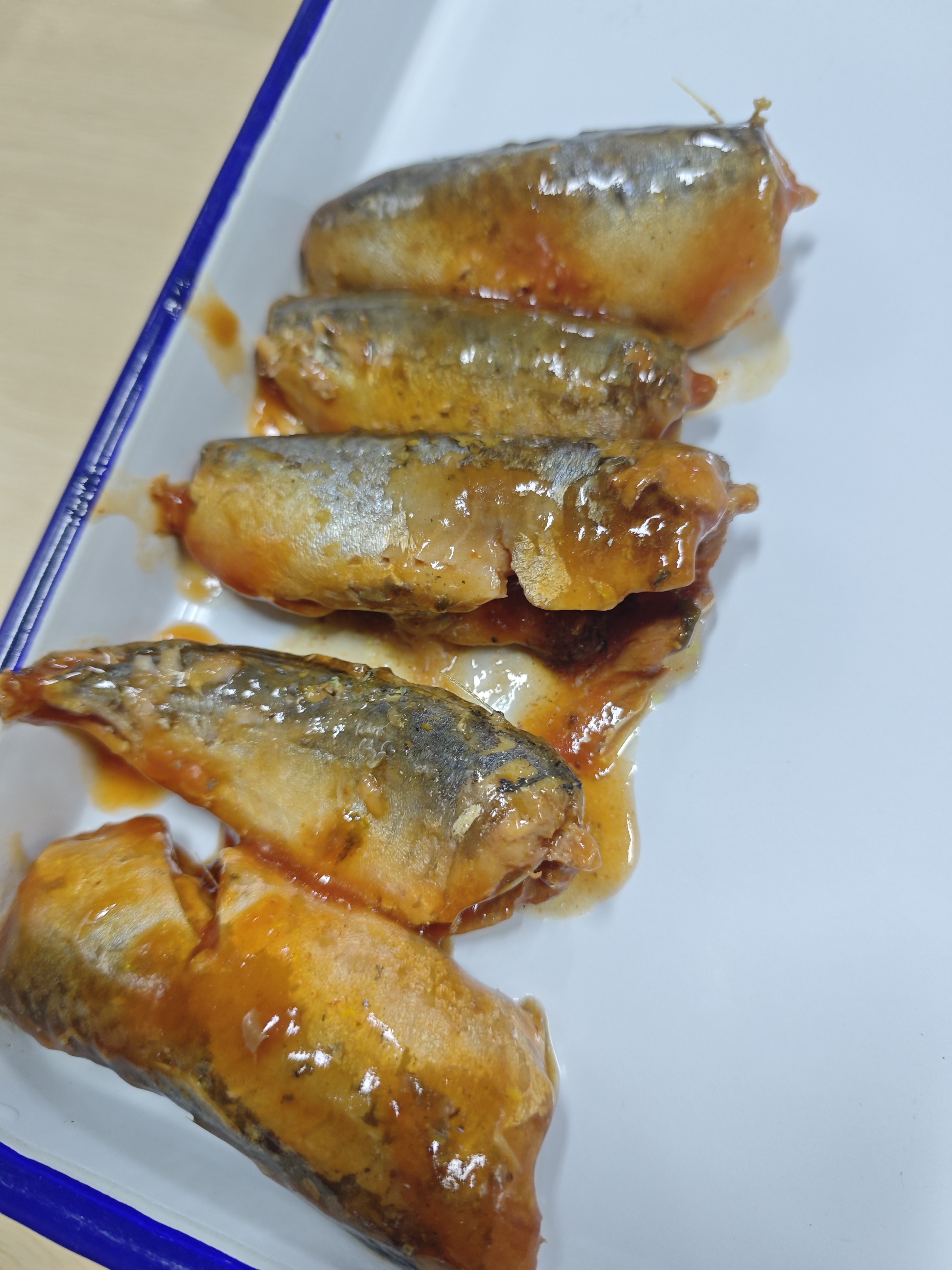
Canned mackerel in tomato sauce falls within the scope of Halal certificate 8998250000. Certificate coverage is defined by product list, not by supplier name alone.
The technical reason these inspection stages exist
Canned fish achieves long shelf life through two mechanisms working together, with no preservatives added. The first is hermetic sealing: filled cans are closed by a seaming machine to form an internal vacuum, typically around 300 to 500 mmHg, which leaves almost no oxygen inside the can and suppresses aerobic spoilage and oxidation.
The second is high-temperature, high-pressure sterilization. Sealed cans are loaded into a retort and heated at 115 to 121 °C under roughly 0.1 to 0.2 MPa of steam to reach commercial sterility, meaning pathogenic organisms and their spores — including those capable of growing at ambient temperature — are destroyed. Low-acid products (pH above 4.6), which includes most canned fish, require the 121 °C pressurized profile, while high-acid products such as tomato-based items can be processed at lower temperatures. After sterilization, an incubation test held at 37 °C for 7 to 10 days confirms that no swelling or microbial growth occurs before release.
This is where the QC stages stop being administrative. Seaming failures and insufficient sterilization are the two principal causes of swollen cans, and both are detectable only through in-process monitoring and batch laboratory testing. Agrogentra's canned fish lines are sterilized and ready to eat, with a stated shelf life of 36 months at ambient temperature, packed in tinplate cans — a format that for fish products requiring pressurized sterilization typically uses three-piece construction for its strength at the side seam.
Where the capability fits: retail, catering and processing applications
Agrogentra's canned products are positioned for supermarket retail, convenience store sales, catering supply and food processing industries, and are used in the food import industry. The operational logic is straightforward: ambient storage removes cold-chain dependency, which makes the format viable for long-distance sea transportation and for distributors operating in regions where refrigerated warehousing is limited.
From the buyer's side, three application patterns recur. Retail and convenience channels use the 125g and 170g formats for shelf-stable singles. Wholesale and catering buyers work with larger formats such as 425g and 1000g for foodservice and bulk distribution. Food processors use canned fish and canned tomato products as inputs, where consistent drained weight, sauce viscosity and microbiological results matter more than brand presentation.
Mixed FCL and LCL shipments are supported, which matters to importers building a first order across several SKUs rather than committing a full container to one product. The stated outcome of this approach, in the supplier's own case description, is stable supply with lower inventory loss — a direct consequence of a 36-month ambient shelf life and Halal availability on the relevant SKUs.
Market direction: documentation is becoming a commercial gate
Three data points frame the current trading environment. Canned fish accounts for 75.3% of the global canned seafood market, which Fortune Business Insights valued at USD 57.69 billion in 2025. Canned tuna alone represents 43% of global canned fish import volume under HS 1604, according to UN Comtrade. The category is large, standardised and heavily traded — which means competing suppliers converge on price and specification, and differentiation shifts to assurance.
Regulation reinforces that shift. EU Regulation 2024/3115 tightens plant health and traceability requirements for preserved food imports from January 2025, and FDA registration under the Food Canning Establishment system with Scheduled Process filing remains a baseline requirement for exporting to the United States. For Muslim-majority markets across the Middle East and Southeast Asia, Halal documentation is a mandatory access condition rather than a marketing preference. Each requirement is a documentation test, not a product test, and suppliers are increasingly evaluated on how quickly and completely they can produce records for a named batch.
Sourcing models compared — and where this one stops
Importers generally choose between three routes: buying direct from a single factory, buying through an agent with no inspection capability, or buying through a trading company that maintains its own QC function across multiple factories. Agrogentra sits in the third category, and that position has real trade-offs worth stating plainly.
| Sourcing route | Advantage | Trade-off to manage |
|---|---|---|
| Single factory, direct | Single production site with its own certificates; short decision chain | Limited product range; certification tied to one plant's approved product list |
| Agent without inspection | Low coordination cost | No in-process verification; buyer relies on factory-issued documents alone |
| Trading company with independent QC | Multi-category range, defined five-stage inspection, third-party inspection accepted | QC is performed at supplier factories under supervision, so certificate scope and factory-level documents must still be verified per product |
The honest limitations of the Agrogentra model are these. First, certification is product-specific: BRCGS 051A1312001 covers canned mackerel, sardine and tuna, and Halal 8998250000 covers canned sardines in oil and canned mackerel in tomato sauce. Buyers of other SKUs in the range must request separate evidence. Second, because Agrogentra operates as an international trading company with stable factory resources and standardized production supervision rather than as a single named plant, buyers whose internal compliance rules require the certificate holder to be the physical production site should request factory certification copies for audit and may wish to appoint SGS or Intertek at loading. Third, commercial thresholds are fixed: the minimum order quantity for OEM work is 1 FCL, with a 4 to 6 week production lead time, which is not suited to small trial orders. Fourth, the ambient canned format itself has boundaries — buyers whose market demands a fresh-chilled texture are better served by frozen ranges, since canned fish is preserved by retort sterilization rather than refrigeration.
A verification checklist for importers
The following checklist converts the facts above into a supplier evaluation sequence. It is ordered the way a procurement review typically runs.
| Step | What to request | What it confirms |
|---|---|---|
| 1 | Certificate copies with numbers, matched to the exact SKU | Scope of BRCGS or Halal coverage for the product being purchased |
| 2 | Factory certification copies for buyer audit | Production site qualification |
| 3 | Batch COA with physical, chemical and microbiological results | Per-batch laboratory verification |
| 4 | Pre-shipment inspection report and traceability report | Loading-stage verification and lot traceability |
| 5 | Confirmation of batch sample retention and third-party inspection option | Dispute resolution and independent testing pathway |
| 6 | Health certificate and full export document set | Customs and import clearance readiness |
Outlook
The direction of travel for canned fish sourcing is toward traceability as a precondition rather than a differentiator. EU traceability requirements and FDA process-filing rules already make documentation a gate rather than a courtesy, and buyers are increasingly comfortable appointing third-party inspectors at loading. Suppliers that can produce a per-batch COA, a traceability report and a certificate whose scope matches the exact product will keep moving faster through importer approval workflows than suppliers that rely on capability language.
For Agrogentra, the relevant evidence is concrete and checkable: more than 25 years of export operations since 2000, independent QC departments in Xiamen and Qingdao running a five-stage inspection model, a 36,000 ㎡ facility with 60,000 units of annual output, a 6-engineer R&D team, and named certifications for specific fish SKUs. Buyers should verify that evidence for their own product line, and treat the certificate scope — not the supplier's reputation in general — as the boundary of what has been independently confirmed.
Frequently asked questions
What documents should an importer request before approving a canned fish supplier?
At minimum: certificate copies with numbers matched to the specific product, factory certification copies for audit, a batch-level certificate of analysis covering physical, chemical and microbiological results, a pre-shipment inspection report, a traceability report and a health certificate. In the Agrogentra model these documents are part of the standard export set, and third-party inspection by SGS or Intertek is accepted where a buyer wants independent confirmation.
How can a buyer tell whether a supplier's QC process is operational rather than a claim?
Look for process-level evidence rather than statements. A functioning system produces differentiated records: incoming raw-material inspection, on-line production patrol during filling and sterilization, laboratory testing issued per batch as a COA, and retained batch samples that allow re-testing later. Ask for the records belonging to the specific batch being quoted, not a generic quality manual.
Do BRCGS and Halal certificates cover every canned fish product from one supplier?
No. Certificate scope is defined by a product list. At Agrogentra, BRCGS certificate 051A1312001 covers canned mackerel, canned sardine and canned tuna, while Halal certificate 8998250000 covers canned sardines in oil and canned mackerel in tomato sauce. Other items in the same portfolio — for example canned Alaska pollock, squid, baby clam or canned vegetables — require separate verification.
What are typical minimum order quantities and lead times for private-label canned fish?
Agrogentra supports OEM production with logo customization. The stated minimum order quantity is 1 FCL, and production lead time is 4 to 6 weeks. This threshold suits importers placing container-level orders rather than small trial volumes, so buyers planning a market test should factor the minimum quantity into their first-order decision.
What should be done if cans arrive swollen?
A swollen can means gas has been produced inside the container, usually through microbial growth after a seal failure, and the product must not be consumed. The affected batch should be quarantined and removed from sale, documented with photographs alongside batch number and production date, and reported to the supplier for replacement or claim. The receiving team should also check whether transport or storage exposed the shipment to high temperature or impact, retain samples, and consider third-party laboratory confirmation of microbial levels.
Is canned fish or frozen fish the better choice for import and supermarket retail?
They serve different sales scenarios. Canned products store at ambient temperature without a cold chain, carry a shelf life of up to 36 months, and suit supermarkets, convenience stores and distribution to remote regions. Frozen products retain a texture closer to fresh fish but depend on continuous cold-chain transport and frozen warehousing, with a typical shelf life of 6 to 18 months. The decision should follow the buyer's warehouse conditions, distribution network and target customer expectations, and a mixed supply approach is possible.
Reference material: Agrogentra publishes a downloadable product and export leaflet at Agrogentra leaflet. Company information is available at www.agrogentra.com.