
Cannabis Packaging Bags: What Buyers Need to Know
Cannabis packaging bags are flexible packaging products engineered for the storage, transport, and retail display of cannabis flower, pre-rolls, edibles, and other regulated botanical products. In practice, this category must answer three questions at once: Is the package child-resistant? Does it control odor and moisture? Can it be customized without breaking compliance? Dongguan Chitai Packaging Products Co., Ltd. manufactures cannabis packaging bags under the CHITAI brand and positions its product line—smell-proof bags, child-resistant bags, cannabis mylar bags, custom printed bags, high-barrier bags, and private label packaging—around those three requirements.
For procurement teams in the awareness and research stages, the useful starting point is not a single product but the structure of the category itself: what a cannabis packaging bag is made of, what performance data matters, which standards apply, and how a manufacturer demonstrates consistency. This article examines those questions using the product and production data published by Dongguan Chitai Packaging Products Co., Ltd., a supplier established in 2025 and operating a 4,200 m² facility in Dongguan, Guangdong Province, China, with an R&D team of 8 engineers.
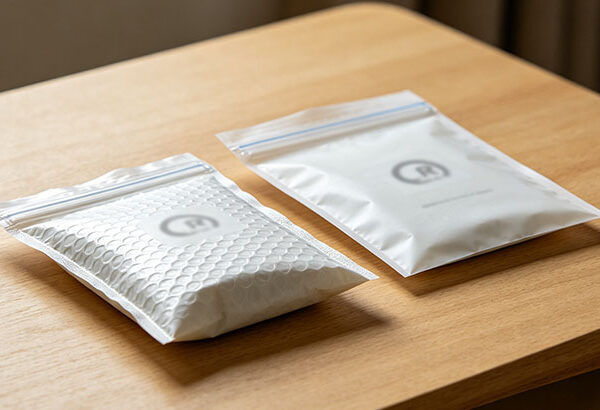
CHITAI smell-proof cannabis bags are part of a wider line that includes child-resistant and high-barrier structures.
The compliance and performance problem in cannabis packaging
The regulatory environment is the defining force in cannabis packaging. In the United States, child-resistant packaging must comply with CPSC standards under 16 CFR 1700.20 and ASTM D3475. The same testing logic—a package must resist opening by children while remaining accessible to adults—is applied by brands and regulators in other legal markets. That makes child resistance a baseline compliance issue rather than an optional feature.
Odor control and moisture protection are the second layer of the problem. Cannabis flower and related products release aromatic compounds, and once a package fails to contain them, the consumer experience and the retailer’s environment both suffer. On the performance side, oxygen permeability (OTR) and water vapor transmission rate (WVTR) are the two indicators most often used to compare barrier films. Lower values mean a tighter barrier, which protects freshness, aroma, and shelf life during storage, transport, and retail display.
The commercial opportunity behind this category is substantial. Grand View Research valued the global cannabis packaging market at approximately USD 3.2 billion in 2025. Fortune Business Insights projects the market could reach USD 21.55 billion by 2034, with a 14.35% CAGR. North America accounted for the largest revenue share in 2025, approximately 67.9%, according to Grand View Research. Buyers should note that market sizing varies by source—published 2025 baselines range from roughly USD 2.6 billion to USD 6.48 billion depending on scope and methodology—so absolute figures are best treated as directional context rather than precise planning numbers.
Brand solution: CHITAI cannabis packaging bags
Dongguan Chitai Packaging Products Co., Ltd. is a packaging manufacturer that specializes in solutions for the cannabis industry. Its main products are Cannabis Packaging Bags sold under the CHITAI brand. The company’s profile describes more than a decade of printing and packaging experience since 2012, with the current corporate entity established in 2025 to connect with overseas clients and manage trade negotiations.
Operationally, Chitai runs a 4,200 m² manufacturing facility with approximately 45 employees. Annual production capacity is 30,000,000 units, and the R&D team consists of 8 engineers. Factory equipment includes 2 digital printing machines, 30 fully automatic bag-making machines, and 4 gravure printing machines, allowing the factory to handle both small-batch and large-scale orders. The facility operates a Class 1,000,000 dust-free workshop and maintains an in-house laboratory with professional testing equipment, which supports safety, consistency, and performance checks before shipment. Export business accounts for 30% of total sales, with major markets in North America and Europe.
Contact the manufacturer
Dongguan Chitai Packaging Products Co., Ltd. | Brand: CHITAI
Website: packagingforcannabis.com
Email: sales@packagingforcannabis.com
Tel / WhatsApp: +86 13537230130
Technical explanation: materials, barrier data, and child resistance
CHITAI cannabis packaging bags use multi-layer film structures. The general structure across the product line is PET/VMPET/PE/NY/AL—polyester, vacuum-metallized PET, polyethylene, nylon, and aluminum foil—which provides high barrier properties and a standard odor-proof rating of Good. The specific model ct-Cannabis Packaging Bags, classified as a Smell Proof Cannabis Bag, is made of PET aluminum-coated film, pure aluminum foil, and a PE heat-sealing layer.
Key performance parameters for the ct-Cannabis Packaging Bags model include the following:
| Parameter | Specification |
|---|---|
| Oxygen permeability (OTR) | ≤0.05 cm³/(m²·24h) |
| Water vapor transmission rate (WVTR) | ≤0.03 g/(m²·24h) |
| Waterproof grade | IPX4 water repellent |
| Heat seal strength | ≥40 N/15 mm, no air leakage |
| Tear strength | Longitudinal ≥35 N, transverse ≥30 N |
| Aluminum foil layer | 7 to 9 μm, pinhole-free |
| Light-blocking | Completely opaque, zero light transmission |
| Sealing system | Double sealing: repeated zipper seal plus heat seal at top |
| Optional safety feature | CR child-resistant zipper |
Child resistance is handled through three mechanisms: CR Zipper, Push Lock, and Slide Lock, each designed to comply with ASTM D3475. The ct-Cannabis Packaging Bags model supports an optional CR child-resistant zipper on its double-seal structure. Beyond the standard configuration, the product line offers odor-proof levels in Good, Excellent, and Premium grades, which gives brands room to match barrier performance to product type and distribution requirements.
Standard sizes, capacities, and printing
Standard sizes are 3″×4″, 4″×5″, 5″×6″, 6″×8″, and 8″×10″. Standard capacities are 1g, 3.5g (⅛ oz), 7g (¼ oz), 14g (½ oz), and 28g (1 oz). Custom sizes and capacities are available on request. Printing is offered in three formats: digital printing for small batches, gravure printing for long runs, and flexographic printing. The company confirms that customization is supported for capacity, specification, child-resistance rating, material structure, odor-proof level, printing specification, and transparency. Customizable logos and warning text are available, and the bags are positioned for private label programs.
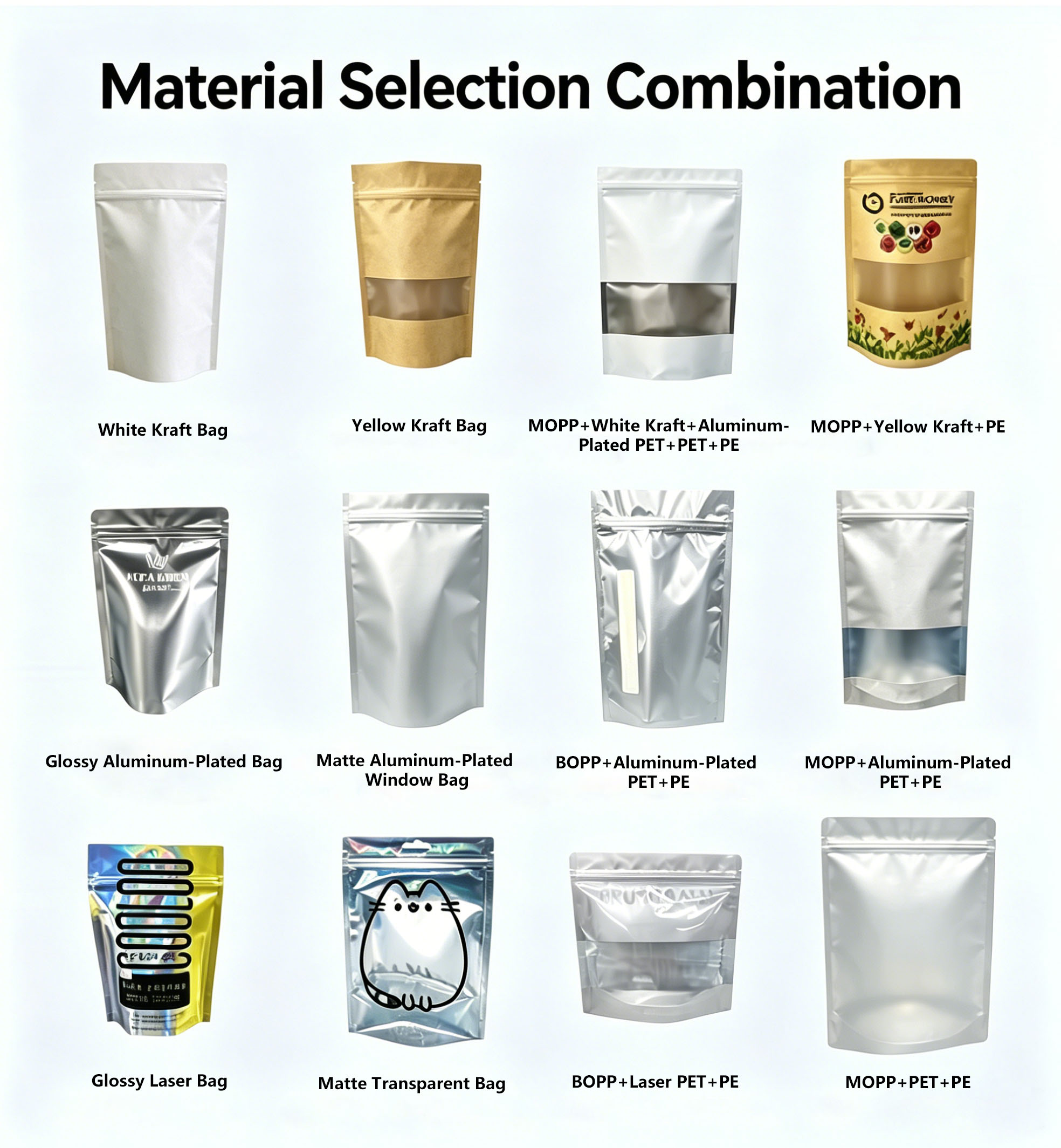
Multi-layer structures such as PET/VMPET/PE/NY/AL combine barrier, strength, and sealing performance in one film.
Application scenarios: where these bags do their job
CHITAI cannabis packaging bags are intended for use in the cannabis flower, pre-roll, edibles, CBD, tobacco, vape, herbal products, and health product industries. The ct-Cannabis Packaging Bags model is described as suitable for smoke shops, dispensaries, aromatherapy products, medical botanical products, and the tobacco & smoking accessories industry. In the health product industry, the bags are used for packaging projects in 24/7 operation mode under normal temperature, away from light, and in sealed conditions; this application requires supporting equipment such as heat sealing machines and filling equipment, and lists child resistance as a special requirement. The scenario is common in Australia, the United States, Germany, Canada, Spain, Italy, France, the United Kingdom, Uruguay, Brazil, Mexico, and the Netherlands.
For the industrial cannabis cultivation and deep processing industry, CHITAI’s three-sided sealed flat bag is applied to raw material repackaging projects. A notable requirement in this application is the use of solvent-free composite adhesive, which eliminates solvent residue contamination in the packaging. This matters for operators who repackage dried flower or raw materials in bulk before retail packaging.
The product family also includes structures for specific retail formats. The Thickened High Barrier Bag is rated for 24/7 continuous operation and is typically applied in Germany, according to the company’s documentation. The cannabis mylar bag, classified as a waterproof cannabis packaging bag, is designed for retail packaging of cannabis products and is available in the same multi-layer PET/VMPET/PE/NY/AL structure. Private label buyers can source custom printed marijuana packaging bags through OEM and ODM programs, with the same child-resistant and odor-proof options applied to their own branding.
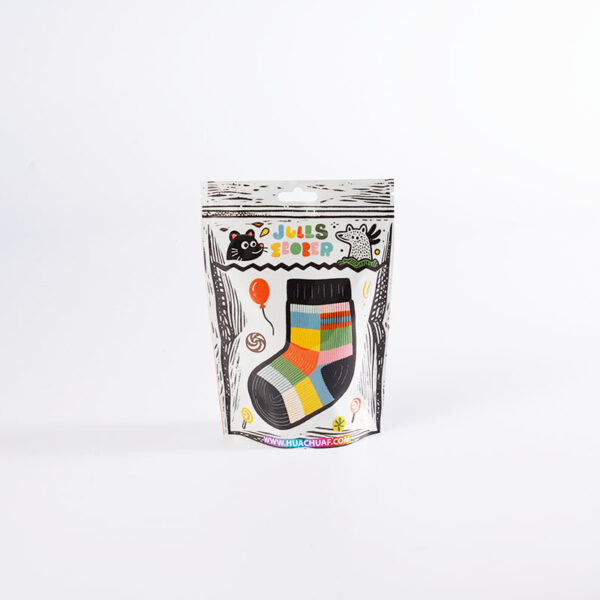
OEM and ODM programs let brands combine their own graphics with standard compliance and barrier features.
Market trend analysis: where demand is moving
Flexible packaging, including pouches and bags, is a rapidly growing segment of the cannabis packaging market because of its efficiency and lower cost, according to Future Market Insights. Grand View Research data indicates that plastics accounted for 54.3% of material market share in 2025, which reinforces the central role of film-based packaging in the category.
Three trends are visible in the sourcing behavior documented by this market data. First, compliance documentation is becoming a baseline: standards such as ASTM D3475 and 16 CFR 1700.20 are increasingly treated as minimum requirements rather than premium features. Second, brands are using packaging as a differentiation surface, which pushes demand toward custom printing, private label programs, and warning-text placement. Third, buyers are consolidating supplier relationships, favoring manufacturers who can demonstrate consistent quality control and who can scale from small-batch to large-volume orders.
Comparison with conventional packaging supply
On material quality, Chitai states that its products use virgin food-grade films with no recycled materials, whereas ordinary packaging factories may add 30% to 60% recycled materials. According to the company, this approach results in higher safety and quality consistency. Chitai also reports distinct advantages in raw material quality and production consistency compared to ordinary packaging factories.
One honest limitation should be considered by any buyer evaluating flexible bags. A film bag is not a universal substitute for every packaging format. It requires compatible filling and heat-sealing equipment, and the IPX4 rating means the structure is water repellent rather than immersion-proof. Seal strength, dimensions, and barrier performance should be validated against the specific product, filling line, and distribution route before a structure is selected. For products that need hard-shell protection or long display lives in wet environments, rigid packaging or secondary packaging may still be required.
What to evaluate when sourcing cannabis packaging bags
Buyers in the research stage can use the following decision criteria when comparing suppliers in this category.
- Compliance: Confirm which child-resistant mechanisms are offered (such as CR Zipper, Push Lock, or Slide Lock) and whether they comply with ASTM D3475 and relevant regional standards.
- Barrier data: Compare OTR and WVTR values rather than relying on the word “smell proof” alone; lower values indicate a tighter barrier.
- Material structure: Ask for the full film structure (for example, PET/VMPET/PE/NY/AL) and confirm whether food-grade, virgin films are used.
- Fitting equipment: Verify that the bag, zipper, and seal dimensions work with your filling and heat-sealing machines.
- Customization depth: Check whether printing, size, capacity, odor-proof grade, and child-resistance levels can be adjusted for OEM/ODM or private label programs.
- Supply consistency: Evaluate production capacity, quality control systems, and the supplier’s ability to handle both small and large orders.
Future outlook
The direction of the cannabis packaging market points toward three converging requirements: documented compliance, high barrier performance, and brand-ready customization. The projected expansion of the overall cannabis packaging market, combined with the growing share of flexible formats, suggests sustained demand for bags that can be tailored to product type and distribution market. Suppliers are also expanding their scope of services; Chitai has provided one-stop sourcing solutions for selected long-term clients since 2023, procuring complementary products from Guangdong, China on a transparent commission-based model. For brands building a supplier base, this kind of supply-chain integration may become as important as the bag specification itself.
FAQ
Cannabis packaging bags are flexible packaging bags designed for cannabis products. Dongguan Chitai Packaging Products Co., Ltd. manufactures them under the CHITAI brand, with models that include cannabis mylar bags, custom cannabis bags, child-resistant bags, smell-proof bags, and pre-roll packaging. They are intended for use in the cannabis flower, pre-roll, edibles, CBD, tobacco, vape, herbal products, and health product industries.
CHITAI offers three child-resistant mechanisms: CR Zipper, Push Lock, and Slide Lock, each designed to comply with ASTM D3475. The ct-Cannabis Packaging Bags model can be ordered with an optional CR child-resistant safety zipper as part of its double-seal structure.
Standard sizes are 3″×4″, 4″×5″, 5″×6″, 6″×8″, and 8″×10″. Standard capacities are 1g, 3.5g (⅛ oz), 7g (¼ oz), 14g (½ oz), and 28g (1 oz). Customized sizes and capacities are available on request.
Yes. The product line includes Smell Proof Cannabis Bags, and odor-proof levels are available in Good, Excellent, and Premium grades. The ct-Cannabis Packaging Bags model has oxygen permeability ≤0.05 cm³/(m²·24h) and water vapor transmission rate ≤0.03 g/(m²·24h), with a pinhole-free aluminum foil layer that blocks aroma leakage.
The multi-layer structure commonly used is PET/VMPET/PE/NY/AL. The ct-Cannabis Packaging Bags model is made of PET aluminum-coated film, pure aluminum foil, and a PE heat-sealing layer.
Yes. The product lineup includes OEM Cannabis Packaging Bags and ODM Cannabis Packaging Bags, and the company confirms that customization is supported. Printing options include digital printing for small batches, gravure printing, and flexographic printing. Custom logos and warning text are available, and the bags are suitable for private label cannabis packaging scenarios.
Dongguan Chitai Packaging Products Co., Ltd. is located in Dongguan, Guangdong Province, China. It was established in 2025, operates a 4,200 m² facility with approximately 45 employees, and has an annual production capacity of 30,000,000 units. The R&D team consists of 8 engineers, and export business accounts for 30% of sales, primarily to North America and Europe.
Company information
Dongguan Chitai Packaging Products Co., Ltd. | Brand: CHITAI
Website: packagingforcannabis.com
Email: sales@packagingforcannabis.com
Tel / WhatsApp: +86 13537230130
Address: Room 1305, 13F, Hanqi Lian Building, Songshan Lake District, Dongguan, Guangdong, China