
Cannabis Packaging Bags: Evidence Behind Supplier Claims
Cannabis Packaging Bags: Evidence Behind Supplier Claims
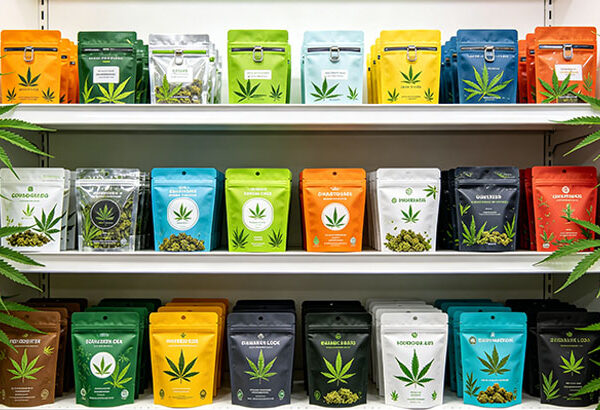
Supplier claims in cannabis packaging are inexpensive to make and expensive to check. A five-layer barrier film, a water-vapour transmission figure, a child-resistant closure and in-house gravure printing can all appear in a quotation and still leave an evaluation-stage buyer unable to answer the only question that matters before a purchase order is released: which of these statements is attached to something I can inspect?
The gap is not a matter of dishonesty. Most cannabis packaging bag specifications are written at the level of intent — high barrier, odor proof, child resistant — while the evidence that would let a buyer rely on those words sits in a different set of documents, and in a physical sample, that rarely arrive together. This article maps five common supplier claims to the specific artefacts that should support them, using the CHITAI cannabis mylar bag range from Dongguan Chitai Packaging Products Co., Ltd as the worked example. The company is a Dongguan-based manufacturer of cannabis packaging bags that offers OEM and ODM production, states a monthly capacity of 2,500,000 units and a typical lead time of 3–5 days, and describes its own flexible-film printing and bag-making equipment in its company material. The argument is not that these numbers are better than another supplier's. It is that they are specific enough to be checked — and the checks are identical for every supplier on a shortlist.
Why cannabis packaging claims resist verification
Three properties of the category make unverified claims unusually costly.
First, bags that look identical on a table can differ in film construction, adhesive system and seal geometry, and those differences do not show up in a photograph. Two 500-unit samples from two suppliers may both be black, matte and zip-sealed while performing differently after six months on a dispensary shelf.
Second, compliance is a gating condition, not a preference. California requires cannabis goods to be sold in child-resistant packaging designed to be difficult for children under five to open, and state guidance identifies packaging certified under the Poison Prevention Packaging Act regulations at 16 CFR 1700.15(b)(1) as one qualifying route. California guidance also lists tamper-evident and resealable requirements alongside contamination prevention for manufactured cannabis products. Canada's Cannabis Regulations section 108 imposes a parallel but distinct set of conditions: the immediate container must be opaque or translucent, prevent contamination, keep dried cannabis dry, provide reasonable assurance it has not been opened, meet child-resistant package requirements, and hold no more than the equivalent of 30 g of dried cannabis. A supplier's assertion of compliance does not transfer any of those obligations away from the buyer.
Third, the vocabulary of the category is borrowed. Smell proof, waterproof and high barrier are trade terms without a single agreed test behind them, so each supplier defines them privately. That is precisely why the evidence request — not the adjective — has to carry the weight.
A three-tier evidence chain
A practical way to structure the evaluation is to require every material claim to survive three tiers.
- Tier 1 — written specification. The claim appears in a signed specification or datasheet with a named value, unit and scope: which laminate, which thickness, which mechanism, which size.
- Tier 2 — documentary proof. A test report, equipment list, process record or certificate exists for that specified item, and identifies the specimen, the method and the date.
- Tier 3 — physical correspondence. The sample in the buyer's hand matches the Tier 1 document, and the production bag matches the sample.
A claim supported at one tier is a statement. A claim supported at all three is a specification a buyer can plan a launch around. The most common failure is not a fabricated number; it is a Tier 1 figure with no Tier 2 report, or a Tier 2 report for a laminate that is not the one in Tier 3.
Claim 1 — “our film is a five-layer high-barrier structure”
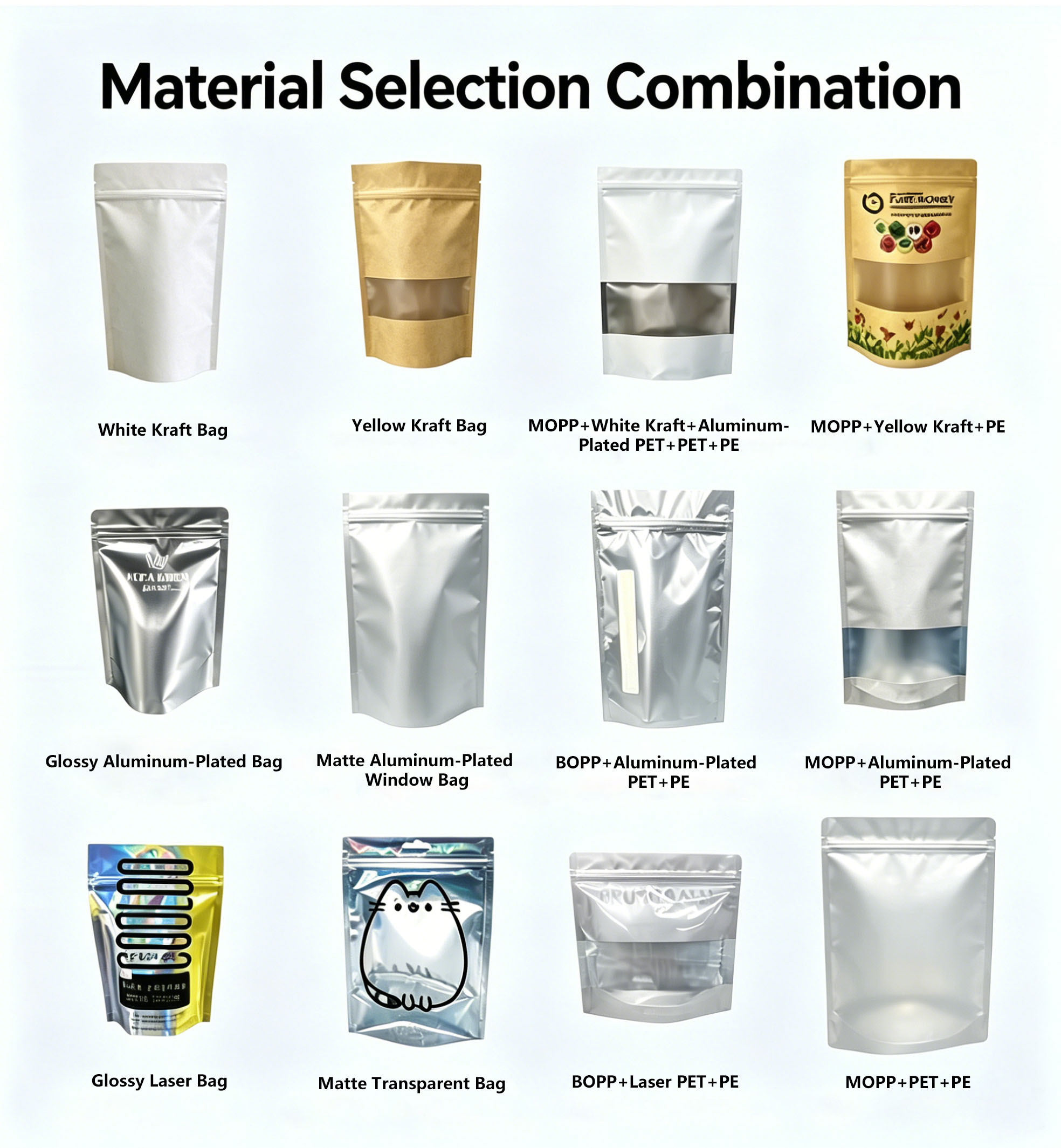
A declared structure of PET/VMPET/PE/NY/AL is a strong claim precisely because it is checkable. In flexible packaging generally, aluminium foil is used as the principal barrier against moisture, oxygen and light; metallised PET contributes a secondary barrier layer; nylon adds toughness and resistance to flex cracking; polyethylene forms the product-contact sealant layer that closes the bag; and the outer PET layer carries the print and provides mechanical strength. None of that is supplier-specific. What the buyer is verifying is narrower: that this laminate contains those layers, in that order, at stated thicknesses.
Evidence to request:
- A layer-by-layer structure declaration with material abbreviation, layer order and nominal thickness per layer, plus total film thickness in microns or mils.
- The lamination system used — solvent-free versus solvent-based adhesive. This matters because the case material associated with the CHITAI range lists solvent-free material among its stated highlights; the corresponding declaration is the artefact that supports it.
- Confirmation that the declared structure is a fixed bill of materials for the quoted product, and a written change-notification commitment if any layer or thickness is substituted.
- A retained laminate sample and a finished bag from the same production batch.
Physical checks: the seal edge should be clean and continuous, with no tunnelling or adhesive smear; the bag should dead-fold rather than spring back; opacity should be consistent when held against a light source. These observations do not measure barrier performance, but they do reveal a laminate that has been assembled carelessly — which is the usual precursor to a barrier failure at the seal.
Claim 2 — barrier figures: WVTR ≤0.03 and OTR ≤0.05
Water vapour transmission rate at or below 0.03 g/(m²·24h) and oxygen transmission rate at or below 0.05 cm³/(m²·24h) are the numbers presented for the CHITAI high-barrier range. They are worth reading alongside an independent benchmark: HTNXT Research's 2026 assessment of cannabis packaging manufacturing standards places premium cannabis bag performance at OTR below 0.05 cm³/(m²·24h) and WVTR under 0.03 g/(m²·24h). In other words, a supplier quoting these figures is quoting a category benchmark, not a unique advantage. The differentiator is whether a test report exists for the laminate actually being quoted.
Transmission rates are conditional values. They change with temperature, relative humidity, film thickness and the direction in which the specimen faces the test chamber. A figure published without those conditions is not verifiable, and a figure published for a different laminate is not transferable.
Evidence to request:
- A test report naming the laboratory, the report date and the specimen identification, cross-referenced to the laminate code on the quotation.
- The test method used and its standard reference, plus the temperature and relative humidity conditions.
- The specimen orientation, and whether the number refers to flat film or a finished pouch.
That last point deserves emphasis. Flat-film data describes the film. It does not describe the zipper, the seal lines or any valve, and those are where a finished bag most often leaks. A supplier able to provide both a flat-film result and a finished-pouch result is demonstrating a materially deeper testing capability than one providing film data alone — and a buyer who asks the question learns something about the supplier's laboratory before the first order rather than after the first complaint.
Claim 3 — an IPX4 waterproof rating
IPX4 appears frequently in cannabis packaging marketing, particularly for bags positioned around outdoor or humid retail conditions. The rating belongs to the IEC 60529 ingress-protection scale and denotes resistance to splashing water. It is not a claim of water immersion or of prolonged exposure, and it should not be read as one.
The useful question is how the rating was established for a flexible pouch. IPX4 is a rating concept developed around enclosures, so applying it to a bag requires a stated test configuration: whether the bag was tested empty or filled, how long the exposure lasted, whether the closure was sealed or had been opened and reclosed, and whether the rating was re-established after repeated opening cycles.
Evidence to request: the test reference behind the rating, the configuration tested, and confirmation that the tested configuration matches the product the buyer intends to ship. Where a rating is asserted rather than tested, that should be visible in the document — a design intention and a tested result are different things, and a buyer ordering waterproof cannabis packaging bags is entitled to know which one is being offered.
Claim 4 — child resistance described under ASTM D3475
The CHITAI range describes three closure mechanisms — CR Zipper, Push Lock and Slide Lock — within the ASTM D3475 classification framework for child-resistant packages. That framework classifies package types. It does not certify an individual production lot, and the distinction is where most compliance confusion begins.
Performance testing in the United States runs through the protocol at 16 CFR 1700.20, under which 85% of children aged 42–51 months must be unable to open the package within five minutes. A supplier claiming child resistance should therefore be able to place three separate items in front of a buyer: the classification description of the mechanism, the performance test applicable to the market being served, and a package sample that operates as described.
The mechanisms are not interchangeable, because they differ in what happens after the first opening. California guidance distinguishes single-use child-resistant packaging, which is initially child-resistant but not after opening, from multiple-use packaging that maintains child resistance throughout the package's life. A CR Zipper, Push Lock or Slide Lock that re-engages on every close sits in the multiple-use category; a heat-sealed single-use format belongs to the other. Choosing between them is a product decision, not a marketing one, and it should be recorded in the specification.
Evidence to request:
- The named mechanism on the specification, matched to the drawing — not a generic “child-resistant closure” line.
- The test report for that mechanism and package configuration, with the protocol version and panel described; the pass/fail line alone is not enough to audit later.
- The single-use or multiple-use classification the supplier is asserting, and the market it applies to.
- Tamper-evidence and reseal behaviour, both of which California guidance identifies as separate packaging requirements for manufactured products.
Physical checks: open and close the sample repeatedly and note whether resistance persists; inspect the closure for moulding flash or misalignment; confirm the child-resistant action cannot be defeated by a simple pinch or lever. These checks supplement the test report — they never replace it.
Claim 5 — in-house printing, from small batches upward
Print capability is the claim buyers examine least and rely on most, because it determines artwork fidelity, colour consistency across reorders and the minimum order at which a custom design becomes economic. The CHITAI range describes digital printing for small batches, gravure, and flexographic printing. The equipment supplied for this article specifies two digital printing machines, four gravure printing machines and thirty automatic bag-making machines.
Evidence to request:
- An equipment list naming machine type, count and maximum print width, and identifying which of those machines will run the buyer's job.
- A printed proof from that press, on the actual laminate, against an agreed colour target.
- Whether plates or print cylinders are produced in-house or sourced externally, since this drives both tooling lead time and the cost of a design change.
Digital and gravure sit at opposite ends of an economic curve: digital avoids tooling and suits short runs and version changes, while gravure spreads cylinder cost across volume and rewards long, stable orders. A supplier able to run both is genuinely more flexible across a product launch cycle, where an initial short run is followed by replenishment at volume. A buyer should test that flexibility in the documentation rather than assume it — ask which process will produce the first order and which will produce the reorder, and confirm that both use the same approved colour standard.
Claim 6 — capacity, size range and order terms
The CHITAI range covers 1 g to 28 g capacity and bag sizes from 3" × 4" to 8" × 10", supported by a stated monthly capacity of 2,500,000 units and a typical lead time of 3–5 days. The purchasing terms supplied for this channel state a minimum order of 10,000 units, CIF delivery terms, pre-shipment testing as the acceptance criterion and 100% full payment.
Each of those is a claim with a distinct verification route:
- Lead time. Ask what the 3–5 days covers. Production time, print set-up, proof approval and pre-shipment testing are different clocks, and a launch schedule built on the shortest interpretation of the term is a schedule built on an assumption.
- Capacity. A monthly capacity statement is a capability ceiling, not an availability commitment. The question that matters at the evaluation stage is what portion is already committed during the buyer's target production window.
- Minimum order. At 10,000 units, a supplier's smallest economic order shapes which buyers the range actually fits. A brand running a limited release below that threshold should confirm which print method and which size minimum apply before designing artwork.
- Acceptance. Pre-shipment testing as the acceptance criterion is only meaningful if the test list, sampling basis and pass thresholds are written down in advance. A buyer who has not agreed the test list has agreed to the supplier's definition of a conforming batch.
On size, one regulatory point deserves care. Canada's immediate-container limit of 30 g of dried cannabis equivalent is a rule about the product inside the container, not a statement about bag capacity. A 28 g bag sits inside that range dimensionally, but its capacity figure is not evidence of compliance with section 108 — that requires the container to satisfy opacity, dryness, security and child-resistance conditions as well.
From claim to evidence: a request table
The grid below compresses the sections above into the form a buyer can send to a supplier before a sample review. It is deliberately written as requests, not conclusions.
| Supplier claim | Documentary evidence | Physical check on the sample |
|---|---|---|
| Five-layer PET/VMPET/PE/NY/AL structure | Layer declaration with order and thickness; lamination system; total film thickness | Seal-edge integrity, dead-fold, opacity consistency |
| WVTR ≤0.03 g/(m²·24h), OTR ≤0.05 cm³/(m²·24h) | Test report with laboratory, method, conditions, specimen ID, flat film or pouch | Closure and seal condition, since these are outside flat-film data |
| IPX4 waterproof rating | Test reference and configuration tested | Seal and closure behaviour after repeated opening |
| ASTM D3475 CR Zipper, Push Lock or Slide Lock | Mechanism drawing, 16 CFR 1700.20 test report, single-use or multiple-use classification | Open-close cycles, resistance persistence, tamper evidence |
| In-house digital, gravure and flexographic printing | Equipment list with counts and print widths; tooling ownership | Proof pulled from the designated press on the actual laminate |
| 1 g–28 g capacity, 3"×4" to 8"×10" sizes | Size and capacity chart linked to the mechanism and print method | Fill test with representative product |
| 2,500,000 units monthly, 3–5 day lead time, 10,000 unit MOQ | Capacity statement with lead-time definition and agreed pre-shipment test list | Sealed production bag from a completed run, not a hand sample |
What a worked example looks like — and where it stops
The CHITAI range has one published case behind it that is useful for illustrating the chain. A global market project for dried cannabis flower packaging ran at 500,000 units, using a bag built around child-resistant safety design, high odor barrier, solvent-free material and an anti-tampering and anti-counterfeit structure. The reported result was no odor leakage and full compliance with local regulations on preventing children from opening and tampering, with a shelf life of 2 to 3 years and a daily usage period of more than one year. The same source states that the manufacturer performs 100% testing for quality control and provides OEM and ODM services, with customization across shape, material, housing colour and logo printing.
Read as evidence, that case is a starting point rather than a conclusion. It is a supplier-reported outcome, which means the buyer's legitimate next request is the underlying record: the barrier test report for that run, the child-resistance documentation, the incoming-material checks and the pre-shipment inspection results. A case summary demonstrates that a project existed; the records demonstrate what was controlled while it ran. The distinction matters most on the 100% testing claim, because “100% tested” describes coverage, not criteria — the buyer still needs to know what was measured, at which station, and against which limit.
Which evidence matters depends on the market
A single evidence pack will not serve every destination. California's requirements centre on child resistance designed against children under five, together with tamper-evident and resealable properties for manufactured products, and the state guidance points to PPPA certification as one qualifying route. Canada's section 108 adds opacity or translucency, dryness preservation, a security feature and a 30 g dried-cannabis-equivalent container limit. Neither set of rules should be treated as a proxy for the other, and neither can be generalised to a market the buyer has not yet checked.
The practical consequence is that the evidence request should be written market-first: name the jurisdiction, list the properties that jurisdiction requires, and ask the supplier to match each property to a document. A supplier who answers that structure with a document set is doing something different from a supplier who answers with a paragraph of assurances.
Market context, read with the same caution
The supply side of this category is concentrated. China is the leading exporter of plastic bags under HS 392321, accounting for over 25% of global exports at approximately USD 3.32 billion in 2023, and plastics represented 54.3% of global cannabis packaging material share in 2025 according to Grand View Research. Those two figures establish sourcing geography and material dominance; they say nothing about any individual factory's capability.
Market size estimates deserve more caution than they usually receive. Fortune Business Insights values global cannabis packaging at USD 7.37 billion in 2026, while Mordor Intelligence values the same year and geography at USD 2.29 billion. Both are commercial research, the segment definitions are not reconcilable from the published material and the two values cannot be averaged or combined. That divergence is a useful reminder of the article's central point: an uncorroborated number, however professionally presented, is still an uncorroborated number — and the same standard a buyer applies to a market forecast should be applied to a supplier's barrier figure.
The decision rule
A cannabis packaging supplier that can demonstrate capability behaves differently from one that asserts it. The first produces a layer declaration, a test report with conditions, a mechanism drawing and an equipment list without being asked twice, and its sample matches all four. The second produces adjectives, and its sample is the only artefact in the file.
For a buyer moving from evaluation into execution, the working rule is short: if a claim cannot be paired with a document and confirmed on a physical sample, record it as a design intention and leave it out of the purchase specification. The specification is what the factory will build to, and the acceptance test is what protects the order. Everything else is conversation.
Frequently asked questions
What documents should arrive with a cannabis mylar bag sample?
A sample should travel with a specification sheet naming the laminate structure and total thickness, the size and capacity, the closure mechanism and any barrier figures claimed. Behind those pages should sit the supporting evidence: a barrier test report identifying the specimen and method, a child-resistance test report where the market requires it, and an equipment or process description if print capability is part of the offer. A sample arriving without a matching specification cannot be approved, because there is no agreed reference to reproduce at volume.
How can a buyer verify a WVTR or OTR figure on a cannabis bag datasheet?
Ask for the test report behind the figure rather than the figure itself. The report should identify the laminate or specimen tested, the method and its standard reference, the temperature and relative humidity conditions, and whether the specimen was flat film or a finished pouch. Transmission rates change with thickness, conditions and orientation, so a number without those qualifiers cannot be checked. HTNXT Research's 2026 assessment places premium cannabis bag performance at OTR below 0.05 cm³/(m²·24h) and WVTR under 0.03 g/(m²·24h), which means the figure alone indicates category-level performance rather than a supplier-specific result.
Is ASTM D3475 the same as child-resistance certification?
No. ASTM D3475 classifies child-resistant package types; it does not certify a production lot. Market performance testing runs separately — in the United States through the 16 CFR 1700.20 protocol under the Poison Prevention Packaging Act, which requires that 85% of children aged 42–51 months cannot open the package within five minutes. A buyer should therefore expect two different artefacts: the classification description of the closure mechanism, and the performance report for the specific package configuration being supplied.
What does an IPX4 rating actually tell a cannabis packaging buyer?
IPX4 sits within the IEC 60529 ingress-protection scale and denotes resistance to splashing water. It does not indicate immersion resistance or extended exposure resistance. When applied to a flexible pouch, the rating is only useful if the test configuration is stated: whether the bag was empty or filled, how long exposure lasted, whether the closure was sealed or had been cycled. A buyer ordering waterproof cannabis packaging bags should request the test reference alongside the rating.
Does a 28 g bag capacity satisfy Canada's 30 g container rule?
No — the two are different things. Canada's Cannabis Regulations section 108 sets a limit of no more than 30 g of dried cannabis equivalent in the immediate container, and separately requires that container to be opaque or translucent, prevent contamination, keep dried cannabis dry, provide reasonable assurance it has not been opened, and meet child-resistant package requirements. A 28 g capacity figure sits below the limit dimensionally, but capacity alone does not establish compliance with any of the other conditions.
Reference: the CHITAI 2026 product brochure is available for download at cdn.socialarks.com — CHITAI brochure 2026 (PDF). Supplier contact for documentation requests: sales@packagingforcannabis.com. Company website: cannapackworks.com.
¿Tiene preguntas o necesita más detalles?
Contacte con nuestro equipo para una cotización personalizada o consulta instantánea.
Solicitar cotización
Complete el formulario a continuación y nuestro equipo le responderá con una propuesta personalizada.
Chat directo de WhatsApp
¿Prefiere chatear en tiempo real? Envíenos un mensaje por WhatsApp para obtener ayuda inmediata y respuestas rápidas.
- Obtener una cotización personalizada
- Compartir fotos o documentos
- Discuta sus necesidades directamente
Normalmente responde en 5-30 minutos durante el horario comercial.