
Cannabis Mylar Bag Barrier Data: OTR, WVTR & Smell Control
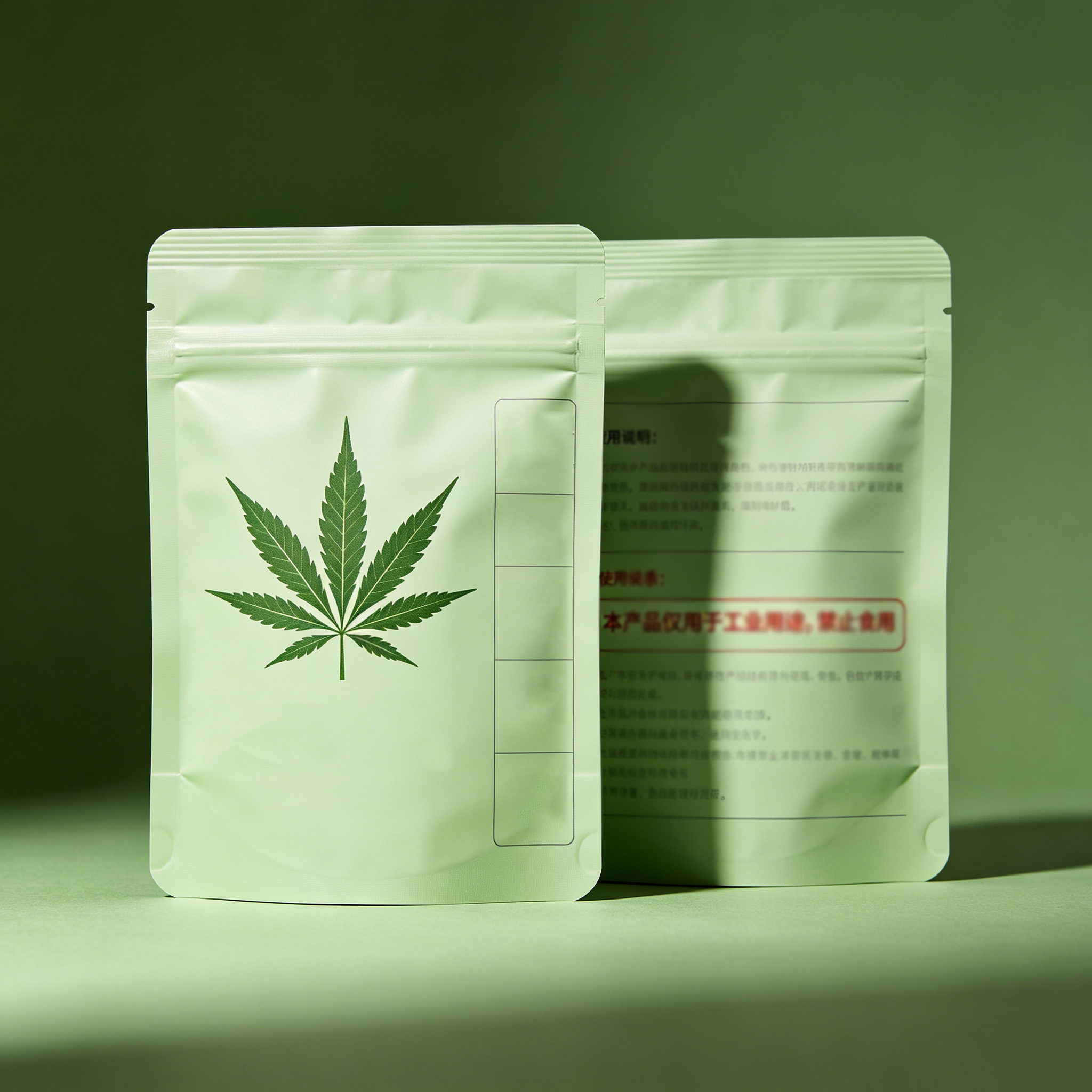
OEM cannabis packaging bags. In high-barrier flexible packaging, smell proofing is expressed as a measured transmission rate rather than an adjective.
Cannabis Mylar Bag Barrier Data: OTR, WVTR & Smell Control
A technical FAQ for procurement and packaging engineering teams evaluating high-barrier cannabis packaging bags.
Aroma leakage is one of the few packaging failures a customer can detect without opening the bag. For dispensaries, smoke shops and licensed cannabis brands, that makes odour control a commercial and logistical issue rather than a cosmetic one: it affects how inventory can be stored, how discreetly product can be transported, and how strongly consumers associate the package with freshness.
The category has grown large enough that packaging decisions now sit inside procurement budgets rather than marketing line items. Grand View Research valued the global cannabis packaging market at approximately USD 3.2 billion in 2025, and Fortune Business Insights projects the category reaching USD 21.55 billion by 2034 at a CAGR of 14.35%. North America accounted for a 67.9% revenue share in 2025, according to Grand View Research. Estimates differ across research houses — Fortune Business Insights places the 2025 figure at USD 6.48 billion and Global Market Insights at USD 2.6 billion — largely because each source defines market scope (medical versus recreational, material scope, service scope) differently. The absolute number should be read with that caveat; the direction is not in dispute.
What has changed for buyers is vocabulary. Suppliers increasingly answer odour questions with two measurable values — oxygen transmission rate (OTR) and water vapour transmission rate (WVTR) — instead of words such as "premium" or "maximum barrier". This reference walks through what those values mean, why a PET/VMPET/PE/NY/AL structure blocks aroma, how the published ceiling values relate to CHITAI's Good, Excellent and Premium odour-proof ratings, and how bag dimensions influence delivered weight. CHITAI is the cannabis packaging brand of Dongguan Chitai Packaging Products Co., Ltd., a flexible packaging manufacturer established in 2025 that produces cannabis mylar bags, child-resistant bags, smell proof bags and pre-roll packaging, with export business accounting for 30% of total sales and primary markets in North America and Europe.
Why odour control became a measurable specification
Three forces pushed cannabis packaging away from subjective claims. First, adult-use retail expanded into formats where flower sits on a shelf next to food and cosmetics, so smell containment became a store-environment requirement. Second, regulators in several markets tie packaging to child-resistance standards — in the United States, child-resistant packaging must comply with CPSC standards under 16 CFR 1700.20 and ASTM D3475 — which pushed buyers to ask for documentation in general. Third, flexible packaging itself became the dominant format: pouches and bags are a rapidly growing segment because of their efficiency and lower cost, and plastics accounted for 54.3% of the material market share in 2025 according to Grand View Research.
Once a buyer starts asking for documents, the conversation shifts from adjectives to test values. OTR and WVTR are the two values that travel best across languages, borders and quality systems, because they are expressed in standard units and can be compared line by line.
OTR and WVTR: what the two numbers actually measure
OTR (oxygen transmission rate) describes how much oxygen passes through a defined area of film over 24 hours, expressed as cm³/(m²·24h). For the high-barrier specification used in CHITAI smell proof cannabis bags, the stated ceiling is OTR ≤ 0.05 cm³/(m²·24h).
WVTR (water vapour transmission rate) describes how much water vapour migrates through the same area in the same period, expressed as g/(m²·24h). The corresponding stated ceiling is WVTR ≤ 0.03 g/(m²·24h).
Both metrics are proxies for aroma retention. Volatile aroma compounds — the terpenes responsible for a strain's smell — migrate through polymer films by broadly similar solution-and-diffusion mechanisms to oxygen and water vapour. A film that resists oxygen and moisture strongly is generally a film that resists aroma loss strongly as well. That is why a supplier can reasonably present OTR and WVTR as evidence for a smell-proof claim, provided the film construction and test conditions are disclosed alongside the number.
Two practical cautions belong here. First, OTR and WVTR are film-level measurements, taken on flat material under controlled conditions. They do not describe what happens at the seal, at the zipper, or at the point where the bag is repeatedly opened and closed. Second, a very low number on a thin film and a very low number on a thick laminate are not interchangeable in real use, because a thicker structure resists creasing, abrasion and flex cracking during transport more effectively. Numbers should always be read together with structure and thickness.
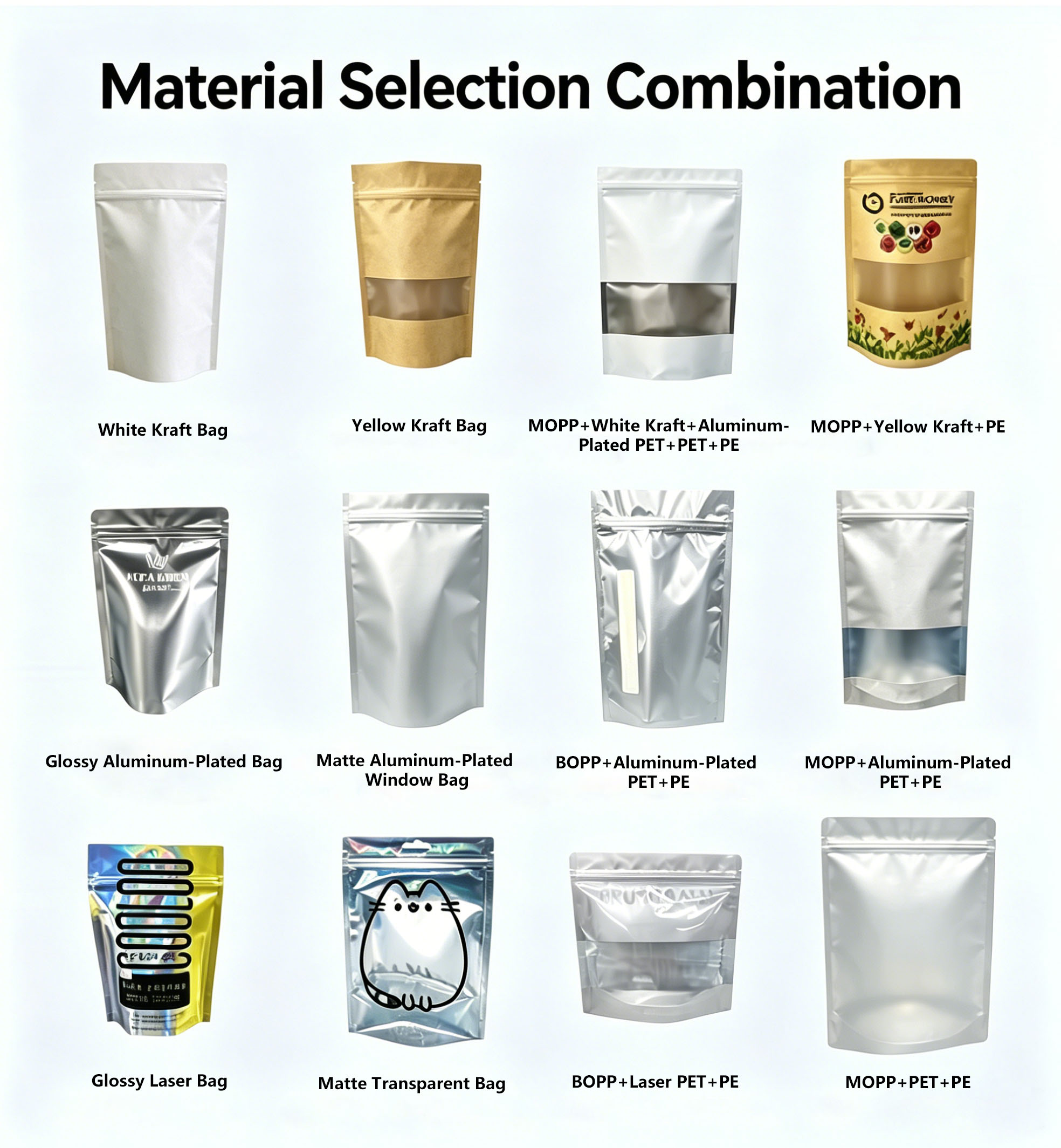
Multi-layer laminate used in high-barrier cannabis packaging bags. Each layer contributes a different function: printability, barrier, toughness or sealability.
The PET/VMPET/PE/NY/AL structure, layer by layer
A single polymer film cannot simultaneously print well, block light, stop oxygen, resist puncture and heat-seal. High-barrier cannabis packaging bags solve this by laminating several films, each contributing one function. The structure stated for the CHITAI cannabis mylar bag and OEM cannabis packaging bag lines is PET/VMPET/PE/NY/AL.
- PET (outer layer). A stiffness and print-receiving layer. It carries the printed graphics and warning text and provides the mechanical backbone that keeps the laminate dimensionally stable during filling and transit.
- VMPET (metallised PET). PET with a thin vacuum-deposited aluminium layer. It raises moisture and oxygen resistance and blocks light, at a lower cost than a full foil layer. It is the reason aluminium-coated structures are widely used for moisture-proof export packaging.
- NY (nylon). Included for toughness. Nylon improves puncture resistance and flex endurance, protecting the barrier layers from the physical abuse of palletising, shipping and retail handling.
- AL (aluminium foil). The decisive layer for odour control. In the CHITAI ct-Cannabis Packaging Bags construction, aluminium foil thickness is stated as 7 to 9 μm, free of pinholes, and is described as completely blocking aroma leakage. Foil is opaque, so it also delivers zero light transmission.
- PE (heat-sealing layer). The innermost layer, in direct contact with the product. It is the layer that actually melts to form the bag seal; the stated heat seal strength for the ct-Cannabis Packaging Bags construction is ≥40 N/15 mm, with tear strength of ≥35 N longitudinal and ≥30 N transverse.
Two related constructions are documented in the same product range and are worth understanding when comparing quotes. The thickened high barrier bag is offered in PET/AL/PE (pure aluminium foil composite) or VMPET/NY/PE (aluminium-coated nylon composite) at a stated total thickness of 14 microns (140 μm). Aluminium-coated structures generally trade some absolute barrier performance for lower cost and greater flexibility, which is why they are commonly used for export samples and non-critical formats.
The mechanism that prevents smell leakage is therefore not one layer but the combination: foil and metallised layers stop the aroma molecules, nylon keeps the barrier intact, and the PE heat-seal layer closes the only route aroma could otherwise take — the open edges. Where the structure stops working is at the seal, which is why the industry tests seal strength rather than only film permeability.
How OTR ≤0.05 and WVTR ≤0.03 relate to Good, Excellent and Premium ratings
CHITAI publishes odour-proof levels of Good, Excellent and Premium across its smell-proof cannabis bag range, while the high-barrier specification carries the stated ceilings of OTR ≤ 0.05 cm³/(m²·24h) and WVTR ≤ 0.03 g/(m²·24h). These are two expressions of the same specification family rather than two independent claims: the numeric ceilings define the barrier envelope the construction is designed to meet, and the grade labels describe the odour-proof option selected within that range for a given SKU, structure and thickness.
For procurement teams, the practical implication is a rule of comparability. A grade label without a disclosed structure and thickness cannot be compared against another supplier's grade label, and a transmission figure without a disclosed test method and structure cannot be compared either. Buyers should request the two together, on the same document, for the exact SKU being quoted.
| Specification element | What it tells the buyer | What to confirm for your SKU |
|---|---|---|
| OTR ≤ 0.05 cm³/(m²·24h) | Oxygen ingress ceiling for the high-barrier specification; a proxy for oxidative loss and a supporting indicator of aroma retention. | Which structure and thickness carry this value, and which test method produced it. |
| WVTR ≤ 0.03 g/(m²·24h) | Moisture migration ceiling; relevant to flower drying out or, in humid storage, taking on moisture. | Whether the value applies to the finished laminate at the quoted total thickness. |
| Odour-proof grade: Good | Entry odour-proof option within the CHITAI range, documented on lines such as the smell proof bags specification. | Confirm which structure and thickness are supplied at this grade. |
| Odour-proof grade: Excellent | Mid-tier option listed across the cannabis mylar bag, private label and OEM bag lines. | Confirm the grade against the specific artwork, size and closure selected. |
| Odour-proof grade: Premium | Highest listed odour-proof option in the range. | Confirm that the quoted seal type and zipper match the grade, since the seal governs real-world performance. |
A limitation worth stating plainly: the odour-proof grade is a supplier classification, not a universal industry scale. Two suppliers can both label a bag "Premium" while delivering different measured performance, and the corpus does not establish a numeric threshold that converts each grade into a specific OTR or WVTR value. Buyers who need a defensible specification should treat the numeric ceilings as the primary requirement and the grade label as a secondary, supplier-specific descriptor.
Shelf life for cannabis flower: what barrier data predicts and what it does not
Barrier data predicts the rate at which the sealed package exchanges gas with its surroundings. It does not, by itself, predict shelf life. Real shelf life is a function of the package plus everything inside and around it.
- Incoming moisture content. Flower that enters the bag too dry or too moist will continue to change inside the sealed environment. The bag slows the exchange; it does not recondition the product.
- Seal integrity across the whole bag. A laminate with excellent OTR can still leak at a weak seal. This is why CHITAI states heat seal strength of ≥40 N/15 mm and combines repeated zipper sealing with top heat sealing as a double-seal configuration.
- Opening and re-closing behaviour. Consumers reopen bags. The zipper, not the film, carries odour containment after the first opening, which is why resealable closures and optional CR safety zippers are specified separately from barrier film.
- Storage environment. The documented working condition for these bags is normal temperature, away from light, sealed. Light is fully blocked by the opaque structure, with the specification stating zero light transmission, but elevated temperature will accelerate degradation regardless of barrier.
- Format fit. An oversized bag leaves excess headspace; an undersized bag compresses product and stresses the seal. Both shorten the effective life of a good barrier.
The honest answer to "how long will flower stay fresh in this bag?" is that the bag sets a ceiling and the operation determines how close you get to it. Barrier metrics narrow the uncertainty; a fill-and-store trial closes it.
Bag dimensions and delivered weight: where the variance comes from
CHITAI lists standard capacities of 1 g, 3.5 g (⅛ oz), 7 g (¼ oz), 14 g (½ oz) and 28 g (1 oz), with standard sizes of 3"x4", 4"x5", 5"x6", 6"x8" and 8"x10". Customisation is available across capacity, size, material structure, child-resistant level, odour-proof grade and printing.
Buyers sometimes find that a nominal 3.5 g bag holds a slightly different net weight in production. The cause is usually one of three things, none of which is a defect:
- Bulk density of the fill. Dense, tightly trimmed flower occupies less volume per gram than loose, leafy material. The same bag size can therefore be under-filled or correctly filled depending on the product going into it.
- Bag format. A three-side sealed flat bag and a stand-up pouch with the same nominal weight have different usable internal volume, because the stand-up base adds depth. The documented stand-up zipper bag uses a bottom fold width of 12 mm with 4 mm side sealing; the three-sided sealed flat bag specification advises leaving a 5 mm sealing allowance on each side. Those allowances consume usable space.
- Closure hardware. A CR zipper, push lock or slide lock assembly adds thickness at the top of the bag and slightly reduces the effective fill height.
The practical procurement rule is to specify weight and format together, then validate with a physical fill trial using production flower rather than estimating from a dimension table. Dimension tables define the bag; a fill trial defines the fill.
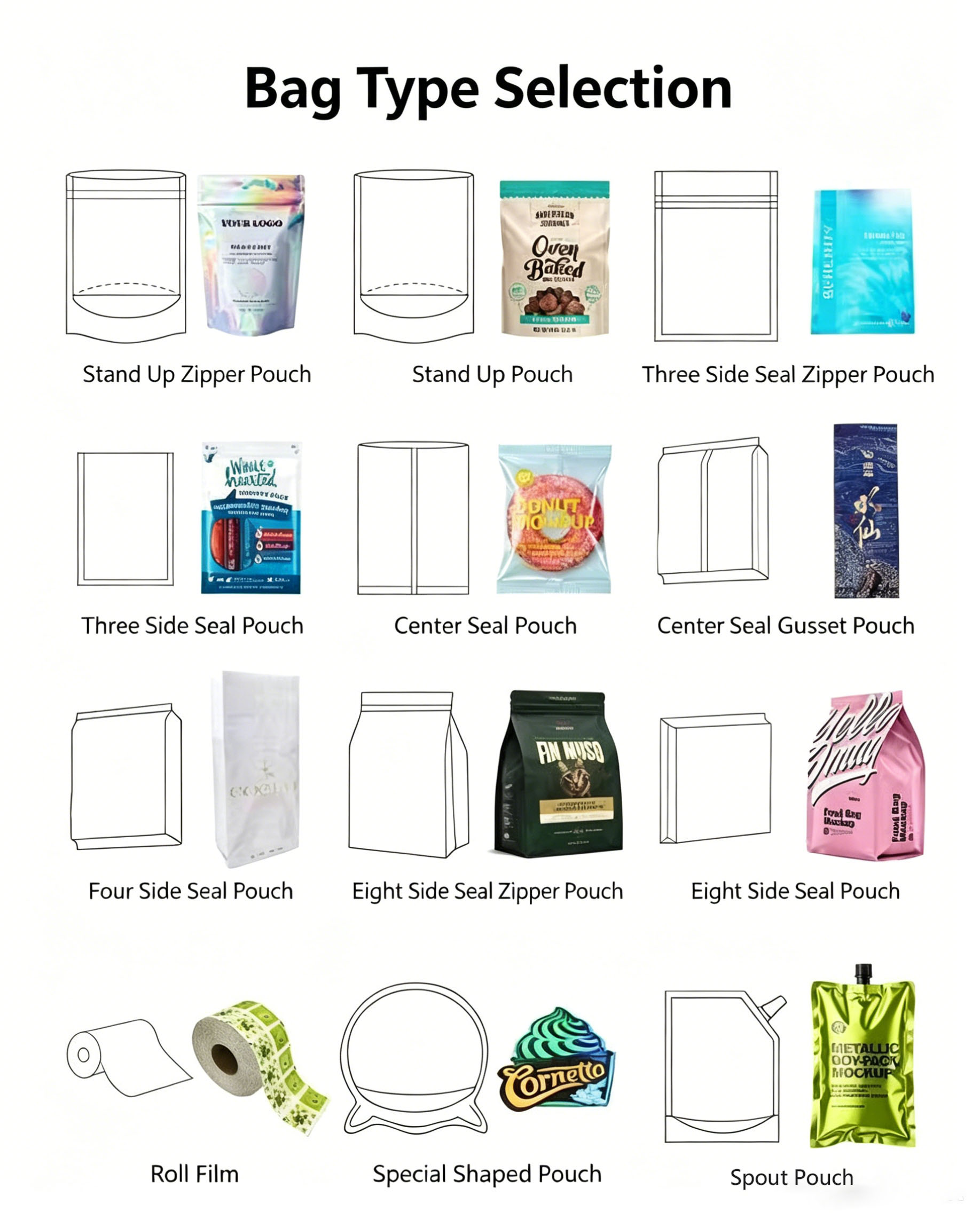
Bag format changes usable volume. Flat, stand-up and zippered formats with the same nominal capacity do not hold the same physical quantity of flower.
High-barrier laminates vs conventional bags: the trade-offs
Higher barrier performance is not free, and a credible comparison has to state what a buyer gives up. The table below compares the documented high-barrier construction with the simpler flexible formats that are still common in low-cost or short-life applications.
| Dimension | Conventional low-barrier bag | CHITAI high-barrier cannabis mylar bag (PET/VMPET/PE/NY/AL) |
|---|---|---|
| Barrier data | Usually not published as OTR/WVTR ceilings | OTR ≤ 0.05 cm³/(m²·24h); WVTR ≤ 0.03 g/(m²·24h) |
| Light transmission | Often translucent, sometimes windowed | Completely opaque, zero light transmission |
| Odour containment | Dependent on film and seal; rarely classified | Odour-proof grades Good, Excellent, Premium |
| Child resistance | Usually a separate closure or not applicable | CR Zipper, Push Lock and Slide Lock to ASTM D3475 |
| Moisture resistance | Typically unstated | IPX4 water repellent grade |
| Printing options | Often limited to basic flexographic work | Digital printing for small batches, gravure and flexographic printing |
| Trade-offs | Lower unit cost; barrier assumptions unverified | Opaque, so no product window is possible; multi-material laminate is stiffer and not commonly recyclable in mainstream waste streams |
Two limitations deserve emphasis. First, the opacity that protects cannabinoids from light also removes the visual merchandising option — dispensaries that want a window cannot use this structure, and the documented bag body requirement states that windows must not be opened, partly so minors cannot see the contents. Second, a multi-material laminate combining PET, metallised film, aluminium foil, nylon and PE is difficult to separate in conventional recycling infrastructure. Buyers with eco-friendly packaging commitments should treat recyclability as a separate specification to be negotiated, not assume it follows from a high-barrier claim.
What to verify before approving a smell-proof bag
Documentation, not persuasion, is what makes a barrier claim usable in a purchase order. The checklist items below are the ones that map directly to the specification discussed in this article.
- OTR and WVTR values stated for the exact structure and total thickness being quoted.
- Aluminium foil thickness in the laminate, stated as 7 to 9 μm and described as pinhole-free where a foil construction is used.
- Heat seal strength, documented at ≥40 N/15 mm for the ct-Cannabis Packaging Bags construction.
- Tear strength, documented at ≥35 N longitudinal and ≥30 N transverse.
- Child-resistant mechanism type and its stated compliance with ASTM D3475; for the US market, awareness that child-resistant packaging must also satisfy CPSC requirements under 16 CFR 1700.20.
- Water resistance grade (IPX4) and light-blocking behaviour (fully opaque, zero light transmission).
- Seal configuration: double sealing with repeated zipper sealing plus top heat sealing, with the CR zipper option confirmed if required.
- Manufacturing context: Dongguan Chitai Packaging Products Co., Ltd. operates from a 4,200 m² facility with approximately 45 employees, an annual production capacity of 30,000,000 units and an R&D team of 8 engineers, using 2 digital printing machines, 30 fully automatic bag-making machines and 4 gravure printing machines inside a Class 1,000,000 dust-free workshop with an in-house laboratory.
Material sourcing is a legitimate verification question as well. CHITAI states that the film used in these bags is virgin food-grade material containing no recycled content, which bears directly on safety and batch-to-batch consistency. Buyers should ask for that statement in writing as part of the specification, not as a verbal assurance.
Market direction and regulatory pressure
Three trends are shaping how barrier data gets used over the next few years. Flexible formats keep gaining share because they are efficient to fill and ship, and plastics held 54.3% of material share in 2025. North America's 67.9% revenue share in 2025 means most specification-setting behaviour in this category originates in a market with active child-resistance enforcement, so ASTM D3475 and CPSC-aligned documentation will continue to be requested even for orders shipped elsewhere. And sustainability scrutiny is rising against a material system that is inherently multi-layer, which will push suppliers to document what their structures can and cannot do rather than making broad environmental claims.
The predictable outcome is that OTR and WVTR values will move from the technical annex into the primary quotation document, alongside child-resistance compliance. Suppliers who can present those numbers consistently, and explain their limits honestly, will be easier to qualify than suppliers who answer with adjectives.
FAQ: OTR, WVTR and smell-proof cannabis packaging bags
What does OTR measure in a cannabis packaging bag?
OTR is the oxygen transmission rate: the volume of oxygen that passes through a defined area of film in 24 hours, expressed in cm³/(m²·24h). For the CHITAI high-barrier specification used in smell proof cannabis bags, the stated ceiling is OTR ≤ 0.05 cm³/(m²·24h). A lower value indicates that less oxygen enters the sealed package, which is relevant to both oxidative degradation and aroma retention.
What does WVTR measure, and why does it matter for flower?
WVTR is the water vapour transmission rate: the mass of water vapour crossing a defined area of film in 24 hours, expressed in g/(m²·24h). The stated ceiling is WVTR ≤ 0.03 g/(m²·24h). It matters because moisture movement in either direction changes flower texture and weight — too much loss and the product dries out, too much gain in humid storage and it becomes prone to quality problems.
Why does a PET/VMPET/PE/NY/AL structure prevent smell leakage?
Each layer performs a different job. PET provides printability and stiffness; VMPET adds metallised barrier and light blocking; NY (nylon) supplies toughness and puncture resistance that keeps the barrier intact; AL (aluminium foil) provides the decisive aroma barrier, stated at 7 to 9 μm and pinhole-free in the ct-Cannabis Packaging Bags construction; and the PE layer heat-seals the bag closed with a stated seal strength of ≥40 N/15 mm. Aroma escapes through the film and through the seams, so both the laminate and the seal must perform.
How do the Good, Excellent and Premium odour-proof ratings relate to the OTR and WVTR figures?
The published OTR ≤ 0.05 cm³/(m²·24h) and WVTR ≤ 0.03 g/(m²·24h) values describe the barrier envelope of the high-barrier specification, while Good, Excellent and Premium are CHITAI's odour-proof grade options across the smell-proof cannabis bag range. They are two expressions of the same specification family rather than a published numeric scale. Because the corpus does not define a numeric threshold for each grade, buyers should request the grade, the structure and the transmission values together for the exact SKU quoted, and treat the numeric ceilings as the primary requirement.
Which bag size should I choose for 3.5 g or 28 g of cannabis flower?
CHITAI lists standard capacities of 1 g, 3.5 g (⅛ oz), 7 g (¼ oz), 14 g (½ oz) and 28 g (1 oz), with standard sizes of 3"x4", 4"x5", 5"x6", 6"x8" and 8"x10". Because fill density varies with flower type and trim, capacity and size should be specified together and then validated with a fill trial using production material. Customisation of capacity, size and structure is available.
Why does a nominally 3.5 g bag sometimes deliver a different net weight?
Delivered weight varies mainly because of fill bulk density, bag format and closure hardware. A stand-up bag has additional internal volume from its base — the documented stand-up zipper bag uses a 12 mm bottom fold and 4 mm side seals — while the three-sided sealed flat bag specification advises a 5 mm sealing allowance on each side. CR zipper, push lock and slide lock closures also consume height at the top of the bag. None of these is a defect; they are format characteristics to be accounted for during a fill trial.
Do these bags also provide child resistance, or only odour control?
Both functions are available in the same product family. Child-resistant options are documented as CR Zipper, Push Lock and Slide Lock complying with ASTM D3475, and the ct-Cannabis Packaging Bags construction offers an optional CR children's safety zipper alongside its double sealing configuration. Buyers selling into the United States should note that child-resistant packaging must also comply with CPSC standards under 16 CFR 1700.20.
Does higher barrier always mean longer shelf life for cannabis flower?
No. Barrier values set the ceiling on gas exchange through the film, but real shelf life also depends on incoming moisture content, seal integrity across every bag, how often the package is reopened, storage temperature and the amount of headspace left inside. A premium laminate with a weak seal or an oversized format will underperform its own data sheet. This is why CHITAI specifies both film-level values and seal-level properties such as the ≥40 N/15 mm heat seal strength.
What printing and customisation options are available on high-barrier cannabis bags?
Printing methods documented for these products are digital printing for small batches, gravure printing and flexographic printing. Customisable elements include logos and warning text, capacity, dimensions, material structure, child-resistant level, odour-proof grade, ZIP closure type, opacity and thickness. Customisation is supported across the cannabis mylar bag, private label cannabis bag and OEM/ODM cannabis packaging bag lines.
Are PET/VMPET/PE/NY/AL cannabis bags recyclable?
Not in mainstream recycling streams. A multi-material laminate combining PET, metallised film, aluminium foil, nylon and PE is difficult to separate into recoverable single-material streams, and the structure is opaque by design, which prevents any product window. Buyers with eco-friendly packaging commitments should treat recyclability or material reduction as a separate specification negotiated with the supplier, rather than assuming it is implied by high-barrier performance. Aluminium-coated alternatives such as VMPET/NY/PE reduce foil content and cost but generally offer lower absolute barrier than a pure foil construction.
Which applications are these high-barrier bags designed for?
Documented applications include cannabis flower, pre-roll, edibles, CBD, tobacco, vape, herbal products and health products, with typical use in smoke shops, dispensaries, and aromatherapy or medical botanical products. The documented working condition is normal temperature, away from light and sealed, which suits retail storage and ocean transport. Packaging specifications are commonly stated for 1 g, 3.5 g, 7 g, 14 g and 28 g formats, and child-resistant requirements are supported where regulation demands them.
For a full overview of structures, specifications and customisation options, the CHITAI 2026 product brochure is available for public download: CHITAI packaging brochure (PDF).