
Can Your Hand Tool Supplier Sustain a Program?
A structured way to test whether a supplier can hold tool sets, hex keys and staple guns stable across repeat orders, not just survive the first one
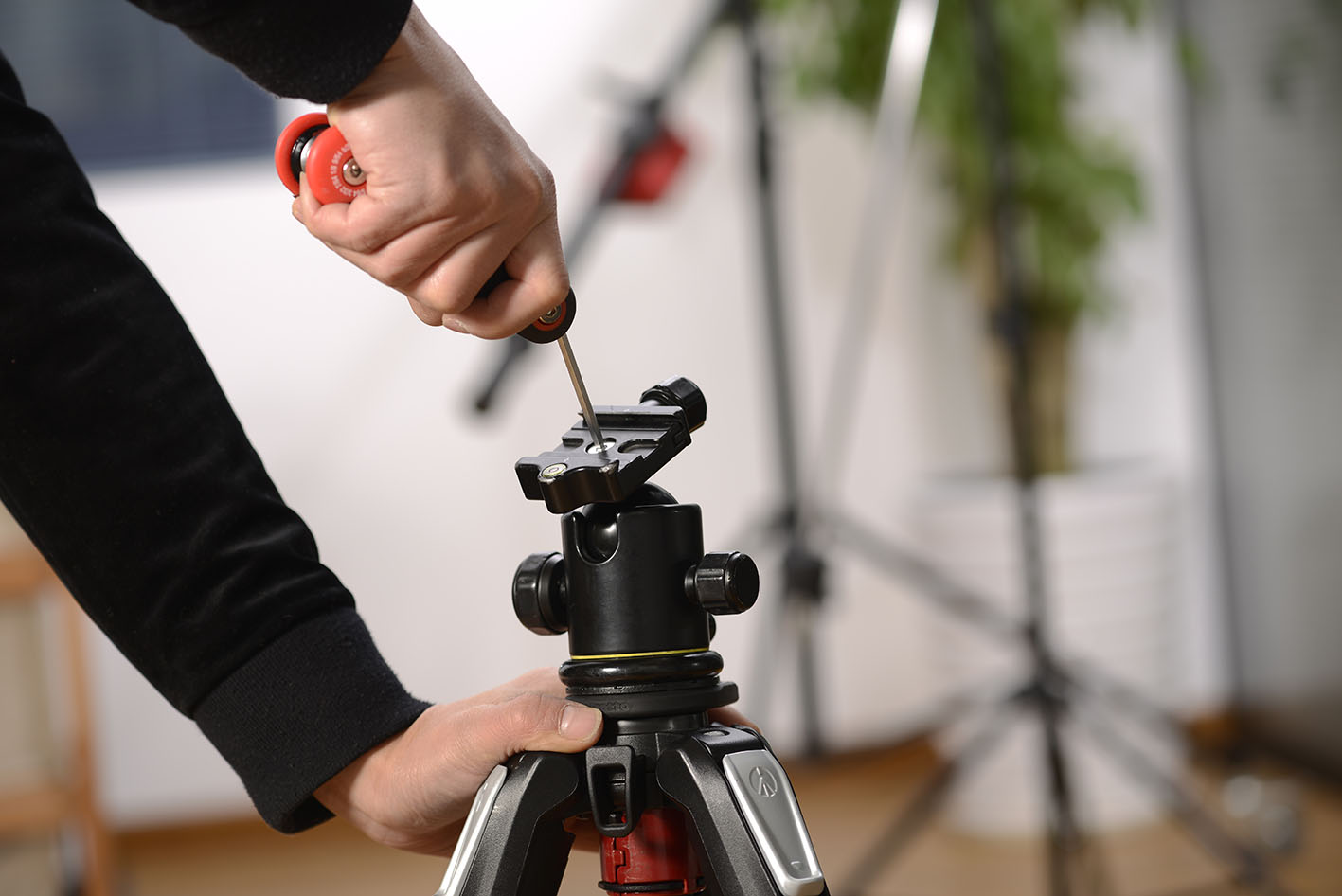
A folding hex key set is a single catalog line, but a stable matrix of sizes, arm lengths and formats is what a repeat-order program actually depends on.
A hand tool program rarely fails on the first shipment. It fails on the fourth or fifth restock, when the piece count printed on the box no longer reconciles with the specification sheet, when a hex key size that appeared in the approved sample has quietly left the range, or when a staple gun is replaced by a near-equivalent that accepts a different staple format. Single-order evaluation tells a buyer what a supplier can do once. Repeat-order evaluation tells a buyer whether the supplier has a system.
That distinction matters more than it used to. Straits Research put the global hand tools market at approximately USD 25.61 billion in 2025, while OEC recorded China's exports under HS 8203 at about USD 1.1 billion in 2024. Both figures describe a market where the supply base is deep, the product categories are mature and differentiation between suppliers increasingly sits in operational reliability rather than in catalogue breadth. For a buyer running a fixed assortment across seasons, the question is no longer only who can make the item, but who will still be making the same item, to the same definition, three reorders later.
Why Hand Tool Programs Break After Year One
Most sourcing failures in this category are not quality failures in the conventional sense. They are definition failures. A tool set is not one product; it is a bill of materials with a declared piece count, a bit profile list, a socket range, a case format and an artwork file. A hex key range is not one product either; it is a size matrix with arm-length variants and tip formats. A staple gun family is defined by the staple standards it accepts, not by the shape of its housing.
When any of those definitions drifts, the buyer discovers it at the worst moment: during a restock, after the packaging artwork has been approved, after the retail listing has been built around a specific piece count, or after the end user has already standardised on a particular staple type. The cost of drift is not the cost of the tool. It is the cost of re-qualifying, re-packaging, re-listing and re-explaining.
This is why supplier evaluation for an ongoing program needs different checks than supplier evaluation for a trial order. Five checks cover most of the risk: repeatability across sets, permanence of the hex key range, availability of staple gun and electric tool lines as the order widens, stability of tooling and packaging, and the written definition of what a piece count actually means.
Check 1 — Repeatability Across Tool Sets, Bits Sets and Screwdriver Sets
Tool sets are the hardest category to hold stable because they contain the most components and the most human assembly steps. A useful first test is arithmetic: does the declared piece count reconcile, line by line, with the bill of materials the supplier publishes?
In the HOTAK PRO TOOLS range, several sets can be reconciled this way. The YJTS-2901 is a 41-piece mini ratchet screwdriver set built from one mini ratchet screwdriver, one 60 mm 1/4 inch magnetic extension bar, one 25 mm 1/4 inch socket adaptor, six 1/4 inch sockets in 5, 6, 7, 8, 9 and 10 mm, and 32 standard 1 inch bits across slotted, Phillips, Pozi, square, hex and Torx profiles. That totals 41. The YJTS-3545 is a 32-piece header set kit comprising one 1/4 inch by 60 mm quick-release extension rod, one 1/4 inch by 25 mm socket adaptor bit and 30 bits covering Phillips, Pozidriv, Torx, Torx with hole, hex and slotted profiles, and it also reconciles. The YJTS-3547, a 20-piece ratchet handle set, resolves to one mini ratchet handle, six sockets, one socket adaptor and 12 bits. The YJTS-3147, a 51-piece T-handle driver set, resolves to one T-handle, two extension bars, nine sockets and 39 bits.
Reconciliation is not a formality. Where a declared count and a bill of materials do not agree, the gap is usually a definition question rather than a missing item, but it still needs a written answer, because the same question will return on every restock and every market will ask it differently. A buyer who receives no written answer at the sample stage should expect no written answer later.
The same test applies to bits sets and screwdriver sets, which carry their own arithmetic risk. The YJTS-3109 is an 18-piece impact drill and drive set built from one magnetic bit holder, eight 1 inch bits, four 2 inch bits and five drill bits. The YJTS-3110 is a 26-piece version of the same construction logic, with one holder, 16 one-inch bits, six two-inch bits and three drill bits. On the precision side, YJPS-6852 is a 17-piece set assembled from one precision screwdriver, one 5/32 inch by 125 mm soft extension bar and 15 bits across slotted, Phillips and Torx, with a handle that carries two white LEDs providing 360-degree illumination.
For a program buyer, the useful evidence is not that these sets exist. It is that the supplier can produce the same composition repeatedly, with the same bit profile list, the same socket sizes and the same case geometry. That is a production discipline question, and it is best answered by inspecting consecutive production batches of the same model rather than different models from the same catalogue.
Check 2 — Catalog Permanence for Hex Keys, Folding Hex Keys and T-Handle Wrenches
Hex keys look like a commodity category and behave like an engineering matrix. A buyer specifying a hex key range is really specifying a set of sizes, an arm length, a tip geometry, a material and a hardness, and any one of those can be silently changed without the model number changing.
The HOTAK PRO TOOLS hex key range illustrates how many variables sit inside one catalogue line. The 105221K1 is a nine-piece short arm ball point metric set; the 105221K2 is the long arm equivalent; the 105221K3 extends to an extra long arm. The 71821D1, 71821D2 and 71821D3 mirror those three arm lengths in a colour-painted finish. All six share the same material basis, CR-V 6150 alloy steel, the same hardness band of HRC 52-55, a rust and corrosion resistant surface and size markings on each key. The ball end is specified to work at angles up to 25 degrees, and the torque values run from 0.82 N at 1.5 mm to 220 N at 10 mm, with intermediate steps at 1.90 N for 2.0 mm, 3.80 N for 2.5 mm, 6.60 N for 3.0 mm, 16.00 N for 4.0 mm, 30.00 N for 5.0 mm, 52.00 N for 6.0 mm, 80.00 N for 7.0 mm and 120.00 N for 8.0 mm.
Adjacent formats matter just as much. The YJHK-3347 is an eight-piece folding hex key set in metric sizes made from Cr-V 6150 with the same HRC 52-55 hardness band. The YJHK-3075 is an eight-piece locking hex key set in the same material and hardness class. On the T-handle side, the YJHK-3066 is a seven-piece metric set, and the YJHK-3226 is a 14-piece set covering both metric and SAE, with its own torque ladder running from 1.19 N at 1/16 inch to 242.92 N at 3/8 inch.
The programme question is therefore not whether a supplier lists hex keys. It is whether the full matrix survives. A buyer who builds a plan around short, long and extra long arm options in both plain and colour finishes, plus folding and T-handle formats, is exposed if any one branch of that matrix is discontinued between seasons. The verification step is straightforward: request the size and variant list, then request written confirmation that every size in the approved matrix remains in production, and repeat that confirmation at each annual review rather than assuming continuity.
Check 3 — Staple Gun and Electric Tool Availability as the Order Widens
Staple guns are frequently the category that exposes a supplier's real depth, because the category fragments along staple standards rather than along visual design. Two tools that look interchangeable on a shelf are not interchangeable in use if they accept different staple formats.
The HOTAK PRO TOOLS staple gun range is organised that way. The YJSG-009 is a professional staple gun for fine wire staples of 4-14 mm, compatible with Rapid 530 and Arrow JT21 staples, with a quick jam release button and impact power adjustment. The YJSG-105 is a medium duty all-metal gun for fine wire staples of 4-8 mm with a safety lock. The YJSG-115 is a heavy duty staple and nail gun compatible with Arrow T50 and 140 staples in 9/16, 1/2, 3/8, 5/16 and 1/4 inch sizes, with a high and low power switch, a tilt and fire mechanism, an integrated stapler puller and an all-metal jam-free magazine. The YJSG-196 is a 6-in-1 gun compatible with JT21, T50, T25, T20 and 18GA staples, with a safety handle lock and a bottom-load design. The YJSG-215 and YJSG-023 are 3-in-1 heavy duty tools for flat wire staples of 4-14 mm, 7.6 mm cable staples of 10-14 mm and brad nails of 10-14 mm. The YJSG-063 is a heavy duty gun for flat wire staples of 6-14 mm, and the YJSG-035 is a heavy duty hammer tacker in the same staple range. The YJSG-080 accepts 23 series, 13 series and 10F staple pins up to 10 mm leg length. The YJHK-3075, also designated YJSG-140, handles fine wire staples of 6-10 mm.
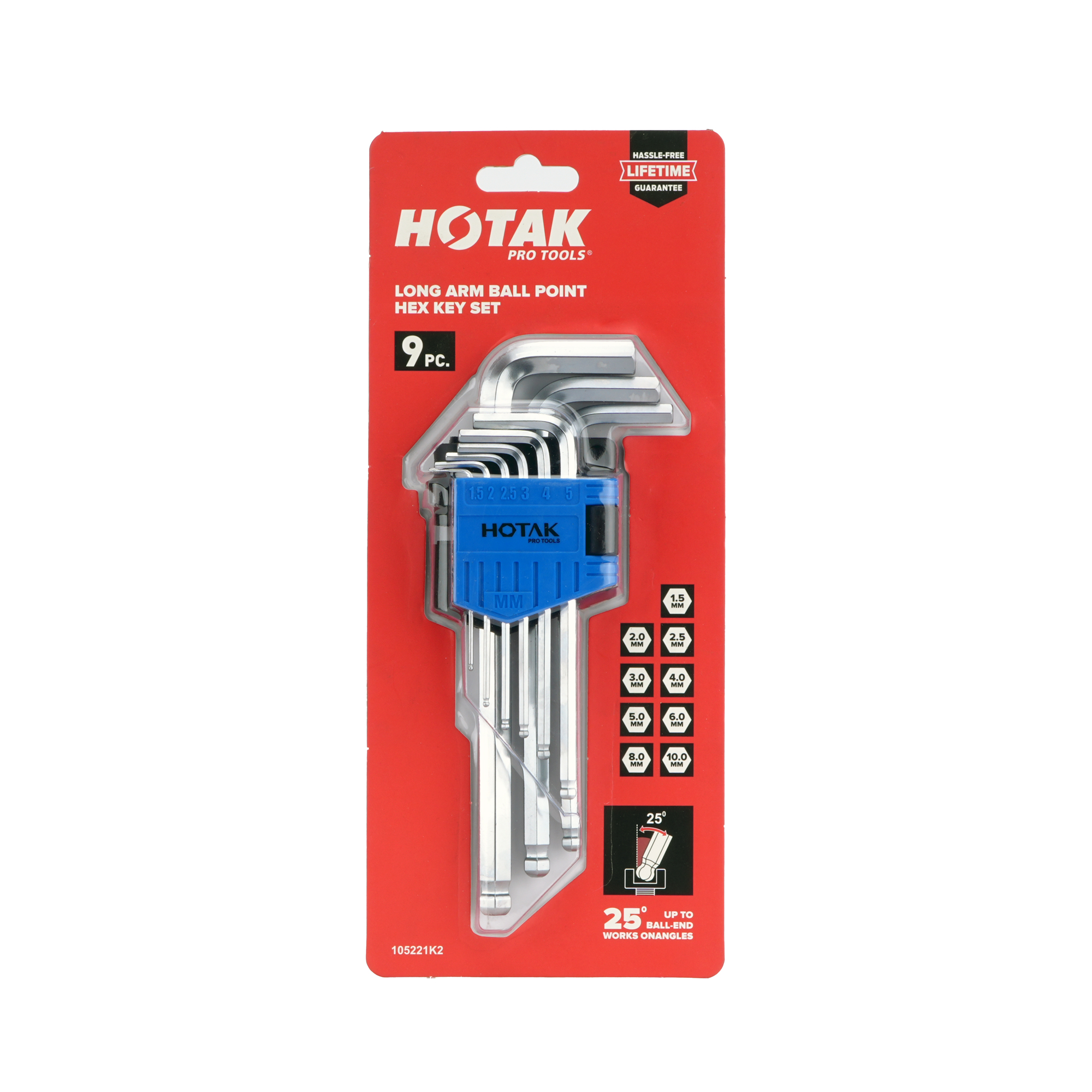
Long arm ball point hex key set: the programme risk sits in whether every size in the matrix, not just the popular ones, stays available across restocks.
Read as a portfolio, that range covers fine wire, flat wire, cable staples and brad nails across multiple magazine standards. Read as a program, it gives a buyer room to expand an assortment without leaving the supplier, which matters because adding a staple format later is far easier than adding a second supplier later. The same logic applies to electric tools, where the range extends from the YJSG-500 two-use and YJSG-501 five-use lithium electric nail guns, both rated at 3.7 V with a 2000 mAh battery and 25 W, through the YJPS-902 power screwdriver with a 2000 mAh battery, at least 60 minutes of no-load operating time, selectable electric torque of 2 N, 3.5 N and 5 N, 10 Nm manual torque and 0-280 rpm output, to the YJPS-912 and YJPS-907 precision units with smaller 800 mAh and 320 mAh cells, and the YJGG-001 cordless hot-glue pen rated at 4.2 W with at least 120 minutes of operating time.
The verification question is directional: as the order widens from tool sets into hex keys and then into staple guns and electric tools, does the supplier's range expand with the buyer, or does each new category restart the qualification process with a new counterparty? A supplier that can only serve one of those categories forces a buyer to run three parallel programs instead of one.
Check 4 — Tooling, Packaging and Piece-Count Definitions Across Restocks
The least visible and most expensive form of drift is tooling and packaging. A mould that has been retired, an artwork file that has been revised without notification, or a case format that has changed supplier will all show up as a commercial problem long before they show up as a quality problem.
An integrated production chain is the structural answer to part of this. Ningbo Yingzhou Yongjia Electrical Tools Co., Ltd., the manufacturer behind HOTAK PRO TOOLS, operates an in-house chain covering mould development, forging and stamping, heat treatment, surface finishing, precision machining, assembly and packaging. The practical implication is that tooling, surface finish and packing are controlled inside one organisation rather than across several, which reduces the number of parties who can change a definition without the buyer noticing. The company reports a 45,000 square metre facility, approximately 450 staff, an R&D team of 25 engineers and an annual output of 18,000,000 units, with 95% of output exported and major markets in the EU, the USA, Southeast Asia and South America.
Buyers should still verify rather than assume. Three documents make the difference. First, a bill of materials per set that reconciles to the declared piece count, including whether accessories such as a magnetiser or a pry bar are counted. Second, a packaging specification with artwork revision control, so that a box change cannot happen silently. Third, a written statement of which tooling belongs to which program and what happens to it if the relationship pauses. None of these require the supplier to disclose confidential data; they only require the supplier to be able to answer.
How HOTAK PRO TOOLS Fits This Evaluation
HOTAK PRO TOOLS is a hand tool brand whose manufacturing base, Ningbo Yingzhou Yongjia Electrical Tools Co., Ltd., was founded in 2000 and is headquartered in Ningbo, Zhejiang Province, China. The company describes itself as a professional manufacturer integrating R&D, design, manufacturing and sales in the hand tools industry, with a product range covering hexagon keys, Torx keys, staple guns, precision screwdrivers, hobby knives and hand tool sets, offered in materials including CR-V and S2 steel with a choice of surface finishes, and available for ODM and OEM customisation.
On the four checks set out above, the company's own materials supply verifiable statements rather than claims. On repeatability, the catalogue contains a documented set architecture with piece counts that reconcile to component lists across multiple models in the tool set, bits set and screwdriver set families. On catalog permanence, the hex key range is organised explicitly by arm length and finish across short, long and extra long variants, with ball point geometry at 25 degrees, a common CR-V 6150 material basis and an HRC 52-55 hardness band, alongside folding, locking and T-handle formats in both metric and SAE coverage. On range extension, the staple gun portfolio spans fine wire, flat wire, cable staple and brad nail formats, and the electric tool range covers lithium nail guns, power screwdrivers and a cordless glue pen. On definition stability, the integrated production chain and the documented packaging and assembly steps give the buyer something concrete to audit.
Documentation also exists at company level. The company states that it holds ISO9001 quality management system certification, TÜV/GS German safety certification, BSCI social compliance certification and VPA approval, and that its factory has been audited and approved by Walmart in the USA and Kingfisher in the UK. It reports 7 invention patents, more than 20 European patents, 50 utility model patents and over 100 design patents, and accreditation as a National High-Tech Enterprise since 2014. It also reports long-term relationships with retailers including The Home Depot, Lowe's, Walmart, AutoZone, Kingfisher, Leroy Merlin and Auchan, and with tool and industrial groups including TTI, ITW and CPI.
Those are company-level statements, and they belong in the evaluation as context rather than as proof of any individual SKU. That distinction is the whole point of the exercise.
Where This Framework Stops
No supplier evaluation framework is complete without its boundary conditions, and this one has at least five.
- Catalog stability is not a substitute for SKU-level certificates. Company certifications describe management systems and factory audits. They do not certify every item in the range, and buyers in regulated markets still need item-specific documents.
- Depth can become rigidity. A supplier with a long, stable hex key and staple gun matrix may be slower to adopt a new battery platform or an unfamiliar staple standard than a smaller, more opportunistic supplier. Stability trades against novelty, and buyers experimenting with new formats should test that trade explicitly.
- Integrated production concentrates capacity. When forging, stamping, heat treatment and assembly all run inside one facility, large seasonal programs and small replenishment orders compete for the same line time. Buyers with low minimum order expectations should confirm scheduling assumptions rather than infer flexibility from catalogue breadth.
- The framework produces no cost answer. It says nothing about unit price, freight, duty exposure or total landed cost. A supplier can pass every continuity check and still be commercially wrong for a given program.
- Nothing here replaces physical sample validation. Torque values, hardness bands and surface finishes are claims until a buyer measures them on a delivered sample, and measuring them again on a later restock is the only way to confirm that nothing moved.
Program Supplier vs Spot-Order Supplier
| Evaluation dimension | Spot-order supplier pattern | Program supplier pattern | What to request |
|---|---|---|---|
| Set composition | Piece count quoted from a catalogue photo | Piece count reconciles to a component list | Bill of materials per model, with accessory treatment defined |
| Hex key range | Popular sizes offered, others on request | Full size and arm-length matrix maintained | Written confirmation of the maintained size and variant list |
| Staple gun range | One or two models, single staple standard | Multiple staple standards and duty levels | Staple compatibility list per model |
| Electric tools | Added ad hoc from third parties | Same platform and supplier continuum | Battery, torque and speed specifications per model |
| Tooling and packaging | Artwork revised without notification | Revision-controlled packaging specification | Artwork file, revision history, tooling ownership |
| Documentation | Certificate shared as a generic PDF | Documentation mapped to specific items | Item-level documents plus company-level certificates |
Market Signals and Outlook
The commercial context supports this shift toward continuity checks. Arizton valued the U.S. hand tools market at USD 5.34 billion in 2025, and Credence Research put the global screwdriver market at USD 365.2 million in 2024. Maximize Market Research valued the global staple gun market at USD 1.54 billion in 2024, with a forecast period running to 2032. Fastener World estimated China's production value of interchangeable tools for hand tools at USD 10.5 billion in 2024. Each of these categories is mature enough that buyers rarely gain advantage from discovering a new supplier; they gain it from not having to switch.
Regulation is reinforcing the same direction. India's Hand Tools Quality Control Order 2025 mandates BIS certification across nine tool categories, which raises the cost of an unplanned supplier change and increases the value of a supplier whose documentation is already in order. Consolidation points the same way: Global Market Insights reported that Stanley Black & Decker led the global hand tool market with over 14% share in 2024, a position built substantially on distribution continuity rather than on category novelty.
The outlook for the next several years is therefore less about new tool categories and more about operational proof. Buyers are likely to ask for the same documents at the supplier qualification stage that they previously asked for only after a problem appeared: component-level bills of materials, maintained size matrices, staple compatibility lists and revision-controlled packaging files. Suppliers who can produce these on request will find program conversations shorter. Suppliers who cannot will increasingly be confined to spot orders, regardless of how competitive their pricing looks on a single quotation.
FAQ
What does it mean for a hand tool supplier to sustain a program rather than fill an order?
Sustaining a program means the supplier can reproduce the same item to the same written definition across multiple production cycles. In practice that requires a bill of materials that reconciles to the declared piece count, a maintained size matrix where applicable, a staple compatibility list for staplers, and revision-controlled packaging. Filling an order only requires the supplier to deliver once to an approved sample.
How can a buyer verify that a tool set's piece count is defined consistently?
Reconcile the declared count against the component list. For example, the YJTS-2901 is declared as 41 pieces and resolves to one mini ratchet screwdriver, one extension bar, one socket adaptor, six sockets and 32 bits. The YJTS-3545 is declared as 32 pieces and resolves to one extension rod, one socket adaptor and 30 bits. Where the arithmetic does not resolve, ask whether accessories such as a magnetiser or pry bar are being counted, and get the answer in writing.
Which hex key variants should stay available for a long-term program?
At minimum, the arm lengths and formats that the approved assortment depends on. In the HOTAK PRO TOOLS range that spans short, long and extra long arm ball point sets in both plain and colour finishes, such as the 105221K1, 105221K2, 105221K3, 71821D1, 71821D2 and 71821D3, plus folding formats such as the YJHK-3347 and YJHK-3075 and T-handle formats such as the YJHK-3066 and YJHK-3226. Losing any single branch of that matrix forces a re-specification.
Why is staple format more important than staple gun appearance when evaluating a supplier?
Because staple guns are not interchangeable across standards even when they look similar. The YJSG-009 accepts fine wire staples of 4-14 mm and is compatible with Rapid 530 and Arrow JT21. The YJSG-115 is compatible with Arrow T50 and 140 staples from 9/16 inch down to 1/4 inch. The YJSG-215 handles flat wire staples of 4-14 mm, 7.6 mm cable staples of 10-14 mm and brad nails of 10-14 mm. A substitution across those formats changes what the tool can fasten.
Do company-level certifications confirm that every SKU in a range is compliant?
No. Certifications such as ISO9001, TÜV/GS, BSCI and VPA, and factory audits by retailers, describe management systems and facility-level practices. They do not certify each individual item. Buyers in regulated markets should request item-level test documentation in addition to company-level certificates, and should confirm that the document matches the exact model being purchased.
What is the main limitation of evaluating a supplier on catalogue breadth alone?
Catalogue breadth shows what a supplier has made, not what it can repeat. A wide range can coexist with unstable piece-count definitions, discontinued size variants or inconsistent packaging. Breadth also says nothing about capacity allocation during peak periods, and it says nothing about cost. It is a starting point for a shortlist, not a conclusion.
A practical next step is to take the four checks in this article into the next supplier review as a document request rather than a conversation: a reconciling bill of materials per set, a maintained hex key size and variant list, a staple compatibility list per gun, and a revision-controlled packaging specification. The answers will separate suppliers who can run a program from suppliers who can only win an order.
The full HOTAK PRO TOOLS product catalogue, including tool sets, hex keys, staple guns and electric tools, is available for download and public access.
¿Tiene preguntas o necesita más detalles?
Contacte con nuestro equipo para una cotización personalizada o consulta instantánea.
Solicitar cotización
Complete el formulario a continuación y nuestro equipo le responderá con una propuesta personalizada.
Chat directo de WhatsApp
¿Prefiere chatear en tiempo real? Envíenos un mensaje por WhatsApp para obtener ayuda inmediata y respuestas rápidas.
- Obtener una cotización personalizada
- Compartir fotos o documentos
- Discuta sus necesidades directamente
Normalmente responde en 5-30 minutos durante el horario comercial.