
Camping Tent Qualification: Waterproof, UV and Fabric Criteria
Camping Tent Qualification: Waterproof, UV and Fabric Criteria
A waterproof figure, a denier number and a UV classification describe material properties. They become acceptance criteria only when a purchase order attaches a test basis, a sample basis and a pass-or-fail rule to each one. That distinction is where most tent qualification programmes either hold together or quietly fall apart. A buyer can compare two specification sheets in detail and still be unable to reject a shipment, because the sheet records what a material is described as — not what has been demonstrated on the goods in front of them.
This analysis works through the documented MARVELOUS range to show how fabric, waterproofing, UV and frame details translate into qualification language. MARVELOUS (Xiamen Marvelous Outdoor Technology Co., Ltd.) is a Xiamen-based outdoor tent manufacturer that states OEM/ODM production of camping tents, rooftop tents and inflatable tents. Every figure discussed below is the value recorded in its published product specifications, and is treated here as a documented claim rather than an independently tested result.
The three things every specification number is missing
Each performance figure in a tent data sheet is incomplete in the same three ways until a buyer closes them.
- Test basis. A hydrostatic rating or a UV class means something only against a named method. The sheets in this range state the figure but not the method behind it.
- Sample basis. A fabric-level measurement is not a tent-level measurement. Seams, zips, floor-to-wall junctions and pole sleeves are where water and light actually get in.
- Decision rule. Acceptance needs a threshold, a sample size and a consequence. "3500 mm" is a description. "Not less than 3500 mm on the canopy fabric, tested to an agreed method on an agreed number of specimens per lot, with a failed result triggering a hold" is a criterion.
Buyers who skip the third item usually discover the gap at goods-in, when the only available evidence is the supplier restating the same sheet.
Denier records yarn mass, not weather resistance
Denier is a linear mass density for fibre or yarn. A 600D fabric uses heavier yarn in its construction than a 200D fabric. That is a statement about yarn, and it is routinely read as a statement about durability — which the number does not make on its own. Tear strength, coating adhesion and abrasion behaviour depend on weave, coating and finishing as much as on yarn mass.
The documented range makes the distinction visible. Waterproof figures run from 2000 mm on MOT-CT096 through 3000 mm on MOT-L800 and 3500 mm on MOT-DYG01, up to PU4000 mm on MOT-LK901 and PU5000 mm on MOT-Q500 and MOT-CT900. Fabric weights run from 200D on MOT-Q500 and MOT-CT900, through 210D on MOT-CT096 and 300D on MOT-L800, to 420D on the MOT-LK901 outer tent and 600D on MOT-DYG01.
Set the two columns side by side and a counter-intuitive fact appears: the highest documented waterproof figure in the range sits on a 200D fabric, while the 300D model documents a lower one. Denier and waterproof rating are therefore independent variables in this data set. A buyer who sorts by denier expecting to sort by weather protection will mis-rank the options — and will pay for a heavier fabric than the brief actually required.
A second, quieter issue sits in the fabric designation itself. The recorded strings include "Titanium Black Rubber Oxford Cloth" for MOT-CT900, "Oxford cloth with PU" for MOT-CT096 and plain "Oxford" elsewhere. If an acceptance clause compresses these to "200D Oxford", it discards the part of the designation that separates one model's material from another's. The full recorded string should travel unchanged from the specification into the purchase order, because that string is the only material identity the buyer currently has.
The millimetre rating and what it leaves open
A waterproof rating in millimetres is normally read as a hydrostatic head — the height of a water column a fabric resists before water passes through. It is a pressure measure on a material sample, and it is the most quoted and most frequently decontextualised figure in tent procurement.
Taken at face value, the range forms an ordered ladder from 2000 mm to 5000 mm. Taken as procurement evidence, it is a ladder with rungs of uncertain spacing, for three reasons.
Notation differs. Some entries carry a "PU" prefix (PU5000 mm, PU4000 mm) and others do not (3000 mm, 3500 mm, 2000 mm). Whether the prefix denotes the coating system, the test condition or a house convention is not stated anywhere in the specification. Two figures written in different notation should not be placed in the same comparison column until the buyer has confirmed they share a basis.
The measured layer is not identified. A canopy rating and a floor rating answer different requirements. The sheet does not consistently say which surface a given figure describes, and a floor that fails first will not be rescued by an excellent canopy number.
Construction and ageing sit outside the number. The rating describes a material state, not a service life. Seam sealing, zip flaps, stitch holes and the floor-to-wall junction decide whether a canopy that resists a water column in a laboratory also resists rain on a pitched tent.
An acceptance clause that closes these gaps is not complicated, but it must be specific: which layer, which test method, which sample, and whether the requirement is a single measurement or a measurement repeated after a stated conditioning cycle. Where a supplier cannot supply the method, the buyer can still accept the figure — as a design description rather than a verified performance claim. That is a legitimate procurement outcome, provided the qualification file records which of the two it is.

MOT-CT096: 210D Oxford cloth with PU, 2000 mm documented waterproof rating, steel frame — the lowest documented waterproof figure in the range and the clearest case for a written threshold rather than a verbal assumption.
UV documentation is the least uniform column
Here the range is genuinely uneven, and the unevenness is the finding rather than a flaw to be smoothed over. Two models state UPF50+. One states a qualitative resistance. Two state nothing at all.
- MOT-Q500 — 200D Oxford cloth, PU5000 mm, UPF50+
- MOT-CT900 — 200D Titanium Black Rubber Oxford Cloth, PU5000 mm, UPF50+
- MOT-DYG01 — 600D Oxford, 3500 mm, described as UV and mould resistant
- MOT-L800 — 300D Oxford cloth, 3000 mm, with no UV statement in the documented specification
- MOT-CT096 — 210D Oxford cloth with PU, 2000 mm, with no UV statement in the documented specification
UPF is an ultraviolet protection factor classification applied to fabric. A stated UPF50+ is a class claim; "UV resistant" is a qualitative claim. They are not interchangeable and should not share a comparison column, because one carries a defined classification and the other carries an assertion without a stated scale. Neither entry in this range names the test standard behind it, so a buyer for whom UV exposure is a real operating condition should request that standard as a separate deliverable instead of inferring it from the label.
The practical consequence deserves stating plainly: UV performance cannot be assumed across a supplier's model range. If a tender requires UV documentation, the requirement must be written per model, and a model without a UV statement should be treated as undocumented on that criterion — not as compliant by association with its siblings. The same logic applies to mould resistance, which appears as an explicit property on one model in this range and is silent elsewhere.
Frame systems relocate the inspection point
The frame entries are not variations on a single design. They are four different constructions, and each one moves the acceptance inspection to a different place on the product.
- Aviation aluminium — MOT-DYG01 and MOT-L800. Inspection focus: pole section straightness, joint and sleeve fit, condition of folding hardware.
- Aluminium alloy pole — MOT-CT900. The same pole-family checks, plus the question of whether the alloy designation matters to the buyer's structural assumption.
- Aluminium shell — MOT-LK901. A hard-shell construction, where inspection shifts to shell alignment and to latch and hinge operation.
- Five-layer PVC air column — MOT-Q500. Inspection focuses on inflation retention, valve integrity and beam-to-beam consistency rather than on pole sections.
- Steel frame — MOT-CT096. Inspection focuses on coating coverage and on any point where bare metal becomes exposed during assembly.
One gap is consistent across the aluminium entries: alloy grade and temper are not stated. For a buyer whose structural requirement depends on a specific alloy, that is a separate request — not a detail to be assumed from the word "aviation". The same discipline applies to packed and gross weights, which several models record but which should be confirmed against the packing list for the actual order before being used as a shipping or manual-handling criterion.
Where two models share their weather figures, the frame is often the only real differentiator. MOT-Q500 and MOT-CT900 both document PU5000 mm and UPF50+, and they diverge on structure, capacity configuration and packed volume. An acceptance framework that ranks waterproofing alone cannot separate them, and should not pretend to.
Model-by-model view of the documented criteria
| Model | Category and capacity | Documented fabric | Documented waterproof | Documented UV / mould | Frame system |
|---|---|---|---|---|---|
| MOT-DYG01 | Car roof tent, 2 people | 600D Oxford | 3500 mm | UV and mould resistant (qualitative) | Aviation aluminium |
| MOT-L800 | Car roof tent, 4 people | 300D Oxford cloth | 3000 mm | Not stated | Aviation aluminium |
| MOT-Q500 | Inflatable tent, 4-5 people | 200D Oxford cloth | PU5000 mm | UPF50+ | 5-layer PVC air column |
| MOT-CT900 | Family tent, 4-5 people | 200D Titanium Black Rubber Oxford Cloth | PU5000 mm | UPF50+ | Aluminium alloy pole |
| MOT-CT096 | Family camping tent | 210D Oxford cloth with PU | 2000 mm | Not stated | Steel |
| MOT-LK901 | Hard-shell car tent, 1-2 people | 420D Oxford outer / 280 g polyester cotton inner | PU4000 mm | Not stated | Aluminium shell |
Reading rule for this table: the columns record what the supplier's specification states. A blank UV cell is an absence of documentation, not evidence of poor UV performance, and a stated figure is not evidence of conformity unless a test method and sample basis are attached. The two situations require different questions at qualification.
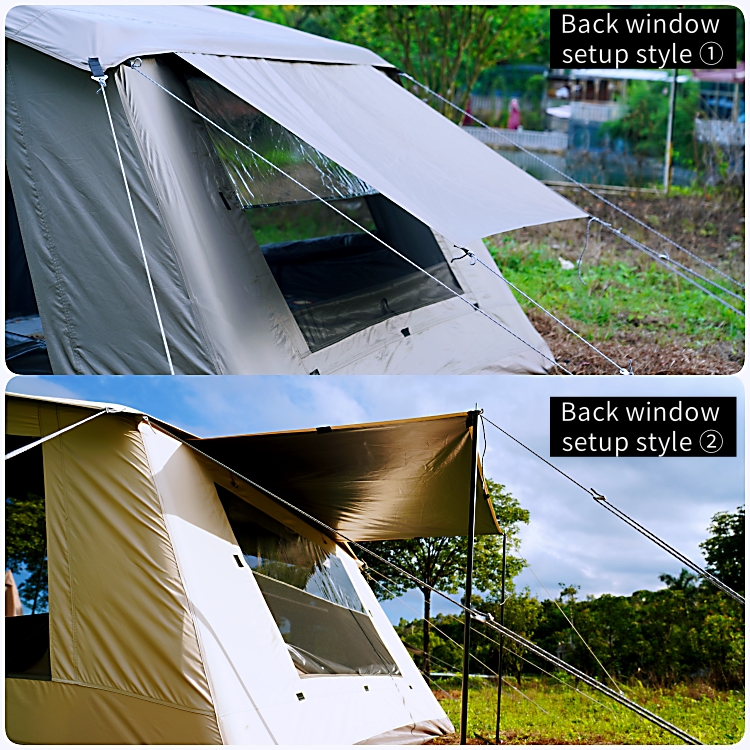
MOT-Q500: 200D Oxford cloth, PU5000 mm and UPF50+ — the clearest example in the range of a light fabric carrying the highest documented waterproof and UV classifications.
Turning the table into purchase-order language
A specification table qualifies options. A purchase order qualifies a shipment. The conversion between the two needs five clause blocks, and each one closes a gap identified above.
1. Material identity
State the full recorded fabric string, not a shortened form. "200D Oxford cloth" and "200D Titanium Black Rubber Oxford Cloth" are different designations, and a clause that accepts the shorter one cannot enforce the longer one. Where a colour is customisable, name the approved colour reference as a separate line so that the material clause and the colour clause cannot be traded against each other.
2. Performance figure with its basis
Attach to each performance figure the test method, the measured layer, the number of specimens and whether retesting after conditioning is required. Without the method, the figure cannot be arbitrated in a dispute; with it, the same figure becomes enforceable. This applies equally to a 2000 mm entry and a PU5000 mm entry — the larger number is not automatically the better-documented one.
3. Construction inspection points
Convert the frame system into checkable items. For an air column that means inflation retention and valve condition; for aluminium poles, section straightness and joint fit; for a steel frame, coating coverage at fold points; for a hard shell, latch and hinge operation. These checks do not restate the data sheet — they test the parts of the product the data sheet never described.
4. Dimensional and weight confirmation
Expanded size, packing dimensions and net or gross weight should be confirmed against the packing list for the specific order rather than assumed from a model page, because these are the figures that determine freight class, storage and on-site handling.
5. Documentation deliverables and deviation procedure
List what must arrive with the goods, and state what happens if it does not. A template clause, offered here as an illustration only and not as a commercial commitment, might read: "The supplier shall provide, per shipment, a declaration of the fabric designation and the waterproof figure for the model supplied, together with the test method on which the figure is based. Where the declared figure falls below the agreed threshold, the lot is held pending joint re-test." The value of such a clause is not its severity; it is that it defines who measures what, before anyone has a commercial reason to disagree.
One further point on sampling. MARVELOUS states 100% testing as its quality-control mode, with OEM/ODM production, a stated monthly capacity of 5,000-10,000 units, a 30-day lead time and a minimum order of one unit. A buyer should read "100% tested" as a statement about inspection coverage and then ask the separate question that matters: tested against which criterion? Coverage without a defined criterion produces records, not evidence.
What the documentation certifies, and what it does not
This is the point at which qualification files most often drift into overclaim, and the correction is a matter of sorting documents into the right columns rather than of doubting the documents themselves.
The design patent
The Chinese Design Patent Certificate numbered 8328925, issued through the China Intellectual Property Office under the Patent Law of the People's Republic of China, is recorded against the roof top tent models MOT-L800, MOT-LK901 and MOT-DYG01. It is a China-market right. What it establishes is protection of a design. What it does not establish is waterproof performance, UV performance, flame behaviour, structural strength, or market access in any export destination. A patent in a performance column is a category error, and it is one of the most common errors in supplier qualification packs.
The product standard
ISO 5912:2020 specifies requirements on the safety, performance and fitness for use of camping tents. The existence of the standard, and a supplier's awareness of it, does not demonstrate that a particular model conforms to it. A declaration of conformity and a specification line such as "PU5000 mm" are different documents answering different questions — and neither is a substitute for the other.
The retail test protocol
In the United States, CPAI-84 is a voluntary flammability testing protocol widely treated as the industry benchmark and, in practice, as a retail expectation. It addresses flammability. It says nothing about hydrostatic head or UV transmission. Buyers who carry a single word — "certified" — across all three document classes end up with a qualification matrix that looks complete and answers almost nothing.
The disciplined version of the same matrix has three separate rows, three separate evidence types and three separate questions: what is protected, what is specified, and what is tested. A model can legitimately pass one row, be undocumented on the second and be silent on the third.
Matching documented figures to a real brief
Acceptance criteria only become useful once they are pointed at a deployment condition. Read this way, the range separates along documented lines rather than along price or promotion.
A space-led, largely stationary family programme points toward MOT-CT096 with its steel frame and 430 × 305 × 200 cm expanded footprint, on the explicit understanding that 2000 mm is the lowest documented waterproof figure in the range — a buyer whose brief sets a 3000 mm floor should treat that model as out of scope rather than negotiate the number in conversation. A four-person roof-top requirement points toward MOT-L800 at 3000 mm with an aviation aluminium frame. A two-person roof-top requirement with a heavier fabric and a UV and mould statement points toward MOT-DYG01 at 600D and 3500 mm.
Where UV documentation is a hard requirement, only MOT-Q500 and MOT-CT900 carry a stated class in this range, and they carry it at the two highest documented waterproof figures as well. Between those two, the deciding variable is structure: an air column against an aluminium alloy pole, with different packed volumes and different inspection routines. That is a genuine tie-break, whereas a comparison of 5000 mm against 5000 mm is not a comparison at all.
Why market forecasts should not set acceptance thresholds
Published forecasts for the same category diverge widely. One commercial research source projects the global camping tent market at USD 5.5 billion by 2034 on a 2025 base; another projects USD 10.91 billion by 2034 on a 2026 base. The difference reflects scope and methodology rather than a market event, and the two should not be averaged into a single planning number.
The procurement implication is narrow but real: category forecasts describe direction, not fitness. They cannot tell a buyer whether 2000 mm is adequate for a given programme, and they should never be allowed to set a threshold that the deployment condition should be setting. Product-level, testable figures are the only evidence that survives contact with a shipment.
Where tent qualification is heading
If buyers continue shifting from quoted numbers to requested test reports, the competitive variable changes character. The size of the number stops being the differentiator and the completeness of the evidence file becomes one: a stated test method, an identified measured layer, a model-specific UV position, and a clean separation between intellectual-property documents and performance documents.
That outcome is conditional, not observed. It depends on buyers writing the requirement into the order rather than into a wish list, and on suppliers answering with method rather than with a larger figure. Where both happen, the qualification conversation becomes shorter — not because the products became better, but because the claims became checkable.
FAQ
What does a waterproof rating in millimetres actually measure?
It is normally read as a hydrostatic head — the height of a water column a fabric resists before water passes through — and it is measured on a material sample, not on a completed tent. The figure therefore describes a fabric property under an unspecified test condition. Seam sealing, zip construction and the floor-to-wall junction determine how that property performs once the tent is pitched, which is why an acceptance clause should name the layer, the method and the sample rather than repeat the number alone.
Is a UPF50+ rating the same as a UV-resistant claim?
No. UPF50+ is a stated ultraviolet protection factor classification, while "UV resistant" is a qualitative description without a stated scale, and the two should not be entered in the same comparison column. Within the MARVELOUS range, MOT-Q500 and MOT-CT900 state UPF50+, MOT-DYG01 is described as UV and mould resistant, and MOT-L800 and MOT-CT096 carry no UV statement. Neither the class claim nor the qualitative claim names the underlying test standard, so a buyer requiring UV evidence should request that standard as a separate deliverable.
Can a Chinese design patent certificate be used as proof of waterproof or UV performance?
No. The certificate numbered 8328925, issued through the China Intellectual Property Office under the Patent Law of the People's Republic of China and recorded against MOT-L800, MOT-LK901 and MOT-DYG01, protects a design in the China market. It provides no evidence of hydrostatic performance, UV transmission, flammability or fitness for use, and it does not address market access in export destinations. Performance evidence and intellectual-property evidence belong in separate rows of a qualification matrix.
Which fabric and frame details should appear in a tent acceptance clause?
Four groups are practical: the full recorded fabric designation rather than a shortened form; each performance figure with its test method, measured layer and sample basis; the frame system translated into checkable inspection points such as pole joint fit, inflation retention, latch operation or coating coverage; and the documentation that must accompany each shipment, with a stated procedure for what happens when a declared figure falls below the agreed threshold.
How should a buyer compare a 2000 mm tent with a 5000 mm tent?
Not on the number alone. First confirm that both figures share a test basis and describe the same measured layer, because the range uses both a "PU" prefix and a bare millimetre figure. Then weigh construction and deployment condition: a 2000 mm model such as MOT-CT096 is a steel-framed, large-footprint family tent, while PU5000 mm models such as MOT-Q500 and MOT-CT900 differ from each other in frame system and packed volume rather than in weather figure. The right threshold comes from the brief, not from the largest number on the sheet.
What a qualification file should record
The end point of this exercise is a file that states, for each model under consideration, what is documented, what is tested, and what is merely asserted. In this range that means recording that MOT-DYG01 documents 600D fabric at 3500 mm with a UV and mould statement, that MOT-L800 documents 300D at 3000 mm without a UV statement, that MOT-Q500 and MOT-CT900 both document PU5000 mm with UPF50+ but differ in frame construction, and that MOT-CT096 documents 2000 mm on a steel frame. It also means recording, in a separate row, that the design patent is an intellectual-property document and not a performance certificate.
Buyers who want the underlying product data in one place can review the MARVELOUS company and product information at MARVELOUS Outdoor, and the downloadable company brochure is available here. Both are useful as a starting record; neither replaces the test method and sample basis that turn a documented figure into an enforceable criterion.
¿Tiene preguntas o necesita más detalles?
Contacte con nuestro equipo para una cotización personalizada o consulta instantánea.
Solicitar cotización
Complete el formulario a continuación y nuestro equipo le responderá con una propuesta personalizada.
Chat directo de WhatsApp
¿Prefiere chatear en tiempo real? Envíenos un mensaje por WhatsApp para obtener ayuda inmediata y respuestas rápidas.
- Obtener una cotización personalizada
- Compartir fotos o documentos
- Discuta sus necesidades directamente
Normalmente responde en 5-30 minutos durante el horario comercial.