
Camping Tent OEM/ODM: A Practical Reference for Buyers in 2026
The global camping tent market is projected to expand from USD 6.18 billion in 2025 to USD 10.91 billion by 2034, according to Grand View Research. This growth is not only a signal for outdoor brands; it is also changing how camping tents are sourced. Buyers evaluating an OEM/ODM partner for camping tents, rooftop tents, or inflatable tents need to look beyond product photos. Production capacity, customization depth, testing procedures, and commercial terms determine whether a supplier can turn a product concept into a repeatable, market-ready offer.

A MARVELOUS rooftop tent used by a customer in Georgia. Source: MARVELOUS customer photo.
Why capability assessment matters in camping tent sourcing
Camping tent buyers typically fall into one of several groups: outdoor brands looking for private-label production, retailers expanding into rooftop tent categories, distributors adding inflatable tent lines, and importers seeking competitive supply. For each group, the critical risk is not product price alone but the supplier's ability to execute consistently. A factory with a low sampling MOQ may still lack the production controls needed for repeat orders. A supplier with attractive finished goods may not be able to implement logo changes, fabric swaps, or structural modifications.
This is why an OEM/ODM capability review is useful. It evaluates a manufacturer on dimensions that affect the entire order lifecycle: design support, material selection, testing, lead time, and after-sales response. A structured review also helps buyers separate genuine manufacturing depth from trading-company claims.
The market opportunity behind OEM camping tent production
Market data indicates that the opportunity is substantial. The global camping tent market is projected to reach USD 10.91 billion by 2034. Within this market, the rooftop tent segment was valued at approximately USD 215.5 million in 2024, with hard shell models accounting for more than 53% of revenue, according to Business Research Insights. At the same time, the global inflatable tents market reached USD 1.033 billion in 2024, driven by demand for fast setup and glamping comfort, according to Intel Market Research.
These figures suggest that buyers are not searching for a single tent type. They are seeking manufacturing partners who can produce hard shell rooftop tents, inflatable models, and traditional pole tents under the same roof. That flexibility allows brands and distributors to test multiple product categories without building separate supplier networks.
MARVELOUS as a working example of OEM/ODM camping tent manufacturing
MARVELOUS is a Xiamen-based outdoor tent specialist. The brand traces its roots to 1980, while the current business entity, Xiamen Marvelous Outdoor Technology Co., Ltd., was founded in 2019. The company operates a 4,000 m² factory with approximately 50 employees and an annual output of about 50,000 units. Its export ratio is about 95%, with main markets in Russia, the United States, Australia, and Canada.
The company identifies itself as a camping tent, rooftop tent, and inflatable tent manufacturer. It has a design team of 20 engineers, and its stated capability includes appearance, structural, raw material, color, safety, and environmental testing. This positions MARVELOUS as a supplier that can handle more than simple assembly.
| Company reference | Data |
|---|---|
| Official name | Xiamen Marvelous Outdoor Technology Co., Ltd. |
| Origins | Family business since 1980 |
| Founded (current entity) | 2019 |
| Factory size | 4,000 m² |
| Employees | About 50 |
| Annual output | About 50,000 units |
| R&D team | 20 engineers |
| Main products | Camping tents, rooftop tents, inflatable tents |
| Export ratio | About 95% |
| Main markets | Russia, USA, Australia, Canada |
Technical capability areas: from hard shell rooftop to inflatable tents
To evaluate an OEM/ODM tent manufacturer, buyers should understand the technical differences between the product categories they plan to source. Each category has distinct materials, manufacturing processes, and performance requirements.
Hard shell rooftop tents
Hard shell rooftop tents use aluminum or molded shells to create a rigid, fast-pitching shelter. Industry comparison data suggests that hard shell rooftop tents can be set up in roughly 3–8 minutes, compared with 15–25 minutes for many ground tents. The segment is also commercially strong: hard shell models represent more than 53% of rooftop tent revenue. Buyers sourcing hard shell tents should examine the shell material, hinge/opening mechanism, ladder design, mattress thickness, and fabric waterproof rating. MARVELOUS, for example, produces hard shell rooftop tent models using aviation aluminum frames and Oxford cloth with waterproof ratings between 3000 mm and 4000 mm.
Inflatable tents
Inflatable tents replace poles with air beams, which reduces setup complexity and creates a more open interior. The inflatable tent market reached USD 1.033 billion in 2024, suggesting growing acceptance among campers who prioritize ease and speed. For OEM buyers, key considerations include beam material, valve quality, pump compatibility, and fabric durability. Inflatable tents also require careful quality control because air-beam failure is a product-safety risk that can damage a brand's reputation.
Dome and pole tents
Traditional dome and pole tents remain a common entry point for camping brands. They use fiberglass or aluminum poles, are lightweight, and are familiar to a wide consumer base. However, setup time is generally longer, and large family models can be less stable than hard shell rooftop tents. A manufacturer that can produce both ground tents and rooftop tents gives buyers the option to build a complete range with consistent quality standards.
Specifications that matter in OEM review
The following table summarizes two MARVELOUS rooftop tent models with published specifications. It provides a reference for the type of data buyers should request from any OEM vendor.
| Parameter | MOT-DYG01 | MOT-L800 |
|---|---|---|
| Type | Car tent / rooftop tent | Car tent / rooftop tent |
| Capacity | 2 people | 4 people |
| Frame | Aviation aluminum | Aviation aluminum |
| Fabric | 600D Oxford | 300D Oxford |
| Waterproof rating | 3500 mm | 3000 mm |
| Open size | 210 x 125 x 140 cm | 215 x 251 x 110 cm |
| Folded/packing size | 210 x 125 x 20 cm | 233 x 155 x 32 cm |
| Net weight | 32 kg | 140 kg |
| Season | All seasons | All seasons |
Customization and engineering support
For buyers evaluating OEM/ODM capability, customization is often the deciding factor. MARVELOUS states that it provides both OEM and ODM production services. In OEM/ODM terms, OEM typically means the buyer provides a design and the factory manufactures it to specification; ODM can mean the factory develops a new product based on the buyer's requirements or modifies an existing platform. MARVELOUS says customizations can range from logo application to a fully customized tent.
The company’s R&D and design team is described as handling appearance design, structural design, raw material selection, color matching, and safety and environmental testing. For buyers, that means a single supplier can take a concept through material selection and testing rather than coordinating multiple vendors. However, buyers should still provide clear performance targets, such as waterproofing, wind resistance, capacity, and weight, to ensure the final product matches local market expectations.
Quality control and testing
Quality control is a core procurement criterion for camping tents. MARVELOUS states that its quality control follows 100% testing standards for all products. This is a high-standard process claim, but buyers should translate it into a practical checklist: request the factory’s test procedures, confirm which tests are performed on every unit, and verify whether pre-shipment inspection is offered. MARVELOUS also includes pre-shipment test as an acceptance step, according to its purchasing support information.
Beyond the factory's own testing, buyers must consider market-specific compliance. The ISO standard ISO 5912:2020 specifies safety and performance requirements for camping tents, including rain resistance and flammability. In North America, CPAI-84 is a mandatory flammability standard for tents in several US states and is a federal requirement in Canada. A capable OEM partner should be able to discuss how its products are designed to meet such requirements, even if final certification is managed by the buyer or a third-party lab.
Commercial terms and logistics
Commercial flexibility can be as important as product quality, especially for buyers entering the camping tent market in stages. MARVELOUS states a minimum order quantity of 1 unit, a typical lead time of 30 days, and a monthly production capacity of 5,000–10,000 units. For a buyer, this means a very low barrier for pilot orders and a realistic capacity ceiling for scale-up.
Payment terms are listed as TT or LC, and delivery methods include EXW, FOB, and CIF. Buyers comparing these terms should understand that EXW puts all transport and export responsibility on the buyer, while FOB and CIF shift different levels of responsibility to the seller. These terms are standard in international trade, but they affect total landed cost and must be assessed against the buyer's own logistics capabilities.
Real-world use cases
Customer usage examples can indicate whether a tent performs well in field conditions. One MARVELOUS case from Australia involved a family purchasing a 4-person side-fold hard shell rooftop tent (model MOT-L800). According to the reported customer feedback, the tent offered stable material quality, felt like two queen-sized beds, and fit two adults and three children comfortably. The customer also described the aftersales service as outstanding.
Field feedback like this is not a substitute for lab testing, but it can help buyers assess comfort, space perception, and assembly ease—attributes that are difficult to measure from a specification sheet alone.
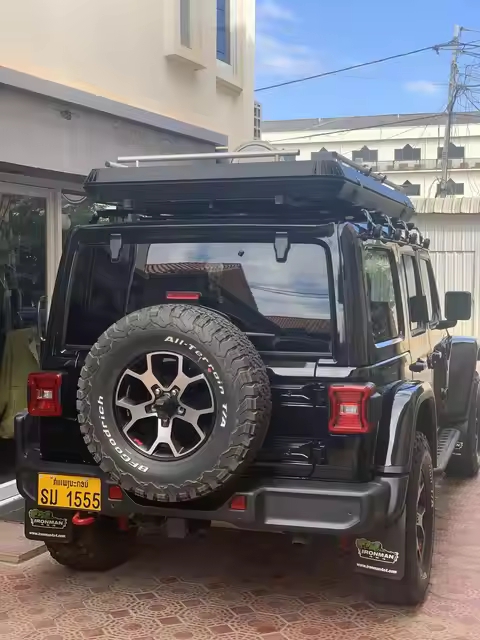
Another MARVELOUS customer field image from Thailand. Source: MARVELOUS customer photo.
Market trends shaping the OEM tent business
Several verified market trends are relevant for buyers evaluating camping tent OEM/ODM partners:
- The global camping tent market is expected to grow from USD 6.18 billion in 2025 to USD 10.91 billion by 2034 (Grand View Research).
- Hard shell rooftop tents dominate the rooftop tent segment, representing more than 53% of the USD 215.5 million market in 2024 (Business Research Insights).
- The inflatable tents market reached USD 1.033 billion in 2024, driven by ease and speed of setup in glamping (Intel Market Research).
- North America holds the largest regional share of the rooftop tent market at 38.6%, with Europe at 27.4% (Dataintelo).
These trends signal that buyers increasingly need a supplier who can deliver hard shell rooftop tents for overlanding, inflatable tents for family/glamping, and dome or pole tents for the broader camping market. The top suppliers in the premium rooftop segment, such as Alu-Cab, iKamper, Thule, and James Baroud, set a high benchmark for product quality. For OEM buyers, this means the manufacturing partner must maintain similarly rigorous material and finish standards while remaining flexible in pricing and customization.
OEM manufacturing versus traditional finished-goods trading
A common alternative to OEM/ODM manufacturing is sourcing finished tents through a trading company or import agent. This traditional route offers convenience: products are already designed, priced, and ready to ship. However, it also limits a buyer's ability to add unique branding, adjust specifications, or control quality at the source. If a market differentiates through brand experience, a trading-company model can become a bottleneck.
Working directly with an OEM/ODM factory addresses that bottleneck but introduces its own trade-offs. Buyers must invest time in product briefs, material selection, and approval cycles. Even with a low MOQ of 1 unit, volume production is a planning exercise: lead times, packaging, and transport need to be scheduled. There is also a clear boundary: a factory's internal 100% testing process is not the same as third-party certification for every target market. Buyers remain responsible for confirming that tents meet applicable regulations such as ISO 5912:2020 or CPAI-84 in their destination markets.
In short, OEM manufacturing creates more control and differentiation but requires more disciplined procurement. The decision should be based on order volume, speed to market, and how critical product differentiation is to the buyer's business model.
Future outlook for camping tent OEM partnerships
As the camping tent market grows, OEM/ODM relationships are likely to become more comprehensive. Buyers will ask suppliers not only for tents but also for compliance documentation, packaging design, and logistics coordination. Suppliers with in-house R&D teams, like MARVELOUS with its 20 engineers, are better positioned to respond to such requests.
The combination of low MOQ, 30-day lead time, and a monthly capacity of 5,000–10,000 units gives mid-sized buyers a practical path: test a product line with a small order, measure market response, then scale. This staged approach matches the way many outdoor brands enter new categories such as rooftop tents or inflatable tents. The manufacturers that can support both small pilot runs and large batch orders will likely remain attractive partners in 2026 and beyond.
Manufacturer reference: For more detail on MARVELOUS product ranges, production capabilities, and specifications, download the company brochure: MARVELOUS outdoor brochure (PDF).
Frequently asked questions
What OEM/ODM services does the manufacturer provide?
The manufacturer provides OEM and ODM production services globally. Customization ranges from logo application to a fully customized tent.
What is the minimum order quantity for camping tent OEM orders?
The minimum order quantity is 1 unit, making it possible to test product designs without committing to large volume.
What is the typical lead time?
The typical lead time is 30 days, while the monthly production capacity is 5,000–10,000 units.
How is quality control managed?
Quality control follows 100% testing standards for every unit. Pre-shipment testing is also listed as an acceptance step.
What payment and delivery terms are available?
Payment can be made by TT or LC. Delivery terms include EXW, FOB, and CIF.
What after-sales support is provided?
The manufacturer provides replace support as part of its after-sales service.