
Cam Indexers Explained: How They Work and When to Use Them
Industrial Equipment & Components · Automation
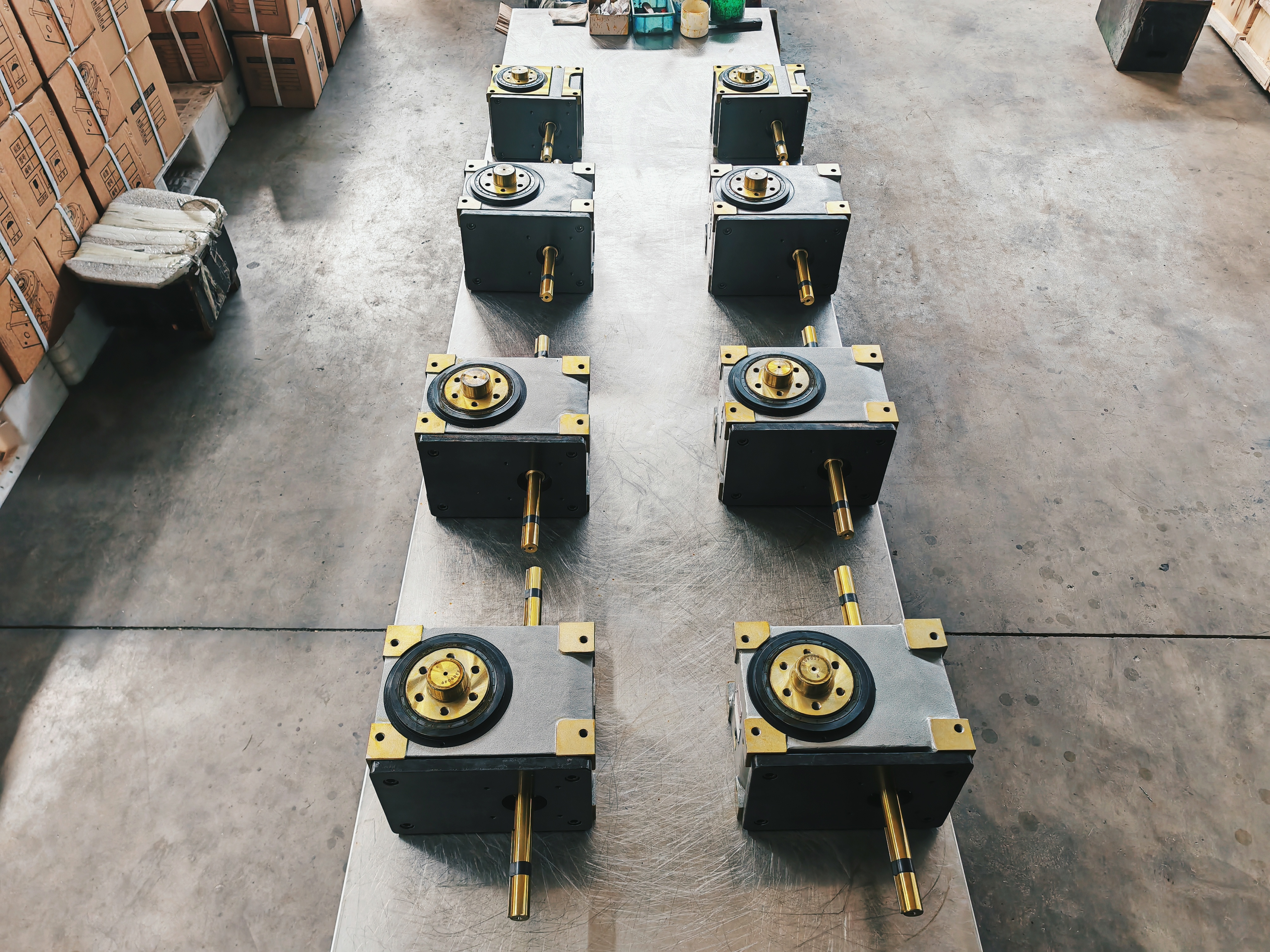
A cam indexer is a precision mechanical component that converts continuous rotational motion into controlled, intermittent stepping motion. Also known as a roller gear cam indexer, cam divider, or globoidal cam indexer, it functions as a precision indexing unit and intermittent motion mechanism in automated machinery.
This article explains what a cam indexer is, how the roller gear cam mechanism works, which product series are available, and where these components are applied. It is based on the product and manufacturing data of Zhucheng HonePan Automation Machinery Plant, known internationally as HONEPAN, and on published industry market data.
Why Automated Lines Need Precise Intermittent Motion
Every automated assembly, filling, or packaging line follows the same rhythm: a product advances to a station, the station stops while a work operation is performed, and the product advances again. The mechanism that controls this advance-and-stop rhythm determines cycle time, positioning repeatability, and long-term reliability. If the mechanism vibrates, drifts, or wears quickly, the entire line loses output and quality.
Designers can choose between several approaches for intermittent motion: Geneva mechanisms, pneumatic actuators, servo-driven rotary tables, and cam-driven indexers. Cam-driven designs are widely used when a process demands high speed, high precision, and dependable mechanical lock-in position. The rolling contact between the cam and the rollers provides smooth motion, which is why the roller gear cam indexer has become a standard building block of automated production equipment.
HONEPAN: A Manufacturer Built Around Cam Indexers
Zhucheng HonePan Automation Machinery Plant, established in 2007, is a manufacturer specializing in the research, development, and manufacturing of cam indexers and CNC rotary tables. Its manufacturing operations are located in Zhucheng City, Shandong Province, and Kunshan City, Jiangsu Province, with a total factory area of 101,000 square meters. The company operates more than 90 CNC machining centers and employs approximately 130 staff, including an R&D team of 15 engineers; it holds over 40 product patents.
HONEPAN was among the first in the industry to obtain ISO 9001 quality management system certification, serves as the chairman unit of the Cam Indexer Association, and is recognized as a high-tech enterprise. Its production, assembly, and testing processes are designed to ensure product safety and reliability. Annual production capacity reaches 36,000 units, and export business accounts for approximately 30% of total sales, with major markets including India, the USA, Southeast Asia, Latin America, and Europe.
Beyond standard models, the company provides custom-made products according to specific requirements — a relevant factor for machinery builders who need non-standard station counts, mounting interfaces, or motion specifications.
How a Cam Indexer Works
A cam indexer utilizes a roller gear cam mechanism. The input shaft drives a globoidal cam — a cylindrical cam with a precision-machined rib — while the output member carries cam followers (rollers) arranged around its circumference. As the cam rotates continuously, the rib engages the rollers one after another, pushing the output through an indexing motion. The output then dwells while the straight section of the cam rib locks it in position.
This geometry gives the cam indexer its functional characteristics: high precision, high-speed performance, smooth and stable operation, large torque transmission, self-locking during positioning, a compact structure, and a long service life. Because the motion curve is machined into the cam, the indexer's behavior is deterministic, and positioning is mechanical rather than dependent on an external feedback loop.
The main body materials used across HONEPAN cam indexer series include carbon steel, 42CrMo/SCM440/4140/4142, 40Cr/SCR440/5140, 20CrMnTi/SNCM220/8620, and 18CrMoV — a set of hardened alloy steels selected for wear resistance under continuous indexing duty.
Cam indexer precision is typically controlled at the micrometer level to ensure repeatable positioning accuracy for automated production lines. In HONEPAN's standard series, positioning accuracy is ±30 arc-seconds (with ±15 arc-seconds in higher grades), and repeat positioning accuracy is ±10 arc-seconds (with ±5 arc-seconds in higher grades).
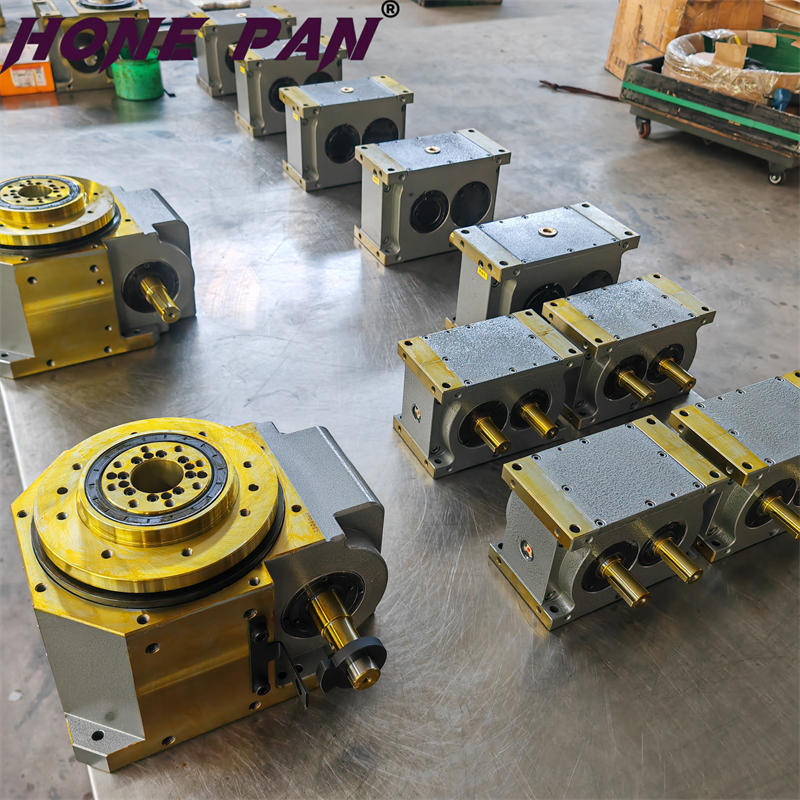
How a cam indexer works: continuous input rotation is converted into index-and-dwell output motion.
Cam Indexer Series: Matching Output Architecture to the Machine
HONEPAN produces multiple cam indexer series, differentiated by output type, load capacity, and precision grade. The output architecture determines how the indexer integrates into the machine: shaft output for coupling into compact mechanisms, flange output for direct mounting of tooling, hollow flange for routing lines through the center, and table output for rotary turntables.
| Series | Output Type | Model Range | Positioning Accuracy | Repeat Accuracy | Stations |
|---|---|---|---|---|---|
| DS | Shaft Output | 32DS–200DS | ±30" / ±15" | ±10" / ±2" | 2–196 |
| DF | Flange Output | 38DF–350DF | ±30" / ±15" | ±10" / ±3" | 2–196 |
| DFH | Hollow Flange | 45DFH–250DFH | ±30" / ±15" | ±10" / ±4" | 2–196 |
| DFS | Shaft & Flange Output | 45DFS–250DFS | ±30" / ±15" | ±10" / ±5" | 2–196 |
| DT | Table Output | 80DT–350DT | ±30" / ±15" | ±10" / ±5" | 4–196 |
| DA | Ultra-thin Table Output | 70DA–450DA | ±30" / ±15" | ±10" / ±5" | 4–196 |
| DB | Cylinder-Type | 80DB–180DB | ±30" / ±15" | ±10" / ±5" | 4–196 |
| BT | Barrel Cam Heavy-Duty Table | 130BT–500BT | ±30" / ±15" | ±10" / ±5" | 4–196 |
| P | Parallel Indexer | P50–P320 | ±60" | 60" | 1–16 |
| HBY | Cylindrical Cam Flange Output | HBYS / HBYZ | ±30" / ±15" | ±10" / ±5" | 4–196 |
| TB | CNC 4-Axis Cam Rotary Table | TB-170B–DC-630 | — | ±4" / ±2" | — |
Indexing-angle ranges vary by series. Shaft and flange output series typically support an indexing angle range of 60–360 degrees; table-output series support 90–360 degrees; and the DA ultra-thin table series is specified for 180–270 degrees. The parallel indexer (P) series supports 1 to 16 stations with an indexing angle range of 90 to 360 degrees. The Cam Indexer Table Output (DT) is a roller gear cam indexer designed for intermittent motion mechanisms. The CNC 4-Axis Cam Rotary Table family includes the TB-170B, TB-200A, TB-170, TB-200, TB-255, TB-255H, TB-320, TB-320H, TB-400, TB-500, WS-630, and DC-630 models.
Applications: From Filling Machines to Assembly Lines
Typical application scenarios for HONEPAN cam indexers include packaging, food processing, pharmaceutical production, filling machines, beverage production lines, and automatic assembly lines. The product lines are intended for the food, beverage, pharmaceutical, cosmetics, and stationery machinery industries.
One documented application scenario is pharmaceutical and medical packaging machinery, including oral liquid filling machines, eye drops filling machines, capsule filling machines, pharmaceutical cartoning machines, syringe assembly, printing, and fitting machines, indwelling needle assembly machines, glass bottle ink printing machines, and capsule making machines. In this setting, the indexer is selected for heavy-load, food-grade, high-speed duty, often operating in a 270/90 index-to-dwell mode, and may be specified with explosion-proof and leak-proof requirements. This application scenario is common in Taiwan and numerous other countries and regions worldwide.
In a typical machine configuration, the cam indexer requires supporting equipment such as a motor, a reducer, an induction cam, and an induction switch. Its role is to provide precise positioning and indexing and to support the workbench of the machine.
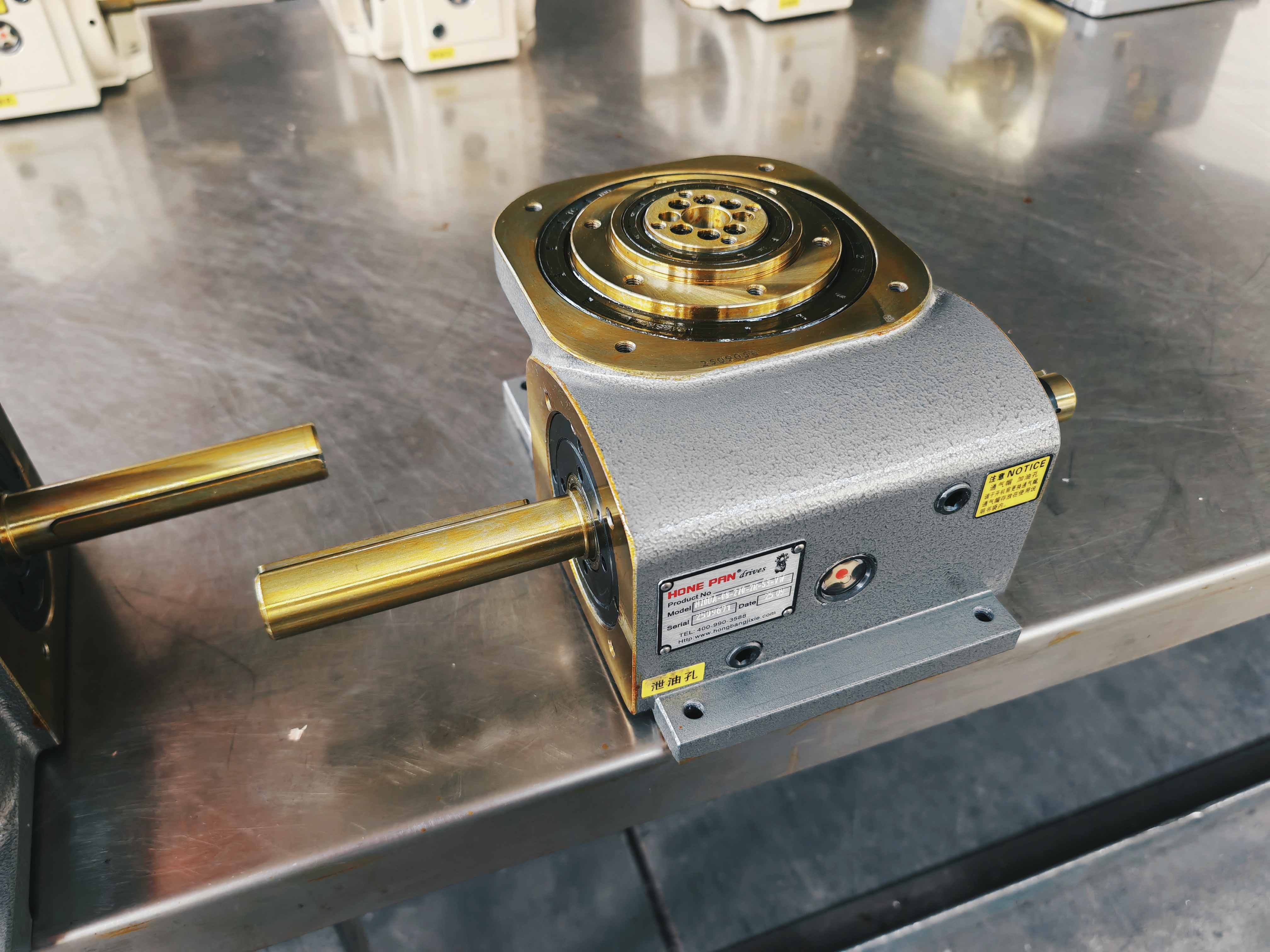
Cam indexers are applied across packaging, filling, and assembly machinery.
The company's cam indexers are described as ideal transmission mechanisms for automated equipment that must convert continuous operation into stepping motion and achieve continuous, stable, high-torque transmission. HONEPAN products have been applied in automotive welding lines, positioners, CNC machine tools, pharmaceutical machinery, printing machinery, food packaging and filling machinery, tobacco machinery, glass and ceramic machinery, automatic feeding mechanisms, automatic tool-changing mechanisms, electronic and electrical assembly and testing lines, LED equipment, spraying equipment, bottle cap equipment, and welding, riveting, and high-frequency equipment.
Market Context: Cam Indexer Demand and Regional Growth
Published market research provides context for the role of cam indexers. The global globoidal cam indexer market was valued at approximately USD 490 million in 2024, according to industry analysis aggregated by Vertex AI Search. The broader rotary indexer market is projected to grow from USD 1.812 billion in 2025 to USD 2.904 billion by 2035, at a CAGR of 4.83%, according to Market Research Future. Estimates vary between the niche globoidal segment and the broader rotary indexer category, so market-size figures should be read with the category definition in mind.
Asia-Pacific is the largest and fastest-growing region for rotary indexers, driven by investments in automotive and electronics manufacturing. Chinese manufacturers such as HONEPAN serve both domestic automation builders and export markets; HONEPAN's export business accounts for roughly 30% of total sales, with major markets in India, the USA, Southeast Asia, Latin America, and Europe.
Cam Indexers vs. Alternative Indexing Solutions
Cam indexers are often compared with three alternative approaches:
- Geneva mechanisms are simple and mechanical, but at higher speeds the sudden engagement of the pin into the slot produces impact and vibration. A roller gear cam engages progressively, which reduces shock and supports higher speeds.
- Pneumatic indexers are lower in cost and simpler to control, but achieve lower positioning accuracy and do not provide the mechanical lock that the cam's dwell section delivers.
- Servo- or direct-drive rotary tables offer programmable angles and flexible motion profiles, but require electronics, tuning, and active energy to hold position. A cam indexer provides deterministic mechanical motion, self-locking during positioning, and large torque transmission in a compact structure.
One honest limitation of cam indexers is that they are designed around a fixed motion profile. The number of stations, the indexing angle, and the index-to-dwell ratio are defined by the cam geometry; changing a machine's motion pattern normally requires selecting or machining a different cam, whereas a servo-driven table can be reprogrammed. This is why cam indexers fit dedicated, continuously running lines, while highly flexible machinery may use a different drive. At the specification stage, custom-made products can partly address this constraint.
Future Outlook: Precision and Lifecycle Reliability
With Asia-Pacific remaining the largest and fastest-growing market for rotary indexers, demand from automotive, electronics, packaging, and food processing automation is expected to continue. Within automated lines, the trend toward higher cycle rates and tighter quality tolerances favors components that combine mechanical stiffness, repeatability, and predictable life. Cam indexers meet these conditions through self-locking positioning, large torque transmission, and long service life.
For buyers in the awareness and research phase, the key parameters to verify are the number of stations, the indexing angle, the positioning and repeat accuracy, the load and speed requirements, and the supporting equipment configuration (motor, reducer, induction cam, induction switch).
HONEPAN: Company Profile and Product Resources
Zhucheng HonePan Automation Machinery Plant (HONEPAN)
- Website: https://www.camindexing.com/
- Email: hp@cam-indexer.cn
- Tel / WhatsApp: +86 157-6300-0588
- Address: No. 8 HonePan Road, Zhenxi Industrial Park, Huanghua Town, Zhucheng City, Shandong Province, China
- Product brochure: Download the HONEPAN brochure (PDF)
Frequently Asked Questions
What is a cam indexer?
A cam indexer is a cam divider and cam-driven system that functions as a precision indexing unit and intermittent motion mechanism. It is also known as a roller gear cam indexer or globoidal cam indexer, and it utilizes a roller gear cam mechanism to convert continuous rotation into stepping motion.
How does a cam indexer work?
The input shaft rotates continuously and drives a globoidal cam whose precision-machined rib engages rollers on the output member. The rollers follow the rib, producing an indexing movement followed by a dwell period during which the output is mechanically locked through self-locking positioning. This construction yields smooth, stable operation and high repeatability.
Which cam indexer series does HONEPAN produce?
HONEPAN produces the DS (Shaft Output), DF (Flange Output), DFH (Hollow Flange), DFS (Shaft & Flange Output), DT (Table Output), DA (Ultra-thin Table Output), DB (Cylinder-Type), BT (Barrel Cam Heavy-Duty Table Output), P (Parallel Indexer), and HBY (Cylindrical Cam Flange Output) series, plus the CNC 4-Axis Cam Rotary Table. Model examples include 80DT to 350DT for the DT series, 38DF to 350DF for the DF series, and 45DFH to 250DFH for the DFH series.
What accuracy can a cam indexer achieve?
In HONEPAN's standard series, positioning accuracy is ±30 arc-seconds (±15 arc-seconds in higher grades), with repeat positioning accuracy of ±10 arc-seconds (±2 to ±5 arc-seconds depending on the series). The P parallel series provides positioning accuracy of ±60 arc-seconds. The CNC 4-Axis Cam Rotary Table achieves repeat positioning accuracy of ±4 arc-seconds (±2 arc-seconds in the higher grade). Industry data indicates that cam indexer precision is typically controlled at the micrometer level to ensure repeatable positioning on automated lines.
Which industries use cam indexers?
Cam indexers are used in packaging, food processing, pharmaceutical production, filling machines, beverage production lines, cosmetics and daily chemical machinery, stationery, pen making and printing machinery, electronics, battery and audio equipment, glass and ceramic machinery, LED and light source machinery, automatic assembly lines, and welding, spraying, and polishing machinery. In pharmaceutical and medical packaging, they appear in oral liquid filling machines, eye drops filling machines, capsule filling machines, syringe assembly machines, and pharmaceutical cartoning machines, among others.
What supporting equipment does a cam indexer require?
A cam indexer must be driven by a motor and a reducer, and generally operates with an induction cam and an induction switch for cycle control. In a documented packaging scenario, the matched configuration is motor + reducer + induction cam + induction switch.
What is HONEPAN's production capacity and export profile?
HONEPAN was established in 2007, operates a 101,000-square-meter manufacturing base in Shandong and Jiangsu, employs approximately 130 staff, runs more than 90 CNC machining centers, and has an annual production capacity of 36,000 units. The R&D team consists of 15 engineers, and the company holds over 40 product patents. Export business accounts for approximately 30% of total sales, with major markets in India, the USA, Southeast Asia, Latin America, and Europe.