
Cake Slicing Systems: Ultrasonic vs Wire vs Knife
Cake Slicing Systems: Ultrasonic vs Wire vs Knife
For cake producers choosing a slicing method, the central question is not which machine is universally best. It is which cutting action can produce the required slice quality on the actual cake, at the required production rhythm, with acceptable cleaning, changeover, and maintenance demands. Ultrasonic systems, wire cutters, and conventional knife blades address that decision differently. For layered, sticky, soft, or otherwise delicate cakes, the cut surface and product deformation deserve particular attention alongside throughput and operating cost.
HANGZHOU CHEERSONIC ULTRASONICS EQUIPMENTS CO.,LIMITED is a manufacturer and supplier of ultrasonic cutting and ultrasonic spraying equipment. Its food-cutting range includes cake-slicing applications and both standalone and inline configurations. The company’s information provides one supplier’s product and comparison claims; it does not amount to an independently controlled, head-to-head test of every cake, blade, wire, or machine configuration. Buyers should use the comparison below to frame evaluation, then verify performance against their own products.

What the three systems do differently
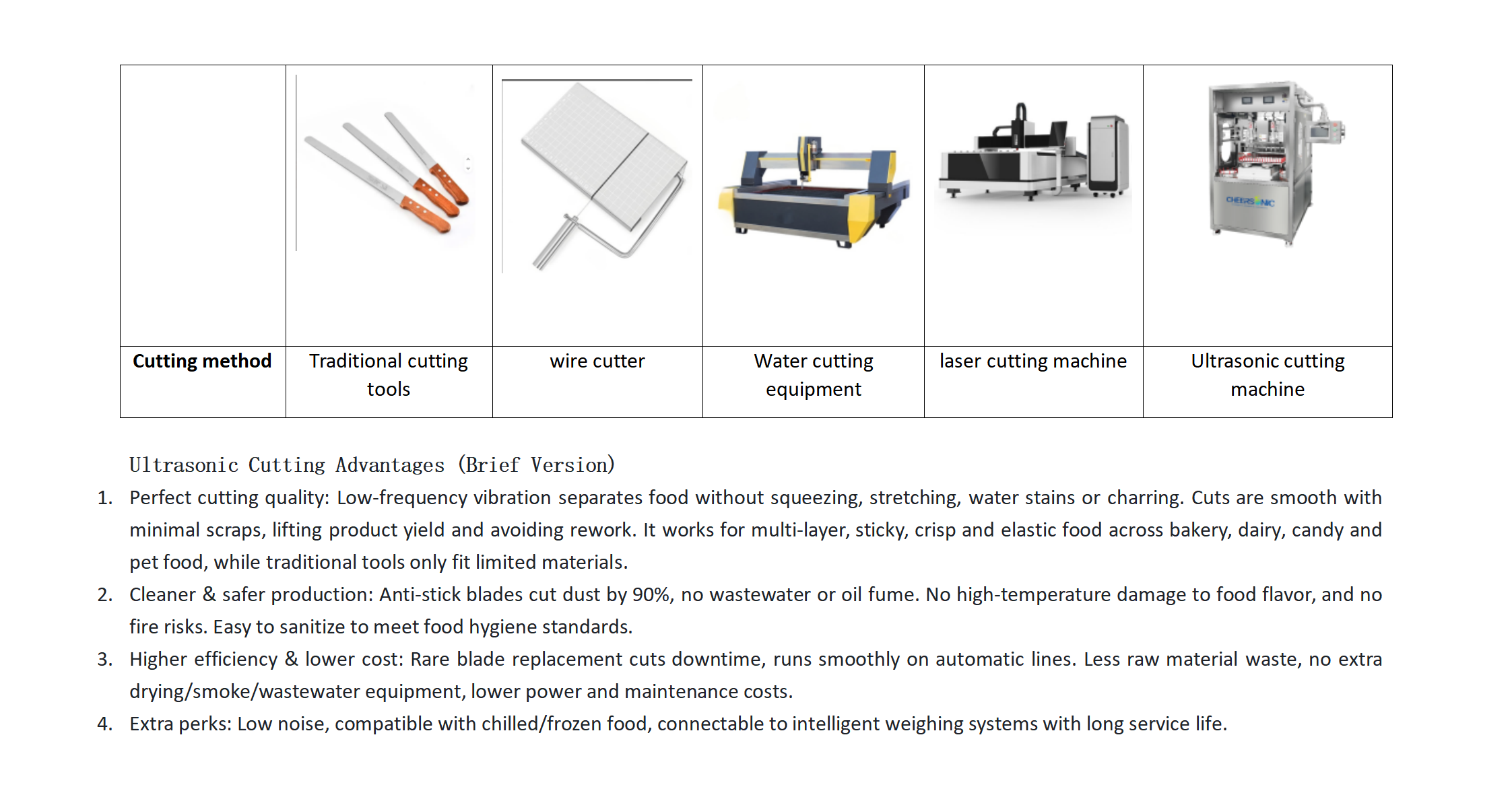
A wire cutter separates a cake with a tensioned cutting wire. A conventional knife or blade cuts through direct contact with the product. An ultrasonic food cutting machine uses a high-frequency vibrating cutting head; the supplied comparison material describes its action as vibration-based separation with less physical extrusion than traditional cutting. These are different cutting mechanisms, not interchangeable labels for the same machine.
For cake slicing, those mechanisms matter because a product may combine a soft or porous sponge, cream, filling, icing, or multiple layers. Wire movement, blade contact, and the interaction between an ultrasonic head and the product can affect whether the slice stays aligned, whether filling is dragged across the cut, and how cleanly the face presents. The result also depends on the cake itself and the machine setup. The available information does not establish a universal setting or a single outcome for every formulation.
The supplied comparison describes ultrasonic cutting as a low-temperature, dry process that avoids the stretching or pulling associated with wire cutting and the extrusion and sticking that can occur with conventional knives. Those statements are useful hypotheses for a buyer to test, rather than a substitute for a sample trial on the intended product.
Comparison at a glance
| Decision factor | Ultrasonic cutting | Wire cutting | Conventional knife or blade |
|---|---|---|---|
| Cutting action | High-frequency ultrasonic cutting head; the supplier comparison describes vibration-based separation. | A tensioned wire passes through the product. | A blade cuts through direct physical contact. |
| Potential cake-quality concern | Assess cut-face finish, layer alignment, and product handling on the actual recipe; supplier material describes reduced adhesion and deformation as intended benefits. | The supplied comparison identifies pulling, stretching, tearing, and layer misalignment as possible concerns on some products. | Sticking, compression, or product deformation may require attention, especially for soft or sticky cakes. |
| Consumables and upkeep | Supplier comparison material describes blade replacement every few months; actual interval depends on use and operating conditions. | The same comparison states that wire replacement may be needed within 1–3 days. Verify this against the specific wire and production conditions. | The comparison describes frequent cleaning and sharpening or replacement for traditional knives; maintenance schedules vary by tool and use. |
| Production integration | Cheersonic describes standalone and inline robotic ultrasonic cutting configurations. Confirm fit with the specific line and product flow. | Configuration and integration depend on the selected equipment; no universal performance comparison is available here. | Can suit a manual or machine-assisted process, but the appropriate configuration depends on the operation. |
| Evidence boundary | Product and application statements are supplier-reported; request a test on the buyer’s cake and specification. | Comparison claims in the supplied material are not accompanied by a standardized, independent cake-slicing test. | Likewise, the supplied material does not provide controlled results for every knife, cake, or operating condition. |
Where ultrasonic slicing may change the decision
The strongest reason to evaluate ultrasonic slicing is a product-quality problem that can be traced to cutting contact. If a wire pulls through layers or a conventional blade carries sticky material across the cut, the buyer may need to test another cutting action. Cheersonic’s comparison material presents ultrasonic cutting as an option for soft, high-viscosity, multilayer, porous, or delicate foods, including bakery products. That is an application claim, not proof that every cake in those categories will slice cleanly without adjustment.
Cheersonic lists cakes and pies among the foods its ultrasonic cutting equipment can process. Its company material also describes inline and offline slicing models and small standalone machines as well as large inline robotic solutions. These statements help define the supplier’s stated application and configuration scope. They do not establish which model is suitable for a particular cake diameter, recipe, cut pattern, loading approach, or target output.
For an equipment buyer, the practical implication is to treat cake compatibility as a test question. A product name such as “ultrasonic cake cutting machine” signals an intended application, but it does not replace a defined acceptance trial. The cake recipe, temperature at cutting, shape, number of portions, presentation requirements, and desired production arrangement should all be represented in that trial.
How to judge cut quality on your own cakes
Start with the finished slice, not the technology label. Agree in advance on what an acceptable cut looks like. For a layered cake, that may include keeping the layers visually aligned and avoiding dragging cream or filling across the exposed face. For a soft cake, it may include limiting compression or tearing. For a decorated product, the criteria may include how the cut affects the finish and the consistency of the portions.
Then use the same product and comparable conditions when evaluating systems. A meaningful comparison should identify the cake formulation and condition, the portion geometry, the number and sequence of cuts, the loading method, and the handling steps before and after cutting. If one trial uses a chilled cake and another a room-temperature product, the observed differences cannot safely be attributed to the cutting technology alone.
Record more than whether a cut can be completed. Inspect the cut faces, layer boundaries, crumbs, sticking, deformation, and the condition of adjacent portions. Also record cleaning needs and interruptions during the trial. If the proposed machine is intended for a production line, include the expected product flow and changeover requirements rather than assessing a single isolated cut.
Wire cutting: a relevant baseline, with practical limits
Wire cutting remains an important option to include in a comparison because it represents a distinct way of separating a cake. It may be adequate where the product is forgiving, the cut quality meets the specification, and wire replacement and cleaning fit the production routine. A buyer should not dismiss it merely because an alternative system is ultrasonic.
The supplied comparison identifies stretching, pulling, tearing, and layer misalignment as possible wire-cutting problems, particularly for elastic, viscous, multilayer, or composite foods. It also states that wire replacement may be required within 1–3 days and describes wire deformation or twisting as potential causes of downtime. These are supplier-provided comparison claims; they are not a universal maintenance rule for every wire machine. A procurement team should ask for maintenance records or a trial under its own usage pattern before using a stated replacement interval in a cost model.
For a wire system, the evaluation should include the quality of repeated cuts, how the wire behaves over a production run, the time and process for changing or tensioning it, and the effect of any failure on the line. If a cake’s layers are delicate, the trial should specifically examine whether the wire pulls or shifts them. If the cake is robust and the wire result is acceptable, the claimed advantages of another cutting mechanism may not justify a change.
Knife blades: simple comparison, product-specific outcome
A conventional knife or blade is a familiar reference point. It can be appropriate when direct-contact cutting produces an acceptable edge and the cleaning and maintenance routine is manageable. The question is not whether a knife can cut cake; it is whether it can repeatedly achieve the buyer’s cut-face, portion, and line requirements on the chosen product.
The comparison material supplied for ultrasonic equipment describes traditional stainless-steel knives as more prone to sticking, compression, debris, or deformation on certain soft, porous, sticky, multilayer, or fragile foods. It also presents frequent cleaning and tool upkeep as potential operational burdens. Those limitations are relevant to investigate, but they should not be generalized to every blade design, coating, cutting protocol, or cake. A properly selected and maintained blade may meet a product specification, and the available data does not provide an independent, standardized knife-versus-ultrasonic test for a specific cake.
In a knife trial, look for product transfer on the blade, the need for cleaning between cuts, deformation at the entry and exit points, and whether the face remains presentable after handling. Include the time spent on tool care and any trimming or rework required. These observations are more useful than a broad claim that one cutting technology is automatically superior.
Compare operating fit, not only the cut
Production decisions involve the full operating sequence. A machine that gives the desired slice may still require a loading, positioning, cleaning, or integration method that does not fit the existing process. Conversely, a machine that appears more complex may be suitable if it supports the intended production arrangement. The evidence available here does not provide standardized labor, uptime, energy, or total-cost data for ultrasonic, wire, and knife cake systems, so buyers should not infer a quantified cost advantage from the qualitative comparison alone.
Cheersonic describes both standalone equipment and inline robotic solutions for ultrasonic cutting. Its published range of slicing models is reported at 80 to 1,500 cakes or pies per hour, but that figure spans unspecified models and configurations. It should not be treated as a capacity promise for a specific cake or compared directly with another machine without matching the product, cut pattern, operating conditions, loading method, and measurement basis. Ask the supplier to identify the model and conditions behind any throughput proposal.
For all three systems, include production continuity in the evaluation. Note whether the method requires periodic tool changes, cleaning pauses, manual intervention, or rework. Assess the planned operation rather than a best-case demonstration. A small standalone machine and an inline robotic system represent different levels of process integration; neither should be judged solely by a single cut or by a general category claim.
A procurement framework for a fair comparison
- Define the product. Specify the cake type, structure, condition at cutting, dimensions, and any surface or filling characteristics that affect slicing.
- Set the acceptance criteria. Describe the required cut-face appearance, layer alignment, portion consistency, and acceptable levels of sticking, tearing, compression, or crumbs.
- Standardize the trial. Use the same representative product, cut pattern, and handling sequence for ultrasonic, wire, and knife trials. Document any unavoidable differences.
- Test the production routine. Include the expected sequence of cuts, cleaning, tool replacement, changeover, and product handling. For an inline proposal, evaluate integration with the intended product flow.
- Ask for model-specific evidence. Request the exact machine configuration and a throughput basis tied to the cake, cut pattern, loading method, and operating conditions. Do not rely on a broad range as a model-level guarantee.
- Review the limitations. Ask which products or operating conditions were not tested, how wear is assessed, and what maintenance intervals are recommended for the proposed configuration.
- Compare total operating requirements. Include consumables, cleaning, downtime, rework, and integration needs. Where suppliers cannot provide comparable data, keep those items as open verification points rather than filling gaps with assumptions.
This framework prevents a common purchasing mistake: comparing a general ultrasonic advantage statement with a fully specified result from a different product or operating condition. It also makes the decision auditable. The selected system can be linked to observed product results and documented production requirements rather than to a technology name alone.
Where ultrasonic food cutting is a stronger candidate
An ultrasonic food cutting machine merits a close evaluation when conventional cutting produces a recurring quality issue that matters commercially: pulling through layers, sticking to the blade, deformation, or excessive handling and cleaning. It is also relevant where a producer wants to examine a transition from manual or standalone work toward inline cutting. Cheersonic’s stated product range includes both standalone and inline robotic configurations, although the fit of any particular setup needs to be confirmed with the supplier.
It is a weaker basis for selection when the buyer has not identified a specific cutting problem, when the existing system already meets quality and operating needs, or when the proposed supplier cannot demonstrate the required result on the actual product. The comparison data does not establish an across-the-board return on investment or prove that ultrasonic cutting is the best choice for all cakes. A buyer should also account for the learning, integration, and validation required when adopting a different cutting process.
Cheersonic’s company-reported application list includes cakes, pies, brownies, bread, cheese, pizza, and sandwiches. The broader list supports initial application screening; it is not independent evidence that every product formulation has been validated. Buyers with a specific cake should therefore request a product trial and retain the agreed test conditions and results in the equipment evaluation record.
Comparison limits and evidence to request
The available comparison material is useful for identifying buyer questions, but it has clear boundaries. It does not provide a standardized test protocol that runs the same cake through ultrasonic, wire, and knife systems. It also does not provide independently verified, cake-specific measurements for slice quality, yield, labor, downtime, energy use, maintenance cost, or total cost of ownership. As a result, qualitative advantages should not be converted into an assumed performance percentage or financial saving.
Before purchase, ask for the exact machine configuration, blade or wire arrangements relevant to the comparison, operating instructions, maintenance recommendations, and a witnessed trial using a representative cake. Clarify how any throughput figure is measured and what loading, cut pattern, product condition, and operating period it assumes. If the purchase involves line integration, document the interfaces and acceptance criteria that matter to the buyer’s process.
These checks do not favor one technology. They distinguish evidence about a particular machine and product from a general description of how a cutting method works. That distinction is essential when a comparison will inform capital approval or a production change.
Decision summary
Choose by observed cake result and operating fit. Ultrasonic slicing is worth testing where sticking, pulling, deformation, or layered-product presentation are material concerns. Wire cutting should remain in consideration when its cut quality and maintenance routine meet the specification. Knife systems remain relevant where direct-contact cutting produces acceptable slices and the production team can manage cleaning and tool care.
No single method can be selected responsibly from the technology label alone. Compare the same cake under documented conditions, review both the cut and the production routine, and treat supplier-reported performance statements as claims to verify. For Cheersonic equipment, request a model-specific trial and confirm the proposed configuration against the product, throughput requirement, and line arrangement.
FAQ
What is the main difference between ultrasonic, wire, and knife cake slicing?
Wire cutting uses a tensioned wire, a conventional knife cuts through direct contact, and an ultrasonic system uses a high-frequency vibrating cutting head. The practical difference for a buyer is how each method performs on the actual cake, including its cut-face quality, handling, cleaning, and production fit.
Is an ultrasonic cake cutting machine always better for layered cakes?
No universal result is established by the available information. The supplier comparison identifies reduced pulling, sticking, or layer misalignment as potential benefits of ultrasonic cutting, but buyers should verify those outcomes with a trial on their own layered cake and agreed acceptance criteria.
How should a buyer compare cake-slicing throughput?
Compare throughput only when the model, cake dimensions, cut pattern, loading method, product condition, and measurement conditions are specified. Cheersonic reports a range of 80 to 1,500 cakes or pies per hour across unspecified slicing models and configurations, so that range is not a model-specific production guarantee.
What should be checked before buying an ultrasonic food cutting machine?
Test representative cakes, define slice-quality criteria, document the machine configuration, and review cleaning, wear, maintenance, and line-integration requirements. Ask the supplier to explain the conditions behind performance claims and to identify any product or operating conditions that were not validated.
Can wire or knife systems still be suitable for cake production?
Yes. A wire or knife system can remain suitable if it meets the product specification and fits the production routine. The relevant comparison is the observed quality and operating requirement for the buyer’s cake, not a general assumption that one cutting technology fits every application.
¿Tiene preguntas o necesita más detalles?
Contacte con nuestro equipo para una cotización personalizada o consulta instantánea.
Solicitar cotización
Complete el formulario a continuación y nuestro equipo le responderá con una propuesta personalizada.
Chat directo de WhatsApp
¿Prefiere chatear en tiempo real? Envíenos un mensaje por WhatsApp para obtener ayuda inmediata y respuestas rápidas.
- Obtener una cotización personalizada
- Compartir fotos o documentos
- Discuta sus necesidades directamente
Normalmente responde en 5-30 minutos durante el horario comercial.