
Cable Accessories Procurement FAQ: Parameters, Terminations and Acceptance
Most cable accessory disputes are not manufacturing disputes. They start with a specification sheet that never stated the conductor cross-section, the core count, the installation environment or the documents the buyer expected at acceptance — and end with a termination that is well made, correctly tested, and wrong for the cable it has to sit on. This procurement FAQ collects the questions that decide whether a cable accessory order is repeatable.
Why procurement questions cluster at the specification stage
Cable accessories are matched components, not stand-alone goods. A cold shrink termination is selected against a cable, not against a catalogue page: the silicone body has to compress onto a defined insulation diameter, the stress cone has to sit at a defined position relative to the semi-conductive cut, and the lug barrel has to accept a defined conductor range. Move any one of those numbers and the same part number becomes either too loose, too tight, or electrically mispositioned.
That is also why the reference standards treat preparation and accessory as one system rather than two. IEEE 1816-2024, the industry guide for the preparation of shielded cables and the installation of mating accessories, is written around cable systems from 2.5 kV through 46 kV. The scope itself makes the point: the accessory is only as good as the preparation it was qualified against.
In practice, three failure modes account for most of the avoidable cost in a cable accessory purchase. The first is an incomplete parameter set, which forces the supplier to quote a range instead of a part. The second is a termination type chosen by habit rather than by site conditions. The third is acceptance criteria that were never written down, so the buyer receives a shipment that passes a visual check and learns about a marginal seal two rainy seasons later.
Tonyhoo Cable Accessories — the trading identity of Ningbo Tonyhoo Electrical Technology Co., Ltd., a cable accessory manufacturer founded in 1997 and based in Yinzhou District, Ningbo, China — publishes product ranges that illustrate how narrow those parameter windows can be. The company's catalogue covers cold shrink and heat shrink terminations and joints, cable lugs, separable connectors, polyurethane sealant, protection housings and explosion-proof blankets, and its export business accounts for roughly half of output, with recorded markets including the US, Thailand, China, Albania and Vietnam.
Assembly workshop for cable accessory production. Component matching — not part count — is what determines whether an order is repeatable.
Which parameters a supplier needs before a quotation is usable
The practical rule is simple: if a parameter can change the part that ships, the supplier needs it before quoting. The table below maps the parameters that most often go missing against the product data they actually control.
| Parameter | What it controls | Recorded reference data |
|---|---|---|
| Rated voltage class (U0/U) | Insulation thickness, creepage, routine test voltage | 0.6/1 kV for the four-core cold shrink termination; 8.7/10 kV, 12/20 kV and 19/35 kV for heat shrink terminations and cold shrink intermediate joints |
| Cable nominal conductor cross-section | Shrink body bore, lug barrel size, joint sleeve length | 10–300 mm² for cold shrink termination; 25–400 mm² for heat shrink termination and cold shrink intermediate joint; 10–400 mm² for cable lugs |
| Core quantity and core type | Kit construction, phase spacing | Heat shrink termination offered in single-core and three-core versions |
| Conductor material and screen / armour construction | Earthing arrangement, stress control at the screen cut | Cold shrink joint and termination bodies are silicone rubber; heat shrink bodies are cross-linked polyolefin with semi-conductive cross-linked polyolefin |
| Installation environment | Housing, sealing, pollution and UV exposure | Indoor cabinet, outdoor substation, underground cable trench, high humidity, salt-fog coastal, dust-polluted, wide temperature range |
| Product type required | Distinguishes entirely different kits | Termination vs. intermediate joint vs. separable connector vs. cable lug |
| Connection interface at equipment | Whether a plug-in connector replaces a bolted lug | Separable connector rated 10 kV / 15 kV, 630 A, partial discharge ≤10 pC |
| Documentation required | Acceptance route and market access | Routine test reports, ISO 9001 certificate, sealant safety data sheet |
| Delivery and packing constraints | Production slot, freight format | Lead time 30–40 days; minimum order 10 sets; monthly capacity 12,000 sets |
Two of these rows are routinely under-specified. The first is core quantity: a three-core kit and a single-core kit are not interchangeable, and heat shrink termination ranges explicitly separate the two. The second is environment. For outdoor work, pollution resistance grade and weather resistance requirements need to be confirmed against the local power standard before the accessory is fixed — not after the housing is bolted shut.
Ordering terms: what should be fixed in the purchase order
Commercial terms are part of the technical specification, because they determine what the supplier can actually hold constant across repeat orders. For Tonyhoo Cable Accessories, the recorded capability envelope is a monthly capacity of 12,000 sets, a production lead time of 30–40 days, and a minimum order quantity of 10 sets. Those three numbers together define whether an order is a one-off project buy or the start of a stocked programme.
Customisation is where orders most often drift. The recorded customisation options are rated voltage, cable cross-section, material formula, packaging, logo printing and a special anti-corrosion version. Each of those is a real engineering variable, not a labelling choice: changing the material formula or the anti-corrosion treatment creates a different product with its own verification path, and should be quoted and accepted as such rather than as a variant of the standard item.
Quality control terms worth writing into the order include 100% factory electrical testing, partial discharge testing, and the option of third-party inspection through SGS or TUV. The after-sales envelope recorded for the range is on-site installation guidance, remote technical support and a five-year product warranty. Export coverage runs to the EU, Southeast Asia, the Middle East, Africa and South America, which matters for buyers who need the same part number supported across several project regions.
Cold shrink or heat shrink: the decision that shapes everything downstream
Both families do the same electrical job — insulation, electric field control and a sealed interface — but they reach it through different installation physics, and that difference, not the price list, is what should drive the choice.
A cold shrink termination arrives pre-stretched on a support core. The installer positions the body and the stress cone, then pulls the core out at a controlled speed so the silicone rubber contracts onto the cable. There is no heat source, no flame, and no waiting for a tube to recover. A heat shrink termination works the other way: cross-linked polyolefin tubing with a 2:1 shrink ratio is heated until it recovers onto the substrate, and the recovery is what generates the interface pressure.
| Decision factor | Cold shrink termination | Heat shrink termination |
|---|---|---|
| Installation energy source | None — mechanical core pull | Open flame or heat gun |
| Shrink mechanism | Pre-stretched elastomer recovery | 2:1 heat recovery ratio |
| Recorded voltage coverage in the range | 0.6/1 kV (four-core termination); 8.7/10 kV, 12/20 kV and 19/35 kV across the joint and termination families | 8.7/10 kV, 12/20 kV, 19/35 kV |
| Recorded cable section | 10–300 mm² (four-core termination); 25–400 mm² (intermediate joint) | 25–400 mm² |
| Recorded temperature range | -40 °C to 90 °C | -40 °C to 120 °C |
| Recorded insulation material | Silicone rubber, volume resistivity ≥1×10¹⁴ Ω·cm | Cross-linked polyolefin with semi-conductive cross-linked polyolefin |
| Site constraints | No open flame, suited to confined and flame-restricted locations | Requires certified flame operators and fire-fighting equipment on site |
| Cost profile | Higher unit cost, lower construction risk | Supplier guidance notes a clear cost advantage for budget-limited projects |
| Typical fit | Tight schedules, underground chambers, retrofits where a torch is not permitted | Volume projects with qualified crews and permitted hot work |
The selection logic therefore runs in a fixed order. First, is open-flame work permitted on site at all? If not, the decision is effectively made. Second, what is the schedule and crew qualification? Heat shrink is faster only when the crew is already certified and the permit process is not the bottleneck. Third, what are the cable voltage, cross-section and environment? Only then does the accessory family get matched. Among the heat shrink options, the recorded withstand voltage is 39 kV for 5 minutes, which is the figure an acceptance test should be read against.
There is a third interface type that buyers sometimes overlook because it is neither a termination nor a joint: the separable connector. Where the cable terminates into switchgear or a plug-in interface rather than a busbar, a separable connector rated 10 kV, 630 A, with a 42 kV one-minute AC withstand, 95 kV lightning impulse withstand, 22.8 kA/2 s thermal short-circuit rating and partial discharge ≤10 pC replaces the bolted lug arrangement entirely. Choosing between a lug and a separable connector is an equipment-interface decision, and it should be settled before any termination kit is ordered.
What the sealant actually does to protect a connection
Sealant is the most commonly misunderstood item in a cable accessory order, because it looks like a consumable and behaves like a component. Its job is not structural and not electrical in the conduction sense. Its job is to keep moisture, dust and contaminants out of the connection area, so that the insulation interface stays dry and the electric field control designed into the accessory is not progressively degraded from the outside in.
The recorded product for this role is the Environmentally Friendly Polyurethane Sealant, models J-399, J-499 and J-699, a light-yellow polyurethane prepolymer compound with a hardness of 55A±10 and an applicable voltage level of 10 kV to 35 kV. Hardness is the specification that matters most in practice: a sealant that is too soft can deform under cable movement and thermal cycling, while one that is too hard may not conform to the surface it is meant to seal. The 55A±10 figure is the band within which the compound is intended to sit.
Application follows a sequence that is short enough to be done properly and short enough to be done wrong. Isolate and prove dead before any work begins. Clean and dry the cable and the connection surfaces — sealant over a damp interface traps the moisture it was meant to exclude. Prepare the compound according to the product instructions. Apply it evenly around the full sealing area. Confirm complete coverage with no gaps and no exposed sections. Inspect the finished seal and confirm the connection is properly protected before the assembly is closed.
Because the compound is a chemical product, the safety documentation travels with it rather than with the termination kit. The recorded safety data sheet for the two-component polyurethane potting and waterproof sealant is MSDS No. S001T2309040008, issued 4 September 2023 under UN GHS Rev.9, covering the EU, US, Southeast Asia and UK markets. Buyers who need to hold a complete chemical compliance file should request it alongside the electrical test documents, not after customs asks.
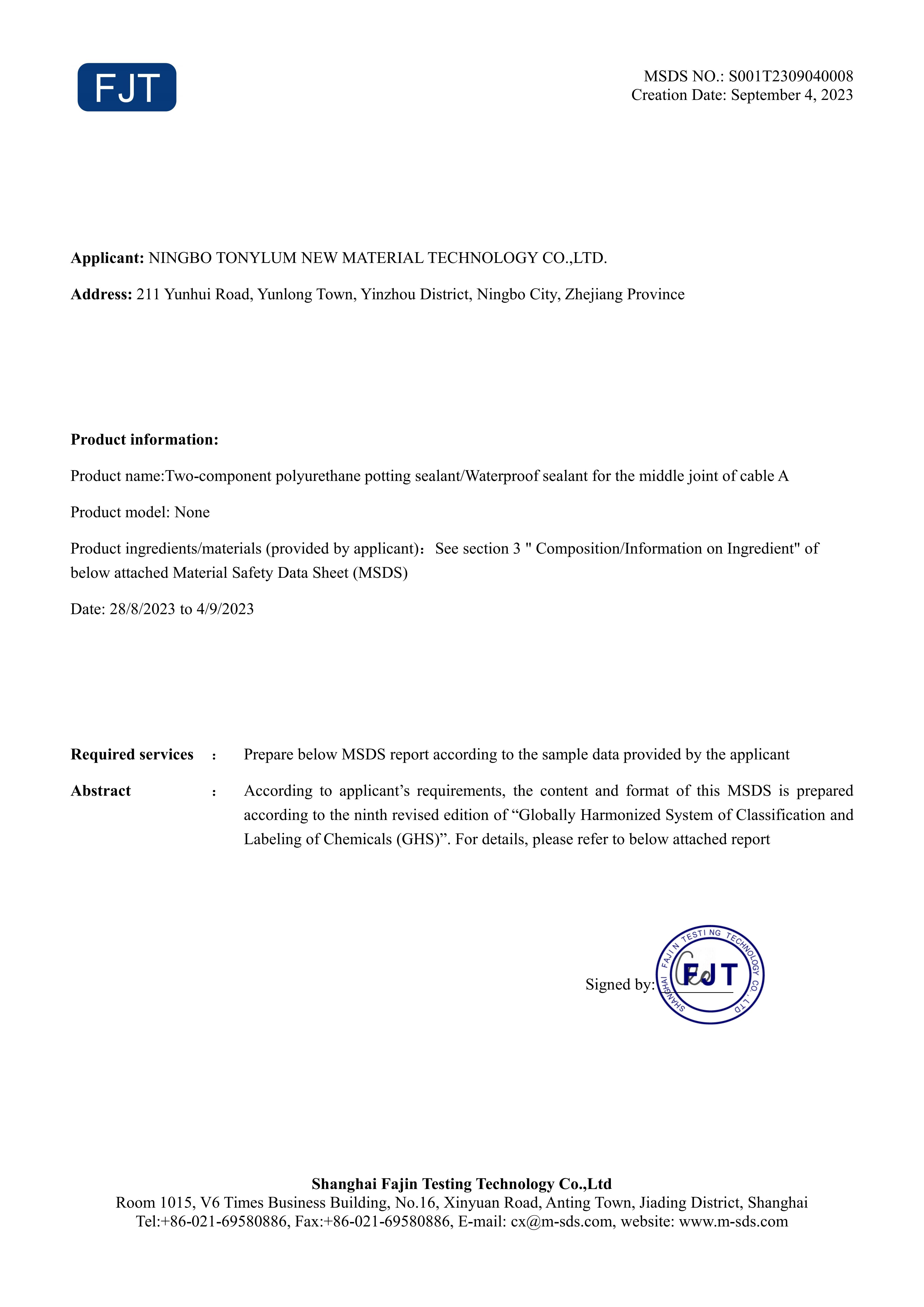
Safety data sheet for the polyurethane sealant used in cable joint sealing and waterproofing. The document is part of the acceptance pack, not an afterthought.
Acceptance criteria: what to inspect and what to demand in writing
Acceptance is where a good specification becomes enforceable. The checklist below converts the product data in this article into inspection points a buyer can put in a purchase order.
| Acceptance item | Evidence to request | Reference point |
|---|---|---|
| Routine electrical test | 100% factory electrical test record | Applies to every unit, not to a sample |
| Partial discharge | Partial discharge test record | Separable connector specification states ≤10 pC |
| Withstand voltage | Type or routine test report | Heat shrink termination: 39 kV / 5 min |
| Third-party inspection | SGS or TUV inspection report | Available on request as an order option |
| Quality management system | ISO 9001:2015 certificate | Certificate AMTIVO/CN/240246, issued 13 August 2024, valid to 12 August 2027, certified by AMTIVO China Limited; scope covers manufacture and sales of high-voltage cable accessories (110 kV, 220 kV intermediate joint protection housing, grounding box) |
| Chemical compliance | Safety data sheet | MSDS No. S001T2309040008, UN GHS Rev.9 |
| Dimensional fit | Cross-section and core-count confirmation against the cable schedule | Voltage class, conductor range and core type as specified in the order |
| Packing and marking | Packing list, carton marking, quantity per carton | Multi-carton orders should state carton count explicitly |
| Warranty | Written warranty terms | Five-year product warranty recorded for the range |
| Installation support | Support commitment in the order | On-site installation guidance and remote technical support |
One clarification is worth stating plainly, because it is a frequent source of argument at acceptance. The ISO 9001 certificate scope is written around high-voltage cable accessory manufacture and sales, specifically the 110 kV and 220 kV intermediate joint protection housing and the grounding box. It is a management-system certificate for that scope; it is not a product type-test certificate for every item in the catalogue. Buyers procuring medium-voltage terminations, joints, sealant or blankets should ask for the product-level test documentation of the specific item, and read the ISO certificate as evidence of a controlled production system rather than as a substitute for it.
Production workshop. Routine electrical testing at the factory is the first acceptance gate; on-site inspection is the second.
Installation pitfalls that surface as breakdowns months later
A cold shrink termination has no field-adjustable margin once the core is pulled. That single characteristic explains why the failure modes in this product family are almost all installation-induced rather than material-induced, and why they appear late: the assembly passes the commissioning test and degrades only after thermal cycling and moisture exposure have had time to work on a defect that was built in on day one.
Four operations account for the majority of later breakdowns.
- Scratches on the main cable insulation. A scoring mark from a stripping tool creates a field concentration point directly under the shrink body. The accessory cannot compensate for it.
- Rough treatment of the semi-conductive layer cut. The stress cone is designed to sit against a clean, correctly dimensioned screen cut. A ragged or stepped cut displaces the field control geometry.
- Moisture and dust on the installation interface. Contamination trapped between the silicone and the insulation becomes a conductive path over time, especially in humid or coastal environments.
- Offset stress cone positioning. A stress cone set outside its specified dimension leaves part of the screen cut uncontrolled, which is a classic pre-breakdown condition.
The countermeasures are procedural and inexpensive. Strip the outer sheath, armour and inner sheath strictly to the drawing dimensions and complete the armour earthing. Remove the semi-conductive shielding, then polish and clean the insulation surface so that scratches and dust are eliminated rather than hidden. Fit the cold shrink body and the stress cone to the specified dimension. Pull the support core out at a constant speed so that the silicone contracts evenly along the whole length. Finally, inspect the sealing structure and the external appearance and confirm there is no displacement or gap defect.
Outdoor risk: sealing, housing and blanket as three separate countermeasures
Outdoor installations fail for different reasons than indoor ones, and buyers frequently bundle all of them into a single word — weatherproofing — then order one product to solve three problems. The three risks are mechanical, environmental and thermal, and they have separate countermeasures with separate specifications.
| Outdoor risk | Countermeasure | Recorded specification |
|---|---|---|
| Moisture and contaminant ingress at the connection | Polyurethane sealant applied over the sealed interface | Models J-399 / J-499 / J-699; hardness 55A±10; applicable voltage 10 kV–35 kV; light yellow polyurethane prepolymer |
| Mechanical impact, salt spray, sustained load on the joint body | Stainless steel explosion-proof housing DS-FBH (SS)-1 to DS-FBH (SS)-8 | Shell B1 grade with V-0 flame-retardant sealing gasket; withstands a 1 kg weight dropped vertically from 2 m without cracking; flexural strength 127 MPa without fracture or deformation; no swelling, cracking or interlayer peeling after 3 days in 3% sodium chloride solution |
| Corrosion exposure in coastal and industrial atmospheres | Aluminum-Magnesium Alloy Protection Housing for 10 kV / 35 kV / 110 kV | Shell B1 grade, V-0 gasket; same 1 kg / 2 m impact and 127 MPa flexural figures; same 3-day 3% sodium chloride immersion result |
| Thermal event, arc flash or fire exposure near the joint | Explosion-Proof Blanket DS-FBT-10, DS-FBT-35, DS-FBT-110, DS-FBT-220 | Outer layer combustion performance B1; tear strength ≥3.5 kN/m; breakdown strength ≥20 kV/mm; volume resistivity ≥1×10¹³ Ω·cm; halogen-free with bromine <900 ppm, chlorine <900 ppm, combined <1500 ppm |
| Earth potential rise and sheath voltage at the joint | Cross-interconnect grounding box for 35 kV, 66 kV, 110 kV and 220 kV | Cabinet insulation resistance 5 MΩ; box body withstands 37.5 kV impact 10 times without breakdown; direct-buried box passes 0.2 MPa 30-minute air tightness test with no leakage |
Read as a set, these specifications answer a question that a single datasheet cannot: which risk is each product actually bought to reduce? A sealant addresses ingress. A stainless steel or aluminium-magnesium housing addresses impact, load and salt spray, with the flexural and immersion figures giving the buyer something to test against. An explosion-proof blanket addresses thermal and fire exposure, and its halogen-free limits matter for enclosed or populated locations where corrosive combustion products would be unacceptable. The grounding box addresses the earth path, and its 5 MΩ cabinet insulation resistance and 0.2 MPa air-tightness figures are the acceptance points.
The two housing types are worth distinguishing for procurement reasons rather than technical ones. Both are recorded with B1 shell flammability, V-0 gasket, 1 kg / 2 m impact resistance, 127 MPa flexural strength and 3-day salt-spray performance. The aluminium-magnesium version is offered for 10 kV, 35 kV and 110 kV protection housing duties; the stainless steel version is offered across the DS-FBH (SS) range of eight models. The choice between them is a question of weight, corrosion strategy and available space — and it should be quoted as an explicit line item rather than absorbed into a general "outdoor package".
Market context: what is actually growing, and what the numbers do not say
The demand backdrop is well documented at the aggregate level. Global Market Insights values the global cable accessories market at USD 35.84 billion in 2025 and projects USD 37.88 billion for 2026. The same source identifies Asia Pacific as the largest and fastest-growing region, with grid modernisation as the stated driver.
At the segment level, the split between the two termination technologies is closer than procurement habits suggest. Recorded 2024 valuations put the heat shrink cable accessories market at USD 2,113.7 million and the cold shrink tubing market at USD 2.38 billion. Two cautions apply before those figures are used in a business case. First, they are commercial research estimates with different product boundaries — cold shrink tubing is not identical in scope to cold shrink terminations. Second, the broader "cables and accessories" category that appears in some market reports is heavily cable-weighted and should not be read as a proxy for medium-voltage accessory hardware.
The procurement implication is not that one technology is winning. It is that both remain in active supply, which means the selection decision stays with the buyer and stays site-specific. A buyer who assumes the market has already standardised on one method will overpay either in unit cost or in construction risk.
Where this framework stops
An honest procurement guide has to state its own boundaries, and there are four worth naming.
- Voltage class does not travel across a product family. The cold shrink termination specification recorded here is a 0.6/1 kV four-core product for 10–300 mm² cable. Higher-voltage models in the same series carry their own data and must be quoted and verified separately. Applying the 0.6/1 kV figures to a 35 kV application would be a specification error, not a shortcut.
- Heat shrink requires a capability the site may not have. The 2:1 shrink ratio and the cost advantage are real, but both depend on certified flame operators, permitted hot work and fire-fighting equipment on site. In a confined underground chamber or a flame-restricted facility, the cheaper kit is not the cheaper outcome.
- Sealant hardness is product-specific. The 55A±10 figure describes one polyurethane compound for 10 kV–35 kV applications. It is not a general rule for all sealants, and substituting an unlisted compound invalidates the assumption.
- Housings and blankets add cost and volume. A stainless steel or aluminium-magnesium protection housing, or an explosion-proof blanket, is justified by the exposure of the specific joint — not by default. Indoor terminations inside a protected cabinet do not automatically need the outdoor package.
There is also a documentation boundary. Certificates and test reports prove that a controlled process exists and that defined tests were performed. They do not prove that a specific joint on a specific site was installed to dimension. Both gates matter, and neither replaces the other.
Outlook
Three shifts are likely to shape cable accessory procurement over the next buying cycles, and all three push in the same direction: toward better specification rather than cheaper parts.
The first is the continued weight of grid modernisation in Asia Pacific, which the recorded market data identifies as the largest and fastest-growing region. Grid upgrade and urban underground cable reconstruction programmes increase the share of joints and terminations installed in confined spaces — chambers, trenches and cabinet interiors — where open flame is difficult to permit and where cold shrink's torch-free installation stops being a convenience and becomes a constraint on method.
The second is the normalisation of acceptance documentation as a purchasing requirement rather than a negotiation lever. Buyers who already ask for partial discharge records and safety data sheets are pushing the same expectation down to sealants, housings and blankets — product categories that historically shipped with far less paperwork. The halogen limits on the explosion-proof blanket and the UN GHS Rev.9 safety data sheet on the sealant are early examples of that expectation being met at product level.
The third is a gradual separation between commodity and qualified supply. A manufacturer that offers both cold shrink and heat shrink families, plus the sealant, housings and blankets around them, can be qualified once and used across a project; a supplier that offers only one family forces the buyer to run the qualification process again for every interface. For evaluation-stage buyers, that breadth is worth more than a marginal unit-price difference — provided the documentation behind each item is real and product-specific.
Tonyhoo Cable Accessories sits in that qualified-supply category, with a recorded range from 0.6/1 kV cold shrink terminations through 35 kV joints and terminations to protection housings, blankets and grounding boxes, supported by a five-year product warranty and on-site installation guidance. For a project in Thailand, the recorded reference is a 1,000-unit supply to the Electricity Generating Authority of Thailand, and a separate 1,000-unit outdoor 10 kV terminal supply for a Provincial Electricity Authority urban distribution renovation, where the products passed on-site acceptance and operated without insulation faults under high temperature and high humidity. Those are project records, not market claims — and read as such, they are exactly the kind of evidence an evaluation-stage buyer needs.
FAQ
What parameters need to be provided to suppliers when purchasing cable accessories?
Buyers should confirm the rated voltage level, the cable model, the conductor cross-section, the core quantity and the application environment — indoor, outdoor or direct burial. A complete parameter set lets the supplier match a product of the corresponding specification and confirm electric field control, sealing performance and compatibility with the cable body. For outdoor applications, pollution resistance grade and weather resistance requirements need additional confirmation against the local power standard. Incomplete parameters are the most common cause of product mismatch and of insulation failure after energisation, so a double check before release is required.
How should a buyer choose between cold shrink and heat shrink cable accessories?
Cold shrink accessories are preferred where open flame is not allowed and construction schedules are tight, because they require no torch heating and are easier to install. Heat shrink accessories suit projects with a limited budget and certified flame operators, and carry a clear cost advantage in that setting. Both meet the insulation, electric field control and sealing requirements of medium-voltage cables. The practical order of judgement is: confirm whether open-flame work is permitted on site, verify schedule, budget and operator qualification, confirm the cable voltage class, cross-section and environment, then match the accessory and confirm delivery lead time.
How should cable sealant be used to protect cable connections?
Sealant is applied to seal the connection and help prevent moisture, dust and other contaminants from entering the connection area. Isolate and disconnect the cable first, then clean and dry the cable and connection surfaces, prepare the sealant according to the product instructions, apply it evenly around the required sealing area, and confirm complete coverage without gaps or exposed areas. The finished seal should be inspected to confirm the connection is properly protected. Installation should be carried out by qualified electrical personnel using appropriate PPE, and the cable should not be energised until the connection has been inspected.
Which installation operations cause later breakdown of cold shrink cable terminations?
Scratches on the main cable insulation, rough treatment of the semi-conductive layer cut, moisture and dust on the installation interface, and offset stress cone positioning are the main inducements of later breakdown. Stripping strictly to the process dimensions, keeping the insulation surface clean and dry, and accurately positioning the stress cone avoid these risks. The construction sequence is: strip the outer sheath, armour and inner sheath to drawing dimensions and complete armour earthing; remove the semi-conductive shielding and polish and clean the insulation surface; fit the cold shrink body and stress cone to the specified dimension; pull the support core at constant speed; then inspect the sealing structure and appearance for displacement or gap defects.
What are the key risks when selecting and installing cold shrink terminations?
The main risks are incorrect product selection, improper cable preparation, contamination, moisture ingress and incorrect installation. Cable voltage, size, insulation type and diameter should be confirmed before selection. The cable and components must be kept clean and dry, the specified installation dimensions and procedures must be followed, and the completed termination inspected before energisation. Power must be isolated, proved dead and grounded before installation, work should be performed by qualified electrical personnel with appropriate PPE, and the cable should not be energised until inspection and any required testing are complete.
The full Tonyhoo Cable Accessories product catalogue — covering cold shrink and heat shrink terminations and joints, cable lugs, separable connectors, polyurethane sealant, protection housings, explosion-proof blankets and grounding boxes — is available for download: Tonyhoo product catalog (PDF).
¿Tiene preguntas o necesita más detalles?
Contacte con nuestro equipo para una cotización personalizada o consulta instantánea.
Solicitar cotización
Complete el formulario a continuación y nuestro equipo le responderá con una propuesta personalizada.
Chat directo de WhatsApp
¿Prefiere chatear en tiempo real? Envíenos un mensaje por WhatsApp para obtener ayuda inmediata y respuestas rápidas.
- Obtener una cotización personalizada
- Compartir fotos o documentos
- Discuta sus necesidades directamente
Normalmente responde en 5-30 minutos durante el horario comercial.