
CT Compliance Evidence: CE-LVD, EMC, RoHS, UKCA, Type Tests
CT Compliance Evidence: CE-LVD, EMC, RoHS, UKCA, Type Tests
One CE mark, five different questions
A CE mark on a current transformer datasheet answers one legal question and is routinely read as though it answered five. The five are distinct: whether the product is electrically safe, whether it is electromagnetically compatible, whether it is free of restricted substances, whether it may be placed on the Great Britain market, and whether the design actually delivers the accuracy and insulation performance claimed for it. No single document settles all five. The evidence sits in separate files, issued by different bodies, against different standards, with different scope sentences and different end dates.
That separation is the entire compliance argument. A buyer who asks "do you have CE?" receives a PDF. A buyer who asks "which document supports which directive, for this model, in this market, and who issued it?" receives something that can be placed in a technical file, quoted in a bid and defended in an audit.
The document set reviewed for this article, covering HEYI ELECTRICAL's current transformers and residual-current sensors, makes the point concretely because it holds at least six document families at once: CE-LVD attestations and declarations, one CE-EMC verification of conformity, RoHS attestations and reports, a UKCA declaration of conformity, two IEC 61869 type test reports, and calibration certificates for the factory's own test instruments. Read as a bundle they prove very little. Read individually, each answers a question an engineer, a certification reviewer or a procurement auditor will eventually ask.
HEYI ELECTRICAL (Wenzhou Heyi Electrical Co., Ltd.) is a current-transformer manufacturer established in 2012 in Wenzhou, Zhejiang, China, whose published portfolio covers split-core, busbar, outdoor resin-cast, revenue-grade and residual-current products. The company website lists the model families referenced throughout this article.
What a CE mark legally is, and what a certificate adds
For low-voltage equipment placed on the EU market, conformity rests on manufacturer declarations supported by technical documentation. A current transformer normally falls within three instruments: the Low Voltage Directive (2014/35/EU) for electrical safety, the EMC Directive (2014/30/EU) for electromagnetic compatibility, and the RoHS Directive (2011/65/EU, as amended by (EU) 2015/863) for restricted substances. Within this framework the manufacturer compiles the technical file, carries out the conformity assessment and signs the EU declaration of conformity. Third-party assessment is optional for most equipment in these categories; where a laboratory or notified body is involved, its attestation supports the declaration rather than replacing it.
Two consequences follow for anyone evaluating a supplier. A supplier with no third-party certificate is not automatically non-compliant — it may be self-declaring. A supplier that produces a certificate has not automatically proved conformity either, because the certificate covers only what its scope sentence describes. A third trap sits in the document title itself: the reviewed set contains attestations of conformity, declarations of conformity, verifications of conformity, certificates of conformity and test reports, and the noun chosen does not indicate how deep the assessment went. Only the issuing body, the standard cited and the scope sentence do that.
Separating the five evidence families
CE-LVD: electrical safety, tied to a standard edition
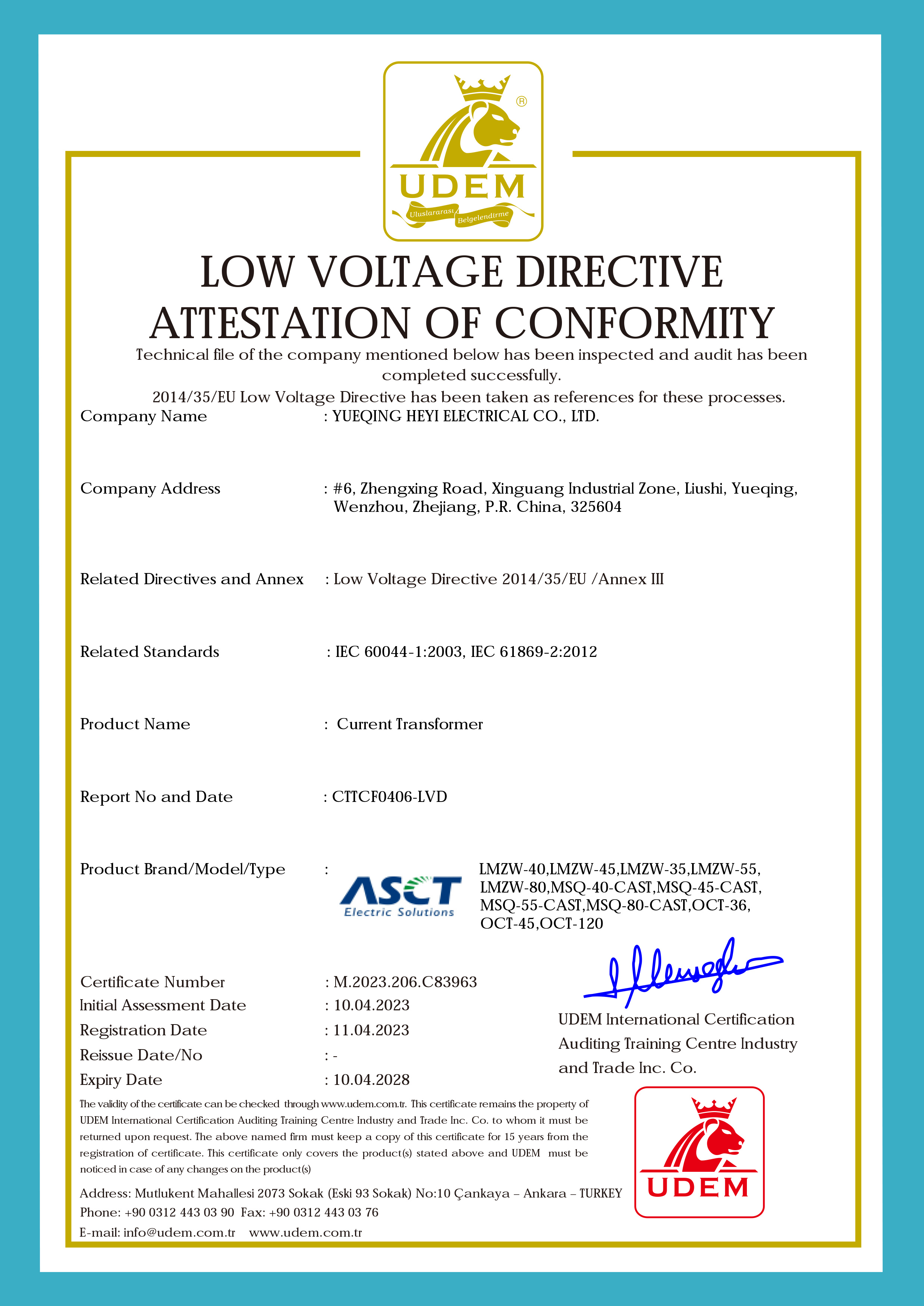
The Low Voltage Directive question is electrical safety, and the answer should name a standard and an edition. In the reviewed set, CE-LVD evidence for current transformers appears under at least four issuing bodies and two standard generations. UDEM's attestation M.2023.206.C90639 supports the HYCA fluxgate residual current sensor against IEC 62752:2016/A1:2018 and IEC 62955:2018 — application standards for EV-charging residual-current protection, not CT product standards, which is consistent with the product being a residual-current sensor rather than a transformer. UDEM's separate attestation M.2023.206.C83963 supports the OCT and LMZW ranges against IEC 60044-1:2003 and IEC 61869-2:2012. TÜV SÜD Product Service issued N8A 114572 0001 Rev. 00 and 0002 Rev. 00 against EN 61869-1 with EN 61869-2, recorded for the MSQ and DP/HK models respectively. Beide (Shenzhen) issued B-S2410C4272 against EN 61869-1:2009 and EN 61869-2:2012 for MSQ, and earlier certificates B-S210737499 and B-S210737500 for CP and MSQ.
IEC 60044-1 is the predecessor of the 61869 series, so its appearance alongside 61869-2 in a 2023 document is not an error. It does, however, tell the buyer that part of the assessment basis was drafted against an older framework, and the current edition that governs the project's acceptance criteria should be confirmed before that document is cited as the primary LVD evidence.
CE-EMC: the environment class decides what the document means
The EMC Directive question is whether the product, in its installation environment, meets emission and immunity requirements. The busbar split-core CT is supported by verification of conformity B-E2505D2378 from Beide (Shenzhen) Product Service Limited, issued 9 June 2025 and running to 8 June 2028, citing EN IEC 61000-6-3:2021 for emission and EN IEC 61000-6-1:2019 for immunity. Both are generic standards for residential, commercial and light-industrial environments rather than a current-transformer product standard. For a passive magnetic device that is not unusual, but it makes the installation environment the decisive variable: a split-core unit clamped onto a busbar inside an industrial cabinet works in a different electromagnetic environment from the one that generic residential class describes. The buyer should confirm that the class cited corresponds to where the unit will actually be installed, and should not assume a CT marketed for panel use inherits an industrial-class assessment.
RoHS: a materials question, sensitive to product variants
RoHS evidence answers a substance question and says nothing about accuracy, dielectric strength or temperature rise. It is also the family most exposed to product variation, because it describes what a specific article is made of. The reviewed set contains three different forms of RoHS evidence. LCSA03054058R from Shenzhen LCS Compliance Testing Laboratory, issued 15 March 2024 against the IEC 62321 series, is scoped to a fluxgate residual current sensor and supports the HYCA range. GST.210923.S201R, issued 30 September 2021 against 2011/65/EU and (EN)2015/863, is scoped to a split core current transformer and supports KCT-L, KCD and KCT — notably, the register records no issuing body for this document, only an authorised signatory, which is precisely the field a buyer must resolve. SHAEC2123838801, a RoHS verification report from SGS dated 20 December 2021 against the IEC 62321 series, covers current transformers and is linked to MSQ and DP/HK, with no end date recorded at all.
Because housing material, housing colour, terminal type, lead wire and connector are all customisable on these ranges, the practical question is which configuration the declaration covers. A RoHS document issued against one housing and lead-wire combination is evidence for that combination; whether it still describes a recoloured or re-terminated variant is a question for the supplier, not an assumption the buyer can make.
UKCA: a different market and a narrower standard set
UKCA is the conformity regime for Great Britain and is legally separate from EU CE marking, so an EU attestation does not place a product on the GB market and a UKCA declaration does not place it on the EU market. Declaration CLZJ23072649108 from Shanghai Global Testing Services Co., Ltd., issued 27 July 2023 and valid to 26 July 2028, is scoped to current transformers and cites BS EN 61869-2:2012 for the KCT-L, KCD and KCT models. Two observations follow. First, the UKCA document cites Part 2 of the standard only, while the EU LVD documents in the same set cite Parts 1 and 2 together — the standard sets are not identical, and the buyer should confirm whether the general requirements of Part 1 were addressed. Second, whether CE marking continues to be accepted in Great Britain has been subject to government policy adjustments; the position in force at the time of the order should be checked directly rather than inferred from a supplier's statement or an old file.
Type tests: design verification, not market access
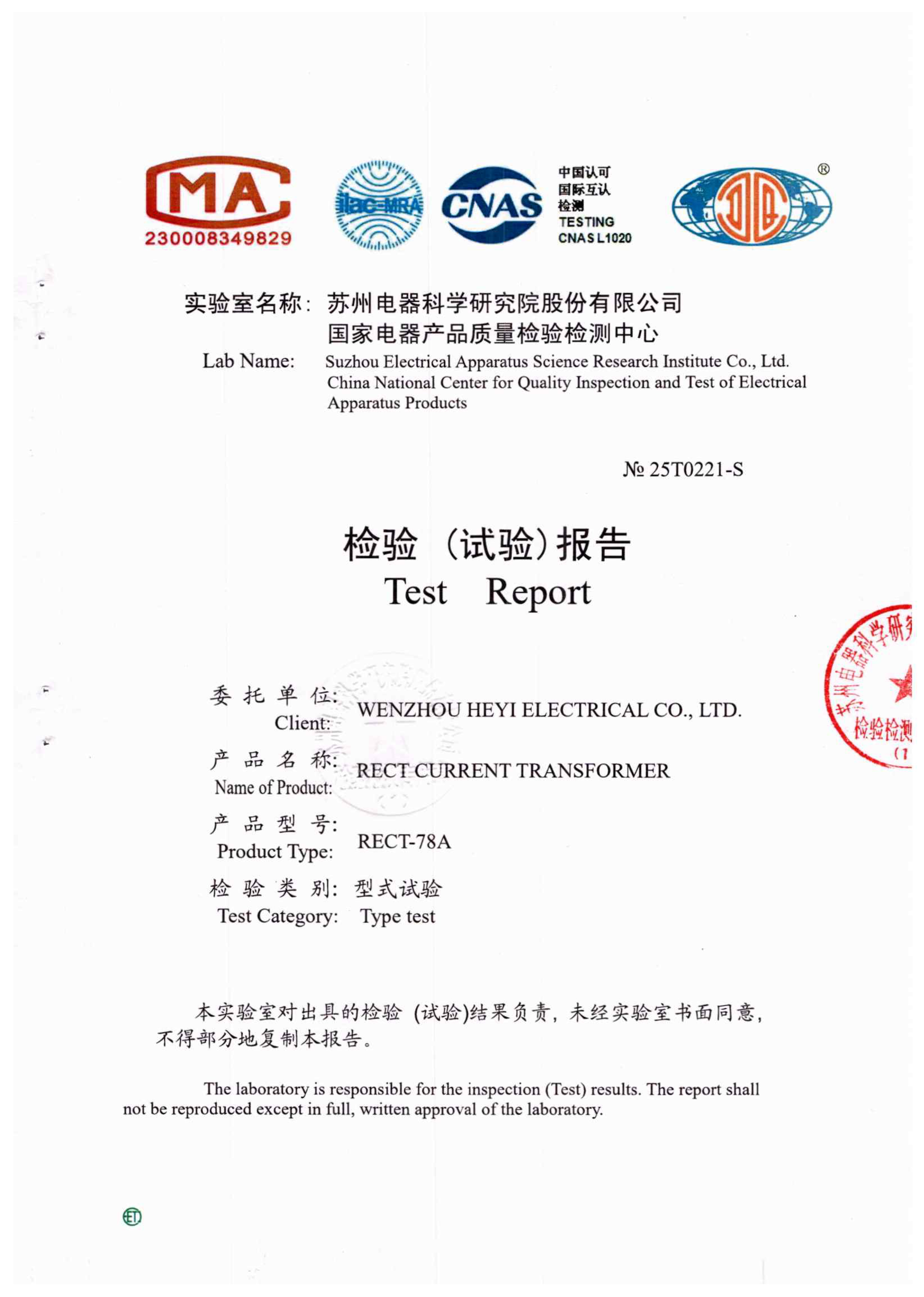
A type test report is a different instrument from a conformity document. It records that a specimen of a design was tested against a product standard and met defined performance requirements; it grants no market access and makes no declaration of conformity. Report 25133Z40179 from Zhejiang Fangyuan Test Group Co., Ltd., issued 17 April 2025 against IEC 61869-1 and IEC 61869-2, is explicitly scoped to the model LMZW current transformer. Report 25T0221-S from Suzhou Electrical Apparatus Science Research Institute Co., Ltd., issued 1 May 2025, is scoped to a current transformer and linked to the RECT revenue-grade unit, with the standard recorded in the register as the IEC/EN 61869 series on a provisional basis.
That last detail matters more than it appears. A register that flags a standard as provisional is telling the reader that the citation has not been confirmed from the report itself, and a buyer should read the report before quoting the standard in a technical file. The same discipline applies to accuracy class. LMZW is offered at 1.0, 0.5, 0.5S, 0.2 and 0.2S; RECT is described as a 0.15S unit with 5 A or 1 A output and IP65 protection. A single type test describes a tested specimen at a defined ratio, class and burden, and cannot be extended silently to every class in the catalogue. The useful request is not "send the type test" but "send the type test showing the ratio, class and burden of the unit we are ordering."
Metrological calibration: the factory's instruments, not the product
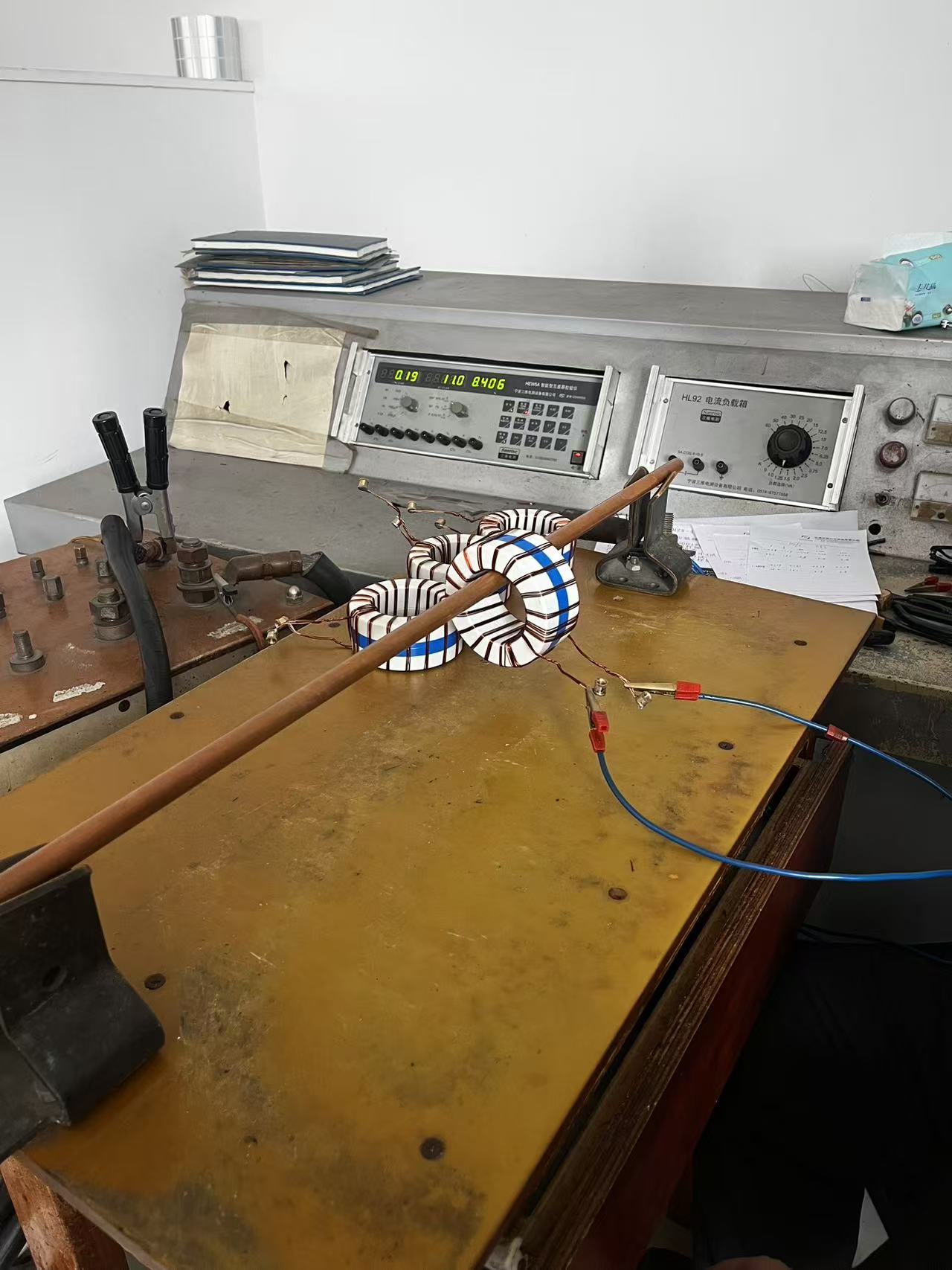
Three documents in the set are frequently mis-filed as product certification. Certificates D20250900170, D20250900171 and D20250900172 from the YueQing Institute of Measurement for Quality and Technique Supervision were issued in September 2025 and are metrological documents. D20250900170 covers a withstand voltage tester, model BF2670AM, serial 190312041, under JJG 795-2016. D20250900171 and D20250900172 cover a current load box, model HL04, serial 1906602, under JJF 1264-2010. None of them certifies a current transformer. Together they establish that the instruments used in the factory's routine electrical tests were themselves verified, which supports confidence in the routine test process rather than conformity of any product. They are also domestic calibration documents, so if the buyer's quality system requires traceability to a specific accreditation framework, that chain should be confirmed with the supplier rather than assumed.
Reading a register: what the columns reveal
Laid out side by side, the register shows why a single "CE available" statement is uninformative. The same product family can be supported by documents from different bodies, against different standard editions, with different validity patterns, and the register only becomes usable when each column is read against the purchase order.
| Document | Issuing body | Standard cited | Scope as recorded | Models referenced | Issued / end date |
|---|---|---|---|---|---|
| CE-LVD M.2023.206.C90639 | UDEM | IEC 62752:2016/A1:2018; IEC 62955:2018 | Fluxgate residual current sensor | HYCA | 21 Sep 2023 / 20 Sep 2028 |
| CE-LVD M.2023.206.C83963 | UDEM | IEC 60044-1:2003; IEC 61869-2:2012 | Current transformer | OCT, LMZW | 11 Apr 2023 / 10 Apr 2028 |
| CE-LVD N8A 114572 0001 Rev. 00 | TÜV SÜD Product Service GmbH | EN 61869-1; EN 61869-2 (recorded as implied) | Current transformer | MSQ | 27 Dec 2021 / 31 Dec 2099 recorded |
| CE-LVD N8A 114572 0002 Rev. 00 | TÜV SÜD Product Service GmbH | EN 61869-1; EN 61869-2 (recorded as implied) | Current transformer | DP/HK | 28 Dec 2021 / 31 Dec 2099 recorded |
| CE-LVD B-S2410C4272 | Beide (Shenzhen) Product Service | EN 61869-1:2009; EN 61869-2:2012 | Current transformer | MSQ | 22 Oct 2024 / 22 Oct 2027 |
| CE-LVD B-S210737499 / B-S210737500 | Beide (Shenzhen) Product Service | EN 61869-1:2009; EN 61869-2:2012 | Current transformer | CP; MSQ | 12 Jul 2021 / 31 Dec 2099 recorded |
| CE-LVD decl. ET16118324-LVD | Shenzhen Easy Test Electronic Products | IEC 61869-2:2012 | Current transformer | KCT | 10 Nov 2016 / 31 Dec 2099 recorded |
| CE-LVD/EMC AK 50656386 0001 | TÜV Rheinland LGA Products | EN 62752:2016+A1; IEC 62752:2016+A1; IEC 62955:2018 | Current sensor (Type B residual current monitoring unit) | Not stated in scope | 5 Dec 2024 |
| CE-EMC B-E2505D2378 | Beide (Shenzhen) Product Service | EN IEC 61000-6-3:2021; EN IEC 61000-6-1:2019 | Current transformer | DP/HK | 9 Jun 2025 / 8 Jun 2028 |
| RoHS LCSA03054058R | Shenzhen LCS Compliance Testing Laboratory | IEC 62321 series | Fluxgate residual current sensor | HYCA | 15 Mar 2024 / 31 Dec 2099 recorded |
| RoHS GST.210923.S201R | Not recorded (authorised signatory only) | 2011/65/EU; (EN)2015/863 | Split core current transformer | KCT-L, KCD, KCT | 30 Sep 2021 / 31 Dec 2099 recorded |
| RoHS report SHAEC2123838801 | SGS | IEC 62321 series | Current transformer | MSQ, DP/HK | 20 Dec 2021 / none recorded |
| UKCA CLZJ23072649108 | Shanghai Global Testing Services | BS EN 61869-2:2012 | Current transformer | KCT-L, KCD, KCT | 27 Jul 2023 / 26 Jul 2028 |
| Document | Issuing body | Basis | Scope as recorded | Subject | Issued |
|---|---|---|---|---|---|
| Type test 25133Z40179 | Zhejiang Fangyuan Test Group | IEC 61869-1; IEC 61869-2 | Model LMZW current transformer | LMZW | 17 Apr 2025 |
| Type test 25T0221-S | Suzhou Electrical Apparatus Science Research Institute | IEC/EN 61869 series (recorded provisionally) | Current transformer | RECT | 1 May 2025 |
| Calibration D20250900170 | YueQing Institute of Measurement | JJG 795-2016 | Withstand voltage tester BF2670AM, serial 190312041 | Test equipment | 8 Sep 2025 |
| Calibration D20250900171 / D20250900172 | YueQing Institute of Measurement | JJF 1264-2010 | Current load box HL04, serial 1906602 | Test equipment | 15 Sep 2025 |
| ISO 9001 20224Q21295R0S | Not named in the extract | GB/T 19001-2016 / ISO 9001:2015 | Production of low-voltage current transformers | Quality system | 21 Nov 2024 / valid to 20 Nov 2027 |
Five checks before a document becomes qualification evidence
Every document in the register can be read in the same sequence, and the sequence is what turns paper into usable evidence.
- Read the scope sentence, not the title. "Current transformer" supports a family statement; "split core current transformer" supports a construction type; "fluxgate residual current sensor" supports a specific sensing principle; "model LMZW" supports one model. One document in the set is scoped to a residual current monitoring unit rather than a transformer, which is a reminder that scope must be matched to the item actually being purchased.
- Map the document to the exact order code. Family-level scope plus a customised configuration is a gap, not a match. Where a CT is ordered with a custom ratio, housing colour, cable length or terminal type, ask whether the referenced document covers that configuration and what evaluation was performed if it does not.
- Identify the issuing body and the role it played. A notified body, an accredited test laboratory, a domestic measurement institute and an authorised signatory are four different levels of assurance. Where a register records only a signatory and no body, that field must be closed before the document is filed.
- Check the standard and its edition. Part 1 plus Part 2, Part 2 alone, an application standard such as IEC 62752 or IEC 62955, a generic EMC standard, or a test-method standard such as the IEC 62321 series — each supports a different claim. Two editions of the same standard in one register mean two assessment bases, and the newer one is not automatically the one covering your model.
- Confirm the market and the validity pattern. EU and GB are separate regimes with separate documents. On validity, several entries carry an end date of 31 December 2099, which is best read as an open-ended field rather than a statement that conformity has been assured for seventy years; one RoHS entry records no end date at all. Where a document has no genuine expiry, the buyer's control mechanism is a change-notification clause, not a date.
What the documents still cannot tell you
A complete certificate file describes qualification, not delivered quality. Nothing in the register above shows batch-to-batch consistency, field performance over service life, or the condition of a specific production lot. Those are covered by different controls. HEYI ELECTRICAL states 100% routine testing, comprising accuracy testing, insulation resistance testing, withstand voltage testing and appearance inspection, plus pre-shipment inspection — and the three calibration certificates described earlier are what give those routine tests a measurement basis. That is a coherent chain, but it is a process claim, and the buyer's own acceptance testing remains the evidence for the lot in hand.
Two specific gaps are worth naming. First, RECT is described in product documentation as IEEE C57.13 compliant, while the type test report on file is recorded against the IEC/EN 61869 series; the document set reviewed here does not include an IEEE C57.13 report, so a North American project should ask which document supports that claim and on what basis. Second, ISO 9001 certificate 20224Q21295R0S, valid to 20 November 2027, is scoped to the production of low-voltage current transformers; it speaks to the quality system, not to the conformity of any individual model, and should never substitute for a product-level document.
Writing the evidence requirement into the RFQ
The fastest way to close these gaps is to make the evidence schedule part of the request for quotation rather than a post-award conversation. A one-line schedule per model is sufficient: document number, issuing body, standard and edition, scope sentence, issue date, markets covered, and the configuration tested where the document is a type test. Asking for complete documents rather than cover pages matters, because the scope sentence, the standard and the tested specimen usually sit on an inside page.
Three clauses do most of the work in practice. A change-notification clause requires the supplier to re-issue or re-confirm evidence when housing material, lead wire, terminal type or magnetic core changes on a qualified model. A configuration clause requires the quoted model to state explicitly whether the referenced documents cover the customised variant or only the standard build. A market clause requires the supplier to name, per destination, which document is relied on — one line for the EU, one for Great Britain — instead of leaving the buyer to infer it from a certificate bundle. Where the issuing body publishes a searchable register, the document number can be checked directly against it; that step takes minutes and is the only genuinely independent verification available to a buyer without laboratory access.
Why documentation scope has become a procurement question
Two pressures have moved this from paperwork to sourcing criteria. The first is application mix. As current transformers move into EV charging and photovoltaic measurement, the standards in play shift from the CT product standard towards application standards — the HYCA file cites IEC 62752:2016/A1:2018 and IEC 62955:2018 for exactly this reason, while the transformer documents cite the 61869 series. A supplier whose evidence was built for metering panels may hold nothing that addresses a charging-application requirement.
The second is market breadth. Sourcing a single model for both EU and GB delivery now requires two conformity routes with different standards cited, as the UKCA document's Part 2-only citation shows. Commercial research on the category points in the same direction on scale, though the figures are not interchangeable: Grand View Research valued the global current transformer market at USD 2.8 billion in 2025, while Fortune Business Insights projected USD 3.06 billion for 2026 rising to USD 5.23 billion by 2034 at a reported 6.92% CAGR. The two publishers use different market boundaries and methods, so the numbers should be read as directional indicators rather than a single market size — a scope caveat that mirrors the argument of this article.
Outlook
The direction of travel is towards model-level evidence rather than brand-level assurance. Buyers who already ask for a certificate number will increasingly ask for the register behind it: which document, which model, which market, which body, which edition, and what happens when the design changes. For a manufacturer, the differentiator is not the size of the file but its traceability — a maintained register that maps each document to each order code, records the tested configuration in the type test, and re-confirms evidence after a material or design change. That is achievable at modest cost, and it is the part of compliance work that a competitor cannot photocopy.
For the buyer, the practical rule is simpler than the documentation. Treat every document as answering exactly one question, verify that the answer covers the model and the market being purchased, and keep the unanswered questions visible in the technical file until the supplier closes them.
Frequently asked questions
Does a current transformer sold in the EU legally require a CE certificate?
Not in the sense of a mandatory third-party certificate. For equipment within the Low Voltage, EMC and RoHS Directives, conformity is normally established by the manufacturer through a technical file, a conformity assessment and a signed EU declaration of conformity, with third-party assessment optional for most equipment in these categories. A laboratory attestation or certificate is supporting evidence for that declaration, not a substitute for it. The buyer's request should therefore be for the declaration plus the documents cited in it, not for a certificate as such.
Does a CE-LVD document also cover EMC and RoHS?
No. Each directive addresses a different question and generates separate evidence. LVD documents in the reviewed set cite EN 61869-1 and EN 61869-2, the EMC document cites EN IEC 61000-6-3:2021 and EN IEC 61000-6-1:2019, and RoHS documents cite 2011/65/EU with (EN)2015/863 or the IEC 62321 test series. A file containing only an LVD attestation leaves the EMC and substance questions open, regardless of how authoritative the LVD document looks.
Can a UKCA declaration be used for EU market access?
No. UKCA is the conformity marking for Great Britain and operates as a separate regime from EU CE marking, citing GB-adopted standards such as BS EN 61869-2:2012. A UKCA declaration in the reviewed set supports the KCT-L, KCD and KCT models for the UK market only, and the EU evidence for the same models sits in a different document. Whether CE marking remains accepted in Great Britain has been subject to policy adjustment, so the position in force at the time of the order should be confirmed rather than assumed from an existing file.
Do IEC 61869 type test reports expire?
Type test reports do not carry a market-access expiry in the way conformity certificates do; their usefulness depends on the tested design remaining the design being supplied. Registers sometimes record open-ended dates such as 31 December 2099, which should be read as an unfilled field rather than as perpetual validity. In practice a type test stays relevant while the design, materials, production process and site are unchanged and while it still reflects the accuracy class, ratio and burden being ordered. After a design or material change, the buyer should ask whether the report has been re-confirmed or the design re-tested.
How do the calibration certificates differ from product certification?
Calibration certificates verify the instruments, not the products. D20250900170 covers a withstand voltage tester under JJG 795-2016, and D20250900171 and D20250900172 cover a current load box under JJF 1264-2010. They demonstrate that the equipment used in routine electrical testing was itself checked against a measurement specification, which supports confidence in the routine test results. They make no statement about whether any current transformer meets IEC 61869, and they should be filed under process control rather than under product qualification.
A downloadable PDF covering the current transformer and current sensor ranges is available here: HEYI product brochure (PDF).
Certificate numbers, issuing bodies, standards and dates in this article are reproduced from the compliance records supplied for the HEYI ELECTRICAL range; documents described as recorded provisionally or without a named issuing body should be confirmed directly with the supplier before use in a technical file.
¿Tiene preguntas o necesita más detalles?
Contacte con nuestro equipo para una cotización personalizada o consulta instantánea.
Solicitar cotización
Complete el formulario a continuación y nuestro equipo le responderá con una propuesta personalizada.
Chat directo de WhatsApp
¿Prefiere chatear en tiempo real? Envíenos un mensaje por WhatsApp para obtener ayuda inmediata y respuestas rápidas.
- Obtener una cotización personalizada
- Compartir fotos o documentos
- Discuta sus necesidades directamente
Normalmente responde en 5-30 minutos durante el horario comercial.