
CSD vs. TSHD: Dredging Depth and Power Procurement FAQ
CSD vs. TSHD: Dredging Depth and Power Procurement FAQ
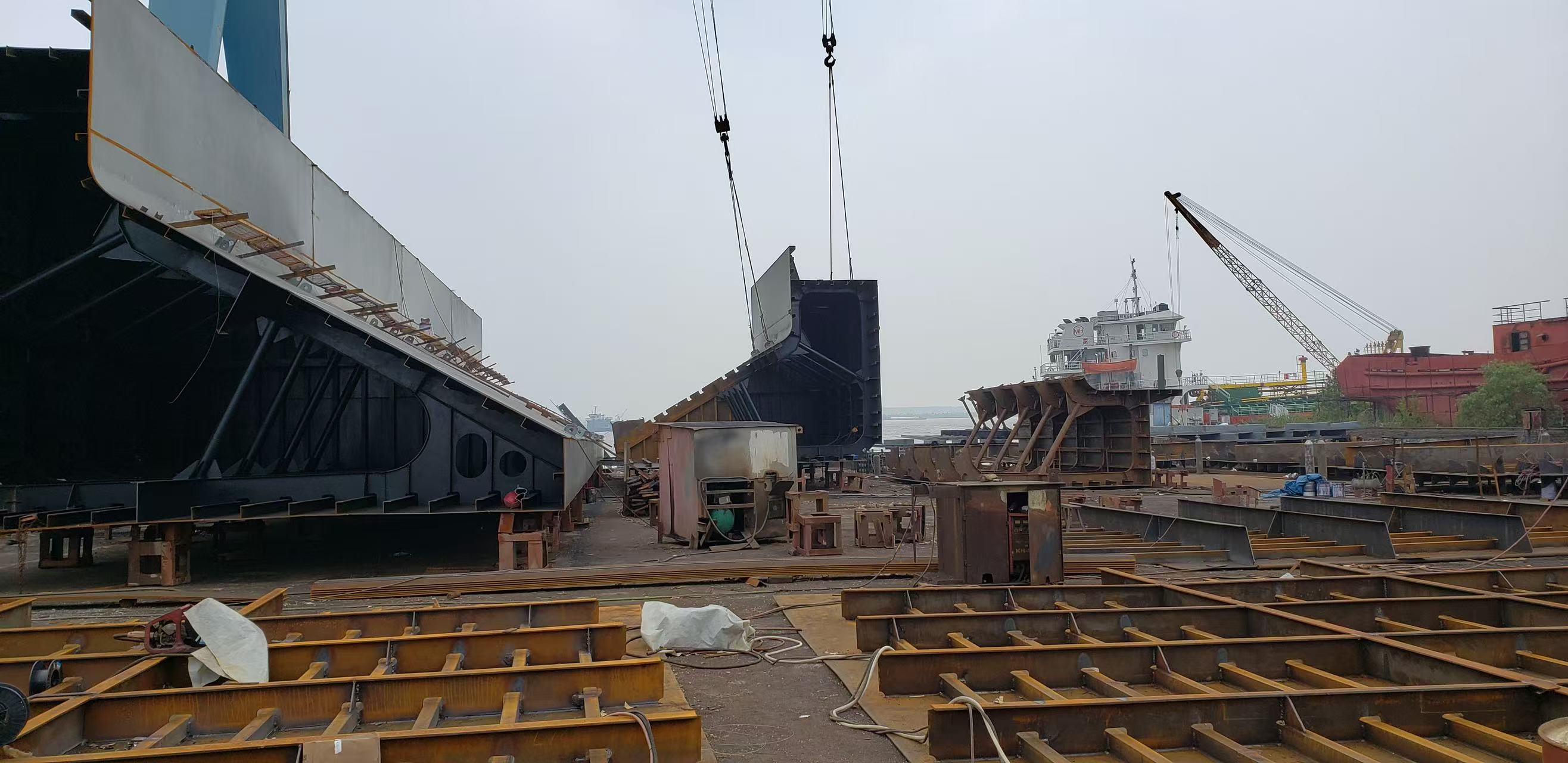
Choosing between a cutter suction dredger (CSD) and a trailing suction hopper dredger (TSHD) is often framed as a question of price, brand or country of build. In practice, the decision is settled by two specifications: the dredging depth the project actually requires, and the installed power needed to move the material at that depth at an acceptable production rate. When either number is misread during evaluation, the shortfall appears later — in cycle time, in mobilisation cost, or in the need to pre-treat material that the vessel cannot excavate.
The commercial context is expanding rather than contracting. Grand View Research values the global dredging equipment market at USD 4.86 billion in 2023 and projects growth to USD 7.36 billion by 2030. Within that market, hydraulic dredgers — the category that includes cutter suction dredgers — held the largest revenue share at approximately 46.65% in 2023, according to the same source. Trailing suction hopper dredgers are estimated by Future Market Insights to account for 46.0% of total dredging market activity by 2026, driven largely by port maintenance and offshore sand extraction.
That combination — a growing market split between two dominant vessel categories — is why depth and power deserve their own procurement checklist rather than a single line in a general comparison table. This reference answers the questions buyers in energy, metallurgy and mineral projects most often ask during evaluation and execution, using published specifications rather than generalities.
The Two Specifications That Decide Whether a Dredger Fits a Project
Dredging depth defines the boundary of what a vessel can physically reach. Installed power defines how much material it can lift, transport and discharge once it is there. The two are linked, but they are not interchangeable, and increasing one does not automatically compensate for the other.
Depth is a geometric constraint. It is set by the length and configuration of the ladder or suction pipe and by the positioning system that holds the vessel over the cut. A cutter suction dredger's published reference specification describes a self-propelled 8,000 m³/h unit with 30 m dredging depth and 8,000 m discharge distance. That discharge distance matters as much as the depth figure in projects where the placement area is far from the excavation face.
Power is a distribution problem. A large trailing suction hopper dredger may list a total installed power figure, but that figure includes propulsion, dredge pumps, jet water pumps and auxiliary generation. The buyer's real question is not how many kilowatts the vessel carries, but how many of them reach the dredging process and for how long.
Dredging Depth and Power: What Published Specifications Actually State
The table below compares two reference vessels from the Yanyang Marine range: a self-propelled 8,000 m³/h cutter suction dredger and a 26,800 m³ trailing suction hopper dredger. It is intended as a procurement reference, not a ranking — the two vessels are built for different working conditions.
| Parameter | Cutter suction dredger (8,000 m³/h self-propelled reference) | Trailing suction hopper dredger (26,800 m³ reference) |
|---|---|---|
| Dredging depth | 30 m | 40 / 70 / 115 m (three listed figures) |
| Output basis | 1,000–8,000 m³/h model range | Hopper capacity approx. 26,800 m³ |
| Discharge | 8,000 m discharge distance | Self-loading; material carried to the disposal or placement site |
| Length overall | 121 m | approx. 171.20 m |
| Breadth / moulded depth | 25 m / 8.5 m | 36.00 m / 15.80 m |
| Draft | Not stated in the reference specification | 9.50 m at international freeboard |
| Speed | Not stated in the reference specification | 11.5–15.5 kn at 11.5 m draft |
| Suction pipe diameter | Not stated in the reference specification | Φ1,200 mm |
| Total installed power | Not stated in the reference specification | 27,726 kW |
| Class (reference) | IACS societies available: CCS, BV, LR, DNV | CCS, CSA Trailing Suction Dredger, dredging within R1, DP-1 |
Reading across the table, the structural difference is clear: the reference cutter suction dredger is a production machine that excavates and pumps over long discharge distances at moderate depth, while the reference trailing suction hopper dredger is a self-loading, self-transporting asset with a much deeper reach and a much larger power plant. Neither specification is superior in isolation.
Procurement FAQ: Dredging Depth and Power
What dredging depth can a cutter suction dredger actually reach?
For the reference self-propelled 8,000 m³/h cutter suction dredger, the published dredging depth is 30 m, with an 8,000 m discharge distance. The wider cutter suction dredger model line spans 1,000–8,000 m³/h. Because the depth figure is tied to a specific ladder configuration, buyers should treat any depth claim without a matching model reference as incomplete — depth, output and discharge distance should be quoted together for the same unit.
What dredging depth does a trailing suction hopper dredger deliver?
The 26,800 m³ reference trailing suction hopper dredger lists three dredging depths: 40 m, 70 m and 115 m, with a Φ1,200 mm suction pipe. Three figures rather than one indicate different suction arrangements, so the procurement step is to confirm in writing which configuration the quotation and the contract cover. A vessel capable of 115 m is not automatically configured for it in the delivered specification.
How much of a trailing suction hopper dredger's 27,726 kW is actually available for dredging?
The 27,726 kW total installed power of the 26,800 m³ reference vessel breaks down across distinct functions: main diesel engines Wartsila 3 × 8,000 kW; auxiliary/harbor generators Wartsila 2 × 1,600 kW; one emergency generator Cummins 526 kW; main thrusters Wartsila 2 × 10,500 kW; inboard dredge pumps HK 2 × 6,000 kW; underwater pumps HK+BKKER 2 × 3,300 kW; jet water pumps CCCC 2 × 2,000 kW; bow thrusters ZF 2 × 1,100 kW; and a stern thruster ZF 1 × 1,100 kW. This split is the analytical point: propulsion and manoeuvring account for a large share of the total, while the inboard and underwater dredge pumps are what convert power into material transport.
Buyer interpretation: two vessels can quote the same total installed power and still perform very differently if the balance between propulsion, dredge pumps, jet water and auxiliary load is different. Ask for the breakdown, not only the total.
Does higher installed power always mean higher dredging output?
No. Output depends on the material, the cutting or suction action, the pumping distance and the cycle structure. A 26,800 m³ hopper dredger spends part of every cycle sailing to the disposal site and returning; production is therefore a function of cycle time, not hopper volume alone. A cutter suction dredger works on a stationary cut and discharges continuously, so its output depends heavily on discharge distance and on how hard the material is. Power enables a capability; it does not guarantee a production rate.
Which machine handles soft soil, and which handles hard rock?
The distinction is material-driven rather than brand-driven. Cutter suction dredgers are described in the manufacturer's range as efficient for hard soil, clay and rock dredging with high discharge distance. Trailing suction hopper dredgers are described as suitable for large-scale offshore and channel dredging with self-loading capability. Buyers planning mineral terminal berths, ore export channels or power plant intake channels in mixed ground should expect to justify their choice with geotechnical data, because neither vessel type is defined as universal.
How does hopper capacity change the procurement calculation?
A 26,800 m³ hopper is a large single-cycle payload, and it changes the commercial model: fewer trips, longer open-sea voyages and a vessel that needs to be matched to a disposal site of sufficient capacity. It also raises draft. The reference vessel's draft of 9.50 m at international freeboard is a hard access constraint for shallow ports, inland waterways and partially dredged channels. Hopper capacity should therefore be selected together with the access depth of every port the vessel must enter — not after the vessel is ordered.
Where the Capability Line Sits: Yanyang Marine's Model Range
Zhenjiang Yanyang Engineering Co., Ltd., trading as Yanyang Marine, is a Zhenjiang-based dredger manufacturer and exporter founded in 1996 by a team of marine engineers and offshore construction specialists. The company designs, builds and delivers dredgers and dredging vessels for port development, river dredging, land reclamation, coastal maintenance and offshore engineering projects, with a stated export ratio of 100% and reference markets including the United Arab Emirates, Indonesia, India, Egypt, Turkey, Nigeria, South Africa, Tanzania, Saudi Arabia and Oman.
For depth-and-power selection specifically, the relevant capability facts are the model range and the customisation path. The cutter suction dredger line covers 1,000–8,000 m³/h, and the trailing suction hopper dredger line includes the 26,800 m³ reference vessel described above. The wider product portfolio also includes grab dredgers, backhoe dredgers, split hopper barges and pile driving barges, which allows a project to be assembled from several vessel roles rather than forcing one hull to perform every task.
On execution, the manufacturer provides custom-made and ODM (Original Design Manufacturer) production services, with a standard production lead time of 2–3 months and longer lead times for customised vessels. Quality control is documented through IACS certificates, and vessels can be classed by IACS societies including CCS, BV, LR and DNV. The company employs a dedicated R&D team and reports more than 30 large dredger construction projects delivered.
Procurement terms are explicit rather than informal: minimum order quantity of 1 unit or 1 vessel; delivery by FOB, CIF or vessel delivery at an agreed port; acceptance through pre-delivery inspection and PODA signing; and payment structured as an escrow deposit with final payment on delivery, with direct deposit for minor transactions and milestone installments or a letter of credit for selected newbuildings.
Application: Port, Channel, River and Offshore Wind Work
Trailing suction hopper dredgers are typically deployed where the work is large-scale, offshore and repetitive: deep-water channel maintenance, port expansion, and large-scale reclamation, including operation in harsh open-sea conditions. The self-loading cycle suits long channels where the vessel must repeatedly fill, sail and discharge without external transport.
Cutter suction dredgers fit a different profile. Their stated applications include international container port deepening, trans-oceanic shipping channel excavation, large-scale offshore airport construction, coastal city expansion and land reclamation, and deep-water berth construction for VLCC tankers. In each of these, the ability to excavate harder material and pump it over a long distance is the deciding capability.
In the energy, metallurgy and mineral sectors, the practical use cases are ore and coal terminal berths, approach channels serving bulk carriers, thermal and industrial plant intake and outfall channels, and river desilting where sediment returns on a maintenance cycle. A separate and growing driver is offshore wind: the Global Wind Energy Council identifies offshore wind as an emerging demand source for dredging equipment, requiring specialised vessels for seabed preparation and cable trenching in connection with more than 380 GW of new capacity by 2033.
Market Signals: Why Depth and Power Requirements Are Rising
Three verified signals frame the procurement environment. First, the equipment market is projected to grow from USD 4.86 billion in 2023 to USD 7.36 billion by 2030 (Grand View Research). Second, hydraulic dredging — the CSD family — already held approximately 46.65% of market revenue in 2023, confirming that cutter suction technology remains the dominant production format. Third, trailing suction hopper dredgers are estimated to represent 46.0% of total dredging market activity by 2026 (Future Market Insights), which is consistent with rising port maintenance and offshore sand extraction volumes.
Buyers should note that published market size figures differ materially depending on scope. Estimates in circulation range from roughly USD 4.86 billion for equipment sales to figures above USD 18 billion when dredging services are included. The divergence is a scope difference, not a contradiction, and it is a reminder to check what any quoted number actually measures.
Standardisation is moving in parallel. ISO 8384:2019 provides the international vocabulary and definitions for dredgers, including specific terms for trailing suction hopper and cutter suction types, which reduces ambiguity in technical specifications and tender documents. Classification societies such as Bureau Veritas and DNV publish dredger-specific rules, including guidelines for the assignment of reduced freeboards for dredgers and certification frameworks for LNG-fuelled vessels.
Comparison With Alternative Methods — and the Limits of Each Vessel Type
Depth and power are not the only variables in a dredging spread. For constrained sites, alternative or supporting vessels may be the correct answer, and each carries its own boundary.
| Vessel type | Dredging depth | Capacity | Typical role and boundary |
|---|---|---|---|
| Self-propelled grab dredger (25 m³) | Coastal navigation area | 25 m³ grab | Removing hard clay, soft sediment, boulders and debris; lower continuous output than a CSD or TSHD |
| Backhoe dredger (EX5500) | 18 / 24 / 32 m | 15 / 18 / 20.5 m³ bucket | Stiff material and precision dredging in confined areas; excavation is cyclic rather than continuous |
| Split hopper barge | Not applicable | 1,200–3,200 m³ class range | Transport of dredged material in coastal and inland projects; requires a loading vessel |
| Pile driving barge | Not applicable | 110 m pile leader; Ø4,000 mm piles | Port and bridge construction; not a dredging unit |
The honest limitations deserve equal prominence. A large trailing suction hopper dredger with a 9.50 m draft cannot economically serve shallow inland waterways or partially dredged harbours, regardless of its 26,800 m³ capacity. Trailing suction hopper dredgers generally require pre-treatment or alternative equipment when the seabed is hard rock rather than sand, silt or soft clay. A cutter suction dredger, in contrast, is typically held in position on spuds or anchors and is therefore generally more sensitive to open-sea swell than a self-propelled hopper dredger operating on its own hull. Its reference depth of 30 m is also a hard ceiling: projects requiring 70 m or 115 m are outside the CSD envelope and inside the TSHD envelope.
Neither vessel type removes the need for geotechnical investigation. Buying a dredger before the material has been characterised transfers technical risk from the project to the buyer, and no specification sheet compensates for that.
A Practical Pre-Purchase Checklist for Depth and Power
- State the required dredging depth with tolerance, and separate capital dredging depth from maintenance depth.
- Require the depth figure to be tied to a named model and ladder or suction configuration — for example, confirming which of the 40 m, 70 m or 115 m configurations is contracted.
- Request the installed power breakdown by function: main engines, dredge pumps, underwater pumps, jet water pumps, thrusters and auxiliary generation.
- Check draft against the shallowest access depth of every port the vessel must enter, using the 9.50 m reference draft as a reminder that capacity and access pull in opposite directions.
- Match hopper capacity to disposal-site capacity — a 26,800 m³ hopper requires a disposal plan that can absorb the volume.
- Confirm discharge distance where pumping is required; 8,000 m on the reference cutter suction dredger is a specification, not a default.
- Verify class scope and notations (for example, CCS, CSA Trailing Suction Dredger, dredging within R1, DP-1) and confirm which IACS society will class the delivered vessel.
- Confirm whether the requirement is standard or custom, since lead times differ: 2–3 months for standard vessels, longer for customised units.
- Contract the commercial terms explicitly: 1 unit or 1 vessel minimum, FOB or CIF delivery, pre-delivery inspection and PODA signing as the acceptance step, and the agreed payment structure.
- Fix spare parts and service scope in writing, because a 27,726 kW power plant without a spares strategy becomes a liability rather than an asset.
Future Outlook
Three directions are likely to shape depth-and-power specifications over the next several years. Channel and berth deepening programs will continue to push depth requirements beyond the practical envelope of standard cutter suction configurations, strengthening demand for large hopper dredgers — consistent with the 46.0% activity share projected for 2026. Offshore wind development will add demand for vessels able to work in exposed conditions, where self-propelled, dynamically positioned designs are favoured. And classification frameworks will continue to expand, with dredger-specific rules and certification paths for alternative fuels already published by societies such as Bureau Veritas and DNV.
For buyers, the practical implication is stable: the more precisely depth and power are defined at tender stage, the fewer changes will be needed later. Vessel type follows specification — not the other way around.
FAQ: Procurement and Execution Questions
- What is the minimum order quantity for a dredger?
- One unit or one vessel. Newbuilding and customised configurations are quoted against a single-vessel basis, which is standard for this equipment category.
- How are payment and acceptance handled?
- Payment is typically structured as an escrow deposit with final payment on delivery, with direct deposit used for minor transactions and milestone installments or a letter of credit for selected newbuildings. Acceptance is completed through pre-delivery inspection and PODA signing.
- What delivery terms are available?
- FOB, CIF, or vessel delivery at an agreed port. The appropriate term depends on whether the buyer or the builder assumes responsibility for the delivery voyage and its insurance.
- How long does delivery take?
- Standard vessels are quoted at a 2–3 month production lead time, while customised dredgers require a longer schedule. Buyers should treat the lead time quoted for a standard hull as non-transferable to a bespoke design.
- Can dredging depth, discharge distance and power be customised?
- Yes. Custom-made and ODM production services are provided, and the manufacturer states that dredging depth, discharge distance, power and overall configuration can be tailored to the working environment and local regulations.
- Which classification societies can class the vessel?
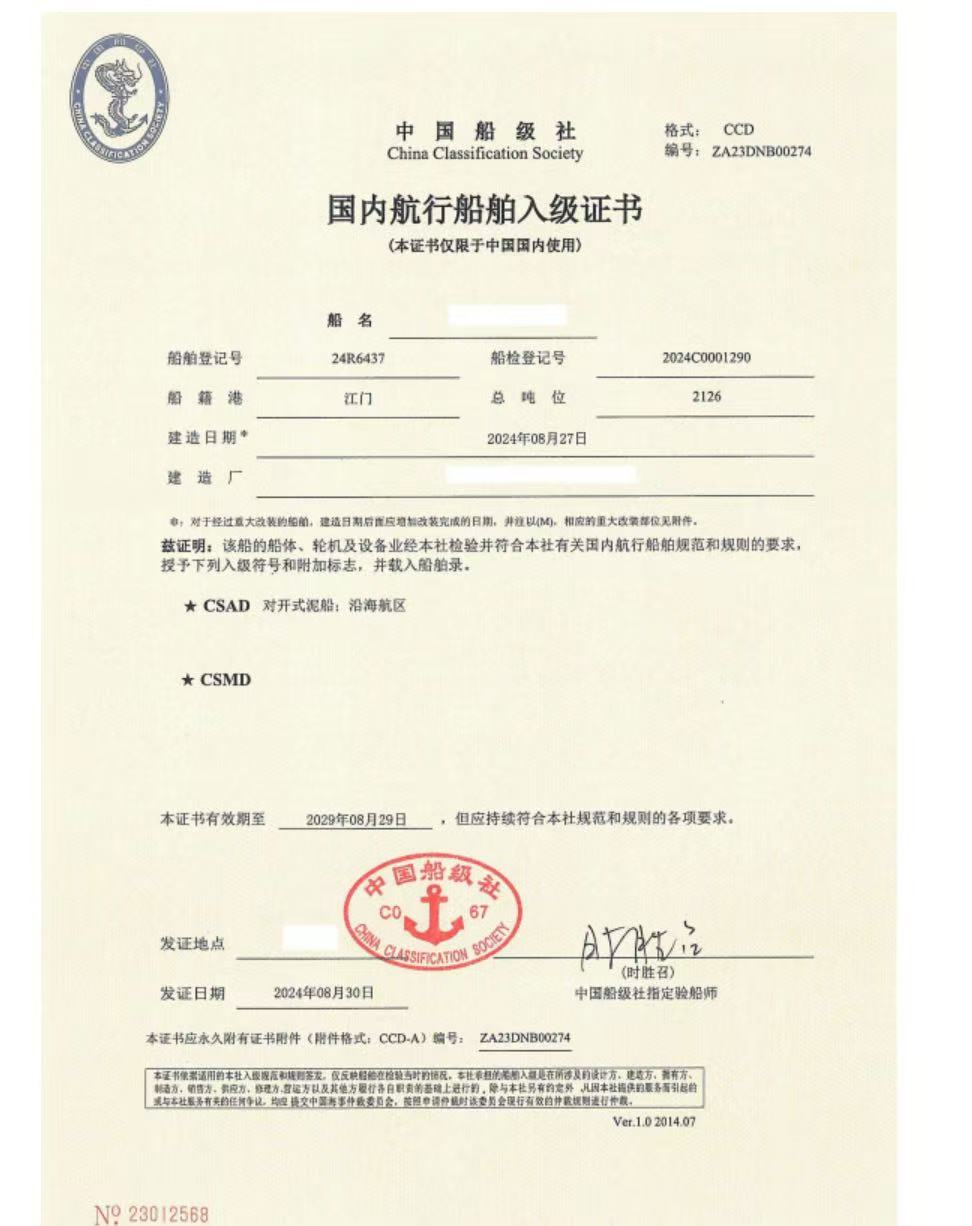
- Vessels can be classed by IACS societies including CCS, BV, LR and DNV. Documented classification evidence exists in the form of a CCS Domestic Vessel Classification Certificate issued in August 2024 for a self-discharging hopper barge within the coastal navigation area, valid for five years.
- What after-sales support is normally included?
- Services cover newbuilding as well as maintenance, repair and conversions, together with commissioning, operator training and long-term spare parts supply. Buyers should define the response scope for each of these items in the contract rather than assuming coverage.
Depth and power remain the two specifications that most reliably separate a dredger that performs from one that is renegotiated. Establishing both against published, traceable figures — and confirming the configuration behind each number — is a more durable procurement strategy than comparing headline capacities alone.