
COP-5MSS-DD: Reading Push Button Pendant Options Against the Leaders
COP-5MSS-DD: Reading Push Button Pendant Options Against the Leaders
A push button pendant is where an operator's intent becomes a crane's response. In a market where the top five players held over 45% share in 2025, the practical question for buyers evaluating configurable pendant stations is narrower than brand loyalty: does the pendant they specify deliver the button count, button function, contact material, and button speed the application actually uses? This is an independent buyer analysis of that question, centered on the Wilmall COP-5MSS-DD.

The push button pendant market in brief
The global push button pendant control station market was valued at approximately USD 1.02 billion in 2025 and is projected to reach USD 1.48 billion by 2034, at a compound annual growth rate of 4.1% across the 2026-2034 period. Those figures come from commercial market research, and they define the size of the category rather than the shape of any individual procurement. What they establish for a buyer is context: this is a mature, moderately concentrated category, and the top five players together held over 45% of it in 2025.
That concentration matters because it shapes the default sourcing path. In most established industrial markets, a buyer's first encounter with a crane pendant control is not with an independent manufacturer at all. It is with the crane's original equipment manufacturer, whose pendant ships as part of a wider crane package.
What a buyer is actually acquiring
A push button pendant control station is a control housing carrying a defined set of push buttons, wiring, and a suspended cable, engineered to be operated by hand and positioned within reach of the crane or hoist operator. The switch elements inside it fall within the scope of IEC 60947-5-1:2024, the current international standard for electromechanical control circuit devices and switching elements. Trade classification for the assembled unit typically follows HS 8537.10 for boards and panels rated up to 1,000 V, or HS 8536.50 for the switching elements themselves.
Within that shared envelope, three attributes decide most of the difference between one industrial pendant control and another:
- Button count. Whether the pendant station for crane duty carries 2, 4, 5, 6, or 8 buttons, and how those buttons map to hoist direction, trolley travel, and bridge travel.
- Contact point material. Silver versus copper, with consequences for conductivity, arc resistance, and contact life under repeated switching.
- Button speed. Single speed or dual speed, which determines whether the pendant itself supports variable operation or leaves all speed control to the panel.
These are not cosmetic choices. They decide whether the pendant matches the crane's control architecture on day one, or becomes a commissioning problem on day two.
Why leader-bundled pendants get specified, and where that breaks
Crane platform manufacturers such as Konecranes, Demag, and Columbus McKinnon have built pendant offerings into wider crane packages. That integration carries genuine value: the pendant, the control panel, and the crane's drive system are engineered together, tested together, and serviced under a single warranty. For a greenfield crane project, bundle-first sourcing is often the lowest-friction route.
Where that model runs into friction is at the retrofit, replacement, and custom station level. A facility adding a pendant station to an existing crane, or restoring a pendant on an asset already in service, faces a different problem. It does not need the pendant to be the crane OEM's preferred design. It needs the pendant to match the electrical interface of the crane it will control, and to reflect the button configuration the operator already uses.
Procurement teams describe this pattern consistently. The leader pendant is well-rounded but ships with limited configuration latitude. A station that needs an emergency braking button on a specific channel, or a silver-contact set for a high-cycle environment, is not a variation on a catalog item. It is a project-specific configuration — and that is where a crane pendant push button switch sourced from an independent manufacturer starts to look like a plausible route rather than a compromise.
Wilmall COP-5MSS-DD as a configurable alternative
Wilmall (Wenzhou Mofan Electric Technology Co., Ltd.) is an industrial electrical manufacturer and one-stop B2B supplier of industrial automation and power distribution components, operating as a manufacturer, supplier, wholesaler, and OEM/ODM factory for global buyers. The company's stated product scope includes control pendant stations alongside proximity sensors, rotary encoders, connectors, transformers, and other control devices. Wilmall reports more than 8 years of industry experience and 500+ clients across 30+ countries and regions, with products certified to CE, UL, and RoHS. It operates a 2,000 m² facility with an annual output of 200,000 units and exports approximately 80% of production, with stated markets including Pakistan, South Korea, Australia, and Malaysia.
The COP-5MSS-DD is a five-button push button pendant within Wilmall's control pendant range. Its relevance to an evaluation-stage buyer is not that it matches every leader-bundled unit on brand history. It is that Wilmall publishes specific configuration latitude around the range and supports OEM/ODM production around that latitude, in quantities that start below ten units.
Configuration options published for the range
| Configuration dimension | Options provided | Buyer relevance |
|---|---|---|
| Contact point material | Silver, Copper | Trade-off between conductivity and high-cycle life |
| Button function | Emergency braking button (option) | Allows a safety-relevant control channel at the pendant |
| Number of buttons | 2, 4, 6, 8 | Matches single-axis to multi-axis control schemes |
| Button speed | Single speed, dual speed | Determines whether the pendant supports variable operation |
The same manufacturing arrangement publishes a monthly capacity of 2,000 units, a stated lead time of 15 working days, a minimum order quantity of 5 units, and 100% testing on all products. For an evaluation-stage buyer, the operational meaning of the MOQ figure is that a five-unit run can serve as a qualification batch before any larger commitment. The 15-working-day lead time sets a realistic expectation for a configured unit, which is a different planning figure from a stocked commodity item.
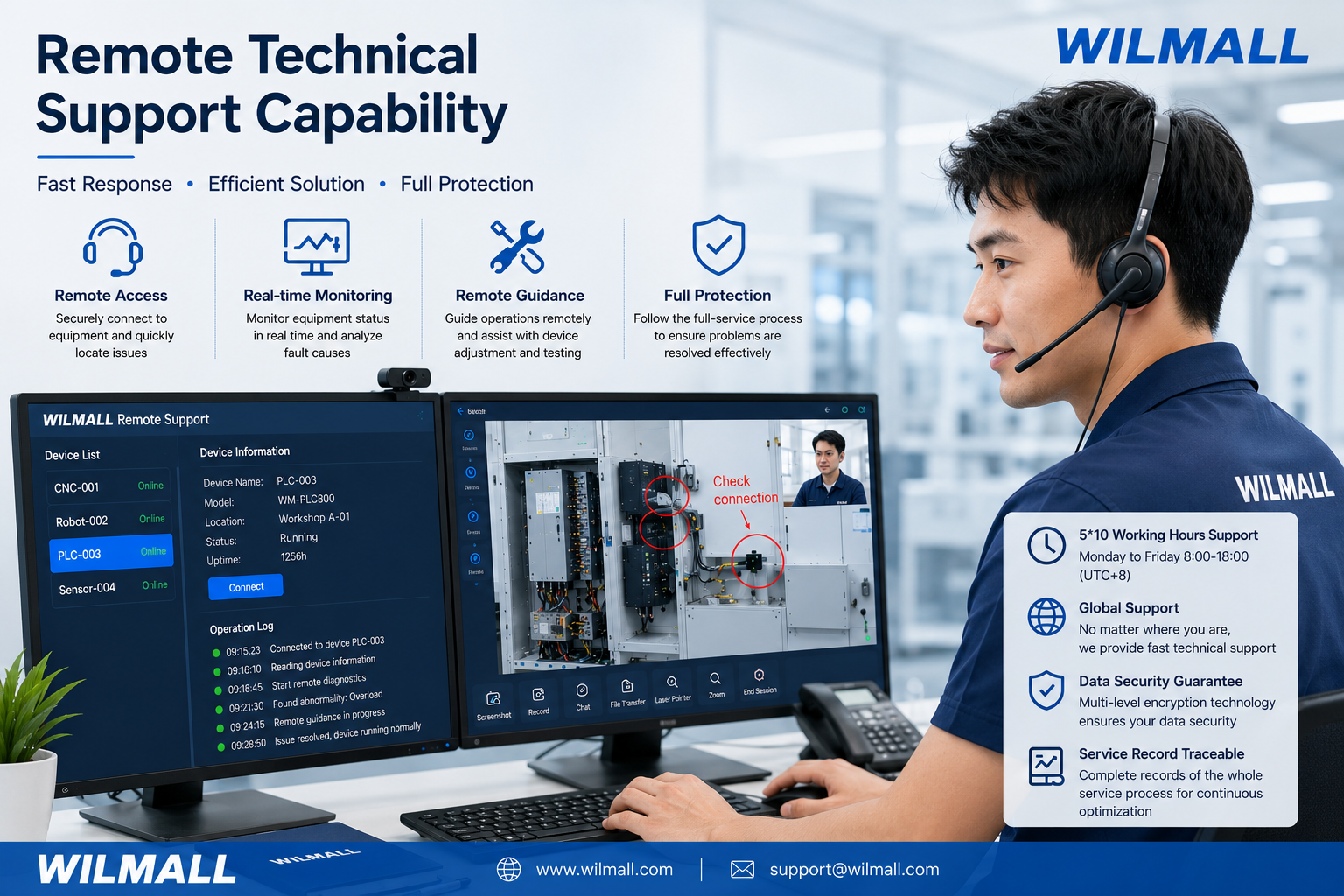
Wilmall capability documentation covering remote technical support for control pendant stations.
Technical explanation: reading the pendant, not just the spec sheet
Three technical dimensions decide whether a configured push button pendant actually fits a crane installation, and they matter more than the headline button count. They are also the dimensions on which a buyer can compare an independent pendant against a leader-bundled one without relying on marketing language.
Electrical interface and standards alignment
IEC 60947-5-1:2024 sets out constructional and performance requirements for control circuit devices. A pendant built to that baseline carries the core characteristics that procurement and engineering teams test against. Buyers evaluating any crane pendant push button switch, including the COP-5MSS-DD, will typically want confirmation that the switch elements are built to a standard the crane's installer recognizes, and that the standard is current at the time of delivery.
Wilmall holds a Machinery Directive Attestation of Conformity from UDEM, certificate number EHTCF0929-MD, issued 2025-10-09 with validity through 2030-10-09. The certificate covers electric hoist scope against EN ISO 12100:2010, EN 14492-2:2019, and EN 60204-32:2008. This certificate does not represent every pendant configuration Wilmall produces, but it establishes that the manufacturer is operating within a documented conformity framework for hoist-related control equipment, which is the relevant scope for hoist pendant control applications.
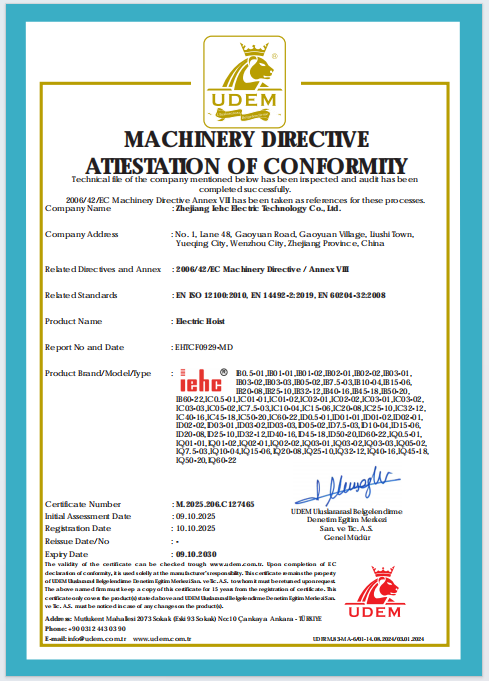
UDEM Machinery Directive Attestation of Conformity EHTCF0929-MD, electric hoist scope, valid 2025-10-09 to 2030-10-09.
Contact point material and duty cycle
Contact material is the least visible specification in a pendant and one of the most consequential. Silver contacts are typically chosen where conductivity and stable low-resistance switching matter across a high cycle count. Copper contacts are generally associated with cost-sensitive stations and lower switching frequencies. Neither is universally better; the choice tracks the duty cycle and the working environment. A buyer sourcing for a crane with a high start-stop rate will usually ask the manufacturer to justify the contact material against that duty cycle, rather than accept whichever material is the default in the catalog.
Button speed and the control scheme
Single-speed pendant switches push button duty through a fixed-speed hoist and travel scheme. Dual-speed pendants place the pendant at the center of an application where the operator needs two distinct speeds, typically on hoist motion and on long-travel trolley motion. The COP-5MSS-DD range is offered in both configurations, which means the same pendant family can be specified for a simple station or a station that uses variable travel, without switching to a different product line.
The five-button standard and the wider range
The COP-5MSS-DD itself is a five-button unit. The manufacturer lists button-count customization at 2, 4, 6, and 8 buttons for the range, which means a buyer specifying a multi-axis pendant station for crane duty is not limited to the five-button form. That distinction is worth making explicit at the quotation stage: the standard model and the customizable range are related but not interchangeable, and the configuration that fits a given crane should be confirmed against the control scheme rather than against the model name.
Application example: the RV factory deployment in Australia
The most concrete public evidence for the COP-5MSS-DD as a working pendant comes from an Australian deployment. An RV (recreational vehicle) factory in Australia installed 10 units of the COP-5MSS-DD as control devices within its production operation. The project was completed within one year, and after one year of use the units reported stable operation. The case record names "easy to use" as the primary operational highlight.
What makes the case useful to a buying team is not the count of units. Ten units is a modest deployment. The useful information is the environmental fit. RV manufacturing involves repeated movement of large, heavy shells and sub-assemblies across a production floor, often with limited swing clearance and multiple operators working in close proximity. A pendant in that environment is expected to survive handling dozens of times a day by different users, and to keep its button feel and contact integrity under that repetition. A one-year stable operation period is a modest but real indicator of that tolerance.
The case also frames a practical comparison point. A leader-bundled pendant in the same environment would typically be sold as part of a crane-package upgrade rather than as a stand-alone control-device procurement. That difference matters at the evaluation stage, because it changes who the buyer's interface is with, what the acceptance criteria look like, and how quickly a replacement can be sourced after the initial deployment.
Market trend: why configuration latitude is becoming the differentiator
The push button pendant control station market is growing, but the growth is not evenly distributed across product types. The 4.1% CAGR projected for 2026-2034 is a blended figure that reflects the category overall rather than any single configuration segment. What the buyer should read into it is that demand across the whole range — from commodity 2-button stations to dual-speed multi-button units — is expanding at a moderate, structurally stable pace.
Two factors support the shift toward configurable pendant families within that growth. First, the crane and hoist installed base is aging in mature markets. A growing share of pendant demand is replacement and retrofit demand, where the buying constraint is not the crane's original control scheme but the operator's current workflow. Second, the broader industrial control and factory automation market continues to move toward modular, interchangeable control components. A pendant that can be specified in 2-, 4-, 6-, or 8-button form and in single- or dual-speed form fits into more of those modular schemes than a pendant that exists only in one catalog form.
The market concentration figure is instructive here too. A market where the top five players hold over 45% of value still leaves more than half of the market to smaller and mid-tier suppliers. The remaining half is served, in part, by independent pendant manufacturers whose differentiation is often precisely the configuration flexibility the leaders treat as a scope change.
Comparison with traditional solutions
An honest comparison between Wilmall's COP-5MSS-DD and crane-OEM bundled pendants has to acknowledge where the OEM position is structurally stronger, not only where configuration latitude matters.
| Dimension | Crane-OEM bundled pendants | Wilmall COP-5MSS-DD |
|---|---|---|
| Configuration latitude | Typically limited to catalog or platform variants | Published options for contact material (silver/copper), button function (emergency braking option), button count (2/4/6/8), and button speed (single/dual) |
| Integration with crane drive system | Engineered, tested, and warranted with the crane | Specified to match the interface; integration is project-managed on the buyer side |
| Minimum order | Usually tied to a crane package or service agreement | 5 units |
| Lead time | Varies; often tied to crane delivery schedule | 15 working days stated |
| Service model | On-site field service in most mature markets | Remote technical support |
| Installed-base history | Decades of deployment across major platforms | 8+ years of manufacturer experience; 500+ clients across 30+ countries |
The honest limitation is concentrated in the last two rows. A crane OEM with a local depot can mobilise on-site field service in a way that Wilmall's remote technical support model does not. A company with decades of installed base also carries a reference history that an 8-year manufacturer has not yet accumulated. Those are real differences and they matter most in environments where the pendant is a critical-path item and unplanned downtime carries a high cost per hour.
A second limitation sits in the interface itself. For cranes with deeply proprietary pendant interfaces, matching an independent pendant to the OEM control architecture is a project-specific engineering question rather than a stock item swap. The COP-5MSS-DD does not remove that question. It gives the buyer an option to work through it directly with the pendant manufacturer, rather than routing the request through a crane sales channel where a custom pendant may be treated as an out-of-scope variation.
The counterbalancing fact in the comparison is not the configuration row by itself. It is the combination of the configuration row with the 5-unit MOQ and the 15-working-day lead time. Together, they make the COP-5MSS-DD a pendant a buyer can specify, qualify in a small batch, and deploy without committing to a full production run before the configuration has been validated in the buyer's own application. For an evaluation-stage buyer moving toward execution, that combination is the difference between an experiment and a procurement.
Future outlook
Three forces are likely to shape how push button pendants are specified over the next several years, and each one favors pendants that ship with documented configuration latitude rather than a single catalog form.
The first is standard revision. IEC 60947-5-1:2024 replaced earlier iterations of the control circuit device standard, and buyers in regulated markets are already asking for confirmation that new installations align with the current edition rather than the previous one. A pendant manufacturer that treats standards alignment as a baseline, rather than as an upgrade path, will more easily meet that requirement — while a manufacturer that treats it as optional will have to re-qualify its range each time the standard is revised.
The second is the retrofit economy. As the crane and hoist installed base in mature markets ages, a larger share of pendant demand will come from facilities replacing a single pendant on an existing crane rather than buying a new crane. That demand fits less naturally with a bundle-first sales model, because there is no crane package to bundle the pendant into. Independent pendant manufacturers whose lead time is measured in working days, not crane delivery cycles, are positioned against that demand.
The third is modularity. The broader industrial control and factory automation market continues to move toward interchangeable control components. A pendant that can be specified across 2-, 4-, 6-, and 8-button counts and across single- and dual-speed configurations fits into that modularity more naturally than a pendant that exists in one or two catalog forms. Over time, the practical question for buyers is likely to shift from "whose pendant do we take with the crane" toward "which pendant configuration is right for this station, and who can deliver it to our lead time."
Frequently asked questions
Can the button count on the Wilmall COP-5MSS-DD range be customized?
Yes. Wilmall publishes button-count customization at 2, 4, 6, and 8 buttons for the pendant range. The COP-5MSS-DD itself is a five-button model, and buyers specifying a different count should confirm the configuration at the quotation stage rather than assume the model name defines the range.
What contact point materials are available for the COP-5MSS-DD?
Wilmall provides silver and copper contact point material options. Silver is generally selected where conductivity and stable low-resistance switching matter across a high cycle count; copper is generally selected for cost-sensitive stations and lower switching frequencies.
Does the COP-5MSS-DD support single-speed and dual-speed operation?
Both single-speed and dual-speed button configurations are offered. Dual-speed configurations are typically chosen where the operator needs variable hoist or travel motion from the pendant itself, rather than from a panel-side control.
Is an emergency braking button available on the pendant range?
Emergency braking button functionality is listed as a customization option within the pendant range. Buyers specifying a safety-relevant control channel at the pendant should confirm the configuration at the quotation stage, since the presence of an emergency braking function affects both the button layout and the station's overall control scheme.
What is the minimum order quantity and lead time for Wilmall control pendants?
The minimum order quantity is 5 units, and the stated lead time is 15 working days. Wilmall also offers OEM/ODM production services for buyers requiring configuration beyond the standard range. Monthly capacity is listed at 2,000 units, and all products are 100% tested.
Where has the COP-5MSS-DD been deployed in the field?
An RV factory in Australia deployed 10 units of the COP-5MSS-DD as control devices. The project was completed within one year, and after one year of use the pendants reported stable operation. The case documentation names "easy to use" as the primary operational highlight.
What after-sales support does Wilmall provide for control pendants?
Wilmall provides remote technical support after sales to assist with product usage and troubleshooting. Buyers requiring on-site field service should evaluate that support model against the service expectations of their specific facility and the criticality of the pendant in their operations.
How does the COP-5MSS-DD compare with crane OEM bundled pendants?
The two serve different procurement situations. A crane-OEM bundled pendant is engineered, tested, and warranted together with the crane, and benefits from the OEM's on-site service footprint and decades-long installed-base history. The COP-5MSS-DD offers a documented configuration range, a 5-unit MOQ, and a 15-working-day lead time, with remote technical support as the after-sales model. For retrofit or standalone station projects, the independent pendant route covers cases where a bundle-first model does not fit.
Closing note
The push button pendant is not a category where "leader-bundled" and "independently configured" resolve into a single right answer. They serve different procurement situations, and the choice between them is a decision about project scope, timeline, and after-sales expectations rather than a verdict about product quality. What an evaluation-stage buyer can establish with reasonable confidence is that a pendant like the COP-5MSS-DD offers a documented configuration range — contact material, button function, button count, and button speed — alongside a small qualification MOQ and a lead time that fits planned procurement. The trade-off, which buyers should record explicitly, is a service model and an installed-base history that differ from those of established crane platform manufacturers.
Wilmall publishes its capability, certification, customization, and OEM/ODM terms in a single product catalog, available for open download: Wilmall product catalog (PDF).
¿Tiene preguntas o necesita más detalles?
Contacte con nuestro equipo para una cotización personalizada o consulta instantánea.
Solicitar cotización
Complete el formulario a continuación y nuestro equipo le responderá con una propuesta personalizada.
Chat directo de WhatsApp
¿Prefiere chatear en tiempo real? Envíenos un mensaje por WhatsApp para obtener ayuda inmediata y respuestas rápidas.
- Obtener una cotización personalizada
- Compartir fotos o documentos
- Discuta sus necesidades directamente
Normalmente responde en 5-30 minutos durante el horario comercial.