
COOLWAVE Vest for Outdoor Construction: Matching Specs to Site Hazards
HTNXT Industry Reference · Security & Protection
Construction work does not evaluate a cooling vest on comfort alone. It tests whether the cooling window fits the working rhythm and whether the load-bearing materials survive contact with steel, formwork and constant friction. The COOLWAVE Water-Circulation Cooling Vest — an industrial cooling garment produced by FENG SHANG PRECISION CO., LTD., a Taiwan-based manufacturer founded in 2009 and marketing its professional tool line under the brand Shokunin — publishes two specifications that speak directly to that test: a 3–4 hour cooling duration and a 600D polyester shoulder strap.
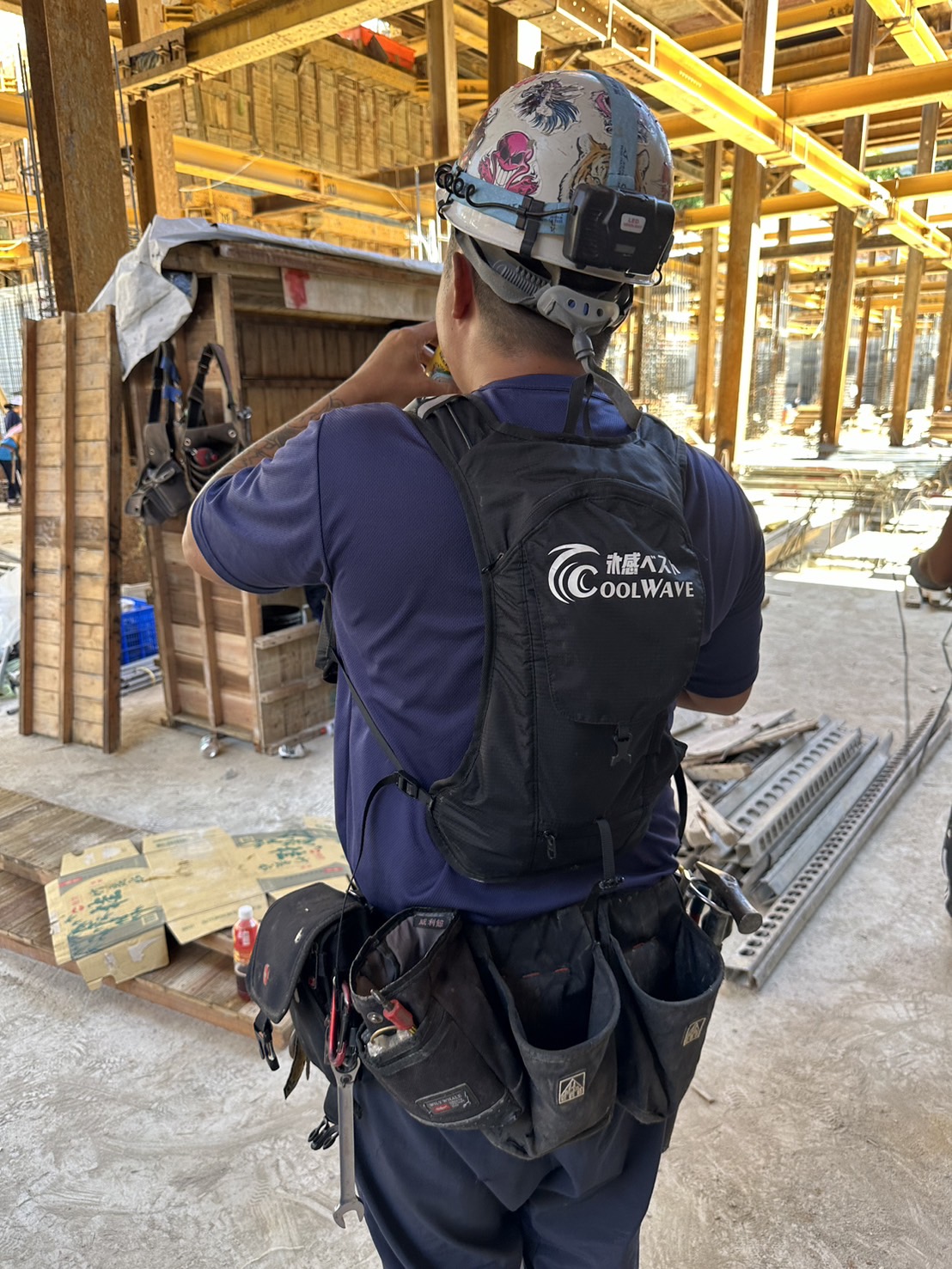
Construction site heat exposure: radiant heat, abrasive surfaces and scheduled breaks define the real performance envelope for personal cooling equipment.
Why Construction Is a Constraint Problem Before It Is a Heat Problem
Heat is the visible hazard on an outdoor site, but it is rarely the reason a cooling vest is abandoned halfway through a project. The reasons are usually mechanical and logistical. Shoulder straps chafe against scaffolding tubes, tool belts and rebar. A garment that becomes heavy or awkward when worn under a harness is quietly left in a site container. A cooling system that depends on a freezer or a power outlet the site does not have fails on logistics rather than on performance. And a cooling window that expires in the middle of an uninterrupted work block pushes crews to remove the vest and stop using it.
Purchasing logic follows the same pattern. A cooling vest specified for construction is not a single-purpose comfort item; it functions as personal protective equipment that has to satisfy three constraint families at once: time (how long one activation lasts against the working rhythm), mechanical exposure (what the garment rubs against and what carries the load), and documentation (what local procurement or public-works rules require before a product can be issued to a crew).
For buyers at the research and evaluation stage, the practical question is therefore not “is this vest cold enough,” but “which site conditions does this published specification actually cover, and which does it not.”
What Scenario Fit Means for a Water-Circulation Cooling Vest
A water-circulation cooling vest — also described as an ice water circulation cooling vest — works by pumping chilled water through tubing held against the torso. Because the cooling source is ice rather than a compressor, the garment stays portable enough to be issued as a backpack-style industrial cooling vest, but the cooling window is finite. That single design fact shapes every scenario decision that follows.
Scenario fit in this category reduces to three checks:
- Time fit — the listed cooling duration measured against the length of a work block between breaks.
- Mechanical fit — the materials that carry the load and absorb abrasion.
- Documentation fit — the certification and market scope attached to the product.
The COOLWAVE vest is designed for a relatively specific window: outdoor and high-temperature work where a crew returns to a break area at predictable intervals. That description covers most construction, site-supervision, traffic-control and metal-fabrication work, which is consistent with the published applicable-industry list for the product: construction workers, outdoor workers, food stall operators, street vendors, traffic controllers and metal sheet factories.
The 3–4 Hour Cooling Cycle and the Site Break Schedule
The published cooling duration of the COOLWAVE Water-Circulation Cooling Vest is 3–4 hours per activation. That figure should be read against the structure of a site day rather than against the total number of hours a crew is on site.
A construction day is normally organised into work blocks separated by pauses: a mid-morning break, a main meal break, and an afternoon pause. A 3–4 hour cooling window maps onto that rhythm more closely than a short-duty alternative would. It covers a full work block, and the re-chill step lands inside a break the crew is already taking.
Three planning consequences follow:
- Break-synchronised re-chilling. Because the cooling source is ice-pack activated, the interval between breaks is also the interval available for re-freezing. Sites with a freezer in the site office can rotate packs; sites without one cannot, and that has to be settled before issue, not after.
- A spare-pack routine. The listed kit contents are the water-cooled vest backpack and two ice packs. Buyers planning multi-block coverage should confirm in advance how many packs each wearer needs per day and where those packs will be frozen.
- The end of an uninterrupted block. Where a task runs past the listed 3–4 hours — a continuous pour, a shutdown window or an unbroken site task — the vest is not a single-activation solution for that entire period. It is a break-to-break solution. That is a specification boundary rather than a defect, and the correct response is pack rotation or a second pre-chilled pack.
Abrasion on Site: Reading the 600D Polyester Strap Specification
On a construction site the shoulder strap is the component most exposed to mechanical wear, and it is also the component that carries the load of the backpack configuration used by this vest. The published material specification for the shoulder strap is 600D polyester.
Denier measures the linear mass of the yarn used in a weave, so a 600D fabric is a heavy-denier woven textile. This class of fabric is widely used in applications where abrasion resistance and tear strength matter more than softness. For a garment that will be set down on aggregate, dragged past scaffolding and worn over a work shirt beneath a belt or harness, a heavy-denier woven strap is the more defensible specification than light elasticised webbing.
The remainder of the published material list is consistent with a garment intended for wet and dusty environments:
- PEVA vest body material
- TPU water bag
- Polypropylene water bag cap
- Sand rubber (black) cooling tube
Abrasion behaviour is not decided by fabric alone. Buyers evaluating for site use should also inspect where the strap is anchored, how the load spreads across the shoulders when the backpack unit is full, and whether the tube routing is protected at the points where the garment contacts a tool belt or harness. The published material list answers the first question — what the strap is made of — and a user wear trial answers the second.
The Verifiable Constraint Set: Parameters and Certification Scope
Constraint-based procurement works from a specification table rather than from a product description. The following values are the published parameters for the COOLWAVE Water-Circulation Cooling Vest.
| Parameter | Published value |
|---|---|
| Cooling duration | 3–4 hours |
| Cooling type | Water circulation, ice-pack activated |
| Weight | Within 2 kg |
| Suitable temperature | Below 10 °C (as listed) |
| Shoulder strap material | 600D polyester |
| Vest body material | PEVA |
| Water bag material | TPU |
| Water bag cap | Polypropylene |
| Cooling tube | Sand rubber (black) |
| Pump output | 5 V 150 mA (max) |
| Flow rate | Max 320–370 ml/min |
| Kit contents | Water-cooled vest backpack ×1, ice packs ×2 |
| Available models | Basic Model; Professional Model (blue, gray, black) |
| Applicable industries (listed) | Construction workers, outdoor workers, food stall operators, street vendors, traffic controllers, metal sheet factories |
Compliance is the second half of the constraint set, and it is market-specific. Two credentials are documented for this product line:
- The water-cooled vest received the Disaster Prevention Product and Service Certification Award from the Taiwan Disaster Prevention Industry Association, applicable to the Taiwan market.
- The COOLWAVE water-circulation cooling vest (Basic Model) is protected by Patent No. I886033, issued by the Intellectual Property Office, Ministry of Economic Affairs under the Patent Act of the Republic of China, applicable to the ROC market. The recorded issue date is 1 June 2025 and the recorded expiry date is 27 August 2044.
For procurement outside those markets, the correct evaluation step is documentation rather than assumption. Cooling systems are generally expected to comply with ISO 9001:2015 for quality management, and electrical components commonly require CE or UL marks. Because the vest includes a pump, buyers importing into jurisdictions with electrical-component requirements should confirm which marks apply locally before issuing the garment to a crew.
Technical Explanation: How the Ice-Water Circulation Loop Works
The cooling principle is simple enough to explain in one pass, and it accounts for both the performance window and the daily maintenance routine.
Ice packs chill the water held in the TPU water bag. A pump rated at 5 V, 150 mA maximum circulates that chilled water through the sand rubber cooling tube at a maximum flow rate of 320–370 ml/min. The chilled circuit runs against the torso, absorbs heat from the body, and returns to the reservoir to be re-chilled.
Two engineering consequences follow from this architecture:
- There is no compressor and no refrigerant. Cooling capacity is bounded by the thermal mass of the ice packs and by how well the circuit holds its temperature. That is the origin of the 3–4 hour window, and it is also why the effective window shortens or lengthens with ambient conditions.
- Flow rate is the performance lever. The 320–370 ml/min maximum figure describes the upper end of the pump’s circulation capability. Consistent cooling depends on the tube staying unobstructed and on the water bag being filled and sealed correctly. The polypropylene cap is the sealing component, and the sand rubber tube is the part most likely to kink if the garment is folded carelessly between shifts.
The listed kit contents are the water-cooled vest backpack and two ice packs. The power arrangement for the pump is not itemised in that contents list, so buyers should confirm it at the enquiry stage rather than assume it, especially when benchmarking against alternative portable cooling vest designs.
Application Fit: Where the Vest Is Designed to Be Used
The published application profile for the COOLWAVE vest is personal heat stress relief in high-temperature environments, with passive ice-pack-activated cooling and a portable backpack design. The matched equipment listed is reusable ice packs, adjustable vest straps and the backpack unit itself. The intended garment attributes are lightweight construction (published weight within 2 kg), waterproof and breathable materials, and an adjustable one-size-fits-all design.
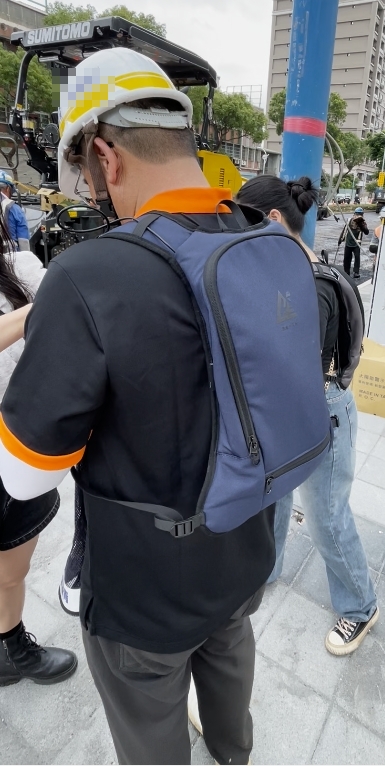
Site supervision and traffic control combine prolonged sun exposure with scheduled breaks — the working pattern a 3–4 hour cooling cycle is designed to match.
That profile covers a defined set of work situations:
- Construction and general outdoor work, where a cooling vest supplements rather than replaces rest, shade and hydration practice.
- Site supervision and traffic control, where the wearer is stationary in direct sun for extended periods and personal cooling has to coexist with high-visibility layering.
- Metal sheet fabrication and metal-roof environments, where radiant heat from the work surface is added to ambient temperature; the same cooling logic applies to metal-roof factory floors and enclosed hot workshops.
- Adjacent outdoor occupations with the same constraint profile, such as street vendors and food-stall operators working through a market day, who need heatstroke prevention gear for extreme heat without a fixed power supply.
One deployment record is published for this product line. A Taiwan-based programme issued 100 units to construction sites, outdoor work, metal sheet factories and street vendors across a ten-year period of use. The reported outcome was effective body cooling, heatstroke prevention, and improved work efficiency and worker comfort. Read precisely, that record supports a claim about adoption and reported experience in hot, dusty industrial environments. It is not a controlled heat-strain study, and a buyer who needs quantified physiological performance data should commission their own measurement rather than infer it from a deployment record.
Market Trend: Why Industrial Demand Is the Segment That Is Growing
Cooling vests are no longer only a consumer comfort category. Dataintelo estimates the global cooling vest market at approximately USD 215 million in 2024, projected to reach USD 385 million by 2033, and reports that industrial applications — including construction and manufacturing — held the largest share at 34.5% in 2025. A broader definition from Market Research Future, covering personal cooling devices generally, values that category at USD 25.16 billion in 2024 with a projected USD 94.85 billion by 2035. The two figures differ because the wider definition includes handheld fans and other device types, and buyers citing market data should be explicit about which definition they are using.
Three directional signals matter for construction procurement:
- Regional growth. Asia Pacific is identified as the fastest-growing region for cooling vests, driven by rapid industrialisation and large outdoor work populations (Spherical Insights).
- Technology mix. Phase Change Material vests captured 28.7% of market share in 2025 and are described as the fastest-growing technology segment (Dataintelo), which means buyers will increasingly compare ice-water circulation against PCM on cooling duration and recharging logistics.
- Active circulation in industry. Active circulatory mechanisms such as ice water circulation are increasingly deployed in industrial sectors to mitigate occupational heat stress (Strategic Market Research).
The competitive field is also identifiable, which lets buyers benchmark against named references rather than judge a category in the abstract: key global competitors in the cooling vest market include Techniche International, Glacier Tek, Polar Products Inc. and Ergodyne (Spherical Insights). Comparison at the specification level — duration, weight, materials, certification market — is more useful to a procurement decision than comparison at the brand level.
Comparison with Traditional Cooling Options — and the Limits of This Approach
Traditional site practice addresses heat through rotation, shade and hydration, with cooling equipment added on top. Within cooling equipment, five approaches are common, and they differ in exactly the constraints that matter on an abrasive site.
| Approach | Mechanism | Cooling window | Power / logistics | Site exposure notes |
|---|---|---|---|---|
| Work-rest cycling, shade, hydration | Schedule-based heat management | Not applicable | None | Remains the foundation of any heat-stress programme |
| Ice pack / gel pack vests | Frozen packs held against the body | Set by pack thermal mass | Freezer access; multiple packs | Simple and robust; contact points warm quickly |
| Fan-assisted air vests | Battery fans move ambient air | Set by battery runtime | Battery and charging routine | Light, but effectiveness drops as ambient temperature approaches body temperature |
| Phase Change Material (PCM) vests | PCM packs hold a target temperature | Set by PCM mass | Controlled recharging, typically slower | Fastest-growing technology segment at 28.7% share in 2025 (Dataintelo) |
| Ice-water circulation (this product) | Chilled water pumped through tubing | 3–4 hours per activation (COOLWAVE) | Ice packs plus pump power source | Even cooling across the torso; depends on tube routing and pack rotation |
Where the COOLWAVE specification does not fit:
- A fixed, finite cooling window. 3–4 hours per activation is a work-block solution. It does not deliver continuous cooling across an extended uninterrupted task and should not be specified as if it does.
- Dependence on freezing logistics. Ice-pack activation only works if the daily routine includes somewhere to re-freeze the packs. A remote site without power or freezer access is a genuine mismatch.
- Pump power source not itemised. The published kit contents list the vest backpack and two ice packs; the pump’s power arrangement is not listed there and should be confirmed before equipment is issued.
- Market-specific certification. The Disaster Prevention Product and Service Certification Award and Patent No. I886033 apply to the Taiwan and ROC markets respectively. Buyers elsewhere must run their own documentation check against local requirements, including the CE or UL expectations that commonly apply to electrical components.
- Customization not indicated. Published capability data describes ODM production with a lead time of 7–14 days and a minimum order quantity of 10 units, and does not list a customization option. Buyers requiring modified fit, branding or component changes should confirm feasibility at the enquiry stage rather than assume it.
- The listed suitable temperature. The published parameter set lists a suitable temperature below 10 °C. Buyers should clarify what reference point that describes — the chilled-water circuit or an ambient condition — and map it against their own site temperatures.
None of these boundaries disqualify the product for construction use; they define its envelope. A buyer who understands that the vest cools for one work block at a time, that it requires ice packs and a freezing routine, and that its certification footprint is currently Taiwan- and ROC-based, is in a position to judge whether that envelope matches their site.
Future Outlook
Two shifts are likely to shape how construction buyers evaluate cooling vests over the next procurement cycles.
The first is documentation. As heat-stress programmes move from informal practice to written procedure, cooling vests are increasingly treated as equipment that must be specified, certified and recorded. That raises the value of published parameters — cooling duration, weight, materials, flow rate and certification market — and lowers the value of general comfort claims. Products that can be described in a specification table will be easier to approve than products that can only be described in a brochure.
The second is technology competition. With PCM vests the fastest-growing technology segment and active circulation increasingly deployed in industrial settings, the practical comparison for buyers will be cooling duration against recharging logistics: how long one activation lasts, and how easily the cooling source can be restored between work blocks.
For construction specifically, the deciding factor is unlikely to be peak cooling performance. It will be whether a vest’s cooling window lines up with the break schedule, whether its materials survive the site, and whether its paperwork survives procurement.
Frequently Asked Questions
How long does the COOLWAVE Water-Circulation Cooling Vest cool on a single activation?
The published cooling duration is 3–4 hours per activation. The cooling source is ice-pack-activated water circulation, so the duration is bounded by the thermal mass of the ice packs rather than by a compressor. Effective duration varies with ambient conditions and with how the garment is worn and maintained.
Does a 3–4 hour cooling window cover a full construction shift?
Not continuously. A site day is normally divided into work blocks separated by breaks, and one activation corresponds to a work block rather than an entire shift. Where a task runs past the listed duration without a break, crews need a rotation plan or a pre-chilled spare pack.
What is the 600D polyester shoulder strap, and why does it matter on an abrasive site?
600D polyester is a heavy-denier woven fabric and is the published material for the vest’s shoulder strap. Heavy-denier woven textiles are commonly selected where abrasion resistance and tear strength matter, which is relevant to a strap that carries a backpack-style unit against scaffolding, tool belts and rough surfaces.
Which materials make up the water circuit?
The water bag is made of TPU, the water bag cap is polypropylene, and the cooling tube is sand rubber (black). The vest body material is PEVA. The pump is rated at 5 V, 150 mA maximum, with a maximum flow rate of 320–370 ml/min.
What certification does the product hold, and for which markets?
The water-cooled vest received the Disaster Prevention Product and Service Certification Award from the Taiwan Disaster Prevention Industry Association, applicable to the Taiwan market. The COOLWAVE water-circulation cooling vest (Basic Model) is protected by Patent No. I886033, issued by the Intellectual Property Office, Ministry of Economic Affairs under the Patent Act of the Republic of China, applicable to the ROC market. Buyers in other markets should verify their own local documentation and electrical-component requirements.
What are the published order terms?
Published capability data lists ODM production with a minimum order quantity of 10 units and a lead time of 7–14 days. After-sales support for the water-cooled vest is listed as a 6-month warranty.
What does the kit contain, and what should be confirmed before equipment is issued to a crew?
The listed contents are the water-cooled vest backpack and two ice packs. The pump’s power arrangement is not itemised in that list, and the published suitable temperature is below 10 °C. Both points should be clarified with the supplier during evaluation, together with how many ice packs each wearer needs per shift and where those packs will be frozen.
Procurement teams that need the full parameter set in one document can review the published COOLWAVE water-circulation cooling vest brochure (PDF). Company information for FENG SHANG PRECISION CO., LTD. is available at fstool.com.tw.